
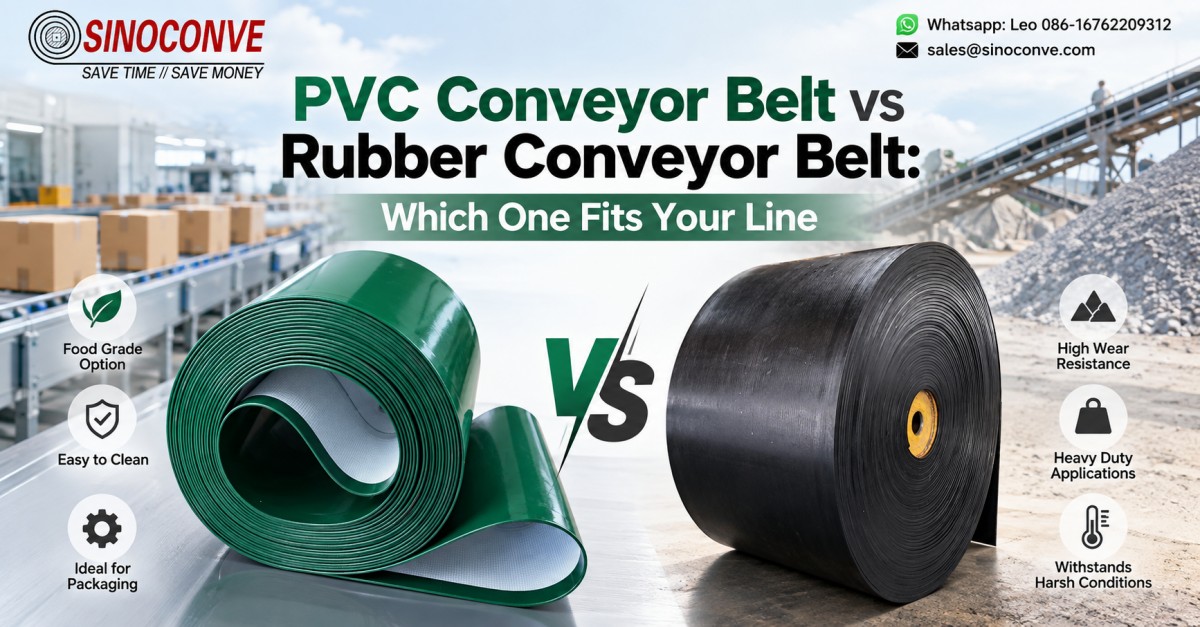
PVC Conveyor Belt vs Rubber Conveyor Belt: Which One Fits Your Line
Short answer first. If you are buying a conveyor belt for packaging on a line that runs tight transfers and small end pulleys, choose PVC. If food sits directly on the belt and the line is washed down at the end of each shift, choose food-grade PVC or PU and stay away from a general-purpose black rubber belt. If parcels ride your belt through a sorting hall and drop onto it from a chute, choose fabric-carcass rubber. Three sites, three different answers.
We have watched this question get answered badly for years, usually because someone starts with the carcass instead of the floor. This article works the other way around. It takes the three places where the choice actually gets made — a packaging hall, a food plant, and a warehouse sorting floor — and asks what each one demands from a belt. Only then do we compare PVC and rubber. The stress logic inside the belt, ply counts, NN versus EP, fabric versus solid-woven, is covered in rubber vs PVC belt material logic, and we will not repeat it here.
One more thing before the details. Nothing on this page is a certification promise. We are a conveyor belt factory, not a notified body. We can tell you which documents to ask for and how to read them. The signature on a food-contact declaration comes from the belt compound supplier and the converter, not from your belt seller's marketing page.

01Start With the Site, Not the Material
A packing hall and a quarry transfer station can buy belts from the same catalogue and still need completely different products. The reason is not the material of the carcass. It is what happens around the belt for sixteen hours a day.
On a packaging line we typically see belt speeds between 0.4 and 1.5 m/s, end pulleys down to 50 mm, and transfers where a 12 mm nose bar carries a carton across the gap. In a food plant the same belt might see a caustic foam wash at 55 °C every night and a squeegee blade dragged across its surface twice a shift. On a sorting floor the belt runs at 2.0 to 2.5 m/s, takes 25 to 30 kg parcels dropping 200 to 400 mm onto the surface, and may be asked to reverse for a jam clear.
None of those three descriptions points at the same belt construction. So we start with a site profile.
| Site | Speed | Smallest pulley in the run | Cleaning | Hardest load | First call |
|---|---|---|---|---|---|
| Packaging hall | 0.4 - 1.5 m/s | 50 mm nose bar | Wipe or brush down | Accumulation, edge wear | PVC |
| Food plant | 0.2 - 1.2 m/s | 60 mm | Foam, CIP, rinse | Knife cuts, oils, heat | Food-grade PVC or PU |
| Sorting floor | 2.0 - 2.5 m/s | 80 mm | Dry, occasional vacuum | Parcel impact at the chute | Rubber |
Three site profiles, and the belt that usually survives each one.
Field note from our engineers: A bakery near us was running a plain black rubber belt on a cooling conveyor and failed an internal hygiene audit three weeks running. The belt itself was fine mechanically. The problem was the 2 mm gap where the fabric edge met the frame, and the black surface that made crumbs invisible. A 3 mm white PVC belt with a welded edge fixed both points in one afternoon.
02What a Packaging Line Demands from a conveyor belt for packaging
Ask a packaging engineer what breaks their belt and you will not hear about tons per hour. You will hear about tracking on a 900 mm centre distance, about a carton that stops dead and drags, and about a transfer where the product has to cross a gap without tipping.
Small pulleys punish belt thickness
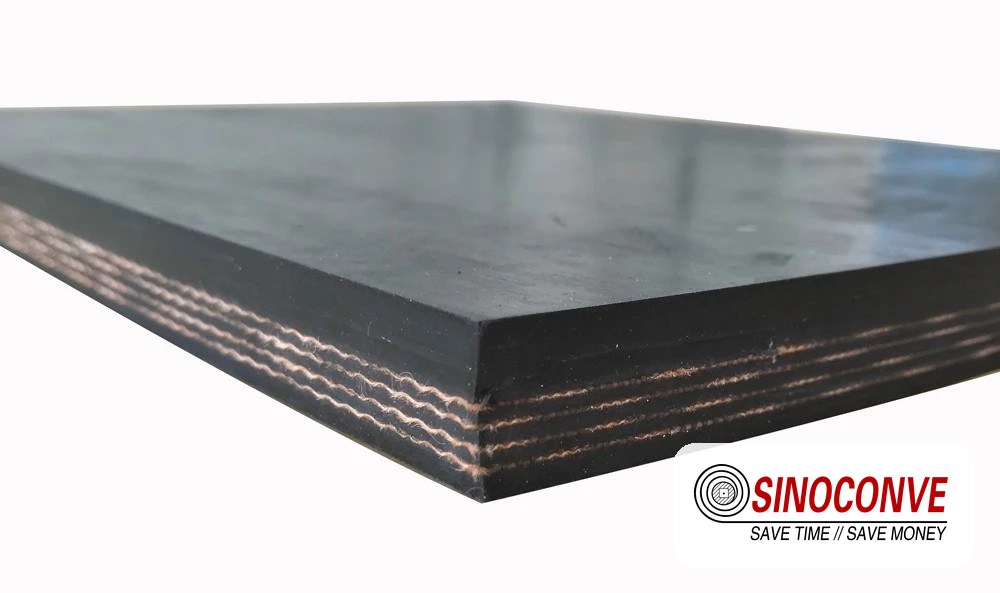
A 2-ply PVC belt with a 0.8 mm top cover and 0.6 mm bottom cover lands around 2.5 to 3.0 mm total. A 3-ply fabric-carcass rubber belt of comparable strength is 8 to 11 mm thick. Wrap that thicker belt around a 50 mm end pulley and the back cover is asked to stretch roughly 12 percent more than the neutral axis allows. You get cracking on the underside within a few hundred thousand cycles. Nobody sees it until the splice opens.
Accumulation needs a friction number you can trust
Zero-pressure accumulation only works if the coefficient of friction between belt and product stays inside a narrow window. Most packaging OEMs design around 0.25 to 0.35 against a clean, dry board. A shiny PVC surface holds that number for years. A rubber belt starts higher, around 0.4, and then climbs as the cover oxidises and picks up dust. When it climbs, light cartons start to tip at the merge instead of sliding.
Static, noise, and the gap at the knife edge
Dry carton dust in a low-humidity hall generates static, and a belt surface that cannot bleed it off will throw faults on the photo-eyes. An anti-static PVC top cover, surface resistance typically quoted in the 106 to 108 ohm range, is the usual fix. Noise is the other quiet cost. We have measured 4 to 6 dB(A) difference between a rubber belt running over a nose bar and a thin PVC belt doing the same job at the same speed. In a hall with six parallel lines, that difference decides whether operators keep their hearing protection on.
The gap at the transfer matters as much as the belt. A 12 mm nose bar with a 3 mm PVC belt leaves a transition that a 200 g carton crosses without a nudge. Put the same nose bar under an 9 mm rubber belt and the product sees a step. On inclined or inclined-with-sidewall packaging transfers, the surface pattern choice starts to matter, and we keep a longer treatment of that in our guide to rough top belts for packaging and light duty lines.
Field note from our engineers: A cartoner line had been chewing through a rubber belt every four to five months at the same spot, right where the belt wrapped the 63 mm drive pulley. Tracking was blamed for two service visits. It was not tracking. The back cover was cracking at 8 mm thickness, and every restart pulled the crack wider. A 2.9 mm PVC belt, endless, lasted the next nineteen months.
Where packaging lines should still not use PVC
Two exceptions. If the product arrives hot, above roughly 80 °C at the belt surface, a standard PVC cover will soften and mark. And if the line handles metal cans or glass with sharp rims at speed, PVC tears where rubber absorbs. Those two cases go to a heat-resistant or a fabric-carcass belt, and we cover the temperature side in our heat-resistant belt specification table. For everything else on a packaging floor, our default recommendation as a conveyor belt manufacturer is a light PVC belt, and we say so even when the customer came in asking for rubber.
Drive-side components deserve the same care. Where a packaging machine uses a synchronous drive for the infeed rather than a friction belt, the belt and pulley pair become the constraint, not the conveyor surface. We keep that discussion in a separate note on PU timing belts for packaging robotics.
03Food Plants: Hygiene Design, Washdown, and Detectable Colour
Food is the one application where the belt is not just a moving surface. It is part of the hygiene envelope. That changes the questions you ask. Instead of asking how many plies, you ask whether water can run off the belt and out of the frame, whether a blade can reach the whole surface, and whether a fragment of the belt that ends up in product could be found before it ships.
Washdown is a different requirement from wipe-down
A dry bakery line wipes and brushes. A wet dairy or ready-meal line washes. Under a foam or CIP regime you are looking at caustic at 1.5 to 2 percent concentration, temperatures up to 82 °C at the nozzle, and a rinse that pushes water into anything with an opening. A standard PVC belt compound handles the chemistry and the temperature. What fails is the construction around it. Exposed fabric edges wick water and stay wet. Stapled or bolted splices give bacteria a shelf to sit on. Open frame gaps hold product.
So the requirement is a solid-woven or coated belt with sealed or welded edges, a splice you can clean across, and a belt surface that does not absorb. This is what buyers mean by a hygienic conveyor belt, and the design rules are stricter than the material name suggests.
Blue, detectable, and why a black belt fails the audit
Colour is a control, not a preference. A blue belt contrasts with almost every food product and with stainless steel, so a fragment is visible. A metal-detectable compound goes further: the belt contains a tracer that a metal detector or X-ray unit will pick up at a stated sensitivity, commonly quoted around 3.0 to 3.5 mm for ferrous and 4.0 to 5.0 mm for stainless on a good inline unit. If your HACCP plan lists metal detection as a control point, a detectable belt is not optional.
A general black rubber belt fails on three counts at once. It hides fragments, it usually has no detectable tracer, and its fabric edges are exactly where a knife cut runs. We have watched a conveyor belt supplier lose a contract at the audit stage for this reason alone while the belt itself was mechanically sound.
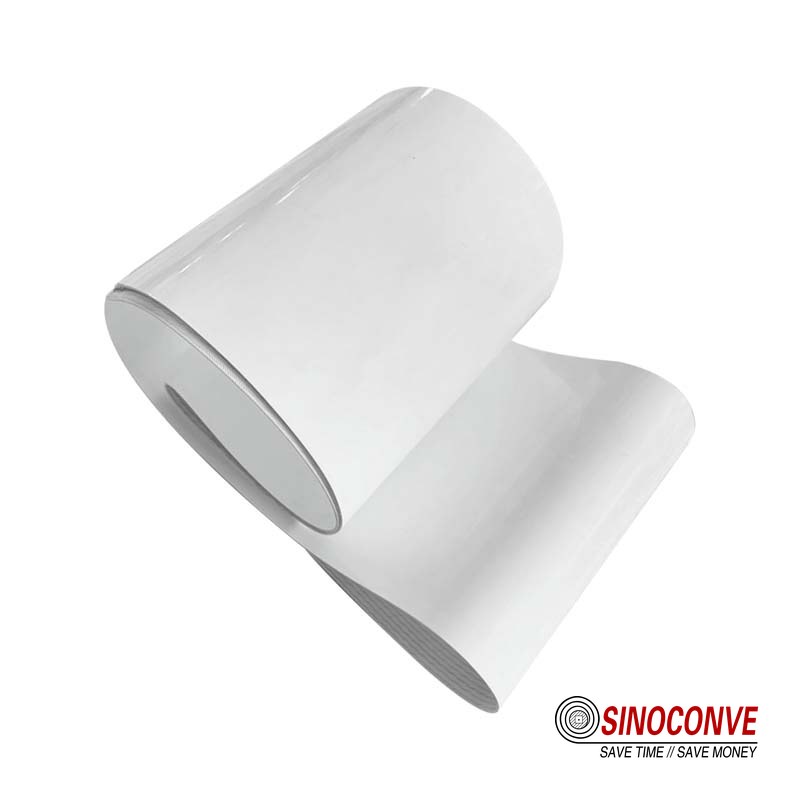
White food-grade PVC with a welded edge. Easy to see soil, easy to clean across.
What "antibacterial" actually means on a belt
A compound can contain an additive that suppresses mould and bacterial growth on the polymer surface. That is a real property and it is worth having in a humid plant. It is not the same as a cleanable belt. An additive will not help you if the splice traps product or the edge is frayed. And it is not the same as a food-contact approval either, which is a separate document trail we deal with in section 07.
There is a temperature edge here too. PVC covers usually carry a working range that tops out near 80 °C, with peaks tolerated briefly. PU covers go higher, often 90 to 100 °C continuous depending on the grade. If your line finishes with a hot-fill or a steam tunnel, check the belt temperature rating against the measured surface temperature, not the product temperature. On a bakery oven exit we have measured belt surface at 96 °C while the ambient reading in the hall was 34 °C, and that gap is what shortens cover life.
For heavy food applications — bulk vegetables, frozen blocks, wet waste streams — the same site logic can still push you back to fabric-rubber. A food-grade white rubber conveyor belt exists for exactly that middle ground, and we would rather sell you the right one than the cheapest one.
04Warehouse and Parcel Sorting: Impact, Throughput, and Downtime
A sorting hall is a packaging line that has been given a heavy parcel, a higher speed, and an impossible maintenance window. Everything that made PVC attractive on the packer still applies — thin profile, quiet running, easy tracking. Two things change the decision: impact and throughput.
The chute is where belts die
A 28 kg parcel dropping 350 mm onto a belt surface delivers a local impact that no 3 mm PVC cover enjoys. The cover takes a bruise, the bruise becomes a crack, and the crack walks until it reaches the splice. A fabric-carcass belt with a 4 to 6 mm abrasion-resistant cover absorbs the same hit and keeps going. That is the single strongest argument for rubber when a conveyor belt for warehouse duty feeds a sorter, a point we make again in our notes for warehouse conveyor belt manufacturers working on parcel sorting.
Where the parcels are light — poly mailers, 1 to 3 kg — the impact argument disappears and PVC becomes the better value. Many modern e-commerce halls therefore run a mixed fleet, and the split usually falls at about 10 kg. We wrote more about that split in our notes on warehouse belts for parcel sorting and logistics.
Tracking at 2.5 m/s with small end pulleys
Sortation conveyors use crowned end pulleys of 80 to 120 mm because the frame height budget is tight. At 2.5 m/s a belt that is 10 mm thick will not follow a crown as willingly as a 3 mm belt, and a single jam that pushes a parcel sideways can walk the belt off in seconds. Thin PVC wins here. The trade is that the same thin belt is the one that tears when a jam clears under load.
This is why so many parcel hubs specify a rubber belt with a mechanical fastener for maintenance speed, then add training idlers to hold it. If you buy through a conveyor belt distributor, ask whether the fastener they stock is rated for the same belt tension, because mismatched hardware is a common cause of a splice pulling out at the sixth week.
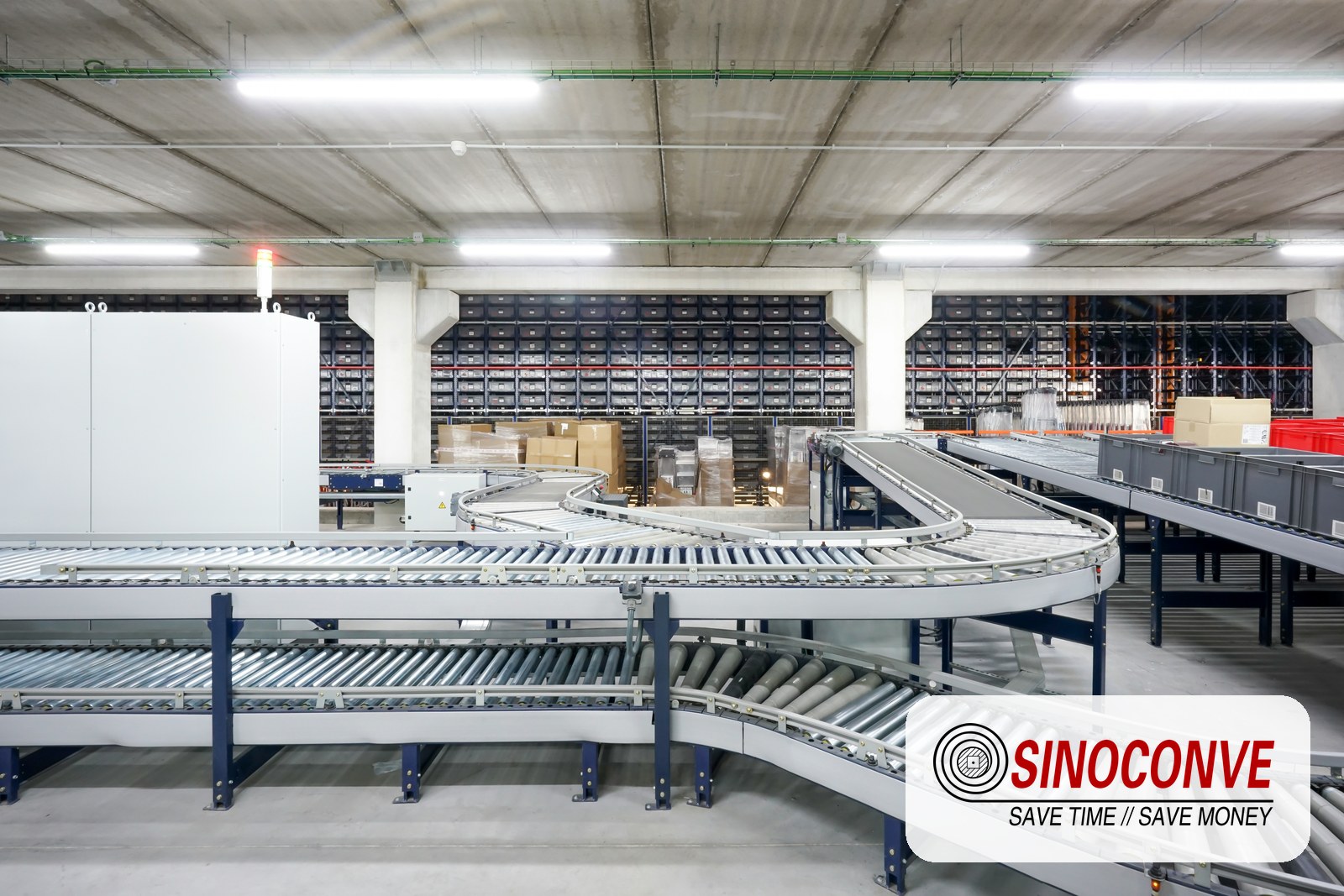
A parcel hub line. Impact at the chute sets the material call, not the speed.
Energy, noise, and a twenty-minute window
Wider belts take more energy to bend. On a 1,200 mm wide, 40 m long sorter, moving from a 10 mm rubber belt to a 3 mm PVC belt commonly drops the drive load enough to fit a smaller gearmotor, and the electricity saving is real but modest — think single-digit percentage of the conveyor's running cost, not a project. Noise is the bigger daily win. Rubber over a nose bar at high speed howls; PVC does not.
Then there is the window. A hub that runs 20 hours a day gives maintenance 20 to 40 minutes between shifts. A mechanical fastener that can be installed with hand tools in that window beats a vulcanised splice every time, even though the vulcanised joint is stronger and cleaner. Practical availability decides. That logic is the same one behind our guide to choosing between a splice and a mechanical fastener joint, and if you are stocking spares across several hubs you can review the range on our wholesale conveyor belts page.
05What PVC Brings to These Three Floors, and What It Costs
PVC earns its place through flatness and cleanability, not through load capacity. Once that is understood, the rest is arithmetic.
Advantages that have nothing to do with strength
The surface is flat and non-porous, so a squeegee blade or a brush actually reaches it. There is no exposed fabric edge on a properly finished belt, so there is no wicking path. Colour is a compound decision, which means white, blue, and green are all ordinary production runs rather than special orders. Anti-mould additives are standard in food grades. And a PVC belt can be welded endless, which removes the last place where product can lodge.
A 2-ply PVC belt of 2.5 to 3.0 mm also bends over a much smaller pulley than any fabric-rubber construction of similar width. That single number — minimum pulley diameter — drives more packaging-line decisions than tensile strength ever does. Our engineering team publishes that table in more detail once you get into the drive side of a machine, and if the line uses a synchronous drive the profile choice starts to interact with the belt on the other end, which is the territory of a transmission belt manufacturer rather than a conveyor supplier.
The three penalties you have to price in
First, tear resistance. A dropped knife, a jammed bottle, or a bent pallet corner will cut a PVC cover where rubber would deform and survive. Second, cold. Standard PVC stiffens below about 0 °C and becomes brittle in a freezer at -18 °C. A cold-resistant grade helps, but a freezer line at -25 °C still wants a different polymer. Third, heat. The working ceiling is near 80 °C, and sustained running above it accelerates plasticiser loss, which shows up as a hard, shiny surface that no longer grips or cleans well.
Belt edge comparison. Sealed PVC edges versus a fabric-rubber cut edge.
| Site | What PVC gives you | What it costs you | Threshold to watch |
|---|---|---|---|
| Packaging hall | Runs over 50 mm pulleys, stable friction for accumulation, quiet | Tears at a jam; sharp product edges cut it | Product above 80 °C at the surface |
| Food plant | Cleanable, colour-controlled, weldable, anti-mould grades available | Cut resistance is modest; hot-fill lines are out of range | CIP above 82 °C, or a knife-cut product |
| Sorting floor | Low energy, low noise, tracks on crowned 80 mm pulleys | Parcel impact bruises the cover at the chute | Parcels over roughly 10 kg, drop over 300 mm |
There is a lifecycle argument for the same product on heavier duty as well. A properly specced PVC belt on a light conveyor can outlast three cheap rubber belts because it stops damaging the pulleys it runs on. That only holds while the load stays inside the window. Push a PVC belt into a duty it was never sized for and you will pay for the belt twice — once when you buy it and once when it stops the line. We keep that trade-off in view when we quote an industrial conveyor belt against a light one, and we would rather talk you out of the wrong product than book the order.
06Where Fabric-Core Rubber Still Wins on These Same Floors
Rubber is not the fallback for people who cannot afford PVC. On three specific duties inside packaging, food, and logistics it is simply the better belt, and we say so at the quotation stage.
Impact and tear loading
Fabric-rubber absorbs energy across the whole cover thickness instead of resisting it at the surface. A 6 mm abrasion-resistant cover will take a 30 kg parcel at a 350 mm drop, or a metal can hitting the belt at a transfer, without the localised bruising that leads to a running crack. The cover grade matters more than the ply count here, and the difference between a 60 mm³ and a 150 mm³ DIN 53516 abrasion figure is what you pay for.
The same logic applies in food plants that handle brutal loads — frozen blocks, root vegetables with soil, waste streams. A white food-grade rubber belt with a smooth cover and sealed edges is the accepted middle ground. We wrote a longer note on what to check in a white rubber conveyor belt if you are weighing that against PVC.
Temperature and cold rooms
A freezer hall at -18 °C to -25 °C is rubber territory. Standard PVC goes stiff and brittle; a nitrile or a specifically cold-rated rubber compound keeps its flexibility down to about -30 °C or below, depending on the grade. Heat is the mirror image: a heat-resistant rubber belt routinely works at 100 to 120 °C and brief peaks higher, which covers bakery oven exits where PVC would mark and harden. We keep the grade detail in our coverage of rubber conveyor belt cover grades.
The price you pay for choosing rubber
Rubber hides product. A fabric cut edge wicks water and holds a biofilm. A mechanical fastener creates a hinge with two gaps that no squeegee can reach. And the compliance route is longer, because a rubber compound that touches food needs its own migration data rather than inheriting the PVC paperwork you already have on file. If your line sits under a food-contact procedure, moving to rubber means starting that folder again.
Rubber also resists bending more. On a small end pulley that means either a thicker drive, more energy, or a belt that runs hotter at the back cover. On a sorting line with 80 mm pulleys that is a manageable cost. On a packaging line with 50 mm nose bars it is usually the reason the answer is PVC.
Field note from our engineers: A cold-store picking conveyor had been fitted with a PVC belt by a contractor who matched the old one by sight. In February the belt cracked across its full width at the drive pulley, at a measured surface temperature of -21 °C. The replacement was a 2-ply cold-resistant rubber belt at -35 °C rating. Same width, same pulleys, no other change. The material was simply wrong for the room.
If you are running a site that mixes food handling with cold storage, it is worth checking where the belt actually spends its time. Our page on belts for food and packaging operations sets out the same three-way split by room rather than by product.
07Food Contact and Compliance: Follow the Paper, Not the Claim
Every belt catalogue in this segment says "FDA" or "food grade". Very few pages tell you what the claim rests on. Here is the trail we hand to customers, and the trail you should demand from anyone else.
The documents, and who signs each one
For the United States, the usual anchor is FDA 21 CFR 177.2600 for rubber articles intended for repeated use, or 21 CFR 177.1010 for certain PVC and vinyl chloride copolymers. In Europe the equivalent route runs through Regulation (EU) 10/2011 on plastic materials in contact with food. Neither framework approves a belt. They approve a material, under stated conditions, against a migration test.
| Document | What it covers | Who issues it | What to check before you file it |
|---|---|---|---|
| Declaration of Compliance | Names the material, the regulation, and the conditions of use | Compound maker or converter | Does the temperature and fat-contact range match your line? |
| Migration test report | Overall and specific migration results against simulants | Accredited laboratory | Simulant choice, test time, and which grade was actually sampled |
| Colour and additive list | Confirms blue or white pigment and any tracer are on the permitted list | Compound maker | Ask whether it is a batch document or a generic file |
| Detectability statement | The fragment size your detector can see | Belt converter, verified on your line | Verify with your own detector, not the vendor's |
One warning we repeat often: we do not issue these certificates and we do not obtain them on a customer's behalf. A belt seller who offers to "get you FDA certified" is describing a document purchase, not a compliance outcome. What we can do is tell you which compound is on file with our material suppliers, and hand over the paperwork that comes with it.
Does an FDA claim mean washdown-safe?
No. These are three separate properties and they are constantly confused. Food-contact approval is about what the material releases into food. Washdown capability is about whether the belt construction survives caustic, heat, and water without delaminating or wicking. Anti-microbial performance is about growth on the surface. A belt can hold the first and fail the other two. Our buyer's check on food-grade PVC belts walks through the questions that separate them, and if you want the wider sourcing view there is more on what buyers should know about PVC belt selection.
When blue or detectable stops being optional
Two triggers make it mandatory. The first is a HACCP plan that lists foreign-body detection as a critical control point, in which case the belt must be detectable at the sensitivity your detector achieves. The second is a customer audit standard, common in retail supply chains, that requires contrasting belt colour. If neither applies, a blue belt is still a sensible default on any line where product and belt share a cutter, a slicer, or a needle. The cheapest belt in the catalogue is never cheaper than a product recall, and on this point we do not offer a cheaper alternative.
08Splices Versus Hygiene: The Joint Decides the Audit
You can buy the ideal belt surface and still fail an inspection at the joint. On food lines, the splice is where hygiene is won or lost, and it is also where material choice narrows the options.
Why a mechanical fastener fails a washdown audit
A steel fastener has two rows of hooks and a hinge pin, which means gaps. Water and fines collect in them, a brush cannot reach them, and on a wet line the pin corrodes. Many food plants accept this on a dry line and reject it outright on a washdown line. On packaging lines the argument is different and much weaker — a fastener is fine there if the line is dry, because the joint is only a product-contamination concern when product can be trapped.
PVC splice options, compared honestly
PVC can be joined by heat welding, by a stepped or finger splice with a press, or mechanically with a steel hook. A welded joint, done properly, reaches close to parent-belt strength and leaves a surface that a squeegee crosses without catching. A finger splice is faster and still clean. A hook is fast, temporary, and the worst option hygienically. If your line washes, the ranking is that simple.
| Joint | Joint strength | Install time on site | Hygiene on a washdown line | Where we use it |
|---|---|---|---|---|
| Welded endless | 70 - 90 percent of parent | Two to four hours | Best; no gap, no pin | CIP food lines, bakery, dairy |
| Finger or stepped splice | 50 - 70 percent | One to two hours | Good if ground flush | Mixed packaging and food |
| Steel hook fastener | 40 - 55 percent | Twenty to forty minutes | Poor; traps soil at the hinge | Dry sorting and parcel lines |
When endless is the only answer
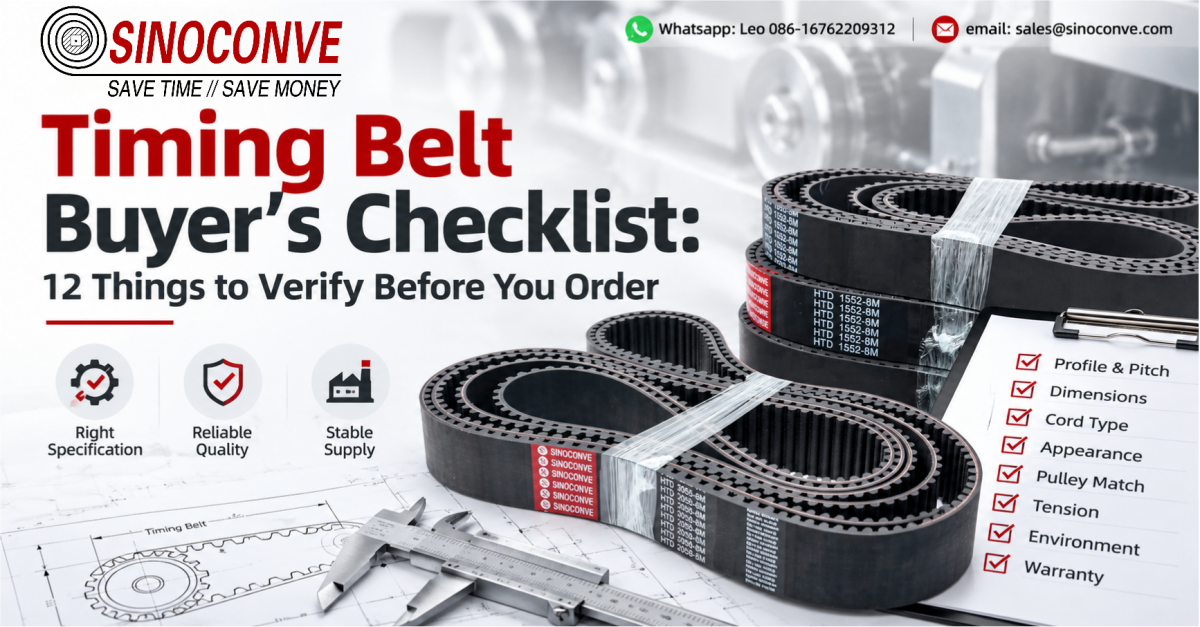
If your product is exposed, anything wet runs over the belt, and the belt sits inside a controlled hygiene zone, specify endless and accept the installation time. It is the difference between a joint you clean and a joint you cannot clean. The mechanics of the alternatives are compared in our guide to conveyor belt jointing methods, and if you want the argument for the closed loop as a product in itself, see endless conveyor belts and where they pay off. Order documentation for a splice should match the belt, and our PVC belt buyer's checklist covers the twelve points worth confirming before the order goes out.
09Minimum Pulley Diameter: The Number That Decides the Belt
If you only take one technical number away from this article, take this one. Minimum pulley diameter, not tensile strength, is what separates a belt that lasts three years from one that lasts four months on a packaging machine.
Why the back cover is the first thing to fail
Bending a belt over a small pulley stretches the outer surface and compresses the inner one. The thicker the belt, the larger the strain for the same pulley, and the strain lands on the back cover, which is the thinnest part of most constructions. Cracks start there and propagate. This is why an 11 mm rubber belt and a 3 mm PVC belt with similar breaking strength cannot share a pulley specification.
| Construction | Total thickness | Typical minimum pulley, 90 degree wrap | Comment |
|---|---|---|---|
| 1-ply PVC, light | 1.8 - 2.2 mm | 25 - 40 mm | Knife edge transfers on small packaging machines |
| 2-ply PVC | 2.5 - 3.2 mm | 50 - 80 mm | The workhorse of packaging and light food lines |
| 2-ply fabric rubber, light cover | 6 - 8 mm | 125 - 160 mm | Sorter and incline duty where impact is the driver |
| 3-ply EP rubber, heavy cover | 9 - 12 mm | 200 - 315 mm | Bulk duty; never a packaging line first choice |
Those figures are typical industry values, not universal law. They shift with the number of plies, the carcass type, belt tension, belt width, and the temperature of the joint during curing. Treat them as a screening filter. If your smallest pulley is 63 mm and somebody quotes you a 3-ply rubber belt, ask for the minimum pulley calculation in writing before you approve the drawing.
What it costs when you ignore the number
Back-cover cracking gives you months of warning and almost nobody looks for it. By the time the crack reaches the carcass the belt has usually also started tracking badly, so the symptom gets misdiagnosed as a pulley alignment problem. We have seen the same line get three alignment visits and one new snub pulley before anyone turned the belt over.
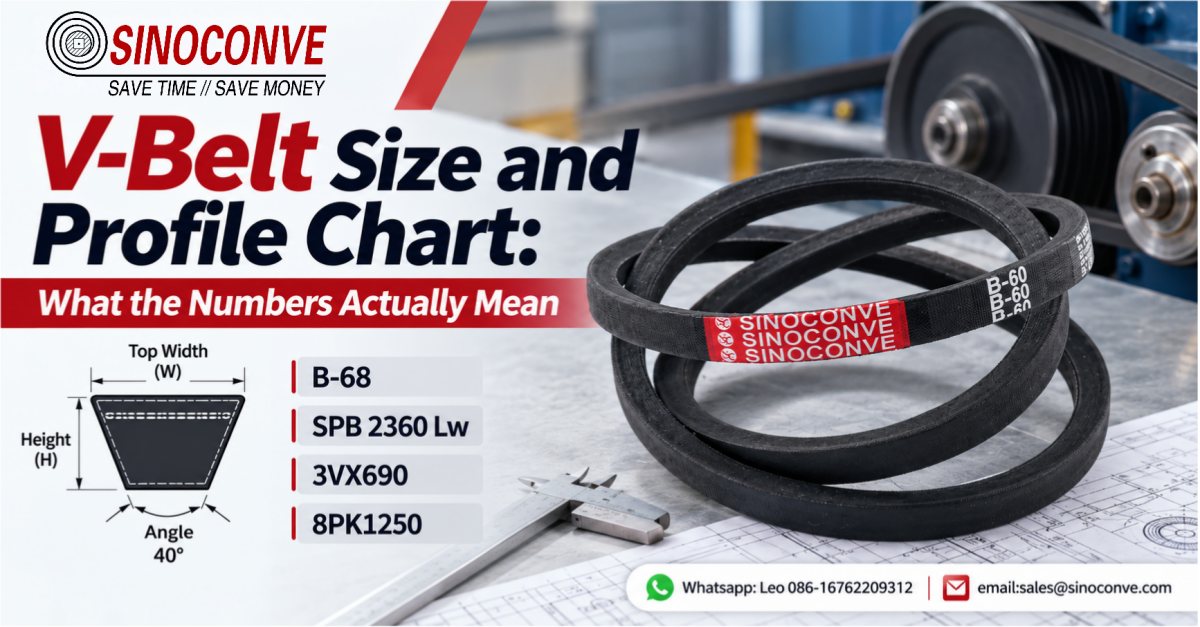
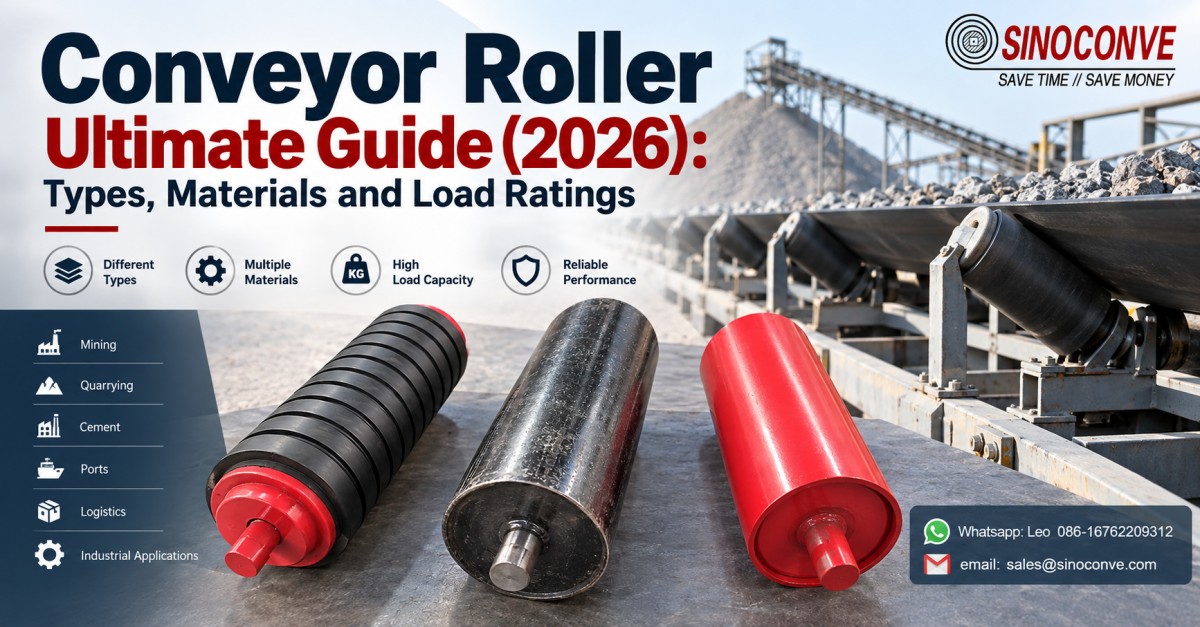
A drive-side check is worth pairing with this. If the machine also runs a V-belt or a synchronous drive, the pulley pair there has its own minimum-diameter rule, and a generic profile swap is the usual culprit. That is the daily subject of a V-belt manufacturer, and we are happy to look at a matched belt and pulley set together. Belt tracking on longer runs is covered separately in our EP conveyor belt tracking guide, and the load rating side of the frame is in our notes on conveyor roller types, materials and load ratings.
10Cleaning Regimes: CIP, Foam, and Dry
The cleaning method your site uses is a belt specification in disguise. Print it on the enquiry next to the speed and the load.
Dry cleaning
Brush, vacuum, and a dry scraper. Almost any belt survives this. The one rule is that a rubber cover must not shed. A cheap compound with a high filler content will dust over a conveyor that carries dry cereal for eight hours, and the dust ends up in the product.
Foam and open washdown
Caustic foam, a dwell time, and a rinse. Here the edge treatment and the splice matter more than the polymer. A cut fabric edge on a rubber belt stays damp for hours and smells by Friday. A sealed PVC edge sheds water and dries flat. If your line washes daily, this is the single strongest reason to move to PVC.
CIP and the closed loop
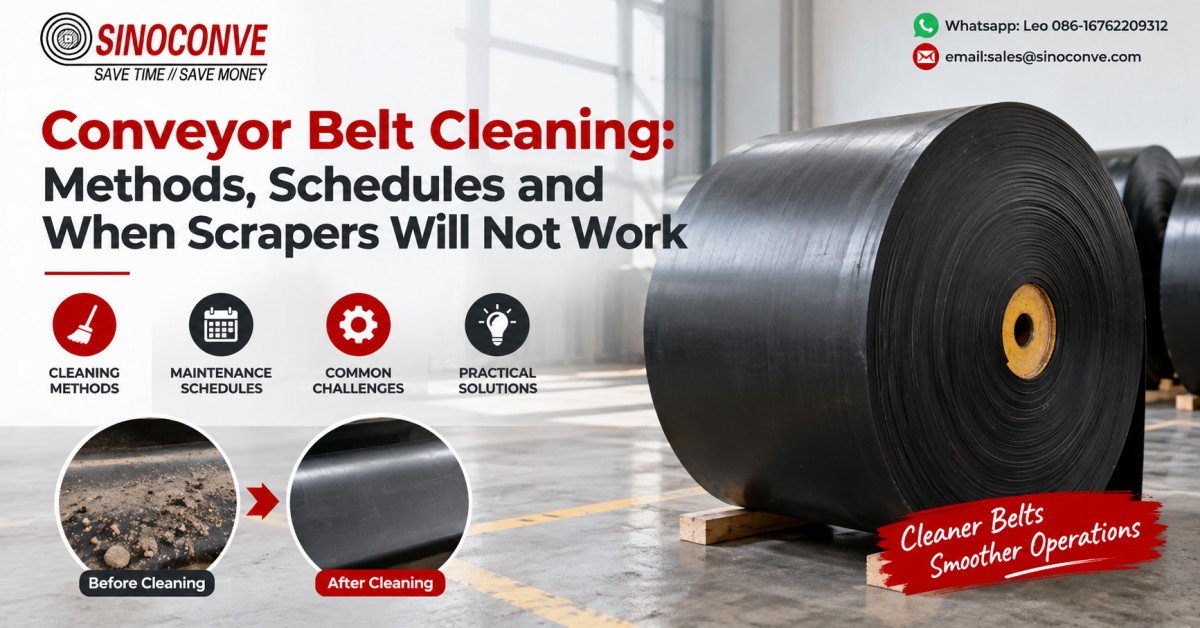
Clean-in-place means the belt is part of the machine that gets cleaned, not an item that gets removed. It also means nozzles reach the back of the belt and the return run. Specify an endless belt, confirm the cover is rated for the chemistry, and check that the water drains off the belt instead of pooling in the trough. Scraper blades are a separate subject if the belt carries sticky product, and we cover the cases where a scraper simply will not work in our notes on conveyor belt cleaning methods and schedules.
| Regime | Chemistry and temperature | What the belt must be | Usual call |
|---|---|---|---|
| Dry brush or vacuum | None | Low-shedding cover; anti-static helps | Either material |
| Foam and rinse, nightly | Caustic 1.5 - 2 percent, up to 60 °C | Sealed edges, cleanable splice, no fabric exposed | Food-grade PVC or PU |
| Open washdown with hot water | Up to 82 °C at the nozzle | Temperature-rated cover, welded joint | PU where heat is high |
| CIP, closed loop | Caustic and acid cycles, verified rinse | Endless, documented compound, drainable path | Food-grade PVC or PU, endless |
11The Decision Matrix, and the Three Straight Answers
Here is the working table we use on the phone when a customer describes a line in two minutes. Read across from your application and your cleaning regime.
| Application | Product and load | Surface temperature | Cleaning | Impact | Call |
|---|---|---|---|---|---|
| Carton and bottle packing | Under 5 kg per item | Ambient | Dry wipe | Low | PVC |
| Packaging exit after a tray sealer | Under 2 kg, warm packs | 60 - 85 °C at the belt | Wipe | Low | PU or heat-rated belt |
| Food contact, dry or chilled room | Loose product to 10 kg | 0 - 40 °C | Wipe or light wash | Medium | Food-grade PVC, blue or white |
| Food contact, washdown or CIP | Loose, wet, sometimes frozen | Up to 80 °C | Foam, rinse, CIP | Medium | Food-grade PVC or PU, endless |
| Cold store below zero | Any | -18 to -30 °C | Dry | Low | Cold-rated fabric rubber |
| Parcel induction and chutes | 10 - 30 kg, dropped | Ambient | Dry | High | Fabric rubber, thick cover |
| Parcel sortation, light mailers | Under 3 kg | Ambient | Dry | Low | PVC, anti-static option |
Reduce all of that to three answers. Packaging lines: PVC, 2-ply, welded where the joint can be closed, anti-static if the hall is dry. Food contact: food-grade PVC or PU with a sealed edge and an endless joint, blue if a detector or an audit asks for it, and rubber only where the load or the temperature forces it. Warehouse sorting: fabric-carcass rubber at the chutes and the heavy zones, PVC on the light mailer runs, and a fastener you can change inside the maintenance window everywhere else.
12Seven Mis-Selections We Keep Seeing on Site
These are not hypothetical. Each one has come across our desk in the last two years, and each one cost more than the belt.
Treating "food grade" as a synonym for "washdown safe". The belt is cleanable in theory, the edge wicks water in practice, and the daily rinse feeds a film you cannot see until the swab test fails. Fix the construction, not the compound.
Putting a general black rubber belt into a food room. It hides fragments, carries no detectable tracer, and looks like every belt a hygiene auditor has already written up somewhere else. You will lose the argument before you get to explain the abrasion data.
Forcing a thick rubber belt onto a 63 mm pulley because the quotation was cheaper. Back-cover cracking at four to six months, then a tracking problem that gets blamed on the frame, then a new belt. The cheap belt cost about twice the expensive one.
Ignoring parcel impact on a sorting line. A thin cover bruises at the chute, the bruise becomes a crack, and the crack reaches the splice during peak season. Add the cover thickness, or move the chute.
Comparing only the price per square metre. A belt that lasts nineteen months at a higher price beats one that lasts five at a lower price, and the arithmetic is not close once you add the labour to change it.
Specifying an endless belt on a hub with a twenty-minute maintenance window. The joint is better and the downtime is worse. Availability wins in a parcel hub; hygiene wins in a food room. Do not confuse the two.
Forgetting cold storage until February. PVC is a summer belt in an unheated loading dock in a cold climate. If the belt crosses a threshold into a freezer, the whole run has to be rated for the coldest point it touches, not the average of the building.
13Incoming Inspection and First-Start Checkout
Whatever you buy, the first hour after delivery decides whether the specification survived the order.
On arrival
Measure the total thickness with a gauge at five points across the width and at both ends. Check the width against the drawing, because a 2 mm difference changes the clearance at a side guide. Read the compound label and confirm the batch number matches the paperwork you were sent. If the belt is blue or metal-detectable, pass a sample fragment over your own detector before the belt goes anywhere near the line. Compare cover colour across the roll for batch consistency — a visible shade change between two rolls usually means two production runs, and that matters if the customer is looking at the belt through a glass panel.
First start
Run unloaded for twenty minutes and watch the back cover temperature with an infrared gun. Anything above about 60 °C on a light conveyor suggests the pulley is too small for the belt. Then check tracking at low speed before you bring the line to full rate, and re-check the splice after the first shift. Most joint failures we are asked about happen in the first fifty hours, and nearly all of them were visible at hour one as a misaligned edge or an over-tensioned belt.
14Cost per Meter Is Not the Number That Matters
A 600 mm wide, 2-ply PVC belt for a packaging line commonly sits in a range that starts below the price of a comparable fabric-rubber belt, and the gap widens once you add the fastener and the extra drive power the rubber belt needs. That is the easy part of the comparison.
The number that matters is cost per hour of operation. Take the belt price, divide it by the service life you actually get, add the labour to change it, and add the lost production for the changeover window. A belt at a 15 percent higher price that runs 18 months instead of 7 is not a 15 percent decision. On a line producing 3,000 packs an hour, an eight-hour unplanned stop is the whole belt budget several times over. This is also why we ask about the maintenance window before we ask about the price.
The same reasoning applies across a mixed fleet, and it is the reason our quotations as a belt source usually include the joint method and the pulley check rather than a bare per-metre figure. If you want the fuller buying view, that material lives on our frequently asked questions page and in the product range at PVC conveyor belts.

15FAQ: PVC, Rubber, and Packaging Belts Compared
What is the best conveyor belt for packaging lines?
PVC, in almost every case. A 2-ply PVC belt at 2.5 to 3.0 mm runs over 50 mm pulleys, holds a stable friction coefficient for accumulation, and stays quiet. Rubber only takes over when the product is hot or the load is heavy enough to tear a PVC cover.
Can I use a rubber conveyor belt in a food plant?
Yes, in specific conditions. A white food-grade rubber belt with a smooth cover and sealed edges is a legitimate choice for bulk vegetables, frozen product, or anything with an impact load. What does not work is a general-purpose black rubber belt from the stock rack. It hides fragments, it has no detectable tracer, and its cut edges hold water.
Is a food-grade belt the same as a washdown belt?
No, and the confusion is expensive. Food-contact approval describes what the material releases into food. Washdown resistance describes whether the construction survives caustic, heat, and water. You need both documents, and you need to see the edge and the splice before you believe the claim.
What is the smallest pulley a PVC belt can run on?
A light 1-ply PVC belt can wrap a 25 to 40 mm pulley. A 2-ply belt of 2.5 to 3.2 mm usually wants 50 mm and up. Push below that and the back cover cracks, usually within four to six months on a two-shift line.
Do I need a blue belt or a metal-detectable belt?
If your HACCP plan lists foreign-body detection as a critical control point, or a customer audit standard requires contrasting colour, then yes. Otherwise blue is still the sensible default anywhere a blade or a needle shares the line with the product.
How should a PVC belt be joined on a food line?
Welded, ideally endless. A welded joint keeps 70 to 90 percent of parent-belt strength and leaves nothing for a squeegee to catch on. A finger splice is an acceptable second choice if it is ground flush. Steel hooks belong on dry packaging and parcel lines, not in a washdown room.
PVC or rubber for parcel sorting and warehouse conveyors?
It depends on the parcel. Above roughly 10 kg with a 300 mm drop onto the belt, use fabric rubber with a thick cover. Below 3 kg, PVC gives you better tracking, lower noise, and less drive power. Many hubs run both, and that is the right answer rather than a compromise.
What documents should arrive with a food-grade belt?
A declaration of compliance naming the material and its conditions of use. A migration test report from an accredited laboratory. A colour and additive list. And, if detectability is part of your plan, a statement of fragment size to verify on your own detector. We do not issue these documents and we do not obtain certifications for customers — we tell you which compound carries which file, and you check it.
Can one belt serve both the cool room and the packing hall?
Only if the whole run stays above about 0 °C. Standard PVC stiffens below zero and can crack at -20 °C, so a belt that crosses into a freezer must be rated at the coldest point it touches. Two belts on one frame is often cheaper than one belt that fails twice a winter.
How do I compare a PVC belt price with a rubber belt price fairly?
Ignore the price per square metre and work out cost per operating hour: purchase price divided by realistic service life, plus the labour to fit it, plus the production lost during the change. On that basis a higher-priced belt that lasts twice as long usually wins.
Related Products You May Need
- PVC conveyor belts — light, flat, washable.
- Rubber conveyor belts — fabric carcass for impact, heat, and heavy duty.
- Timing belts for packaging machine drives — synchronous infeed and indexing on packaging and sorting equipment.
- Chevron conveyor belts — for inclined transfers into and out of packaging halls.
- Full product catalog — belts, rollers, and drive components from one factory.
- Belts for logistics and warehousing — sorting, induction, and take-away conveyor specifications for parcel operations.
Related Blog Posts
- Rubber conveyor belt vs PVC conveyor belt
- PVC conveyor belt types and selection guide
- Food grade PVC conveyor belt buyer's check
- PVC conveyor belt selection
- Warehouse conveyor belt guide for parcel sorting
- Logistics conveyor belt warehouse guide
- PU conveyor belt for food handling and hygienic lines
- Rough top conveyor belt guide for packaging lines