
Scrap is the least polite material a belt will ever carry. A stamping press pushes out a skeleton of cold-rolled sheet less than a millimeter thick, burrs standing along every cut edge, and it lands on the belt edge first. A shredder throws fist-sized chunks, torn plate and tangled wire, and every third piece seems to have a point on it. Between those extremes sits everything else a yard handles: sheared strip, demolition rebar, baled light iron, machining turnings. None of it arrives gently.
We build belts for these lines, and the failure pattern is repetitive enough to be predictable. A scrap metal recycling conveyor belt rarely dies of abrasion alone. It dies because a thin hard edge found a path through the cover, and then a second event turned that small hole into a long split. That second event is usually a snag on a skirt board, a piece wedged under a pulley, or a jam at the magnet discharge.

So the useful question is not how hard the rubber is. It is what happens in the four seconds after a burr touches the cover at two meters per second. Answer that, and the rest of the specification follows: compound, cover gauge, breaker, carcass, chute geometry, inspection interval. Our conveyor belt manufacturer team spends most of its scrap-line conversations on those four seconds.
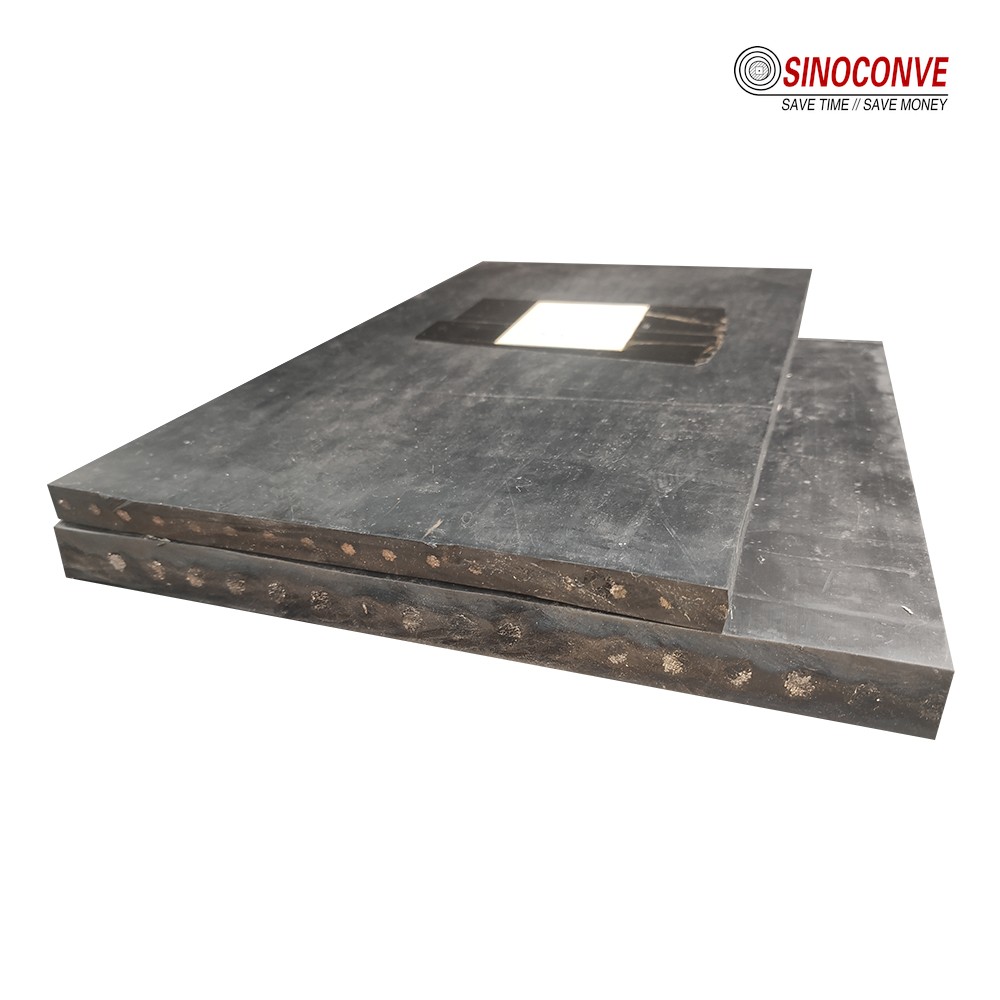
Shredder discharge duty: mixed ferrous with torn plate, wire and fines, all of it moving faster than the operator can react.
01Scrap Metal Forms and the Three Failure Modes We See
Yards talk in grades. Belts feel shapes, and only three shapes matter. The first is flat and thin: stamping skeletons, laser-cut frames, guillotine trimmings, litho plate. Thickness usually lands between 0.5 mm and 3 mm, and the cut edge is a burr rather than a blade. That is worse in one respect, because an irregular edge saws instead of slicing. The second is lumpy: shredded ferrous between 50 mm and 300 mm, with torn ends and a fines fraction that packs into every low spot. The third is long: rebar, channel, wire, and the strip a shear leaves when the blade gap drifts.
Thin Edges Do the Damage, Not Heavy Weight
A 600 kg bale dropped from 1.5 m will dent a pulley and crack a carcass, and every maintenance team respects that. The quieter killer is a 12 g sliver of 1 mm plate standing on edge. Put 15 kg of point load on a 20 cm square and the rubber barely notices. Put the same 15 kg on a contact patch the width of a burr and the local stress climbs into the range where a 60 Shore A cover simply yields.
One impact proves nothing. Two hundred thousand of them, which a busy shredder discharge line reaches in a few months, carve a channel. Once the channel is deeper than about 40 percent of the cover gauge, the rubber under it stops absorbing energy and starts transmitting it to the breaker and the first fabric ply. From there the belt is on a countdown that nobody has written on the maintenance board.
Why a Small Puncture Opens Across the Width
A puncture that reaches the breaker or the first ply creates a stress concentration at the hole edge. Under running tension the hole grows, slowly at first. If the same impact also severed weft yarns, the belt loses width integrity, and the tear runs across the belt at close to 90 degrees to travel. We have measured those transverse tears at 600 mm to 1,200 mm by the time an operator hears the change in sound.
This is why we ask buyers to send photographs of failed belts instead of descriptions. A lengthwise rip points at a seized idler, a misaligned plow or a buildup on a return roller. A transverse tear points at a puncture followed by a snag. The two failures need different fixes, and often a different belt construction. Our rubber conveyor belt range is built around that distinction rather than around a single headline number.
Field note from our engineers: A stamping plant in the Yangtze delta sent us a 1,200 mm EP belt with 17 punctures logged in six weeks. Every one sat in a 300 mm band, 150 mm in from the drive-side edge. The cause was not the belt. A worn deflector plate was dropping skeletons corner-first onto the same strip of cover, and the plant had been buying heavier belts instead of a 40 mm steel wear bar.
02From Shredder to Bale: Where the Belt Actually Works
A scrap line is not one duty. It is five or six short duties chained together, and the belt that survives the baler feed may be wrong for the shredder discharge. A metal shredder conveyor belt and a baler feed belt should never share one datasheet. We survey a plant backwards, from the baler to the receiving pit, because that is the direction the damage reports travel.
Drop Heights and Burden Depth Change Everything
At the receiving end, a grab bucket opens two meters above the belt and releases half a ton of mixed plate, so the belt sees one event worth more than a week of abrasion. Under the shredder, the same belt sees a continuous stream at 1.5 m/s to 2.5 m/s, with a burden depth that swings by 300 mm as the feeder cycles. Downstream the burden turns thinner and cleaner, but the belt starts and stops every time the baler calls for material.
Those three profiles load the cover in different ways: impact, gouging, and fatigue at the start. A single cover gauge across the whole line is therefore a compromise. Plants that run one specification everywhere usually end up replacing the shredder discharge belt twice as often as the baler belt, which is exactly what the duty table predicts. This is the conversation our industrial conveyor belt engineers have on almost every first site visit.
| Conveyor position in the scrap line | Dominant load that shortens belt life there | Construction we normally propose for that point |
|---|---|---|
| Receiving infeed ahead of the primary shredder | Whole assemblies and heavy plate drop straight from the grab bucket | Heavy EP carcass with thick cover and closely spaced impact idlers |
| Shredder discharge carrying mixed ferrous and fines | Torn edges arrive fast and hot, and fines grind the cover continuously | Cut resistant cover over a closed weave breaker fabric layer |
| Transfer belt under the overband magnet | Ferrous pieces are released from magnet height onto a short load zone | Short center EP belt with a reinforced load zone and tight skirt rubber |
| Sorted ferrous feed into the baling press | Frequent stop start cycles fatigue the splice and the bolt holes | Flexible EP belt with a vulcanized splice and generous pulley diameter |
| Bale discharge and outbound loading conveyor | Point loads from dense bales plus abrasion from dragging on the deck | Thick cover on a steel cord or heavy EP carcass with a low slope |
Two numbers drive most of the choice. The first is free drop height at the load point. Below 600 mm, a 6 mm cover and a breaker will usually hold a shredder discharge line for years. Above 1.2 m, no cover survives indefinitely, and the budget is better spent on a rock box, a deflector or a short chain curtain than on another two millimeters of rubber. The second is the fines fraction: a burden with a lot of sub-10 mm material behaves like grinding paste on the return side.
We also ask about the baler cycle. A line that runs flat out for six hours is easier on a belt than one that indexes every ninety seconds, because every start sends a tension wave through the splice. If the plant cannot smooth the cycle, the splice should be vulcanized rather than mechanically fastened. The recycling conveyor system overview covers that layout logic. Past the baler, the outbound conveyor belongs to the logistics and warehousing side of the plant rather than the yard.
03How This Duty Differs from Municipal Waste, E-Waste and Tyre Recycling
The recycling industry uses one word for four very different material streams, and that word causes more bad belt specifications than any other. Scrap metal is dense, dry, magnetic and edged. The other streams are none of those things in the same combination. If a plant handles several of them under one roof, the conveyors should not share a single belt specification, and the maintenance schedule should not share a single interval either. Our industries we serve overview and the recycling sector page group the applications, but the engineering underneath each one is separate.
What Municipal Waste Belts Have to Solve Instead
Mixed household waste arrives wet, ragged and unpredictable. The damaging fractions are film plastic that wraps around idlers, organic matter that turns the belt surface slick, stringy textiles that bridge across the trough, and a moisture content that changes with the weather. A municipal line fights carryback and cleaning, not puncture. Belts there are often cleated or profiled to stop material rolling back on an incline, and the compound usually leans toward oil and fat resistance because the stream contains food waste and packaging residue.
None of that applies to a scrap yard. Ferrous scrap does not wrap, does not rot and does not need a cleated surface on a flat run. A belt specified for municipal duty carries a softer, thicker cover tuned for grip and cleaning, which is the opposite of what a shredded plate stream needs. If your line also takes black bag waste, start from the municipal waste conveyor belt article and treat the metal leg as a separate design. Squeeze a handful of the burden: if it leaves moisture on your glove it is a municipal problem, and if it cuts the glove it is a metal problem.
E-Waste and Tyre Lines Are Different Problems Again
Electronic scrap is small, brittle and valuable. The sharp items are circuit board corners, connector pins and broken glass, and the real risk is not a 900 mm tear but a fire from a lithium cell that got through the sort. E-waste conveyors tend to be narrow, slow and equipped with metal detection and quick stops. The cover resists small hard objects without generating static, and the surface releases small parts cleanly so they can be recovered rather than carried back. Our e-waste recycling conveyor belt guide stays inside that envelope.
Tyre recycling looks closer to scrap metal because of the steel bead wire, but the mechanics are different. The burden is rubber crumb, sidewall chunks and wire bundles, and the dominant damage is heat build-up plus abrasion, with oil from the rubber compounding the slip risk. Tyre lines also tend to run slower and wider, and the cut resistance that matters on shredded plate is less important than heat and oil resistance. We cover that combination in the tyre recycling conveyor belt article rather than here.
| Material stream as it enters the plant | Damage signature we find on the belt | Why the belt answer has to differ |
|---|---|---|
| Mixed municipal waste with organics and film plastic | Wrapped idlers and slick surfaces from wet organic residue | Grip, cleaning and oil resistance matter far more than cut depth |
| Discarded electronics with boards, glass and battery cells | Small cuts, static pickup and occasional burn marks near the sort cabin | Narrow slow belts need fine part release and fire prevention instead |
| Whole tyres, sidewall chunks and steel bead wire | Heat hardening, groove wear and oil softened cover rubber | Heat and oil resistance outrank puncture resistance on these lines |
| Ferrous scrap, stamping offcuts and shredded plate | Point punctures that grow into transverse tears under tension | Only this stream justifies a breaker fabric and a cut resistant cover |
04Puncture Resistant Covers and the Breaker Layer
Cut resistance in rubber is not the same property as abrasion resistance, and the two are frequently sold as if they were. An abrasion resistant compound is judged by how much material it loses when rubbed against a drum under load. A cut resistant compound is judged by how much energy it absorbs before a sharp edge initiates a tear, and by how far that tear travels once it has started. A compound can score well on the first test and poorly on the second. That is why a belt with an excellent wear number can still be punctured by a stamping skeleton in the first month.
A Breaker Is a Sacrifice Layer, Not a Shield
The breaker is a closed-weave fabric ply laminated between the cover and the carcass, usually two to three millimeters below the surface. Its job is to spread a point load over a wider circle, typically from a burr contact patch into something closer to 25 mm across, and to stop a cut from reaching the load-bearing plies. It is sacrificial by design. Once a breaker is cut through in several places, it stops distributing load and the next puncture goes straight into the carcass.
Three rules follow. A breaker only helps if it is bonded properly; a poor skim coat leaves a plane where water and fines travel sideways. A thicker cover above the breaker buys time, but only up to a point, because a very thick soft cover cups at the edges. And a wire mesh breaker is a different animal: it resists severe gouging, stiffens the belt, complicates splicing and rusts once moisture gets in. We reserve wire mesh for primary dump points where a missed piece of structural steel is a realistic event.
Hardness is the other lever. Going from 55 Shore A to 65 Shore A improves indentation resistance and reduces the depth a burr reaches at a given impact energy. It also reduces conformity around small pulleys and raises splice stress. On a line with 400 mm pulleys, 65 Shore A is usually fine. On a 250 mm tail pulley it is not, and the splice will tell you first. As a conveyor belt supplier we would rather quote two hardness options than argue about a failure later.
| Duty point on the scrap line | Cover gauge and hardness we would quote | Breaker choice and the reasoning behind it |
|---|---|---|
| Primary dump from grab bucket into the receiving hopper | Ten millimeter cover at sixty five Shore A for heavy point loads | Wire mesh breaker where structural steel can arrive unannounced |
| Shredder discharge with mixed ferrous and torn sheet | Eight millimeter cut resistant cover at sixty Shore A | Single closed weave fabric breaker bonded directly under the cover |
| Magnet transfer and short sorting conveyors | Six millimeter cover at sixty Shore A to keep flexibility | Fabric breaker only where the drop height exceeds half a meter |
| Baler feed with sorted ferrous and occasional wire bundles | Five millimeter cover at fifty eight Shore A for flex life | No breaker needed once the stream is screened and drop height is low |
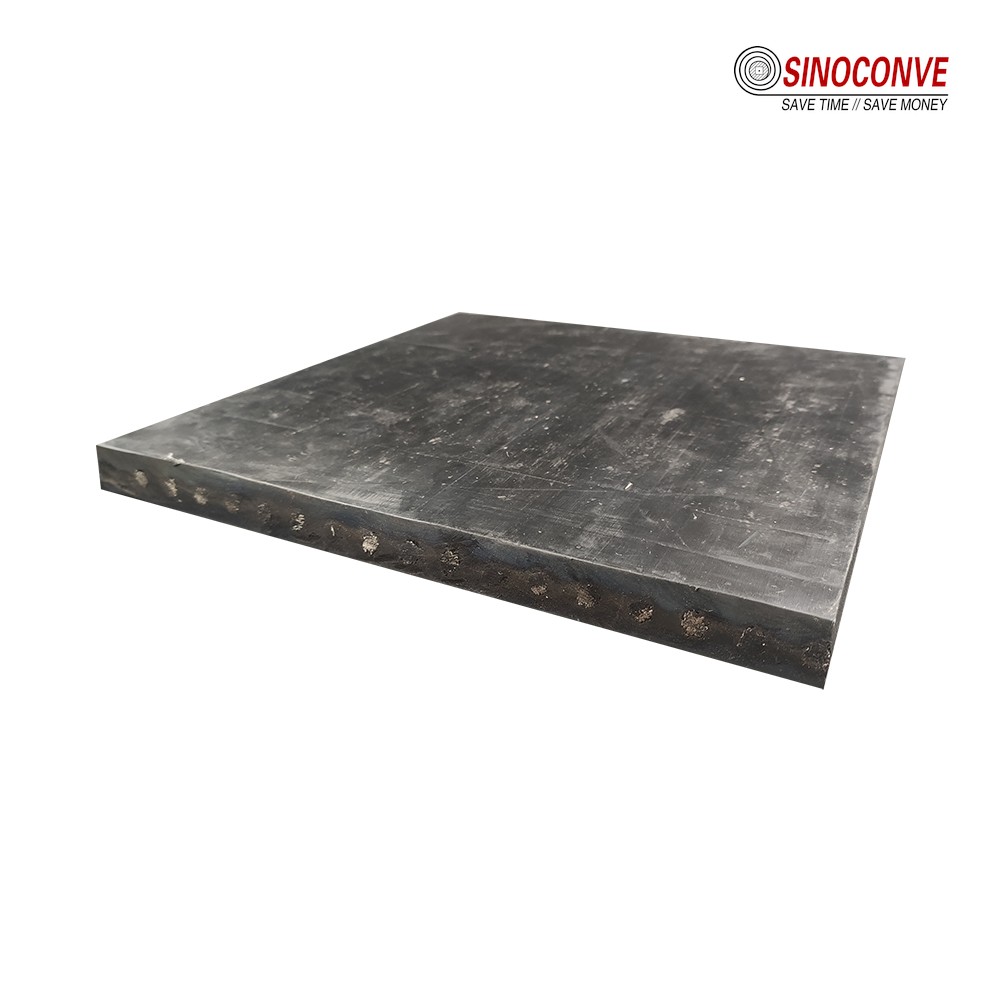
A breaker ply sits two to three millimeters under the cover and spreads the point load before it reaches the carcass.
Buyers of a steel scrap conveyor belt often want the thickest cover available. On short centers the opposite failure is more common: an eight millimeter cover on a 315 mm pulley bends hard, cracks at the splice and lets water into the fabric from the inside. Cover gauge has to match pulley diameter as well as impact energy.
05Steel Cord or EP Fabric: Choosing the Carcass for Sharp Scrap
On a scrap metal recycling conveyor belt the carcass decides how the belt behaves after damage, once cover and breaker are settled. Here scrap lines diverge from aggregate. On a quarry belt the carcass is mostly a tension member; on a scrap belt it is also a rip-stopper, a repair surface and a moisture barrier, roles that pull in different directions.
Where Steel Cord Wins and Where It Loses
Steel cord earns its place on long centers and high lifts. It stretches little under load, so take-up travel stays short and the belt tracks predictably. It also carries far more tension per millimeter of width than a fabric carcass, which matters when a plant moves 120 tons per hour up a 200 m incline. For a long surface run from the yard to the furnace building, steel cord is often rational.
The weakness is damage tolerance. A steel cord belt has almost no weft reinforcement, so a transverse cut can sever a bundle of cords and remove much of the strength at that section. Moisture then reaches the exposed wires, corrosion starts, and the cord-to-rubber bond degrades from the inside. A puncture that would be a nuisance on an EP belt becomes a section replacement on steel cord. Field repair also demands a hot vulcanized splice with proper cord preparation, which most yards cannot do at two in the morning.
EP fabric behaves the other way. It stretches more, so the take-up needs travel and startup tension matters. In exchange it tolerates impact, distributes point loads across several plies, and can be repaired with a vulcanized patch or, in an emergency, a mechanical fastener. On a shredder discharge conveyor of 30 m to 60 m we specify EP almost every time. The fabric versus steel cord comparison goes deeper into the tension arithmetic.
There is a middle path that works well in scrap plants: a heavy EP carcass with a breaker on the violent conveyors, and steel cord only on the long clean transfer out of the yard. Splitting the line that way keeps the difficult repairs where the plant can handle them. If you are comparing constructions for a long run, our steel cord conveyor belt page lists the cord counts and cover options we build.
| Decision factor for the scrap plant | How an EP fabric carcass behaves in service | How a steel cord carcass behaves in service |
|---|---|---|
| center distance and lift on the installation | Comfortable on short and medium centers with modest take up travel | Best choice for long overland runs and tall lifts at high tension |
| behavior after a sharp edge cuts the belt | Damage stays local because several fabric plies share the load | A transverse cut can sever many cords and strip most of the strength |
| Repair options available to the maintenance team | vulcanized patch or mechanical fastener can restore the section quickly | Requires a hot splice with careful cord preparation and skilled labor |
| Impact absorption at the loading point | Thick elastic plies cushion the blow and spread it along the belt | High tensile stiffness transmits shock into the splice and the pulley |
| Handling and installation in a cramped yard | Lighter rolls that a small crew can move with a forklift | Heavy rolls needing a crane and a carefully planned pull through |
One more point rarely appears in a datasheet: detection. A metal detector or rip loop behaves differently on each carcass. Steel cord interferes with some magnetic detectors, and so can a fabric belt with a wire breaker. If the plant relies on detection to stop the line before a jam becomes a tear, say so before the order.
Spares planning belongs to the same discipline. One roll of the right specification in the warehouse avoids the worst outcome: accepting a substitute too stiff or too thin because it was available. Our wholesale conveyor belts program exists for that reason, and every roll from our conveyor belt factory carries a test record for gauge, hardness and splice strength. We check the drive side too, because a slipping drive often explains a stalled shredder, and as a transmission belt manufacturer and v-belt manufacturer we would rather size the drive than watch the belt take the blame. The same discipline applies to retrofits: a short incline out of the baler usually wants a profiled belt rather than a taller cleat, and our conveyor belt distributor network keeps chevron stock for exactly that case.
06Chute Geometry, Magnet Transfer and Jam Release
Half the punctures we investigate on a scrap metal recycling conveyor belt were created upstream, in the chute. When a conveyor is installed under an existing structure, the drop height is whatever the steel allows, and the material arrives with a horizontal component that throws it at the skirt board instead of onto the belt. Sharp plate then hits the skirt, bounces, and lands corner first. The belt gets blamed for a geometry problem.
Build a Dead Bed Before You Buy a Thicker Belt
The cheapest fix is usually a rock box or a dead bed: a pocket of material that sits on the chute floor and absorbs the impact instead of the belt. Where a dead bed will not fit, a 45 degree deflector plate or a short chain curtain spreads the stream. We aim for a free drop under 600 mm at the load point and a chute exit that matches the belt direction within about 15 degrees. Beyond that, the material tends to land on the idler gap rather than on the belt.
Skirt rubber needs attention too. A clearance of 25 mm to 40 mm keeps the seal without pinching the cover, and a skirt longer than about 1.5 m adds friction without adding much guidance. We have seen plants cut punctures by roughly a third simply by shortening the skirt boards and replacing a worn liner. Loading zone hardware matters as much as the belt: impact rollers for loading zones at 300 mm pitch will do more for a shredded plate stream than another millimeter of cover.
The magnet transfer is the second weak point, and it is counter-intuitive. An overband magnet lifts ferrous out of the burden and releases it onto a short transfer belt from 200 mm to 300 mm above the surface, so pieces land on the same square meter of belt all shift. A head pulley magnet is worse in one way: it holds pieces against the belt through the wrap, pressing sharp edges into the cover at the nip while the belt is under tension. That is where the clustered punctures on magnet tail belts come from. Lagging helps grip and does nothing for the cover, so the belt itself needs the breaker here.
Jams deserve their own discipline. Long wire, rebar and tangled sheet hook on skirt rubber, on the chute lip or on a return bracket, and then get dragged. The belt does not fail at the hook point; it fails where the trapped piece finally wedges. Current monitoring on the drive, a torque limit that trips before the belt stalls and a reverse jog function cover most of the risk. None of that replaces the basic rule: never clear a jam while the belt is running, and never clear one with the drive in automatic. The industrial equipment sector page describes how these controls are typically integrated on a shredder line.
Cleaning belongs here too, because carryback on a scrap line is abrasive rather than sticky. Fines that pass the skirt ride back on the return side, grind the cover from beneath and pack the rollers. A primary scraper and a secondary cleaner at the head pulley, checked weekly, keep that layer thin. Our guide to belt cleaning methods covers the cases where a scraper will not work.
07Wound Mapping and the Shutdown Inspection That Pays
A scrap metal recycling conveyor belt generates damage faster than a maintenance team can report it. The plants that get ahead do one thing differently: they map damage instead of counting it. Counting tells you the belt is failing. Mapping tells you where, and the pattern points upstream.
Mapping Wounds Instead of Counting Them
The method needs no software. On the shutdown walk, mark every cut longer than 10 mm with a paint crayon, write the running meter on the cover, and note the distance from the drive-side edge. Photograph the section with a tape measure in frame. After three inspections you have a map, and the map will separate a chute problem from a tracking problem from a splice problem.
Punctures clustered within 300 mm of one edge usually mean the stream is landing off-center or the skirt is pinching. Punctures scattered across the full width point at drop height. A line of cuts along the splice shoulder points at pulley diameter or splice quality. Cuts on the return side only mean the damage is happening underneath, often at a seized roller or a buildup of wire.
The Shutdown Checks We Would Not Skip
Four checks earn their time on every scrap conveyor. Measure cover depth at the same six points each time, because a cover that has gone from 8 mm to 4 mm in a year is telling you something the calendar cannot. Look at the breaker through the deepest cut with a torch; if the weave is visible and frayed, plan a patch rather than a monitor. Check the splice for lifted edges and hardened rubber at the shoulder. And turn every return roller by hand, because a roller that will not spin freely is a rip waiting for a wire.
Repair thresholds should be written down, not negotiated during a breakdown. In our service work we treat a cut that reaches the breaker as a patch within the next planned stop. Exposed carcass means stop the belt. An edge tear longer than 50 mm gets trimmed and sealed before it grows. Three patches inside one 500 mm window justify replacing that section.
A crayon mark, a running meter and a photograph turn a puncture into data the next inspection can use.

08Frequently Asked Questions
Can a standard EP belt handle shredded scrap?
Not on the shredder discharge, no. A general purpose EP belt has the tensile strength for the conveyor, but its cover and carcass were never designed for torn plate landing at two meters per second. It will run, and it will fail early: a field of small punctures, then a transverse tear at a splice.
What cover thickness should we specify for stamping offcuts?
For skeletons under 3 mm thick dropping less than half a meter, a 5 mm to 6 mm cut resistant cover at around 60 Shore A is usually enough, provided the chute lands the material flat. If the press ejects parts corner-first, go to 8 mm and add a breaker. Thickness alone will not compensate for a bad landing.
Will a breaker fabric stop a puncture completely?
No, and any supplier who says otherwise has not looked at a used belt. A breaker spreads the load and stops most cuts from reaching the carcass, which is a large gain in service life. It is still fabric, and repeated impacts in one spot will eventually cut through it. What the breaker buys is time between inspections.
Why does our belt tear across the width instead of along its length?
Because something punctured it and then something snagged it. A transverse tear needs two events: a cut that severs weft yarns, and a trapped piece that holds part of the belt while the rest keeps moving. Look for the original hole at one end. It is usually within 200 mm of the edge, and smaller than the maintenance team expected.
Is steel cord better than EP for a scrap yard?
Only where the run is long and the tension is high. On a 30 m shredder discharge conveyor, steel cord repairs harder and tolerates transverse damage less, so EP with a breaker wins. On a 200 m transfer out of the yard, low elongation is worth the trade. Splitting the specification by duty is normal practice in plants that run both.
How often should we inspect a scrap conveyor belt?
Weekly on the shredder discharge and the magnet tail, monthly on sorted and baler feed conveyors, and always after a blade change or a jam that tripped the drive. The interval matters less than the consistency. A plant that maps damage every week learns more in a quarter than one that performs a thorough inspection once a year.
If you are replacing a belt punctured three times in a year, send the failure photos and the conveyor layout. We will tell you whether the answer is a different construction, a different chute, or both. Our engineers usually recognize the pattern from a handful of images.
Related Products You May Need
- Rubber conveyor belt for general scrap handling duty
- Steel cord conveyor belt for long transfer runs
- Chevron conveyor belt for short incline retrofits
- Conveyor rollers and impact idlers for load zones
- V-belts for shredder and baler drive maintenance
Related Blog Posts