
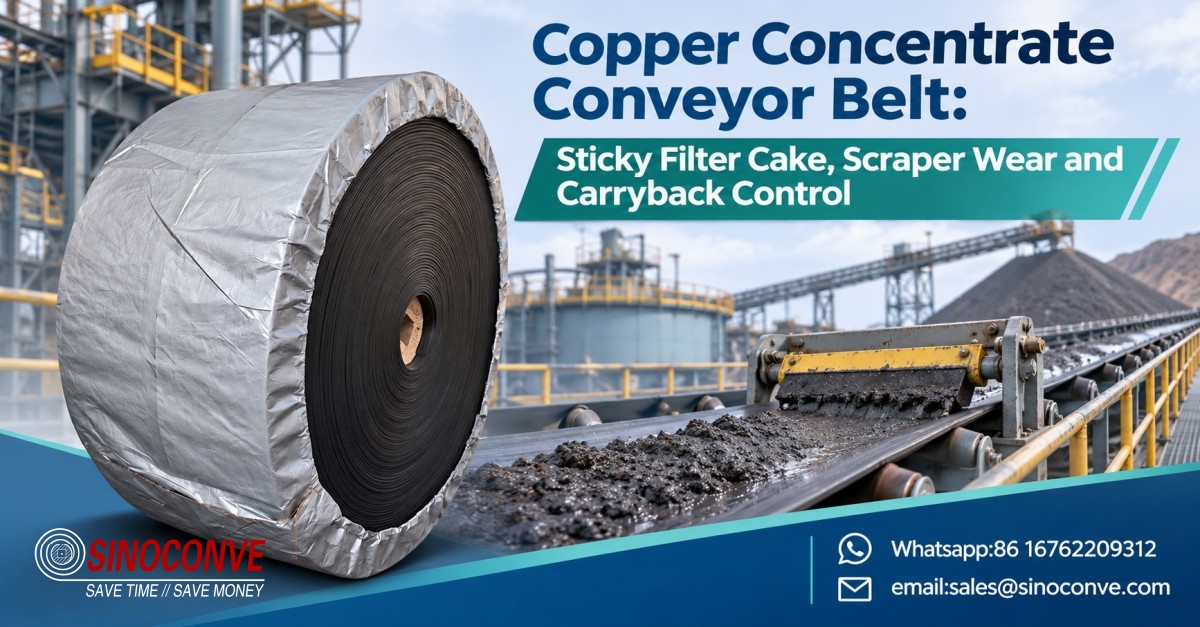
Copper concentrate is a powder problem dressed up as a rock problem. By the time it reaches a belt in a concentrator, the ore has been blasted, crushed, ground and floated, and what leaves the filter press is a damp, dense, faintly soapy cake that would rather stay on the belt than leave it. That behavior decides whether a copper concentrate conveyor belt runs for six years or fails inside nine months.
We build belts for mineral plants and we spend a lot of time on filter floors. On this duty the money goes into scrapers that cut a cover open in a season, return rollers that grow a shell of re-cemented fines, and belts that walk off their pulleys because one edge carries 40 mm of caked cake while the other edge is clean. None of that appears in a price per meter comparison.
As a conveyor belt manufacturer we are asked for "the same belt as the crusher line, but wider" more often than for any other specification on concentrate duty. That request is nearly always wrong. Section 03 explains why. The short version: this duty wants a dense low-adhesion cover, a stiff EP carcass and a cleaning system chosen in the same meeting as the belt.
If you are comparing suppliers for a new filter building, the plant and terminal conveying duties we cover by industry page beats a product list as a starting point, because the duty sets the specification.

01Copper Concentrate Circuit Realities: High Density, Sub-Sieve Fines and Sticky Filter Cake Rheology
A typical concentrator thickens its final concentrate to between 55% and 65% solids by weight, then a membrane or chamber press squeezes that slurry down to a cake holding 8% to 12% moisture. To the eye the cake looks dry enough to handle. To a belt it is a pressure-sensitive adhesive with a mineral filler.
Why the cake behaves like a paste rather than a powder
Grinding to a liberation size of 60 to 100 microns leaves a concentrate that is often 70% to 85% passing 200 mesh. Sub-sieve particles carry enormous specific surface, and the collector and frother film from flotation is still on them. Xanthate and dithiophosphate are surfactants by design: they lower interfacial tension so a thin water film can bridge two particles, and against rubber that same film bridges particle to cover just as willingly.
The cake is also thixotropic. It gels at rest, flows when sheared, then gels again when the shear stops. In practice it sets in the chute, liquefies at the load point and re-solidifies in the trough where the belt is momentarily still. Anyone who has watched a filter cake drop arrive as a lump and spread into a 900 mm wide smear has seen the whole sequence in about four seconds.
What the filter press hands to the belt
When the plates open, cake leaves in slabs 20 to 45 mm thick. The belt usually sits 300 to 900 mm below the plate line, so the drop is short and the impact is mild compared with run-of-mine rock. The problem is dwell time. The slab lands, deforms and starts to bond while the belt is still moving under it, and cloth wash water adds a mist of fines that dries into a glaze between shifts.
| Stage in the concentrate flow sheet | How the material behaves on a moving belt | Belt property that decides success here | What a general-purpose belt does badly |
|---|---|---|---|
| Filter press cake dropping from the plates | Slides as slabs then smears and bonds to any dry rubber | Low surface energy cover with a high density matrix | Builds a film layer that the scraper cannot lift |
| Reclaimed stockpile feeding the loadout bin | Dry crust outside but still damp and cohesive inside | Cut and tear resistance in the top cover | Chute blockage followed by slip under a slug |
| Rail wagon loading through a telescopic chute | Spills over the edges whenever the chute sits off centre | Stable tracking under a badly uneven load pattern | Edge damage from repeated spillage and rubbing |
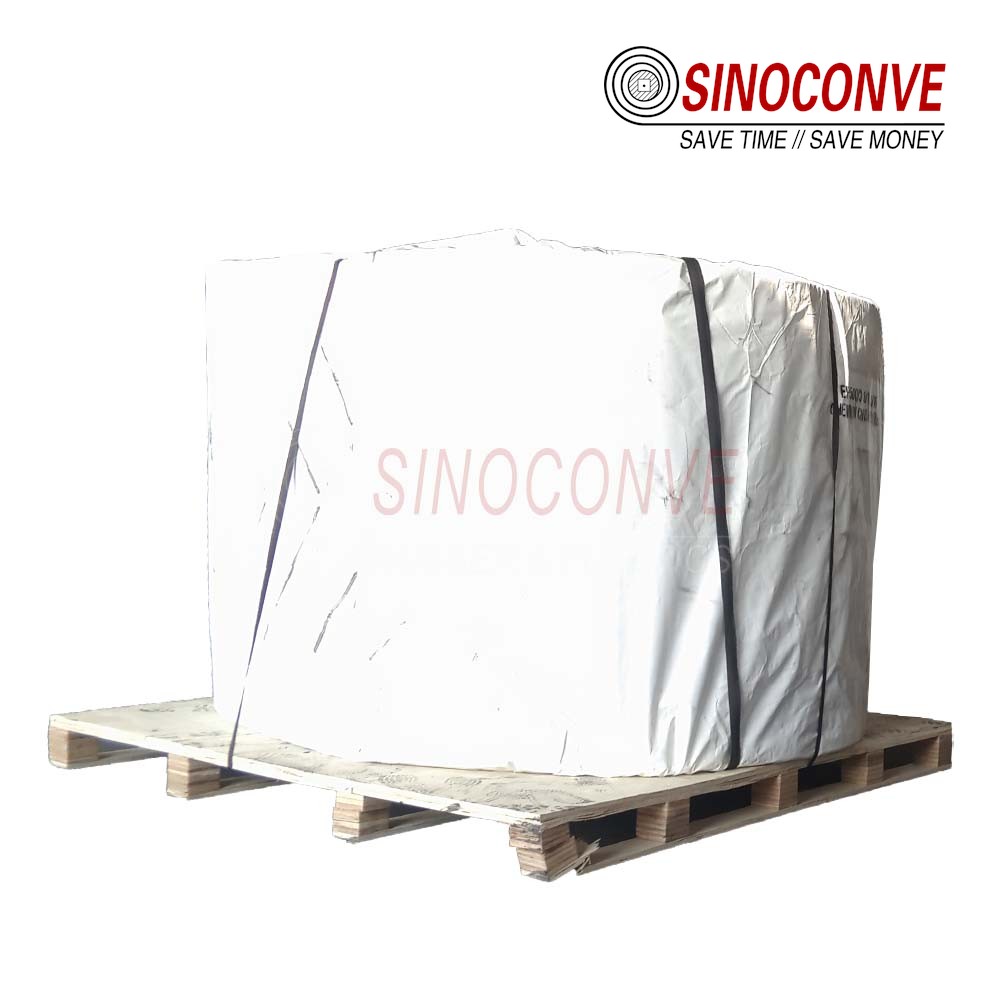
A concentrate belt leaves our works as a single wrapped roll with its splice kit, cover compound and carcass matched before dispatch.
02Process Transfer Challenges: Filter Discharge, Reclaim Tunnels, Rail Loadout and Port Stacking
Concentrate does not stay soft. Once a film of it sits on the return strand for an hour, the water flashes off, the residual salts crystallize, and the film sets into a shell closer to cement than to mud. That shell is what grinds rollers, lifts splice edges and drags a belt sideways.
Filter discharge: the worst thirty seconds of the shift
The press cycle gives the belt a rhythm it was never designed for. For 20 to 40 minutes the belt runs empty and light. Then the plates open, eight to twenty slabs land within seconds of each other, and a 1,200 mm belt under a 20 m3 press takes 12 to 18 tons almost at once.
We specify impact idlers at 300 mm pitch for the first three positions under a press, then standard spacing beyond the skirt zone. The cover on that section should be 8 mm rather than 6 mm, not because the impact is severe but because the scraper takes 1 to 2 mm off it every year and something has to be left at year five.
The drives around the press deserve a mention because nobody audits them. Feed pumps and agitators are usually V-belt driven, and a slack belt on a feed pump delivers thinner slurry, stretches the cycle and produces a wetter cake that the filter cloth gets blamed for. Our transmission belt manufacturer desk quotes wrapped and cogged profiles from the same drive schedule as the conveyors.
Reclaim tunnels, rail loadout and the return strand
Underground reclaim conveyors are where carryback becomes structural. The gallery is humid, the belt is enclosed, and there is no wind to dry the return strand. Fines that drop off at the tail pulley land on the floor, get picked up again, and migrate along the frame until they reach a roller.
A 20 mm layer on a roller shell changes its effective diameter by 8%. That roller now runs faster on one side than its neighbours, the belt is pulled toward it, and the training idlers fight a battle they cannot win. The complaint is "the belt will not stay centered" and the cause is a roller nobody looked at because it sits 400 mm off the walkway.
Sump pumps in those galleries are V-belt driven as well, and a stretched belt in a humid tunnel is a pump running slow that nobody notices. As a v-belt manufacturer we keep the wrapped B and C profiles that tolerate that environment without glazing.
This is where a conveyor belt supplier either adds value or wastes your time. A quote that lists only width, ply and cover grade has not asked the question that matters. Ask for the return-side layout: spiral rollers, disc returns, or a flat return with a wash box. The belt has to suit the cleaning hardware, and the concentrator and quarry conveying duty we build for differs from a dry aggregate line for exactly this reason.
Loadout is a weighing problem as much as a conveying one. A 70 ton wagon fills in three or four passes, the chute moves between them, and cake left hanging in the chute arrives as a lump that makes the cut-off fire late.
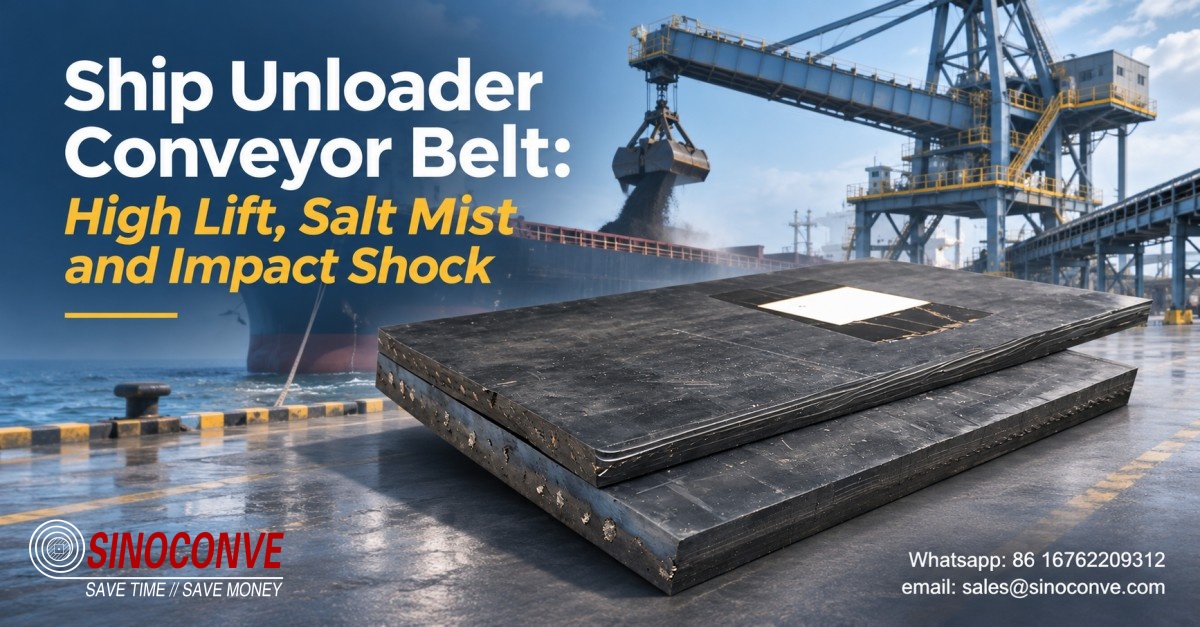
At the terminal the same material meets salt air, rain and a stacker boom up to 60 m long. Humidity softens the crust formed in the wagon and the cake re-wets on the boom, so ship loader belts need the strongest release property in the chain; a boom discharges at one point for hours and the cover never gets a clean run. The bulk terminal and ship loading work we specify for usually justifies a premium cover on cleanup and cargo loss alone.
| Transfer point and the duty it performs | Symptom that operators usually report first | Root cause we normally confirm on site | Correction on the belt and on the hardware |
|---|---|---|---|
| Press discharge underneath the filter plates | Cake spills past the skirt rubber on every cycle | Skirt gap wider than 30 mm with soft rubber | Close the gap and add impact idlers at 300 mm |
| Reclaim tunnel on the return strand | Belt drifts to one side and both edges fray | Caked fines changing a roller diameter by eight percent | Fit spiral return rollers and a second scraper set |
| Rail loadout boom feeding the wagon | Wagons overfilled with product spilled on the ground | Lumps left hanging in the chute between passes | Line the chute and tighten blade contact pressure |
| Ship loader boom at the port terminal | Product found in the hold water and on the quay | Re-wetted cake film that no single blade removes | Two stage scraping with a low adhesion cover |
03Technical Boundary: Fine Sticky Concentrate vs Coarse Run-of-Mine Copper Ore and Kiln Belts
Three belt enquiries land on the same desk every week and get confused with each other. One comes from a copper mine hauling run-of-mine ore from the primary crusher. One comes from the concentrator next door, moving filter cake. One comes from a brickworks running a kiln discharge. The word "copper" appears in two of them and "heavy duty" in all three, which is how the wrong belt gets ordered.
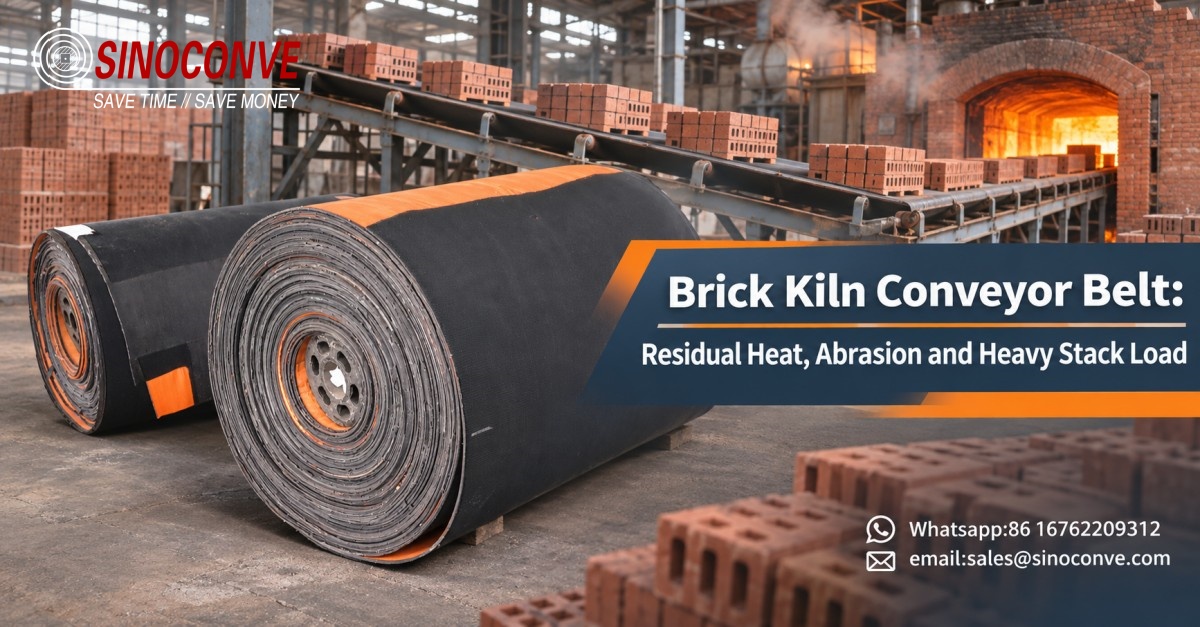
We covered the coarse end in our guide to copper ore conveyor belt selection for run-of-mine haulage, and the hot end in the brick kiln conveyor belt guide for hot contact duty. This article deliberately covers neither. What sits between them, and what almost nobody specifies properly, is the wet fine middle.
Where the run-of-mine and kiln comparisons both break down
Run-of-mine copper ore arrives at 800 to 1,200 mm top size after a coarse blast, drops 2 to 4 m from a dump hopper, and delivers several kilojoules per kilogram of point impact. The answer is a thick soft cover, closely spaced impact idlers and a cut-resistant compound that absorbs energy by deforming. Mass matters, edges matter, and the cover is a sacrificial cushion.
Filter cake delivers almost no impact energy. A 40 mm slab falling 600 mm is a gentle event. Put a run-of-mine belt under a filter press and you get a belt that is too soft, too thick and too tacky on the surface, with a cover that deforms under the scraper instead of resisting it. We have seen that combination chew a 10 mm cover down to fabric in 11 months, with the blade intact and the belt written off.
A brick kiln belt works at 120 to 160 °C in continuous contact with hot fired product, and its enemy is heat ageing: the rubber hardens, cracks at the flex line and eventually delaminates. Ambient temperature in a filter building is 15 to 35 °C, so heat is simply not in the specification. Concentrate brings a chemistry problem instead, because residual collector, frother and lime sit against the cover in a wet film for hours. A heat resistant compound has no answer to that.
| Selection criterion we compare across duties | Coarse run-of-mine copper ore haulage duty | Filter cake concentrate duty in the plant | Brick kiln hot contact duty on fired product |
|---|---|---|---|
| Dominant stress at the loading point | Point impact from large lumpy ore with sharp edges | Adhesion and scraper shear across the whole cover | Heat soak plus abrasion from hot brick edges |
| Moisture state of the cargo being carried | Surface damp from dust suppression only | Eight to twelve percent water held inside the cake | Essentially dry product leaving the kiln tunnel |
| Temperature that the cover actually sees | Ambient with occasional sun loading on the frame | Ambient, rarely above 35 °C in the filter hall | Continuous contact between 120 °C and 160 °C |
| Cover property that matters most on this duty | Energy absorption with cut and gouge resistance | Low surface energy with high hardness and density | Retained elasticity after long hot contact cycles |
| Typical failure mode if the belt is specified wrong | Puncture and edge cut through the carcass plies | Gouged cover, caked rollers and permanent mistracking | Hardened cover cracking open along the splice line |
One boundary worth stating, because it comes up in tenders. An industrial conveyor belt sold as general-purpose heavy duty is not automatically a concentrate belt, even when the datasheet claims abrasion resistance. Abrasion resistance describes a cover against sliding grit. It says nothing about a cover against a wet cohesive paste held down by a spring-loaded blade. Those are different tests and, more to the point, different compounds.
04Cover Compound Formulation: High-Density Polymer Matrix for Low Adhesion and Scraper Abrasion
Release is a surface property and it is set in the mixer, not in the scraper. Two covers can both read 65 Shore A, both pass the same abrasion test, and behave completely differently under a wet cake. The difference is polymer selection, filler structure, and how much of the plasticizer stays where it was put.
Formulating for release rather than for hardness
Adhesion between a wet mineral paste and rubber is driven by two things: the polar component of surface energy and the real contact area. Rubber at 50 to 60 mN/m total surface energy will wet a hydrophilic mineral surface quite happily. Pushing the polar fraction down and the matrix density up closes both routes.
Density is the part buyers overlook. A cover compounded to a specific gravity of 1.20 to 1.32 has far less closed-cell porosity than a general 1.10 grade, and porosity is where capillary absorption starts. A dense cover does not let the fine fraction key into the surface, so the film that forms is thin and a blade can lift it in one pass instead of polishing it into the rubber.
Plasticizer choice decides whether the belt stays clean in July. Aromatic oils bloom to the surface at 35 to 45 °C and leave a tacky film that grabs fines like flypaper. Polymeric plasticizers cost more and migrate far more slowly, and that single substitution explains a good number of the sticky belt complaints we investigate. Anti-tack waxes are not the easy answer: the wax that repels cake also repels the cushion gum at the splice.
Hardness has a ceiling. Above 70 Shore A the cover becomes brittle at the flex line over small pulleys, so the gain in blade resistance is paid for in cracking. Our working window for concentrate duty is 62 to 68 Shore A on the top cover, 18 to 22 MPa tensile, and tear strength above 45 kN/m.
We are a conveyor belt factory that mixes its own covers in Ningbo, and that matters on this duty. Formulation for concentrate is a series of small adjustments, and adjustments are only possible when the compound is under your own control. Buy a rubber conveyor belt through three trading layers and nobody can tell you which plasticizer is in it, let alone change it when the cake starts sticking.
05Carcass Engineering: Multi-Ply EP Fabric and Transverse Rigidity for Trough Support
Concentrate is dense, and dense material punishes a belt in a way light bulk does not. At 1.8 to 2.2 t/m3, a 35 degree trough carrying 300 mm of cake on a 1,200 mm belt moves close to 1,400 t/h at 2.5 m/s. That is a lot of mass per meter, and the tension it generates has to be carried by fabric, not by rubber.
Why EP rather than NN, and how much transverse rigidity to buy
Polyester warp with nylon weft stretches about half as much as an all-nylon carcass under the same load. On a 300 m conveyor that difference decides whether you need a 1.2 m gravity take-up or a 2.5 m one, and how often the belt is re-tensioned in its first six months. Low elongation also protects the splice, because a belt that creeps 1.5% under load keeps working the joint in a way the step edges were never designed for.
Transverse rigidity is the number nobody calculates. A 45 degree trough on a 1,200 mm belt bends the edges up sharply, and if the fabric is too soft the belt bridges the wing rollers, the edges flutter and fines work underneath. Too stiff is just as bad: the carcass lifts off the centre roller at the transition, opens the skirt gap and starts the spillage cycle from section 02. We aim for a transition of 1.5 to 2 times belt width.
Ply count follows from tension, not from habit. A 1,200 mm belt at 900 N/mm working tension is comfortable on four plies of EP 250 and marginal on three plies of EP 315 once a realistic safety factor and the splice are accounted for. Where the frames come from an equipment builder supplying OEM conveyor packages, we work from their pulley diameters rather than from a catalog, because a 500 mm drive pulley and a three ply EP 315 belt shorten flex life noticeably.
| Belt width with the design capacity | Ply count with the fabric grade | Top cover thickness that we recommend | Trough angle with the idler spacing | Where this build normally goes in a plant |
|---|---|---|---|---|
| Eight hundred millimeters carrying 350 t/h | Three balanced plies of EP 200 fabric carcass | Six millimeters, with eight under the press | Thirty five degrees on 1,200 mm idler spacing | Small filter buildings and pilot plant circuits |
| One thousand millimeters carrying 700 t/h | Four heavy plies of EP 250 fabric reinforcement | Eight millimeters across the whole run | Thirty five degrees on 1,200 mm idler spacing | Typical mid-size concentrator press discharge duty |
| One thousand two hundred millimeters at 1,200 t/h | Four high-tensile plies of EP 315 fabric reinforcement | Eight millimeters with a six millimeter underside | Forty five degrees on 1,000 mm idler spacing | Main plant conveyor and loadout feed belts |
| One thousand four hundred millimeters at 1,800 t/h | Five extra-strength plies of EP 315 fabric reinforcement | Eight millimeters with a six millimeter underside | Forty five degrees on 1,000 mm idler spacing | Port terminal booms and high tonnage trunk lines |
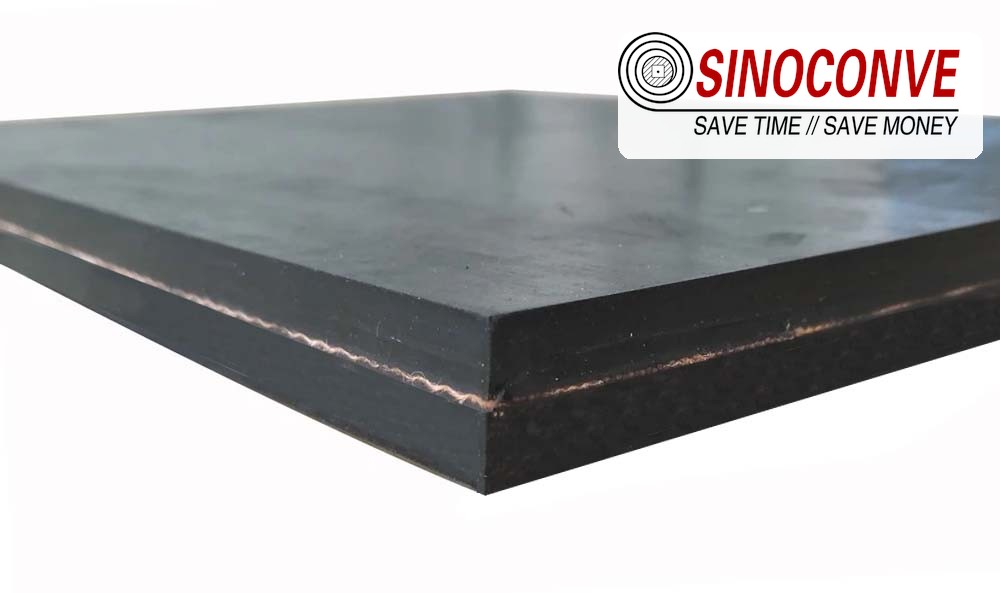
Section through a four ply EP build: the dense top cover is the release surface, and the fabric steps carry the tension the cake mass generates.
Buyers who consolidate three plants and a terminal under one frame agreement tend to ask us for wholesale conveyor belts on a single specification, and this is where standardizing pays. One ply and cover build across sites means one splice kit, one blade type and one spare roll strategy instead of four.
06Return Belt Protection and Cleaning Architecture: Primary/Secondary Scrapers, Spiral Return Rollers and Wash Boxes
Cleaning on concentrate duty is a three stage system, and it fails as a system when one stage is missing. A press that runs a primary blade only keeps the carrying side presentable and leaves the return strand filthy. A press that runs two blades but no wash box keeps the cover clean until the salts crystallize in the grooves.
Two scraper stages and the wash box that has to follow them
The primary sits at the head pulley where the belt is still round, usually between 2 and 3 o'clock, with a polyurethane blade at 60 to 80 Shore A and 20 to 40 N per 100 mm of tension. It removes 70% to 85% of the loose film. More tension does not clean better; it wears the blade and heats the tip.
The secondary is a different instrument. It sits at 4 to 5 o'clock where the belt has begun to flatten, carries a carbide or ceramic tip at a 15 to 20 degree attack angle and 25 to 50 N per 100 mm, and it decides your carryback number. It is also the blade that gouges covers when it is set too hard or runs with a damaged tip. Both blades need a mechanical stop so the tip cannot be over-driven, and on an 8 mm cover we set secondary interference at 1 to 2 mm.
Water is the only thing that reliably removes the salt-bearing film left after two blades. A wash box with two or three fan nozzles at 3 to 5 bar, mounted just behind the head pulley, drops carryback by another 60% to 80% on a concentrate belt. The objections are always water in the tunnel, water on the floor and water balance in the plant. The first two are containment problems solved with a stainless tray, a squeeze roller and a drain. The third is a false problem, because the wash water can return to the thickener feed and bring its solids with it.
Return rollers that shed instead of collecting
Spiral return rollers are the default here. The helix pushes fines toward the ends instead of letting them pack on a smooth shell, and it keeps the effective diameter constant along the roller. Rubber disc returns work on the same principle and are gentler on a cover that is already thin at the edges.
Self-aligning return idlers help, but they are a correction, not a cure. A training idler fighting a caked roller simply drags the belt against the structure harder. Fix the build-up first. Our note on conveyor carryback solutions for sticky bulk materials covers the layout side in more detail than we can here.
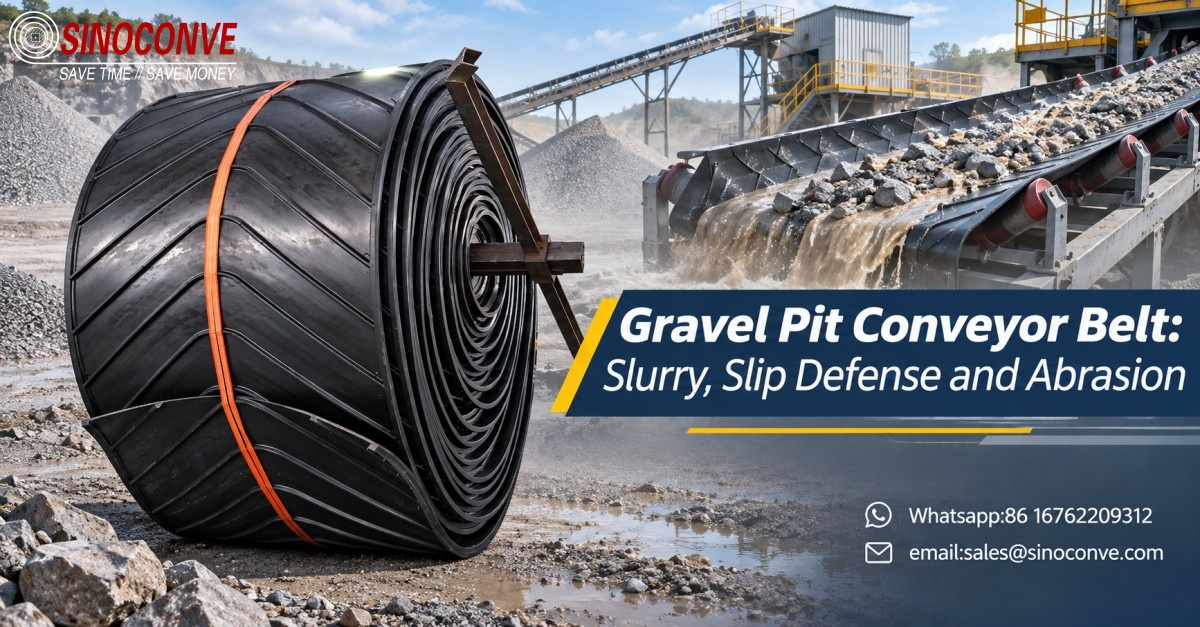
One configuration defeats cleaning entirely: the chevron profile. A profiled cover lifts the blade off the surface, so the valleys between the ribs stay full and the ribs hold cake like a comb. If you are a conveyor belt distributor supplying mineral plants, expect the request on incline transfers and advise a wash box or a dual return arrangement, because blades alone will not do it.
Field note from our engineers: A terminal in Southeast Asia ran two secondary blades on the same boom and still lost product over the side. The blades were fine. Both were mounted on one tensioner arm, so as the belt crown wore the arm rotated and tip pressure faded to nothing in the middle. Splitting the blade into three independently sprung segments cut carryback from 260 g/m2 to 55 g/m2 in a single shift.
If the plant has already tried blades and rollers and the return strand is still losing, our guide to conveyor belt cleaning methods and when scrapers will not work is worth reading before anyone buys a third blade type.
07Mineral Plant Field Maintenance Audit: Carryback Weigh Tests, Scraper Tension Checks and Tracking Drift Thresholds
The carryback weigh test we ask every plant to run
Pick a clean section of return strand about 5 m behind the head pulley. Lay a 300 by 300 mm template on the cover, scrape everything inside it into a pre-weighed bag with a putty knife, and weigh it on a kitchen scale. Divide grams by 0.09 to get grams per square meter.
Our limits are simple. Under 50 g/m2 is a belt being cleaned properly. Between 50 and 150 g/m2 needs a tension adjustment this month. Above 150 g/m2 is a system building a roller shell somewhere, whether or not anyone has noticed. Run the test at the same spot every month, because the trend matters more than the reading, and run it twice the first time, once before the shift and once four hours in.
Scraper tension, tracking drift and the splice log
Hook a spring balance on the blade arm, pull it off the belt by the specified amount and read the force against the tensioner chart rather than against what the last fitter tightened it to. We find more under-tensioned secondaries than over-tensioned ones, usually after a blade change. Blade wear has a hard limit too: a polyurethane primary that has lost 8 to 10 mm of height, or a carbide tip with a nick deeper than 1 mm, is finished, and a worn blade changes its attack angle and polishes a groove into one strip of cover.
For tracking, measure the distance from the belt edge to a fixed reference at the tail, mid-run and head, with the belt loaded. A drift of 25 mm over a 30 m run is where we start adjusting; below that most belts are following the load and come back when the chute is centered. Adjust a training idler by no more than 20 mm per pass and let the belt run three revolutions before touching it again. Log the splice in the same round, because a 5 mm step or a soft spot under the tap test means the joint is taking water, and on this duty that ends with an open splice and a stopped plant.
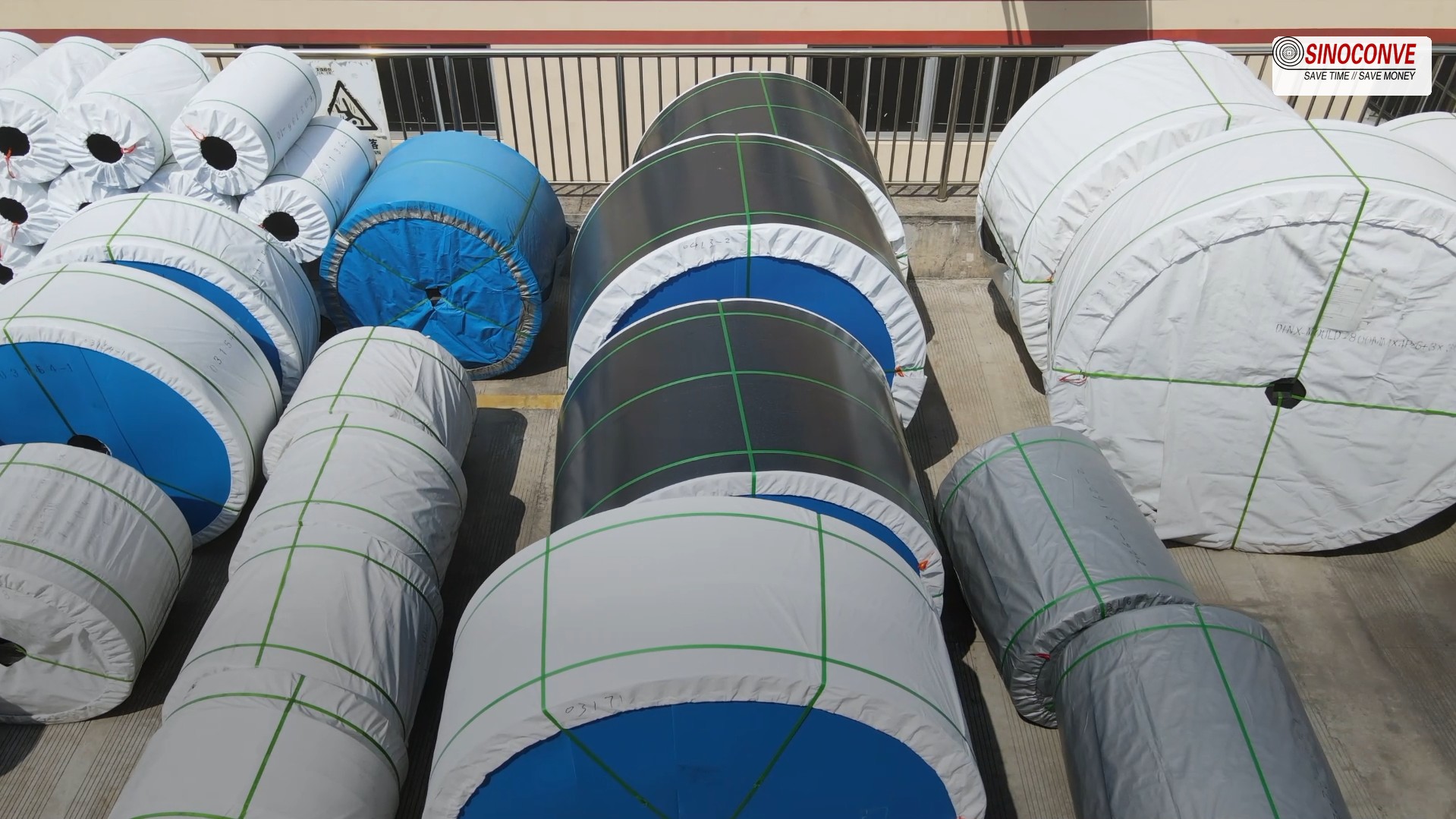
Finished rolls in our dispatch yard, each tagged with cover grade, ply build and splice instructions before it leaves for a mineral plant.

08Frequently Asked Questions About Copper Concentrate Conveyor Belts
Why does copper concentrate stick to the belt when copper ore does not?
Surface area and chemistry. The concentrate is ground to liberation, often 70% to 85% passing 200 mesh, and every particle still carries a collector film that was designed to make mineral surfaces water-repellent and air-attractive. At 8% to 12% moisture those films form capillary bridges to the rubber. Coarse ore has the same minerals but a thousandth of the surface area for the same mass, so the same water does nothing.
Will an abrasion resistant belt handle filter cake?
Not on its own. Abrasion resistance is measured against sliding grit, and it tells you nothing about adhesion or about how a cover behaves under a loaded blade. We have seen high-abrasion covers glaze over with cake in a week because the compound was soft and full of blooming oil.
Our scraper blades cut through the cover in a few months. What is the likely cause?
Almost always blade pressure combined with a cover that is too soft for the job. Check three things in this order. First, the secondary blade interference, which should be 1 to 2 mm and not 5. Second, the tip condition, because one chipped carbide insert will plough a groove on its own. Third, the cover hardness, because a 55 Shore A cover deflects under the tip and the blade rides in a permanent depression that gets deeper every week.
How do we stop carryback from caking on the return rollers?
Remove the film before it dries, not after. In practice that means a correctly tensioned secondary blade, a wash box if the plant water balance allows it, spiral return rollers so what does land cannot pack into a smooth shell, and a rubber V-plow in front of the tail pulley. Cleaning the rollers with a scraper is a losing game; the material sets harder than the roller shell within a shift.
Does a chevron or cleated belt help on the incline out of the filter building?
It helps the material stay on the incline and it makes cleaning much harder, because a profile lifts the blade off the cover and traps cake in the valleys. If the incline is under 18 degrees, a smooth cover with a properly designed skirt usually beats a profile on this duty. Above that, go to chevron and budget for a wash box from day one.
What belt should we specify for 1,200 t/h of filter cake?
Our default is a four ply EP 315 carcass at 1,200 mm width, 8 mm top cover at 62 to 68 Shore A on a dense low-adhesion compound, 6 mm underside, 45 degree troughing, and a three stage cleaning package. Check the tension calculation against your actual centres and lift before you commit, because 1,200 t/h on a 60 m conveyor and 1,200 t/h on a 400 m conveyor are not the same belt.
Related Products You May Need
- EP fabric carcass belts for high tension concentrate runs
- Abrasion resistant rubber covers for wet sticky minerals
- Return and troughing rollers with sealed bearing housings
- Complete factory catalog of belts rollers and drives
Related Blog Posts