
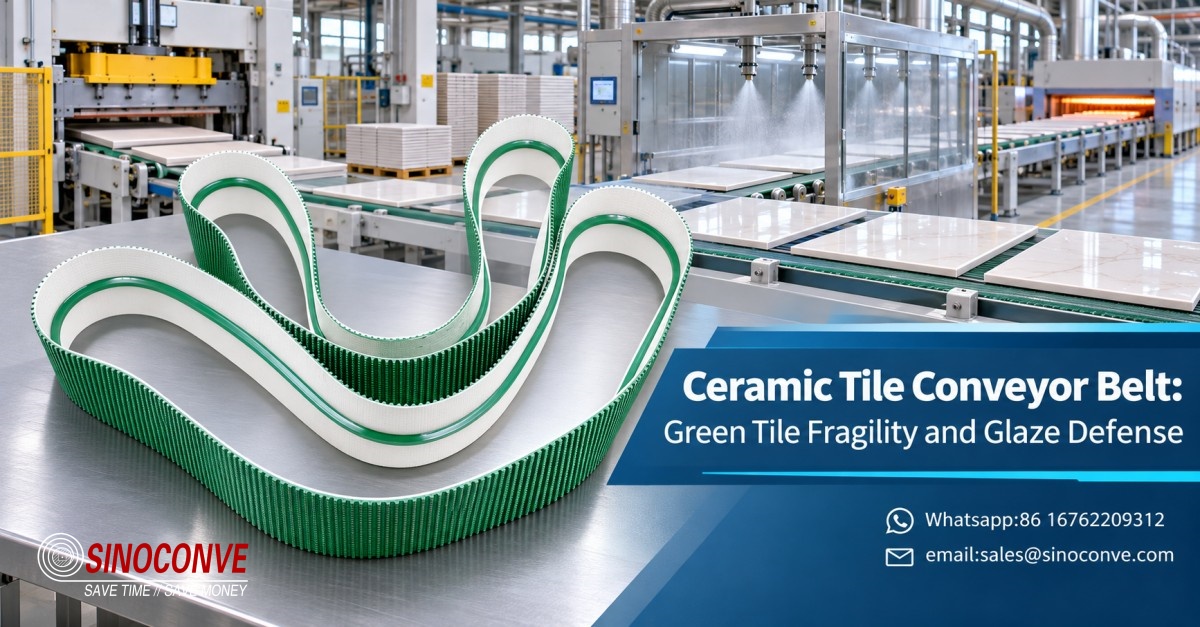
Press exit, glaze booth, cooling exit, sorter: four stops for one tile, each with its own belt problem. The checks below follow that route.

01Three places where the tile or belt gets hurt
At the press: support the whole handover
Put a straightedge across the press table and the receiving conveyor. Then jog one tile over the joint and watch its leading corners from the side. The important measurement is the height change under the moving tile, including any dip created by belt sag.
Record the actual gap, support spacing and height mismatch on the drawing before ordering another belt.
Glaze residue on the return
A stripe that repeats on the return can come from one leaking nozzle.
Fresh glaze slip looks like a cleaning problem. Dried slip is a wear problem.
Temperature at the tile contact point
Keep the belt maker’s continuous and short exposure limits separate.
02One production line, several conveying duties
Speed, surface contact and cleaning change with it. The table is a starting map for the site walk, with each suggested construction subject to the actual temperatures and chemicals.
| Line position | First symptom to look for | Belt and hardware check |
|---|---|---|
| Press exit and green tile buffer | Corner chips or a faint diagonal crack | Flat, clean cover; flush joint; supported handover and matched speed |
| Glaze curtain or digital decoration | Dried slip on return rollers or stained tile backs | Wipeable PU or PVC surface; sealed edges; drip control and accessible cleaning |
| Kiln infeed and cooling exit | Curl, joint lift or cover marking after warm-up | Measured contact temperature; heat rating; pulley and take-up check |
| Polishing and edge finishing | Lateral drift, scratching or grit trapped at guides | Stable carcass; gentle guides; good removal of abrasive fines |
| Sorting and packing | Tile slip, skew or impact at an acceleration gap | Surface grip matched to speed and incline; controlled transfer geometry |
The transfer may be the real defect
Suppose rejects appear at the sorter, although the sorting conveyor itself is clean. Follow a marked tile upstream. A speed mismatch at the preceding transfer may make it rotate slightly; the edge then meets a guide several metres later.
For fired tiles, allow the product to clear the preceding belt before a faster section accelerates it. The correct setting depends on tile size, spacing and line speed. A trial with the largest format is more informative than an unloaded belt run.
03Where light process belts fit, and where they do not
Do not carry a quarry belt specification across to a press table simply because both are in the same factory.
There is a useful boundary at the scrap return. A conveyor moving broken fired tile and sharp fragments should be evaluated for cutting and impact. A line moving a decorated face should be evaluated for contact marks and trapped grit. Even when both runs have the same nominal width, they should have separate duty sheets. A cement plant conveyor offers a useful comparison for mineral abrasion, but its cover selection does not settle a delicate tile transfer.
If a line includes mixed duties, write the boundary on the layout: “last green-body transfer,” “glaze exposure begins,” “hot-tile contact ends.” Those labels make the RFQ less ambiguous than a single drawing with belt widths highlighted.
04PU, PVC and textured surfaces in the tile hall
Related product references: PVC belting, rough top belting and flat PVC belting. Compare samples before selecting a surface.
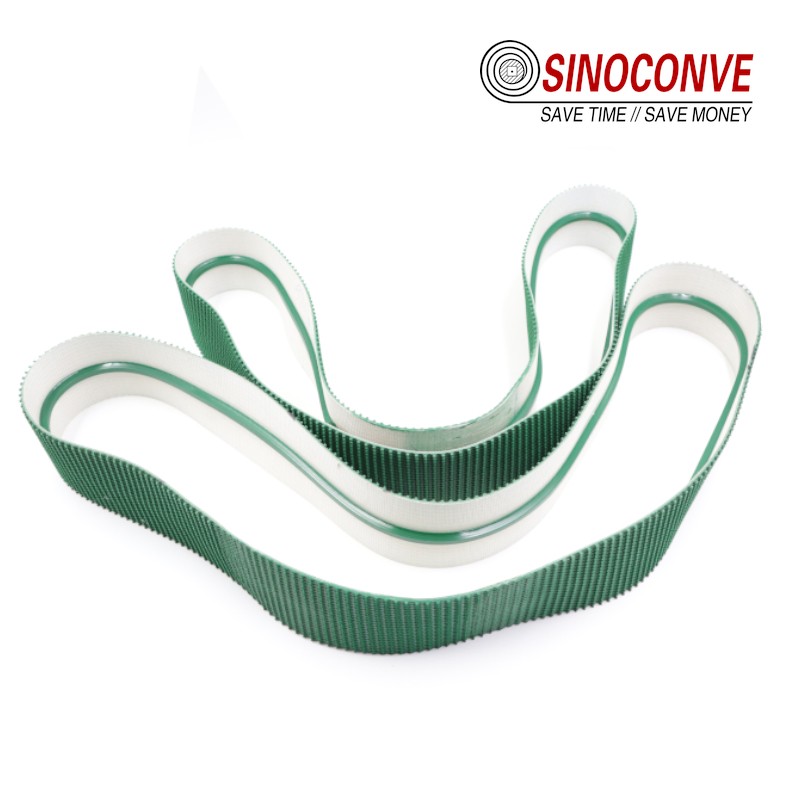
None of these names alone specifies a finished belt.
| Surface | What to verify with a sample | Common mismatch |
|---|---|---|
| Smooth PU | Glaze release after drying; tile-face marking; cleaner compatibility | Sharp grit left between tile and cover scratches the face |
| Dense PVC | Wet exposure, edge seal, joint finish and maximum temperature | A cut fabric edge wicks liquid or a warm span takes a set |
| Fine rough top | Grip with the actual tile back and incline; cleanability | Texture traps glaze or marks a green body |
| Cleated or profiled belt | Tile clearance and controlled positioning on an incline | Cleat collision at transfer or residue at the rib root |
Test the material on the actual contact face
A sample that feels soft by hand can still hold abrasive dust.
On an incline, a texture that grips a fired tile may drag a green tile edge during handover.
05Check the loaded belt against the guides
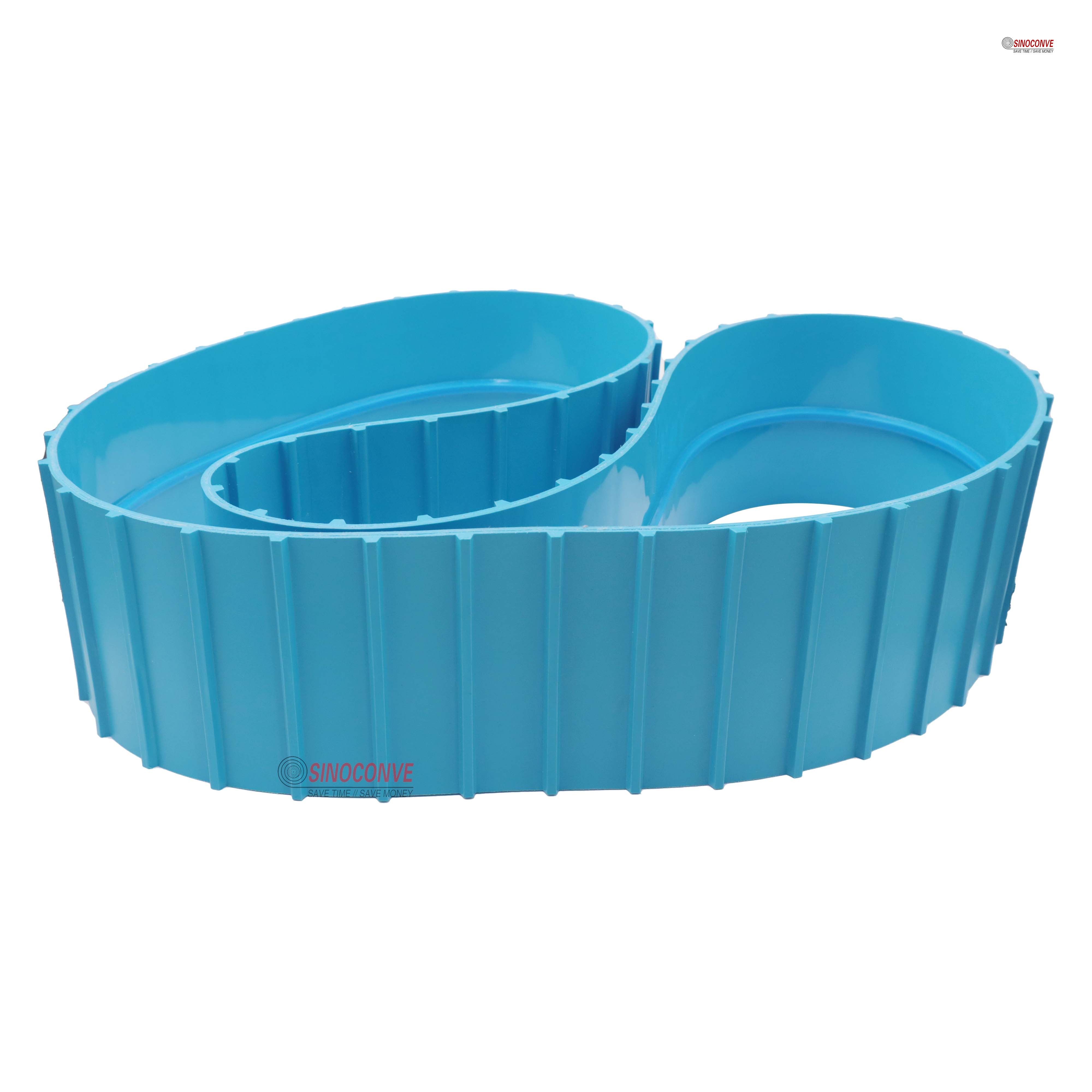
Carcass, guides and joint all matter
A low stretch carcass makes it easier to hold a stable centreline, but a guide profile cannot repair a crooked frame. A bottom guide must match its pulley groove through the whole circuit, including the return. Check groove clearance and the guide’s passage over each small pulley. If the guide is forced sideways, the bond line may fail even while the carrying face still looks sound.
The splice is another alignment test. Mark a fine line across it and let the belt run unloaded. A change in tracking each time that mark passes a pulley points to the joint or local thickness.
06Cleanout at the glaze station
For the hardware side, see spray cleaning and return side cleaning.
Scraper contact and washdown
The overnight stop is a useful cleaning trial. Put a small amount of the plant’s glaze on an offcut, leave it for the same shutdown interval and clean it with the line’s normal solution. Check the cut edge and a prepared splice sample as well as the top. If the required cleaning force rises sharply after drying, the answer may be a better drip tray or a shorter cleaning interval.
“Washable” is too broad to establish compatibility. Test any cleaner on a belt offcut and examine the edge and joint after repeated cycles. The spray cleaning guide and return-side cleaning note cover two places where a good top-surface inspection can miss carryback.
Allow access for cleaning when designing the transfer.
07What to put in a ceramic tile belt enquiry
The buyer’s most useful attachment is a marked line sketch.
Joint, edge and electrical details
Put three details on the sketch: the smallest pulley, the available take-up travel and the side from which the belt is serviced. These can rule out an otherwise attractive joint. Include a close photograph of the current splice with a ruler beside it. A drawing marked only “endless belt” leaves the supplier guessing about the surface step that the tile actually crosses.
A press exit generally calls for a very flat joint. Ask for a joint drawing and inspect the first production run. The splice versus fastener guide explains the maintenance trade.
Specify edge sealing where wet slip can reach fabric. Where static is suspected around powder or decoration, measure the process and state the required resistance test and acceptance value with the plant electrical team. The word “antistatic” on its own is not an acceptance criterion.
| RFQ field | Record from the plant | Acceptance check at installation |
|---|---|---|
| Tile and contact condition | Dimensions, mass, green or fired, contact face | Largest tile passes each transfer without tipping or marking |
| Belt geometry | Width, length, pulley diameters, guide and incline | Guide clears every pulley; belt runs centred empty and loaded |
| Process exposure | Glaze formula, cleaner, duration, tile and return temperature | Sample survives the agreed contamination and cleaning cycle |
| Joint and edge | Splice method, finished thickness, edge seal | No joint lift under a straightedge; no exposed wet fabric |
| Line acceptance | Speed range, reject location, cleaning interval | Observe warm running, handovers and a planned cleanout |
A supplier can use those records to select a more suitable flat PVC construction or alternative surface, rather than inferring duty from a catalogue description.
08Questions from a tile line
Where can the press exit hide a chipped corner?
Jog a tile across the press handover and view both leading corners from the side. Check the first support position, belt sag, table height and splice shoulder. A belt may look flat while stationary and still dip under a moving tile.
Can PVC run beneath a glaze curtain?
It can be considered where the actual glaze and cleaner are compatible with the chosen cover, the fabric edge is protected and the temperature is within its rating. Test dried slip removal and inspect the return rollers.
Where does the overnight glaze crust begin?
Find where the liquid first lands.
Which splice should we ask for at a green tile handover?
Ask to see a finished joint on the proposed belt, measured against a straightedge. The chosen splice must pass the smallest pulley and remain flat under the tile. A convenient fastener may create an unacceptable step beneath a fragile body.
What should the RFQ say about static?
Have the plant electrical team state a measurable resistance requirement and test method where static control is necessary.
Will a thicker belt save the press exit?
Thickness cannot fix an unsupported transfer. Check the carcass, finished joint and support geometry together before increasing cover thickness.