
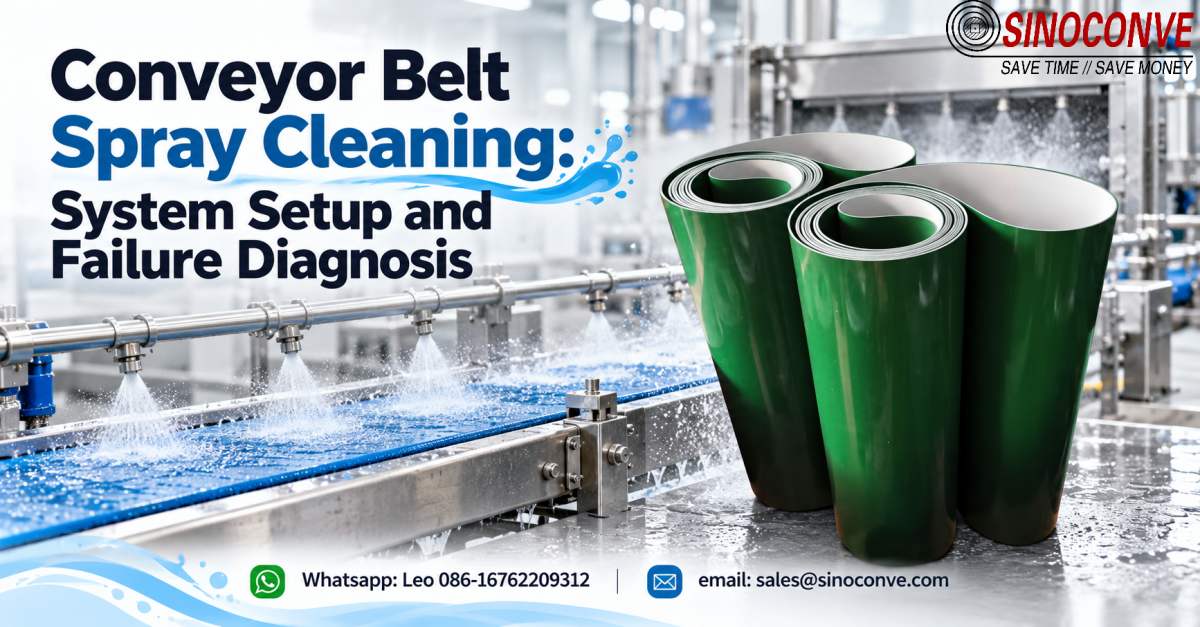
Set a flat fan 150–200 mm off the belt, aimed 15–30 degrees off perpendicular, at 4–8 bar and 2–4 L/min per nozzle, and most carryback comes off without flooding the return run. More pressure is the wrong first move. The page speaks to the engineer who owns the skid, or the buyer on the enquiry form. Nozzle families come first, because they set the shape of the wet patch, then the numbers that decide a wash, pressure and flow. Water temperature and food-line verification get their own sections. Three tables carry the numbers.

We have built conveyor and transmission belts for mines, quarries, cement works and food plants for more than three decades, and we sell as a conveyor belt manufacturer who is asked, often, why a wash system is eating a belt cover. Spray stations are bought for hygiene, quoted on flow, judged on whether the floor stays dry. Most calls we take are geometry failures, not pump failures.
01What a Spray Station Must Achieve
A spray station is easy to describe and hard to specify. Most enquiry forms ask for material removal and stop there. Almost nobody writes how much, at what moisture, or what residue. So we ask for an objectives register before a single nozzle is chosen. Each line names the owner and the number that proves it was met. A target you cannot measure belongs on a wish list.
| Objective | Measurable Metric | Typical Target | Verification Method |
|---|---|---|---|
| Remove loose carryback | Residue mass from a 300 mm square patch | Below 10–20 g/m² on a smooth cover | Wipe a marked patch with a weighed cloth and re-weigh |
| Keep the return strand dry | Wet-streak width on the return belt | No continuous film beyond 100 mm in from the edge | Visual check 5 m downstream of the box |
| Protect cover life | Cover thickness loss per year in the wash zone | Under 0.3 mm per year at fixed gauge points | Caliper or ultrasonic reading at three marked stations |
| Control water use | Litres of make-up water per tonne conveyed | 0.3–1.5 L/t for light carryback | Meter on the supply header, read per shift |
| Contain overspray | Water reaching structure or floor | No pooling; all drips routed to the trough | Floor and frame check at the end of a shift |
| Stay verifiable for hygiene | ATP swab result on food-contact belts | Below 150 RLU per swab, per area | Swab and log after each wash cycle |
The objectives register we ask buyers to complete before nozzle selection starts.
The Gap Between Clean and Provably Clean
There is a real difference between a belt that looks clean and one you can sign off. The first is an opinion formed under plant lighting. The second is a number in a log, and it survives an audit. Wipe a marked 300 mm patch with a weighed cloth and you have the number in ten minutes.
Why the Register Comes Before the Hardware
Order the register the other way and the hardware dictates the target, which is how a plant ends up with a station that wets 60 percent of a belt width. So we write down what it must not do as well. It must not wet the return strand. It must not strip grease out of the idler bearings with harsh alkali. The trough also has to run at 1:100, so run-off never pools at the frame. If you are still weighing a wet wash box against mechanical cleaning hardware, our system-level overview of conveyor belt cleaning methods covers that choice. We build belts in our own conveyor belt factory in Ningbo, so this guidance comes from watching covers after months of washing.
02Nozzle Types: Fan, V-Jet, Full-Cone and Flat
The nozzle decides the shape of the wet footprint, and the footprint decides whether you clean the whole belt or only its middle. Four families cover almost every duty we specify. As a conveyor belt supplier we come back to one question. Can the maker give you the spray angle and the flow at your pressure, in writing? If the answer is a table of angles and no flow figure, walk away.
Fan and V-Jet Nozzles Do Most of the Work
A fan nozzle flattens the jet into a curtain, so one row lays an overlapping line of water across the belt. Least fussy option, easiest to overlap. The V-jet runs 15 to 30 degrees with a harder core, so it keeps cutting where a fan has given up.
Cone Nozzles Spread the Same Water Over a Wider Patch
Where a fan puts its energy along a line, a cone spreads the same water over a circle. Dwell time on any one patch goes up; peak impact comes down. Full-cone nozzles suit wide, flat belts, running 30 to 90 degrees at 2 to 10 L/min. Hollow-cone types wet fine dust without adding much volume.
Where Air-Assisted Types Earn Their Place
Air-assisted nozzles mix compressed air into the water and make a very fine mist, often 0.05 to 0.5 L/min per nozzle. They earn their place when the water budget is tight, or when the material is fine dust. On a mainline conveyor with real carryback they are the wrong tool; impact at 150 to 300 mm standoff is too low. On a 1,400 mm transfer belt we looked at last month, the tips came off inside a fortnight.
What the Spray Angle Actually Tells You
The angle printed on a nozzle body is the full included angle of the fan or cone, not the half-angle you aim with. A "110 degree" fan throws a fan twice as wide as a "55 degree" one at the same standoff. Swap them and you either leave dry lanes or soak the belt edges.
| Nozzle Type | Spray Angle | Flow Range | Standoff | Best Use |
|---|---|---|---|---|
| Flat fan | 25–65 degrees | 1.0–6.0 L/min | 150–250 mm | General carryback on smooth covers |
| V-jet | 15–30 degrees | 1.5–8.0 L/min | 120–200 mm | High-impact strips, edges, dried mud |
| Full cone | 30–90 degrees | 2.0–10 L/min | 200–400 mm | Widest coverage, gentle on full-width belts |
| Hollow cone | 40–100 degrees | 1.5–8.0 L/min | 200–350 mm | Fine even film for wetting and dust control |
| Air-atomising | 10–30 degrees | 0.05–0.5 L/min | 150–300 mm | Thin wetting film on a tight water budget |
Nozzle selection by family. Angle is the full included angle, not the half-angle.
03Nozzle Angle and Standoff Geometry
Angle and standoff decide whether the water reaches the interface between cover and material, or just bounces off. Set both badly and you can double the pressure and still not shift the film holding the carryback on. A rubber conveyor belt cover that stays wet but never gets scrubbed stays dirty. We have pulled covers after two years of wash duty and found the middle 0.6 mm thinner than the edges, because the standoff sat 60 mm too short.
The 15 to 30 Degree Rule and Where It Comes From
A nozzle aimed straight down drives water into the cover and straight back at itself. Tilt it and the jet picks up a lateral component, sweeping material toward the discharge instead of pressing it in. Most of the useful work happens between 15 and 30 degrees off perpendicular. Past 45 degrees the jet skids along the surface instead of cutting in.
Working Through a Nozzle Spacing Calculation
Nozzle spacing is not a guess, and it is not the spray width. Take the spray width at your chosen standoff and multiply by 1.3 to get the centre-to-centre distance. The factor buys a 30 percent overlap, so the tail of one fan sits under the core of the next. A 1,200 mm belt running 2 m/s with a 55 degree fan at 200 mm standoff gives a 208 mm band, so spacing lands near 270 mm and the run needs five. Drop the standoff to 150 mm and the band narrows to 156 mm, so spacing falls to 200 mm and the count climbs to six or seven. A 50 mm change in height has cost you a nozzle.
Setting Standoff Without Going Too Close or Too Far
Close standoff concentrates energy but narrows the footprint, which forces more nozzles and more water. Far standoff widens the band, but the jet has lost its punch by the time it lands. The practical window is 150 to 250 mm.
| Standoff | Angle Off Perpendicular | Effect on the Belt | When to Use It |
|---|---|---|---|
| 100–150 mm | 15–20 degrees | Hard, narrow strip; strong impact | Stubborn dried mud in a narrow band |
| 150–200 mm | 15–30 degrees | Balanced sweep and penetration | The standard setting for most belts |
| 200–300 mm | 20–30 degrees | Wide, gentler film; some drift risk | Wide belts, light dust, low water budget |
| Above 300 mm | Any | Mostly wetting, little scrubbing | Only for dust suppression, not removal |
Angle and standoff work as a pair; changing one without the other breaks overlap.
Field note from our engineers: A wastewater-plant belt we were asked about had nozzles bolted to a frame repaired three times. Original standoff was 200 mm. When we measured it, the frame sat at 260 mm on the drive side and 195 mm on the return side, so one row laid down two different footprints. That 80 mm dry lane let carryback bake into a hard ridge, and the ridge took four months to build.
04Pressure and Flow: Setting Two Numbers Together
Pressure and flow are not independent. For a given nozzle, flow rises with the square root of pressure, so doubling the pressure raises flow by about 40 percent, not 100 percent. Impact grows by roughly the same 40 percent. That square root is why "just turn it up" fails. You gain a little cleaning and pay for it in water. A transmission belt manufacturer watches the same curve on the drive side, where a slack belt slips long before the pump complains.
Impact Is Not Linear With Pressure
Impact scales with flow times the square root of pressure, so the return on an extra bar falls away fast. Go from 4 to 8 bar and the flow roughly doubles while impact gains about 40 percent. Go from 8 to 12 bar and flow rises another 22 percent, for twice the pumping cost. Past 10 bar you are mostly making mist.
Matching the Pump Curve to the Nozzle Count
Nozzle count sets the flow, and the pump has to follow. Ten nozzles at 3 L/min is 30 L/min at the header, and the pump must hold that with every tip clean. Block two of them and the other eight see a pressure rise, unless a relief valve absorbs it. That is how a station that ran perfectly on commissioning starts misting in month seven. Match the pump to a clean set and leave margin. On a belt-driven pump, fit a matched set from a reputable V-belt manufacturer and check tension every quarter.
| Stage | Pressure (bar) | Flow (L/min per nozzle) | Impact | Notes |
|---|---|---|---|---|
| Pre-rinse | 2–4 | 2.0–4.0 | Low | Move bulk material, not a scrubbing pass |
| Wash | 4–8 | 2.5–5.0 | Medium to high | Add detergent here, with real dwell |
| Final rinse | 2–5 | 2.0–4.5 | Low to medium | Clean water only, no chemistry carry-over |
| Above 10 bar | 10+ | 5.0+ | Excessive mist | Rarely justified; drives drift and wear |
The three stages each want their own pressure band. One header pressure for all of them is a compromise.
Field note from our engineers: A food plant tried to cure residual starch by taking the wash header from 4 bar to 9 bar. Residue did fall, but mist carried onto the return strand, idlers picked up damp starch, and three rollers seized inside a fortnight. We brought pressure back to 6 bar, tilted the nozzles to 20 degrees off perpendicular, and closed the spacing from 250 mm to 180 mm.
05Water Temperature: Where It Helps and Where It Hurts
Warm water helps with fats, sugars and oils, and it hurts the moment the temperature passes what the belt compound and the cover-to-carcass bond will tolerate. Heat the chemistry, not the belt. A hot jet is far more aggressive than a hot soak. The useful band is 30 to 50 °C.
Warm Water and Fat-Based Soils
Fats, greases and many food soils are temperature sensitive. Below about 30 °C they cling; above 45 °C they lift readily. If your carryback is fatty, a temperature increase does more than a pressure increase ever will, and a small heater pays for itself.
The PVC Ceiling
Thermoplastic belts are the limiter. A PVC conveyor belt softens as it warms, and sustained contact with water above roughly 60 °C can dull the surface and accelerate wear. Keep PVC wash water below 50 °C. The grades worth comparing are set out in our notes on rubber conveyor belt cover grades.
Rubber Covers and Hot Water
Rubber tolerates warm water well, but hot water plus an aggressive alkaline detergent plus mechanical impact is a three-way attack on the cover-to-carcass bond. We have seen edge lifting start within a year on belts washed above 70 °C with a strong caustic. On a heavy-duty industrial conveyor belt the cover protects the plies.
| Water Temperature | Effect on Belt Surface | Effect on Chemistry | Verdict |
|---|---|---|---|
| Below 20 °C | No softening | Detergent works slowly, fats cling | Fine for dust, poor for grease |
| 30–50 °C | Safe for all common covers | Fats lift, detergent reaches full strength | The practical working band |
| 50–60 °C | PVC softening begins; rubber still fine | Very effective on oil and fat | Rubber only, short contact |
| Above 70 °C | Cover softening, bond attack, edge lift | Alkali becomes aggressive | Avoid on any belt |
Temperature limits by belt construction. PVC sets the ceiling for most food lines.
06Chemistry Compatibility: Detergent vs Belt Compound
Detergent choice is a compatibility question long before it is a cleaning question. The same caustic that strips fat from a stainless chute will attack a rubber cover, soften a PU belt and discolour a PVC one, and the damage is slow enough to be blamed on something else. This is where a conveyor belt distributor earns their margin.
Caustic, Acid and Neutral Detergents
Caustic alkalis at 1 to 2 percent and 50 °C are the workhorse for organic and fatty soils, and also the fastest way to age a rubber cover if concentration or temperature drifts. Acidic cleaners handle mineral scale, but must never be left to dwell. Neutral detergents are the safe default.
Solvents and the Cover
Solvents are the category to keep away from a conveyor entirely. Hydrocarbon solvents swell and soften rubber, extract plasticiser from PVC, and leave a tacky surface that collects everything you are trying to remove. If a spot problem demands one, wipe it on and off by hand.
Rinse-Off and Residue
Every chemistry you introduce has to leave again. Detergent left on a belt becomes a sticky film, and on food lines it is a contaminant regardless of how food-safe the label claims to be. Design the final rinse to dilute whatever the wash stage applied. Buyers should also read what a food grade PVC conveyor belt check covers.
| Chemistry | Belt Compound | PVC | COULD | Rubber | Rating |
|---|---|---|---|---|---|
| Neutral detergent | Any | Good | Good | Good | Preferred default |
| Caustic alkali 1–2% | Any, below 60 °C | Fair | Fair | Fair | Use with temperature control |
| Acid cleaner | Any | Fair | Fair | Poor on some grades | Short contact only; rinse hard |
| Chlorinated sanitiser | Any | Fair | Fair | Poor over time | Low dose, short dwell, full rinse |
| Hydrocarbon solvent | Not in a spray header | Poor | Poor | Poor | Avoid; spot hand-wipe only |
Compatibility is graded for intermittent wash contact, not continuous immersion.
07Staged Washing: Pre-Rinse, Wash, Final Rinse
One spray bar trying to remove bulk, dissolve soil and leave a clean surface is doing three incompatible jobs at once, which is why single-stage stations underperform. Split the work into a pre-rinse that moves the bulk, a wash stage that applies chemistry with enough dwell, and a final rinse that carries everything away.
Pre-Rinse: Move the Bulk First
The pre-rinse exists to knock off the loose layer before chemistry arrives. Use low pressure and a wetting fan, aim it in the direction of travel, and accept that this stage is about volume and coverage rather than impact. If you have watched a wash box turn damp carryback into a paste that then has to be scraped off, you have seen a station with no pre-rinse. A belt for a sand washing conveyor belt duty behaves differently from one on dry crushing.
Wash Stage: Dwell Beats Pressure
Chemistry needs time. Two seconds of contact at 5 bar cleans far better than half a second at 9 bar, and the cheap way to buy time is a longer wash zone rather than a bigger pump. A belt at 2.5 m/s through a 1.5 m zone gets about 0.6 seconds.
Final Rinse: One Job Only
The final rinse has one job: remove what the wash stage left, including the detergent. It uses clean water, modest pressure and enough volume to dilute. A final rinse that recycles the pre-rinse water is a pre-rinse, not a rinse.
| Stage | Purpose | Parameters | Recovery Destination |
|---|---|---|---|
| Pre-rinse | Remove bulk carryback | 2–4 bar, wide fan, high volume | Primary settling tank |
| Wash | Dissolve soil with chemistry | 4–8 bar, 30–50 °C, 1–2% detergent | Reuse tank, screened before pump |
| Final rinse | Remove residue and detergent | 2–5 bar, clean water, fresh supply | Feed back to pre-rinse |
Three stages, three sets of numbers. The rinse feeds the pre-rinse; the wash keeps its own tank.
08Water Recovery and Recycling Basics
Recovery is where the economics of a wash station are decided, and where good intentions turn into a pump-killing slurry. The question is not whether to recycle. It is how much solid material the recycled water may carry.
Settling, Screens and Cyclones
Most conveyor wash water is best cleaned by gravity first. A settling tank drops the heavy fraction, a screen or rotary separator catches fibrous material, and a cyclone handles the middle if volumes are large. Pass the dirty water through coarse separation before it reaches a pump.
Recovery Rate: What the Number Really Means
When a vendor quotes a recovery rate, ask whether it means volume returned to the header or to the tanks. Recycled water that is captured but never reused is a disposal cost with extra steps. A realistic figure for a staged station is 60 to 80 percent of pre-rinse volume reused at the pre-rinse.
When Recycling Is Not Worth It
On food lines with microbiological requirements, recycling wash water can complicate the validation more than it saves. If the recycled stream has to be filtered, chilled, chlorinated and sampled, the saving shrinks fast. Run the numbers on water price against the treatment train.
| Method | Typical Recovery | What It Removes | Limits |
|---|---|---|---|
| Settling tank | 60–75% | Heavy sand and grit | Needs retention time and periodic desludging |
| Screen or rotary separator | 70–85% | Fibrous and coarse solids | Blinds if not washed down; bypasses fines |
| Hydrocyclone | 75–90% | Fine suspended solids | Needs consistent flow; adds a pump duty |
| Full treatment train | 85%+ | Most suspended and dissolved load | Capital and monitoring cost rarely pays on small stations |
Recovery figures are quoted for water returned and reused, not merely captured.
09Containment: Splash Guards, Curtains and Troughs
Containment is what separates a wash station from a water feature. Spray that escapes the box does not stop being your problem; it lands on the return strand, the idlers, the structure or the floor. The engineering is unglamorous and often skipped.
Splash Guards and Side Skirts
Guards close the sides of the box so lateral spray is thrown back onto the belt rather than out into the aisle. They work best when they sit close to the belt without touching it and overlap the trough so drips run in. A guard that touches the belt becomes a wear point and fights the tracking of the belt itself, a topic covered in our EP conveyor belt tracking guide.
Curtains and Air Knives
Flexible rubber or plastic curtains hang across the box entrance and exit to stop mist travelling along the belt. They are cheap, effective and often forgotten. An air knife at the exit strips water and creates an air curtain that keeps mist inside. Where space is tight, a curtain and a knife handle both jobs.
Troughs and Collection
The trough under the belt captures everything the nozzles throw off, and its shape decides whether that water flows or sits. A generous fall and a smooth surface beat a shallow pan. Where the belt runs on rollers inside the box, use hardware that tolerates wet grit; a self aligning roller works only if its seals and its trough clearance are right.
10Drainage and Floor Interface Under the Station
Drainage is the part of the design that nobody photographs and everybody curses. Water that cannot leave the area under a wash box becomes a slurry pit and a slipping hazard. Slope, channel and sump keep the station maintainable in year three.
Slope, Channels and Sumps
A floor fall of 1 in 100 toward a channel keeps water moving without making the area awkward to walk. Route the channel clear of the belt so a blockage cannot back water onto the return strand, and size the sump for the pump’s flow. Give it a desludging point.
Keeping the Floor From Becoming a Slurry Pit
Most slurry problems start with spillage that reaches the floor before the spray ever runs. Fix the loading point and the skirt first, then let the wash water carry away only what is left. Choose hardware with the exposure in mind; a sealed conveyor roller resists grit ingress far better than an open bearing.
| Element | Recommended Figure | Purpose | Watch For |
|---|---|---|---|
| Floor fall | 1 in 100 to the channel | Keep water moving | Local dips that hold water |
| Collection channel | 200–300 mm wide, covered | Route water clear of the belt | Blockage back-flowing onto the return |
| Sump | Sized for peak pump flow | Buffer and settle grit | Sludge build-up without a cleanout point |
| Grit trap | Before the pump, accessible | Protect pump and nozzle body | A trap nobody empties |
Drainage numbers that keep a wash station serviceable after the first year.
11Drying and Residue Control After the Rinse
A belt that leaves the box wet is not finished cleaning; it is finished rinsing. Water left on the surface carries dissolved soil and detergent downstream and re-wets whatever the belt touches. Drying is about stopping the residue in the film.
Air Knives, Blowers and Squeegee Elements
An air knife at the exit is the most direct answer: a thin, high-velocity curtain that strips the film from the cover. It costs compressed air or blower power, so it suits a line where dryness matters. A squeegee or wiper element is cheaper, but it must be set with light contact and renewed before it starts to smear rather than wipe. On dusty plants, the same equipment works better if the belt itself sheds material cleanly, which is one reason to look at a dust resistant conveyor belt when the wash zone sits inside a dry handling area.
Why the Belt Is Still Wet at the Discharge
Wet discharge usually has one of four causes: the air knife is undersized for the belt speed, the final rinse volume is too high to strip, the belt is running too fast for the contact time available, or water is running along the belt from an upstream leak and never entered the box at all. Check the last one first, because it is the cheapest to rule out and the most often missed.
Residue, Not Just Water
Dry is not the same as clean. A belt can leave the station bone dry and still carry a detergent film, which on a food line is a contaminant and on any line is a dust magnet. Wipe a patch, feel it, and if it is tacky, the rinse or the drying is short of what the chemistry needs. Residue control is where stage design, rinse volume and drying hardware all have to agree.
| Method | Residue Check | Risk If Skipped | Typical Setting |
|---|---|---|---|
| Air knife | Visual film after 2 m | Detergent carry-over downstream | 2–6 bar air, 0.5–1 mm gap |
| Squeegee element | Water line left on the cover | Smearing and renewed build-up | Light contact, renewed on wear |
| Blower plus curtain | Feel test on a stopped belt | Mist spreading along the belt | Curtain at entry and exit |
| Dwell before drying | Residue wipe test | Wet belt re-dirtied by its own film | 2–5 m of free run between stages |
Drying methods and the residue signals that tell you whether each one is working.
12Washdown Verification on Food Lines
On a food line the wash station has to be proved clean, not merely run. Verification turns a wash cycle into evidence: a swab result, a visual standard, a temperature record, and a signature. Without it the station is a process nobody can defend when a customer audits the plant. Buyers comparing belts for a wash zone, including those pricing wholesale conveyor belts across several suppliers, should confirm that the belt surface can be cleaned to the standard their hygiene plan demands before the order is placed.
ATP, Visual and Microbiological Checks
ATP swabbing gives a fast, numeric readout of organic residue, and it is the tool most plants use between wash cycles because the answer arrives in seconds. Visual checks catch what an ATP swab can miss on a textured surface. Microbiological sampling, done on a schedule rather than every cycle, confirms the whole regime rather than a single pass. The three are complementary, and a station verified only by eye is not verified at all. Where the belt carries product directly, a PU conveyor belt for food handling is often the better substrate for repeatable washdown, because its smooth surface releases residue and biocide more predictably than a fabric-backed cover.
What a Washdown Log Has to Contain
A useful log records the checkpoint, the method, the limit, the frequency and the person responsible. The limit is the part most plants leave vague, and it is the part an auditor asks about first. Write it as a number with a unit, decide in advance what happens when the number is missed, and keep the record with the belt's own maintenance history so that a hygiene trend and a wear trend can be read together.
| Check Point | Method | Limit | Frequency | Record Kept By |
|---|---|---|---|---|
| Belt surface, product zone | ATP swab | Below 150 RLUs | After every wash cycle | Line operator |
| Belt underside near edges | Visual under light | No visible film or residue | Daily | Sanitation lead |
| Final rinse water | Temperature and clarity check | Under 50 °C, no foam | Every cycle | Utilities technician |
| Nozzle spray pattern | Pattern card or flow check | Within 10% of rated flow | Weekly | Maintenance planner |
| Microbiological swab | Laboratory culture | Per plant hygiene specification | Monthly and after a changeover | Quality manager |
A washdown log skeleton: every line has a number, a frequency and a name against it.
13Failure Diagnosis: Streaking, Carry-Over, Clogging
Most complaints about a spray station arrive as one of five symptoms, and each has a short list of likely causes and a fixed order in which to check them. Work the order and you avoid the classic mistake of adjusting the pump when the problem is a worn nozzle tip. This is the chart we use on the phone before anyone travels to site.
Streaking After an Upgrade
Streaks almost always mean the footprint changed. A nozzle swap that kept the flow but changed the angle, a standoff that moved when the frame was repaired, or spacing that was never recalculated after the count went up. The fix is geometric, not hydraulic. Measure the spray width at the actual standoff and reset spacing to width times 1.3.
Carry-Over to the Return Side
Water reaching the return strand points at mist, containment or excess rinse volume. Check the curtains and guards first, then the pressure, and only then consider the nozzle angle. Carry-over that starts slowly and worsens usually tracks a rising pump pressure as nozzles block, because the remaining nozzles see more head and atomise more finely. Where the wet return then loads up the rollers in the box, it is worth reviewing the roller choice on the hub pages for a conveyor roller supplier range built for wet, gritty service.
Clogging and Flow Loss
Flow loss with a healthy pump is nearly always the nozzle set. Scale, fines and polymer build-up narrow the orifice, and because flow varies with the square root of pressure, a partly blocked nozzle still sprays; it just sprays less and unevenly. Flow-check the set, not the individual nozzle you suspect, because blockages spread from a shared header.
| Symptom | Likely Cause | Check Order | Corrective Action |
|---|---|---|---|
| Streaks along the belt | Footprint changed; overlap lost | Angle, then standoff, then spacing | Reset spacing to spray width times 1.3 |
| Wet return strand | Mist, missing containment, too much rinse | Curtains, then pressure, then angle | Fit exit curtain, reduce rinse volume |
| Falling flow, pump healthy | Nozzle blockage or scale | Filter, then full nozzle set flow test | Clean or replace as a set, fix filtration |
| Carryback untouched in the centre | Wrong nozzle count or a dead fan | Spray pattern card, one nozzle at a time | Add a nozzle, or re-space the row |
| Cover wear accelerating in the box | Too much pressure, too little angle, hot chemistry | Angle, then temperature, then pressure | Lower pressure, add angle, cool the wash |
The five-symptom diagnosis chart: check in the order given, not in the order that is easiest.
14Maintenance Schedule and Consumables
A spray station is a consumables machine. Nozzles, filters, seals and wiper elements all wear, and the station drifts out of specification quietly rather than failing outright. A short, honest maintenance list costs far less than the production loss from a station that nobody noticed had stopped cleaning properly.
Nozzles and Their Enemies
Nozzles wear from the inside out. Abrasive fines and hard water scale enlarge or distort the orifice, and the pattern degrades before the flow changes enough to notice. Replace as a set rather than one at a time, because a new nozzle beside four worn ones will over-deliver and upset the overlap. Hard-water sites should expect a shorter interval than soft-water sites on the same duty.
Filters, Pumps and Seals
The supply filter is the cheapest protection in the whole system and the first thing to fall behind. Check differential pressure rather than the calendar. Pumps and mechanical seals wear at a rate set by solids in the water, so a degraded filter shows up as a pump repair three months later. On a belt-driven pump, treat the drive belts as a scheduled consumable alongside the nozzles.
Field note from our engineers: A twelve-nozzle rinse header on a recycling plant dropped from 2.5 to 1.6 L/min per nozzle over six months. The pump curve and the pipework both tested fine, so the crew assumed a pressure problem and nearly bought a larger pump. Stripping the header instead found five nozzles choked with hard scale from the site's borehole water. We put a flow check on the eight-week calendar, twenty minutes each time. The flow has held within 8 percent since.
| Component | Interval | Consumable to Hold | Failure Signal |
|---|---|---|---|
| Nozzles | 8–16 weeks, or on flow loss over 10% | A full spare set | Streaks and uneven fans |
| Supply filter | On differential pressure | Replacement elements | Rising pressure drop |
| Pump seals | Annually, sooner in grit | Seal kit | Weeping and pressure loss |
| Pump drive belts | Matched set, re-tension after 24 h | Matched set | Slipping, pulsing pressure |
| Wiper or squeegee elements | On visible wear or smearing | Spare blade strip | Water lines left on the cover |
A maintenance list short enough to actually be followed.
15Design Checklist Before You Buy the Skid
Most wash stations that disappoint were bought against the wrong data pack. The supplier quoted a box, the plant installed it, and the mismatch only surfaced once real material met real nozzles. Send the same information you would send for a belt order, and the station arrives sized to the job rather than to the catalogue.
The Data Pack to Send
Belt width, belt speed, material type and moisture, tonnage per hour, available water pressure and flow, drain location, power supply for the pump, and the hygiene standard if the line is a food or pharma duty. Add the belt construction and cover grade, because a station tuned for a hard rubber cover behaves differently on a smooth PVC one. If you are not sure which belt you are running, our product pages and the product catalog will identify it by construction and cover. Getting that one fact right removes most of the guesswork.
Commercial Points to Pin Down
Ask what the quoted flow assumes, whether nozzles are included, what the spare-parts policy is, and what documentation comes with the station. A skid that ships without a nozzle list, a wiring diagram and a maintenance schedule is a skid that will be re-engineered on site by whoever is on shift. If your own engineers want a second opinion on the belt side before the station is ordered, our team is reachable through our enquiry page and will review conveyor data against the wash duty.
| Item | Why It Matters | Typical Value |
|---|---|---|
| Belt width and speed | Sets footprint, nozzle count and dwell | 400–1,600 mm, 0.8–4.0 m/s |
| Material and moisture | Decides chemistry and water volume | Abrasive, oily, or food soil |
| Available water pressure | Limits the achievable pressure band | 4–8 bar at the header |
| Drain and sump location | Fixes trough fall and pump position | Gravity return preferred |
| Spare parts and documentation | Keeps the station serviceable | Nozzle list, diagram, schedule |
The data pack that turns a station quote into a station design.
16Interface With Skirt Rubber, Tracking and Scrapers
A wash station does not sit in isolation. It shares the belt with skirt rubber at the loading point, with the tracking hardware upstream, and with mechanical cleaning hardware nearby, and it interacts with each of them. Most of the surprising wash-station faults we investigate turn out to be interface faults rather than station faults.
Skirt Rubber and Loading Zones
Skirt rubber at the loading point controls spillage, and it also decides how much loose material ever reaches the wash box. Set it too high and the box inherits a job it was never sized for; set it too tight and the skirt itself becomes a wear item that abrades the cover. The wash box and the skirt should be designed together, because they share the same goal of keeping the belt surface in good condition. Where the belt must run inside the wet zone, the roller hardware should be chosen for that exposure, and the conveyor roller range we supply is built with wet and dusty duties in mind.
Tracking, Scrapers and the Order of Operations
Water changes tracking. A belt that runs true dry can wander when the cover is wet, because friction and material build-up both change. If a spray station is added to a line that already had a tracking history, expect that history to resurface, and deal with the basics before blaming the water. Mechanical cleaning hardware can sit alongside a wash box, and the choice between the two is a system decision rather than a component one; our overview of a conveyor belt cleaner sets out how the options compare. Fit the spray station first, then tune whatever mechanical hardware remains, and leave a clear gap so neither component re-wets the other's work.
| Adjacent Component | Interaction With the Wash Station | What to Watch |
|---|---|---|
| Skirt rubber | Sets how much carryback reaches the box | Clearance that abrades the cover |
| Tracking hardware | Wet covers change friction and drift | Old drift returning once the belt is wet |
| Mechanical cleaner | Shares the duty; order matters | Cleaner re-wetting what the box dried |
| Idlers inside the box | Run in permanent wet and grit | Seal ingress and trough clearance |
Interfaces decide more wash-station outcomes than the station hardware itself.

17Frequently Asked Questions
What nozzle angle gives the best carryback removal?
Between 15 and 30 degrees off perpendicular, and 20 degrees is where we usually start. Straight down presses material into the cover instead of sweeping it off, and beyond about 30 degrees the jet glances away from the surface. The angle only works if the standoff is right too, so treat the two as a pair.
Is higher pressure always better for spray cleaning?
No. Flow rises with the square root of pressure, so doubling the bar buys roughly 40 percent more impact while doubling the water volume and the mist. Past about 8 bar on a typical conveyor duty you are usually buying drift, cover wear and a wet return strand rather than a cleaner belt.
How far should a nozzle sit from the belt?
150 to 250 mm for a fan nozzle, with 200 mm a sensible default. Closer concentrates the jet but narrows the footprint, which forces more nozzles; further away widens it but loses impact and invites drift. Measure the frame, not the drawing, because frames sag and drift over years of service.
What water temperature is safe for a PVC belt?
Keep it below 50 °C. PVC softens as it warms, and sustained contact above roughly 60 °C can dull the surface and accelerate wear. Short, warm contact beats long, hot contact on any thermoplastic belt.
Which detergents attack a rubber cover?
Strong alkalis and chlorinated sanitisers are the usual culprits, and hydrocarbon solvents should stay out of a spray header entirely. A neutral detergent is the safe default. If you must use caustic, hold it at 1 to 2 percent and below 60 °C.
How many rinse stages does a food line need?
Three, as a rule: pre-rinse, wash with chemistry, and a fresh-water final rinse. Two stages can work on a light duty, but only if the chemistry is mild and the dwell generous. Where a swab result has to be defended, the third stage is not optional.
How do I stop spray water reaching the return run?
Start with containment, not pressure. Fit an exit curtain and side guards, close the gaps between guard and trough, and check that rinse volume is no higher than the duty needs. If water still crosses over, drop the header pressure.
Why is my belt still wet at the discharge?
Check for an upstream leak first, because it is the cheapest cause to rule out and the one most often missed. If the water really is coming from the box, the air knife is undersized for the belt speed, the final rinse volume is too high to strip, or the belt is moving too fast.
What causes streaking after a spray station upgrade?
A change in the wet footprint. A new nozzle with the same flow but a different angle, a standoff that moved during the upgrade, or a nozzle count that went up without the spacing being recalculated. Measure the spray width and reset spacing to width times 1.3.
How often should nozzles be replaced?
Every eight to sixteen weeks on most sites, or sooner where the water is hard or abrasive fines are present. Replace the set rather than the individual nozzle, and base the interval on a flow check.
Can I recycle the rinse water?
Pre-rinse water, yes, and 60 to 80 percent reuse is realistic with good separation. Final rinse water on a food line, usually no, because the validation cost of a recycled stream often outweighs the saving.
18Related Products You May Need
- Rubber conveyor belts – EP and NN fabric carcass grades built for wash zones and wet duties.
- PVC conveyor belts – smooth covers for food and package handling where washdown is routine.
- Conveyor rollers and idlers – sealed and self-aligning hardware for wet, gritty stations.
- V-belts – matched drive sets for the pumps and drives that keep a station running.
- Full product catalog and frequently asked questions about ordering, tolerances and lead times.
19Related Blog Posts
- Conveyor belt cleaning methods, schedules and when scrapers will not work – the system-level choice this page builds on.
- Conveyor belt cleaner – how mechanical cleaning hardware compares with a wet station.
- EP conveyor belt tracking guide – why a belt that runs true dry can wander once it is wet.
- Sealed conveyor roller manufacturer for fine dust – roller hardware for wet and dusty stations.
- Self-aligning roller: choosing the right conveyor solution – keeping a wash box tracking straight.
- Food grade PVC conveyor belt: what buyers should check – surface finish, compound and washdown behaviour.
- Dust resistant conveyor belt supplier – keeping a wet zone and a dry handling area apart.
- Sand washing conveyor belt supplier – how a wet stage changes load and release behaviour.