Why buyers s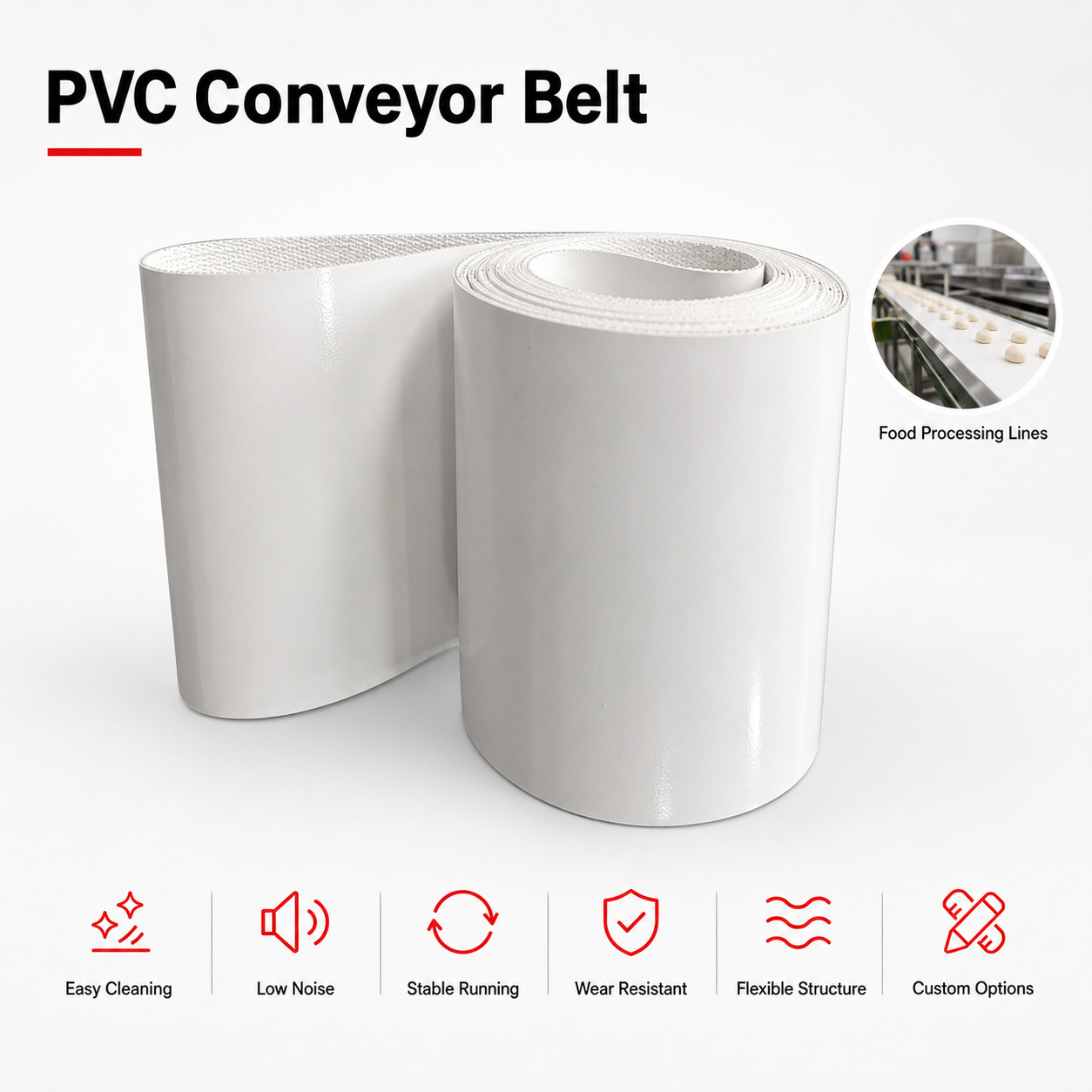
Food Grade PVC Conveyor Belt: What Buyers Should Check
Food-grade belting is often bought too late in the project. The conveyor frame is already fixed, the product path is known, and then someone asks for “a white food belt” to finish the line. That can work for a simple bakery transfer conveyor. It can also create trouble if the belt is expected to handle hot trays, oily dough, wet cleaning chemicals, or small pulleys that the belt was never built for.
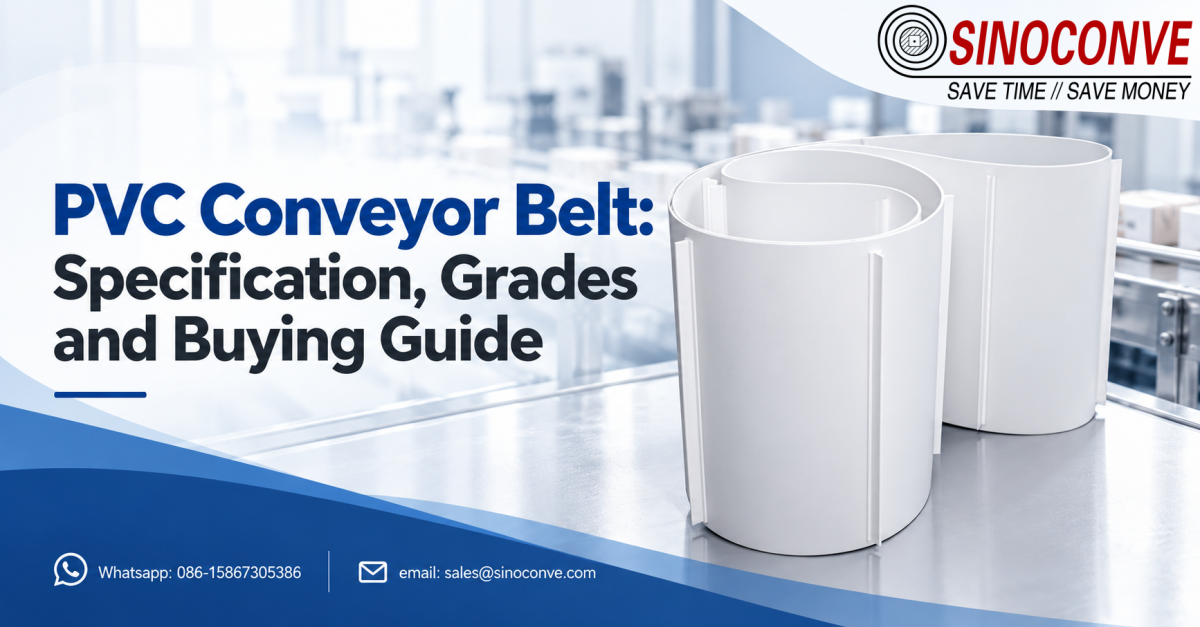
A food grade PVC conveyor belt is a practical choice for many dry and light-duty food handling lines. It is smooth, easy to see, usually quieter than heavier rubber belting, and friendly to simple packaging or inspection conveyors. But the word food grade should never be treated as a color description. A white belt is not automatically compliant for direct food contact. A glossy surface does not tell you how it behaves after daily cleaning. The buyer still has to check the belt construction, documentation, cleaning method, and machine layout.
That is the difference between buying a roll of white belting and specifying a belt that will actually work on the line.
What “Food Grade” Should Mean in the Purchase
For a sourcing team, the first check is not the belt width. It is the intended food-contact status. Some belts are used under packaged goods only. Some touch dough, biscuits, fruit, vegetables, or frozen products directly. The documentation needed for those situations is not the same.
If the belt is intended for direct food contact, ask the supplier for the actual declaration or test documentation used for the target market. For U.S. business, buyers usually ask about FDA food-contact compliance. For European customers, EU food-contact material requirements may be relevant. The exact document depends on the belt material, coating, additives, and use conditions. A supplier who only says “food grade” without documents is asking the buyer to take the risk.
PVC itself can be a useful conveyor material because it is flexible, durable, and suitable for many conveyor systems. That does not mean every PVC conveyor belt belongs on every food line. Formulation, surface finish, fabric reinforcement, edge treatment, and splice method all affect the final choice.
|
Buyer check |
Why it matters |
What to ask the supplier |
|
Food-contact documentation |
Color and surface appearance do not prove compliance. |
Request the declaration, test report, or compliance statement for the intended market and food-contact use. |
|
Use condition |
Dry biscuits, packaged products, oily dough, wet fruit, and washdown lines stress the belt differently. |
Describe product type, contact condition, temperature, oil/moisture, and cleaning method. |
|
Belt construction |
PVC coating, fabric layers, edge condition, and splice all affect cleaning and service life. |
Ask for belt thickness, plies, top cover, bottom fabric, minimum pulley diameter, and splice options. |
|
Machine layout |
A belt that works on a straight conveyor may fail on a small nosebar, incline, or tight transfer point. |
Send pulley diameter, conveyor length, speed, transfer position, and photos of the line. |
Where a White PVC Belt Usually Fits Well
A smooth white PVC belt is normally a good candidate for clean, light-duty transport. In a bakery conveyor, it may carry biscuits, bread packs, trays, or wrapped products from one station to another. On a food processing line, it may work at inspection tables, sorting sections, packing infeed, or accumulation areas where the product is not extremely hot, sharp, oily, or heavy.
Its value is ordinary but important: operators can see residue more easily, wiping is simpler than on a heavily textured surface, and the belt does not add much bulk to the conveyor. That is why these belts are often supplied in rolls to equipment builders, service teams, and distributors who cut and splice them to fit different machines.
The limit is also clear. A food grade PVC conveyor belt should not be selected by appearance alone for heavy washdown, frying oil exposure, hot trays, frozen impact, or abrasive crumbs mixed with sugar and hard particles. Those applications may still use food belting, but the material and construction should be checked more carefully.
|
Line position |
Good-fit situation |
Caution point |
|
Bakery transfer conveyor |
Dry or lightly handled bakery goods, wrapped products, trays, or cartons. |
Check whether hot trays or sticky dough contact the belt directly. |
|
Biscuit or snack inspection line |
Smooth product movement where visibility and cleaning matter. |
Crumbs and sugar buildup can affect tracking if cleaning is irregular. |
|
Packaging infeed / outfeed |
Light loads, stable running, low noise, and simple belt replacement. |
Confirm product weight and pulley diameter before choosing belt thickness. |
|
Sorting table |
White surface helps operators see residue or mixed product clearly. |
Edge fraying and splice quality matter if the belt is cleaned often. |
|
General food handling section |
Suitable when product contact is dry, moderate, and easy to clean. |
Ask for documents if the belt touches unpackaged food directly. |
Cleaning Method Changes the Belt Choice
Many belt problems on food lines start after cleaning, not during normal conveying. A dry bakery line may need brushing, vacuuming, or light wiping. A wet processing line may use water, sanitizers, scrapers, or clean-in-place stations. These routines affect the belt surface, splice, edges, and tracking behavior.
PVC can be easy to clean when the surface is smooth and the residue is moderate. It becomes less forgiving when cleaning chemicals, heat, and water reach the fabric edges or splice repeatedly. If the line has aggressive washdown, ask whether a PVC belt is still the best construction or whether another food-belt material would be more suitable.
The question is not which belt is easiest to describe in a catalog. The question is which belt can survive the cleaning method actually used by the plant.
|
Cleaning condition |
What it can do to the belt |
Buyer response |
|
Dry wipe / brushing |
Usually manageable for smooth PVC when crumbs and powder are light. |
Confirm surface release, static behavior, and cleaning frequency. |
|
Wet wiping |
Water may reach edges and splice if sealing is poor. |
Ask about edge treatment and splice recommendation. |
|
Sanitizing chemicals |
Some compounds or adhesives may age faster. |
Check chemical compatibility before ordering. |
|
High-temperature cleaning |
PVC may not be suitable if heat exposure is too high. |
Confirm temperature limits and exposure time. |
|
Scraper use |
Incorrect scraper pressure can score the surface or stress the joint. |
Check scraper material, pressure, and belt surface finish. |
Common Failure Signs on Food PVC Belts
A belt does not need to snap before it becomes a problem. On a food line, small symptoms are often enough to slow production: the belt starts wandering, product residue collects at the splice, the edge begins to fray, or the surface becomes shiny in one lane. These are not cosmetic issues if they repeat after every cleaning cycle.
Before replacing the belt, look at where the failure begins. If damage starts near a small end pulley, the belt may be too thick or too stiff for the conveyor. If the edge frays after washdown, the edge treatment or cleaning routine may be the real problem. If the product sticks after a short running time, the surface finish may not match the product.
|
Failure sign |
Likely cause |
What to check before reordering |
|
Product residue builds at the splice |
Wrong splice method, poor cleaning access, or sticky product behavior. |
Splice type, product temperature, sugar/oil content, cleaning routine. |
|
Edge fraying |
Fabric edge exposure, belt rubbing, poor tracking, or washdown damage. |
Edge sealing, guide rails, pulley alignment, tension setting. |
|
Belt tracks to one side |
Uneven tension, worn rollers, contaminated underside, or frame alignment issue. |
Roller condition, pulley crown, return path, product loading position. |
|
Surface becomes glossy or scratched |
Scraper pressure, abrasive crumbs, or unsuitable surface hardness. |
Cleaner setting, product residue, belt surface grade. |
|
Cracking near small pulley |
Belt too stiff for pulley diameter or repeated bending stress. |
Minimum pulley diameter and belt thickness. |
Food Grade PVC Belt vs Other Food Conveyor Options
A food grade PVC conveyor belt is not the only food conveyor option. It is one useful option. Buyers get better results when they compare the application instead of the material name.
|
Belt option |
Often suitable for |
Main caution |
|
Smooth food grade PVC conveyor belt |
Bakery transfer, packaging, inspection, dry food handling, light-duty clean transport. |
Not automatically suitable for high heat, oil, or harsh washdown. |
|
PU conveyor belt |
Many food-contact applications requiring flexibility and good release. |
Cost and chemical suitability still need checking. |
|
Modular plastic belt |
Drainage, washing, cooling, curves, or easy section replacement. |
Hinges and gaps can require careful sanitation design. |
|
Homogeneous belt |
Lines where fewer fabric layers and easier sanitation are priorities. |
Drive system and pulley design may need adjustment. |
|
Rubber food belt |
Some special handling or grip applications. |
Must verify actual food-contact compliance and cleaning compatibility. |
What to Send for a Useful Quotation
A useful inquiry is more than belt width and length. For replacement orders, the old belt still tells the best story. Photos of the surface, underside, edge, splice, pulley area, and product buildup can help a supplier see whether the belt failed because of material mismatch, cleaning damage, or machine condition.
For OEM projects, the buyer should also send the intended product, line speed, cleaning method, pulley diameter, and whether the belt will touch food directly. This saves time and reduces wrong samples. It also supports SINOCONVE’s practical goal for buyers: save time, save money by confirming the real working condition before production.
|
Information to provide |
Why it matters |
|
Belt width, length, thickness |
Basic sizing for production and quotation. |
|
Old belt photos and marking |
Helps identify structure, surface type, and failure pattern. |
|
Food product and contact condition |
Direct contact, packaged product, dry product, oily product, or wet product require different checks. |
|
Cleaning method |
Determines whether PVC, splice, and edge treatment are suitable. |
|
Pulley diameter and conveyor layout |
Prevents bending, tracking, and transfer problems. |
|
Temperature and chemical exposure |
Avoids early hardening, cracking, swelling, or surface damage. |
|
Quantity and packaging requirement |
Important for distributors, OEM buyers, and repeat orders. |
FAQ
Is every white PVC conveyor belt food grade?
No. White color is only a visual feature. Food grade status depends on material formulation, intended use, and supporting documentation.
Can a food grade PVC conveyor belt be used on a bakery conveyor?
Yes, it is often suitable for dry bakery transfer, biscuit lines, packing sections, and inspection conveyors. Hot trays, oily dough, and heavy cleaning should be checked separately.
What is the main advantage of a smooth PVC belt in food handling?
The smooth surface is easier to wipe and makes crumbs, residue, or contamination easier to see. It also works well on many light-duty transport lines.
When should buyers consider something other than PVC?
Consider other materials when the line has high heat, aggressive washdown, heavy oil exposure, sharp product edges, or very small pulley diameters.
What should I request from the supplier?
Request the belt specification, food-contact documentation if needed, cleaning compatibility, minimum pulley diameter, splice options, and photos or samples before bulk ordering.
Final Purchasing Note
A food grade PVC conveyor belt is a sensible choice when the line needs a cleanable, flexible, low-noise belt for light-duty food handling. It is not a shortcut around specification work. Before ordering, confirm compliance requirements, cleaning method, product contact, pulley layout, and the reason the old belt failed.
The best belt is not simply the whitest or the smoothest. It is the one that matches the food product, the cleaning routine, and the machine design without creating extra work for the people who run the line every day.