
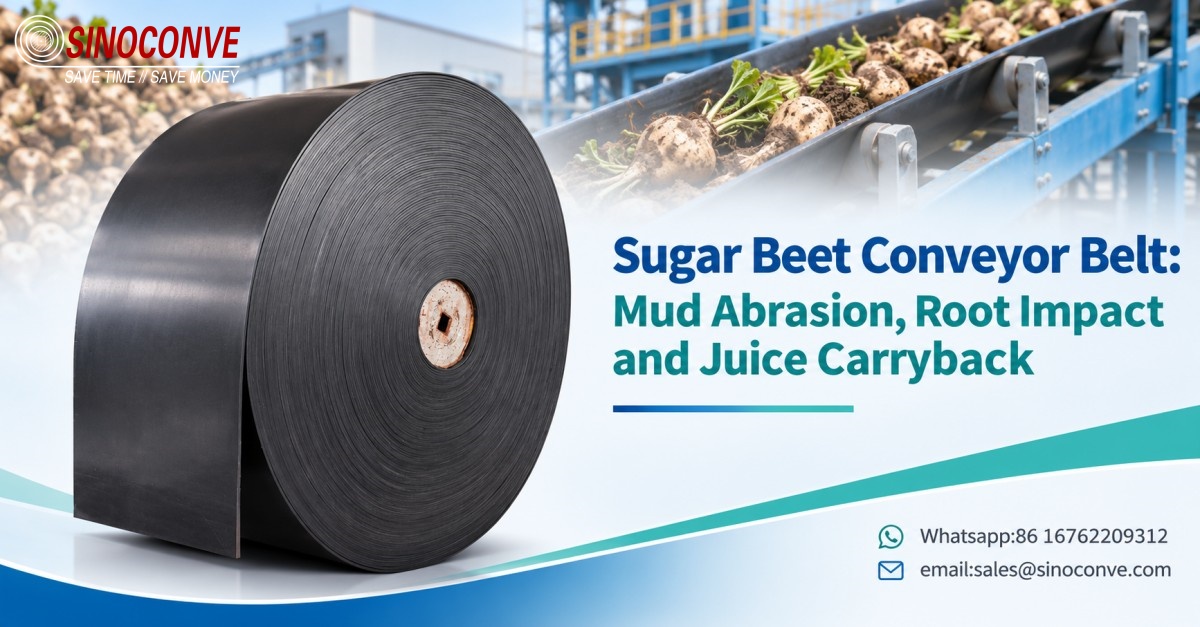
01Why Washed Sugar Beets Still Punish a Conveyor
Stand at the beet infeed of a factory in mid-campaign and the first thing you notice is not the noise. It is the water. A thin film runs down the carrying side, pools at the low edge of every troughing station, and drips onto the floor in a line that follows the conveyor like a wet pencil mark. The roots on top look clean. They are neither dry nor light.
A washed whole beet still holds sand in the crown crevices, grit in the root grooves, and a skin of process water that never drains before the slicer. Quoted soil figures for beet at the gate sit near ten percent by weight; washing removes most of it and leaves the rest. What stays is enough to change how the belt wears and how often somebody shovels mud from under the head pulley.

Three loads arrive at once, which is where most specifications go wrong. Sand and grit work like a lapping compound between cover and load. A beet of a kilogram or more, dropped from a chute mouth, lands as a point load in a patch no wider than a hand. Juice from cut surfaces dries into a sticky varnish that holds the grit where it landed.
Field note from our engineers: At one plant we followed a belt that had been replaced twice in three seasons. The complaint was always the splice opening. Above the chute, a patch the size of a dinner plate was worn to the first fabric ply while the rest of the belt still had full cover. The splice was the symptom. Nobody had ever measured the drop.
Impact here is rarely one clean hit. Roots arrive in clumps, so the belt sees a surge, a lull, another surge, and the load lands somewhere new each time. A beet is round on one face and flat on the other, so it lands, rocks forward, and rolls. That rolling scrubs the cover sideways while compressing it, and sideways scrubbing under load is what removes rubber.
Then there is the juice. Sugar in solution is harmless to most cover compounds; sugar left to dry with sand and plant fiber is not. The mixture sets into a hard ring on the return side, usually where the belt crosses the first return roller after the head. The belt then rides on its own debris, the edge takes the load, and the tracking problem that follows gets blamed on the idlers.
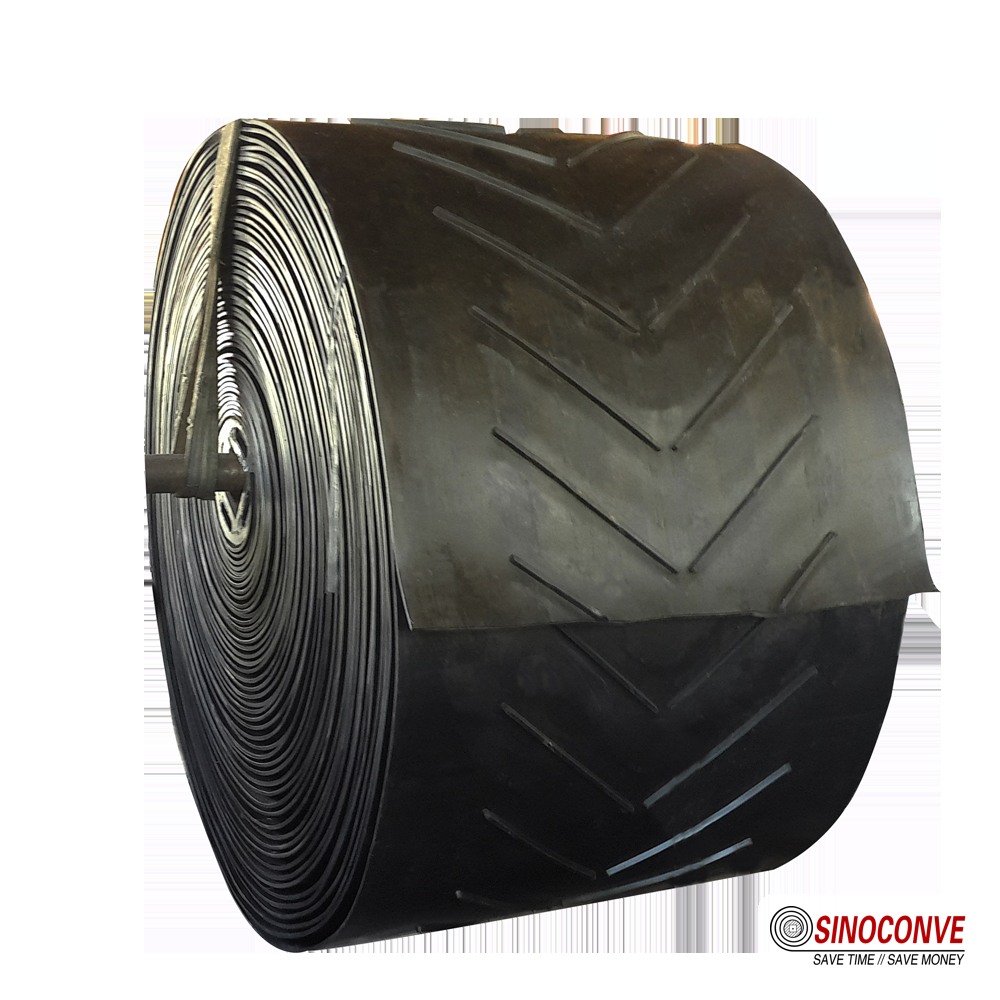
A wide, thick-covered belt for whole-root infeed, staged before shipping.
A campaign is short and brutal. Factories run flat out for a few months, and this belt may see more water in a week than a quarry belt sees in a season. Cold water, outdoor galleries, and wash-down push moisture where a cover was never meant to protect. You cannot keep the belt dry. You can decide where the water goes.
02Three Beet and Sugar Duties That Must Not Be Confused
Whole beet appears in four conveying duties, and three of them already have their own pages on this site. They look alike in a photograph and behave nothing alike. Swap the specifications and the belt fails in a way that looks mysterious until you compare the actual service conditions.
The first duty is the field. A beet harvester lifts roots and hands them to an open rod conveyor, where loose soil falls through the gaps before the beet reaches the tank. That machine runs in dirt, at low speed, with a chain that tolerates mud because it has nowhere to trap it. Our beet harvester open-rod conveying guide covers that duty, and none of it applies to a washed root inside a building.
The second duty is the general root crop harvester, the potato and carrot machines that lift and transfer delicate roots with padded drops and slow belts. Their enemy is bruising rather than abrasion, and their belts are thin, soft, and often cleated. That is a different problem from a surge of wet beet landing on a steel-supported belt, which is why the root and stem crop harvester belt reference stays on the field side of the wall.
The third duty is the finished product. After slicing, diffusion, purification, crystallization, and drying, the material on the belt is sugar: free-flowing, dusty, hygroscopic, and governed by hygiene rules rather than by impact. Our sugar granule conveying page covers that end of the plant. A belt built for sugar dust is a poor choice for wet roots, and the reverse is worse.
The fourth duty is the one this page owns: the factory infeed from the outlet of the washing and destoning line to the slicer feed. Whole, unpeeled, un-sliced roots, water still on them, sand still in them, and nothing between the belt and the knife except a few meters of conveyor and a metal detector. The equipment around that transfer matters as much as the belt itself.
| Process stage and where it happens | Dominant wear or the failure mechanism | Belt style that usually fits the duty | Existing page that covers this duty |
|---|---|---|---|
| Field beet harvester lifting and open rod soil separation | Wet soil sticking to rods and chain wear at every pin joint | Rod link or open mesh chain rather than a closed rubber belt | Beet harvester open rod conveyor belt farm revolution page |
| General root crop harvester transfer and gentle drop points | Bruising and skin damage rather than abrasive cover loss | Soft thin cleated belt running at low tension and slow speed | Root stem crop harvester conveyor belt technical reference page |
| Washed whole beet infeed between destoner and slicer feed | Mud abrasion plus root impact plus juice carryback working together | Heavy EP carcass with thick abrasion cover and cushioned impact support | This page covers the factory infeed segment and nothing else |
| Finished sugar granule conveying after drying and screening | Dust, caking and hygiene rules more than mechanical impact | Smooth food contact belt with sealed edges and easy cleaning | Sugar conveyor belt page written for granule handling duties |
Confusing these duties is expensive in both directions. A smooth, thin, food-finish belt on washed beet tracks beautifully for three weeks and then wears through above the chute. A heavy beet belt in the sugar house is too stiff to trough on a small pulley and sheds cover dust into a clean product stream. The plant is the same. The engineering is not.
03Receiving and Destoning: Control the First Heavy Drop
Most beet belt failures we are asked to diagnose start within two meters of the loading point. Not because the belt is weak, but because that is where the energy arrives. A root of a kilogram falling through 1.5 meters lands with roughly fifteen joules concentrated into a few square centimeters. Multiply that by a surge of thirty roots in a second and the cover is being hammered rather than loaded.
The first control is the feed itself. A hopper allowed to empty and refill sends waves, and every wave lands on the same worn strip. A variable-speed feeder driven from a level or weigh signal turns those waves into a steady carpet of roots. Plants that make this change often report longer belt life before the belt itself changes. The industrial conveyor belt interface is only as good as the meter that feeds it.
Drop height is the second control and the cheapest to fix. Going from 1.5 meters to 0.6 meters cuts impact energy by more than half without touching the belt specification. A chute at fifty to sixty degrees keeps roots sliding instead of falling, and a small dead bed of beet held in the chute mouth absorbs the first hit. Where the geometry cannot change, a rock box or a short horizontal shelf does the same work.
Under the load zone, support spacing matters more than belt thickness. Carrying idlers at 1,200 millimeters let the belt sag between stations, so every impact stretches the carcass and releases it. Impact idlers at 300 to 400 millimeter spacing, with rubber discs or a cushion roller directly under the chute, hold the belt nearly flat and spread the load across several plies. Our impact roller notes for loading zones run through the spacing arithmetic, and the numbers are blunt: halving the span can double the impact the belt survives.
Skirt boards are the third control and the most common source of self-inflicted damage. A skirt set too low pinches roots against the belt; set too high, it lets the load spill and water run over the edge. We ask for 25 to 40 millimeters of clearance and a chamfered leading edge so a rolling root is guided inward instead of caught. Any root wedged under a skirt gets dragged until it tears the cover.
Water needs somewhere to go. A receiving section built as a flat pan with raised edges holds a puddle, and a puddle under a moving belt acts like a suction cup while it lubricates the drive pulley. Perforated deck plates, a two-degree crossfall, and a drain at the low corner cost little at the design stage. Retrofitting them means cutting structure during a campaign, which nobody wants to schedule.
Stones deserve their own line in the specification. A working destoner still lets the occasional flint through, and a 60 millimeter stone trapped under a beet will punch a hole through a cover that survived a season of sand. Thickness alone is a poor defence, which is why the cradle, the chute, and the destoner setpoint belong in the same conversation. Our notes on washing and dewatering belts cover the upstream side.
04Belt Construction for Mud, Roots and Repeated Impact
Once the drop is under control, the belt can do its own job. What we recommend for washed beet infeed is not exotic: a heavy fabric carcass, a thick and tough top cover, a thinner bottom cover, and a splice that takes the same beating as the body. What changes plant to plant is how those elements are balanced against pulley size, belt width, and tonnage.
The carcass carries tension and spreads impact. For a 1,200 millimeter belt moving several hundred tonnes per hour, four plies of EP fabric is a common starting point; lighter lines can use three. More plies are not automatically better. Every extra ply adds stiffness, and a stiff belt on a small head pulley cracks through the cover instead of flexing around it. We size plies from working tension, then check the belt still troughs.
The top cover does the wearing. We look at thickness first and hardness second, because a very hard cover resists sand and then chips on a stone, while a very soft cover absorbs impact and abrades away in weeks. A cover in the middle of the common hardness range, at eight millimeters over the load zone, usually outlasts either extreme. As a conveyor belt manufacturer we would rather quote two thickness options with reasoning attached than quote one number and let the buyer guess.
Cut and tear resistance is a different property from abrasion resistance, and beet lines need both. A root crown is a hard, woody point. It does not scratch a groove; it starts a small cut that grows sideways under rolling load until a flap lifts. Transverse reinforcement in the cover, or a compound formulated for cut growth, slows that process, and our quarry abrasion belt guidance follows the same reasoning.
Troughability matters more than most buyers expect. A washed beet sits in a trough of thirty to forty-five degrees and behaves like a wet, irregular lump rather than a free-flowing solid. A belt too stiff to form that trough lets roots roll to the center, so the belt loads like a ridge and the edges run unloaded and uncontrolled. A rubber conveyor belt that is too hard for its width is one of the quiet causes of center wear on beet lines.
Cover thickness and ply build checked on a belt destined for a beet infeed.
| Belt element we look at first | What we typically specify for washed beet | Field reason that sits behind that choice |
|---|---|---|
| The EP fabric carcass and its ply count | Four plies on wide belts carrying high tonnage per hour | Impact spreads across several plies instead of one weak spot |
| The top cover thickness and its hardness | Eight millimeter cover at the receiving end with medium hardness | Enough material to wear before the carcass is ever exposed |
| The bottom cover and its friction behaviour | Thinner bottom cover matched to a crowned drive pulley | Grip for a wet start without polishing the pulley face |
| The splice and the step length we ask for | Vulcanized splice with stepped fingers and a long overlap | A joint as strong as the body under repeated heavy impact |
| The edge construction and its protection | Cut edges sealed and checked for root wedging at skirts | Edge damage starts small and then runs the whole length |
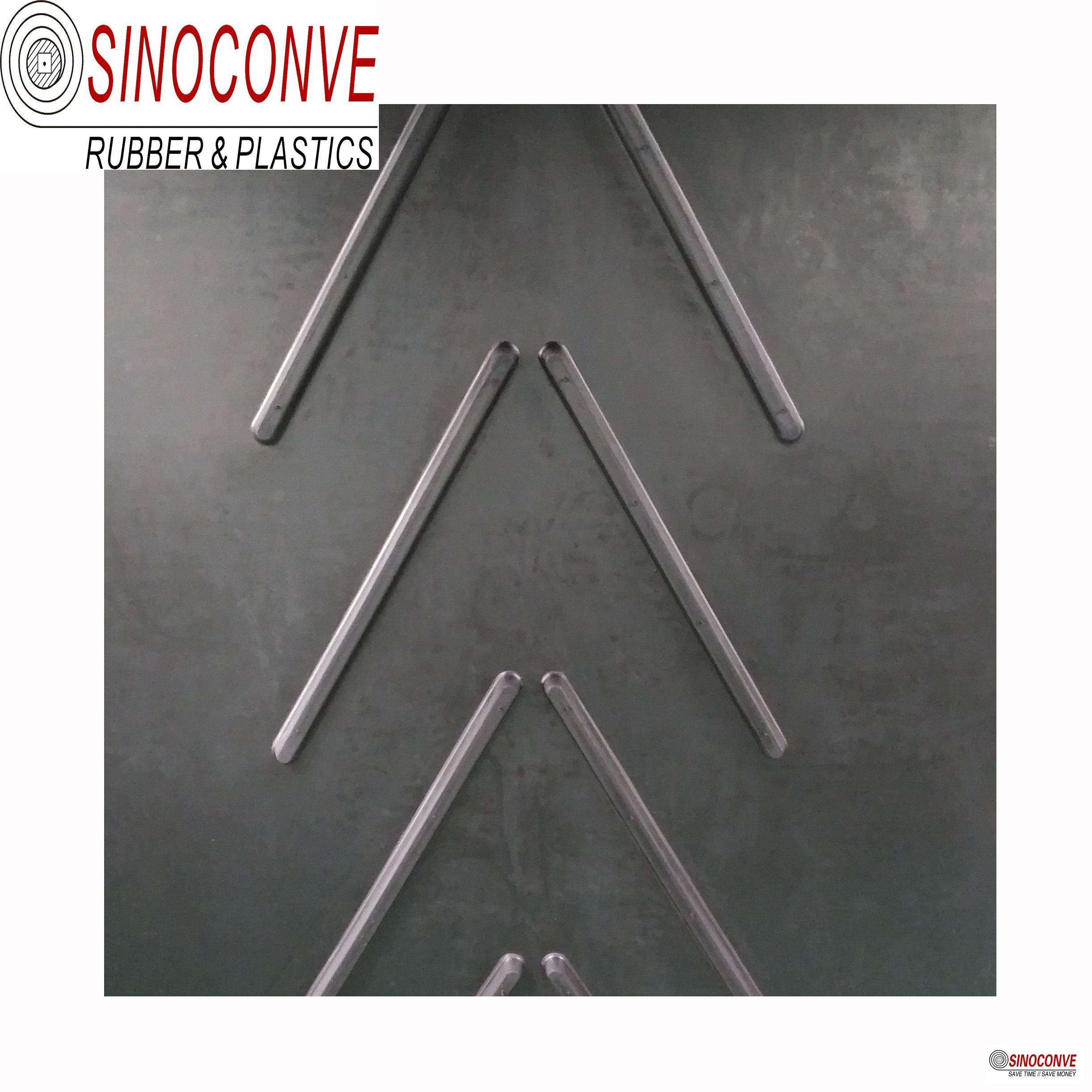
Belt speed belongs to the construction decision, not to a separate one. Washed beet tolerates roughly 0.8 to 1.6 meters per second on a flat or slightly inclined run. Faster and roots bounce at the transfer points; slower and the belt has to be wider than the building allows. Incline is limited too, because a wet root slides back at angles dry aggregate would climb. Where the layout forces a steeper lift, a patterned cover earns its place, and our conveyor belt distributor stock programme holds those profiles.
One purchasing note on chemical resistance. Juice is mildly acidic, cleaning chemicals vary by plant, and we are often asked for an acid-resistant belt. We will not name a grade, because the honest answer depends on the agent, its concentration, and how long it sits on the belt. Instead we ask for the cleaning schedule, then for measured swell and hardness change in that medium. A cover that swells two millimeters in a week is worse than one with no chemical label.
05Preventing Juice Carryback and Return-Side Mud Rings
Everything that sticks to the belt comes back. On a beet line the return side shows the evidence first: a damp stripe under the carrying run, a growing collar of debris around the first return roller, and a floor wetter than the wash house drain should allow. None of that is a belt defect. It is carryback, and it is predictable.
The mechanism is simple. Juice and water stay on the cover after the roots leave at the head. Sand and plant fiber stick to that film. By the time the belt reaches the tail, every return roller has pressed the mixture flat, and pressure turns a film into a patch. Wet patches then pick up more material, and the cycle accelerates until the rollers run on dried beet pulp instead of rubber.
A primary cleaner at the head pulley removes most loose material if it is set correctly. Blade pressure matters more than blade material: too little and the film stays, too much and the blade wears a groove in the cover within weeks. We set polyurethane blades with light, even contact and check them weekly, because a blade worn back by two millimeters stops touching the belt.
Secondary cleaning is where beet plants differ from quarries. A second blade or a rotating brush behind the primary catches what the first lifted but did not remove. On lines with heavy juice, a low-pressure spray between the two stages, aimed at the cover rather than the pulley, keeps the film from setting. The spray needs a drip tray and a drain, or it simply relocates the problem to the return run.
Return rollers need help on this duty. A plain steel roller under a wet, gritty belt builds a collar at its center within a shift or two, and the belt then runs over a roller that is no longer cylindrical. Rubber-disc, spiral, and cage designs shed material as they turn. If the line has plain rollers, retrofit the first three stations after the head, where carryback is still soft enough to remove.
Drainage is the cheapest part of the system and the one most often left out. Troughs should drain to one side, not hold water. A belt running through standing water drags a film back to the tail pulley, and the tail pulley then slips on a wet start. Floor drains under the head and at the take-up frame turn a daily hose-down into five minutes instead of an hour with a shovel.
Field note from our engineers: One factory replaced return roller bearings at the head end every few weeks and blamed the bearing supplier. The roller was buried in a hard collar of beet fiber and sand baked on during a weekend shutdown. We moved the primary cleaner closer to the pulley and added a drip tray. The failures stopped, and the belt had been fine the whole time.
Cleaning frequency should follow the campaign, not the calendar. At full rate, the head area needs a check every shift and the return rollers every week. During a stop, run the belt empty and wash it before it cools, because dried juice on a cold belt is far harder to remove than the same juice on a warm one. A cleaning schedule built around the material is worth more than a thicker cover.
Spares belong in the same plan. A conveyor belt distributor who serves beet factories normally holds one spare roll of the running specification, because a campaign does not wait for a production slot. If the belt is an unusual width or cover, that spare should be ordered with the original, not after the first splice failure.
06Tracking Through Wet Starts and Uneven Root Loading
A dry belt that tracks perfectly can still walk off its pulleys on a wet Monday morning. Water changes friction, friction changes the balance of forces across the width, and a beet line adds a load that is never evenly distributed. Tracking problems here are usually a system issue rather than a belt issue, and they are better solved before the belt is ordered.
The wet start is the classic case. The belt has sat with a film of water and juice on both sides, the drive pulley is wet, and the take-up sits near the end of its travel. When the motor starts, the pulley slips for a second, the belt creeps on one side, and half an edge is off before full torque arrives. Soft-start drives and a take-up with reserve travel solve most of it.
Uneven loading is the second cause, and it is a chute problem more than a belt problem. Roots that land on the left half push the belt left, and training idlers correct it only after the belt has moved. A centering plate, a split chute, or a deflector above the load point costs less than a set of self-aligning rollers and works better. Look at the cover wear: a stripe 200 millimeters off center tells you where the load lands.
Tracking is not the only reason a line slows down. The drive side has its own wear path. Slicer drives, pump drives, and wash-water agitators run on belts that see the same wet, dirty atmosphere as the conveyor, and a slipping drive is often mistaken for a conveyor problem because both show as a slowdown. A V-belt manufacturer will normally ask for the pulley groove wear pattern before recommending a profile, and that is the right first question. The same logic applies when a transmission belt manufacturer matches a replacement to an existing drive: measure the grooves, do not read the old belt.
| Symptom that the operator usually reports | Likely cause on a washed beet line | Check to run before touching the belt |
|---|---|---|
| Belt runs to one side only when loaded | Roots land off center and push the belt sideways | Move the chute or add a centering plate above the belt |
| Belt creeps sideways during the first minute | Wet pulley slip before full torque reaches the belt | Check take-up reserve and start the discharge first |
| One edge frays just after the load zone | A root wedged under the skirt board on that side | Clear the skirts and set clearance to thirty millimeters |
| Belt wanders even when running empty | Frame misalignment or a seized return roller collar | String-line the frame and clear the return rollers first |
None of these checks need a specialist. They need somebody to write down what the belt did, under what load, at what point in the shift. Three lines per shift will find the cause faster than any amount of idler adjusting, and it gives the next order a set of real numbers to design against.
07RFQ, Acceptance and Shift Inspection Checklist
A beet infeed belt is one of the few items where the inquiry arrives as a width and a length. We understand why: the old belt is on the floor and the campaign starts in six weeks. But a width and a length describe a shape, not a duty, and the difference between two campaigns and five is decided by five or six numbers that are cheap to collect early.
Data to send with the inquiry
Start with tonnage, not width. Hourly tonnage at campaign peak plus the average gives the load per meter and lets us check speed and ply count together. Add the widest and narrowest root the line will see, because a chute sized for a 250 millimeter beet still passes the occasional 400 millimeter one, and that outlier does the damage. Then send the drop height and chute angle.
After that come the wet facts: wash water temperature, whether the belt runs outdoors, how the plant cleans during a stop, and which chemicals are used. We do not need a brand name. We need to know whether the belt sits wet for two hours or two days, because that changes the cover recommendation more than the chemical itself. A conveyor belt for agricultural root handling is specified from the process, not from the product name.
Acceptance at the works
Before a belt leaves a conveyor belt factory, somebody should measure it against the order rather than against the previous belt. We record overall length, width, cover thickness at several points across the width, and the position of the splice. Cover thickness at the edges matters as much as at the center, because thin edges are how water reaches the carcass on this duty.
For the splice we record step length, cure temperature and time, and the finished appearance of the joint. A vulcanized joint that looks proud on one side will be the first place to lift. Buyers who order wholesale conveyor belts for several plants usually ask for the same record set with every roll, which makes later comparison possible. As a conveyor belt supplier we would rather send an inspection sheet a buyer can file than a photograph that proves nothing.
First week on site
The first week tells you whether the specification fits. Run the belt empty for an hour and watch tracking at the tail, the head, and the take-up. Then load at half rate and watch the same three points, then at full rate. Most installation problems show up in that sequence, and they are much easier to correct before the plant runs around the clock.
| Item that must be fixed before quoting | What we ask the buyer to send us | Check we run at our own works | Check the maintenance crew runs each shift |
|---|---|---|---|
| Peak tonnage and the average tonnage per hour | Hourly tonnage range with the campaign peak written down | Belt speed matched to the tonnage and the width | Throughput stays inside the quoted range all shift |
| The widest and narrowest beet the line will see | Root size range with a sample photograph if possible | Cover thickness chosen for that impact energy | No oversized roots jam the chute or the skirts |
| Drop height and the angle of the feed chute | A dimensioned sketch of the transfer point geometry | Impact cradle spacing under the chute mouth | Cradle rollers turn freely and sit flat |
| Water volume and the cleaning chemicals in use | The wash water temperature and the cleaning schedule | Cover compound checked against that cleaning medium | No swelling, softening or colour change on the cover |
| Pulley diameters, shaft sizes and take-up travel | A drawing of the drive station and the take-up frame | Pulley to belt thickness ratio verified before release | Take-up reserve recorded weekly in the log |
| Splice method and the crew that will install it | Whether the joint is vulcanized on site or in our works | Splice step length and a full cure record | Joint looks flush and shows no lifted edge |
Shift inspection that takes four minutes
Walk the carrying side from tail to head and look for three things: a wet stripe on the return run, a dark line along one edge, and a change in the sound at the drive. Then check the cleaner blade by hand and the take-up position by eye. That is the whole inspection, and it catches almost everything that becomes an unplanned stop.
Plan the replacement before the failure. A belt on this duty gives warning: cover worn thin above the chute, a splice that has started to step, edges that lost their square profile. Any one of those is reason to order while the line still runs. Ordering mid-campaign buys speed; ordering in the off-season lets the crew fit the belt without pressure.

Splice and cover checks before a wide belt is released for shipment.
Where the line runs from the destoner straight into a slicer house, this belt is the last place a whole root can be looked at by a person. That is worth remembering when the specification is written. The food processing conveyor stage downstream has its own rules, but a belt that carries roots gently keeps that inspection meaningful.
For a wider view of how this segment fits with washing, destoning, and the rest of the line, the industry by industry conveyor overview is a reasonable starting point.

08Frequently Asked Questions About Sugar Beet Conveyor Belts
What is the right belt for washed beet going into a slicer?
A heavy fabric carcass with a thick, medium-hard top cover and a vulcanized splice. Four plies is the usual starting point for a wide line, and eight millimeters of cover over the load zone is common. Those numbers follow tonnage, drop height, and the smallest pulley in the run, so treat them as a starting point.
How thick should the cover be at the receiving point?
Thick enough that the carcass is never exposed before the next planned shutdown. In practice that means measuring wear rate rather than guessing. If the cover loses two millimeters in a campaign, eight millimeters gives four campaigns of margin. Thicker starts to cost troughability and pulley wrap, which is a poor trade.
Can one belt handle both washed roots and finished sugar?
No, and it is worth being blunt about why. The two duties punish different things. Wet roots need impact absorption, cut resistance, and drainage. Dry crystals need a smooth, cleanable surface with no place for product to lodge. Keep the two specifications separate even when one crew maintains both lines.
Why does the return side build up a hard ring?
Because juice and water leave the head pulley with the belt, and sand sticks to that film. Every return roller presses the mixture flat, and the pressure turns it into a patch that dries hard between shifts. A primary cleaner set correctly removes most of the film before the first roller.
How often should the belt be inspected during campaign?
Once per shift for the four-minute walk, and once a week for cleaner blades and return rollers. Cover thickness above the chute is worth measuring monthly, because that is where wear is fastest and where a thin patch becomes a hole.
Does acid resistance matter for beet juice?
It can matter, but the label on a data sheet will not tell you whether it matters at your plant. Ask instead for measured swell and hardness change in the actual cleaning medium, at the actual concentration and contact time. If a supplier cannot produce that, the claim is marketing rather than engineering.
Still comparing options? Our engineers answer specification questions from drawings, photographs, and a tonnage figure, and they will say when a belt is not the right answer.
Related Products You May Need
- Heavy duty rubber belt for wet root infeed
- EP fabric carcass belt with thick abrasion cover
- Patterned belt for the inclined lift after washing
- Drive belts for slicers and wash water pumps
Related Blog Posts