
Impact Roller Supplier for Loading Zones: Rubber Rings, Bearings and Shaft Specifications
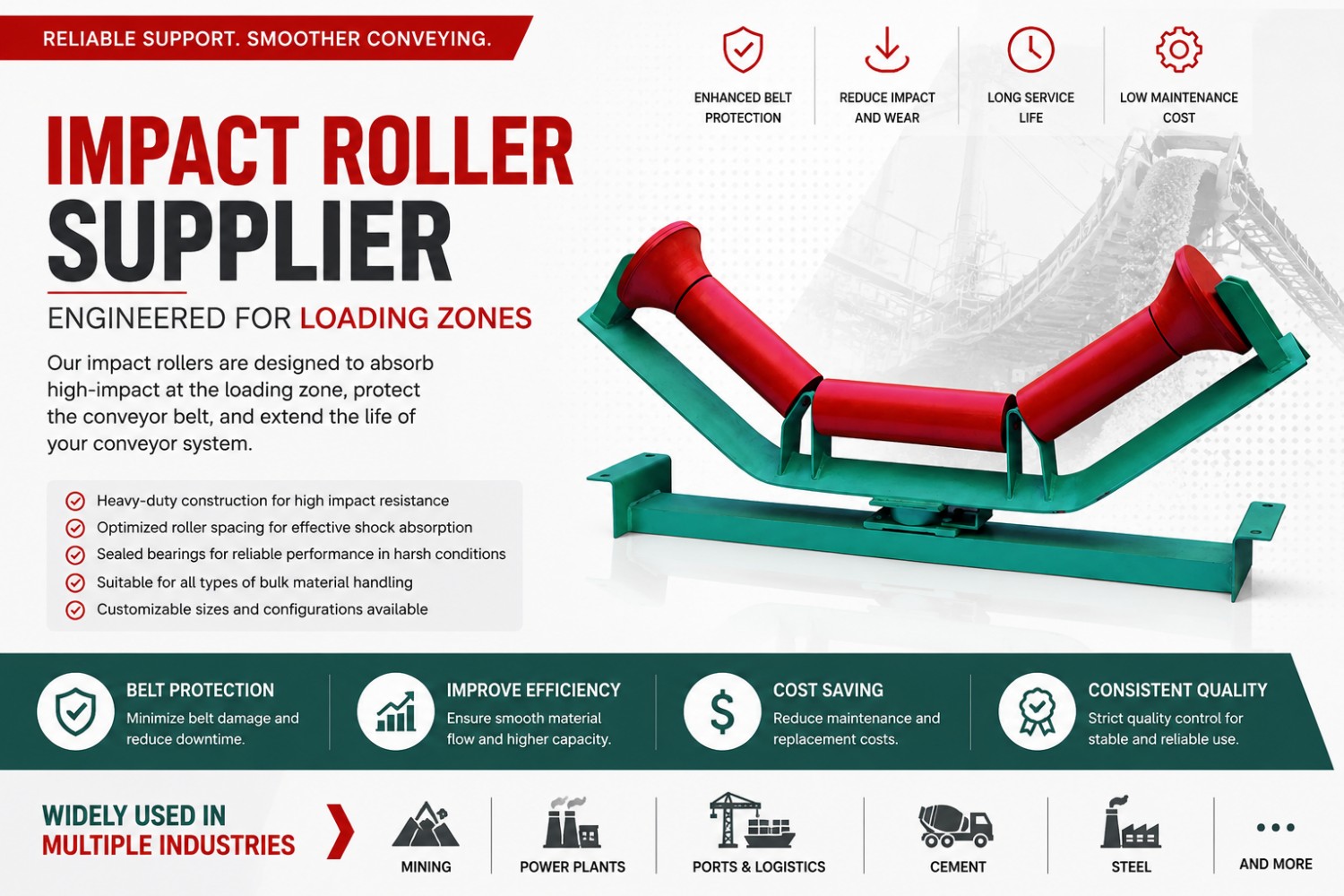
A loading-zone roller can match the required outside diameter and still be the wrong component for the conveyor. Material falling from a chute creates repeated shock rather than the relatively steady support load seen farther along the carrying run. That changes what a project buyer needs to verify: rubber-ring construction, shell and shaft design, bearing protection, dimensional compatibility, and the complete impact-idler arrangement.
For an RFQ, “impact roller, heavy duty” is therefore not enough. Two suppliers may quote visually similar rollers while making different assumptions about shaft ends, bearing arrangement, rubber rings, sealing, face length, or installation geometry. Those differences can become replacement problems after delivery.
This guide explains how to evaluate an impact roller supplier for loading zones and what technical information should be fixed before a bulk order or project approval.
Quick Answer: Do not qualify an impact roller supplier from price, roller diameter, and a product photo alone. Confirm the loading conditions first, then compare rubber-ring construction, tube and shaft dimensions, bearing and sealing arrangement, shaft-end geometry, runout requirements, frame compatibility, inspection documents, and packing. For replacement projects, an approved drawing or existing roller sample is one of the safest ways to prevent dimensional mismatch.
1. Why Loading-Zone Impact Rollers Need a Different Buying Approach
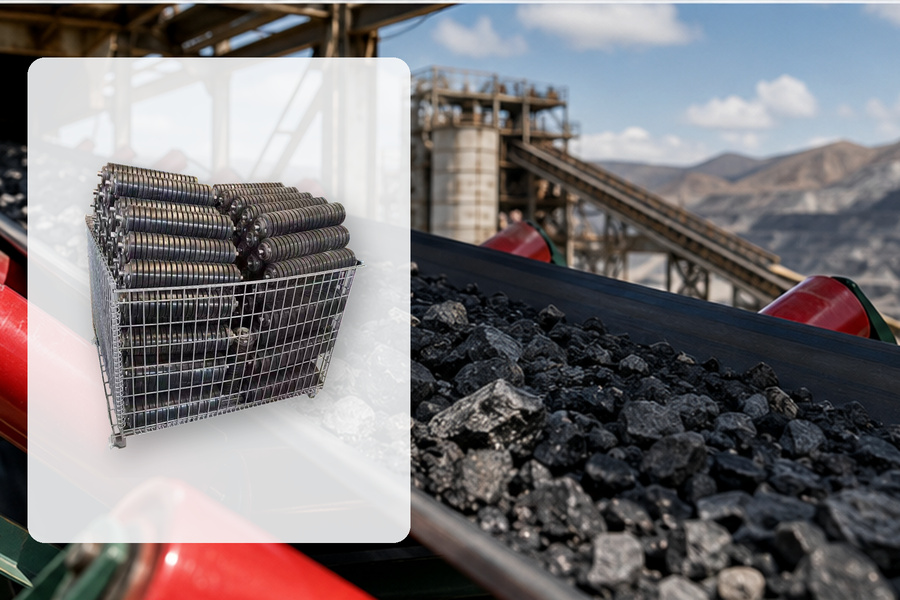
A normal carrying idler supports the loaded belt after the burden has settled. An impact roller works where material enters the conveyor and the belt may be exposed to concentrated dynamic loading. Rubber rings or discs around the roller body provide a resilient contact surface intended to help cushion that loading.
This does not mean that adding more rubber automatically creates a better impact roller. The roller remains a mechanical assembly. The rings, shell, bearing housing, bearings, seals, shaft, and mounting ends have to work together under the actual conveyor conditions.
The loading zone itself also matters. Drop height, lump size, material mass, belt speed, loading direction, idler spacing, chute geometry, and belt support all influence the severity of impact. An impact roller should not be expected to compensate for an uncontrolled transfer point.
Where large lumps or severe drops create loads beyond the practical duty of conventional impact idlers, the project may require closer support spacing, an impact bed, or another engineered loading-zone arrangement. The correct answer depends on the transfer-point design rather than on the roller alone.
RFQ Warning: “Suitable for mining” or “heavy-duty impact roller” is not a measurable specification. Ask the supplier to confirm suitability against your actual loading conditions and approved dimensions.
2. Rubber Rings: More Than a Visual Feature
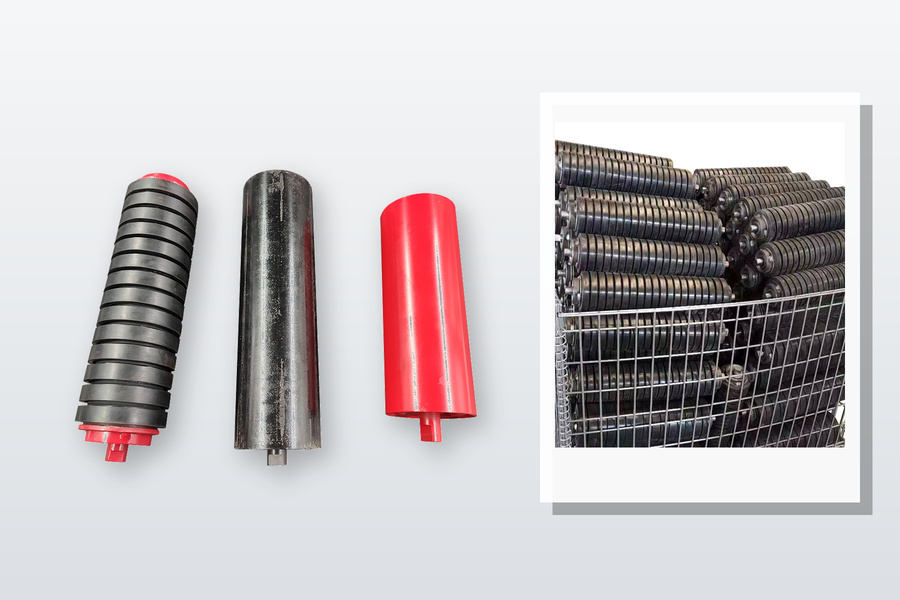
The rubber-ring assembly is the most visible difference between an impact roller and a conventional steel carrying roller, but procurement teams should look beyond appearance.
Ring dimensions and arrangement affect how the belt contacts the roller and how impact is distributed. The supplier should therefore work from the required drawing, existing assembly, or project specification rather than assume that one standard ring pattern will fit every conveyor.
| Rubber-Ring Item | Why the Buyer Should Check It | Useful RFQ Information |
|---|---|---|
| Outside diameter | Affects installed roller geometry and belt contact. | Required diameter and tolerance from the drawing. |
| Ring width and spacing | Determine the contact pattern across the roller face. | Ring layout, quantity, spacing, or an existing sample. |
| Rubber performance requirement | The required compound depends on impact, wear, environment, and project specification. | Required material specification or test requirement rather than an undefined “high-quality rubber.” |
| Ring retention | The assembly must remain stable during repeated operation. | Request construction details or a sectional drawing where required. |
Be careful with unsupported hardness or rubber-grade claims. The required rubber specification should come from the project duty and approved technical requirement. A supplier offering a particular compound should be able to state what is being supplied and how it will be verified.
3. Bearings and Seals Often Decide Whether the Roller Keeps Turning
The rubber rings absorb attention during purchasing, but many field failures begin at the roller ends.
An impact roller bearing experiences rotation plus the load transmitted through the roller assembly. Dust, fine particles, moisture, washdown, and material buildup can make the operating environment harder on the bearing system. A larger bearing number by itself does not solve poor contamination control.
For that reason, an RFQ should distinguish between the bearing and the complete bearing protection system. Ask how the bearing is mounted, what sealing arrangement protects it, how the housing is constructed, and whether the design is appropriate for the contamination level at the transfer point.
Buyers replacing an existing roller should also avoid specifying only a preferred bearing brand. Brand information may be commercially useful, but dimensional fit, load suitability, sealing, housing quality, and installation conditions still need to be correct.
Buyer Tip: If existing impact rollers repeatedly seize, send the supplier photos of the failed roller ends as well as the bearing designation. Contamination marks, damaged seals, bent shafts, buildup, or abnormal wear may reveal more than the bearing number alone.
4. Shaft Specifications Can Make or Break Replacement Compatibility
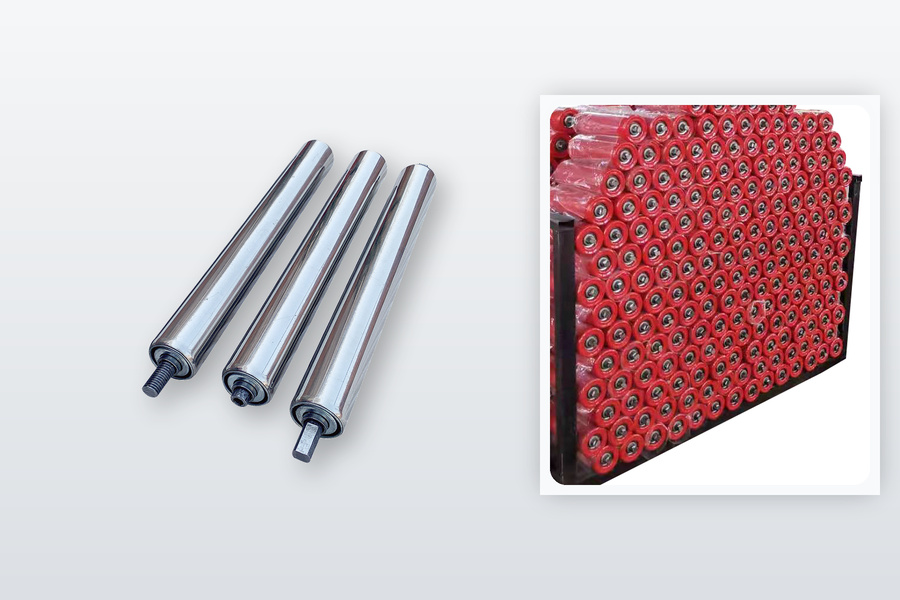
A roller that looks correct in a catalog can still be impossible to install because the shaft ends do not match the existing frame.
The shaft transfers roller loads into the supporting structure. Diameter matters, but it is only one dimension. Overall shaft length, bearing positions, shoulders, flats, slots, threads, drilled ends, and other mounting features may all affect interchangeability.
This is particularly important for international replacement orders. Terms such as “standard shaft” are risky because the original conveyor may use a project-specific frame or an older regional design.
| Dimension | Procurement Risk if Missing | Preferred Verification |
|---|---|---|
| Roller outside diameter | Incorrect belt support geometry | Approved drawing or measured existing roller |
| Face length | Poor support or frame interference | State face length separately from overall length |
| Shaft diameter | Structural or bearing-fit mismatch | Drawing with tolerances where applicable |
| Overall shaft length | Roller does not fit the frame | Dimensioned drawing |
| Shaft-end geometry | Installation or retention failure | End-view drawing, photo, or sample |
| Bearing position | Changes support and internal assembly geometry | Section drawing when required |
For project buyers who need a broader dimensional checklist, SINOCONVE's conveyor idler roller guide covers roller diameter, face length, shaft ends, bearing spacing, shell construction, runout, and other selection points.
5. The Impact Roller Is Only One Part of the Loading-Zone Assembly
One common procurement error is treating a loose impact roller as if it defines the entire impact idler station.
In a troughed conveyor, the roller works with the frame and adjacent rollers to support the belt profile. Trough angle, center and wing-roll geometry, mounting positions, spacing, and clearances have to remain compatible with the conveyor.
ISO 1537 addresses dimensions, arrangement, and clearance of three-idler arrangements for troughed belt conveyors handling loose bulk materials. For a project buyer, the important lesson is not simply to put “ISO” in the purchase order. The supplier still needs the applicable project dimensions and acceptance requirements.
A standard reference also does not automatically prove that a particular roller has the required impact capacity, bearing life, sealing performance, or rubber properties for your transfer point. Those requirements need separate technical verification.
If the project includes several roller positions, review the broader conveyor roller range rather than assuming that impact, carrying, return, rubber-disc, and tracking rollers are interchangeable.
6. What a Project Buyer Should Put in the RFQ
A technically useful RFQ reduces assumptions before quotations are compared. This matters even more when several suppliers are bidding, because a low quotation may simply reflect a narrower interpretation of the requirement.
| RFQ Category | What the Buyer Should Provide | Why It Matters |
|---|---|---|
| Conveyor duty | Belt width, speed, capacity, trough arrangement, operating hours | Defines the basic operating context. |
| Material | Material type, bulk density, typical and maximum lump size | Helps assess load and impact conditions. |
| Transfer point | Drop height, chute arrangement, loading direction, photos or drawings | Impact severity cannot be judged from roller dimensions alone. |
| Roller dimensions | OD, face length, overall length, shaft dimensions, shaft ends | Controls physical interchangeability. |
| Rubber rings | Required dimensions, layout, compound or performance requirement | Prevents visually similar but technically different quotations. |
| Bearing and sealing | Required bearing arrangement, environmental exposure, sealing requirement | Critical where dust and moisture threaten bearing reliability. |
| Acceptance | Applicable standard, drawing revision, inspection and documentation requirements | Creates a common basis for technical approval. |
| Commercial scope | Quantity, required delivery schedule, packing, destination, spare requirement | Allows quotations to be compared on equivalent scope. |
For replacement orders, attach the old roller drawing if available. If no drawing exists, photographs should include the complete roller, both shaft ends, frame interface, and dimensional measurements. A physical sample can further reduce interpretation risk where geometry is difficult to document.
7. How to Qualify an Impact Roller Supplier Before a Bulk Order
Supplier qualification should answer two separate questions: Can the supplier manufacture the required configuration? and Can the supplier demonstrate that the delivered batch matches the approved requirement?
7.1 Check Technical Response Quality
A useful supplier does not respond to an incomplete RFQ only with a price. For loading-zone applications, the supplier should identify missing information that materially affects construction or fit.
Watch how the supplier handles drawings and deviations. If its proposed shaft end, bearing, ring arrangement, material, or dimension differs from your specification, that difference should be visible before approval rather than discovered during installation.
7.2 Ask for Evidence Relevant to the Order
Project buyers can request an approved drawing, material or component specifications where applicable, inspection scope, product test documents required by the purchase specification, packaging details, and pre-shipment records.
Do not treat a general company certificate as proof of every product characteristic. Quality-system documentation and product-level verification answer different questions.
7.3 Use Samples or Pre-Production Approval When the Risk Justifies It
A sample is particularly useful for replacement projects with uncertain legacy dimensions or when the order volume makes a fit error expensive. Check the sample against the approved drawing and frame interface before treating visual similarity as approval.
SINOCONVE states that standard samples or small test samples can be discussed with buyers. For customized roller projects, the exact sample and approval arrangement should be confirmed against the order requirements.
8. Compare Quotations on the Same Technical Baseline
Unit price is meaningful only after the technical scope is normalized. Otherwise, procurement may be comparing different products under the same description.
| Comparison Item | What to Verify | Warning Sign |
|---|---|---|
| Dimensions | Same drawing revision and tolerances | Quote lists only diameter and length |
| Rubber rings | Same layout and specified performance | “Rubber impact rings” with no further definition |
| Bearing/seal system | Same bearing requirement and environmental protection | Bearing number supplied but seal construction omitted |
| Shaft | Diameter, material requirement, ends, overall geometry | Supplier assumes a “standard” shaft |
| Inspection | What will actually be measured or documented | “100% quality” without defined acceptance criteria |
| Packing | Protection appropriate to shipment and handling | Export packing excluded or undefined |
This approach also makes negotiation cleaner. Once every bidder is pricing the same approved construction, procurement can evaluate commercial differences without unknowingly trading away technical requirements.
For larger conveyor projects, the related guide on conveyor rollers for heavy-duty belt conveyor systems provides additional checks for bearings, seals, frame fit, failure marks, and spare planning.
9. Capability Proof: What SINOCONVE Buyers Can Request
Ningbo Sinoconve Belt Co., Ltd. was established in 1988 and has more than 35 years of manufacturing experience in industrial belt products. The company information provided for supplier evaluation states more than 200 employees, including engineering and quality-control personnel, together with laboratory and product-testing capability.
SINOCONVE's quality-control process covers incoming raw-material inspection, in-process checks, and final inspection before shipment. ISO certificates and product test reports can be provided, while third-party testing can be arranged when a customer has specific standard requirements.
For customized products, SINOCONVE supports development based on customer drawings, samples, and technical requirements. That is useful for replacement programs where an impact roller has to match an existing frame rather than a generic catalog dimension.
These company-level capabilities should still be connected to the individual purchase order. Project buyers should state which drawings, inspections, reports, or approval documents are required for the specific impact roller order rather than assuming that general supplier qualification replaces product verification.
10. Common Sourcing Mistakes That Increase Project Risk
- Ordering from a photo: Rubber-ring appearance does not establish shaft, bearing, sealing, or frame compatibility.
- Specifying only OD and length: Critical shaft-end and internal assembly details remain undefined.
- Using “heavy duty” as an acceptance criterion: It has no useful meaning unless tied to actual operating requirements.
- Comparing bearing brands only: A good bearing cannot compensate for poor sealing, incorrect fit, or a bent shaft.
- Ignoring the transfer point: Repeated roller failure may originate in excessive drop, poor chute alignment, unstable belt support, or severe lump impact.
- Approving the supplier but not the drawing: Factory capability does not eliminate dimensional ambiguity.
- Comparing price before normalizing scope: The lowest quotation may exclude construction or inspection requirements included elsewhere.

11. FAQ for Impact Roller Procurement
Is an impact roller the same as a rubber-disc return roller?
No. Both may use rubber elements, but their duties differ. An impact roller supports the belt in a loading or impact zone. A rubber-disc return roller is used on the return side and can help manage carryback. The installed position and function should be stated clearly in the RFQ.
Can I order an impact roller using only belt width?
No. Belt width does not define roller diameter, face length, shaft geometry, frame fit, bearing arrangement, rubber-ring layout, or loading severity. Provide the existing drawing or a complete dimensional specification whenever possible.
Should I specify a particular bearing?
You can specify a bearing requirement where the project calls for it, but also define the operating load, speed, environment, sealing expectation, and acceptance criteria. Bearing designation alone does not define the complete roller performance.
What should I send when replacing an old impact roller?
Send the existing drawing if available. Otherwise provide roller OD, face length, overall shaft length, shaft diameter and end geometry, bearing information, ring arrangement, frame photos, and clear images of the old roller. Information about material, drop height, belt speed, and recurring failure is also valuable.
Does compliance with an idler dimensional standard prove that the roller is suitable for my loading zone?
No. A dimensional standard can help define geometry and arrangement, but loading-zone suitability also depends on actual impact conditions, construction, bearings, seals, rubber elements, shaft design, and the complete support arrangement.
When should a buyer consider an impact bed instead of relying only on impact rollers?
Where the transfer point has severe lump impact, high drop energy, unstable belt support, or demanding sealing requirements, the loading zone may need an engineered support system rather than simply heavier rollers. The transfer-point conditions should be reviewed before selecting the solution.
Can SINOCONVE produce rollers from drawings or samples?
SINOCONVE supports customized production based on customer requirements, drawings, or samples. For a project order, send the applicable dimensions, operating conditions, quantity, and inspection requirements so the configuration can be reviewed before quotation.
12. Prepare the RFQ Before Selecting the Supplier
An impact roller supplier should be evaluated on more than the ability to produce a rubber-covered roller at a competitive unit price. The more important question is whether the supplier can translate your loading conditions and interface requirements into a controlled, verifiable product specification.
For a new project, prepare the belt width and speed, conveyed material and lump size, loading capacity, drop height, trough arrangement, roller dimensions, required ring construction, environmental conditions, applicable drawing or standard, quantity, and destination. For replacement orders, add photos of the existing installation and failed components.
SINOCONVE can review customized conveyor roller requirements for industrial projects. Send your drawing, sample information, operating conditions, quantity, and required inspection documents to sales@sinoconve.com, or submit the project through the SINOCONVE quotation page.
Related Products
- Conveyor Roller — Review SINOCONVE roller solutions for belt conveyor applications.