
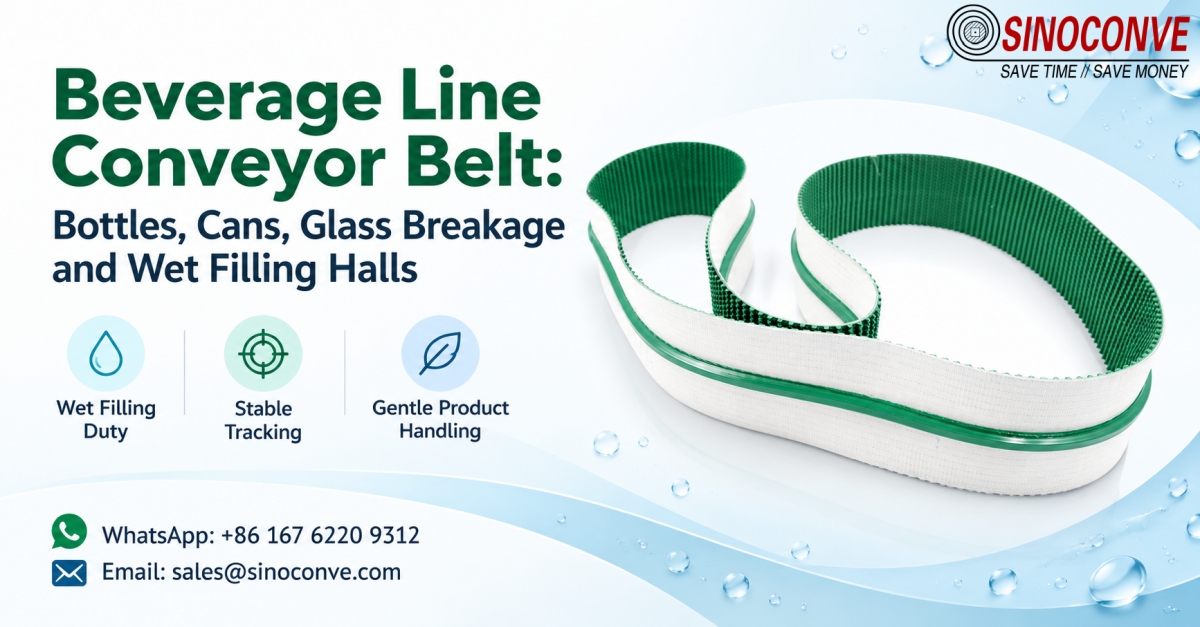
A beverage line punishes a belt in a way that bulk conveying never does. The bottle is light, rigid and top-heavy once filled, and it touches the cover only across a small patch of its base, so the belt is less about carrying load than about keeping an unstable object moving in a straight line through a hall that is wet for most of the shift. Judging that duty by width and price is how a plant replaces the same belt three times in a year.

01Why a Beverage Line Punishes the Wrong Belt Differently
On paper a bottle line is light duty: no rock, no impact bed, and a belt narrower than a person's arm span. What the paper misses is consequence. A stopped filler costs a shift, and one shard carried downstream can wreck a labelling head and contaminate a pallet that then has to be destroyed.
The duty profile is odd. Short centres, high surface speed, water most of the day. Load is trivial. Fatigue is not, because the belt wraps small pulleys and reverses every time the line stops.
Where This Page Ends and Three Related Guides Begin
This site already answers the neighbouring questions, and pointing you at the right page beats repeating it. For hall zoning, staff flow, or how hygiene design shifts between raw and finished areas, the food packaging conveyor line design guide covers it, and this page deliberately does not. For rough-top belting on dry packing runs with cartons and trays, start with the rough top belt guide for packaging and light duty lines; here the only question is whether rough top survives a wet filling hall. For surface patterns as a catalogue, the PVC conveyor belt types selection guide lists them; we skip the catalogue and argue about contact area.
One boundary matters. The lightweight PVC work we do for parcel and tote handling, described in the OEM PVC belt page for logistics automation, is a different duty. A parcel is soft, irregular and dry, and it absorbs a tracking error by deforming; a bottle is rigid, fragile and wet, and it will not. Belts that sort cartons beautifully can be the wrong belt for a filler, which is why we quote the two duties from separate drawings.
02Speed, Accumulation and the Pressure Behind a Jam
Accumulation is where most damage happens and where belt specifications say least. When the machine downstream stops, bottles keep arriving and queue, each one pushed against the next while its base sits on a moving cover. Two regimes follow. The bottles either slide, scuffing the base and polishing the cover, or they grip and tip, loading the rails until the queue shingles into a jam a photo-eye cannot clear.
The Jam That Keeps Pushing After the Photo-Eye Trips
Which regime you get depends on the friction pair between base and cover, and on how much pressure the logic allows. A drive keeps pushing until its torque limit or the stop signal arrives, and the delay between those events compresses the queue. On a short run that load is enough to deform PET and chip glass. The measurement worth taking is standing pressure, read by pulling a bottle out with a spring balance while the belt still runs. If the reading climbs while the line is stopped, the logic is fighting the drive and no belt will fix it.
Transport sections need grip to accelerate a bottle cleanly. An accumulation conveyor belt needs controlled slip, which usually means a lower-friction cover, less support area, or rollers instead of a belt. Where the line is driven through a shaft, the drive belt takes jam torque before the clutch does, and a transmission belt manufacturer sizes it for the peak rather than the running load.
03Glass, PET and Aluminium: Three Different Damage Risks
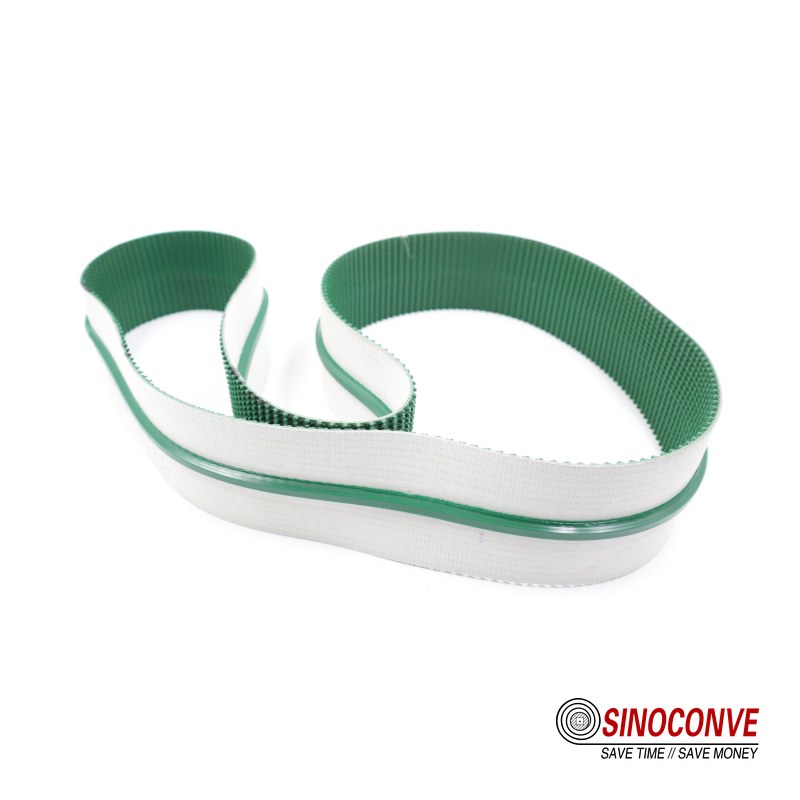
Three packages travel one line and fail in unrelated ways. Glass shatters, PET deforms, aluminium dents, and no cover is best for all three. Specify for the package least tolerant of error on each segment, then confirm it does not ruin the other two.
| Package type and how it loads the cover | First damage mode we look for on site | What the belt surface shows afterwards | Signal that tells you the belt is implicated |
|---|---|---|---|
| Glass bottle with a moulded heel and a narrow standing ring | Chipping and star cracks that begin at the heel during accumulation | Fine glittering dust worked into the fabric and small pits in the cover | Fresh shards appear after every stop rather than after every start |
| PET bottle with a petaloid base and a thin stretched wall | Base creep, white stress rings and leaning bottles in a stopped queue | A polished ring on the cover exactly where the base has been spinning | Bottles rotate in place while the queue is stationary and the belt runs |
| Aluminium can with a thin wall and a rolled base rim | Dents in the side wall and lacquer wear along the base rim | Grey oxide smear that cold water will not rinse away | Rails show bright metal transfer and cans begin to shingle |
Glass turns a glass bottle conveyor into a contamination risk. A shard that lands point-first can stand in the cover and machine every bottle after it; we have pulled covers where one sliver made a new chip every few hundred bottles. Glass dust with wash water is a lapping compound that works into the cut edge and splice.
PET fails quietly. The petaloid base stands on small pads, and sustained pressure creeps them until the bottle leans rather than falls; a base allowed to rotate on a slick cover scuffs a white ring that later becomes a crack origin. Aluminium dents at the rail before it moves, and lacquer worn at the rim oxidises into a grey smear. The logic is the one behind an industrial conveyor belt for stone, and as a conveyor belt manufacturer we settle it on the drawing.
04Wet Filling Halls: Water, Sugar and Syrup on the Belt Surface
A filling hall is wet in three ways, each attacking the belt differently. Rinse water is clean and evaporates. Product spill is sugar, syrup or concentrate, and it does not dry to a harmless powder. Soap-based rail lubricant adds a film neither of the others resembles.
Sugar is the difficult one. As it dries it passes through a sticky phase, and in a humid hall it may never leave it. The film stays tacky, holds glass dust and label adhesive, and turns the cover into flypaper. Dried syrup needs warm water and dwell time, which is why a cold hose at shift end moves the top layer only.
Clean water is not harmless either. A continuous film on a smooth cover drops friction to almost nothing, so the bottle stops being driven and is carried by whatever is behind it. Bottles spin, queues compress unevenly, and the drive pulley slips because the return side is wet. The slip heats the cover, the cover glazes, and glazing lowers friction further.
So the answer is a closed cover, an edge that does not wick, and a pattern that gives water somewhere to go. If the cleaning window is already too short, start with this guide to cleaning schedules and when scrapers stop working. Ask a conveyor belt supplier which of the three fluids the cover was tested against, in writing.
05Belt Surface and Structure for Bottle Stability
Stability is a contact-area problem before it is a friction problem. A PET base stands on a handful of pads, a glass heel on a narrow ring, a can on a rolled rim, so the touching area is a fraction of the footprint and point pressure is far higher than package weight suggests.
| Surface structure and typical cover finish | How a bottle base behaves on it | Where it earns its place on the line | What it costs in cleaning and changeover time |
|---|---|---|---|
| Smooth closed cover with a fine matte or gloss finish | The base slides with little resistance and stays flat in a queue | Accumulation tables, single file runs and transfer plate approaches | Rinses quickly, but a water film can lift the bottle off the surface |
| Evenly spaced dimples or a pebbled embossed pattern | Water escapes into the pattern and the base keeps contact on the crowns | Wet filling halls, rinser outfeeds and any section with standing water | Pattern traps syrup and glass dust, so brushing replaces rinsing |
| Raised rubber nubs on a heavier fabric backed cover | High grip that holds bottles on inclines and stops them spinning | Short inclines, elevators and dry end of line packing sections | Syrup collects between the nubs and the cover is slow to dry |
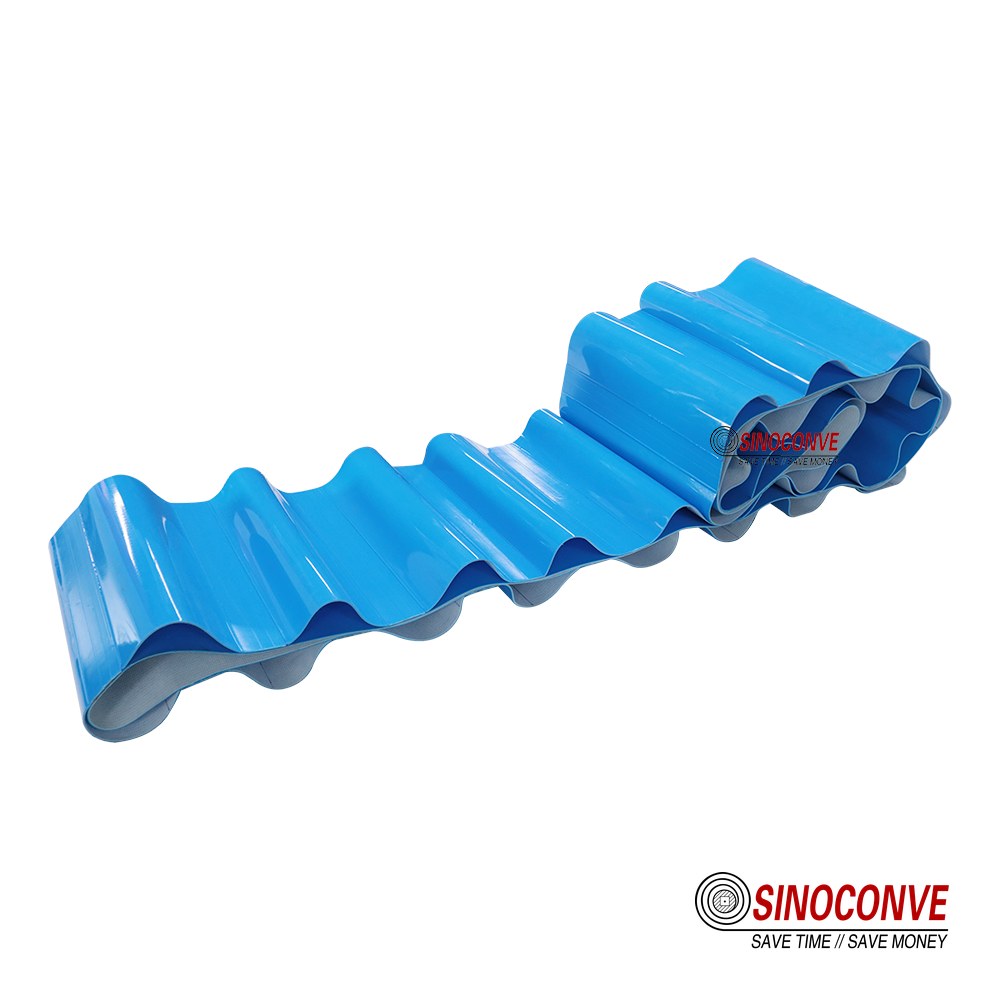
Plain, Dimpled and Rough Top Under a Bottle Base
Grip holds a bottle upright and stops it spinning; it also refuses to let it slide when the queue stops, so pressure goes into the package. A rough-top cover that performs on a dry incline can be the worst choice in a wet hall, because the nubs hold syrup in every valley and the cover never dries.
Field note from our engineers: A beverage plant asked us to look at white rings on PET bases just before the labeller, on a run that stopped often. The belt was a rough-top PVC, chosen years earlier for an incline that had since been removed. Bottles were gripping, tipping slightly, then sliding, and the base was scrubbing on the nub crowns. We replaced the run with a fine dimpled cover and the rings stopped within two shifts.
Dimpling is the compromise most wet halls settle on, because water sits below the contact plane and the base meets material rather than fluid. The cost is cleaning, because a dimple is a small cup. Grouping widths across lines is where the volume saving sits, and the wholesale conveyor belts overview sets those groupings.
06Guide Rails, Wear Strips and Transfer Plates
The rails do the centring, not the belt. On a can conveyor belt its only obligation is a consistent surface; if it has to steer the bottle as well, the rails are already wrong. Worn wear strips are the usual culprit, because they develop a lip that the bottle heel catches, and the correction shows up as a tip-over several metres downstream.
The Transfer Gap That Decides Whether a Bottle Tips
A rail should bear above the centre of gravity of the tallest bottle on the run, otherwise a tall bottle pivots over the strip. Too tight and the bottle is scuffed into a jam; too loose and the file shingles on the first curve. Transfer plates are where bottles tip most often, since the gap grows as the plate wears. Order wear parts from the same drawing as the belt, so the conveyor belt distributor and the plate supplier are not each assuming the other's tolerance.
07Cleaning Windows and Changeover Between Products
Changeover is where a filling line conveyor belt loses its grip. Each product switch needs a wet clean, and the belt is the slowest thing in the hall to dry. A cover with an open structure or a deep pattern holds liquid and releases it into the next product run, which is how a flavour complaint starts.
The Test That Matters Is Drying Time
We ask how long the belt takes from running to clean to dry, and compare that with the changeover window. If drying exceeds the window, the line restarts wet or restarts late, and both cost money. Metal lacing in a wash-down hall corrodes, traps syrup and gives bacteria a place to sit, and the guide to jointing methods covers what to inspect on a bonded joint instead.
08Friction, Static and Noise at Line Speed
Friction on a beverage line is not one number. It changes with water film, sugar loading, cover temperature and how polished it has become. A cover that measures well dry can lose most of its grip after a week of syrup, so we ask for friction data measured wet, with the test method named.
Static, Dust and Sensor Faults on PET Lines
PET is a good insulator, so a bottle sliding on a dry cover can carry a charge that attracts dust, jumps a rail, or confuses a capacitive sensor. Grounding through a conductive cover or a carbon-loaded backing helps; antistatic sprays do not survive a wash-down. Noise at speed comes from small pulleys, rails chattering against bottles, and stick-slip where a slow belt carries a heavy queue. Where the line is driven through a shaft and V-belts, a V-belt manufacturer can supply a profile that transmits the same torque with less slip.
09Tracking on Long, Narrow Bottle Lines
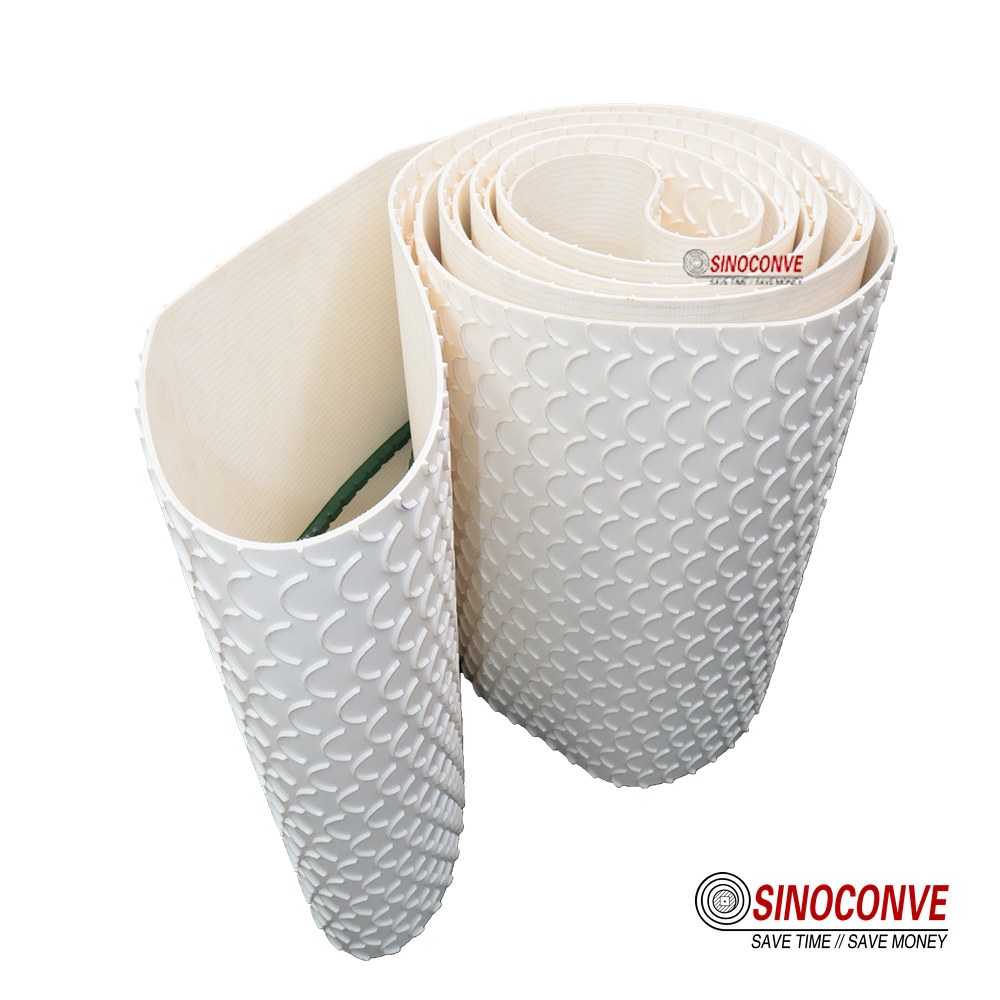
Narrow bottle conveyor belts track badly on short centres. A splice that is a degree or two out of square makes the belt walk sideways, and the shorter the centre distance, the less run there is to absorb the error. On a wide bulk belt that error hides. On a narrow bottle line it shows as edge contact within a shift, and the edge that rubs is the edge that cracks first.
Crowned Pulleys and Short Centre Distances
Small pulleys are usually uncrowned, so tracking depends on alignment rather than on a crown: pulley parallel to the frame, frame square, tension equal across the width. Thermal movement near a capping steam tunnel shrinks one edge more, producing a wander that only appears after warm-up. Tension is the other lever. Too much curls the edge and loads the bearings; too little lets the belt slip, heat and glaze. Set it on a running, wet belt.
10Material Choice: PVC, PU and the Case Against Rubber Here
PVC is the default for bottle lines for reasons that hold up. It is stiff enough to track on short centres, takes a clean closed cover, welds into a reliable splice, and comes in food-contact grades with the right patterns. Its weaknesses are real too: plasticiser migrates, the cover hardens with age and cold, and a belt stored in a cold bay tracks differently on its first day than on its tenth.
PU costs more and earns it in specific places, with better resistance to cuts from glass shards, better flexibility when cold, and a surface that resists glazing longer under sugar. Where the hall is warm and the product is water-based, PVC does the job. The comparison is set out at length in the PVC versus rubber belt comparison for packaging lines.
Why Rubber Is the Wrong Default Here
Rubber grips hard, which is exactly what a queue of PET bottles does not need. It marks light product paths, sheds black debris, and is hard to clean in a sugar hall. A rubber conveyor belt earns its place on the incline out of the hall, not on the filler table. Construction at the conveyor belt factory follows the same rules whatever the cover, so the material question belongs at drawing stage.
11Acceptance and Spares Strategy for a Multi-Line Plant
Acceptance is where a plant gets its money back, because most failures we are called to were visible on the supplier's own bench.
| What we ask to see at acceptance | Document or physical evidence we require | How we test it before sign-off | What a weak answer looks like |
|---|---|---|---|
| Cover hardness measured across the full belt width | A test record from the batch with the method named | We compare our own readings at three points across the width | A single number quoted for the whole roll without a method |
| Splice straightness and thickness build at the joint | A splice record stating press time, temperature and operator | We run the belt and watch the joint cross the smallest pulley | Silence about who made the splice and when it was made |
| Edge quality and seal on both sides of the belt | Samples of the cut edge from the same production run | We flex the edge by hand and look for fabric print-through | A photograph offered instead of a physical sample |
Spares matter too. One pre-spliced spare per critical segment, stored flat, dark and off the floor, rotated oldest first. Standardise widths, but not surfaces across accumulation and transport runs.

12Frequently Asked Questions
Can one belt type serve both transport and accumulation sections?
Rarely, and never without a compromise you will notice at the labeller. A cover with enough grip to accelerate a bottle cleanly holds it too firmly when the queue stops, so the pressure goes into the package. If one cover must do both, choose a fine dimple.
How do we tell whether grip or the rails are tipping our bottles?
Look at where the bottle falls. A tip-over at a transfer plate points at the gap, one in the middle of a queue points at rail height and pressure, and a bottle that leans without falling points at base creep. Marking the belt and watching how far a bottle rotates settles the grip question.
Is rough top ever the right choice in a wet hall?
On a short incline inside the hall, yes, because that section needs grip more than drainage and can be brushed at changeover. On a level accumulation run, no. The nubs hold syrup in every valley, the cover never fully dries, and friction becomes unpredictable. That is worse than steady low grip, because nobody can set a rail or a pressure limit against it.
What causes the white ring that appears on PET bases?
Rotation. A base that spins on the cover scuffs the heel, and the ring appears where the contact pads have been polished. Look at accumulation pressure before ordering a new belt, because a cover change will not fix an over-driven queue.
Do glass and cans need different belts on the same line?
They need different rail settings more than different belts. Glass tolerates grip but not impact, so transfer gaps and plate condition matter most; aluminium tolerates neither side pressure nor a rough surface. Where both run, specify for glass at the transfers and hold rail pressure at the can's limit.
When should wear strips and transfer plates be replaced?
Earlier than most schedules allow, and at changeover rather than at shutdown. A strip develops a lip long before it looks worn, and a plate gap grows by fractions nobody notices until a bottle base finds it. A weekly pass with a straight edge catches both. A new bottle design deserves a full check before its first run.
Which details should go into an inquiry for a beverage line belt?
Package type and base diameter, belt width and centre distance, the highest surface speed, which sections accumulate and for how long, the cleaning chemicals and the water temperature, plus a photograph of the worst transfer. The photograph shows rail condition and plate gap better than a drawing.
Why does a new belt track badly for the first few days?
Because it has not yet been run wet, warm and under load. A belt seats itself on the pulleys as it takes up working tension, and a splice that was square on the bench can look out of square once the frame reaches production temperature. Re-check tracking after the first warm shift rather than during installation.
Related Products You May Need
- PVC conveyor belt for bottle and can handling lines
- Rubber conveyor belt for incline and bulk sections
- Conveyor rollers for accumulation and transfer zones
- Timing belts for filling and capping machine drives