
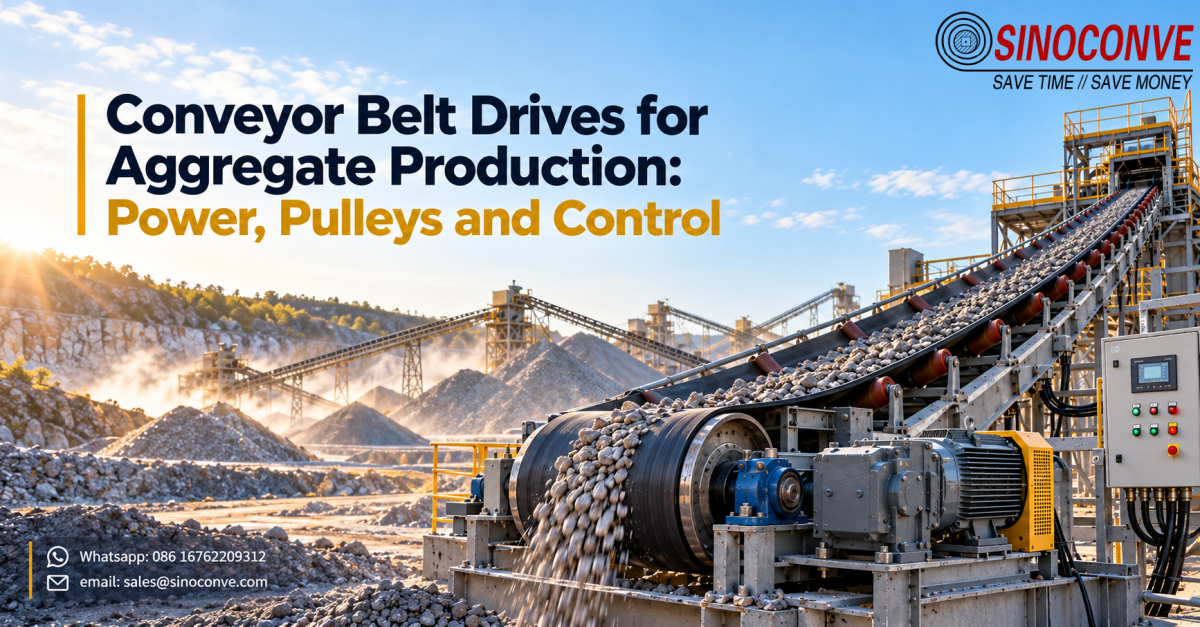
Conveyor drives for aggregate production are not chosen by fixing a motor size and moving on. The drive is set jointly by throughput, lift height, line length and incline, the starting method, and the stop-start sequence of the crushers and screens upstream. When a drive is misapplied, the belt rarely announces a drive fault. You see mistracking, slip under full load, abnormal elongation, and an energy bill that keeps climbing. This guide works through the drive and transmission layer of an aggregate line, from layout choice to acceptance on site, so that procurement and maintenance teams can specify and check a drive with confidence.

01Reading a drive fault before you move to blame the belt
On most aggregate lines we visit, the first complaint is about belt quality, and the symptoms usually point somewhere else. A belt that drifts to one side, slips only when the surge pile empties into the chute, or stretches a hand's width in the first month is responding to the drive and the steel around it. Sorting the true cause takes an afternoon of measurement rather than a replacement order.
Start with the load path. Material leaves a jaw or cone crusher with a particle size spread that shifts hour by hour, and the belt feels that variation as a changing traction demand at the head pulley. A drive sized for the average tonnage but not for the wet morning after a rain, or for the moment a full surge pile discharges into the chute, will slip precisely when the plant is running flat out. We have traced more full-load slip events to a wet, poorly cleaned return side than to a genuinely worn cover.
Three things govern everything downstream of the motor. Throughput in tons per hour, the vertical lift between the loading point and the discharge, and the inclined length of the flight together fix the steady-state tension the belt must carry. Change any one of them in a redesign and the starting duty of the drive changes with it, even when the motor nameplate stays exactly the same.
Drive faults and belt faults leave different fingerprints. A belt that is genuinely under-strength for its duty shows edge damage, short splice life and a cover that wears through in a predictable pattern. A drive that is under-applied shows a wandering, slipping belt running hot at the head end while the belt body itself is still sound. Getting that distinction right early saves real money, and it usually takes nothing more than a tape measure, a tachometer and a careful look at the drive pulley face.
Working with a conveyor belt manufacturer that also understands the drive side of the line shortens this whole process, because the belt and the drive have to agree on tension and pulley geometry before either one is ordered.
Field note from our engineers: A granite plant once asked us to quote a replacement for a belt they described as stretched beyond use. The head pulley lagging had glazed to a glassy sheen, so the drive was pulling far harder than the tension design assumed and the belt was paying for it. Fresh lagging and a cleaning pass on the return side ended the elongation complaint for good.
02Drive layout choices that fit the line
Layout comes before motor selection. Where the drive sits decides how much wrap angle the belt gains around the driving pulley, how running tension splits along the flight, and how hard it is for a maintenance crew to reach a gearbox at three in the morning. Four arrangements cover almost every aggregate conveyor we see, and each one trades something away.
Head single pulley drives and where they fit
The single head pulley is the default for short and moderately inclined flights. It gives decent wrap around the drive pulley and keeps the mechanical package in one place, which simplifies guarding, alignment and grease routes. On a transfer conveyor feeding a screen deck, a single head drive is often the cheapest arrangement to build and the easiest to keep running. Its limit appears on long, steep climbs, where the tension needed to avoid slip climbs faster than one wrap around one pulley can support.
Head dual pulley, head-tail combined and intermediate drives
When traction runs out at the head, the next step is usually more wrap rather than more motor. A dual head pulley adds contact area and shares the drive torque across two shafts, a head and tail arrangement splits the pull between both ends of a long flight, and an intermediate drive cuts a very long line into shorter tension zones. Every one of these adds expense, structure and maintenance surface, so the choice belongs to the specific mix of length, lift and incline rather than to habit.
None of these layouts is free.
Drive placement also changes how the line behaves when it stops. A head-only drive runs the belt into tension at start and lets it relax toward the tail, while a combined drive redistributes tension entirely and must be sequenced carefully during starting and stopping so that one end does not fight the other. We ask for the written starting sequence before we agree on any layout, and we check it against the material already sitting on the belt when the plant shuts down loaded.
| Drive layout and where it usually fits | Site conditions that call for this arrangement | Footprint and maintenance implications seen on site |
|---|---|---|
| Head single pulley drive on short transfer flights | Moderate incline with easy access to one head end | Compact package with the simplest alignment and guarding routine |
| Head dual pulley drive where wrap angle runs short | Steep or long climbs that exceed a single pulley wrap | Two coupled shafts to align and a longer head end footprint |
| Head and tail combined drive sharing one long flight | Very long lines where head-only traction would stay marginal | Two drive stations to maintain plus interlocked control logic |
| Intermediate drive splitting a long line into tension zones | Extended overland conveyors carrying high total tension | Extra structure, walkway and a third maintenance point to service |
Choosing among these arrangements is a question for the site, not for a catalog. A plant running a short, flat transfer conveyor will gain nothing from an intermediate drive, and a quarry with a long uphill flight will struggle with a head-only arrangement no matter how large the motor becomes. As a transmission belt manufacturer working alongside drive builders, we treat layout as the first decision and everything else as a consequence of it.
Maintenance access is a design input, not a luxury. A gearbox tucked behind a chute may be aligned perfectly on commissioning day and then neglected for two years, because nobody wants to climb into a tight space with a grease gun. We ask where the crew will stand, how a shaft will come out, and how the coupling will be checked, and we treat those answers as real constraints on the layout rather than afterthoughts.
Field note from our engineers: A limestone quarry kept adding motor power to a long overland conveyor that slipped on wet days. Splitting the line with an intermediate drive and cutting the maximum tension did more than any motor change; the slip stopped and the extra power was never needed.
03Motor, gearbox and pulley selection criteria
With the layout settled, the drive train itself comes under scrutiny. We treat motor, gearbox and pulley as one chain, because each element constrains the other two and the belt usually pays for a mismatch. The aim here is not to derive transmission formulas. It is to define the criteria and the interfaces so a plant can brief a supplier with real numbers instead of adjectives.
Starting torque margin and the risk of a stalled start
A loaded aggregate belt is hardest to move from rest. Frozen or wet material, a partly buried tail pulley and the inertia of a long flight combine to demand far more torque at start than during steady running. The starting torque margin is the gap between what the motor and gearbox can deliver and what the loaded belt actually needs, and a thin margin shows up as a stalled start, a tripped breaker or a belt that shudders into motion.
A stalled start is expensive evidence.
Where a plant has never measured its starting load, the honest position is that the margin is unknown. We ask for a direct measurement of starting current and a written statement from the drive supplier of the expected starting torque, both referenced to the same operating condition. Any figure quoted without those references should be treated as a placeholder rather than a design input.
Choosing between a VFD, a soft starter and direct-on-line
The starting method shapes both mechanical life and grid behavior. A variable frequency drive controls acceleration, keeps starting current low and allows a gentle start even with a fully loaded belt, with the trade-off of electronics that must tolerate dust, heat and humidity. A soft starter is simpler and cheaper to keep running, though it gives no running speed control. Direct-on-line starting is the cheapest to install and the hardest on the belt, the gearbox and the local supply, so it suits short, lightly loaded duties where the belt can be started empty.
Each option carries its own failure profile.
Our default recommendation for a long inclined flight fed by a crusher is a controlled start, because belt damage from repeated hard starts accumulates quietly and then appears as a splice failure or a stretched carcass. On a short transfer conveyor that can be cleared and started empty, direct-on-line starting is often perfectly adequate. The decision belongs to the duty, and it should be written into the specification rather than left to whoever builds the panel.
How pulley diameter and wrap angle limit belt plies
Here the drive reaches back into the belt body. A large drive pulley with a generous wrap angle lets the belt grip with lower tension, which in turn allows a lighter carcass. A small pulley with a short wrap demands higher tension to avoid slip, and higher tension pushes the belt toward more plies or a stronger cord. That is why a drive redesign that shrinks the head pulley can quietly force a heavier, stiffer belt onto the same line, and why the two decisions should never be made in separate rooms.
The relationship between tension, plies and pulley geometry is worked through in our guide to EP belt selection for stone crusher and aggregate plants; here we only need to note that the drive sets the floor for the belt.
An industrial conveyor belt chosen without reference to drive geometry is a belt waiting for an early replacement. The same logic applies to the smaller transmission between motor and gearbox, where our notes on the banded V-belt for crusher drive and heavy-duty machinery cover the belt that carries torque into the reducer. As a V-belt manufacturer, we treat pulley diameter and wrap angle as the two numbers that must be agreed before either the belt or the drive is ordered.
Gearbox selection deserves its own moment. A reducer rated for steady output can still become the weak link if it was chosen for average torque rather than peak torque, and on a crusher-fed line the peaks arrive often. The service factor printed on the nameplate tells you how much shock the reducer is meant to absorb, and it is one of the first things we confirm when a plant reports repeated coupling failures.
| Criterion to confirm with the drive supplier | What it changes on the belt we select | What it changes on the drive train |
|---|---|---|
| Starting torque margin under a fully loaded belt | Shortens or extends the peak tension the carcass must survive | Decides whether the motor can break the belt from rest |
| Drive pulley diameter against the minimum bend radius | Sets the smallest pulley the chosen carcass can safely wrap | Limits how compact the head end package can be built |
| Wrap angle available at the main driving pulley | Determines how much tension the belt needs to avoid slip | Decides whether more motor torque can be transmitted at all |
| Acceleration time allowed by the chosen starting method | Governs the transient tension spike at every single start | Sets the thermal and electrical duty on the starter |
| Service factor of the gearbox at the real duty | Protects the belt from shock loads carried through the drive | Sets realistic overhaul intervals for the reducer |
| Efficiency class stated for the motor and gearbox | Changes how much of the input energy reaches the belt | Feeds directly into the plant's running energy use |
| Take-up device travel and the type of tensioner fitted | Maintains the tension the drive assumes it already has | Absorbs the elongation the drive introduces over time |
04Slip and mistracking are two different problems
This is the part of the drive conversation that saves the most money. Slip and mistracking both look like a belt that is misbehaving, yet they sit on different branches of the same fault tree. Treating one as the other is how plants end up pouring tension into a line that never needed it.
Slip is a traction problem at the driving pulley
Slip happens where the drive meets the belt. The pulley turns but the belt lags behind it, so the surface scrubs, heats and polishes while throughput quietly drops. The causes cluster tightly: too little traction between pulley and belt, too small a wrap angle, lagging that has glazed or worn smooth, or simply too little running tension to develop the grip the load demands.
None of those is a belt-body defect.
We confirm slip by comparing pulley rim speed with belt speed under load, and a difference that grows with tonnage is the signature. Inspecting the drive pulley face tells the same story without instruments, because the polished band is exactly where the belt has been scrubbing. Our EP conveyor belt tracking guide is useful here as a cross-check, since a belt that tracks well at low load and wanders only when loaded often has a traction issue rather than a geometry one.
Mistracking is a geometry problem along the whole line
Mistracking is different in kind. The belt leaves its centered path somewhere along the structure, and the causes are geometric or loading-related: pulleys mounted out of parallel, an idler frame knocked skew, a structure that is not square, or material dropped off-center in the loading zone. A tracking belt can be gripped perfectly by its drive and still wander, and a slipping belt can wander because of the heat and friction it generates. The two faults coexist often enough that the diagnosis has to be taken step by step.
| Symptom you can observe on site | Slip as the more likely underlying cause | Mistracking as the more likely underlying cause |
|---|---|---|
| Belt runs slow under load and speeds up when empty | Traction or tension fails to develop enough grip | Rarely explains a purely speed-related change |
| Shiny polished band appearing on the drive pulley face | Belt is scrubbing because the pulley outruns it | Not a normal signature of a tracking fault |
| Belt steers to one side only in certain sections | Can appear locally where a pulley has lost grip | Points to skew frames or out-of-parallel pulleys |
| Drift changes whenever the loading point moves | Unlikely unless the change alters total tonnage | Strong sign of off-center material loading |
| Heat and rubber smell at the head after a hard start | Consistent with heavy slip during acceleration | Would not normally generate drive-side heat |
| Belt wanders more on wet or dusty days | Wet lagging reduces the friction available | Wet carryback changes belt path and weight |
When a belt misbehaves, the reflex on many sites is to wind up the take-up and add tension. That reflex is dangerous when the real fault is mistracking, because extra tension stiffens the belt, raises the load on every idler and pulley bearing, and can make a crooked line track worse rather than better. On a slip fault the same adjustment may help for a shift, but if the underlying issue is glazed lagging or a short wrap angle, the plant simply runs at a higher tension than the design intended and pays for it in bearing life and belt fatigue.
A practical way to separate the two faults is to change one variable at a time. Reduce the load on the belt and watch whether the drift changes; if it does not, the cause is probably geometric. Clean and dry the drive pulley and watch the slip; if the belt grips again, the cause was traction rather than alignment. Two short tests, run in the right order, usually settle the question before anyone reaches for a wrench.
Measure first, then adjust.
Field note from our engineers: A plant with a chronic drift problem had wound its take-up almost to the end of its travel chasing the fault. The belt had never been off-center because of tension; a bent idler frame a few bays upstream was steering it. Straightening the frame and backing off the tension cured both the drift and a persistent bearing whine.
05How pulley lagging and belt cleaning change the drive
What lagging actually does to the friction coefficient
Lagging is not decoration. It raises the friction available between the drive pulley and the belt, and that single change ripples through the whole tension calculation. Better grip means the belt can transmit the same torque at lower tension, which reduces the load on the carcass, the bearings and the take-up. When lagging glazes, wears smooth or sheds in patches, the drive loses that grip and slip returns even though nothing else on the line has changed.
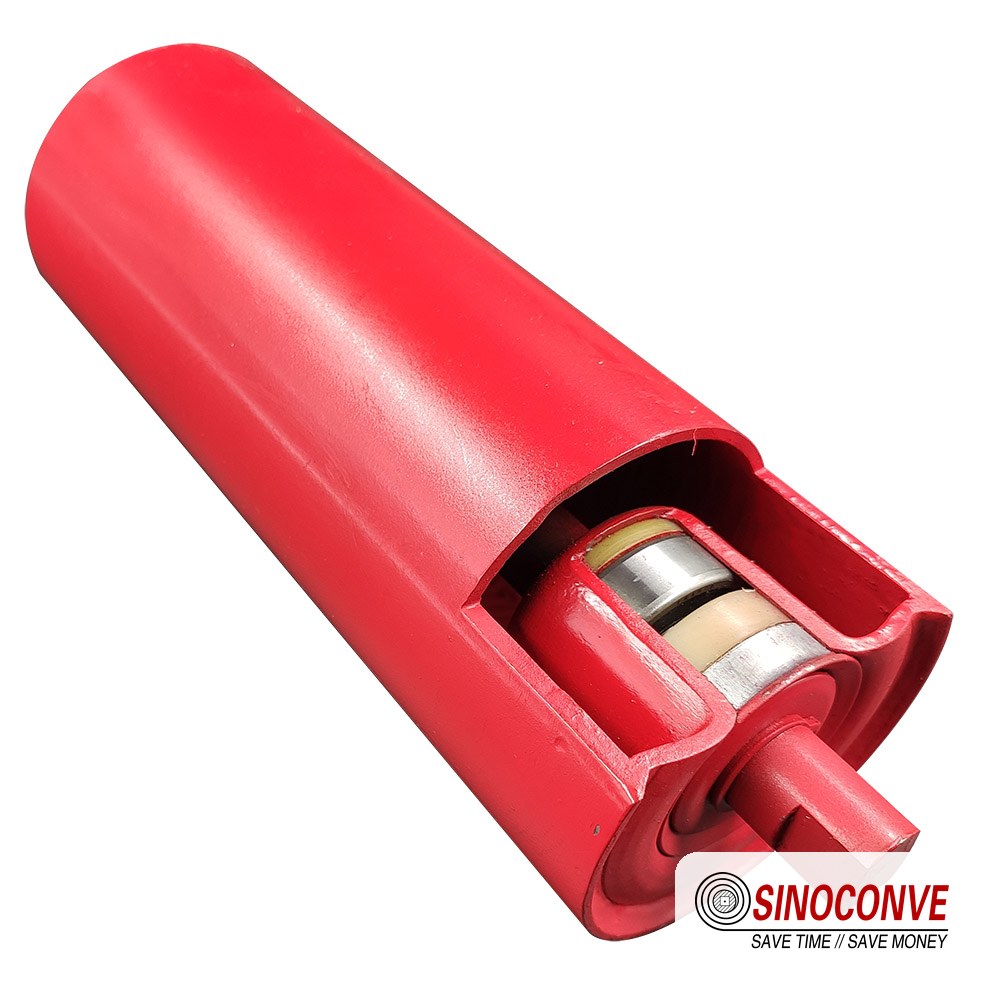
Material choice matters as much as presence. Rubber lagging grips well across a wide range of conditions, while grooved or ceramic patterns help where the pulley sees water, fines or oil. Whichever is chosen, the plant should be able to state the material and the pattern on the drawing, because a replacement pulley ordered without that detail will behave differently from the one it replaces.
Lagging wears, so it belongs on the inspection round.
Why the return side decides the load the drive sees
Carryback is one of the biggest hidden loads on an aggregate drive. Material that sticks to the belt after discharge rides back on the return strand, adds weight the drive must move, builds up on return idlers and the tail pulley, and feeds the very mistracking a plant is trying to cure. A scraper worn down to its backing, a badly placed secondary cleaner or a chute spilling fines onto the return belt will all show up as higher current draw and a heavier, dirtier return side.
Good cleaning is therefore a drive measure, not just housekeeping. We have watched a plant's running current settle once the return side stopped carrying a steady trickle of fines, without a single change to the motor or the belt. Cleaning hardware wears like everything else, so it belongs on the same round as the lagging.
Our notes on conveyor carryback solutions and on return-side belt cleaning go deeper into scraper selection and positioning, and they are worth reading alongside this section whenever carryback is a live problem on the line.
06Aggregate-line environment and the reliability it demands from drives
Dust, thermal cycling and the wet season
Aggregate plants are hard on drives for reasons that have nothing to do with tonnage. Fine dust works into bearings, cooling fins and terminal boxes, and in summer it bakes onto hot surfaces. Open-air installations swing from cold nights to hot afternoons, so metal and lagging expand and contract daily and bolted joints slowly loosen. The wet season adds the last variable, raising the weight of the load, cutting the friction at the drive pulley and turning fines into a paste that clings to the return side.
The crusher end of the line injects shock loads straight into the drive train. A large lump entering the chamber, a momentary jam or a surge of material from the primary stage all translate into torque spikes that travel back through the belt and the gearbox. Controlled starting and gentle acceleration blunt those spikes while uncontrolled starting amplifies them, which is one reason a controlled start earns its electronics on a crusher-fed line even when the steady-state duty looks modest.
We treat the drive enclosure as part of the specification. Dust-tight boxes, proper cable glands, breathing arrangements that do not invite dust, and a motor frame that can shed heat without a mat of fines on it are simple choices that decide how many years the electronics survive. A rubber conveyor belt will outlast a poorly housed drive panel by a wide margin, and our notes for dust-resistant conveying in fine-dust environments pick up the same theme from the belt side.
Seasonal planning helps more than any single upgrade. Plants that service lagging, scrapers and bearings before the wet season starts deal with far fewer slip and carryback events during it, and the pattern repeats every year for anyone who reads the maintenance log. The pattern is predictable, and that is the whole point.
07The interface checklist that connects the drive to the belt
Most of the expensive misunderstandings we see on aggregate lines come down to information that never crossed between the drive engineer and the belt supplier. One document describes the mechanical duty; the other describes the belt that must survive it. Unless the two are read together, somebody is guessing.
What the belt supplier needs from the drive engineer
Before a belt can be selected properly, a conveyor belt supplier needs the fields that define the duty, not just the headline tonnage. Tension at the drive and at the take-up, the minimum pulley diameter the belt must bend around, the wrap angle at the drive pulley, the splice position and strength expected and the cover grade the material demands all belong in the same request.
Why both documents must reach the same supplier
Splitting the belt and the drive across two suppliers who never compare notes is how a plant ends up with a belt that meets its own datasheet but not the geometry of the drive beneath it. When one team holds the belt details and another holds the pulley sizes, the mismatch surfaces only at commissioning. Handing both to the same supplier, or at least to the same review, is the cheapest insurance available against that outcome.
| Field the belt supplier must receive | Where that number comes from on the project | What goes wrong when it is missing |
|---|---|---|
| Running and starting tension at the drive pulley | Drive design calculation for the heaviest loaded condition | Belt is selected for too light a duty and fatigues early |
| Minimum pulley diameter the belt has to wrap | Head, tail and bend pulley drawing set | Carcass is bent below its limit and cracks at the pulley |
| Wrap angle at the main driving pulley | Drive layout and pulley position drawing set | Belt needs more tension than the drive can properly tolerate |
| Splice position and the strength it must develop | Line layout with pulley spacing and take-up travel | Splice lands on a pulley and fails before its time |
| Cover grade dictated by the conveyed material | Material size, abrasiveness and moisture survey results | Cover wears through long before the carcass is spent |
| Take-up travel expected across the whole service life | Drive tension calculation plus belt elongation estimate | Take-up runs out and the belt cannot be kept tracking |
Our notes on aggregate conveyor vulcanizing cover how the splice is executed and checked once the belt is on site, and the sand washing conveyor belt supplier page deals with the wet end of an aggregate plant, where the belt choice shifts again. Both are worth reading before a new line is specified, because a splice requirement and a wet-duty cover both belong in the same interface document we just described.
08How this article differs from our belt-body selection pages
The aggregate cluster on this site already covers the belt body in detail, and this article deliberately stays on the drive side of the fence. Knowing which page answers which question saves a lot of back-and-forth between a plant and its suppliers.
The belt-body questions those pages already answer
If your question is about EP grade, ply count, cover thickness or the fabric-versus-steel-cord decision for a stone crusher line, the belt-body pages handle it. Our guide to EP conveyor belt selection for stone crusher and aggregate plants works through carcass and cover choices for the exact material and abuse a crusher feed delivers. A companion piece on quarry crusher conveyor belt selection deals with the impact and cutting conditions at the loading zone, where the belt body takes its hardest hits.
What the drive layer adds on top
This article picks up exactly where those stop. Layout, motor and gearbox criteria, starting method, lagging, the drive-to-belt interface and the acceptance tests are decided at the drive end, and they set the tension and pulley limits the belt body has to live inside. A plant can choose the perfect carcass and still fail if the drive forces it past its minimum pulley diameter or runs it at a tension the structure was never built for.
Buyers sourcing wholesale conveyor belts meet the same interface question from the other side, and anyone auditing a new source can see what comes off our line by reading about our conveyor belt factory. Keeping the belt body and the drive layer separate on paper, and joined on the drawing, is how both pages stay useful.
09Energy use and the changes that actually reduce it
Where the energy actually goes
Energy on an aggregate conveyor leaves through a handful of doors. Lifting material against gravity takes the largest share on any inclined flight, and that part is fixed by the duty. Friction in idler bearings and belt flexing takes the next slice and grows with poor alignment and over-tensioning. Slip wastes energy as heat at the drive pulley, and long stretches of running empty waste it for no product at all.
Because the mix is known, the levers are known too. Reducing slip by fixing lagging and wrap angle recovers energy at once.Keeping the belt aligned and the idlers free-running cuts friction losses, and avoiding long no-load running through control logic or scheduling removes waste that no belt change can recover. Choosing a drive form with better transmission efficiency shifts the last few percent.
We do not publish efficiency figures, because the honest answer depends on the specific motor, gearbox, loading profile and duty cycle and must be confirmed by design calculation and the manufacturer's specifications. What we will say is that the cheap wins come from stopping obvious waste before they come from replacing hardware.
Roller and pulley condition deserves a mention here, because a conveyor roller that has seized or is running rough turns directly into current draw. A conveyor belt distributor who understands the drive layer will raise roller condition in the same conversation as belt selection, and our general product catalog shows the wider set of components a line can be assembled from.
Load control is the other quiet lever. A belt that runs partly full for most of its life wastes the same friction and flexing energy as a full one, so matching the feed rate to the crusher output rather than running wide open is worth a look. That is a control decision rather than a hardware decision, and it takes almost nothing to correct.
10Procurement requirements and the site acceptance tests that matter
What to put on the request
A drive enquiry should ask for more than a motor rating. We want the motor and gearbox nameplates with their efficiency class stated, the pulley lagging material and pattern named, the take-up device type and its full travel, and a list of the protection devices fitted, including over-speed, belt alignment, blockage and thermal protection. Those items decide how the line behaves in its second and third year, long after commissioning day is forgotten.
Site acceptance tests we ask for
Acceptance is a sequence rather than a single handshake. We record the no-load current and a noise baseline before any material flows, then run one full-load start and watch the starting current and the belt for shudder. Alignment is checked by watching the belt over a full circuit rather than a single pass, and the temperature rise at the gearbox and the drive pulley bearings is logged after a sustained run. Any drift from those baselines later becomes a trend line instead of a mystery.
Protection devices should be tested deliberately, not merely installed. Tripping an alignment switch on purpose, at a safe moment with the line empty, proves the interlock works and shows the crew what a real fault will look like.
We also recommend keeping the acceptance record. Once the no-load current, the noise reading and the bearing temperatures are written down, every later shift has a reference point. A small rise over several months is a warning; without the baseline, the same rise looks like nothing until a bearing finally fails.
11The common mistakes we see again and again in drive work
A drive upgrade that moved the problem
The most common mistake is treating a symptom as a capacity shortfall. A plant adds a larger motor to cure slip, and the slip disappears into a heavier belt that now over-tensions the take-up and overloads the idlers. Or a head pulley is shrunk to fit a new gearbox, and the belt is quietly forced past the minimum bend radius it was built for. Upgrades should start from a measured fault, not from the nearest bigger part.
A close second is skipping the interface review between drive and belt. When the drive drawing and the belt datasheet are never laid side by side, the mismatch waits until the first loaded shift. A short review meeting is trivial next to the expense of a belt that was never going to fit the pulleys it had to run on.
12Bringing the whole drive picture together
A conveyor drive on an aggregate line is a small system, not a single component. Layout fixes the wrap angle, the wrap angle fixes the tension, the tension fixes the belt carcass, and the starting method decides how hard all of it is hit every time the plant comes up. None of those decisions is expensive to get right at the drawing stage, and all of them are expensive to get wrong after commissioning.
The practical sequence we recommend is short. Measure the real duty, choose the layout for the actual length and lift, define the starting method against the crusher sequence, write the drive-to-belt interface into one document, and check the finished installation against a recorded baseline. Everything else follows from those five steps.
Working with a manufacturer that builds both the belt and the transmission side of a line removes a whole class of mismatch before it can even start. Whether you are planning a new line, a drive upgrade or a belt replacement on an aggregate conveyor, getting the drive and the belt into the same conversation early is the single most valuable step you can take.

13The questions we are asked most about aggregate conveyor drives
How do I size a conveyor drive for an aggregate plant?
Start from the duty, not the motor. Throughput, lift height, line length and incline set the running tension, then the starting method and the material on the belt set the starting demand. The final figures come from a design calculation tied to the actual equipment parameters, so treat any single-number answer with suspicion.
When is a dual pulley drive needed?
A dual head pulley usually earns its place when the wrap angle around a single pulley cannot transmit the required torque without pushing tension higher than the belt and the take-up can comfortably accept.
Why does my conveyor slip when fully loaded?
Full-load slip almost always means the drive cannot develop enough grip at the moment of highest demand. Check the drive pulley lagging for glazing, confirm the wrap angle, and measure running tension against the design value. If the return side is wet or carrying fines, clean it before you touch the take-up. Adding tension first can hide the fault while making the bearings and the belt suffer.
Does a VFD help on aggregate conveyors?
A variable frequency drive helps most where the belt starts loaded, where the grid cannot take a hard start, or where the line benefits from a controlled ramp up and down. It adds electronics that must survive dust, heat and humidity, so on short conveyors started empty a soft starter is often the simpler choice.
How does pulley lagging affect capacity?
Lagging changes the friction available at the drive pulley and therefore the tension needed to move a given load, so better grip lets the belt carry its rated tonnage at lower tension while worn or glazed lagging does the opposite.
Can I add a drive to an existing line?
Yes, and it is a common way to cure slip on a long flight without buying a bigger belt. An added drive changes the tension distribution along the whole conveyor, so the whole line has to be reviewed for pulley loads, take-up travel and control sequencing. The belt itself must be checked against the new pulley geometry. Done without that review, an added drive simply relocates the problem.
Why does the belt drift after a drive upgrade?
A drive upgrade changes the forces on the belt, and faults that were hidden can suddenly surface. If a pulley was replaced, it may sit slightly out of parallel with its partners, and the belt will follow the geometry rather than the drawing. Higher tension can also straighten a belt that was tracking acceptably at lower tension. Check pulley alignment and frame squareness first. Then recheck the loading point for off-center material.
What should I collect before ordering a belt for a new drive?
Collect the running and starting tension, the minimum pulley diameters, the wrap angle at the drive pulley, the splice requirements and the cover grade the material demands, then hand that one package to a single supplier for selection.
Related Products You May Need for Aggregate Conveyor Drives
- Conveyor rollers and pulleys built for aggregate conveyor lines
- Rubber conveyor belts for crusher feed and transfer duty
- EP fabric conveyor belts built for tough aggregate duty
- V-belts for crusher drives and other heavy-duty machinery
- Full product catalog for conveyor and transmission belt lines
Related Blog Posts on Conveyor Drives for Aggregate Production
- EP conveyor belt selection for stone crusher and aggregate plants
- Quarry crusher conveyor belt selection for heavy impact duty
- Aggregate conveyor vulcanizing along with on-site splice acceptance checks
- EP conveyor belt tracking guide for aggregate conveyor lines
- Conveyor carryback solutions for return-side material control on site
- Banded V-belt for crusher drive and other heavy-duty machinery