
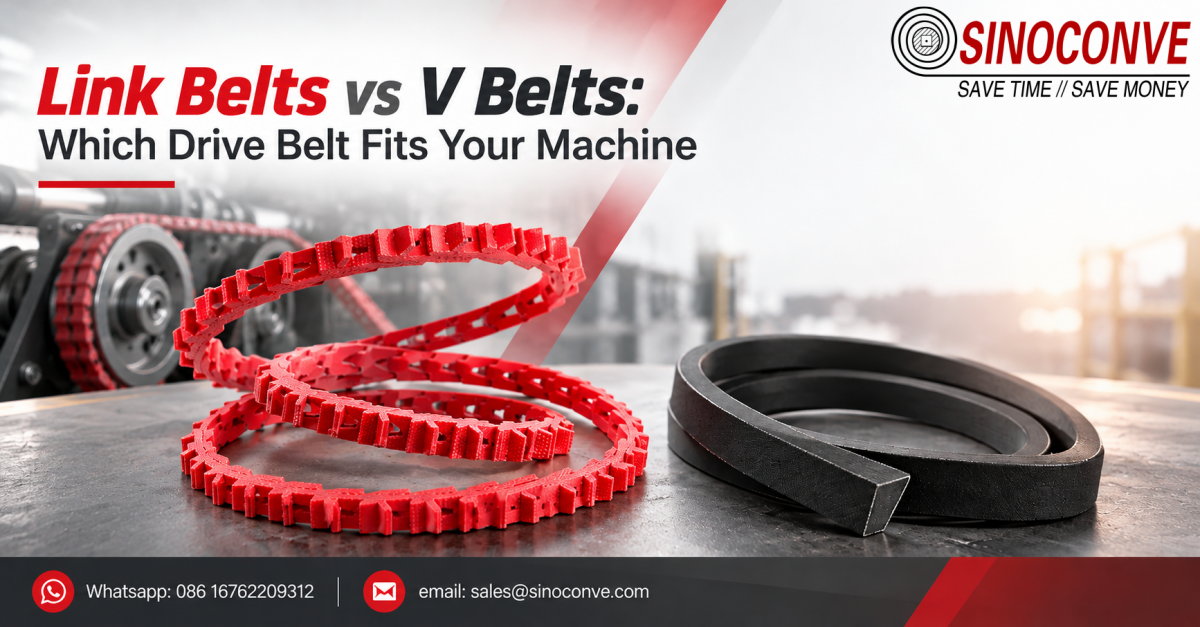
A link belt and a V belt solve two different problems, and confusing them is why the same drive keeps coming back down. A link belt, assembled from detachable links you join on the machine, is a downtime and inventory answer: it goes on without pulling the shaft, it trims to length one link at a time, and a single box of links can cover several drives across a plant. A V belt, cured as one endless ring that grips the pulley groove, is an efficiency and life answer: it runs quietly at speed, holds tension, and carries more load in the same footprint. Which one belongs on your machine comes down to five things, and we walk through all of them below: what a stop actually costs you, whether the drive can be reached, the speed and load it runs at, the environment around it, and how much service life that drive still has left.

01Why This Choice Comes Down to Downtime and Efficiency
Almost every drive belt question that reaches our desk lands in one of two buckets. The first is a machine that has to run again tonight, usually in a corner where nobody wants to pull a bearing or break a coupling. The second is a machine that logs thousands of hours a year and punishes anything that slips, heats up or creeps longer. A link belt earns its keep in the first bucket; a V belt earns its keep in the second. Most of the arguments we settle on site come from someone forcing one belt into the other bucket because a supplier or a storeroom only carried one of them.
You can put a link belt on a drive built for a V belt, and you can go the other way. Whether you should is the entire question.
Two figures usually decide it before anyone starts comparing brands. One is the cost of a stopped line, counted in the tonnes that do not move while a crew waits for a part. The other is the duty the drive actually performs, counted in the hours it turns and the shock it takes each shift. Put those two on the table and the choice is rarely close. What follows is how we run that comparison for mining, quarry, cement, port and EPC customers who call us after a belt has already failed once.
Field note from our engineers: On a quarry screen drive we once watched a maintenance team rebuild a link belt four times in one shift because the belt kept throwing links. The drive turned fast and shocked hard. The right answer was a proper endless belt and a spare ring on the shelf, not a link belt that promised a fast repair. The link belt had solved the wrong problem very well.
02What Each Belt Actually Is
Strip away the sales language and the two products are built in fundamentally different ways, and that single difference explains nearly every behavior we talk about later on this page. One is assembled on the machine from parts; the other is cured as a finished loop. Everything else, from how it stretches to how it fails, follows from that split.
A Link Belt Is Assembled From Separate Links
A link belt, sometimes called a detachable link belt or a link V belt, arrives as a stack or a reel of individual links that you join with pins as you thread the belt around the pulleys. Each link is a short moulded segment with a tab and a slot on the ends, and the pins hold the chain together. Because the segments separate, the belt can be built in place and shortened one link at a time, which is exactly the behavior that saves a plant when a drive sits behind a guard, under a chute or inside a tight enclosure.
A V Belt Arrives as an Endless Ring
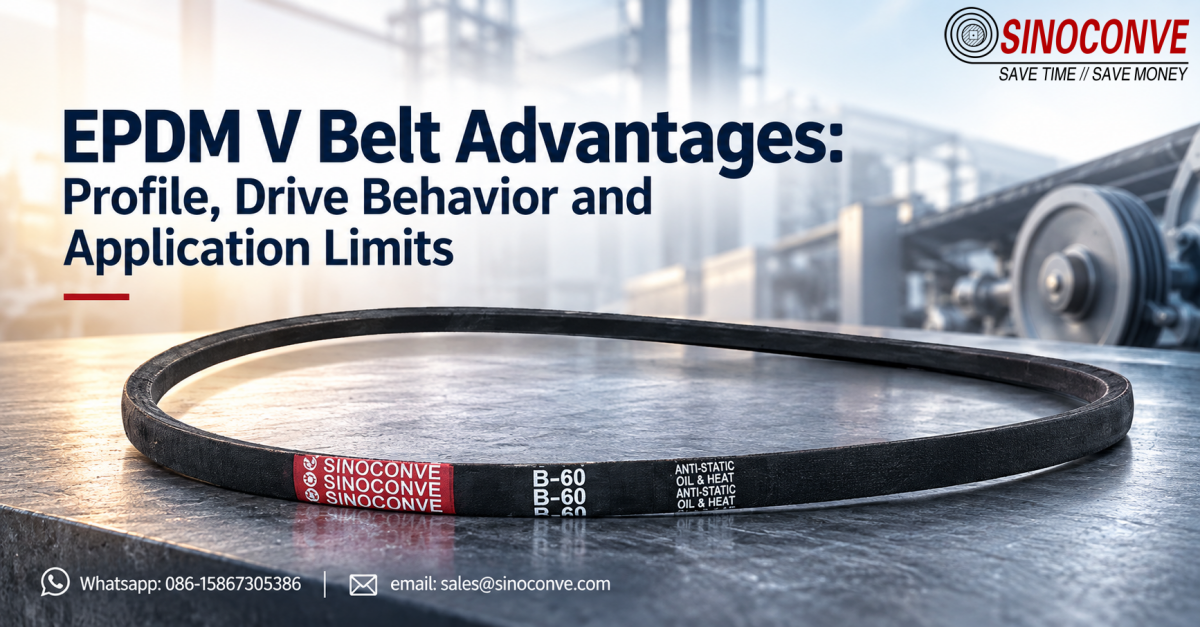
A V belt is cured as one continuous ring with no joint anywhere in the loop, and its wedge-shaped cross-section seats into a matching pulley groove to transmit force through friction. That single piece of construction is why a V belt holds its length, runs smoothly at speed and needs far less re-tensioning over its life. It also means the length is fixed at the factory, so a wrong length cannot be corrected on site and a spare has to match the drive exactly. If you need to identify an unfamiliar belt before ordering, that job belongs on a separate page, and our V belt size and cross reference guide covers the codes without repeating them here.
The table below sets the two builds side by side at the level that matters for a purchasing or maintenance decision, and it is the frame we use for the rest of this article.
| How the belt is built before it reaches the drive | What that build does to the way it runs | The kind of duty where this build usually ends up |
|---|---|---|
| A link belt reaches you as a stack or reel of loose links joined by pins. | Because the links separate, the belt can be built on the machine and shortened one link at a time. | It tends to end up on older drives that are hard to reach and painful to stop. |
| A V belt is cured as one continuous ring with no joint in the loop. | The unbroken ring grips the groove along its whole length and holds length far better under load. | It usually ends up on main drives that run long hours at speed under steady load. |
| A banded belt groups several strands so they share one heavy drive together. | Sharing the load stops one strand snatching ahead of the others when the load pulses. | It is chosen for crusher and mill drives where shock and heavy load arrive together. |
03The Situations Where a Link Belt Genuinely Wins
We sell both products, so we have no reason to oversell either. The honest position is that a link belt wins in five situations, and in those five it wins clearly enough that no amount of V belt quality will rescue the alternative. The rest of the time it is a compromise. Recognizing which situation you are standing in is the whole skill.
Installing Without Dismantling the Shaft
The first real advantage is access. To fit an endless belt you normally have to move something: slide the motor, strip the guard, pull a bearing, drop a shaft, or split the coupling so the ring can be threaded over a pulley. On a drive tucked inside a frame or under a chute, that is a day of rigging and a lot of risk. A detachable link belt threads around the pulleys link by link and joins on the spot, so the machine never comes apart. For a cramped drive on a machine you cannot afford to open, that single point often ends the discussion before speed or load is even mentioned.
Trimming Length and Carrying One Spare
Length is the second advantage, and it is quieter but just as useful. Because each link adds a fixed amount of length, you can tune the loop to the drive instead of forcing the drive to accept a factory length, which matters when a take-up is already near the end of its travel. The same property cuts the spares a plant has to hold. One reel of links can be trimmed to fit several different drives of similar section, whereas an endless belt demands one exact spare for every distinct length on site. Storerooms that run lean feel that difference more than anyone.
Installation needs almost no special tooling.A pin punch, a soft mallet and a knife to trim a link are usually enough, and a fitter who has done it twice can rebuild a drive in the time it takes to fetch a crane for the endless alternative.
Emergency Repair and Low-Speed Duty
Emergency repair is where link belts have saved more production than any marketing claim ever could. When a V belt fails on a Friday night and the replacement is two days away, a link belt already on the shelf puts the machine back to work, at reduced duty, until the correct ring arrives. That is a temporary bridge, not a permanent cure, and we always say so plainly. The duty it suits best while it bridges is a drive that turns slowly, carries a moderate load and does not shock, such as an older fan, a small conveyor drive or a slow pump. At those speeds the periodic impact of the links stays mild and the belt behaves well. We build link belts and endless belts on the same floor, and a conveyor belt factory that makes both can tell a buyer honestly which one a given drive wants.
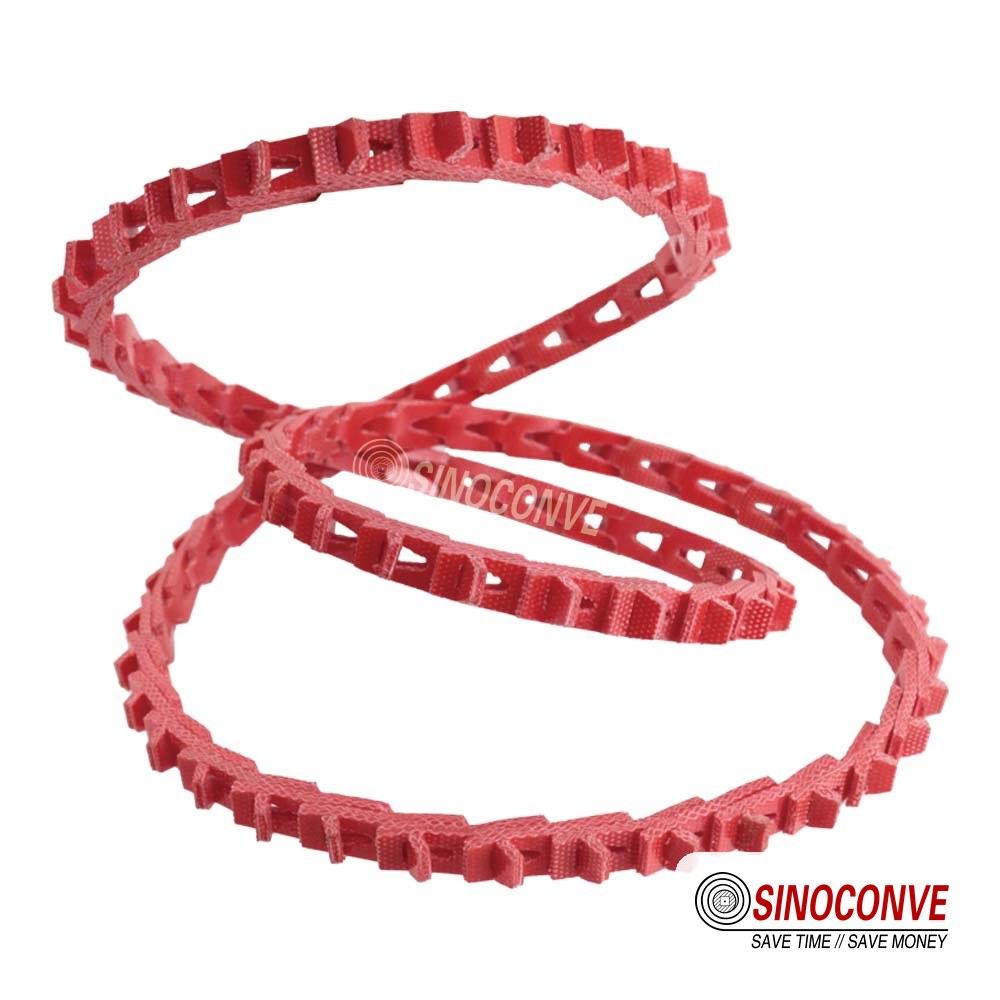
A link belt arrives as separate segments, which is what lets a fitter build it in place without opening the drive.
The fifth advantage is invisible until it is needed: an inventory strategy that fits the real world. Plants that keep one reel of links and a handful of pins cover a surprising number of drives, and they stop writing off whole shelves of belts that were bought for machines since sold or rebuilt.
04Where Link Belts Lose: Speed, Vibration and Noise
Now the other side, and this is the part of the story that appears in a link belt catalogue only in small print. A link belt is not simply a V belt in pieces. The joints between the links change how the belt behaves the moment it starts to turn fast, and on a high-speed drive that change is decisive.
Periodic Impact at Every Link Joint
Every link joint is a small interruption in an otherwise smooth belt. As the belt wraps a pulley, each joint passes over it in turn and delivers a tiny repeating knock. At low speed the knock is harmless and you will not hear it above normal plant noise. Raise the speed and the frequency of that knock climbs until it becomes a steady, buzzy vibration, and that vibration travels straight into the bearings, the pulley and the machine frame. A chain of links running fast is a chain of little hammers, and the faster it runs the harder each one lands.
Vibration is also a diagnostic you should learn to read rather than ignore. A link belt that has suddenly started to hum has usually lost tension, thrown a link, or picked up a worn pin, and continuing to run it at speed turns a cheap fix into a bearing job. When a customer tells us a link belt is loud, our first question is always how fast the drive turns, because on a genuinely high-speed drive the noise is not a fault to be fixed. It is the product telling you it is the wrong product.
An endless belt has no joints to pass over the pulley, which is the entire reason it is quiet. That is not a small detail on a machine in a workshop, a hospital or a residential area, where noise limits can decide a purchase on their own. Our V-belt manufacturer team builds endless rings for exactly the drives where a smooth, quiet run outranks the convenience of a field repair.
05Elongation, Tension Retention and the Load Ceiling
Two more weaknesses sit close together, and buyers often discover them at the same time. One is how a link belt behaves as it ages under load. The other is how much load it can carry before that behavior becomes unsafe.
Why the Belt Keeps Asking for More Tension
A link belt elongates more than an equivalent endless belt, and it keeps elongating as the pins bed into their seats and the link material creeps under load. What that means on the floor is repeated re-tensioning, because a belt that was correct yesterday is slack today and slipping tomorrow. Each re-tension you take up is travel you will not have next month, so a drive with a short take-up adjustment runs out of room well before the belt has run the hours you planned for. The endless design sidesteps most of this by holding its length far more steadily, which is why a main drive that nobody wants to touch twice a week is almost never a link belt.
The Load a Link Belt Cannot Reach
The load ceiling comes next, and it is a hard boundary rather than a slope. A link belt of a given width carries less than an endless V belt of the same section, because the joints interrupt the load path and the pins concentrate stress. Push a link belt toward the top of what an equivalent endless belt handles and you get slip, heat and rapid link wear long before the endless belt would complain. The limit depends on the link grade, the pin material and the drive itself, so treat any figure as a starting point and confirm it against the manufacturer's specification and your own equipment parameters. Do not assume a link belt can stand in for the belt a heavy drive was designed around.
06Link and Pin Wear: A Different Failure Mode
A worn V belt and a worn link belt do not just wear at different rates. They fail in different ways, and that difference catches out maintenance teams who judge a link belt by V belt habits.
What Wears First on a Link Belt
On a link belt the first parts to go are the pins and the tab-and-slot faces where the links meet. Every time a joint passes a pulley, that face rubs and the pin works a little in its bore. Over time the seats open up, the pins wear oval, and the belt grows longer in a way no tension take-up can reverse. A worn V belt usually announces itself through a cracked or glazed jacket and a section that has lost its grip; a worn link belt announces itself through a growing length, a rattle and eventually a thrown link. The two failures look nothing alike on the bench, which is why a fitter can misread a tired link belt as merely loose and keep taking up the slack until there is none left.
That wear also means a link belt ages by count, not by hours alone. A drive that runs slow still wears its joints if it starts, stops and reverses often, so a low-speed duty is not automatically a low-wear duty. When a customer reports a link belt that dropped a link within weeks, the cause is usually a shock load or a misaligned pulley rather than the belt material alone.
07Hygiene, Contamination and the Food-Contact Question
Dust, Oil and the Food-Contact Question
Every joint on a link belt is a place where material can collect, and every pin is a tiny crevice that cleaning water cannot easily reach. On a dusty quarry fan or an oily machine shop drive that hardly matters. In a food plant, a pharmaceutical line or any area held to a hygiene standard it matters a great deal, because a joint that traps flour, sugar or product residue is a contamination risk that an inspector will find and an endless belt simply does not create. Grease from a worn pin can also migrate, and on a drive near open product a link belt is usually the wrong answer no matter how convenient it is to fit.
We are careful here because hygiene rules vary by country, product and plant, so we never tell a customer a belt is safe for food contact without knowing the application. What we do say is that a link belt introduces crevices and a lubricated joint where an endless belt introduces neither, and that this should be weighed before a machine is judged on access alone. A plant that runs a food or packaging line well knows the belt has to pass an inspection, not just a stretch test.
08Long-Term Cost: Why a Low Unit Cost Misleads
Counting the Cost Past the Invoice
A link belt often looks cheaper on the purchase order, and that is the trap. The number that decides the matter is the cost across the life of the drive, and it has to include the labour for every re-tension, the production lost when the belt throws a link at the wrong moment, the pins you keep replacing, and the shortened interval between changes.An endless belt that costs more up front but runs two or three times as long, holds its tension and fails predictably usually wins that sum by a wide margin.A plant that buys on the invoice alone buys the same drive twice.
The comparison flips only when the link belt is doing the job it was built for. If it is saving you a rigging crew and a night of downtime, and running at a speed and load it can genuinely hold, then the belt is earning its place and the unit cost is beside the point. The rule we give customers is simple. Weigh the belt against the duty it has to do, and stop weighing it against the shelf.
09What a V Belt Still Does Better
It is easy to read the losses above and decide link belts are inferior. They are not; they are specialized. A V belt is the better engineering answer for the majority of drives that run steadily, and it is worth being clear about why, because the reasons are exactly the ones a link belt cannot copy.
Continuous Duty and Stable Efficiency
An endless ring holds tension, runs without a joint to hammer the bearings, and keeps its transmission efficiency steady across a long shift. On a drive that turns around the clock, that stability is worth more than any field-repair convenience, because the belt is not expected to fail and the plant is not built around it failing. A transmission belt manufacturer sells that steady behavior as much as the belt itself. Higher torque density in the same space is the other quiet benefit, since a wedge section packs more grip into a narrow groove than a jointed chain of links ever can.
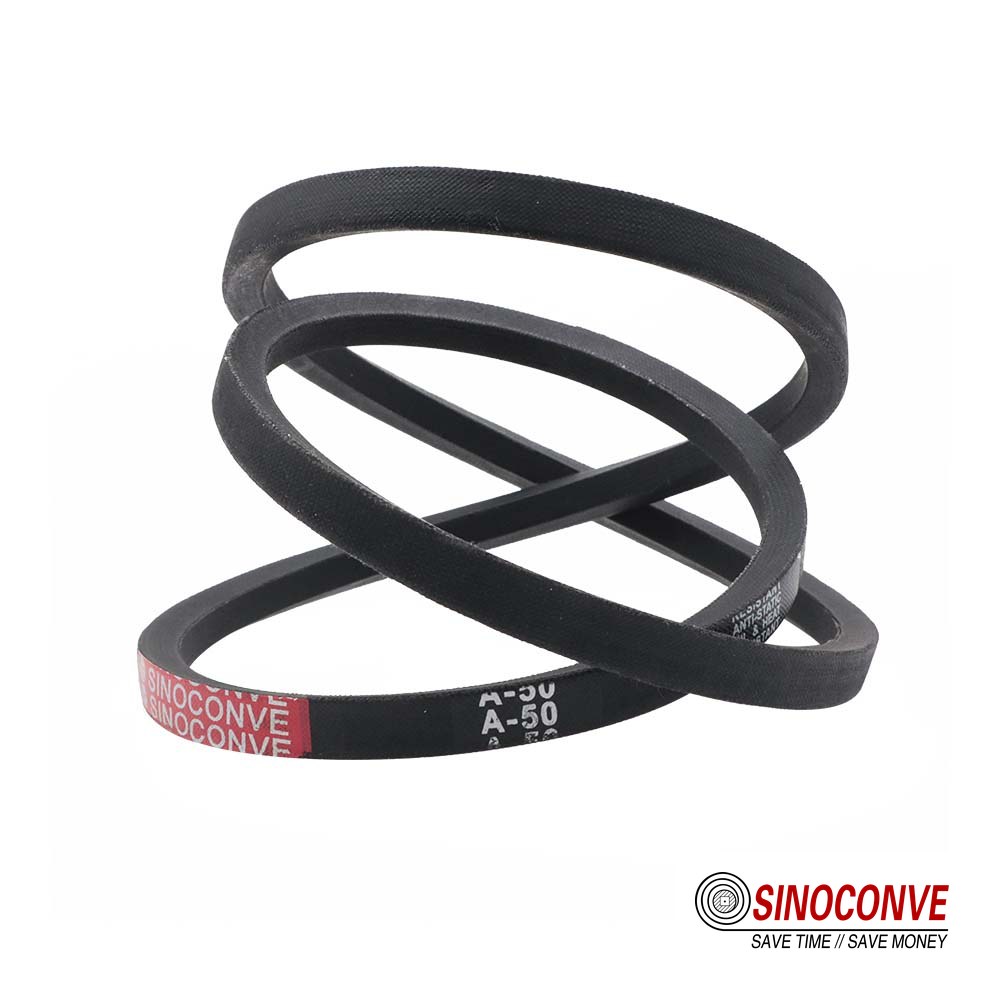
An endless ring carries load across an unbroken loop, which is why it stays smooth and quiet where a jointed belt cannot.
Where a heavy drive also shocks, the answer is not a link belt at all but a banded belt that ties several strands together, and our guide to the banded V belt for crusher drives explains when that jump is worth making. The point for this decision is narrower. When the drive runs fast, runs long and runs loaded, reach for the endless product and treat the link belt as the exception rather than the plan.
Belts are only one part of what we supply, and the same crews that quote a drive belt also fill orders for a rubber conveyor belt for the material side of the same plant. Keeping both on one purchase order is how a site avoids a shelf full of parts that almost fit.
10The Decision Matrix in One Table
Written out, the choice looks more complicated than it is. We collapse it into a single table that a buyer or a fitter can run down in a minute, matching the drive in front of them against the situation that most resembles it. Read the row that fits, and treat the last column as a starting recommendation rather than a rule.
How to Read the Matrix on Your Own Machine
| What the drive does and how hard it works | Whether the shaft can come apart for a belt change | What a stopped line costs while a part is fetched | The belt we would reach for first |
|---|---|---|---|
| It turns slowly, carries a medium load and gets changed or moved often. | The shaft has to stay together because the drive is buried behind a frame. | A stop is irritating but not ruinous once a spare is on the shelf. | A link belt is usually the better fit in this corner. |
| It runs fast, long and loaded, and it never gets a rest during the shift. | The drive opens easily during a planned shutdown without any drama. | An unplanned stop is expensive, so reliability outranks convenience here. | An endless V belt earns its place on this drive. |
| It carries heavy load with a shock every time the crusher bites. | The frame is heavy and wants a proper ring fitted on a planned stop. | A stop costs real production, so the belt has to be dependable above all. | A banded endless belt shares that shock load best. |
| It sits in dust or oil but stays well away from any food product. | The drive is awkward to reach and the area is only dirty. | A stop hurts in season and hardly matters in the quiet months. | Either belt can work if the tension is watched closely. |
| It runs near open product under a strict hygiene inspection. | The drive is easy to reach, but cleaning rules are strict and audited. | A stop is costly, yet a contamination finding costs far more. | An endless belt avoids the crevices a link belt creates. |
Two rows cover most of the machines we are asked about, and neither of them is a close call once the downtime figure is written down. A conveyor belt supplier who also sells drive belts should be able to walk you down this table for your own machines rather than hand you a single recommendation.
11Retrofitting a Link Belt on the Shop Floor
Suppose the matrix points to a link belt for a drive that currently runs an endless belt. The swap is not complicated, but it does have a handful of practical steps that decide whether the change is a success or a nuisance. Everything below comes from fitters we work with who do this on live machines.
Choosing the Link Count Before You Order
Work out the link count from the path the belt will actually follow, not from the length printed on the belt you are replacing. Measure around the pulleys with the take-up set near the middle of its travel, so you keep adjustment in both directions, then add the number of links that filling that path requires and leave yourself the ability to remove one or two if the run comes out tight. Counting by eye and ordering short is the most common retrofitting mistake, because a short belt cannot be stretched and a link cannot be added in half measures. If the drive runs at any real speed, ask whether the section and grade you are ordering are rated for it before you commit.
Tools and the First Re-Tension
The tooling is modest. A pin punch, a soft mallet, a pair of pliers and a sharp knife for trimming will cover most jobs, and a straight edge helps check pulley alignment while the belt is off. Expect the belt to settle and stretch during its first hours of running, so plan on a re-tension after the first shift and again after the first full day.That early slackening is normal for a jointed belt and should not be read as a fault.What is not normal is a belt that keeps loosening every shift, which points to worn pins or a drive that is loading the links harder than they were rated for.
When Capacity Has to Be Recalculated
Some retrofits need more than a belt change. If the original drive was designed around an endless belt and you are dropping to a link belt of the same section, the load ceiling falls, so any drive running near its design limit has to be recalculated before the swap rather than after a failure. Recalculation is also needed when the link belt changes the effective length enough to shift the take-up range, when the speed is high enough that joint impact becomes a real load on the bearings, and when the duty includes shock or frequent reversal. When in doubt, send us the pulley sizes, the centre distance, the speed and the load and let the numbers decide. We serve plants that buy an industrial conveyor belt for the same site, and those drives get the same careful check.
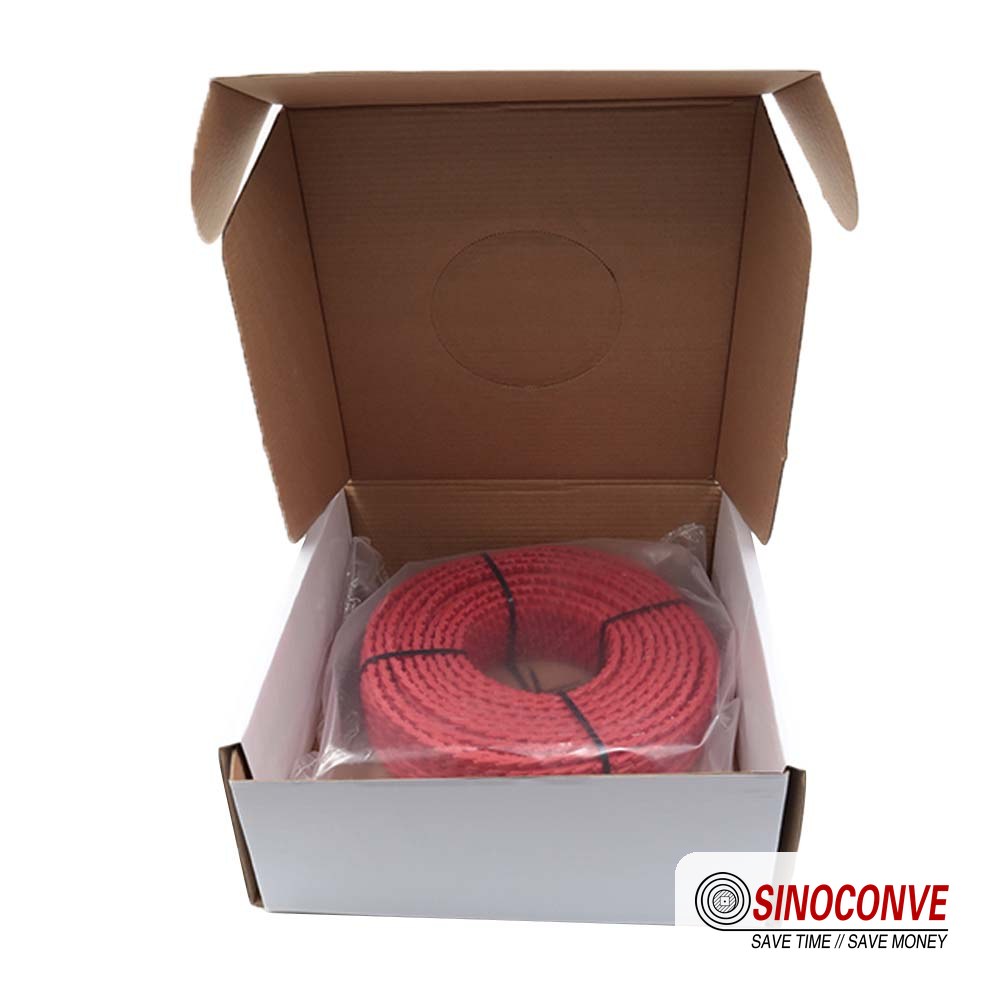
A spare reel and a small tool kit are enough to rebuild most link belt drives on site, which is the whole appeal of the product.
A well-run store keeps both options, and that is where the inventory argument closes. One reel of links, a set of pins and a small kit of hand tools let a conveyor belt manufacturer customer cover several drives without holding a matched ring for every one.
12Procurement and Acceptance Checks
Buying a link belt on the basis of a single photograph and a section letter is how plants end up with belts that fit but do not last. A short list of questions and a simple incoming inspection will separate a belt that will do the job from one that will not.
What to Ask the Supplier to Declare
Ask for the material and tensile grade in writing, because two link belts of the same section can be built for very different loads and the difference is invisible on the shelf. Ask how uniform the link pitch is, since links that vary in length will make a belt that hunts and vibrates no matter how carefully you tension it. Ask what the pins are made of, because pin material decides how fast the joints wear and how the belt will eventually fail. Finally, ask for batch traceability, so that if one delivery misbehaves you can tell us the batch and we can find out why. A supplier who can answer all four in a sentence is a supplier worth keeping.
| What you should request before the order is placed | Why that detail decides whether the belt lasts | The check you run when the delivery arrives |
|---|---|---|
| A written statement of the link material and its tensile grade. | Two belts of one section can be rated for very different loads, and the difference never shows on the shelf. | Splice a first piece and measure the total length before you fit it to anything. |
| Confirmation that the link pitch stays consistent from link to link. | Links of uneven length make a belt that hunts and vibrates whatever you do with the tension. | Run the belt unloaded and watch it for vibration before you put load on it. |
| The pin material and how the joint is expected to wear. | Pin material sets how quickly the joints open up and how the belt will finally fail. | Load the belt and re-measure the elongation so you know your real take-up margin. |
| Batch traceability that ties the delivery back to a production run. | If one delivery misbehaves, the batch number is how the cause gets found instead of guessed. | Record the batch on the storeroom card against the drive it went to. |
Why not simply buy the cheapest link belt on offer? Because the savings on the order are small and the cost of a belt that throws a link mid-shift is large, and the two numbers rarely sit in the same budget line. A buyer who compares only the invoice is comparing the wrong thing. Whether you source through us or through a conveyor belt distributor, insist on the four declarations above and a delivery you can inspect before the machine goes back into service.
Plants that buy in volume tell us the same thing: a spare shelf that mixes wholesale conveyor belts for the material side with a reel of links for the drive side is cheaper to run than a shelf of matched rings, provided the link stock is bought on grade rather than on the lowest offer.
13How This Guide Fits Our Other Drive Belt Pages
We write about drive belts from several angles, and it helps to know which page answers which question before you start digging. This article covers one thing only, the choice between a link belt and a V belt for a machine you already have. Two other pages carry the engineering detail that sits either side of that decision, and we link them here so you do not have to hunt.
Start With Drive Design, Then Return Here
If you are designing a drive from scratch, or changing pulley diameters, centre distance or the ratio between the two pulleys, that work belongs to a different guide. Our page on the industrial V belt drive covers pulley geometry, centre distance, tension and ratio, which are exactly the topics we deliberately leave out here. Do that design work first. Once the drive exists and you are choosing what to hang on it, come back to this page and run the matrix. If you also need to understand how section depth affects the way a belt seats and wears, our note on whether V belt depth matters handles that question on its own.
Identifying the Old Belt Is a Separate Job
Reading a worn belt and working out which code it carries is a distinct task, and it has its own page. The V belt size and cross reference guide walks through section symbols, length figures and how to measure a belt whose markings have worn away. We keep that detail out of this article on purpose. Here you decide which type of belt the drive wants; there you work out which exact belt, in which length, replaces the one that failed. Between the two pages, a buyer can move from a stopped machine to a correct part without guessing at any step.

14Frequently Asked Questions
What is a link belt?
A link belt is a drive belt built from moulded links that a fitter joins with pins on the machine, so its length can be set and changed on site rather than at a factory.
Are link belts as good as V belts?
No, and any supplier who says otherwise is selling you the wrong product for the wrong reason. A link belt is better than a V belt at access and at inventory, and worse than a V belt at speed, quiet running, load capacity and life. The two are tools for different jobs rather than rivals on one scale.
Can I replace a V belt with a link belt?
Sometimes, and the word to hold on to is sometimes. You can physically fit one whenever you can reach the drive, because that is exactly what a link belt is made for. What you cannot assume is that it will carry the load or tolerate the speed the old belt handled, so on any drive running near its design limit the swap has to be checked first. On a slow, lightly loaded drive that is hard to open, we do it without hesitation. On a fast main drive under heavy load, we would only ever treat it as a temporary bridge.
Why do link belts vibrate at high speed?
Because every joint knocks a little as it passes over the pulley, and the faster the belt travels the more of those knocks land each second. What starts as a harmless tick at low speed becomes a steady hum or buzz once the speed climbs.
Do link belts stretch?
Yes, and more than an endless belt of the same section, both as the pins bed in early on and as the joints wear over the life of the belt.
What is the maximum speed for a link belt?
We will not hand you a single number, because the honest answer depends on the link grade, the pin material and the machine it is going on, and a figure copied from someone else's catalogue is how drives get damaged. Give us the belt size and the drive speed you are running and we will tell you whether a link belt belongs there at all, rather than pushing one onto a drive it cannot serve.
Can link belts be used in food processing?
Only after the hygiene question is answered for your specific line, because a link belt brings crevices and a lubricated joint that an endless belt does not. In a dry, dirty area far from product the joint is not a concern at all. Near open food, or anywhere an inspector looks for places where residue can collect, we would normally steer you back to an endless belt and settle the access problem another way. Tell us the product and the cleaning regime and we will be straight with you rather than guessing.
How often should link belts be re-tensioned?
Expect the first re-tension after the belt has run a shift, and a second look after the first full day, because a new jointed belt settles quickly at the start. After that, check it on a normal maintenance round rather than on a fixed calendar, and re-tension only when the belt has actually gone slack. A belt that needs tightening every single shift is telling you something more serious than slack. It usually means the pins are wearing, the drive is loading the links too hard, or a pulley has moved out of line.
Do link belts fit the same pulleys as V belts?
Yes, a link belt of the matching section seats in the same groove a V belt would use, which is the reason the swap is possible in the first place.
Related Products You May Need
- Detachable link V belts for hard to reach drives
- Classic and narrow V belts for industrial drives
- Industrial timing belts for synchronous drives
- Conveyor rollers and idlers for bulk handling lines
- The full SINOCONVE product catalog