
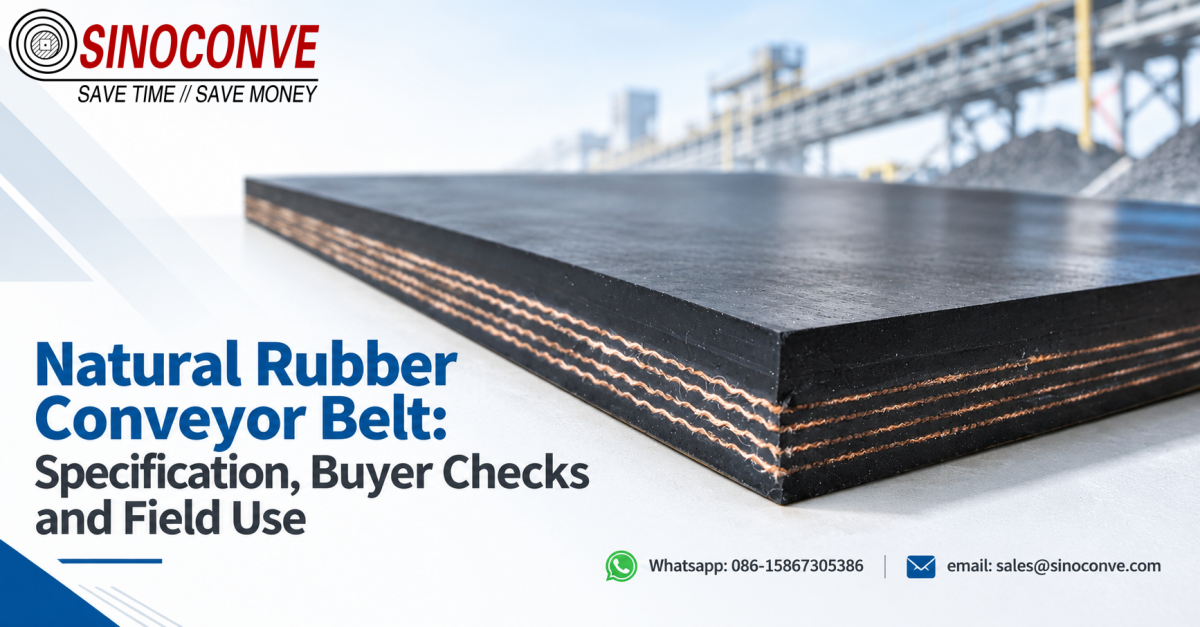
Short answer first. Natural rubber earns its place as a cover compound through a mechanism called strain-induced crystallization, in which the molecular chains line up and lock when the rubber is stretched, delivering high tensile strength and remarkable resistance to cutting, tearing and chunking. That single behavior is why quarry and aggregate crews keep specifying an NR cover at high-abrasion loading points. The trade is real and specific: natural rubber ages faster under heat and ozone and has almost no tolerance for oil, so it behaves like a brilliant specialist rather than an all-rounder.
This article stays strictly on the material layer, the natural rubber cover and what its recipe does out in the field. We do not repeat the generic selection flow, which already lives in our rubber conveyor belt selection guide for industrial lines, and we do not re-list the cover-grade ladder, which is treated in detail over in rubber conveyor belt cover grades. The carcass, whether fabric or steel cord, gets only a passing mention here because that comparison belongs to a separate article.
One more thing before the detail. We are a conveyor belt factory, not an independent test laboratory, and we will tell you which documents to ask for and how to read them rather than handing you numbers we did not measure ourselves. Where a figure matters, the right move is to request the test-method name and the report, and we return to that idea repeatedly below.

01The Mechanism That Makes Natural Rubber Hard to Cut
Most people describe natural rubber by what it feels like, tough and springy, and never ask why it behaves that way. The why is worth two minutes, because it is the same reason the material both excels and disappoints depending on where you put it.
Strain-induced crystallization, in plain language
When a piece of natural rubber is stretched, the long polymer chains stop flopping around and start to straighten. Past a certain elongation those straightened chains fall into an ordered, crystalline arrangement, and that ordering resists further extension. The rubber literally gets tougher as you pull on it, building internal reinforcement at the exact moment a sharp edge is trying to tear through it. This is why an NR cover survives a pointed rock that would slice a softer compound open, and why the cover recovers instead of leaving a permanent divot.
A synthetic like SBR does not crystallize this way to the same degree, so it depends more on carbon black to reach a comparable strength. The difference shows up at the very tips of cuts and tears, where NR keeps absorbing energy long after other compounds have started to run a crack.
Why this matters at the loading point
Every loading point concentrates force. Material drops onto the belt, bounces, and drags across the cover while the belt keeps moving underneath. A cover that stiffens under strain turns that abuse into heat and stretch instead of tearing, which is exactly the job description at a primary crusher discharge or a surge pile feed. We have watched a single NR cover run long past the point where a less forgiving compound had already opened up, and the reason was never magic, just chain ordering doing its work.
There is a second, quieter benefit hiding inside the same mechanism, and it is recovery. Because the crystallization is temporary, the rubber snaps back to its relaxed state once the load passes, instead of taking a permanent set the way an over-stretched compound does. Across thousands of cycles that spring-back behavior is what keeps a cover from thinning unevenly and forming the soft, torn patches that then catch on the next lump of material.
The same batch of NR cover behaves very differently at a loading point than on a straight carry run, and the reason is mostly the angle and shape of what lands on it. At the loading point, lumps arrive steeply, often edge-first, and they dig in, so the cover leans on its tear resistance and its recovery. Along a level carry section the material slides flat and shallow, so the cover only has to resist slow grinding, and the difference is why one belt can look nearly new at the head end while the tail section shows all the work.
Layer thickness matters too. A deep bed of material spreads the force and cushions the blows, which lets the cover coast, while a thin, fast-moving stream hammers a narrow line and concentrates the wear into a strip. Watching where the belt thins first tells you which of those two situations you actually have, long before any test report arrives.
02Tensile Strength, Cut Resistance, Tear Resistance and Chunking
Four separate words get thrown around on quotation sheets, and they are not the same property. Understanding the difference saves you from buying a cover that is great at one and useless at the other three.
Tensile strength is the floor, not the feature
Tensile strength tells you how hard the rubber is to pull apart in a straight line, and natural rubber sits near the top of the common cover compounds on this measure. It is useful as a sanity check but rarely the property that fails first in the field, because a belt cover is almost never torn apart in a clean straight pull. Still, a low tensile figure is a red flag, and we treat it as a minimum to clear before we look at the properties that actually decide belt life.
Cut resistance, tear resistance and chunking are different enemies
A cut is a single sharp object slicing into the cover, think a broken bolt or a slab of plate with a ragged edge. Tear resistance is what stops that small nick from running into a long split when the belt wraps a pulley or reverses under tension. Chunking is something else again, whole pieces of the cover being ripped out by repeated impacts from heavy, angular lumps. Natural rubber performs well on all three because the strain hardening keeps re-forming ahead of every crack tip, but no single number captures all of them at once.
When you read a specification, the abrasion number, usually reported under a rotating-drum abrasion test, tells you almost nothing about cut or tear performance. That gap is precisely why the brief later in this article insists on asking for test-method names rather than a bare value.
Field note from our engineers: A granite site kept two otherwise identical belts on the same feeder, one NR and one a cheaper general-purpose compound. After a season the cheap cover looked like a map of cracks radiating from every impact point, while the NR cover showed dull, even wear. The abrasion numbers on paper were close; the tear and chunk behavior in real lumps of rock were not.
When a specification sheet does try to describe these properties, it leans on named methods rather than raw claims. Tear strength is reported under a trouser-tear or angle-tear method, and abrasion under a rotating-drum test, and the point of asking for the method name is that it locks down how the number was produced. Two laboratories quoting the same method are at least speaking the same language, which is more than you can say for two bare figures with no method attached.
03The Price of That Strength: Heat, Ozone and Oil
Every strength in a polymer comes with a bill. For natural rubber the bill is written in three places, heat aging, ozone attack and oil, and each one narrows where you should confidently use an NR cover.
Heat aging hardens and cracks the cover
Natural rubber dislikes sustained heat because the same double bonds that give it toughness are also the spots where oxidation attacks. Over time, and faster as temperature climbs, an NR cover hardens, loses its snap and begins to crack at the surface. A belt carrying hot clinker or sitting close to a kiln is asking for exactly this failure, and it is why heat-resistant duties move to compounds built for that job rather than a plain NR cover.
We will not quote an absolute temperature ceiling here, because the safe number moves with cover thickness, load and dwell time. The honest guidance is to compare the material temperature at the belt surface against the compound's published working range, which you get from the manufacturer's data sheet, not from a rule of thumb.
Ozone and oil are quieter, slower killers
Ozone cracks are the classic outdoor failure.Unstressed NR survives ozone for a while, but a cover held under tension at a bend or a pulley wrap develops fine cracks that run across the surface like crazing on old glaze, and those cracks deepen with every flex cycle. A well-formulated NR cover carries anti-ozone wax and antioxidants to buy time, but it is still a mitigation, not a cure. Oil is the simplest to understand: natural rubber swells and softens in the presence of mineral oils, losing strength and grip, so any oily or greasy environment points you toward a different compound entirely.
04Natural Rubber Against SBR, BR, EPDM and NBR
Placing NR against its synthetic cousins is the fastest way to see where it belongs. The table below reads each material across six dimensions that actually show up on a jobsite, and every cell is phrased as a working judgement rather than a bare rating.
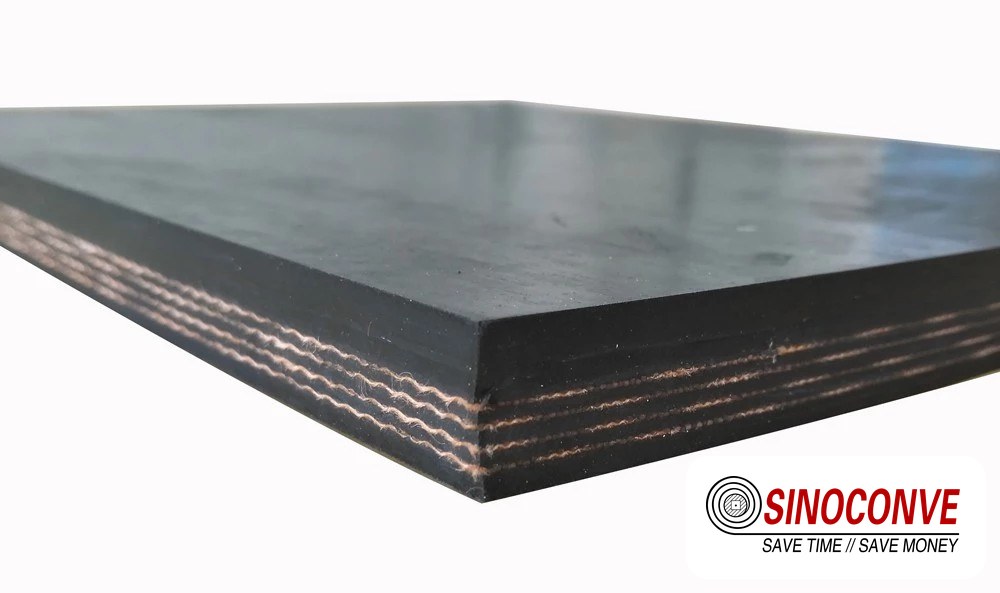
An NR cover over a fabric carcass. The dark outer layer is where the strain-crystallization behavior lives.
| Material family being compared in this row | Wear behavior under abrasive sliding duty | Cut, tear and chunking resistance of the cover | Heat and ozone aging resistance of the cover | Resistance to mineral oil and solvent contact | Behavior under extended low-temperature service exposure | Relative cost for the same duty |
|---|---|---|---|---|---|---|
| Natural rubber, shortened to NR in quotations | Wears well under heavy impact and sliding abrasion once it is properly reinforced with carbon black. | Strain crystallization gives it outstanding cut, tear and chunking resistance at ordinary ambient temperature. | Ages noticeably faster in heat and cracks under ozone, so tensioned outdoor sections need protective additives. | It swells and softens quickly in mineral oils, which rules NR out of oily or greasy zones. | Stiffens in deep cold but stays serviceable, so sub-zero duties usually blend in some BR. | Sits in the mid-to-upper band for a high-performance cover, with price tied to grade. |
| Styrene-butadiene rubber, known in the trade as SBR | Delivers dependable abrasion resistance and remains the standard choice for general-purpose bulk conveying. | Needs carbon black to approach NR's tear strength, so raw cut resistance is a step below natural rubber. | Ages more slowly than NR in moderate heat and tolerates ozone slightly better, but it is still no heat specialist. | Shows poor oil resistance similar to NR, so oily environments push you toward an oil-rated cover instead. | Handles ordinary cold about as well as NR, with no particular low-temperature advantage of its own. | Usually the most economical option, which is why it dominates high-volume general duty belts. |
| Polybutadiene rubber, commonly written simply as BR | Offers good abrasion and excellent resilience, often blended in to improve flex fatigue and rebound. | On its own it is weaker in cut and tear than NR, so it is rarely used alone as a full cover. | Shares NR's weakness to heat aging and ozone and contributes little extra protection there. | Resists oil about as poorly as NR and SBR, ruling it out for oily or solvent-heavy lines. | Stays flexible at low temperatures better than NR, the main reason it is blended into cold-climate covers. | Comparable to NR in cost and mostly used as a modifying blend component rather than a standalone cover. |
| Ethylene-propylene-diene monomer, almost always called EPDM | Sacrifices some cut and tear strength but excels where heat, weather and ozone would destroy an NR cover. | Lower tensile and tear resistance than NR, so it is a poorer choice for sharp, angular rock at ambient temperature. | Its saturated backbone shrugs off heat aging and ozone, making it the outdoor and hot-weather workhorse. | Swollen badly by mineral oils just like NR, so it offers no relief in oily environments. | Stays pliable in cold conditions, though NR blended with BR can often match it for typical winter duties. | Slightly higher in cost than general-purpose SBR, justified only when weather or heat is the deciding factor. |
| Nitrile rubber, referred to throughout the industry as NBR | Chosen for oil rather than wear, and its abrasion and tear performance trails NR by a clear margin. | Lower cut, tear and chunking resistance than NR, so it is wrong for high-impact rock unless oil demands it. | Ages reasonably but is not selected for heat or ozone; its reason to exist on a line is oil contact. | Resists mineral oils and fuels far better than NR, SBR or BR, which is its entire selling point. | Stiffens in cold more readily than NR, limiting its use in freezing outdoor installations. | Priced higher than general-purpose covers, and you only pay for it when oil is genuinely present. |
The six dimensions that matter on a jobsite, judged as working behavior rather than abstract ratings.
Notice how no single material wins the whole row. That observation leads straight to the next section, because the real commercial question is rarely "which rubber" and almost always "which blend of rubbers."
Blending is a trade-off exercise, and it helps to think in pairs. Add SBR to NR and you give up a little of the peak tear strength while gaining steadier processing and lower cost, a fair exchange on a line that grinds more than it cuts. Add BR and you trade some raw strength for cold-weather flexibility, worth it only where the site actually freezes. The moment you stop seeing the blend as a dilution and start seeing it as tuning, the whole specification conversation gets easier.
Every gain is borrowed from somewhere. A cover that is excellent at everything usually does not exist, so the honest specification names the property you are willing to sacrifice.A buyer who demands maximum cut resistance in a cold, oily plant is really asking for three compounds at once, and that buyer is usually better served by splitting the duty across two belts than by hunting for one miracle cover.
05Why a "100% Pure Natural Rubber" Cover Is Rarely the Best Recipe
Buyers sometimes ask for a cover that is one hundred percent natural rubber, as if purity were the same as performance. It usually is not. The best cover for a job is a blend that borrows the strong points of two or three rubbers and cancels out their weak ones.
What each partner brings to the blend
Natural rubber supplies the strain-crystallizing backbone, the tensile strength and the tear resistance that carry the cover through heavy impact. SBR is added to improve processing and to deliver steady abrasion resistance at a lower raw cost, and it also helps the compound mix and extrude consistently. BR comes in when the line must stay flexible in cold weather, because polybutadiene keeps its rubbery behavior further down the temperature scale than NR does on its own.
The proportions shift with the duty. A warm, dry, heavily impacted loading point leans on more NR, while a cold-climate line with ordinary wear leans on more BR and SBR. There is no single correct ratio, which is exactly why the quotation should state the blend rather than hiding behind the words "natural rubber."
"Natural rubber" on a datasheet is not a formula
Two belts can both be sold as natural rubber covers and still deliver very different lives, because the polymer is only one ingredient. The reinforcing filler, the anti-degradation package and the cure system decide whether that NR actually reaches its potential outdoors and under heat. This is the point where procurement gets vague, and the next section is meant to make it concrete.
A supplier who prints "natural rubber" on a quotation without naming the blend or the protection package is selling you a category rather than a formula. The polite response is to ask the same questions from the inquiry section, and the honest suppliers will already have the answers written down. The ones who stall are usually the ones whose cover cracks in its first season.
06What Else Lives Inside the Cover Compound
A cover is a recipe, and the polymer is only its base note. Carbon black, antioxidants and anti-ozone waxes do the rest, and knowing their roles lets you ask sharper questions than "is it rubber."
| Ingredient present inside the cover compound | Role it plays in the compound | What you observe when it is done well |
|---|---|---|
| Carbon black, the reinforcing filler for the rubber | Reinforces the rubber, raises tensile and abrasion resistance and turns a soft gum into a durable cover. | Even, slow wear across the surface rather than rapid scalloping at the impact points. |
| Antioxidants, the additives that fight oxidation | Slow the oxidation that hardens and cracks the cover as it ages in warm service. | A cover that stays supple through the season instead of going brittle and losing rebound early. |
| Anti-ozone wax, the surface shield against ozone | Migrates to the surface to form a protective film that shields tensioned rubber from ozone cracking. | Fewer fine surface cracks on outdoor sections that wrap pulleys under tension. |
| Plasticizers and processing oils, the flexibility adjusters | Adjust processing and low-temperature flexibility, and the type chosen can shift the cover's oil behavior. | A compound that still bends cleanly in cold weather instead of stiffening and cracking. |
| The cure system, which cross-links the polymer | Cross-links the polymer into a stable network and sets the balance between strength and heat aging. | Consistent hardness and rebound across the roll instead of soft spots near the edges. |
Here is the practical consequence of all that chemistry. Two covers that both carry the word "natural rubber" can differ sharply in field life simply because one skimped on the anti-degradation package, and that difference will not show up in a single abrasion number on a quotation. It shows up months later as cracks on the wrap section.
The anti-degradation package has a boundary that is easy to miss. Antioxidants protect the rubber from the heat and oxygen it meets in service, while anti-ozone wax blooms to the surface and builds a physical shield, and both are consumed as they work, so a cover that is brilliant in its first season can go bare in its second. That is why a label saying natural rubber is not enough on its own. You need to know the protection is present and roughly how much of it the compound carries, because the polymer percentage says nothing about how long that protection lasts.
Outdoors and near heat, this is the difference between a belt that ages gracefully and one that cracks early, and it is the single most common thing we find missing when a customer's NR cover fails young. Ask for the protection detail the same way you ask for the grade, and treat a blank answer as an answer in itself.
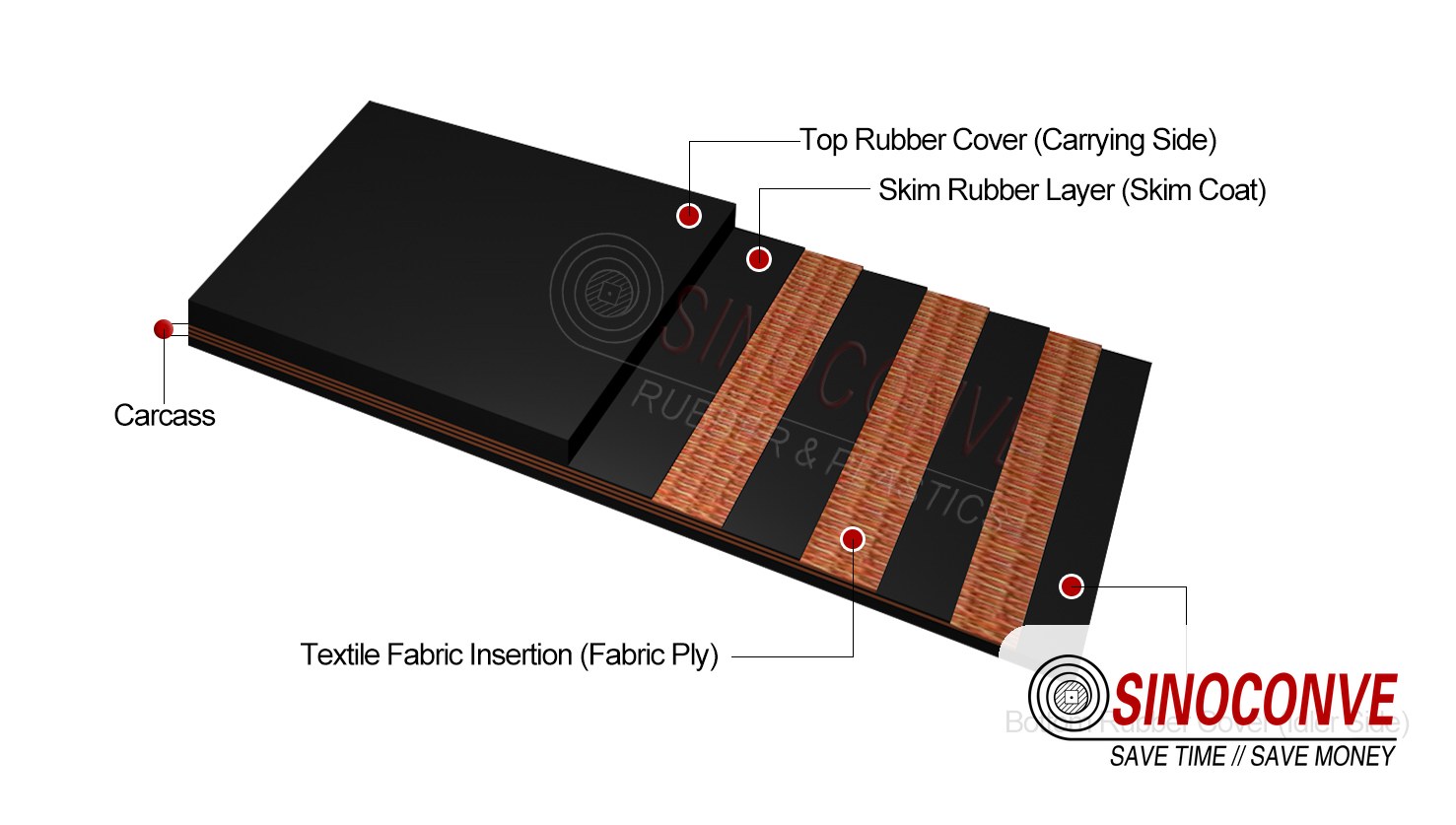
A sectioned sample. Cover thickness and the reinforcement inside are two different specification lines.
07The Four Field Types Where Natural Rubber Earns Its Keep
Natural rubber is not a default choice, it is a decision. There are four situations where it reliably repays the price, and each one is easy to recognize on a walk around the plant.
Matching the material to the abuse you can actually see
High-abrasion loading points at quarries and aggregate plants are the first and most obvious case. Material drops from a crusher or a screen onto the belt, lands hard, and drags against a moving surface, and that combination of impact plus sliding wear is exactly where an NR cover outlasts a plain general-purpose compound.
The second case is large, sharp material, think oversized ore, demolition rubble or broken glass, where the cover takes cuts and rips instead of just grinding down. Strain crystallization keeps closing off those cuts before they run, which is why an NR cover holds up where a harder but more brittle compound would open up.
The third case is the quiet one, a short to medium line at ordinary ambient temperature with no oil and no strong ozone exposure. On those lines the NR cover simply lasts, and the maintenance team stops thinking about the belt entirely, which is usually the real measure of success.
The fourth case is negative, and it is just as important. Where the deciding factor is heat stability rather than cut resistance, the same buyer should turn toward an EPDM or heat-rated cover instead, and we make that point again in the boundaries section that follows.
For the quarry loading point, the sign you chose correctly is even wear with no scalloped divots under the drop zone. If divots appear anyway, look at the chute angle and the skirt contact before you blame the rubber, because the loading geometry usually fails first.
For the sharp-material case, the healthy tell is a cover full of small, shallow nicks that never deepen, which means the tear resistance is catching each cut. A single long split that keeps re-opening points the other way, and that is when you re-check the cover grade rather than the impact.
For the quiet ambient line, the proof is simply that the belt stops appearing on the maintenance report. Absence of a problem is the whole point, and the only real discipline is to keep oil and ozone away so the cover keeps coasting.
For the reverse case, the early warning is hardening at the surface, a cover that starts to feel stiff where it once bounced. Catch that before the cracks show and you can often move to a heat-rated cover on the same carcass instead of living with a premature failure.
As a conveyor belt manufacturer, we see these four cases repeat across very different industries, and the same physics drives all of them. The correct rubber conveyor belt is the one whose cover matches the abuse, not the one with the longest headline number on its datasheet.
08Hard Boundaries: Where Natural Rubber Should Not Be Specified
Knowing when to walk away from NR matters as much as knowing when to buy it. Four boundaries stand out, and each one has a cleaner alternative on the other side of the line.
Heat and ozone push you toward other compounds
Hot material and long outdoor exposure are the two classic disqualifiers. A belt carrying clinker, hot ash or any load near a heat source ages an NR cover quickly, and a belt parked outdoors under tension cracks along its wrap sections as ozone attacks the stressed surface. In both cases the honest answer is a heat-resistant or weather-resistant compound, not a thicker NR cover hoping to outlast the chemistry.
Oil and deep cold narrow the window too
Any environment with mineral oil, grease or solvent rules NR out, because the cover swells, softens and loses its grip within a short service life. Deep sustained cold is a softer boundary, where NR stiffens but can often be rescued by blending in BR, and it is only when the temperatures stay low for long stretches that a full switch to a cold-flexible compound makes sense.
Heat aging shows up as a cover that hardens and then crazes, and the honest test is to flex the rubber at the spot that has been hot and feel whether it still rebounds. Ozone shows up as fine cracks running across the surface at right angles to the tension, most often on the wrap. Oil shows up as swelling and a soft, tacky surface that has lost its grip, usually obvious to the touch. Cold shows up as stiffening at the bends, and a blend with BR usually fixes it before it turns into a crack. Each boundary has its own signature, and matching that signature is faster than guessing at the polymer.
These boundaries are not quirks. They are the same physics from section three applied as a purchasing rule, and the discipline is to let the operating environment decide the polymer instead of stretching one material across every duty on the site. For heavy industrial lines where these boundaries interact, an industrial conveyor belt engineered for a specific duty usually beats a general-purpose cover, and we write the power-transmission side of our catalogue separately as a transmission belt manufacturer and V-belt manufacturer so the two product lines never blur into one.
09How to Ask for a Natural Rubber Cover During Inquiry
The commercial side is where natural rubber gets quietly diluted. The way to protect yourself is not to demand a single number, it is to ask for the names of the test methods, because a method tells you whether two quotations are even comparable.
Test-method names beat raw values every time
Two suppliers can both quote an abrasion figure and still be measuring different things if one used a different method or a different reference compound. Asking which abrasion method was applied, a rotating-drum test measured against a reference sample for wear, and which tear method, a trouser-tear or angle-tear test, makes the numbers mean something. A value without its method is close to worthless in a comparison.
The fields a serious inquiry should include
Before you commit, ask for the polymer type and the blend ratio, the cover grade with its top and bottom thickness, and the test-method names for abrasion and tear. Then ask for the anti-degradation package, the batch traceability trail and the splice process, because those last three decide whether the belt still performs the same way on its second delivery as it did on the sample.
| What to request from the supplier | What that request reveals to you | The trap it helps you avoid |
|---|---|---|
| Polymer type and blend ratio of the cover | Confirms how much natural rubber is actually in the cover and what else carries the load. | Avoids paying for an NR cover that is mostly a cheaper general-purpose polymer in disguise. |
| Cover grade with its top and bottom thickness | Shows how much wear material you are actually buying on top and bottom. | Prevents a mismatch where a thin cover is quoted against a thick one at the same price. |
| Test-method names for abrasion and tear | Tells you whether the quoted figures were measured the same way across all bids. | Stops you from ranking suppliers by numbers that were never directly comparable. |
| The anti-degradation package that guards against aging | Indicates how the cover is protected against heat aging and ozone before it ships. | Catches the short-lived cover that cracks outdoors a season before it should. |
| Batch traceability and the splice process applied to the belt | Proves the second delivery matches the approved sample and the joint is made correctly. | Guards against a repeat order that quietly changes compound or a joint that fails early. |
When you work through a conveyor belt supplier, ask these questions in writing so the answers land on the quotation. If you are a conveyor belt distributor reselling to end users, the same list is what you pass along to keep your own customers honest, and buyers placing volume orders through a catalogue of wholesale conveyor belts should expect the same transparency at any quantity.
Here is the practical version of that rule. When two reports land on your desk, line up the method name first, not the result. If one supplier ran a rotating-drum abrasion test against a reference compound and the other used a different procedure, their numbers are not rivals, they are two different languages, and comparing them directly will mislead you. Only when the methods match do the figures become a real ranking, and even then check the sample batch and the test date, because a report for last year's compound tells you nothing about what ships this quarter.
10Reading Wear in the Field: Normal Loss vs a Compound That Falls Short
When an NR cover looks worn, the first question is whether it wore normally or whether the recipe under-delivered. The two look different, and a maintenance team that can tell them apart stops ordering the wrong fix.
What the surface is actually telling you
Normal abrasion shows up as smooth, even thinning across the wear face, the cover gets gradually thinner but stays intact and supple. A formulation or processing problem shows up differently, as deep localized scalloping, early surface cracking in low-stress areas, or a cover that has gone brittle and begun flaking. Cut damage from sharp product is distinct again, appearing as clean slits that tear resistance should have contained.
| What you see on the cover | What it most likely means in practice | The sensible next step to take |
|---|---|---|
| Smooth, even thinning across the face | Normal abrasion from sliding product, the cover is doing its job. | Schedule the next replacement and keep an eye on thickness at the wear points. |
| Deep scallops under the loading point | Localized impact concentrated in one spot, often a chute or skirt problem. | Fix the loading geometry before blaming the compound, then re-check wear. |
| Fine cracks on a pulley wrap, especially outdoors | Ozone attack on tensioned rubber, a sign the anti-degradation package is thin. | Ask for the compound's antioxidant and wax detail before the next order. |
| Brittle, flaking surface in low-stress areas | Heat aging or an under-cured or badly protected compound, not normal wear. | Request the test report and compare the cure and aging evidence to the spec. |
There is a quiet rule hiding in that table. Most cover failures we are called in to explain are not the polymer being wrong, they are a loading, tracking or protection problem that got blamed on the rubber, and sorting those out saves more money than swapping to a more expensive compound.
Look at the worn face closely and the two conditions separate themselves. Normal abrasion leaves a smooth, satin surface that thins gradually from the centre outward, and the cover stays supple right up to the end. A formulation that falls short leaves a different fingerprint, micro-cracks that appear early, a surface that turns brittle and sheds small flakes, or scalloping that starts in a low-stress zone where wear should have been lightest. Hold both mental images side by side and a five-minute walk along the belt tells you whether you have a wear problem or a recipe problem, and that answer decides whether you change the compound or the maintenance routine.
11Storage, Aging and What Degrades a Roll in the Warehouse
A natural rubber cover starts aging the day it is cured, and bad storage simply fast-forwards the process. The good news is that the rules are cheap to follow and easy to inspect.
Ozone, light and heat are the enemies in storage
Store rolls away from direct sunlight and any ozone source, electric motors and welding are the classic offenders, and keep them in a cool, dry space rather than beside a furnace or a boiler wall. A roll left standing on its edge for months can distort the carcass and take a set, so long-term storage means rolls supported evenly and, where practical, rotated occasionally.
The rubber tells you when storage has hurt it. Surface crazing, a loss of rebound when you press a thumbnail into the cover, or a brittle feel at the edges all mean the roll has aged beyond its best, and none of those show up on a visual-only incoming check unless someone is looking for them.
A properly stored roll keeps its cover supple and its carcass undistorted until installation day.
12Where This Article Fits Among Our Other Rubber Guides
This page deliberately covers one narrow slice, the natural rubber cover and its recipe, so that it does not repeat three other guides we already publish. Keeping the boundaries straight is how you avoid reading the same paragraph three times.
Three guides, three different jobs
If you need the full decision flow, how to gather site data, weigh carcass options and arrive at a belt specification, that is the job of our rubber conveyor belt selection guide for industrial lines, and we have kept it out of this article on purpose. If you need the cover-grade ladder, what a grade number means, how the grades rank and which one a given duty calls for, that lives in our guide to rubber conveyor belt cover grades, and we have not re-listed it here.
The carcass is the third boundary. Fabric versus steel cord is a real decision, but it belongs to its own article on fabric vs steel cord conveyor belt, and this page mentions the carcass only as background while staying on the cover compound. Read the three together and you get the whole picture without any section doing another section's job.

13Frequently Asked Questions About Natural Rubber Conveyor Belts, Answered
What is a natural rubber conveyor belt?
It is a conveyor belt whose cover compound is built around natural rubber, the polymer tapped from rubber trees, usually blended with synthetic rubbers and reinforced with carbon black. The natural rubber supplies the tensile strength and tear resistance that carry the cover through heavy, sharp loads.
Is natural rubber better than SBR for conveyor belts?
It is better at cutting, tearing and chunking, but not better in general. SBR is cheaper, processes more easily and ages a little more slowly under moderate conditions. The right answer depends on whether the line punishes the cover with sharp impact or just grinds it down with sliding wear.
What is natural rubber best at?
Absorbing high-impact, high-cut abuse at ordinary temperatures without tearing or chunking out.
What are the temperature limits of natural rubber?
There is no single safe number, because the limit moves with cover thickness, load and how long the heat is applied. What is certain is that hot material and long exposure near a heat source age an NR cover fast, and the working range should come from the manufacturer's data sheet rather than a rule of thumb. For genuinely hot duties, a heat-resistant compound is the honest choice.
Why does a natural rubber belt crack outdoors?
The cracks are usually ozone attack on rubber held under tension, worsened by sunlight and weather. An NR cover can be protected with anti-ozone wax and antioxidants, but that protection is a mitigation, not a cure. For a permanently outdoor, tensioned line, a weather-resistant compound is often the better call.
Can natural rubber belts handle oil?
No, natural rubber swells and softens in mineral oil and loses its strength quickly.
How do I verify the rubber grade before ordering?
Start by asking for the polymer type and blend ratio, then the cover grade with its top and bottom thickness, then the test-method names for abrasion and tear. Ask for the anti-degradation package and the batch traceability trail as well. A supplier who can name the methods and provide the reports is one you can compare fairly against the next bid. A supplier who only sends a single number without its method is not giving you anything you can rank.
How should natural rubber belts be stored?
Keep rolls cool, dry and out of direct sunlight, and away from ozone sources like electric motors and welding. Support the rolls evenly and avoid leaving them standing on edge for long periods. Before installation, press the cover and check for a brittle feel, surface crazing or a loss of rebound, because those signs mean the roll has aged past its best.
Does a higher natural rubber content always mean a better belt?
Not at all, because the filler, the anti-degradation package and the cure system matter more than the polymer percentage alone.
Can natural rubber belts be used outdoors?
Yes, but only with protection, because ozone and sunlight attack a tensioned NR cover. An anti-ozone wax and antioxidant package buys time, though it is a mitigation rather than a cure. For a permanently outdoor line under high tension, a weather-resistant compound is usually the safer long-term choice.
Related Products You May Need
- Rubber conveyor belts — fabric-carcass belts with NR and blended covers for impact and abrasion.
- EP rubber conveyor belts — polyester-nylon carcass for high-tension, long-haul conveying.
- Steel cord conveyor belts — for the longest spans and highest tonnage duties.
- Heat resistant conveyor belts — compounds built for hot material where NR ages too fast.
- Chevron conveyor belts — patterned covers for inclined and steep-angle transfer.
- Full product catalog — belts, rollers and drive components from one factory.