
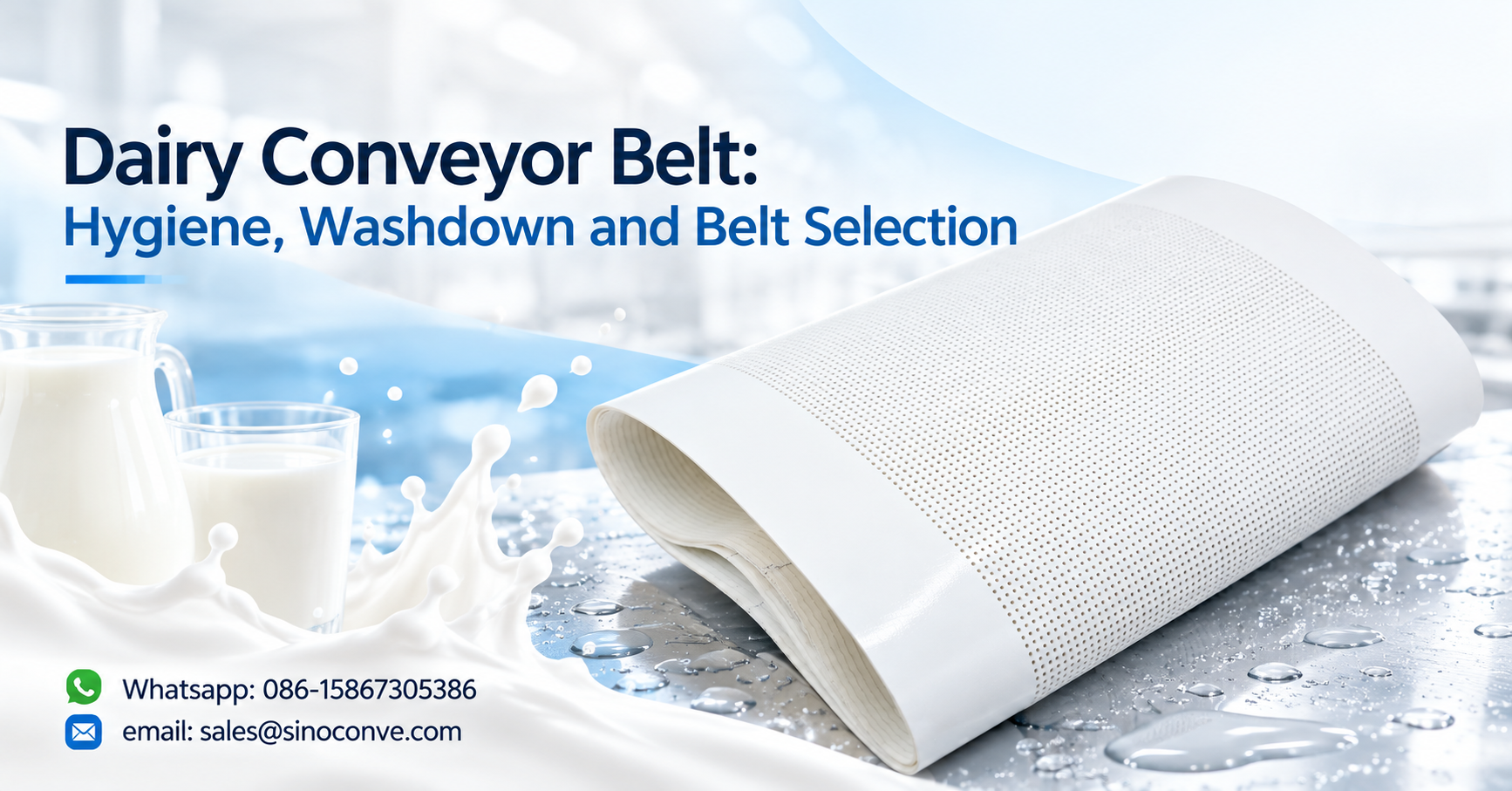
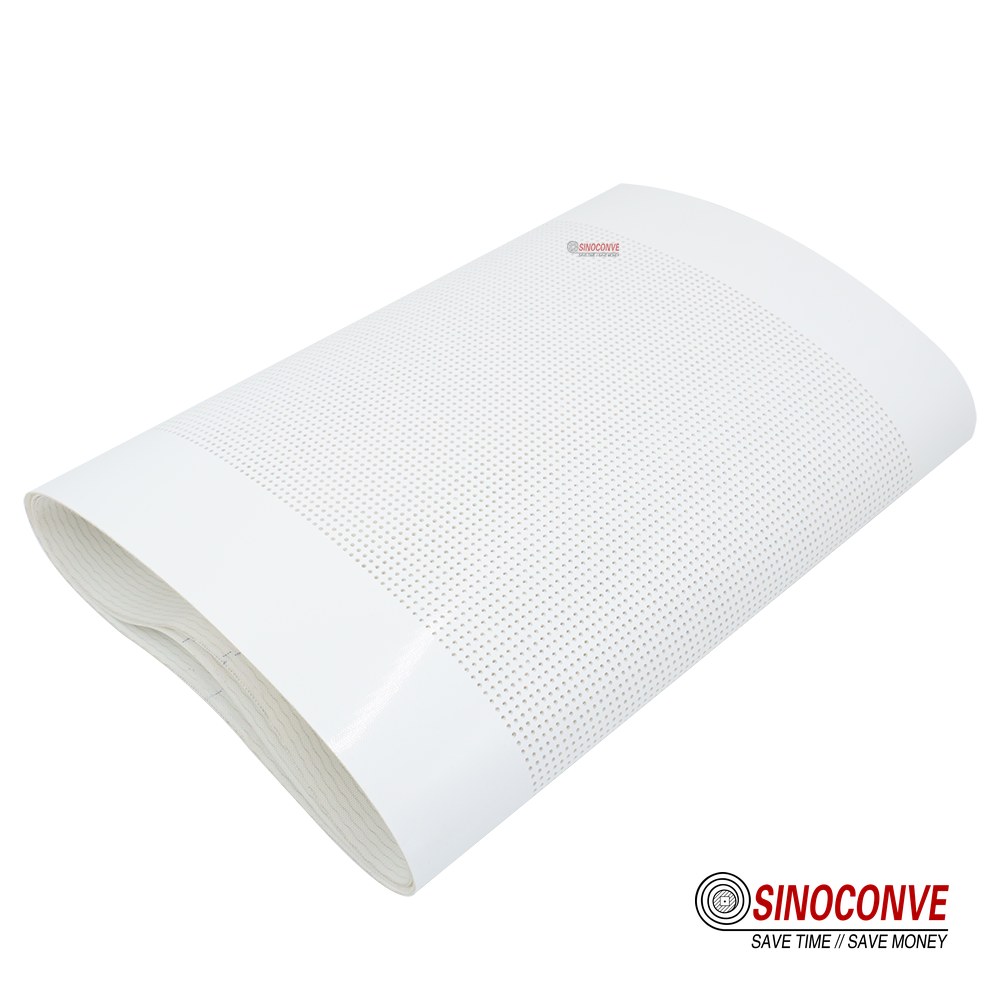
A dairy conveyor belt has to do two jobs that pull against each other: it must be a food-contact surface clean enough to pass a swab test, and it must keep running through caustic CIP, cold-room condensation and clinging milk powder without stretching, cracking or shedding material. On a dairy line the belt is not a carrier that happens to get washed. It is part of the hygiene system, and the compound, the joint and the edge all decide whether the line clears an audit. This guide walks stage by stage from milk intake to the powder room, names the selection constraint each stage imposes, and closes with the acceptance checklist our engineers sign against before a dairy belt leaves the plant. If you are sourcing for a receiving bay, a cheese vat hall, a filling line or a milk powder tower, the dairy-specific decisions are all collected below.

01Conclusion First: The Three Forces That Set a Dairy Belt Apart
Three forces define belt duty in a dairy plant, and product weight is not one of them. The first is water, because milk leaves the cow at close to nine-tenths water, so every surface the product touches stays continuously wet and every organism that lands on the belt has a vehicle to travel with. The second is chemistry, since a dairy cleans with hot caustic, chlorinated alkaline and acid solutions, and each one attacks a different part of the belt. The third is thermal range, because one building may hold 65 °C cleaning water, a 4 °C filling room and a -25 °C frozen store inside the same envelope.
Put those three together and a dairy belt fails differently from a general food belt. A biscuit line dusts its surface with dry crumbs, while a vegetable line rinses with cold water and mild detergent. A dairy line leaves a milk film that dries into hard mineral-and-protein scale, and that scale anchors bacteria in the exact texture of the cover. We have pulled belts at fourteen months that showed almost no mechanical wear yet failed a hygiene swab along the weld, because deposit had built a reservoir the foam could not reach.
Field note from our engineers: In a yoghurt filling hall we surveyed, two identical conveyors sat ten metres apart and ran the same product. One belt was replaced after eleven months for a frayed edge while the other lasted three years. The compound was identical; the difference was that the short-lived belt sat directly under a chiller coil, so condensate dripped onto it all shift and kept a film of water trapped between belt and slider bed. Water in the wrong place ages a dairy belt faster than product ever does.
Cleaning chemistry runs continuously, not occasionally
A general food room might wash down once a shift. A dairy commonly cleans between every product change and runs a full CIP at the end of each campaign, so a belt can see two or three chemical cycles a day. That adds up fast. A belt in a filling hall touches more sanitizer in one week than some belts touch product in a month. Chlorinated alkaline solution lifts protein but slowly attacks certain polymers, caustic dissolves fat and protein yet leaves mineral scale untouched, and acid strips the scale while doing nothing to fat. No single chemistry does the whole job, so the cover has to survive all three in rotation rather than being matched to one of them.
Milk stone and biofilm set the real failure clock
Milk stone is the deposit that makes a dairy belt fail for reasons a maintenance log never captures. It forms where a thin milk film dries or where warm product meets a warm surface, and it is denser than the film it came from because calcium phosphate and denatured protein pack together. Once that layer sets, a routine rinse leaves the mineral lattice behind, and the rough surface underneath gives bacteria a place to attach and build a biofilm that resists a normal foam. On the belts we open at end of life, the deposit sits at the weld, along the sealed edge and in the base of any profile, which are exactly the spots a spray lance reaches last.
SINOCONVE builds food-grade light belts on the same floor as our heavy rubber lines, so the team that sizes a quarry belt also welds the guide profiles onto your filling conveyor. We are a conveyor belt manufacturer that keeps the polymer cell next to the rubber press, and it is why a conveyor belt factory can hold one tolerance across the cover and the frame instead of reconciling them after delivery.
02Stage Map: From Milk Intake to Finished Pack
A dairy plant is really six different conveying problems sharing one roof, and the belt that works in the receiving hall is wrong for the powder tower. We lay the stages out in the order product follows, then read each one as a pair: the operating condition the belt actually meets, and the selection constraint that falls out of it. Read the matrix below as a constraint list rather than a shopping list, because the number that decides the belt is rarely the one printed on the throughput sheet.
| Stage along the dairy production line | Operating conditions the belt actually meets | Selection constraint that follows from it | Point we confirm before the order is released |
|---|---|---|---|
| Raw milk receiving, filtration and clarification | Product arrives warm and wet with a heavy organic load that never fully drains away. | The surface must shed a continuous milk film and tolerate a cold-to-warm swing of about thirty degrees. | We confirm the drainage slope and the surface finish before anything else is fixed. |
| Fermentation, curdling and whey separation stages | Warm acid product and whey create mineral and protein deposits that set hard once they cool. | Washdown chemistry has to strip mineral scale without eating into the cover compound. | We check acid resistance of the cover and of the weld against the same acid. |
| Pre-fill buffering and product holding spans | Product waits under a wet film while the filler changes format and the room stays at chiller temperature. | The belt must hold its line across a long slow run with almost no product load to grip the pulleys. | We verify tracking behaviour at low load rather than at nameplate capacity. |
| Filling, sealing and package handling operations | The surface sees light oil from seals, fine condensate from filler heads and frequent fog cleaning. | The cover must not transfer material to film and must stay flat enough for stable weighing. | We confirm migration evidence and surface flatness at the exact width quoted. |
| Cold store, blast chilling and dispatch | Ambient condensation forms on a cold belt the moment warm moist room air touches the surface. | The compound has to stay flexible near minus twenty-five and still grip a wet carton. | We confirm the lowest service temperature against the smallest pulley diameter on the drive. |
| Milk powder and whey powder handling | Fine hygroscopic powder absorbs moisture quickly and moves on a cushion of air that builds static. | The belt must resist static build-up and release fine powder instead of embedding it in the cover. | We check antistatic behaviour and the cleanability of any fabric edge before shipment. |
Read across any single row and the cost of a one-size decision becomes obvious. A plant that orders the same belt for all six stages usually over-specifies the buffering and dispatch lanes, then under-specifies the two hardest stages, which are fermentation and the powder room. We would rather quote four different constructions for one building than sell one construction six times, and the range of wholesale conveyor belts we hold lets a buyer move between grades without changing suppliers.
03Receiving, Filtration and Clarification
The receiving hall is the wettest room in a dairy and the one most often treated as a utility space. Tankers discharge through a dump line, milk passes a filter and a clarifier on its way to balance tanks, and crates, ingredient bags and pallets move around the same floor. Water volume here is enormous, the floor slopes hard toward the drain, and the air carries a mist that settles on every horizontal surface. A belt in this room is working in a splash zone rather than under product, and that changes what we specify.
Splash-zone conveying for crates, bags and returns
Most receiving conveyors here move packaging rather than product. Empty crate lines, ingredient bag take-away and pallet-return spans are the usual belts, and they sit inside the washdown envelope even though they never touch milk. The constraint is water shedding combined with mechanical abuse, because a crate dropped from 300 mm dents a light cover and a bag of milk powder tears it. For these spans a coarser top surface and a heavier carcass beat a delicate smooth belt, and we often step up to a heavier industrial conveyor belt build because the load is friable packaging and the room is hostile to anything thin.
04Fermentation, Curdling and Whey Drainage
Fermentation and curdling produce the most aggressive wet environment on a dairy line, and it is aggressive in a way most buyers underestimate. Curd forms at warm temperature, whey drains away with an acidity that sits around pH 4.6 for many cultured products, and the liquid that leaves the belt carries dissolved minerals. When that whey film dries on a warm surface, it leaves a hard mineral-and-protein deposit that ordinary alkaline foam loosens but does not fully dissolve.
Drainage geometry before cover chemistry
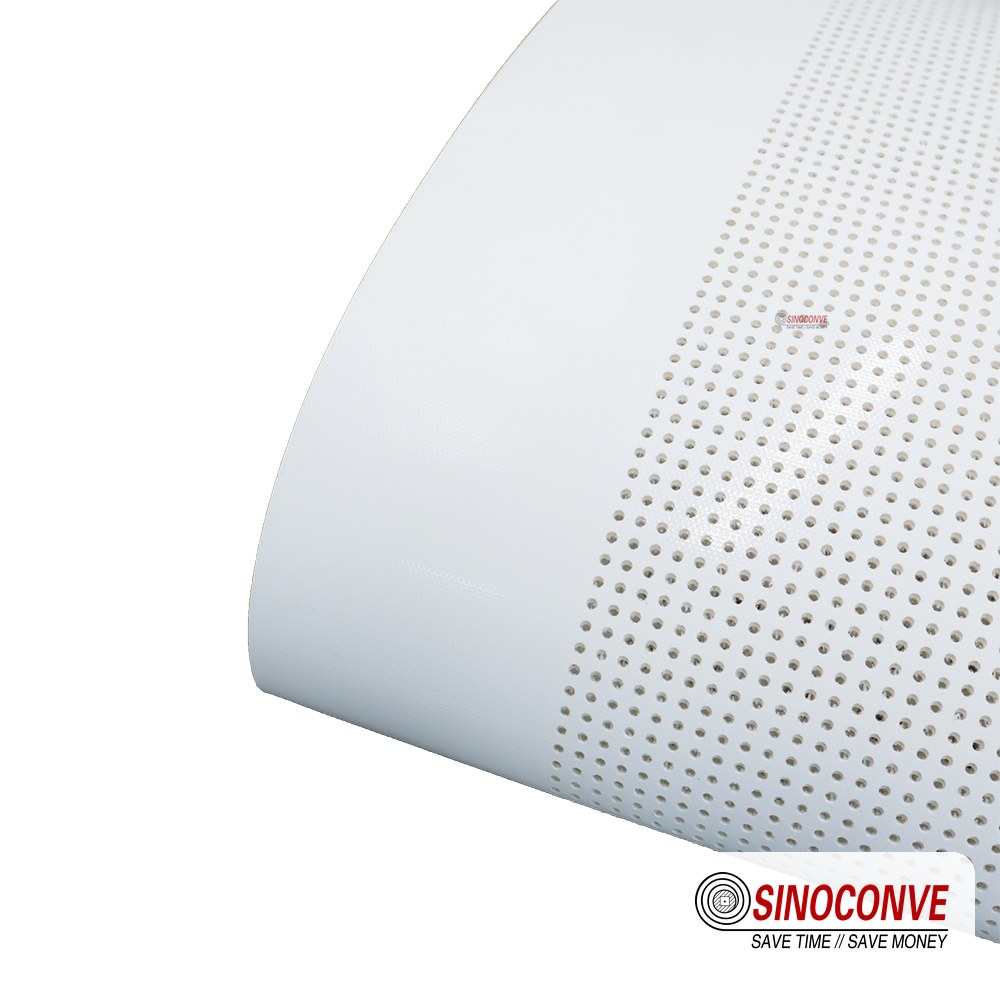
On vat-adjacent and curd-transfer conveyors, drainage does more work than any detergent. A belt that lets whey run off the sides and a frame that falls 2 to 3 degrees toward the drain keep the surface from sitting under a pool of acid liquid between washdowns. Where product must be retained for a cooking or stretching step, a perforated or open-structure surface lets whey pass through, but every opening is a cleaning task. We usually recommend a solid belt with profiled drainage gutters for soft curd and reserve open surfaces for harder cheese types where the whey volume is genuinely high. The cover here needs real acid resistance, because the failure we see most often is not a tear but a cover that goes chalky and dull at the discharge end within eighteen months.
Field note from our engineers: A mozzarella line we helped audit had two belts of the same grade and the same age. The one after the cook-stretch step ran at 72 °C and showed surface crazing in ten months; the one on the chill section at 8 °C was still clean. The plant had assumed both saw the same duty because they carried the same cheese. Temperature, not product, separated the two belts.
05Pre-Fill Buffering and Product Holding
Between processing and filling sits a stretch of conveyor that looks unimportant and causes a surprising amount of trouble. Product is held for minutes at a time under a wet film while the filler changes format or waits for the next batch, the room sits at chiller temperature, and the belt runs slowly with almost nothing on it. This is the classic low-load, long-dwell duty, and it exposes a belt weakness that only appears when there is no product weight to stabilise the run.
Tracking on a long slow run with almost no load
A belt that tracks perfectly at full load can wander when it is nearly empty, especially if the frame is long and the pulleys are lightly crowned. On a buffering span we pay attention to the ratio of belt width to pulley diameter, to the freedom of the take-up, and to whether the belt has a welded centre guide that can run in a grooved pulley. A guide solves mistracking but adds a cleaning line along the underside, so it is a trade we make deliberately rather than by default. Humidity in a chiller room also softens the carcass slightly, which changes the tension needed to keep the same tracking behaviour from one shift to the next. A dependable conveyor belt supplier will quote the guide and the pulley together so the two cannot drift apart in assembly.
06Filling, Sealing and Package Handling
The filling hall is where the belt stops carrying milk and starts carrying containers, and the hygiene demand does not drop with the change of load. Filled cups, tubs and pouches cross a short infeed into a sealer, then a checkweigher and a case packer, and the room is cleaned with the same chemistry as the process side. Two things dominate the specification here: the surface must not transfer material to film or packaging, and the belt must be flat and stable enough that a checkweigher reads a true tare.
Infeed geometry and the film-contact question
Filler infeed belts are short, fast and lightly loaded, often running 20 to 40 m/min over a centre distance under two metres. That short geometry makes tracking sensitive, so we lean toward a well-guided belt and a genuinely square frame rather than a wider tolerance. The film-contact question is separate. Where the cover can touch the inside of a lidding film, the compound has to carry migration evidence at the intended service temperature, and the surface should be smooth enough that no texture transfers a mark onto print. A PVC construction is common for these infeed spans and we keep a documented range of PVC conveyor belt grades for exactly this job, while a matt finish helps where reflection off a glossy belt would confuse an optical sensor.
07Cold Store, Blast Chilling and Dispatch
The cold side of a dairy is where two physics problems arrive together, and both of them are invisible on a specification sheet. The first is condensation: warm, moist room air meets a belt chilled to a few degrees above zero and gives up its water as a film on the surface and, worse, on the underside. The second is dimensional change, because a belt that is tight in a warm filling hall is not the same belt in a freezer at -25 °C. Neither problem is about the product, and both are about the environment.
Why condensation causes slip and belt wander
Water on the drive side of a belt acts as a lubricant exactly where you need friction least. The pulley loses grip, the belt slips, and slip generates heat that dries the surface into a patchy, glazed condition that then grips unevenly and drags the belt to one side.In a chilled dispatch room we have measured surface temperatures 15 °C below the room air, which is more than enough to hold a persistent condensate film through a whole shift.The countermeasures are practical rather than exotic: keep the underside dry with a drip tray and a small air sweep, choose a cover that drains rather than holds water, and set the take-up so it can recover a small slip event without going slack. A wet-room cover with good release beats a high-friction compound that only works when dry.
Tension compensation across a temperature gradient
Every belt changes length as it changes temperature, and a dairy plant can put a 60 °C differential between a washdown and a freezer within a few metres of conveyor. A fabric carcass contracts in the cold, so a belt set correctly at 20 °C can be over-tensioned at -25 °C and it will overload the bearings and the splice. The fix is a take-up with real travel, sized for the worst-case cold length, plus a splice rated at the cold end of the range. We size the compensation for the coldest belt the line will actually run, not the average room temperature, because the failure shows up on the coldest night of the year. Synthetic-carcass light belts, and where duty is heavy, a rubber conveyor belt with a low-temperature compound, both handle this far better than a cover grade chosen only for washdown.
08The Powder Section: Milk Powder and Whey Powder
The powder side of a dairy is a different plant wearing the same roof, and buyers routinely carry wet-area habits into it. Milk powder and whey powder are dry at rest and dangerously mobile in motion, and they do not behave like the wet product three rooms away. A powder line has almost no water in the process, tolerates almost no water on the belt, and creates a fine airborne fraction that settles everywhere and finds every crevice.
Hygroscopicity, caking and the wet-film trap
Milk powder is hygroscopic, which means it pulls moisture out of the air and out of any surface it rests on. A belt that is still damp from a rinse will turn a dusting of powder into a sticky paste within minutes, and that paste sets into a hard cake as it dries. The cake then fouls the belt, the scrapers and the frame, and it feeds the same kind of deposit problem the wet side has with milk stone. For powder spans the rule is simple: clean dry, or clean and then dry completely before powder runs again. A cover that releases well and a frame with no flat ledges to hold a puddle matter more than any special additive. On any incline in a powder line, an open-surface belt that lets fines drop through can help, but the openings have to be reached by the cleaning routine or the system just trades one deposit site for another, a trap we cover in our note on the dust-resistant conveyor belt supplier problem.
Static build-up and the case for antistatic grades
Dry powder moving across a dry belt generates static charge, and in a powder handling room that charge is a real hazard rather than a nuisance. The dust cloud is combustible, and a discharge from an unearthed belt or a plastic component can ignite it. Antistatic and conductive belt grades, plus proper earthing of rollers, frames and pulleys, keep the charge below the threshold where a spark forms. Beyond safety, static also makes fine powder cling to the belt and to guards, which turns a clean line into a cleaning problem. Where a plant moves large volumes of dried powder, we specify an antistatic cover as standard and confirm the surface resistance figure rather than assuming any conductive belt will do.
A common mistake in the powder room is to order a heavy rubber belt because the load is dusty. A general dust belt resists abrasion but may not be antistatic and is often hard to keep bright enough for a food-contact inspection. Where temperature is also involved, an intake belt feeding a dryer may need a heat-resistant conveyor belt rather than a thick contaminant-hiding cover.
09What Dairy CIP Chemistry Does to a Belt
Cleaning-in-place is the defining chemical load on a dairy belt, and it is a rotating cycle rather than a single product. Caustic, chlorinated alkaline and acid each do a specific job, and each one stresses the belt in a different way. When a belt fails early for no obvious mechanical reason, the cause is usually one of these three applied in the wrong concentration, the wrong temperature, or the wrong order.
What each chemistry attacks
Hot caustic around 1 to 2 percent at 60 to 80 °C saponifies fat and dissolves protein, and over time it can dull a polished cover and extract plasticiser from some flexible compounds. Chlorinated alkaline products add a sanitising action that lifts protein soil but will attack certain polymers, which is why a chlorine-containing cycle can shorten the life of a belt that a plain caustic cycle would not. Nitric or phosphoric acid at the end of the cycle dissolves calcium phosphate scale, and it is the step that keeps milk stone from building, but repeated acid exposure also hardens some covers. The cover you pick has to live with all three, which immediately rules out compounds chosen only for their tolerance of one step.
Rinsing, drying and validated cleaning
A chemical cycle is only as good as its rinse. Residue left in a weld or under a guide becomes a nutrient layer for the next batch, and a belt that never fully dries grows biofilm in the cool hours between shifts. Spray coverage matters as much as chemistry, and we treat the cleaning design as part of the belt specification, which is why we point buyers to the mechanics of conveyor belt spray cleaning before they choose a compound. Cleaning validation belongs on the same drawing. A dairy usually proves a line with ATP swabs or protein residue tests, and a belt that cannot be swabbed in its corners because a profile blocks the lance will fail that test no matter how good the polymer is.
Drying is the step plants skip and later regret. We have seen a high-care room pass its swab routine every morning and fail a weekend-holiday check, because the belt sat wet for two days and the residual film seeded the next production run. Air knife at the discharge, a short dry run before shutdown, and a frame that lets the underside drip free all cost less than one failed batch.
10Milk Stone, Biofilm and the Cleanability of Joints
Nine hygiene problems out of ten that we are called to are geometry problems, not chemistry problems. The polymer is usually fine. What fails is a crevice, a fastener or a weld that the cleaning routine cannot reach, and the deposit that builds there slowly spreads. On a dairy belt the two places that decide the outcome are the joint and the edge, because they interrupt an otherwise smooth surface and they are the hardest parts to flush.
Where deposits actually hide
Milk stone concentrates where a surface is rougher than its surroundings, where two materials meet, and where liquid can pool without draining. On a belt that means the weld bead, the underside of any cleat, the pocket of a mechanical fastener and the underside of the belt itself, which almost nobody inspects. A spray that reaches the top face and misses the return side leaves the underside to grow a biofilm that the next production run then carries back to the product face. Two of our own field notes cover this closely, and the return-side habit is worth building into any dairy routine, as we argue in our guide to return-side belt cleaning.
Joint and edge cleanability, method by method
The joint is the single decision that most changes how cleanable a dairy belt is, and it is usually made last, on price. That is the wrong order. A flush heat-welded splice behaves as if the belt were never cut, while a mechanical fastener is a row of crevices that no foam lance fully enters. For a wet dairy line the welded joint wins almost every time, and the edge deserves the same treatment: an open cut edge on a fabric carcass wicks milk inward by capillary action and cannot be cleaned once the contamination is inside the plies.
| Joint or edge method used on a dairy belt | How it behaves under dairy cleaning and cold cycling | Cleanability risk we watch for on site |
|---|---|---|
| Heat-welded finger splice with the plies interlocked | Stays flush and smooth through repeated chemical cycles and survives cold flexing where the belt turns a small pulley. | We look for an under-cured weld that opens into a hairline crack after a few months in service. |
| Endless belt made without any joint at all | Gives the smoothest possible surface and removes the joint as a cleaning variable completely. | We confirm the frame can be opened enough to fit the endless belt over the pulleys before delivery. |
| Mechanical hinge or bolted fastener joint | Allows a fast field repair but introduces metal edges and pockets that trap product and hold moisture. | We treat every fastener row as a documented risk and move it out of direct product contact if possible. |
| Sealed or hot-welded side edge on the carcass | Keeps milk out of the fabric plies and stops the edge fraying where it rubs a guide or a frame rail. | We check that the seal survives the knife edge of any scraper fitted along the discharge end. |
| Welded sidewall, cleat or tracking guide profile | Adds a functional corner to the belt that becomes the hardest zone to flush during a normal washdown. | We insist on a welded profile with an open fillet rather than a bolted one with holes to trap soil. |
11Material Choice: PU, PVC, Polyolefin and Silicone
Four polymer families dominate food-grade light belting, and a dairy line separates them on four properties: resistance to hydrolysis, resistance to acid and alkali, usable temperature range, and migration behaviour in contact with food. Weight and abrasion matter too, but they rarely decide a dairy belt because the loads are light. The decision is usually chemical, and the four families answer it very differently.
Fastening the four families to dairy duty
Polyurethane wins on cut and abrasion resistance and works across a wide band from -30 to about 80 °C, yet its weakness is hydrolysis, so a polyester-based PU can degrade under constant hot caustic and a polyether-based grade is the safer choice for a wet filling hall. PVC is the dairy workhorse: it welds cleanly, tolerates acid well, stays flexible to about -5 °C, and costs less than PU, but it softens above roughly 70 °C and its plasticiser can move over time. Polyolefin resists acid and alkali strongly and sheds sticky product because of its low surface energy, which suits aggressive chemistry and release-critical spans, though its temperature ceiling is lower than silicone. Silicone covers the widest thermal band, from around -60 to 200 °C, and is chemically inert, but it tears and abrades easily and costs the most, so it is reserved for hot or high-release duty rather than general conveying.
| Belt material we compare for dairy service | Resistance to hydrolysis and to dairy washdown chemistry | Temperature envelope and migration behaviour of the belt | Where we specify it on a dairy line |
|---|---|---|---|
| Polyurethane cover on a fabric or solid carcass | Cut and abrasion performance is high, yet some grades hydrolyse in hot caustic so we select hydrolysis-resistant types. | Runs from about -30 to 80 °C and can carry migration evidence for direct food contact when the grade is approved. | We fit it where cold, oil and cut resistance meet, such as chilled portion lines and oily fillings. |
| Food-grade PVC on a standard fabric carcass | Good acid resistance and dependable weld quality, with moderate tolerance of chlorinated alkaline cleaning. | Suitable from roughly -5 to 70 °C, and approved grades carry food-contact migration documentation. | We use it across filling, buffering and packing spans as the default dairy light belt. |
| Polyolefin belt with a low-energy release surface | Strong against both acid and alkali and highly resistant to hydrolysis in continuous wet service. | Works across a moderate range and releases sticky product cleanly, with migration data available for food grades. | We choose it for aggressive chemistry and for sticky product that a PVC cover would grip. |
| Silicone belt for hot and release-critical duty | Chemically inert against most cleaning agents and unaffected by water, though it tears and abrades more easily than the others. | Covers the widest range from about -60 to 200 °C and carries food-contact approvals in the right grades. | We reserve it for heat and release duty rather than general conveying on a dairy line. |
Migration and food-contact evidence
Migration is the property buyers forget until an auditor asks for a certificate. Any cover that can touch product has to demonstrate that it will not transfer harmful substances at the intended temperature, and the evidence has to match the grade you actually receive, not a family-level claim. We treat migration documents as a delivery item, checked against the exact compound, and we keep the paper trail with the belt. When a plant is weighing PVC against a heavier rubber construction, the comparison of rubber conveyor belt cover grades helps, and the full buying logic for the light-belt side sits in our guide to PVC conveyor belt specification and buying.
12Why Steel Scrapers Are Rarely the Right First Choice in Dairy Wet Areas
On a quarry or a power plant the steel scraper is the default answer to carryback, and it earns its place there.On a dairy wet area the same tool usually shortens belt life, and the reason is the specific soil rather than any weakness in steel. Dairy residue is a soft, sticky film of protein and mineral scale carried on a wet cover, and a rigid steel blade pressed against that film scrapes mineral grit straight into the polymer.
Pressure, grit and the damage a knife edge does over time
A steel scraper has to press hard to remove a tenacious film, and hard pressure on a wet belt is where the trouble starts. The blade traps calcium and silica particles from milk stone and drags them along the cover, so the belt is polished into a groove within a few months. On a welded splice or a sealed edge the same edge can lift the weld and open the joint that was the whole point of paying for a welded belt. Blade tips also break, and a broken steel fragment in a food stream is a foreign-body incident rather than a maintenance job. Our field position is blunt: in a dairy wet zone we reach for a low-pressure urethane doctor blade, a rotating brush or a rinse spray before we reach for steel, and the general limits of scraper cleaning are laid out in our guide to conveyor belt cleaning methods and when scrapers will not work. Where carryback still needs handling, a secondary cleaner on the return run at minimal contact pressure does more good than a heavier primary blade, and the wider options are gathered in our note on conveyor carryback solutions.
The ancillaries around the belt follow the same logic. Rollers in a dairy room sit in a wet, mildly aggressive atmosphere, so a corrosion-resistant roller with sealed bearings lasts far longer than a standard unit, and the fine powder and mist that settle on a powder-room line make sealing essential, as we explain in our guide to a sealed conveyor roller. We also stock the conveyor roller range in stainless grades for exactly this duty. The drives that turn a head pulley on a dairy line are equally exposed, and buying the motor, the gearbox and its V-belt manufacturer range from a single transmission belt manufacturer keeps the washdown protection consistent across the whole unit. Where a steep incline uses a profiled belt instead of a flat one, a conveyor belt distributor range that includes patterned constructions lets the same supplier cover both flat and cleated spans.
13Division of Labour with Our Other Food and Cleaning Guides
This article sets out to do dairy-specific work only, and we keep it separate from two neighbouring guides on purpose so a buyer is never reading the same paragraph twice. The first neighbour covers the whole-line view of hygienic design for food factories, including how raw, ready-to-eat, packing and high-care zones shape layout, where a conveyor system starts and stops, and how belt width and speed are sized from a throughput target. If your question is about plant zoning or system boundaries rather than about milk, that is the page to read, and we link it here as conveyor systems for food processing. Nothing in the present article repeats its zoning logic, and we deliberately leave the capacity arithmetic there.
The second neighbour is a general treatment of cleaning methods across all belt types, from scrapers and brushes to washes and schedules, together with the specific conditions under which a scraper stops being effective. That page is the right place to learn how a primary and secondary cleaner work in the abstract, and we reference it as conveyor belt cleaning methods and when scrapers will not work. What the present article adds is the dairy layer on top of those methods: why chlorinated alkaline and acid cycles differ in what they attack, why milk stone and biofilm behave differently from ordinary soil, and why a steel scraper loses to a low-pressure blade in a wet dairy room. There is also a packaging-line zoning guide in our library, but packaging-line layout is a separate subject and we leave it to that page rather than restating it here.
14Procurement and Acceptance Checklist for a Dairy Belt
A dairy belt order is only as good as the checklist behind it, because the failure points are quiet. Documents, dimensions and joint quality all look acceptable on a quotation and then decide the outcome in the first six months. The checklist below is the version we walk through with a customer before we release a dairy order, and every row is a go or no-go item rather than a preference.
| Item we verify before a dairy belt is accepted | What good looks like on site | How the check is actually carried out |
|---|---|---|
| Compound and grade identity of the delivered belt | The belt matches the grade on the quotation and carries a traceable batch reference we can look up. | We compare the shipment label and the mill certificate against the ordered compound line by line. |
| Food-contact and migration documentation for the exact grade | A current report names the compound that was shipped and covers the intended service temperature. | We check the report identifier against the batch and file it with the commissioning pack before installation. |
| Joint type and edge seal as ordered | A flush welded splice with no step, and a sealed edge where the belt rubs a guide. | We run a straight edge along the joint and check for any lip, then flex it cold once before sign-off. |
| Width, length and tracking behaviour at the duty load | The belt runs centred at full load and at near-empty load, with take-up travel still available. | We track the belt at both load extremes and measure the remaining take-up travel on the coldest room. |
| Antistatic behaviour and earthing on powder spans | A conductive grade in place with rollers, frame and pulleys bonded to a common earth point. | We confirm the surface resistance figure and continuity-test the earthing path around the whole run. |
| Cleaning access to every surface including the return run | Sprays, blades and drains reach the top face, the edges and the underside without dismantling the belt. | We watch a normal cleaning pass and note any surface the lance cannot reach in under a minute. |
| Change-of-supplier re-verification at the same position | A new supplier proves the identical grade, joint and edge rather than a family-level equivalent. | We re-run the migration check, the joint inspection and the tracking test from scratch on the first replacement belt. |
The last row is the one plants skip and later regret. Switching suppliers at the same position looks like a straight swap on paper, yet a different mill may weld a joint to a slightly different standard, cure a compound to a different point, or seal an edge to a different width. When that happens the belt behaves differently in service even though it carries the same grade name, and the blame then falls on the conveyor rather than on the substitution. We ask customers to re-verify the full checklist on the first belt from any new supplier, at the same position, before releasing the rest of the order.

15Frequently Asked Questions About Dairy Conveyor Belts
What conveyor belt is used in dairy processing?
The everyday answer is a food-grade PVC belt on a stainless frame for the wet filling and buffering spans, with a PU cover where cold, oils and cut resistance matter and a polyolefin or silicone belt for a specific chemical or thermal duty. On the powder side, an antistatic grade takes over because dry milk powder builds static that a standard cover does not handle. The joint and the edge matter as much as the compound, since a welded splice and a sealed edge decide whether the belt can be cleaned to a swab standard.
Is PVC or PU better for dairy conveyor belts?
Neither is universally better, and the choice turns on chemistry and temperature rather than on price.
How do you clean dairy conveyor belts?
Cleaning follows the same caustic, chlorinated alkaline and acid cycle the rest of the plant uses, with the belt treated as part of the CIP envelope rather than as a surface wiped at the end. The parts that decide success are coverage and drainage: a spray that reaches the underside as well as the top face, and a frame that lets the belt dry between shifts. We also recommend a short dry run at shutdown, because residual moisture in a cool room is what seeds the next batch of biofilm.
Can a metal scraper be used on a dairy line?
It can be fitted, but in a dairy wet area it usually does more harm than good, because a hard steel edge presses mineral grit into a soft wet cover and can lift a welded splice or a sealed edge. A low-pressure urethane blade, a rotating brush or a rinse spray removes dairy soil without that damage.
What happens to a belt in a cold room with condensation?
Warm moist air meeting a cold belt leaves a water film on the surface and the underside, and that film lubricates the drive pulley until the belt slips. Slip then glazes the cover unevenly and drags the belt to one side, so the symptoms look like a tracking fault when the cause is water. The belt also contracts in the cold, which adds tension and load on the bearings and the splice. Drip control, a small air sweep and a take-up with enough cold travel fix the problem better than a different compound.
How do you handle milk powder on a conveyor?
Clean dry, keep the belt dry, and earth everything, because hygroscopic powder turns a damp surface into a sticky cake and static in a dust cloud is a genuine ignition risk.
Should a dairy belt be endless or have a welded joint?
An endless belt is the cleanest option when the frame can be opened wide enough to fit it, and a fully cured welded splice is the next best choice for any span that must be joined in place.
What documents should a dairy belt supplier provide?
A supplier should hand over a mill certificate or batch reference that ties the delivered belt to the ordered compound, plus current food-contact and migration documentation that names the exact grade. The joint and edge specification should appear on the same paperwork so a replacement cannot drift. We also ask for the surface resistance figure on any antistatic belt and the lowest service temperature for the compound. None of this is optional when an auditor asks for it after the line is running.
How do you specify a belt for acid whey and curd?
Start with drainage and acid resistance, then confirm the cover grade against the real whey pH and the highest temperature the curd sees, because a belt that is fine at the chill section can craze after ten months next to a warm cook step.
Related Products You May Need
- PVC conveyor belt for wet dairy filling, buffering and packing spans.
- Product catalog covering the full light-belt and heavy rubber range.
- Rubber conveyor belt for heavy receiving and cold-store duty.
- EP rubber conveyor belt for ingredient intake and bulk handling.
- Chevron conveyor belt for steep inclines in the powder section.
- Conveyor roller in stainless grades for washdown rooms.
Related Blog Posts
- Conveyor systems for food processing covers whole-line zoning and system boundaries for a food factory.
- Conveyor belt cleaning methods and when scrapers will not work sets out general cleaning methods and scraper limits.
- Conveyor belt spray cleaning explains nozzle coverage and rinse mechanics.
- Return-side belt cleaning shows why the underside decides long-term hygiene.
- Conveyor carryback solutions compares blades, brushes and sprays for sticky soil.
- Dust-resistant conveyor belt guidance for fine, mobile powders.