
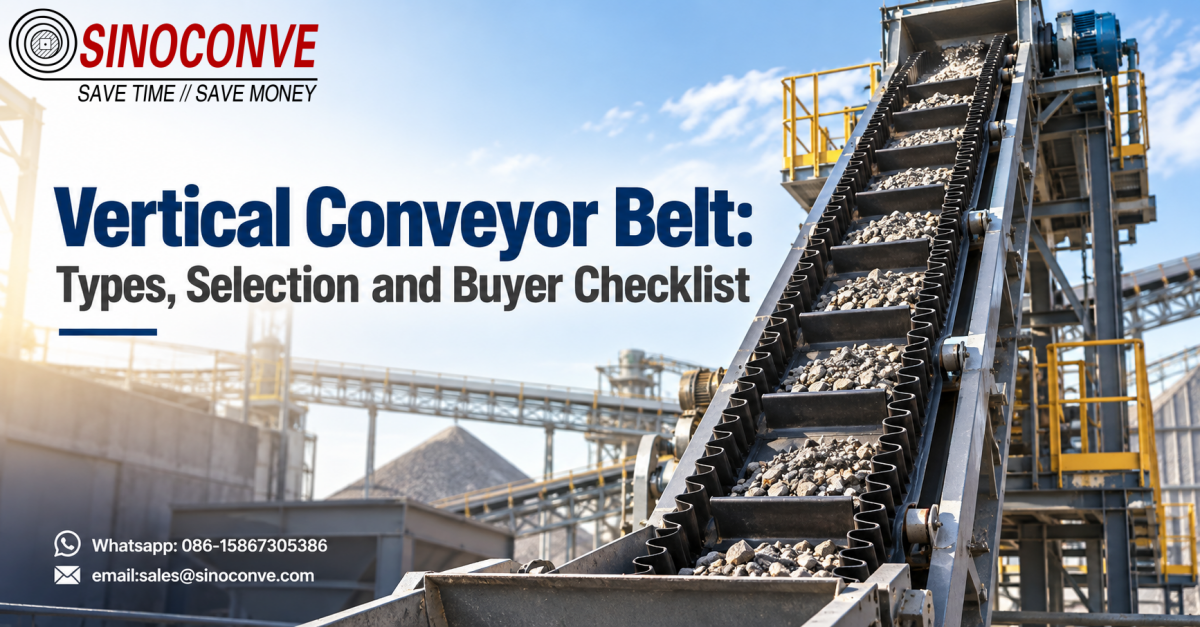
A vertical conveyor belt is not one product. The phrase gathers a family of belt-based systems that lift bulk material at angles from roughly 30 degrees through to a true 90-degree climb, and every member of that family answers a different requirement. Choosing the belt before you choose the type is the most expensive mistake on a steep route, because the type fixes the layout, the drive, the maintenance routine and the failure pattern long before any belt dimension matters. What follows compares the types first, matches each to the duty it suits, and finishes with what we ask for at acceptance.
We have built steep-angle, cleated and sidewall belts in Ningbo for quarries, cement lines, ports and aggregate yards, and as a conveyor belt manufacturer we sit inside these arguments all the time. Somebody wants a vertical lift, the drawing shows a tower, and the equipment list has already been frozen around a single idea. Reopening the type decision even at that stage saves money, and it is rarely too late to compare options.
Not every job that sounds vertical actually is, and that is the first thing worth settling. A 55-degree incline, a 70-degree transfer and a genuine 90-degree lift demand different hardware, and treating them as one question is how a project ends up over-specified in one place and hopelessly short in another.

01Why Type Comes Before Belt on a Vertical Lift
On a flat or gently inclined conveyor the belt is almost the whole story, and selection comes down to carcass strength and cover grade. The moment the route turns steep, that changes. Load stops resting on the belt and starts pressing against it, and the machine has to hold material that gravity is actively pulling back down. Which machine does that holding decides almost everything downstream.
Engineers who have only run troughed belts size a vertical route the way they size everything else, starting from tonnage and belt speed and arriving at a belt specification. That order works on a horizontal run and breaks on a lift. A colleague once spent a week arguing about cover grade on a 38 m clinker lift before anyone asked whether a pneumatic line would have handled the dust better.
Think about what the type actually determines. It sets the number of moving assemblies, the building height the structure must reach, the count of transfer points where dust escapes and material degrades, and the range of materials the line can tolerate at all. A bucket elevator and a sandwich belt may both lift 300 t/h to 40 m, yet they will not accept the same feed, occupy the same footprint, or fail in the same way.
So we keep one fixed order. Describe the duty in full, shortlist the types, compare them honestly against your real constraints, and only then write a belt specification. Skipping ahead to the belt is how a plant ends up buying a beautiful rubber belt that is technically perfect and attached to the wrong machine.
The Route Description That Changes the Shortlist
Before anyone opens a catalogue, we want six facts written down. Required tonnage at the design point. Lift height measured from feed point to discharge lip. Largest lump size and the share of fines. Bulk density and moisture. Whether the material is abrasive, sticky or both. And how much floor area is genuinely available, including the space a maintenance crew needs to work.
Those six lines eliminate whole families of equipment before money is spent on drawings. Feed a wet, cohesive clay into the shortlist and pneumatic transport drops out on its own, because the material will blind the line. Ask for 90 m of lift and a single sandwich belt becomes structurally awkward, so a tower-based type starts to look calmer. The description does the filtering, not the salesman.
02Reading the Duty Before You Choose Hardware
Good selection starts with a clear read of the duty, and that read is subtler than most enquiry sheets suggest. Two plants can quote the same tonnage and height and still need different machines, because those are headline numbers rather than deciding ones.
Material behaviour sits at the center of the decision. Angular crushed granite at 1.5 t/m³ flowing freely will tolerate almost any type that can carry it. Damp coal fines that pack under pressure will clog a screw and bridge in a choke-fed pocket belt. Sticky iron ore will stick to a belt surface that a bucket style simply scoops off. The same tonnage means nothing across those three, and experienced buyers read the material first.
Height range deserves the same care. Anything up to about 15 m can usually be handled by several types at similar cost, so the choice leans on footprint and maintenance access. Push past 40 m and the field narrows fast, because only a few belt-based types stay structurally sensible and the non-belt options start to win on their own merits.
Where the Cheap Option Becomes the Expensive One
Footprint and building height are the two constraints buyers most often underestimate. A steep belt that climbs 30 m over a 15 m horizontal run still needs a structure, a head frame and a maintenance platform at the top, and those civils frequently cost more than the machine itself. A vertical screw occupies almost nothing in plan and almost everything in height, so it fits a tight plant and fights a low-roof one.
Maintenance access is the constraint that gets designed in last and regretted first. Whatever type you pick, somebody will eventually have to reach the top of it with tools and a spare part. If the only route up is a ladder welded to a tower during the final week of commissioning, the maintenance plan is already broken.
Then comes material degradation. A chain bucket that drops fragile finished aggregate repeatedly is a poor fit no matter how cheap it looks up front.
03Belt-Based Type One: Corrugated Sidewall with Crossbars
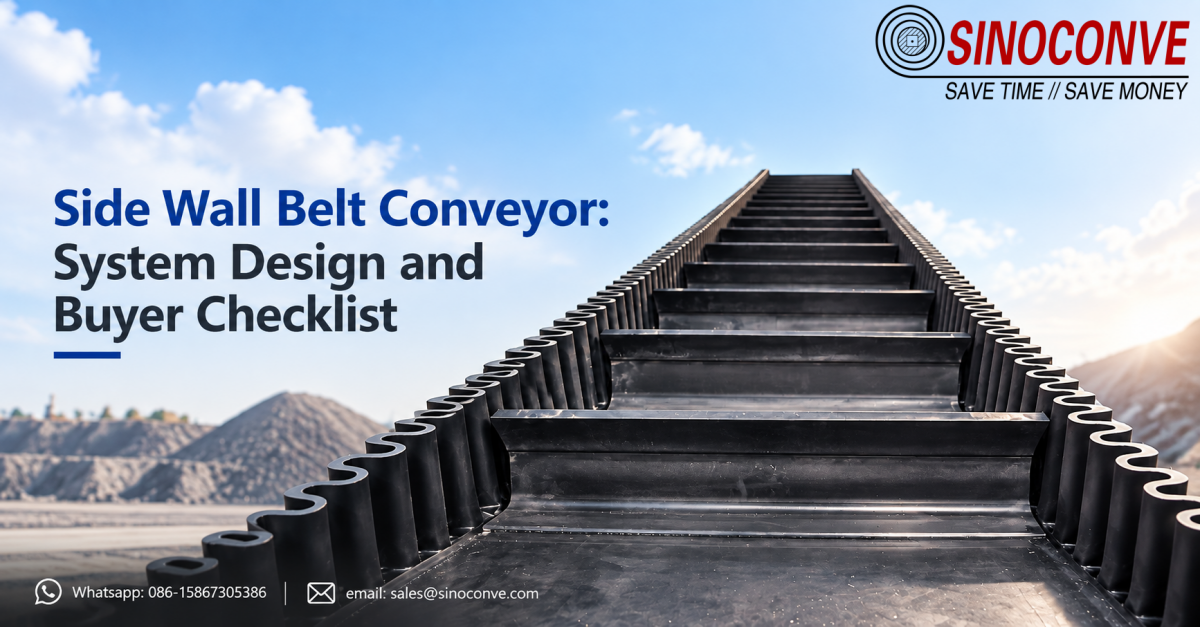
The sidewall belt is the type most people picture when they say vertical conveyor belt. Corrugated rubber walls run along both edges of a flat base belt, and rubber crossbars sit between those walls at a fixed pitch. The wall and crossbar together form a pocket that carries the load up any angle the route asks for, including a true vertical run.
What makes this type popular is its flexibility. It climbs 90 degrees as easily as it climbs 60, and it can bend through a curve on the way if the plant layout has an awkward corner. Feed can arrive from a chute or a horizontal section, and discharge comes off the top of the head pulley much like a conventional belt. For a quarry or aggregate yard that already runs troughed belts, the maintenance habits transfer almost directly.
The limitations are real, and they are mostly about material. Very fine, dry, free-flowing powder will work its way along the belt surface and past the wall base during the climb, so a sidewall system struggles with material that behaves like sand or flour. Sharp, heavy lump feed also punishes the pocket, because every impact lands on the bond line at the foot of the wall rather than on a plain belt surface.
Crossbar pitch is the tuning knob on this type, and it does not appear in the machinery catalogue. Shorten it and the pockets get smaller but the material column gets more support, which suits coarse lump. Lengthen it and capacity per pocket rises while the load hangs longer between supports, which only works for material with a shallow natural slope.
Where You Will Not Find This Type
Reach for a sidewall belt when the material is coarse to medium, the lift is vertical or near-vertical, and the plant wants belt-style maintenance. Steer away when the feed is fine and dry, when the product is so fragile that any tumbling hurts it, or when a screw or pneumatic line would keep the powder enclosed from the start. A wet, sticky material also argues for caution, since residue clinging to the wall base is hard to clean once it sets.
For an industrial conveyor belt carrying crushed stone on a steep lift, this type is usually our first recommendation, and a sidewall belt paired with a robust EP carcass handles the duty well. We set the wall height and crossbar pitch from the material grade, not from habit, and we ask the buyer to weigh a sample before the drawing is frozen.
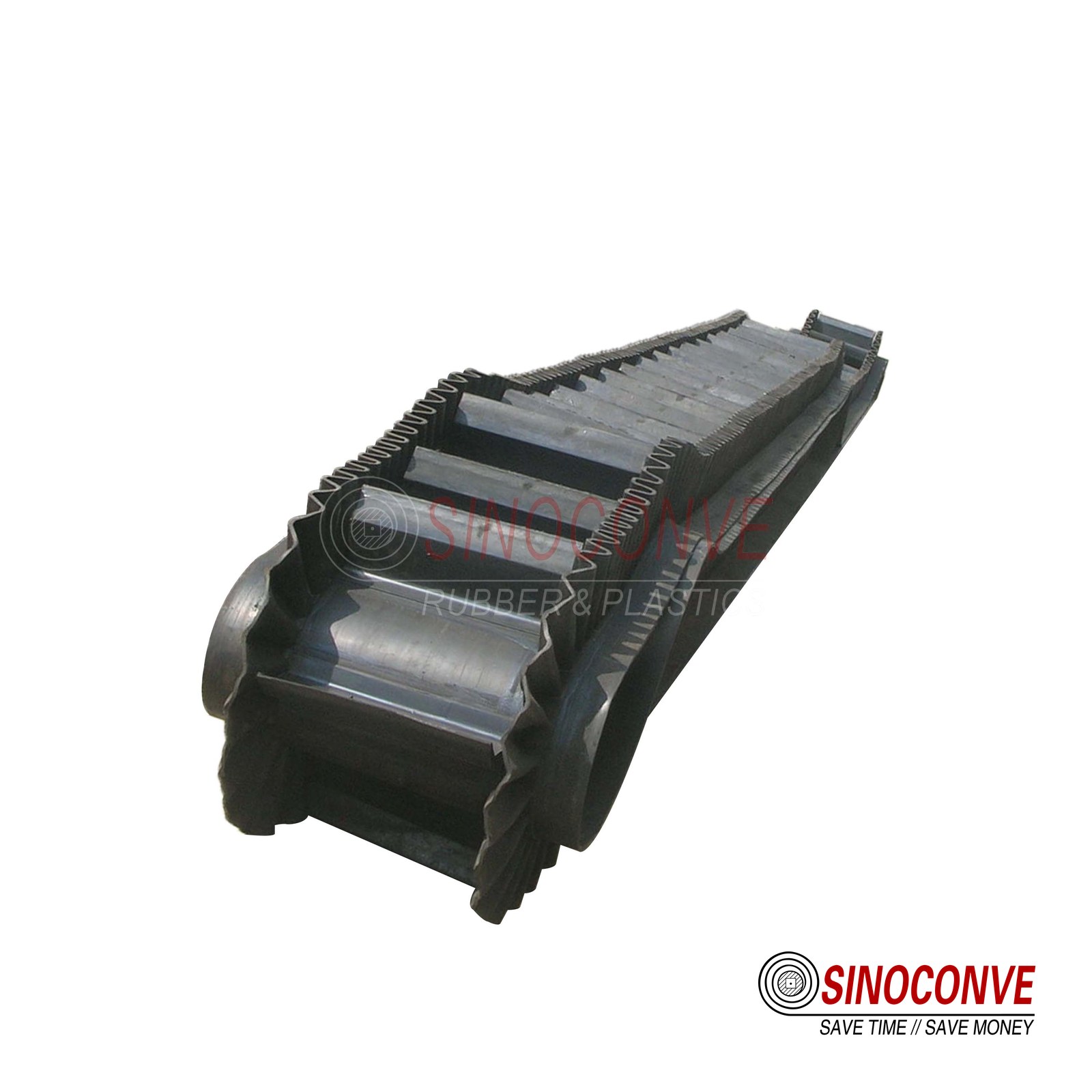
A sidewall belt climbs 90 degrees as readily as 60, which is exactly why it dominates the vertical lift conversation before the material is even considered.
04Belt-Based Type Two: Sandwich and Gripping Belts
The sandwich belt takes a different route to the same problem. Two belt surfaces grip the material between them and hold it by contact pressure, so a loose bulk solid behaves as if it were a solid block travelling up the incline. Feed enters at the bottom between the two surfaces, the material is compressed slightly, and it rides to the top clamped in the moving sandwich.
Because the load is held by surface grip rather than by pockets, this type tolerates steeper angles than any open belt and can accept material that a sidewall pocket finds awkward. It also keeps the product enclosed along the whole climb, which suits dusty or friable material where an open pocket throws fines into the air on every revolution.
The cost of that grip is mechanical complexity. Two conveyor lines must run together at matched speed and matched tension, with the grip pressure tuned so the material neither slips nor crushes. Misalignment between the two surfaces is the classic failure here, and it shows up as uneven wear along one edge before it shows up as a spill at the discharge.
Choosing Gripping Belts Against Other Options
Sandwich systems earn their place when the product must stay intact and stay contained. When we compare options for a fragile or dusty feed, the enclosed climb usually settles the argument in their favor. They also make sense where the plant already has the drive and take-up experience of a conveyor line, since a sandwich is really two of those lines working as one machine.
The friction is that doubling the belt doubles the belt cost, the pulley count and the inspection rounds. On a duty where a single sidewall belt would climb the same angle, the sandwich is often harder to justify, and we say so rather than sell the more intricate machine. Grip pressure also depends on the material's own friction behaviour, so a feed whose moisture swings widely through the year needs a controller who understands the trade.
05Belt-Based Type Three: Pocket Belts and Bucket-Belt Hybrids
A pocket belt is a belt that carries moulded pockets along its length rather than relying on walls and crossbars. The material sits in each discrete pocket, and the pocket travels from feed to discharge without needing sidewalls at all. Variants attach actual buckets to a belt carcass, which is why the type sits between a conveyor and an elevator.
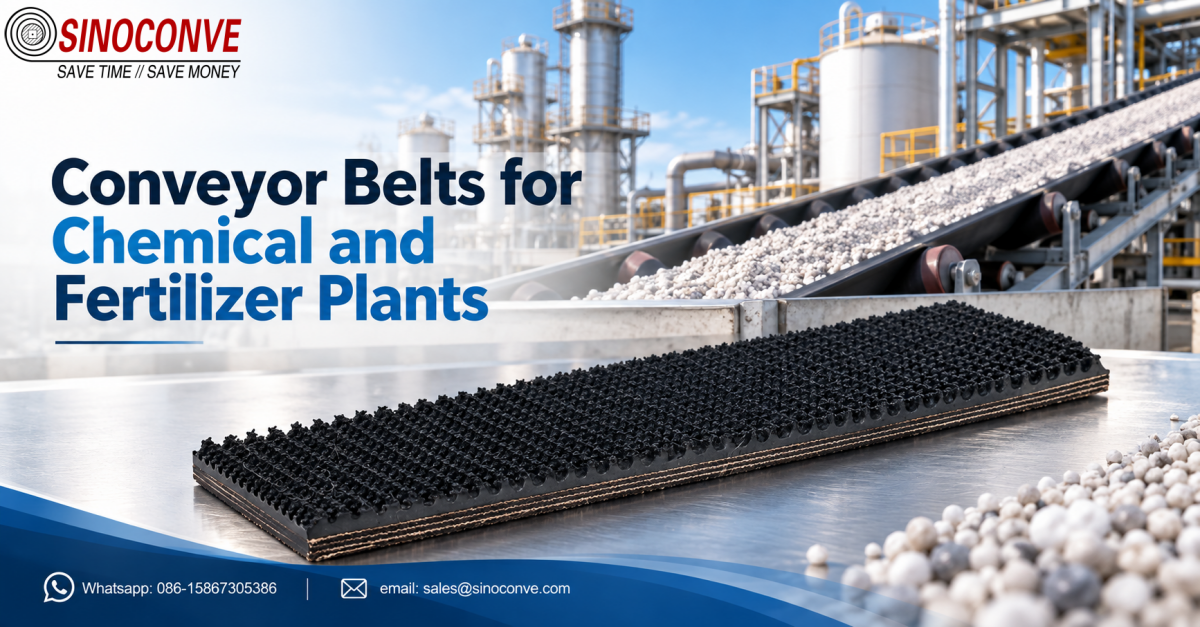
Free-flowing granules and powders suit this family best, and so do small, uniform particles that would leak out of a sidewall pocket. Because the load travels inside a defined container, spillage along the climb is minimal and the discharge is clean. Food and fertilizer plants use pocket designs for exactly this containment, and a smooth or lightly patterned surface can help release sticky residue.
Pocket belts dislike anything bulky. A lump larger than the pocket opening simply will not enter, and coarse angular rock quickly wears the pocket edges and the belt underneath the moulding. They also fare poorly with very abrasive material, because the pocket floor takes the whole sliding load on the way up.
Where a Pocket Belt Beats a Sidewall Belt
When the feed is a uniform granule and containment matters more than raw lump capacity, the pocket design usually wins. Think of a fertilizer plant lifting prilled product, or a food line moving dry ingredients that must not scatter. The pocket holds each charge, the belt release at the head is gentle, and the conveyor can run fully enclosed if the plant wants it so.
Turn the same enquiry toward wet sand or blasted rock and the pocket becomes the wrong tool. Material sticks in the pockets, half of them climb empty, and cleaning turns into a daily job. Buyers sometimes assume "belt is belt" and ask for one type across a whole plant; the honest answer is that the pockets that fit the packing hall will fail in the quarry.
06Belt-Based Type Four: High-Angle Patterned Belts
Patterned belts carry moulded ribs, chevrons or other profiles on the cover, and they lift material on inclines that a smooth belt cannot manage. Chevron or ribbed surfaces interrupt the slide path and hold bulk solid against the pull of gravity, so a patterned belt often reaches 25 to 35 degrees where a smooth belt would spill its load back down the slope.
Buyers frequently lump patterned belts under the vertical heading, and that is only half true. They are steep-angle belts rather than true vertical belts, and they rarely climb past about 35 degrees on their own. Where they shine is on medium inclines, on mobile crushing spreads, and as the inclined section of a route that later becomes vertical elsewhere.
Our conveyor belt distributor team sees patterned belts chosen for their release behaviour as much as their grip. Material that would cling to a plain cover often lets go cleanly from a ribbed one, and on a quarry line that difference decides how much carryback the return run has to handle.
Cleaning and Tracking Consequences
Every raised rib is a place where a scraper cannot reach, so patterned belts demand more thought about cleaning than smooth ones. A standard blade sweeping a chevron cover leaves material in the valleys, and that residue builds until it either dries into hard lumps or lands on the return rollers. Belt cleaners that suit patterned surfaces exist, and specifying one at the start is far easier than retrofitting after the return run has fouled.
Tracking also changes with the profile. The ribbed cover stiffens the belt laterally in ways a smooth belt is not, and a mistimed idler or a poorly centred load shows up as edge wear sooner. For deeper reading on how profiles and cleats behave, our own write-up on chevron and cleated conveyor belts covers the surface side of the same subject.
07Belt-Based Type Five: Z-Shape and Combined Layouts
Real plants rarely present a clean vertical lift with nothing before or after it. Material usually arrives horizontally, must climb, and then must travel horizontally again to reach a stockpile or a silo. The Z-shape layout answers exactly that, using one belt with a horizontal feed section, a steep or vertical climb, and a horizontal discharge section, all joined by curves.
What the combined layout buys is a reduction in transfer points. Each transfer is a place where dust escapes, material degrades and a chute wears, so collapsing three separate machines into one continuous belt removes a set of problems at once. The cost is that the belt now has to bend through tight curves at both changeovers, and those curves put bending stress into the same wall and crossbar assembly that carries the load.
Whether a Z-layout is even possible depends on the belt type. A sidewall belt bends through vertical curves readily and is the natural choice for this arrangement. A patterned belt will not curve, so a Z-layout on a patterned belt needs either separate machines or a different solution entirely.
When to Accept the Complexity
We lean toward a Z-layout when the alternative is a tower with three transfer points and a building full of ladders. Fewer machines mean fewer drives, fewer control panels and fewer inspection routes, and for a plant that values uptime that simplicity is worth real money. The curved sections do demand a belt built for bending, and the take-up has to hold tension through both transitions rather than just one.
08Non-Belt Alternatives That Sometimes Win
A serious comparison has to include the equipment that does not use a flat belt at all, because on some duties those machines are simply better. Nobody should buy a belt system out of habit when a screw or a bucket elevator would run more cheaply and last longer. As a conveyor belt supplier we have no reason to steer you away from a belt when it fits, and every reason to tell you when it does not.
The bucket elevator is the classic rival. Buckets mounted on a chain or belt scoop material at the bottom and dump it at the top, and the whole machine fits in a narrow casing that keeps dust inside. For a tall lift of dry, free-flowing material it is often the cheapest answer, and it handles fine powder that would leak along a sidewall belt without complaint.
Vertical screw conveyors spin a helical flight inside a tube and push material up by rotation. They occupy almost no floor space and can be sealed completely, which makes them attractive for dusty or mildly hazardous products in a cramped plant. Their weakness is abrasion, since the flight rubs the material constantly, and they handle sticky feed poorly because the material cakes onto the flight.
Pneumatic conveying moves material as a cloud in a fast air stream, either by pressure or vacuum, through a pipe that can route almost anywhere. Chain bucket elevators, meanwhile, use a loop of chain carrying buckets or scrapers, and they suit hot, abrasive or lumpy material that would wreck a belt.
When Each Non-Belt Type Is the Better Buy
Bucket elevators win on tall lifts of dry granular product where the tonnage is steady and the material will not cake. Vertical screws win where space is tight and the product is fine, light and only mildly abrasive, and where full enclosure is worth more than efficiency. Pneumatic lines win when the route twists through existing structures and a pipe is far easier to thread than a conveyor. Chain buckets win on coarse, abrasive or hot material that would destroy a fabric belt.
The belt types keep their edge in a few situations. When the climb is not perfectly vertical, when the material is coarse and lumpy but not brutally abrasive, or when the plant already maintains belts and wants one skill set across the floor, a belt system remains the sensible default. That last point matters more than datasheets admit, because a machine the local crew understands gets fixed faster than one it does not.
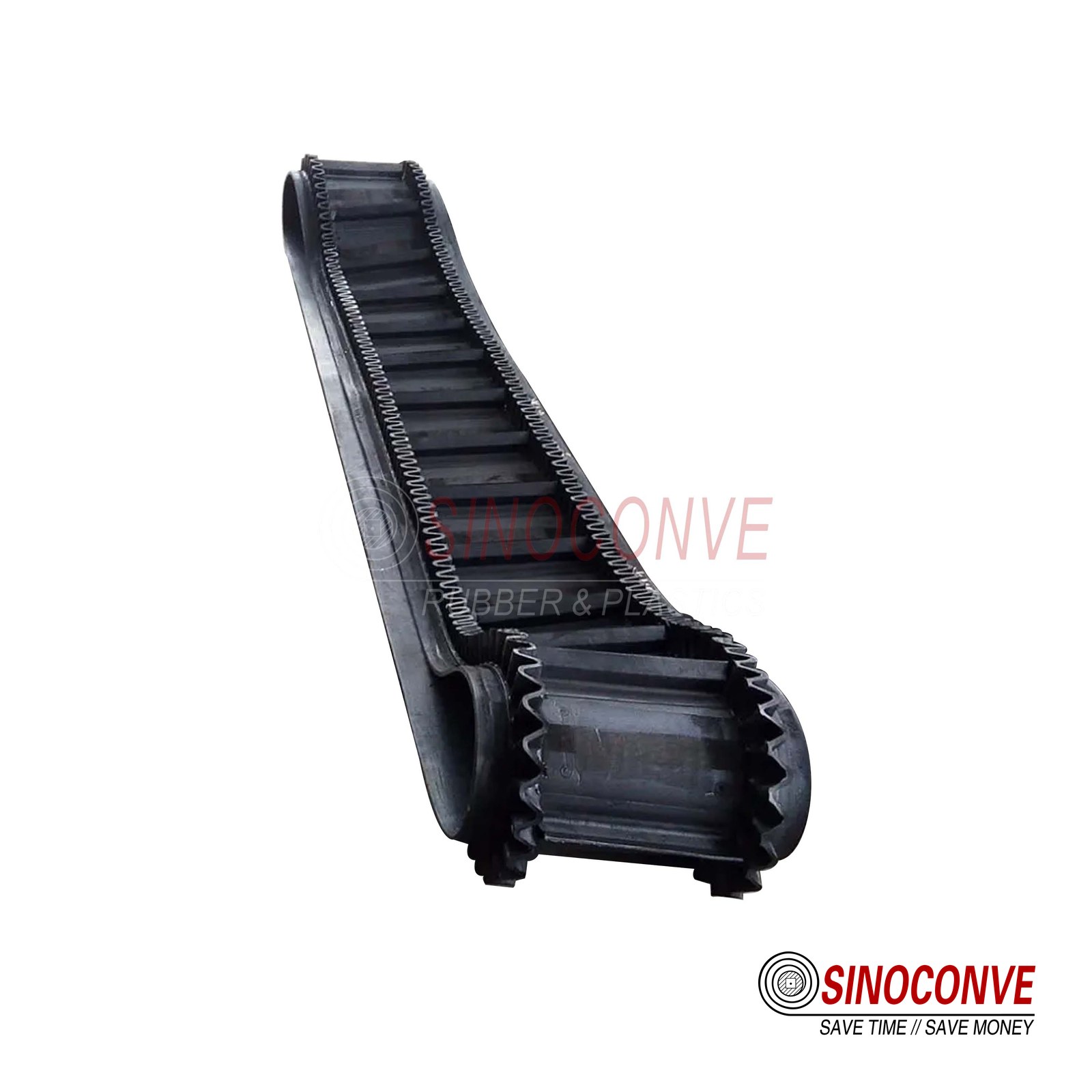
On a tall lift the belt is only part of the argument; the casing, the head frame and the dust control often decide whether a belt or a bucket machine is the cheaper machine to own.
09The Selection Matrix: Matching Type to Duty
Once the duty is described, the shortlist boils down to a handful of comparisons. The matrix below sets out how each major duty factor pushes you toward one family or another, and it is written as full sentences so a buyer can argue with each line rather than tick a box.
| Duty factor that shapes the choice | What a high value on this factor pushes you toward | Type that usually wins the comparison |
|---|---|---|
| Required tonnage per hour at the design point sets how wide and how fast the carrying member has to run. | Very high tonnage favors a continuous belt surface over discrete buckets, because one wide belt out-carries a chain of scoops. | A wide sidewall belt or a sandwich belt handles the heaviest flows most economically. |
| Total lift height from feed point to discharge lip decides whether a tower or a compact machine makes sense. | Moderate height keeps every type in play, while extreme height narrows the field to machines that climb in a tight vertical envelope. | Bucket elevators and vertical screws take over once the lift grows very tall. |
| Material size, abrasiveness and stickiness together rule out more equipment than any other single factor. | Coarse abrasive rock and sticky cohesive feed each eliminate a different group of machines before cost is even discussed. | Heavy abrasive feed points to chain buckets, while dry free-flowing fines point to pneumatic or screw types. |
| Permissible product degradation tells you how gently the machine must transfer the load at every step. | A fragile product that must not crack favors smooth, low-impact handling over machines that drop the material repeatedly. | An enclosed sandwich belt or a gentle pocket design protects the product best. |
| Available floor area and building height define the physical envelope the machine must fit inside. | Tight ground and generous headroom favor a vertical machine, while a low roof forces the decision in the opposite direction. | A vertical screw fits a cramped plan, and a sandwich or sidewall belt suits a long shallow route. |
| Energy consumed per tonne lifted is a running cost that compounds every hour the plant operates. | A machine that rubs or agitates the material wastes more energy than one that simply carries it in a stable mass. | Belt systems and bucket elevators are generally the lightest energy users per tonne. |
| Maintenance reachability decides how quickly a stopped line gets running again after a breakdown. | A machine whose wearing parts sit high and out of reach costs more downtime than its price tag ever reveals. | Enclosed belt and screw machines with accessible inspection points win on serviceability. |
| Dust generation and cross-contamination between products set how tightly the machine must be sealed. | A dusty or multi-product plant needs a machine that contains the load completely rather than letting fines escape. | Pneumatic lines and enclosed screws contain dust best, with enclosed sandwich belts close behind. |
| Capital cost against operating cost decides which machine is genuinely cheaper over a full service life. | A low purchase price means little if the machine needs frequent wearing-part replacement and long shutdowns. | The cheapest machine over five years is the one that fits the material and stays accessible. |
Reading down that matrix rarely produces a single answer on its own. Most real projects have one or two rows that dominate, and the rest fall away. A quarry lifting 400 t/h of blasted rock 25 m cares about abrasion and tonnage, so those rows settle it, while a fertilizer plant lifting 40 t/h of prills 30 m cares about containment and answers differently.
Where a buyer also needs the drives and smaller belts for the machines around the lift, it helps to buy them from one source. An order that includes wholesale conveyor belts beside the drive belts for the same plant keeps the specification consistent, and it means one transmission belt manufacturer answers for the whole package.
Two Rows That Quietly Decide Most Projects
If we had to name the two factors that settle the most enquiries, they would be material abrasiveness and lift height. Everything else shapes the detail, but those two narrow the field fastest. Abrasive material rules out the types with rubbing contact, and tall lifts rule out the types that cannot climb in a compact envelope. Get those two right and the rest of the matrix mostly confirms what you already suspected.
10Failure Modes That Only Show Up on a Vertical Run
Vertical duty tests equipment in ways a horizontal line never does, and the failures it produces are specific enough to deserve their own list. Knowing which type tends to fail where helps a buyer ask sharper questions at the quote stage, and helps a maintenance team know what to inspect first once the machine is running.
Side tracking on the vertical section tops the list for belt types. A vertical run has little of the self-centering help that a troughed section provides, so any slight side load grows instead of settling, and the belt drifts toward one edge. The result shows up as edge wear long before it shows up as a spill, which is why vertical belts need straight, well-aligned support through the climb.
Root fatigue at the base of a sidewall or crossbar is the failure the earlier pages describe in mechanical detail, and it belongs here only as a warning sign. Any cracking along the bond line, opening wider on the pulley side, means the bend radius is wrong for the wall height or the wall has grown too tall for its base. For everything a rubber conveyor belt endures on a steep route, the bond line is where it usually tells you first.
Back-leakage, the return of material down the slope past the carrying pockets, is a vertical-only problem. It starts as a trickle along the belt surface and ends as material piling at the boot. Fine, dry and rounded material leaks worst, and a pitch or wall that is mismatched to the feed opens the path for it.
Impact damage at the loading point piles on top of all of these. On a steeper machine the feed often drops in from a height, and every impact lands on a moving pocket rather than on a flat belt deck, so the loading zone is where the belt takes its hardest hits. Insufficient take-up travel is the last common one; a belt that runs out of stroke cannot hold tension, slips on the drive, and then damages everything downstream.
Which Type Fails Where
The failure profile differs by type, so matching the likely failure to the machine tells you where to look first.
| Failure that appears on vertical duty | Type most exposed to this failure | First sign a maintenance team sees on site |
|---|---|---|
| Side tracking and drift grow whenever a side load is left uncorrected. | Sidewall and patterned belts amplify lateral force along a walled edge. | Uneven wear appears along one edge as the belt rides off-centre. |
| Root fatigue and peeling start where the wall meets the base belt. | Sidewall and pocket designs meet the highest load at that bond. | A fine crack opens along the bond line, wider on the pulley side. |
| Back-leakage sends material sliding down the slope past the pockets. | Sidewall and patterned belts leak worst on fine, dry, rounded feed. | A trickle of material runs down the belt toward the boot. |
| Impact damage grows wherever material drops onto the loading point. | Every belt type shares the exposure, and pocket machines suffer most. | Torn pockets and dented chutes mark a loading zone under stress. |
Cleaning is genuinely harder on every vertical type, and that difficulty is the quiet root of many of the failures above. Residue that stays on the belt adds mass, changes tracking and feeds back into the load, so the machines that clean themselves cleanly last longer than the ones that do not. Our own experience building both belt and drive products at one conveyor belt factory is that the maintenance argument you hear from a plant almost always traces back to cleaning and access, not to belt quality. Teams that also keep spare drives on the shelf deal with a V-belt manufacturer for those belts in the same week.
11Capacity and Power: The Factors That Move the Needle
We are not going to run pocket arithmetic on this page, because the earlier guides already walk through that calculation in full. What matters at the selection stage is which variables actually change capacity and power, so a buyer can tell whether a quoted figure rests on sensible assumptions or on wishful ones.
Raising belt speed is the obvious lever, and it is the one most often overused. Faster running lifts more material per hour, but on a vertical belt it also throws the load about, increases wear and gives back-leakage more chance to start. Somewhere on every vertical design there is a speed past which the extra tonnage is cancelled by the extra spill, and finding that ceiling matters more than chasing a number.
Crossbar or pocket pitch, wall height and the material's own surcharge angle work together to set how much load each pocket carries and how much of it stays put. Change any one and the other two move with it. A taller wall and a shorter pitch both add capacity up to a point, then add mass, bending strain and cost for diminishing returns.
Where Start-Up Loads and Blockage Eat Your Margin
Drive sizing for a vertical machine cannot ignore the harder moments. A jammed boot or a choked loading point turns the start-up into a much heavier pull than normal running, and the drive has to survive that without stalling or snapping. We size the margin for a blockage that clears only once the motor has already loaded up, because that is the case that destroys drives.
Power also has to cover the vertical lift itself plus every friction point between boot and head. On a long vertical run the lift component dominates, but friction still matters, and it grows with belt weight, crossbar count and the grip force in a sandwich type. Plants that drive their crusher motors from the same source as the conveying line usually plan the drives and the belts together.
A Word on the Smaller Drives Around the Plant
Plants rarely buy only a vertical belt. The surrounding equipment comes with its own drives, and those are usually wrapped or cogged belt drives on the crusher, the feeder and the stacker. Buyers who consolidate the order specify those drive belts alongside the conveying line, and the two arrive on the same truck. It saves a surprising amount of specification chasing.
12Buying and Acceptance: Documents and On-Site Checks
A vertical conveyor is one of those purchases where the paperwork you receive at order confirmation tells you how the project will go. Vague documents produce vague machines, and the arguments at acceptance are almost always about things that could have been specified months earlier. The table below sets out what we expect to exchange for a belt-and-machine order.
| Item to be verified at purchase stage | Document or evidence the buyer should hold | On-site check that confirms it once delivered |
|---|---|---|
| The belt specification should state carcass, ply count, cover grade and total thickness as agreed. | A signed belt datasheet plus the mill test certificate for the carcass and cover compounds. | Measure width, thickness and cover hardness against the datasheet before the belt is even unrolled. |
| Sidewall or pocket dimensions should match the selection drawing, not a standard catalogue size. | An approved general arrangement drawing showing wall height, pitch and every curved section. | Check wall height and crossbar pitch on the delivered belt against the approved drawing. |
| The joint method and its strength class need to suit the duty and the site's splicing ability. | A splicing procedure with the specified joint efficiency and the cure data for the chosen method. | Inspect the finished joint for alignment, thickness and freedom from voids before the machine runs. |
| Drive sizing must cover normal running plus the blockage case defined at the design stage. | A power calculation showing tear-off, running and blockage loads against the selected motor. | Run the empty belt first, then load it in steps and watch current draw and belt tracking together. |
| Take-up travel needs to be long enough to tension the belt through its whole service life. | The take-up design with its full stroke and the belt's expected elongation range stated. | Confirm the stroke is still well inside its limit once the belt is at working tension. |
| Loading and discharge points should be built so material enters and leaves without damage. | Chute and skirt drawings with impact angles and any wear-liner specification called out. | Watch the first loaded start for spillage, bounce and material clinging to the belt surface. |
Two checks on that table are worth stressing. The blockage case in the power row is the one buyers most often skip, and the take-up stroke check is the second, because a vertical belt stretches through its life.
We also ask for a material sample before finalising any vertical design. A two-kilogram bag of the actual product, at the actual moisture, tells us more about how it will behave in a pocket or a screw than any description on an enquiry form. It is the cheapest test in the whole project.
What Good Acceptance Looks Like in Practice
Acceptance is not a single inspection; it is a sequence that runs from delivery to load-up. Start with a document review against the approved drawings, then a dimensional check on the belt, then an empty run to watch tracking and current, and finally a staged load-up with a stop-start cycle thrown in. Skipping that empty run is how tracking faults get blamed on the material later.
Keep a written record of every number measured on the day. When a joint fails nine months later, the thickness and alignment figures taken at acceptance are what settle the conversation, and they cost nothing to write down.
13How This Page Fits With Our Other Vertical Lift Guides
We publish a lot about steep and vertical conveying, and the risk is that three pages end up saying the same thing three ways. They do not, and it helps to be exact about where each one sits.
Our guide on the flexible sidewall conveyor belt works at the level of the belt itself. It walks through the carrying cross-section, the capacity arithmetic behind a pocket, and the profile geometry that decides how much of that capacity the belt can physically reach. Read that page when the type is already chosen and the question has moved to belt dimensions and load behaviour.
Our guide to the side wall belt conveyor works one level up, at the machine. It covers how the whole conveyor is laid out, how material enters and leaves it, how the return run and the take-up are arranged, and what maintenance on a sidewall machine actually looks like week to week. Read that page when the machine exists and the questions are about running and servicing it.
This page sits one level above both. It compares the types, weighs belt systems against the non-belt alternatives, and sets out the criteria that decide which family you should even be considering. The three fit together as a sequence in which you pick the type here, design the machine with the second guide, and size the belt with the first.
Where to Go Next Depending on Your Question
If your question is which type suits a given material and height, stay on this page. If it is how a chosen sidewall machine should be arranged and maintained, move to the side-wall guide. If it is how big the pockets need to be and how they behave under load, move to the flexible sidewall guide. For the steep-angle middle ground between horizontal and vertical, our write-up on abrasion resistant belts for quarry and steep-angle conveying covers that band in more detail.
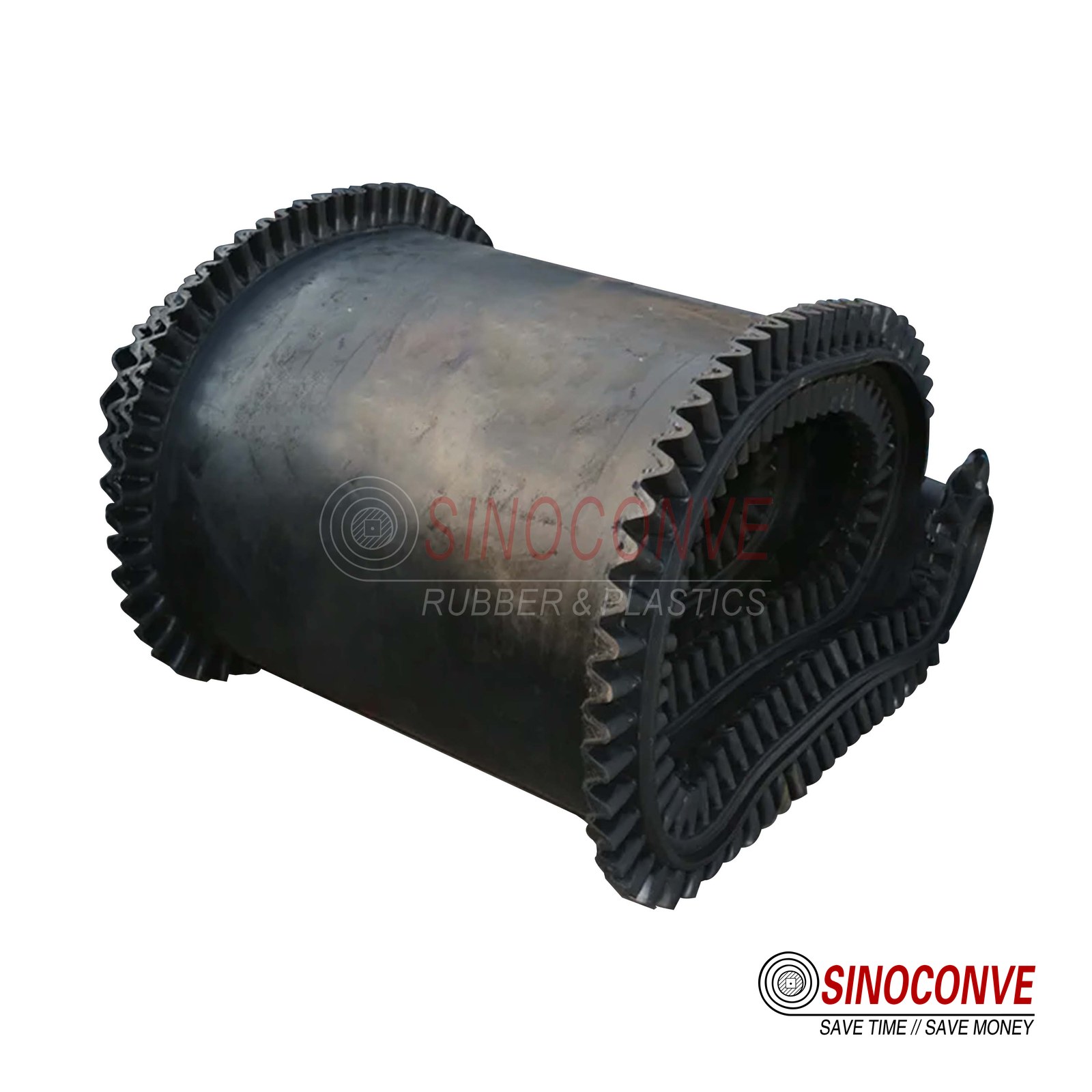
Choosing the type is a plant-level decision; the belt and the machine drawing come after, which is the order these three pages follow.

14Frequently Asked Questions
What is a vertical conveyor belt?
A vertical conveyor belt is a belt-based system that lifts bulk material at a near-vertical or fully vertical angle, most often using corrugated sidewalls with crossbars to form carrying pockets. It is a family of designs rather than one product, and it competes directly with bucket elevators, vertical screws and pneumatic lines on the same duties.
How steep can a vertical conveyor belt go?
Sidewall and sandwich belts can reach a full 90 degrees, and in practice they run from about 30 degrees up to vertical. Patterned belts are the exception and generally stop around 35 degrees, because they hold material by surface friction rather than enclosing it in a pocket. If your incline is between 35 and 60 degrees, compare a patterned belt against a sidewall belt before settling.
Which is better, a vertical conveyor belt or a bucket elevator?
Neither is better in the abstract, and the material decides it. A bucket elevator usually wins on tall lifts of dry, free-flowing, fine or dusty product, because it seals the load in a casing and costs less to run. A belt system wins when the material is coarse and lumpy, when the climb is not perfectly vertical, when the route needs to bend, or when the plant wants to standardise on belt maintenance. Feed a wet or cohesive product into an elevator and it will choke, which is where a belt starts to look better.
What materials are suitable for vertical belt conveyors?
Coarse to medium bulk solids are the natural fit: crushed stone, clinker, ore, bauxite and most quarry products. The type tolerates wet or moderately sticky material better than a screw or a pneumatic line, though very fine dry powder leaks along the belt and very sticky clay clings to the pockets. For uniform granules and powders that must stay contained, a pocket belt or an enclosed sandwich design is usually the better choice.
What are the common failures of vertical conveyors?
The recurring ones are side tracking on the vertical section, fatigue and peeling along the wall or crossbar root, back-leakage of material down past the pockets, impact damage at the loading point, and slipping caused by a take-up that has run out of stroke. Each type has its own weak spot: sandwich belts fail at the grip interface, pocket belts at the pocket floor, patterned belts at the ribs, and chain buckets at the joints. Cleaning difficulty sits behind several of them, because residue changes tracking, weight and load.
Can a vertical conveyor handle wet or sticky material?
Often yes, and better than most alternatives, but the design has to be tuned for it. A shorter crossbar pitch, a taller wall and a cleaner belt surface all help a wet load stay in the pocket on the way up. Very sticky material is the harder case, because residue that clings to the wall base or the pocket floor builds up until it disturbs tracking and sheds material onto the return run. Run a sample test before committing to any vertical design with a sticky feed.
Do I need a sidewall belt or a pocket belt for my product?
Match the belt to how the material behaves rather than to how the plant is laid out. Coarse, lumpy, free-flowing rock points to a sidewall belt with crossbars, which handles large pieces and steep angles together. Uniform, fine, valuable granules that must stay contained point to a pocket belt, which keeps each charge separate and discharges cleanly. When the product is dusty and fragile, an enclosed sandwich design earns its extra complexity by protecting the load all the way up.
How much maintenance does a vertical conveyor need?
Plan for more than a horizontal belt of the same tonnage, because the vertical run concentrates wear in a few specific places. Expect regular checks on tracking, on the wall and crossbar roots, on the loading zone and on cleaning. The cost is mostly time, not parts, and the machines that get maintained well are the ones whose inspection points and access platforms were designed in from the start.
Can a vertical conveyor belt be retrofitted into an existing plant?
Sometimes, and the answer depends on the space above the feed point and the structure that would carry the head end. A steep belt can replace an inclined line and a transfer tower where the footprint is tight, but it still needs a head frame, a drive and a discharge arrangement at the top. Retrofit projects live or die on that access, so measure the available headroom and maintenance route before choosing a type.
Related Products You May Need
- Chevron and patterned conveyor belts for steep-angle and inclined duties
- Rubber conveyor belts for quarry, cement and heavy bulk handling
- EP fabric carcass conveyor belts for long and steep conveying lines
- Conveyor rollers and idlers for the feed and return sections
- Browse the full SINOCONVE product catalogue for conveying and drive belts
Related Blog Posts
- Flexible sidewall conveyor belt: pocket cross-section and profile geometry explained
- Side wall belt conveyor: layout, infeed, return run and maintenance
- Abrasion resistant belts for quarry and steep-angle conveying
- Conveyor belt cleaning methods and when scrapers will not work
- Conveyor carryback solutions for return-side residue control