

A dough belt is judged by what it gives back. Stone, clinker and sealed cartons leave a surface when gravity asks them to. Freshly mixed dough does not. It clings to the cover, stretches at the discharge lip, and leaves a thin film that dries hard on the return side before the shift is over.
Most bakery lines we walk into are not fighting a belt failure in the usual sense. There is no torn carcass and no burned edge. What the quality team sees is a slow drift: piece weights creeping up by two or three grams across a shift, a divider that needs constant trimming, and a scrap tray that fills faster after lunch than at start-up. Those symptoms usually trace back to a transfer between mixer and proofer, and to a belt chosen from a food-handling catalogue without anyone asking what the dough does to it.

01Why Dough Creates a Different Belt Duty
The material arriving on the belt is a viscoelastic network, not a solid. Gluten strands hold starch granules and free water in a structure that deforms under its own weight, springs back when the stress is removed, and sticks to almost anything smoother than itself. A divider blade cuts that network cleanly only when the feed is calm. A belt that pulls, ripples or stalls at the infeed turns the same dough into a smeared ribbon with a torn skin, and the tear follows the piece all the way through proofing.
The Belt Sees a Continuous Sheet, Not Discrete Pieces
Between the mixer discharge and the divider hopper, dough is one continuous mass, so whatever happens to one part of the sheet reaches the next. That is why a small speed mismatch becomes a large weight error. We check three numbers before touching hardware: surface speed at the mixer discharge, surface speed at the divider infeed, and the height between them. If the second is slower by a few percent, dough folds onto itself, traps air, and the divider cuts volumes that weigh different amounts. A lean straight dough at 26 °C behaves nothing like a wet whole wheat or a laminated base, which wets the cover within minutes. No data sheet separates those cases; only a trial with your dough does.
Where Flour Dust and Release Agents End Up
Dusting flour is applied at the divider and the moulder to stop sticking, and a portion of it always ends up on the belt. Fine particles are small enough to travel into the step at a splice, under an edge seal, and into the gap between the belt and a scraper blade. Once flour is packed into a splice step it absorbs water from the dough, swells, and turns into a hard ridge that lifts the following pieces. That ridge also scrapes the cover each pass, so the damage accelerates.
Release agents create the opposite problem. A silicone or oil film makes the first hundred pieces look perfect. By mid-shift the film has been partly transferred to the dough, partly wiped away by the scraper, and partly pushed to the belt edges. Release becomes uneven across the width. Operators respond by spraying more, which then contaminates the divider and the moulder. We would rather see the release built into the cover texture than added at the line, and we ask for the customer's release-agent list before recommending a surface.
Field note from our engineers: On a 700 mm wide croissant line in Ningbo, the night shift reported pieces sticking at the transfer to the moulder only between 02:00 and 05:00. The belt was not the variable. Ambient humidity had climbed, the dough surface had wetted out, and the scraper was pressing harder because the previous shift had tightened it to stop a different problem. Releasing the scraper load and adding a short air gap fixed a fault that had already been quoted as a new belt.
Pressure is the third variable, and it is the one most often ignored. Dough is soft enough that a roller, a hold-down bar or a tight scraper can degas it. Degassed dough proofs differently, and the finished loaf shows a dense band where the belt pressed it. That is a quality defect produced by a conveyor, not by the baker. Buying a heavier belt to solve a tracking problem usually makes this worse, because a heavier belt needs more tension and more tension means more pressure at every contact point.
This is why we treat dough handling as its own duty class rather than a subcategory of general food conveying. The same reasoning applies when a buyer moves from a heavy rubber conveyor belt on a raw-material intake to a light, wide, low-tension belt at the divider: the questions change from tensile strength to peel force and surface texture. A conveyor belt manufacturer that only quotes breaking strength has not answered the dough question at all.
02Separate Dough Contact From General Food and Packaging Duties
We divide a bakery into four zones and write a separate line for each. The first is general food processing: ingredient intake, sieving and the dry transfers that feed the mixer. The second is the food-grade PVC and PU selection step, where polymer family and finish are still open. That is a material decision for a PVC conveyor belt page, not a dough page. The third is the zone this article covers: the wet, pressure-sensitive path from mixer discharge through divider, rounder and sheeter to the hand-off at tins. The fourth is post-bake packaging, which handles a cooled product that no longer deforms and belongs with food packaging duties.
| Duty zone and what it moves | What the belt must resist in service | What to specify in the written RFQ |
|---|---|---|
| General food processing upstream of the mixer, including flour, sugar and dry ingredient transfer. | Abrasive dry powder, fine dust ingress and long dry running hours without washing. | Dust-tight edge construction, a documented polymer grade and a stated minimum pulley diameter. |
| Food-grade PVC or PU selection for the plant, where polymer family and finish are still open. | The actual cleaning chemistry, the rinse temperature and the product contact documentation. | Polymer family, surface pattern, colour, thickness and the supplier's food-contact document set. |
| The dough contact segment covered here, from mixer discharge through divider, rounder and sheeter. | Wet adhesion, gluten peel, flour packing at the splice, scraper wear and low-pressure degassing. | A dough sample trial, a peel check at shift start and a splice step drawing with the scraper position. |
| The post-bake packaging line, moving cooled product that no longer deforms under light pressure. | Abrasion from crust edges, crumb dust and frequent stop-start indexing at the packer. | Index accuracy, cut resistance and a surface that releases crumbs at the cleaning station. |
Written this way, the table does two jobs. It stops a single belt specification from being stretched across four incompatible duties. It also gives the buyer a defensible reason to reject a quote that answers the packaging question when the dough question was asked. The industries we serve page groups these zones by plant type, which is a useful starting point, but the zone table above is what we actually price from.
The boundary matters in both directions. A belt that performs well on a cooled bread roll will often fail within a week on a 62 percent hydration dough, because the failure mode is adhesion rather than abrasion. An easy-release dough surface, in turn, is wasted on a packaging line where the product never sticks. If the polymer family is still open, our food grade PVC conveyor belt buyer's check covers the document trail; the section below assumes that decision is made.
03Feed the Divider Without Stretching or Smearing the Dough
The divider is usually blamed for weight error, and it is usually innocent. By the time dough reaches the hopper it has been stretched, folded or compacted by the transfer that delivered it. A divider can only cut what it is given. If the sheet arrives with variable thickness, the volumetric cut produces variable mass, and no calibration will hold the target.
Buffer Between Mixer Discharge and Divider Infeed
A mixer discharges in batches, a divider wants a steady ribbon, and a short incline belt plus a hopper absorbs the difference. We size that buffer around batch weight and divider rate rather than floor space. If a 120 kg batch clears the mixer in ninety seconds and the divider eats 1.2 kg per second, the buffer holds roughly a fifth of the batch at any moment. The belt must be wide enough that the sheet spreads sideways only slightly, because dough that reaches the edges loses its square section and the guides then squeeze it.
Incline angle deserves more attention than it gets. Wet dough slides back on a smooth cover, and operators compensate with tension or cleats. Both create new faults: tension presses the dough flat, and cleats release it in lumps. Keep the incline shallow and use the horizontal run for accumulation. Where floor space forces a climb, a textured cover and a correctly set head-pulley scraper do more than a tension increase.
| Feed condition we measured on site | What the dough does at the transfer point | Corrective change we make before the next shift |
|---|---|---|
| Discharge belt runs eight percent faster than the divider infeed roll. | The sheet buckles into a standing wave and folds a layer of air into itself. | Match surface speeds within two percent by changing the drive ratio, not the belt. |
| Batch drops forty centimetres from the mixer outlet onto the belt. | The leading edge slaps flat, degasses and takes a permanent flat spot on the underside. | Add an inclined chute or raise the belt so the drop stays under fifteen centimetres. |
| Dough sheet is fed to one side of a belt that is wider than the sheet. | The loaded side runs tighter, the belt steers toward the heavy edge and the guide rubs. | Centre the feed with a short guide chute and re-check the take-up on both sides. |
| Operators stop the divider for five minutes while the mixer keeps running. | Dough sits still on the belt, wets the cover and bonds to it along the full contact area. | Interlock the mixer with the divider, or add a slow creep mode during short stops. |
Side guides are a quiet source of smear. A guide set too tight creates a stationary band of dough that dries, cracks and sheds into the product. We set guides with visible clearance and let a short low-friction strip do the centring. A moulded guide profile follows a grooved pulley instead of rubbing a steel edge, which is why our guide PVC conveyor belt range exists and why the profile must be matched to the groove.
Think about what the divider does when it is starved. The guillotine closes on a thin ribbon, the cut is incomplete, and the returning knife drags the tail. That tail causes many stringing complaints blamed on the recipe. A rough top conveyor belt on the incline holds the ribbon steady without extra tension, and a conveyor belt supplier who knows divider feed will ask for batch size and cut rate before quoting a surface.
04Surface Release, Edge Sealing and Splice Geometry
Release is a system property. It depends on the cover texture, the contact time, the pressure at the support rollers, the dough temperature and what the previous piece left behind. Changing one of those and expecting the others to stay constant is how a belt that worked in the trial fails in production.
Reading Release From a Peel Test, Not a Brochure
We run a simple peel check whenever a new dough is introduced. A piece is placed on a sample of the candidate cover, left for a fixed interval that matches the longest dwell on the line, and then lifted by hand at a steady rate. What matters is not a number in a table. It is whether the dough separates cleanly at the interface or tears internally, leaving a film on the cover. A tear means the adhesion is stronger than the dough's own cohesion, and on a production belt that film will build up.
Surface finish changes the result even within one polymer family. A high-gloss cover wets out completely; a fine matte or lightly embossed cover leaves micro-channels where air and a little flour remain, and the peel is shorter. That is why two belts of the same thickness and polymer behave differently on the same line, and why we send physical samples instead of describing a finish in words.
Polymer choice sits underneath the finish. With wet, high-absorption doughs, PU covers generally release more readily than PVC and resist fat in laminated doughs better. That is an observation across many lines, not a guarantee. Fat-rich, high-sugar and enzyme-treated doughs behave differently, and the only defensible evidence is a trial on your mix. A PVC conveyor belt guide to surface patterns covers the finishes if PVC stays the plant standard.
Splice Steps and Edge Seals in a Wet Zone
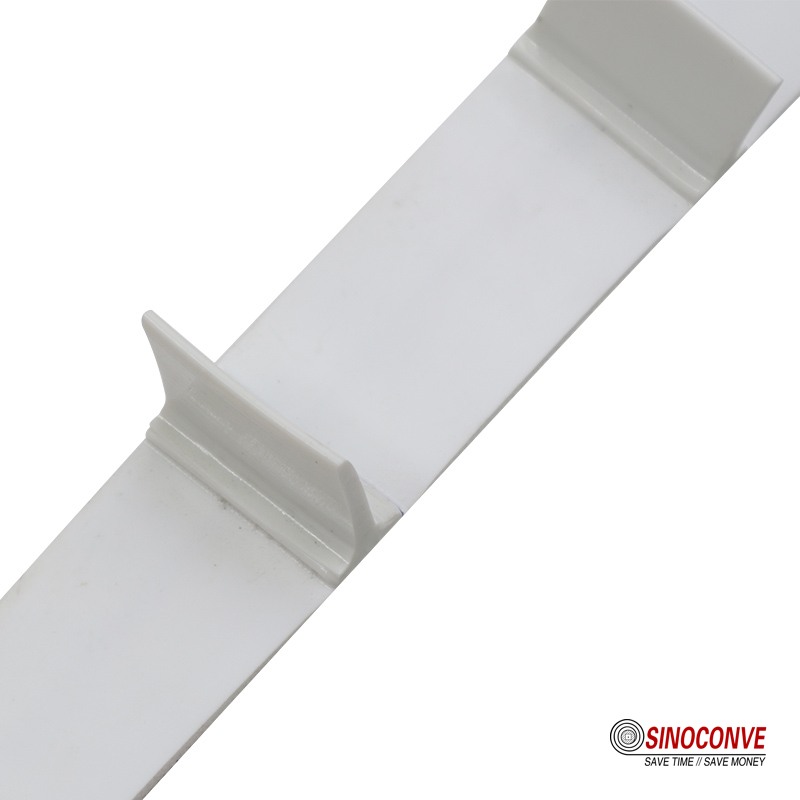
Every splice is a discontinuity, and dough finds discontinuities. A step of half a millimetre is enough to catch a scraper, gather flour and start a ridge. On a thin belt running at divider speed, that ridge passes the dough twenty or thirty times a minute. We specify a splice that is pressed and trimmed flush, then measured with a straight edge across the joint in both directions. If a fingertip can feel the step, the dough will feel it too.
Edge sealing matters more here than in dry conveying. Dough moisture and wash-down water attack an open fabric edge; once water wicks in, the belt swells, tracks badly and delaminates. A defined seal width on the drawing is a purchasing requirement, not an upgrade. We also ask for the joint method: a stepped splice in a thin belt runs flatter than a finger splice, and the trade-off in strength should be explained rather than assumed. Our note on splice versus mechanical fastener joints covers the decision; metal fasteners do not belong on the product side.
| Belt feature under review for dough contact | Why sticky, wet dough cares about this feature | Evidence we ask the supplier to provide first |
|---|---|---|
| Cover finish, gloss level and the visible surface pattern. | A glossy surface wets out completely and holds a longer peel against wet dough. | A physical sample of the exact finish, plus the pattern reference on the drawing. |
| Splice type, step height and how the joint is trimmed. | Any raised step collects flour, lifts the following piece and wears the scraper edge. | A joint cross-section drawing and a measured step value on the finished belt. |
| Edge seal construction and the sealed width on each side. | Wash water and dough moisture wick into an open edge and swell the carcass. | A written seal width, the sealing method and a photo of a production sample edge. |
| Minimum pulley diameter against the belt thickness supplied. | An undersized nose pulley bends the belt sharply and opens the splice on every pass. | A stated minimum diameter for the supplied construction, in writing and not verbal. |
One geometry point gets missed: the nose bar at the discharge. A small nose roller is common where dough crosses a short gap, and the tighter the wrap, the more the cover bends. If the belt is too thick for that roller, the splice takes the strain and the cover cracks along the joint within weeks. The fix is a larger roller or a thinner belt, and a flat PVC conveyor belt in a lighter construction is often cheaper. When we quote wholesale conveyor belts for a bakery, nose roller diameter is the first dimension we ask for.
05Scraper Release, Flour Dust and Return-Side Cleanup
The scraper is the most misunderstood component on a dough line. It is installed to remove the film the belt brings back from the product side, and on a sticky dough that film is continuous rather than occasional. When the blade cannot keep up, the return side carries dough into the tail pulley, where it wraps, cures and changes the belt path.
Setting a Scraper to Peel, Not to Press
Operators tighten a scraper because it seems to be leaving material behind. The result is a blade pressed hard against the cover, running dry, heating the surface and burnishing it glossy. A glossy band releases worse than the surrounding belt, so more dough sticks there, and the operator tightens again. That loop is common and it is entirely avoidable.
We set a polyurethane blade with light, even contact and check it with a strip of paper: the paper should pull out with drag but without tearing. Blade angle matters as much as pressure. A blade set close to tangent peels the film; a blade set at a steep angle pushes it into the cover. On a dough belt we would rather run two lightly loaded blades in sequence than one heavily loaded blade, because the second pass catches what the first lifts. If the film is still present after that, the problem is surface release, not scraper force, and adding pressure will not solve it.
Flour dust changes the picture. Dry dust on the return side is harmless until it meets water, then it becomes a paste that packs into idler grooves and under the blade holder. A dry brush ahead of the blade keeps dust moving; a wash-down nozzle behind it dilutes what remains. Water applied before the brush turns dust into glue, so the order matters. Our article on return side belt cleaning sets out the sequence, and the limits of scraper-based cleaning deserve a read before anyone specifies a third blade.
Cleaning access is a purchasing decision, not a maintenance detail. A belt that cannot be lifted off its support surface will never be cleaned underneath, and the underside is where wet flour collects. We ask for take-up travel enough to release tension, a hinged guide section, and a drain path that does not run back under the frame. Where two shifts run with a wet clean between them, the belt must be designed for that routine from the start. Any cleaner should be confirmed against the actual construction by the supplier, in writing, at the concentration and contact time you really use.
Field note from our engineers: A plant in Shandong washed a dough belt with a foaming alkaline cleaner every night and rinsed with water at the end of the shift. The belt edges swelled after about five months and the splice opened. Nothing was wrong with the belt for the duty it was sold for. The wash routine had simply never been written into the specification, so nobody had asked whether the edge seal was built for it.
06Tracking, Transfer Gaps and Piece-Weight Stability
Weight control on a bakery line is usually discussed as a divider setting. In practice, half the drift we investigate starts at a transfer gap. A piece that is stretched as it crosses from one belt to the next has a different length, a different density and a different behaviour in the moulder, and the checkweigher records the result long after the cause.
Why a Dough Belt Wanders
A dough belt is wide, thin and lightly loaded, so it is sensitive to anything that changes the tension balance across its width. A crowned pulley that centres a thick rubber belt will steer a thin PVC belt unpredictably, and a frame square to within a few millimetres at installation can move once the line warms through the day and the wash-down water cools it. We check three things before adjusting anything: pulley alignment with a string line, belt width against guide clearance, and whether the wander follows the belt or stays with the frame. If the belt drifts to the same side whichever way it is turned, the belt is the problem; if the wander stays with the frame, the frame is. Guide profiles help when the groove is machined to match, and self-aligning rollers on the return run can remove a slow oscillation that no take-up adjustment will cure. Our tracking guide covers that sequence, and a self aligning roller selection note explains where rollers help and where they mask a frame fault.
Weight Drift Is a Transfer Symptom
When the checkweigher trend climbs through a shift, we plot it against three line variables: dough temperature at the divider, hopper level, and the gap between the discharge nose bar and the receiving belt. Temperature changes the dough's density slightly and its stickiness substantially. Hopper level changes the pressure on the cut. The gap changes how far the piece falls and how much it deforms on landing. None of those three appears on a divider calibration screen.
| Symptom seen on the checkweigher or line | Likely cause at the dough transfer point | First check we run at the start of a shift |
|---|---|---|
| Average piece weight climbs slowly from first hour to last. | Dough temperature rises, the sheet becomes more extensible and stretches on the incline. | Record dough temperature at the divider every hour against the weight trend. |
| Weights scatter widely with no clear trend across the shift. | Hopper level swings, so the pressure above the knife changes cut to cut. | Watch the hopper level for two minutes and compare it with the scatter pattern. |
| Pieces arrive at the moulder noticeably longer than they are wide. | The receiving belt runs faster than the discharge belt and draws the piece out. | Measure both surface speeds with a tachometer rather than reading the drive settings. |
| One edge of each piece is flattened and the rest looks normal. | A side guide or a worn belt edge is pressing the dough as it passes. | Inspect the guide clearance and the belt edge for fraying or a lifted seal. |
The transfer gap itself is a design value that should be on the drawing. We like a gap small enough that the piece is supported across most of its length but large enough that the belts never touch. On a thin belt with a small nose roller, that gap can be held to a few millimetres if the frame is stiff. Where the gap has to be larger, a short dead plate at the same height as the belt surface prevents the leading edge from dropping and folding under.
Downstream of the dough section, the same question appears in another form. Filled trays leave the moulder on a tray conveyor that feeds the racks and the logistics and warehousing side of the plant, where indexing accuracy matters more than release. Carrying one belt standard across that boundary is a mistake. A conveyor belt factory visit shows how different the two constructions are.
07RFQ, Acceptance and Shift Inspection Checklist
A dough belt RFQ that gets a useful answer contains four things: the dough, the line geometry, the cleaning routine and the acceptance test. Most enquiries we receive contain only the dimensions. Dimensions tell us what to make, not what it has to survive.
What to Put in the RFQ Package
Start with a dough description in the customer's own words: hydration, fat content, sugar level, flour type, target dough temperature at the divider, and whether the dough is laminated. Add a photograph of the sheet as it leaves the mixer, because a photograph shows folding and tearing that a written description hides. Then the geometry: pulley centres, diameters including the nose roller, belt width, incline angle, and the gap at each transfer. Finally, the cleaning routine with the chemicals named and the frequency stated.
Acceptance should be written before the order, not after delivery. We propose a short run on the actual line with the actual dough, a weight sample of at least thirty consecutive pieces at start-up and again at the end of a shift, and a visual check of the return side after the first full production day. If the belt is spliced, the joint should be measured and recorded at installation so there is a baseline for later comparison. These are ordinary steps, and a supplier who resists them is telling you something.
Drive components belong in the same document. A divider is only as steady as its drive, and a slipping belt on the mixer or moulder produces weight variation that looks like a conveyor fault. We supply both sides of that problem, so we would rather see the whole drive train in one enquiry than quote a conveyor into a machine that is oscillating. Start with our V-belt range, and let a V-belt manufacturer who also makes the conveyor check that the two selections do not fight each other. The same applies to a transmission belt manufacturer asked to match an existing pulley set: the profile has to be measured.
For plants specifying a complete line, our quality assurance process records each production stage, and the industrial equipment section explains how we handle machine builders who need belts supplied to a drawing. A wholesale guide for food conveyor belts is a reasonable next read if you are consolidating several positions into one order.
One sourcing note before the paperwork goes out. A plant that also runs a raw-material intake or a case-handling line will need an industrial conveyor belt on the heavy side, and that construction is wrong for a dough transfer. If you buy through a conveyor belt distributor, ask for the same dough trial and joint measurements you would ask the factory for.

08Frequently Asked Questions About Bakery Dough Conveyor Belts
What makes a dough belt different from a standard food belt?
The failure mode. A standard food belt is judged on abrasion, cut resistance and how easily it wipes clean. A dough belt is judged on how cleanly wet gluten lets go of the surface after a contact time measured in seconds. That difference drives the cover finish, the splice quality, the tension setting and the scraper design.
Can we run a high-hydration dough on our existing PVC belt?
Sometimes, but test it before committing a shift. Wet dough on a glossy PVC cover will usually transfer for the first hour and then begin to leave a film as the surface wets out. Run a peel check with your own dough at the longest dwell time on your line, and look for a film left behind rather than for a number. If a film appears, a matte finish or a PU cover is the more likely answer than a tighter scraper.
How do we stop dough sticking at the divider infeed?
Fix the feed before you change the belt. Check that the discharge and infeed speeds match within a couple of percent, that the drop height is small, and that the dough is not standing still on the belt during short stops. Sticking at the infeed is often a dwell problem rather than a surface problem. Once the motion is steady, a lightly textured cover and a correctly loaded scraper will handle the rest.
Should the dough belt be endless or spliced?
Endless is the better answer where the frame allows it, because there is no joint to catch flour or lift a piece. Many bakery frames are built for a spliced belt, though, and a well-made stepped splice trimmed flush will run acceptably. What matters is the measured step height and the seal at the edges. A raised joint on a dough line is a quality defect waiting to happen.
How often should a dough belt be cleaned during a shift?
More often than most schedules say, and the belt itself will tell you. Watch the return side at the tail pulley: when a visible film starts to build, the interval between cleans is already too long. Dry brush during production, a full wet clean between shifts, and a documented deep clean of the frame and support surface weekly is a reasonable starting pattern. Adjust it to your dough and your dusting practice rather than to a generic table.
What information do we need to send for a dough belt quote?
Send the dough type and hydration, the measured dough temperature at the divider, a photograph of the sheet leaving the mixer, the pulley layout with nose roller diameters, the belt width and incline, and your cleaning chemicals and frequency. Add your target piece weight and the acceptable tolerance. With those in hand we can propose a construction and a joint, and we can tell you which parts of the duty still need a trial on your line.
Related Products You May Need
Related Blog Posts