
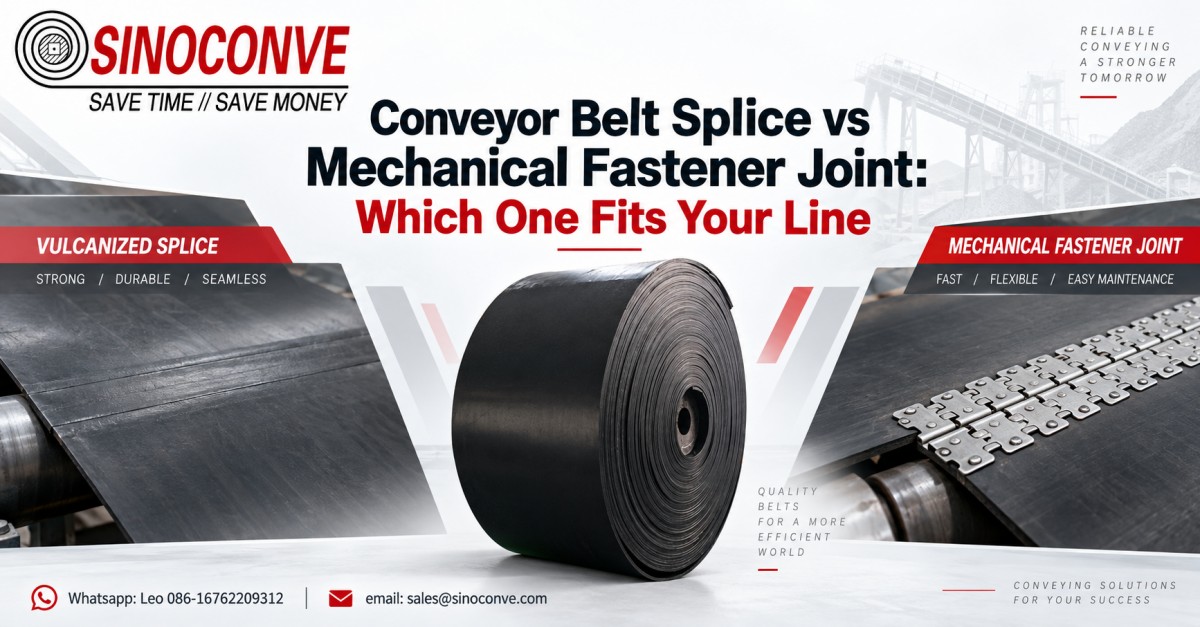
Conveyor Belt Splice vs Mechanical Fastener Joint: Which One Fits Your Line
Choose the hot vulcanized splice for any permanent, high-tension run. Choose the mechanical fastener when the belt has to come apart again soon, when the belt is short and lightly loaded, or when there is no power and no press standing next to the structure. That is the decision, in one line. The rest of this page shows where the boundary between those two cases actually falls, because the money gets lost in the grey middle — 2-ply belts on 40 m transfer runs, quarries that "save four hours" with a hinged fastener on a 1,000 mm primary belt, and steel cord lines where somebody tries to bolt plates through the cable layer.
We make both kinds of joint, in our shop and on customer sites. One pattern shows up again and again: the joint that gets fitted is chosen by whoever is standing at the belt at 2 a.m., not by the engineer who sized the belt six months earlier. This page is written so the person at the belt arrives at the same answer the engineer would.

01The Short Answer: Vulcanize by Default, Fasten by Exception
The default is a hot vulcanized splice. On a fixed conveyor carrying a real tonnage, spliced is the only joint that behaves like the belt. The mechanical fastener is not a cheaper version of the same thing; it is a different device with a different job, and it is the right answer in a narrower set of conditions than the field usually assumes.
Where hot vulcanizing wins outright
Anything at or above 3 plies, anything in a troughed main haul, anything running above roughly 60% of rated belt tension, and every steel cord belt. Add high belt speed, a heavy impact zone behind the joint, or a downhill regenerative run and the case gets stronger. On those belts a fastener is not a compromise, it is a countdown.
Where a mechanical fastener is the correct engineering choice
Short belts, light belts, belts that must be opened for cleaning or transport, and belts that sit where no vulcanizing crew can reach them. A 2-ply 500 mm stacker belt is a legitimate fastener application and we will say so to a customer's face. Bolting plates onto a 5-ply granite primary hauler is not.
Three questions that settle it in five minutes
Ask these before anyone opens a toolbox. They resolve most arguments on site.
| Condition on your line | Joint to fit | Why |
|---|---|---|
| Width 800 mm or more, 3 plies or more, permanent run | Hot vulcanized splice | Tension path stays inside the fabric carcass |
| Steel cord belt, any width or ply rating | Hot vulcanized splice, stepped with cord re-lay | Plates cannot develop cable tension at all |
| Troughed main haul running above 60% of rated tension | Hot vulcanized splice | Fastener fatigue life collapses under sustained load |
| 20–60 m transfer or stacker belt, 2 ply, under 200 t/h | Mechanical fastener is acceptable | Low tension, easy access, cheap to redo |
| Mobile or portable conveyor, belt moved every few weeks | Mechanical fastener | Repeatable pull-apart beats permanent bonding |
| Line already down, no press within 300 km | Fastener as a stopgap, then vulcanize in the next planned window | Production first, service life later |
| Sheltered site below about −5 °C with no heat blanket | Mechanical fastener or a proper cold bond | Uncured rubber will not cross-link reliably |
| Belt opened monthly for washdown or product change | Mechanical fastener | You need a joint you can undo, not a better bond |
Read the table and you will notice the fastener column only wins on short, light, mobile, or temporary duty. That is not a sales position. It is what the load path allows, and the next section explains why.
02Two Load Paths That Have Almost Nothing in Common
Strip away the hardware and the two joints differ in one thing: where the pulling force travels. Everything else — downtime, cost, life, repairability — follows from that single difference.
A vulcanized splice rebuilds the carcass
Fabric plies are stepped and re-laid against each other, then cured under heat and pressure until the rubber between them becomes one piece again. The tensile members continue across the joint. Load transfers ply to ply through sheared rubber, exactly as it does in the middle of the belt. There is nothing protruding, nothing to catch, and the joint is as flexible laterally as the belt around it. As a rubber conveyor belt leaves our press, the joint is a slight thickening in an otherwise continuous band.
A mechanical fastener bolts the two ends to a metal strip
Hinged plates, staples or hooks clamp the belt ends and pin them together. The carcass no longer carries the load; the metal does, and it hands that load back to the belt only at the point of each individual hook or staple. Force concentrates at a few hundred small holes punched through the fabric. That is the whole story of mechanical splice behaviour: high local stress, low distributed strength, and a joint whose life is set by how fast those perforations tear out.
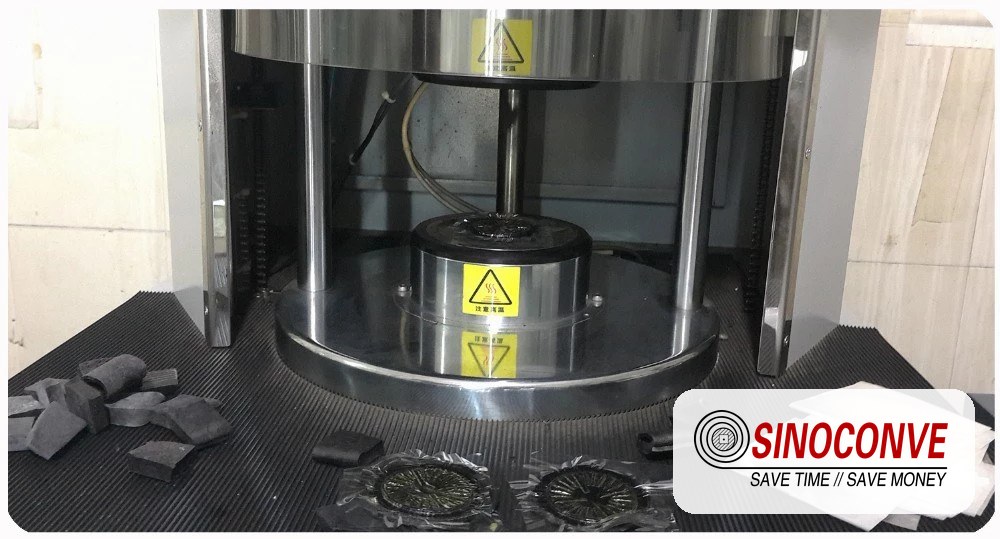
Platens closed on a stepped EP splice. Pressure, temperature and cure time are the three numbers that decide whether this joint holds.
Because the mechanics are so different, you cannot swap one for the other and expect a proportional change in life. You get a step change. A vulcanized joint might be measured against the belt; a fastener is measured against itself, and it ages far faster than the surrounding belt does. If you want the full catalogue of options including cold bonding and finger splices, our conveyor belt joint methods guide covers every method in detail. This page stays on the two-way decision.
03Strength Retention: How Much of the Belt Do You Keep?
Every joint removes strength. The question is how much, and whether the number is stable across the life of the joint or decays.
Typical retained-strength ranges
A correctly made hot vulcanized splice on an EP carcass typically retains a high proportion of the belt's rated tensile strength — the joint efficiency quoted in the trade usually sits in the upper part of the range, and well-made stepped splices are routinely credited with figures in the 80–95% band by the people who test them. A mechanical fastener does not live in that band. Depending on fastener type, ply count, belt thickness and who installed it, retained strength typically falls in the 30–65% region, and the low end is reached quickly once the belt is thicker or the installation rushed.
Those numbers are order-of-magnitude ranges, not guarantees. Treat them as a way to size your tension margin, not as a specification to quote to a customer.
What moves the number up or down
Five variables do most of the work. Carcass type and ply count come first. Fabric weave and rubber adhesion come next. Then splice geometry — step length, step count, whether the splice is bias-cut at the customary angle or square. Then installation quality: surface preparation, moisture, press pressure, platen temperature uniformity, cure time. And finally the belt's own reserve: a belt running at 40% of rated tension has room to lose joint efficiency, a belt at 85% does not.
| Factor | Hot vulcanized splice | Mechanical fastener |
|---|---|---|
| Retained strength, typical range | Upper band, roughly 80–95% | Lower band, roughly 30–65% |
| Sensitivity to ply count | Moderate, handled by step design | Steep, thick belts punish fasteners hard |
| Sensitivity to installer skill | High, but errors are visible in testing | High, and errors show up as pull-out weeks later |
| Strength over time | Broadly stable until belt wear governs | Decays as hooks loosen and fabric holes enlarge |
| Effect on belt tension margin | Small; take-up rarely needs changing | Large; expect to re-tension sooner |
| Verifiability on site | Destructive test on a sample coupon | Visual only; no coupon to pull |
If your belt was supplied by a conveyor belt supplier who can quote joint efficiency against the actual carcass, ask for it in writing before the joint is designed. Generic catalogue numbers are how lines end up with a splice that passes handover and fails at month five.
04The Comparison Matrix: Eight Rows That Decide It
This is the table we carry to site meetings. Eight rows, both columns, no hedging. Where a cell says "it depends", the dependency is named in the next column so you can judge it against your own numbers.
| Decision row | Hot vulcanized splice | Mechanical fastener |
|---|---|---|
| Downtime window needed | 4–12 h for a ready crew, plus curing wait on some designs; longer on steel cord | 1–3 h, and the belt can run as soon as pins are in |
| One-time cost | Higher per joint; pressure, labour and cure time dominate | Lower per event, sometimes by a wide margin |
| Expected joint life | Ordinarily matched to belt life | Months, sometimes weeks, on loaded belts |
| Can it be opened again? | No. Cutting it out is the only disassembly | Yes, repeatedly, with a hinge pin or lacing |
| Damage to the belt itself | Consumes 300–1,000 mm of belt length per splice | Punches a row of holes that stays in the belt forever |
| Belt types it suits | EP, NN, steel cord, heat resistant, flame resistant | Thin 1–2 ply belts; very poor on steel cord |
| Site conditions required | Power, a press or blanket, dry belt surface, above roughly 5 °C, skilled crew | A hammer, a lacing tool and two people |
| Field repairability | Poor. A failed vulcanized splice means a new splice | Good. Replace a plate or a section of lacing, run again |
How to read the matrix without fooling yourself
Add the rows up in the order that matters to your plant, not the order they are printed. If the line feeds a crusher that stops the whole operation, downtime beats first cost every time and the matrix already answers you. If the belt is a 30 m shuttle that runs when a loader is free, no row will justify a vulcanizing crew.
The two rows that get misread most
Field repairability and belt damage. Teams pick fasteners because a failure is easy to fix — true, and completely outweighed on a heavy belt, where the belt damage caused by repeated fastener rows is what eventually kills the belt. And on an industrial conveyor belt rated at 1,000 N/mm, the joint is not the weakest element only if it was made properly in the first place.
Field note from our engineers: A 900 mm aggregate plant belt, 4 ply EP, was joined with a hinged fastener to avoid a six-hour stop. It held for five weeks. Then the hooks started pulling, the belt edge around the fastener opened up, and by week nine the crew was replacing lacing every second Friday night. The plant had saved six hours once and spent an estimated 40–50 hours of night shift over the next three months. The vulcanized splice they finally ordered took seven hours and ran out the rest of the belt's life.
05Conveyor Belt Joint Cost: One-Time Price Against a Three-Year Bill
Comparing the price of a fastener kit with the price of a vulcanizing job is the most common accounting error we see on these decisions, and it always pushes the answer toward the wrong joint. The kit costs less. The joint costs more. Those are different numbers.
The life-cycle formula we use
Three-year joint cost equals the number of joint events multiplied by the cost of one event, plus the total hours the line is stopped for those events multiplied by what an hour of that line is worth. That is it. No discount rate, no depreciation curve, nothing that needs a finance department to argue about.
The two inputs people get wrong are events and hour value. Events means every re-splice, every re-lacing, and every unplanned stop caused by the joint. The typical field-life figures we work from are 300–1,000 mm of belt consumed per vulcanized splice and, on loaded belts, a mechanical joint life measured in single-digit months rather than years. Hour value is your own number — a cement kiln feed, a port shiploader and a gravel stockpile line do not share one.
Worked example A: 1,200 mm, 5-ply EP primary haul
Primary limestone belt, 1,200 mm wide, 5 plies, 380 t/h, running most of a two-shift day. Line contribution at the plant is put at roughly USD 900–1,500 per stopped hour. A vulcanized splice on this belt requires a press, two to three skilled hands and about eight hours of access; the one-event cost magnitude, including consumables and crew, sits in the order of USD 1,500–3,000 depending on access, whether a crane is needed, and how much belt has to be pulled back.
Worked example B: the same belt fastened instead
The same line, same tension, joined with a heavy-duty hinged fastener. One event costs in the order of USD 300–800 in parts and three hours of access. On a 5-ply belt at this duty, our honest expectation is a joint that needs attention every two to three months — call it 12 to 18 events across three years, with the belt edges degrading throughout.
| Three-year item | Vulcanized splice | Mechanical fastener |
|---|---|---|
| Joint events over 3 years | 2 (install plus one re-splice) | 12–18 |
| Parts and labour, total | Roughly USD 3,000–6,000 | Roughly USD 3,600–14,000 |
| Downtime hours | About 16 h | 36–54 h |
| Downtime at USD 1,200/h | About USD 19,000 | USD 43,000–65,000 |
| Extra belt replacement caused by edge damage | None attributable to the joint | Often brings the belt's replacement forward |
| Indicative three-year total | Order of USD 22,000–25,000 | Order of USD 47,000–79,000 |
The fastener loses by a factor of roughly two to three on this duty, and the gap widens as the hour value rises. Note where the money is. Not in the hardware. Not even in the crew. It is in the 20 to 40 extra stopped hours, and that is exactly the quantity a rushed decision at 2 a.m. is least able to see.
Numbers like these are magnitudes, not quotations, and they move with access, crew travel distance, belt width, ply count and the local price of the vulcanizing team's travel time. If you buy wholesale conveyor belts for several sites, run the calculation per line rather than per plant; the lines that justify fasteners are a minority and they are easy to identify once you have the hour values in one column.
Where the arithmetic flips — and it does flip
A 24 m mobile stacker belt, 2 ply, 650 mm, feeding a stockpile nobody is waiting on. A vulcanized splice here means a press, a crew travelling from another town, and a joint that cannot be opened when the machine is moved in eight weeks. Fastener cost is in the order of USD 200–500 and the belt runs again the same morning. Three-year arithmetic: fasteners roughly USD 1,500–3,000 with almost no production loss; a vulcanized joint roughly USD 2,500–4,000 plus a day of transport disruption. Here the fastener wins on cost and on practical grounds, which is why we recommend it without qualification.
That is the shape of the whole decision. Long, loaded, permanent: vulcanize, and stop pretending the hardware saving is real. Short, light, movable, or unscheduled: fasten, and don't apologise for it.
One more consideration that belongs in this section rather than the parts list. Whether you buy belt from a conveyor belt manufacturer who can also splice on site changes the arithmetic, because it removes the third-party mobilisation charge and lets one company carry the joint warranty instead of splitting it between a belt vendor and a splicing contractor. That is not a cost trick; it is the difference between one number and three on the same invoice.
06The Decision Tree: Six Branches, One Answer
Work down the branches in order and stop at the first one that matches your line. The tree is ordered by how often each branch decides the outcome in practice, not by how technical it sounds.
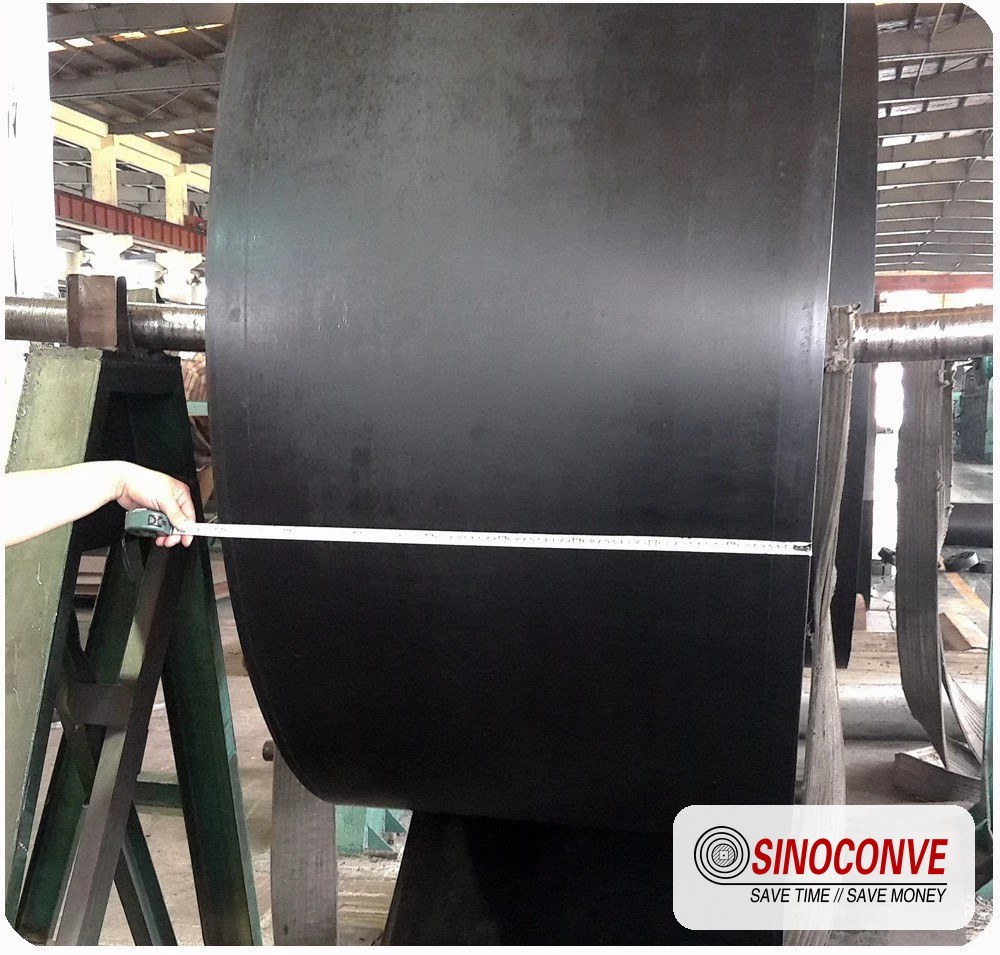
Thickness and strength check on a finished joint. A 2 mm variation in splice thickness will show as a bump at the rollers for the next three years.
Branch 1: carcass and ply count
Steel cord, or fabric with 3 plies and up — go to vulcanized, no further discussion. One or two plies of fabric and under about 500 mm wide — continue to branch 4, a fastener may well be right.
Branch 2: can the line actually be stopped?
If a planned window of six to eight hours exists inside the next two weeks, vulcanize. If there is no window and the belt is failing now, fasten as a stopgap and write the vulcanized splice into the next shutdown plan. Do not let a stopgap become the permanent arrangement; that is how belts get retired early.
Branch 3: belt width and tonnage
Above roughly 800 mm width, or above about 200 t/h on a fixed structure, assume vulcanized. Below both, and with a short centre distance, a fastener stays on the table.
Branch 4: power, press and crew on site
No power, no press and no trained splicer within reach: fasten. Power available and a press can be brought in over good ground: vulcanize. Be honest about the ground. We have watched a crew spend four hours winching a press up a ramp that looked straightforward on the site map.
Branch 5: ambient temperature and humidity
Below roughly 5 °C with no shelter or heat blanket, uncured rubber does not cross-link predictably and moisture on the belt surface does the rest of the damage. Fasten, or wait for a warmer window with a tented and heated staging area. Above 5 °C and dry, vulcanizing is straightforward.
Branch 6: conveyed material temperature
Hot clinker, sinter or cement at 120–200 °C is a hostile place for a hook-and-pin assembly, and the elastomer in a heat resistant carcass will still cure normally. On hot duty, vulcanize. On ambient material with a light belt, branch 4 decides it. Our notes on clinker handling belt selection go deeper into that temperature band if your material runs hot.
Summary of the tree, in the order you walk it:
- Steel cord or 3+ plies → vulcanized.
- No shutdown window available → fastener now, vulcanized splice booked.
- Over 800 mm wide or over 200 t/h on a fixed frame → vulcanized.
- No power or press reachable → fastener.
- Below 5 °C, damp, unsheltered → fastener or cold bond.
- Belt must be opened for transport or cleaning → fastener.
Field note from our engineers: A 42 °C clinker gallery is the worst place we have ever tried to make a vulcanized splice in a hurry. Two attempts failed on the same shift because belt surface moisture kept reading high after wipe-down. We moved the belt end into the transfer tower, tented it, and the third attempt cured clean. If your site is hot and humid, schedule the splice in the coolest four-hour window of the day rather than the first one available.
07When a Mechanical Fastener Is Genuinely the Better Choice
We sell belt, not hardware, so there is no commercial reason for us to defend fasteners. We defend them anyway on four kinds of line, because on those lines the customer who insists on vulcanizing is the one making the expensive mistake.
Short conveyors and light belts
Centre distances under roughly 40 m, belt width under about 650 mm, one or two plies, and a duty under a couple of hundred tonnes an hour. On this class of belt the fastener is doing very little work, and a hinged joint lasts a respectable time. Vulcanizing here buys a marginal life gain for a press, a crew and a longer stop.
Emergency repair and temporary runs
Belt torn at the loading point, no spare, ore piling up. Fasten it, run it, and put the splice on the shutdown list. A temporary joint that holds three weeks is a good outcome; a temporary joint that quietly gets promoted to permanent is not. This is the one case where we will always say fasten first — detail on the repair methods themselves is in our jointing methods guide.
Lines that must be opened often
Washdown duty in a food plant, a belt that goes onto a machine for a seasonal campaign and comes off again, a portable crushing spread moved every few weeks. If the requirement is a joint that separates and re-closes, that requirement outranks joint efficiency. No vulcanized splice can be reopened without cutting it out, and cutting it out consumes belt length every single time. If you buy through a conveyor belt distributor who also handles the joint hardware, ask them to quote the fastener and the vulcanized alternative side by side for your exact line — it is a two-column question and most vendors only ever answer one column.
No power, no press, no vulcanizing crew
Remote pits, barge loaders, plantation conveyors, temporary stockpile belts on a site that will be gone in a year. A press needs a generator and a level staging area. Two people with a lacing tool need neither. The full method comparison, including cold bonding as the third option, sits in our splicing guide with costs and field tips.
| Application profile | Fastener type that behaves | What to watch |
|---|---|---|
| 24 m mobile stacker, 2 ply, 650 mm | Hinged plates with a removable pin | Pin wear; re-tension after each move |
| Washdown food line, PVC or light PU | Stainless or polymer lacing | Hygiene of the pin cavity; corrosion |
| Emergency tear at a loading point | Heavy-duty hinged plates, largest size the belt accepts | Replace within days, not months |
| Portable crushing spread, relocated monthly | Bolt-plate lacing rated for the belt | Edge tear at the outer hooks |
| Very cold site, no shelter, belt under 500 mm | Lacing plus a cold-bond edge seal | Freeze-thaw loosening of staples |
08Five Ways Mechanical Fasteners Fail
If you fit fasteners on a belt that is too heavy for them, one of these five will end the joint. They also happen in this rough order of frequency, so the list doubles as a diagnostic sequence.
1. Fastener pull-out
Hooks or staples rip out of the carcass under tension, usually starting at the outer edges and working inward. Once one row of hooks lets go, the load redistributes onto its neighbours and the failure accelerates within hours. Root cause is nearly always the belt being too thick for the fastener, or installed with the belt not properly square.
2. Edge tear at the fastener strip
The belt edge splits just ahead of the last hook, where stress concentration is highest. On a troughed belt, the edge also flexes every time it passes a wing roller, so the fatigue cycle count is enormous. A torn edge then grows into a longitudinal split.
3. Accelerated belt edge wear
The plates are harder than rubber. Where the belt used to slide through a skirt with a rubber-on-rubber interface, it now drags a steel edge along the skirt rubber. You can measure this: belt edge loss on our own test runs typically tripled within about 4–6 weeks of a fastener being fitted on a skirted section.
4. Cleaner blades catching the plates
A primary cleaner set after a vulcanized splice will chatter over a row of hinged plates. Either the blade tips wear flat in days, or the blade catches a plate and lifts the joint. This one is entirely predictable, and entirely avoidable: check the cleaner position before you start the belt. Our colleagues' notes on splice failure causes cover the geometry in more depth than we can here.
5. Misalignment after take-up
Fasteners stretch and settle. The belt grows length, the take-up pulls, and the joint no longer sits square in the trough. Tracking drifts, one edge loads harder, and the joint fails at that edge. On short belts this can happen within the first two shifts after fitting.
What the five have in common
They are all first-month phenomena, and they all cost more in belt damage than they do in parts. That is why a fastener on a heavy line is not a temporary saving; it is a deferred belt replacement with interest added.
09Why Hot Vulcanized Splices Fail Too
Vulcanizing is the right default, not a guarantee. When a vulcanized joint gives trouble, it is almost never the rubber compound and almost always one of four process failures. We are listing them briefly here because you only need to recognise them; the repair procedure belongs on the press, not on a web page.
The four causes we meet most
Contamination on the buffed fabric surface — dust, oil, or moisture that was not fully dried. Uneven platen temperature, usually a cold corner that leaves a strip of under-cured rubber a few centimetres wide. Wrong pressure, either too little to close the stepped interface or so much that uncured gum squeezes out of the joint line. And insufficient cure time for the belt thickness, taken straight from a generic table instead of the actual carcass. A fifth factor sits underneath all of them: a belt that was never dry to begin with.
Equipment matters more than most crews admit. Platen flatness, heater zoning and pressure control are the difference between repeatable joints and joints that depend on luck. Our notes on choosing a vulcanizing machine and on modern press features and tips cover that hardware in detail.
Repair or start over?
A small unbonded area at a joint edge can sometimes be re-buffed, re-gummed and re-pressed. A joint that failed across a step, or one where the failure runs more than about 100 mm, gets cut out and redone. Adding fasteners to a failed vulcanized splice is not a repair; it puts metal plates right where the belt has already proved it is moving under load, and it usually takes the belt out within two months. Put the belt in service with a proper splice, and keep the fasteners for the jobs described in section 07.
10Site Conditions That Decide This Before You Do
Three conditions are commonly known to settle joint choice before anybody has discussed strength. Check them on the drawing and in the yard, not from the office.
Temperature and humidity
Ambient temperature governs the cure. Site humidity governs whether you can get a dry interface at all. A coastal port conveyor in the wet season and an inland quarry on a dry day are the same belt and two entirely different splicing jobs. If the belt surface cannot be kept dry for the duration of the cure, the vulcanized option is off the table that day.
Access and lifting
How far is the splice point from where a vehicle can stand? Can the belt end be pulled back far enough to expose the full splice length plus working room? On many retrofits the answer is no, and the honest options are to lift the belt with a crane, cut more belt out, or fasten. Deciding that on the day is how an eight-hour job becomes a 26-hour job.
Dust, cleanliness and staging space
Vulcanizing needs a clean staging area roughly as long as the splice, protected from wind-blown dust. In a transfer tower with 5 mm of limestone dust on every surface, that means tents and floor plates. A mechanical fastener needs none of this, which is genuinely part of its value. In our conveyor belt factory we can control all three of those variables; on your structure you cannot, so plan for the worst of them.
We make both belt and transmission belts, and a fair amount of what we learn about joint behaviour comes back from service visits rather than from the press bay. One thing that carries across product lines: joints fail for process reasons, not material reasons, far more often than the parts list would suggest.
11Safety, Commissioning and Acceptance Checks
Whichever joint you fit, the belt is not released to production until these checks pass. They take less than an hour and they catch the failures that otherwise appear on the second shift.
Before you tension the belt
Three things. Confirm the joint is square across the belt — measure the diagonal from corner to corner on both sides, because a joint that is 8 mm out of square will track badly no matter how good the bond is. Confirm the fastener plates, if used, sit below the belt's top cover line so they never meet a cleaner blade. And confirm the joint thickness over the full width. On a vulcanized splice, 2 mm of excess thickness at the splice shows up as a bump at every roller for years.
First run and tracking
Run slowly if your drive allows it, watch the joint through two or three complete revolutions, then check the splice under the loading point and at the first return roller. Mark the tracking position on the structure with paint at the first run; on a newly installed fastener it will move, because the lacing settles into the belt and the belt lengthens a little. If the joint shifts more than a few millimetres sideways at a fixed roller, stop and correct the take-up before running loaded.
Fastener zone against rollers and cleaners
Walk the full belt path and look for anything the joint can hit: skirt rubber with too little clearance, a bent roller, a cleaner blade with 2 mm of adjustment left, a chute lip with a burr. A fastener will find every one of them. A vulcanized splice will not, and that difference in forgiveness is a benefit nobody puts in the specification but everybody notices at month three. Our colleagues keep a splicing acceptance checklist that pairs well with this section if you are writing a handover document.
Port and bulk-terminal users should also look at the roller and pulley setup for port systems, because on high-speed belts the joint-to-roller interface is where most of the wear dialogue happens.
12Match the Belt to the Joint You Have Chosen
The joint decision and the belt decision are not independent. A belt with a thicker top cover and a clean, tightly woven carcass splices well and fastens badly. A thin, forgiving 2-ply belt fastens beautifully and gains little from vulcanizing. So the belt you order should be the belt your joint strategy needs, and that is worth settling before the enquiry goes out rather than after the belt lands on site.
If you will vulcanize
Buy belt with a documented carcass construction and known ply adhesion, keep the cover grades consistent along the run, and order enough extra length to cover a splice or two. The rubber conveyor belt guide to types and grades runs through the cover options, and if your carcass choice is still open, the comparison of EP and NN carcasses matters here because the two splice differently under load.
If you will fasten
Choose a belt thickness the fastener is actually rated for, keep the cover hard enough to resist edge wear, and make sure the belt has enough tension reserve to carry the joint's reduced strength. That last point rules out high-tension duty more often than anything else.
SINOCONVE makes belt and drives. As a transmission belt manufacturer we spend a lot of time on permanent joints of a different kind — moulded timing belts and endless V-belts — and the lesson transfers. A joint designed in from the start costs less than a joint improvised at the end of an installation. The same argument holds for drives, and as a V-belt manufacturer we would rather quote the right profile the first time than replace a stretched belt twice.
Whatever you settle on, the belt itself has to come from a source that documents the carcass, so the joint can be engineered rather than guessed. Start from the full product catalogue, and if you buy for multiple sites or resell belt, the catalogue is also the fastest route to matching carcass and joint strategy line by line for a whole mining and quarrying operation, or for a contract portfolio spread across several sites.

Splice bench and inspection station. Belt that is measured before it leaves will splice the same way on your site.
13FAQ: Mechanical Splice vs Hot Vulcanized Joint
Ten questions we field from maintenance engineers and buyers, answered the way we would answer them on a site walk. More general answers on belt handling sit in our company FAQ pages.
Is a vulcanized splice always stronger than a mechanical fastener?
Yes, on every belt that carries real tension. Typical retained strength for a well-made vulcanized splice falls in the upper band, while mechanical fasteners sit well below it, and the gap widens with ply count and belt thickness. There is one situation where the comparison is uninteresting: a very light 2-ply belt where neither joint is anywhere near its limit.
How long does each joint take to install?
A mechanical fastener on a 900 mm belt is a three-hour job including pulling the belt together — less if two people know the tool. A vulcanized splice on the same width takes six to eight hours with a press, or longer on steel cord and on belts where the end has to be moved to a clean staging area.
Can I put a mechanical fastener on a steel cord belt?
No. Nothing about a hook or plate assembly develops tension in steel cables, and the perforations cut into the cable layer itself. If someone has already done it on your site, plan the permanent vulcanized splice now rather than after the belt tears at the joint.
How often will I be replacing lacing on a heavy belt?
On a 4–5 ply belt at high tension, expect attention every one to three months, and expect the first event sooner than the second. If you are re-lacing more often than that, the belt is telling you the fastener is the wrong device and the arithmetic from section 05 already reflects it.
What does a conveyor belt joint actually cost?
Order-of-magnitude only, because access, width and crew travel dominate: a mechanical joint event typically runs in the low hundreds of dollars in parts, while a vulcanized splice is measured in the range of roughly 1,000–3,000 dollars equivalent per joint depending on width and ply count. The real cost is the stopped hours, which can be ten times the parts value, and the extra belt consumption, which shows up years later.
Can you vulcanize outdoors in winter?
Not reliably below about 5 °C without shelter and heat. Uncured rubber needs a temperature window to cross-link properly, and frost on the fabric is a bond killer. Build a tent, heat the staging area, or accept a fastener and a cold bond for the winter and book the vulcanized splice for spring.
Which joint suits a portable crusher moved every month?
Mechanical, without much debate. A belt that has to be split for transport needs a joint you can open and close, and on a short 2-ply belt the fastener's lower strength is not the limiting factor in the system. Keep spare lacing and a pin on the machine.
Will a mechanical fastener damage my belt permanently?
It leaves a row of holes that never closes, and on loaded belts it also accelerates edge wear at the outer hooks. Whether that shortens the belt's life depends on how long the fastener stays on. A three-week stopgap usually costs nothing measurable. A permanent installation on a 5-ply primary belt routinely brings the belt change forward by a season or more.
Can I have one vulcanized splice and one fastened joint on the same belt?
You can, and plenty of plants do — usually where a temporary repair was left in place. It is not a stable arrangement. The fastened joint is the weak point, it drifts under take-up, and it keeps the belt from tracking as cleanly as a belt with two equivalent joints. Settle the belt's whole joint strategy in one shutdown if you can.
Should the belt specification change if I decide to fasten?
Yes, in three ways: stay within the thickness the fastener is rated for, keep a harder cover where the edges see abrasion, and leave tension reserve in the drive design. A belt specified for a vulcanized splice and then fastened is being asked to do something it was never sized for, and that is how joints fail while the belt itself still has years left.
Related Products You May Need
- Rubber conveyor belt — the grade most vulcanized splices are made on.
- EP rubber conveyor belt — high-tension carcass with predictable ply adhesion.
- Heat resistant conveyor belt for clinker, sinter and cement duty where fasteners are a poor fit.
- PVC conveyor belt for light lines that are usually fastened.
- Chevron conveyor belt.
- EP1000 stone crusher conveyor belt
- Product catalogue
Related Blog Posts
- Conveyor belt joint methods: a comprehensive guide — every method side by side, including cold bonding.
- Conveyor belt jointing methods guide
- Conveyor belt splicing: methods, costs and field tips
- Conveyor belt splice failure causes
- Vulcanizing machine selection guide
- Vulcanizing machine features and press tips
- Endless conveyor belts and where they pay off
- Splicing buyer’s checklist: 12 things to verify
- Heat resistant belt failure modes and field fixes
- Rubber belt vs PVC belt: which one fits your line
- V-belt vs timing belt: the same decision on the drive side
- All SINOCONVE blog articles