

Ask ten belt suppliers to quote a 1,200 mm belt for a stone crusher and you will probably get two different carcass recommendations back: EP or NN. Both are rubber conveyor belts reinforced with synthetic fabric, both roll off the same production lines, and both will carry rock all day. Yet the two constructions behave differently under impact, in troughing idlers, and after years of tension — which is exactly why the choice deserves more than a coin flip.
We build both constructions at our plant in Ningbo, so this guide is not an argument for one fabric over the other. It explains how EP and NN carcasses are constructed, where each one earns its keep, how to splice and cover them correctly, and exactly what to send a rubber conveyor belt manufacturer so the quotation you receive is the belt your conveyor actually needs.
Not sure whether your conveyor needs EP or NN?
Send us your belt width, length, tonnage, lump size, pulley diameters and take-up travel. Our engineers will recommend the right carcass with a quotation and test report terms — usually within one working day.
01 What the Letters EP and NN Actually Describe
A conveyor belt is a sandwich. The filling is the carcass — woven synthetic plies that carry the tensile load. The bread is the rubber cover, which protects those plies from abrasion, impact, heat, oil or whatever your material throws at it. When a quotation says "EP500/4", the letters describe the ply fabric and the numbers describe its strength rating and ply count.
EP means polyester warp, nylon weft
Polyester yarns run along the length of the belt — the direction that carries tension — and nylon yarns run across the width. Polyester is dimensionally stable: it stretches very little under load, which keeps belt length predictable. Nylon in the weft gives good flexibility and impact absorption across the width. EP is the workhorse carcass of mining and aggregate because it combines low elongation with reasonable cost.
NN means nylon warp, nylon weft
Every yarn in an NN carcass is nylon.Nylon is tougher and more elastic than polyester, giving NN two distinctive traits: outstanding impact resistance and noticeably higher elongation. An NN belt shrugs off impacts that would bruise an EP belt, but it also stretches more under tension, which means more take-up travel and more re-tensioning attention in service.
Both carcasses are manufactured to the same international reference standards — DIN 22102, ISO and RMA among others — and both can be fitted with abrasion-resistant, heat-resistant, oil-resistant, flame-resistant or cold-resistant covers. The difference is not quality. The difference is how the carcass behaves as a structural member of the conveyor. If you are comparing suppliers, an EP conveyor belt and an NN belt of the same rating will quote at similar prices; the real question is which one fits your duty.
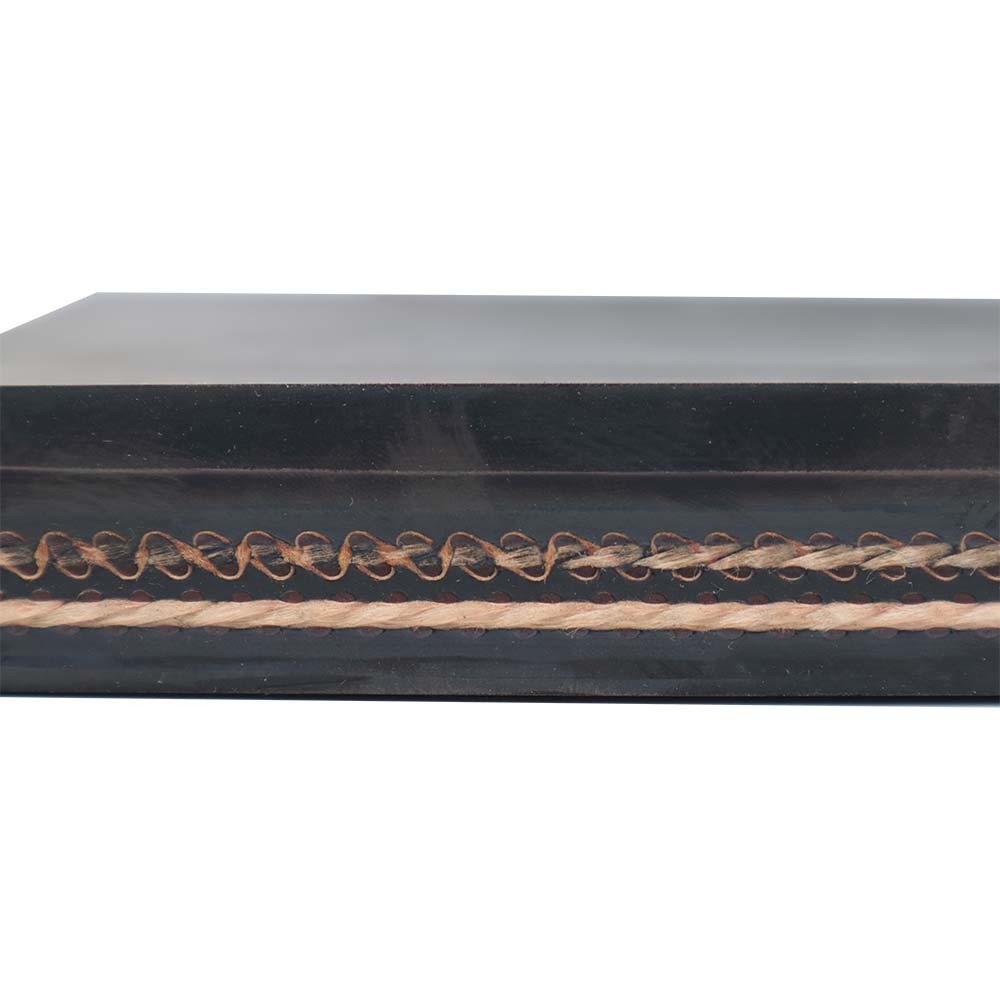
A cut section of a multi-ply conveyor belt. The even ply structure keeps tension balanced across the belt width.
02 EP vs NN at a Glance
Before the detail, here is the short version.Use this table to shortlist a carcass, then read the sections that follow to confirm it against your real operating conditions.
| Property | EP (polyester/nylon) | NN (nylon/nylon) |
|---|---|---|
| Working elongation | Low, typically around 1–2% | Higher, typically around 1.5–2.5% |
| Impact resistance | Good, with proper cover and breaker ply | Excellent — the traditional choice for heavy lump impact |
| Flex life on small pulleys | Very good | Very good,often better on small diameters |
| Dimensional stability | Excellent — belts hold ordered length | Moderate — more take-up stroke needed |
| Long-distance / high-tension lines | Preferred | Less common (higher creep) |
| Typical cost level | Lower per unit strength | Somewhat higher per unit strength |
| Typical applications | Quarry, aggregate, cement, overland lines | Crusher feeds, heavy impact loading zones |
How to read this table
Treat the two right-hand columns as tendencies, not laws. A short conveyor with a screw take-up and modest impact can run either carcass successfully, and the price will decide. A long, high-tension line with a limited take-up should lean EP.A brutal loading point under a primary crusher should lean NN — unless you add a breaker ply to an EP construction, which we cover in Section 04.
03 Elongation and Take-Up: The Difference That Bites in the Field
If you only compare catalogue prices, EP and NN look close. The difference shows up in your take-up system. A fabric belt always stretches a little in its first weeks of service, and the take-up must absorb that growth. Because NN elongates more than EP, an NN belt needs more take-up travel on the same conveyor length.
Why elongation changes the tension balance
Think about a 400-metre conveyor. If the belt settles with roughly one and a half percent elongation, the take-up must swallow about six metres of growth. With an NN belt at two percent or more, that figure climbs toward eight or nine metres. If your take-up was designed for an EP belt, it can run out of stroke — the result is a slack belt, slip at the drive pulley, and premature wear across the whole system.
What to check before switching carcass
On a short conveyor with a gravity take-up, the difference is rarely a problem. On a long, high-tension line it can be the entire problem. The single most useful piece of information you can send a supplier when replacing a belt is not the belt width — it is the available take-up stroke and the old belt's carcass construction.We ask for both before we recommend a change, because a good recommendation starts with the machine that already exists on your site. A serious conveyor belt manufacturer will request your take-up data before quoting a replacement — treat any quotation that skips this question as incomplete.
04 Impact Loading: Where NN Earns Its Keep
Drop large, sharp rock onto a belt from three metres and the impact energy has to go somewhere. A strong carcass spreads that energy across the plies; a weak one lets it concentrate into a bruise, a cut, or a ply separation that grows every time the damaged spot passes over an idler.
Nylon absorbs; polyester resists
This is classic NN territory. Nylon's elasticity lets the belt deform and recover under a falling lump instead of resisting it rigidly, which is why primary crusher feed belts and loading zones under heavy impact are traditionally NN. EP belts handle impact well too, especially with a breaker ply or a thicker bottom cover, but when the loading point is brutal and continuous, many operators still specify NN first.
When EP plus a breaker ply is the smarter buy
A breaker ply — a coarse fabric layer between the carcass and the top cover — distributes impact over a wider area and stops punctures from becoming long carcass cuts. If your loading point is severe but the rest of the conveyor suits EP, asking for a breaker ply often delivers most of NN's toughness at an EP price. Tell your supplier the drop height and lump size; that is what makes the breaker recommendation honest. And if your conveyor climbs at more than about 15 degrees, the carcass question is only half the story — you will also want to compare a chevron conveyor belt or sidewall option to keep material from rolling back.
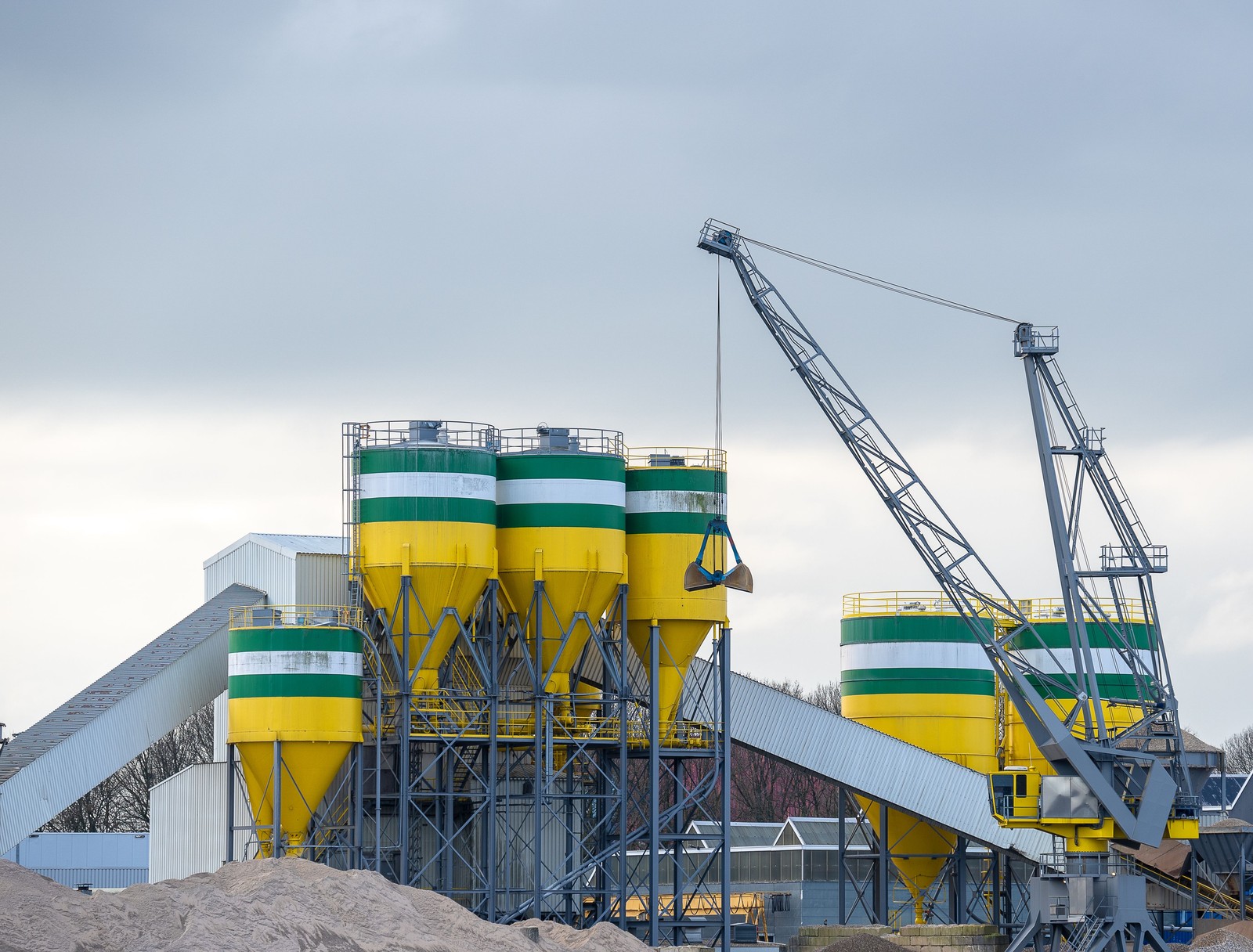
The loading zone at the feed end of an aggregate conveyor decides how much impact the carcass must absorb every cycle.
05 Splicing, Covers and the Breaker Ply
How the carcass changes your splice plan
A conveyor belt is only as strong as its weakest splice.Both EP and NN belts are normally joined with hot vulcanized step splices on heavy-duty lines, where plies are stepped, covered with rubber and cured under heat and pressure to restore a high percentage of original strength. The practical difference is behaviour after the splice: an NN belt flexes and stretches the joint more, so preparation must be exceptionally clean and step lengths must follow the manufacturer's specification closely. EP splices are more forgiving because the carcass stretches less. If your crew splices on site, that difference matters — you can read the full procedure in our conveyor belt jointing methods guide.
Match the cover to the material, not the brochure
Choose the right carcass and the wrong cover, and you will blame the carcass for a problem the rubber caused. Top cover thickness follows abrasiveness and lump size: fine sand might run a 4 mm cover, while sharp 300 mm rock deserves 6 mm or 8 mm. Cover grade follows the environment — DIN-Y, DIN-W and DIN-X rate abrasion resistance from moderate to highest; heat-resistant, oil-resistant and flame-resistant compounds suit their own conditions. None of these choices changes whether the carcass should be EP or NN, but all of them change how long the belt survives. If you want to go deeper on matching the cover to your material, our rubber conveyor belt cover grades guide walks through each class with examples.
06 A Decision Checklist: Which Carcass for Your Conveyor?
Here is the process we walk customers through when they are unsure which carcass they need. Answer these questions in order and the right choice usually falls out by itself. When a case sits between two columns — and plenty do — the tie-breaker is the take-up system and the loading point.
| Question | If yes, lean toward | Reason |
|---|---|---|
| Is the belt longer than roughly 500 m, or running at high tension? | EP | Low elongation keeps tension and take-up predictable |
| Is there severe impact (large lumps, high drop height)? | NN,or EP with breaker ply | Nylon absorbs impact energy |
| Is the conveyor short with a screw take-up? | Either — cost decides | Limited travel makes elongation less critical |
| Are you replacing a belt on an existing conveyor? | Match the old carcass | Switching constructions needs take-up and pulley checks |
| Are small pulleys or tight snub positions involved? | NN | Higher flexibility reduces fatigue on small diameters |
| Do you need maximum splice strength retention? | EP | Lower carcass creep helps spliced joints stay stable |
Three rules that override the table
First, the conveyor structure matters more than the fabric.A belt cannot fix a misaligned frame or an undersized pulley, so repair the machine before you buy any belt. Second, hybrid constructions exist — some producers blend EP warp with a nylon weft to balance stability and toughness; if your application sits between the columns, ask rather than guess. Third, when replacing a belt that performed well, matching its carcass and cover specification is rarely the wrong answer. And if your project is a new build rather than a replacement, talk to an EP conveyor belt supplier before the conveyor structure is welded — pulley diameters and take-up design are far easier to change on paper than after commissioning.
07 What to Put in Your Inquiry: The RFQ Data Sheet
The biggest cause of wrong belt deliveries is not bad manufacturing — it is incomplete ordering information. A quotation is only as good as the data behind it, so send a supplier the full picture the first time. This is the data sheet we use; copy it into your email or RFQ and you will get a sharper quote in fewer rounds.
| Item | Example value | Why it matters |
|---|---|---|
| Belt width | 1,200 mm | Sets price and availability |
| Length per roll / total | 500 m in one roll | Affects splicing count and freight |
| Material carried | Crushed granite, 0–150 mm | Lump size drives cover and carcass |
| Tonnage and speed | 800 t/h at 3.2 m/s | Determines strength rating |
| Centre distance | 420 m | Long lines favour EP |
| Incline angle | 14° | Steep angles may need a chevron pattern |
| Drop height at loading point | 2.5 m | Impact risk decides NN vs EP + breaker |
| Material temperature | Ambient / up to 80°C | Heat-resistant cover if hot |
| Pulley and idler diameters | Drive 630 mm, return 400 mm | Small pulleys need flexible carcasses |
| Take-up type and travel | Gravity, 6 m stroke | Confirms EP or NN viability |
| Current belt (if replacing) | EP500/4, 4+2 covers | Best starting point for the quote |
Send the same data sheet to every supplier
You do not need every field answered to the decimal, but sending one standard data sheet to several manufacturers makes their quotations comparable.When we receive a complete inquiry, we can confirm the construction the same day — and, just as usefully, we can tell you when your requested specification is more belt than the conveyor needs.
08 Quality Control: What "Made in a Real Factory" Means
Every belt manufacturer prints a data sheet; the difference is what happens before the belt is coiled. When you buy EP or NN belts from an established producer rather than a trading company, you are paying for a chain of checks that most buyers never see — and that chain decides whether a belt lasts three years or six.
From rubber bale to finished roll
Raw rubber arrives as bales with batch numbers, and it is tested before it goes near a calender: a moving-die rheometer checks how the compound cures, and tensile testing confirms fabric strength and elongation. If the compound does not match the recipe, it never reaches the production floor. During manufacturing, the calender applies rubber to both sides of the fabric in one pass so the plies stay evenly coated, and ply tension is controlled so the belt comes out straight and uniform in thickness.
The final inspection that protects you
Finished belts are inspected for surface defects, width, length and thickness before packing.A belt that is 5 mm wider than ordered, or whose carcass has a soft spot from a low-pressure area in the press, will announce itself early in service. Many "brand new belt failed in a month" stories trace back to exactly these invisible defects, which is why we test every roll and issue a quality report covering abrasion, adhesion and tensile data with the shipment.
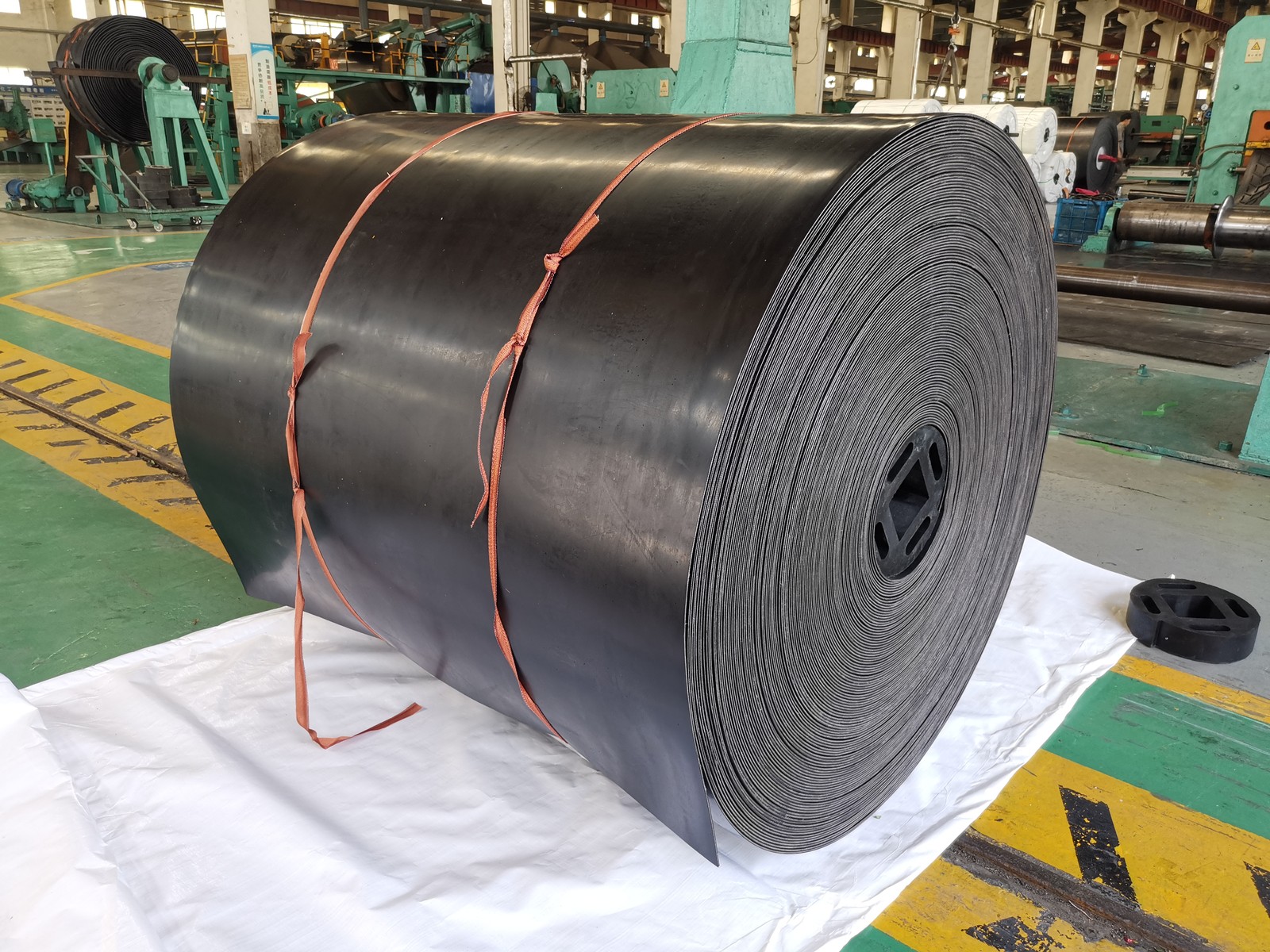
Finished rolls leaving production. Each roll is checked for width, thickness, length and surface condition before packing.
09 Standards, Test Reports and Verifying the Supplier
Which standard should the quotation name?
Conveyor belts are sold against standards, and the standard on the quotation should mean something to you. DIN 22102 is the baseline most international buyers treat seriously for fabric belts; ISO 14890 and RMA are common alternates depending on your market; AS 1332 and SANS 1173 appear frequently in Australian and South African projects. A good supplier will state the standard clearly and back it with test reports.
Three numbers to read on a test report
Abrasion loss — often reported in cubic millimetres — tells you how fast the cover will wear; lower is better. Adhesion strength between plies tells you whether the belt will delaminate under flexing. Tensile strength confirms the belt meets its rated carcass strength. If a supplier cannot or will not share these results before you order, treat that as a red flag rather than a formality.
Verify the factory, not just the brochure
Beyond documents, take time to verify the supplier itself before a large order. A factory tour — in person or by video call — tells you whether the production line actually exists and whether the calender, press and testing equipment are real. Ask for references from customers in your industry and speak to one of them. Reputable manufacturers welcome this scrutiny because it separates them from trading desks that resell other people's belts without a factory, a lab or a quality system of their own. You can also review our production setup on our company and factory pages before you make contact.
10 The Cost Question: Price per Metre vs Cost per Tonne
This is where buyers make the mistake that haunts them longest.The price difference between EP and NN at the same strength rating is usually modest — often a few percent — so choosing the wrong carcass rarely shows up as a shock on the invoice. It shows up later as downtime, extra splices, or a belt changed eighteen months early.
Measure the belt in cost per tonne carried
When we cost a belt, we look at cost per tonne of material carried over the belt's service life, not price per metre on the day of purchase. A belt that costs eight percent more but lasts twenty percent longer is the cheaper belt. Present the decision as cost per tonne — with assumed life, maintenance hours and change-out labour included — and the EP versus NN question usually answers itself.
Where the real savings hide
Cover grade often moves lifecycle cost more than the carcass choice. Putting a heavier abrasion-resistant cover on a moderately rated carcass can be the highest-value upgrade on a whole conveyor. Freight and lead time are fixed costs that do not change with the carcass, so there is no reason to let a small material-price difference push you into the wrong construction. Ask for both belt prices and expected life guidance, then decide on lifetime cost.
11 Common Mistakes When Choosing Between EP and NN
After years of quoting both constructions, we see the same missteps repeat.Avoiding them saves more money than finding a slightly cheaper belt.
Copying the old belt without asking why
Many buyers reorder the same carcass the previous belt used. That is a fine default — unless the previous belt failed early, in which case you are reordering the failure. If a belt did not reach its expected life, ask what killed it before you replace it with an identical construction. Impact damage points to NN or a breaker ply; elongation and splice trouble points to EP; cover damage points at the cover, not the carcass.
Specifying the carcass but not the covers
"EP500/4 conveyor belt" is not a complete specification. Add cover grades and thicknesses, or the factory will supply its default covers — which may be fine, or entirely wrong for your material. A complete specification protects both you and the manufacturer.
Buying the strength rating from a brochure, not the conveyor
An over-specified belt costs more and runs stiff; an under-specified one risks early failure. The correct rating comes from the actual tension the conveyor imposes: tonnage, speed, length, lift and starting conditions. If you do not have the calculation, send the conveyor parameters to a manufacturer and let them do it instead of guessing from a neighbour's belt.
12 Final Word: Let the Conveyor Decide
Strip away the marketing and the EP versus NN question comes down to a few mechanical facts. NN absorbs impact better because nylon stretches and recovers; EP holds its length better because polyester resists elongation. Everything else — price, brand, country of origin — is secondary to matching those behaviours to your conveyor's real duty.
Start with the material. If your loading point drops heavy, sharp lumps, give NN serious consideration, or ask for an EP belt with a breaker ply and a robust cover. If your conveyor is long, fast or tension-limited, EP is usually more forgiving and economical. If you are replacing a belt that performed well, matching its carcass and cover specification is rarely a wrong answer. Then complete the specification before you compare prices, and send the full data sheet to a supplier who builds both constructions — because a factory that makes only one fabric has a favourite child to push.
FAQ EP vs NN Conveyor Belt: Common Questions
Is EP belt stronger than NN belt?
At the same rated strength (EP500/4 versus NN500/4), both carry the same maximum load.The difference is behaviour, not strength: NN tolerates impact better, while EP holds its dimensions better under sustained tension.
Why do some suppliers only recommend EP belts?
Many factories standardise on EP because it covers the widest range of applications with one compound and fabric family, which simplifies their production planning. That does not make NN obsolete — it makes the recommendation worth questioning when your loading point is severe.
Can I replace an NN belt with an EP belt on the same conveyor?
Usually yes, but check take-up travel first. EP elongates less than NN, so if the take-up was sized for NN it will have extra stroke — generally fine. Going the other way, from EP to NN, needs more travel and more frequent re-tensioning, so confirm the available stroke before switching.
Which carcass is better for a crusher feed belt?
For severe impact under a primary crusher, NN (or an EP belt with a breaker ply and thicker bottom cover) is the classic choice because nylon absorbs impact energy. On gentler secondary lines, EP is usually more economical and perfectly adequate.
How can I tell if my current belt is EP or NN?
Check the label printed on the belt cover or the delivery documents — it usually states the construction (EP500/4, NN400/3 and so on).If the label is gone, a cut section of the carcass inspected by an experienced splicer can usually identify the fabric.
Can I get samples of both carcasses before ordering?
Yes. We can send cut-section samples of EP and NN constructions so you can compare ply structure, flexibility and cover quality in your own hands, and we can produce short trial lengths for test installations.
Send us your conveyor data — we build both EP and NN
Width, length, material, tonnage, incline, pulley sizes and take-up travel are all we need to recommend the right carcass. You will receive a detailed quotation with test report terms, usually within one working day.
Related Products You May Need
| Rubber Conveyor Belt Multi-ply EP/NN fabric conveyor belts in widths up to 3,000 mm with custom covers. |
EP Conveyor Belt Polyester/nylon carcass for long, high-tension and overland conveying duties. |
| Chevron Conveyor Belt Patterned cover for inclined conveying at angles from 15° to 45°. |
V-Belt Classical, cogged and banded V-belts for conveyor drive systems. |
| Conveyor Roller Carrying, return and impact idlers matched to your belt and load. |
Full Product Catalog Browse the complete SINOCONVE belt and transmission range. |
Related Blog Posts
- Rubber Conveyor Belt Cover Grades Explained — how cover thickness and grade change belt life
- Conveyor Belt Jointing Methods Guide — vulcanized vs mechanical splicing, step by step
- Conveyor Belt Sourcing Guide to Reduce Downtime — what to check before you order
- Fabric vs Steel Cord Conveyor Belt — when to move up to a steel cord construction


