
Rubber Conveyor Belt vs PVC Conveyor Belt: Which One Fits Your Line
Somewhere between the third and the fourth quote, the question changes. Nobody asks which belt is cheaper anymore. They ask which belt is still running next spring. An 800 mm belt for a stone or clinker line is quoted at roughly four to eight times the per-meter price of a PVC belt of the same width, and on a spreadsheet that PVC number looks like a gift. Eleven weeks later the same buyer sends us photographs of a chewed edge, a stopped line, and a maintenance crew standing around it.
The price gap is real. So is the difference in what these two belts were built to survive. We run a conveyor belt factory in Ningbo, so we make both families, and we have no interest in steering everybody toward the expensive one. Half the projects we quote end up on PVC or PU, correctly. The failure cases we see almost never come from the material being wrong in principle. They come from a belt being pushed two steps past the boundary it was designed for.
So here is how this article is built. Section 01 gives the verdict immediately. Sections 02 to 08 explain the mechanism behind it, because a rule you cannot reason from is a rule you will misapply the first time a project does not look like the textbook. Section 09 is the decision matrix you can take into a meeting. Sections 10 to 12 cover cost, hidden comparison costs, and a sustainability calculation done with numbers rather than adjectives. Everything after that is failure patterns and questions buyers actually send us.

01Where the Line Really Divides
Two belts, two load paths. Everything below follows from that.
Choose a fabric-reinforced rubber rubber conveyor belt — EP carcass first, NN if the impact load is the dominant problem — when the material is heavy, sharp, hot, wet, or falling from a height. Concretely: hard rock, ore, clinker, coal, wet sand and gravel; lump sizes above roughly 150 mm; drop heights above about one meter; working tension above roughly 80 to 100 N/mm of belt width; center distances beyond 50 m at real tonnage; material or ambient temperature above 80 °C; and any layout where the belt runs on troughing idlers through dust, mud, and rain.
Choose PVC or PU when the payload is lighter and the environment is cleaner or fussier. Cartons, parcels, packaged food, sachets, small castings, waste sorting lines. Working tension under roughly 40 to 50 N/mm. Head and tail pulley diameters under about 150 mm, sometimes 80 mm. Belt widths under 1200 mm. Cleated and sidewall profiles bonded onto a homogeneous belt body. Washdown, hygiene approvals, oil mist, or mild chemical contact. Thirty meters of incline instead of three kilometers of overland haul.
The overlap band, 40 to 100 N/mm, needs a second question. Ask about the largest lump and the drop height before you ask about price. Then ask about cleaning. A recycling line moving light shredded material at 60 N/mm can run PVC for years. The same tension on a transfer point dropping 200 mm granite chunks will destroy a PVC belt in a season. Tension alone does not decide it. Impact does.
One more thing before the mechanics. Nobody wins an argument by claiming rubber is "stronger." PVC wins plenty of projects, and we quote them every week. The point is that the two materials sit at different ranks in the same chain of decisions: carcass first, plies second, cover third, construction details fourth, price last. Get the chain out of order and the cheap option becomes the expensive one.
02Why the Carcass, Not the Rubber, Decides the Comparison
Look at the cross-section before you look at the invoice. A fabric-reinforced belt is a stack: top cover, a thin skim layer, a set of woven fabric plies, another skim layer, bottom cover. The cover touches the material. The plies carry the tension.
That division of labor explains almost every comparison question in this category. Abrasion, gouging, and impact damage happen in the cover. Tension, elongation, and the loads that reach the pulley and take-up happen in the warp yarns of the plies. When a buyer tells us a six-ply belt wore out faster than their previous four-ply belt, they are describing a cover problem in a carcass inquiry. And when a three-ply belt snaps after a jam on a 900 m center distance, they are describing a carcass problem in a cover conversation.
So the real "rubber versus PVC" question is not about the polymer at all. It is about which load-carrying architecture you are buying:
| Load path element | What it does | Fails as |
|---|---|---|
| Rubber cover | Absorbs abrasion and shock | Gouges, worn-through patches |
| Textile plies | Carry running tension | Edge pull-out, splice separation |
| PVC / PU body | Carries low tension, stays hygienic | Brittle cracking, tear runs at the edge |
| Splice | Transfers tension ply by ply or through fasteners | Pull-apart at the step joints |
| Pulleys and take-up | Convert elongation into tracked running | Ran out of take-up travel |
Once you read a belt this way, the questions that dominate belt procurement — what it is made of, how many plies, which cover grade, what the splice is worth — collapse into one connected calculation instead of four disconnected specifications. The rest of this article walks that chain, and where it helps we point at the deeper material guides already published on our site, such as the rubber conveyor belt selection guide and the PVC belt guide.
03NN Conveyor Belt: Impact Tolerance Bought With Stretch
An NN conveyor belt uses polyamide (nylon) in both warp and weft. Nylon's elastic range is enormous, and that single property drives everything else about the belt.
On a primary crusher discharge, where a 400 mm boulder lands on the belt every few seconds, an NN carcass absorbs that energy and hands it back. The yarns stretch, the impact spreads across several plies, and the belt survives events that would punch a hole through a stiffer carcass. Rip and tear propagation is slower too, because nylon's high elongation blunts a growing cut. That is why NN still dominates certain mobile crushing spreads and short shuttle conveyors where the drop point is brutal and the center distance is short enough that a long take-up is not a design headache.
The bill arrives in three places.
First, elongation. An NN carcass working at rated tension can stretch on the order of 1.5 to 2.5 percent, and a meaningful part of that is permanent. You need take-up travel for it — a screw take-up usually cannot cope, so you are specifying a gravity or hydraulic take-up with roughly 2 percent of center distance available, sometimes more. On a 60 m conveyor that is over a meter of travel. On a 900 m overland conveyor it is not a detail, it is the whole tensioning station.
Second, moisture. Polyamide loses a share of its wet strength and grows slightly with humidity. In a dry quarry that may never matter. In a wash plant or a port handling wet ore, EP is the safer carcass on dimensional grounds alone. Publicly quoted figures for wet-strength retention put polyester well ahead of nylon in this respect, and our own re-splice data from wet installations agrees.
Third, tracking stability. A belt that stretches unevenly across its width will wander. NN's wider elastic range means more sensitivity to uneven loading and to a single over-tensioned edge strand.
Per-ply ratings for NN fabrics typically run from about 100 N/mm up to 300 N/mm, and occasional designs reach 400 N/mm. A 4-ply NN200 belt is therefore rated near 800 N/mm at the full belt before you apply any splice efficiency reduction. Keep that number in mind; it returns in section 06.
Also worth knowing: NN takes mechanical fasteners better than EP. If your maintenance strategy is bolt-on fasteners and weekend repairs, that is a genuine, quantifiable advantage, and it is one reason some plants standardize on NN even where EP would carry the tension more cheaply.
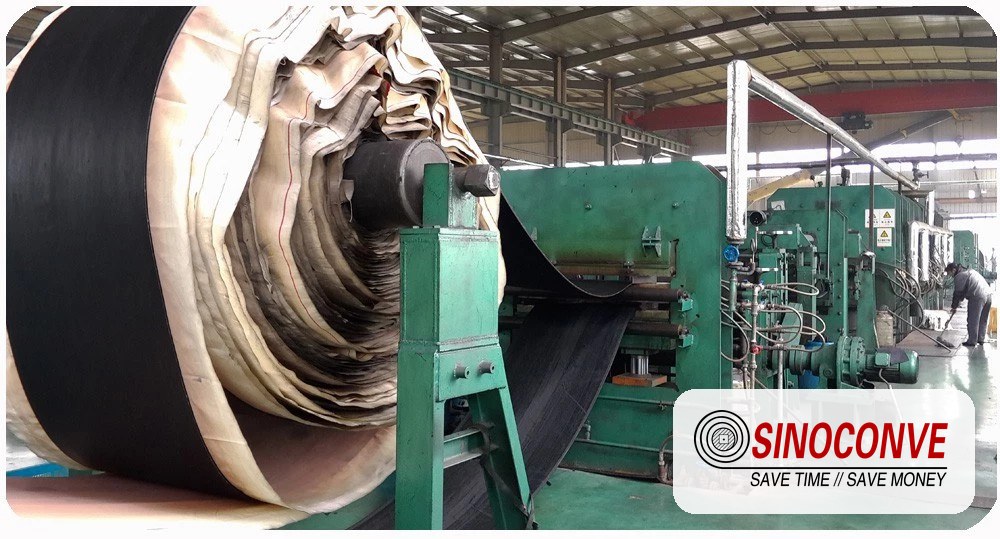
Fabric ply carcass cross section: cover, skim layer, textile plies. Tension lives in the plies, wear lives in the cover.
04EP Conveyor Belt: The Default for Mining, Quarry and Cement
An EP conveyor belt puts polyester in the warp and nylon in the weft. You get the stiffness where you need tension carried and the toughness where you need troughability and impact spread. That combination is why EP became the working standard for hard-rock quarrying, cement, coal, and bulk ports.
The numbers behave better. Working elongation usually lands between 0.5 and 1.5 percent, so take-up travel is roughly half to one third of what an NN belt of the same rating demands. A 200 m conveyor may be fine with about 1.2 to 1.5 m of travel on a gravity tower. Wet strength retention is good, dimensional stability is good, and the belt holds its width in a trough through years of cyclic loading. Anyone sourcing from a conveyor belt supplier in this segment will see EP offered as the default, with NN presented as the impact-driven alternative rather than the other way around.
Per-ply ratings commonly quoted for EP fabrics run from EP100 through EP400, with EP150, EP160 and EP200 doing most of the work in aggregates and cement. A 5-ply EP200 belt is rated close to 1000 N/mm, which is where our industrial conveyor belt built for stone crushers sits. That belt exists because primary crushed stone punishes both ends of the system at once: heavy impact at the loading point and sustained tension over hundreds of meters.
Above EP400 per ply, fabric becomes an awkward way to carry tension. The plies get numerous, the splice gets thick, the pulley diameters grow, and the belt gets heavy. That is the doorway to steel cord belts, which carry far higher tension in one layer and tolerate much longer single flights. Steel cord is outside this comparison, but you should know the boundary exists, because the worst specification mistake we see is a 7-ply or 8-ply fabric belt pushed onto a duty that wanted steel cord.
Why EP beats NN in the wet
Polyester's molecular structure holds up better when saturated, and its shrinkage on drying is lower. In a wash plant running 12 hours a day, an NN belt exposed to constant spray can creep past its take-up in a way an EP belt does not. If your plant has a wash screen upstream of the same conveyor that carries the product, treat that as a wet application regardless of what the site looks like on a dry day.
Where NN still wins on an EP-dominated site
Two situations come up often. Mobile or semi-mobile crushing where the discharge-to-first-transfer distance is under about 30 m and the drop is severe. And plants that repair with mechanical fasteners in the field rather than calling a vulcanizing crew. In both cases the extra take-up travel is affordable and the impact tolerance is worth the stretch. Standardizing everything on EP for paperwork convenience is a decision you can defend, but not for free.
05PVC and PU Belts: Where the Light-Duty Boundary Sits
A PVC belt is not a weak rubber belt. It is a different product serving a different job, and judging it with quarry metrics is as unfair as judging a delivery van by its towing capacity.
Most PVC and PU belts are homogeneous — the body is the belt — or carry one to three thin fabric plies for dimensional control. They run on slider beds or small-diameter idlers, they bend around pulleys you could hold in one hand, and they are usually 300 to 1200 mm wide. A typical two-ply PVC belt carries something in the range of 60 to 125 N/mm of total rated strength. Compare that with an 800 N/mm EP carcass and the reason for the whole price gap is already visible.
What you buy for that lower strength is control. PVC and PU belts accept pulley diameters down to roughly 80 mm, sometimes 50 mm on thin grades. They can be cleated, flanged, sidewalled, and profiled without a separate bonding operation that risks delamination, because the profile can be welded or bonded into the same body chemistry. They are hygienic and cleanable, which is why you find them in food and packaging plants, on parcel sorters, and on picking lines where a cotton or rubber dust trail would fail an audit.
Temperature is the constraint that catches people. PVC is typically rated to about 80 °C and becomes brittle in hard cold; PU handles roughly -20 °C to +90 °C and resists oils and greases better. Neither belongs anywhere near a clinker cooler. If material arrives at 120 °C, the conversation is over and you are choosing between rubber compounds, not polymers.
The three boundaries that actually get crossed
Lump size and drop height. A PVC belt can move 200 mm lumps if they are laid on gently. It cannot absorb them falling. As a rule of thumb, keep maximum lump size under about one third of belt width for uniform material, and keep free-fall drop heights under roughly half a meter unless you add impact idlers and a chute that presents the material at belt speed.
Edge loading and tracking. PVC and PU bodies are thin, so off-center loading does not forgive itself. A rubber belt 14 mm thick with a 6 mm cover will shrug off a chute that is slightly out of alignment. A 3 mm PVC belt will run off within two shifts.
Sharp or hot contamination. Tramp metal, wire, and hot slag are the end of a PVC belt. Cut resistance in these polymers is simply not in the same class, and a single tear at the edge becomes a full transverse fracture fast.
Field note from our engineers: A recycling yard replaced a worn 4-ply rubber belt on a shredder discharge with a two-ply PVC belt because the material looked light on the walk-through. It was light, until the shredder pushed a piece of plate steel through the chute. The drop was 1.1 m. The PVC belt was out of service in eleven weeks, with a tear that started at the edge and ran 400 mm across. The tonnage was fine for PVC. The impact load was never modelled.
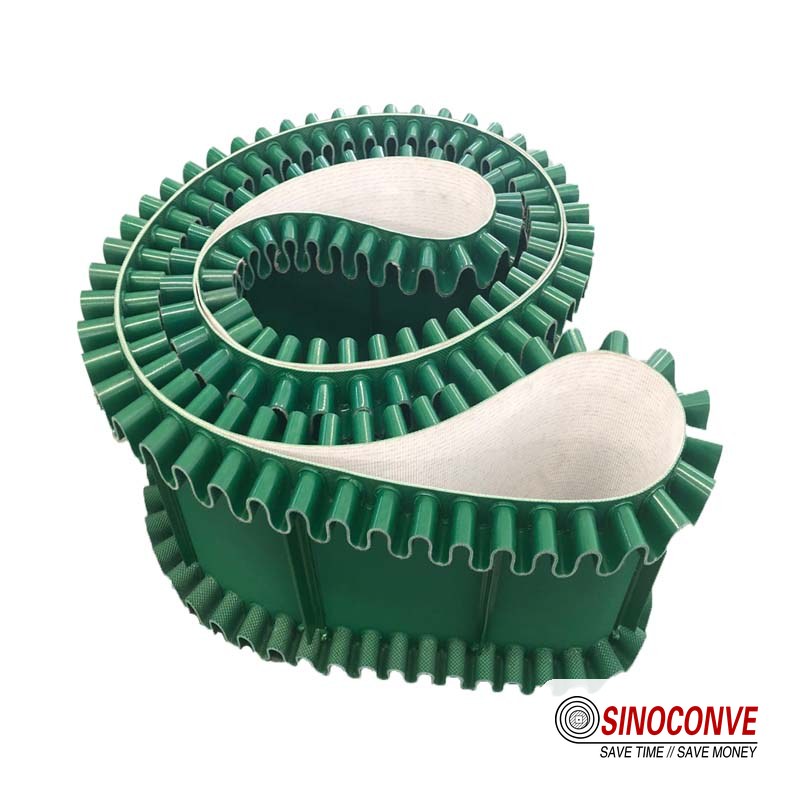
Light-duty PVC belt on a slider bed: small pulleys, tight transfers, hygiene requirements. Different job, different architecture.
06Back-Calculating Ply Count From N/mm
This is the part of the comparison that turns opinions into a specification. It works the same way whether you end up with rubber or PVC, and it takes about ten minutes.
Step one: get the effective tension. If you know drive power and belt speed, effective tension Te in newtons is roughly (power in kW × 1000) ÷ belt speed in m/s. A 75 kW drive on a 2.0 m/s belt gives Te of about 37,500 N.
Step two: add the slack side tension. On a single drive pulley with a good wrap and lagging, T2 is commonly somewhere between 0.3 and 1.0 times Te. Take 0.5 as a starting assumption and refine it once you have the drive geometry. With Te at 37,500 N, T2 lands near 18,750 N, so the maximum running tension T1 is about 56,000 N.
Step three: convert to tension per unit width. Divide T1 by belt width in millimeters. On a 1000 mm belt that is 56 N/mm.
Step four: apply a safety factor. Fabric belts in steady bulk service are usually designed somewhere between 8 and 12 times the working tension depending on impact severity, starting torque, and how much the plant values uptime. Call it 10 for a clean installation. Required full-belt rating becomes 560 N/mm.
Step five: divide by the per-ply rating and round up. At EP200 per ply, 560 ÷ 200 = 2.8, so three plies. At EP150 it is 3.7, so four plies. At NN200 it is the same arithmetic, with the take-up consequences from section 03 attached.
Then apply the two overrides that experience keeps insisting on. Minimum ply count for impact: on primary crushed rock with lumps over 300 mm, we rarely go below three plies regardless of what the tension says, and four is common. Minimum ply count for fasteners: if the belt will be mechanically spliced, three plies is the practical floor, because a two-ply belt gives the fastener very little to grip.
Finally, check the splice. A vulcanized step splice in a fabric belt typically retains a large share of belt strength, often quoted in the 60 to 75 percent range, and a mechanical fastener retains less. If your tension is close to the full-belt limit, a jam or a start under a full load can find the splice before it finds the belt.
| Belt width | T1 running tension | Rating at SF 10 | EP150 answer | EP200 answer |
|---|---|---|---|---|
| 650 mm | 20,000 N | 308 N/mm | 3 plies | 2 plies, raise to 3 |
| 800 mm | 40,000 N | 500 N/mm | 4 plies | 3 plies |
| 1000 mm | 56,000 N | 560 N/mm | 4 plies | 3 plies |
| 1200 mm | 95,000 N | 792 N/mm | 6 plies | 4 plies |
| 1400 mm | 150,000 N | 1,071 N/mm | 8 plies — check steel cord | 6 plies — check steel cord |
The last row matters more than the others. When your arithmetic asks for seven or eight fabric plies, stop and re-open the drive design or move to steel cord. Nobody enjoys being told that after the tender.
07Cover Grade Decoded: DIN 22102 Y, X, W, Z and RMA I/II
The cover grade is where the comparison stops being academic. Two belts, identical carcass, identical width and length, can differ in service life by a factor of three on the same conveyor. The variable is the compound on top.
Under DIN 22102 the cover grades that appear most often in quotations are Y, X, W and Z. The letters describe a family of properties, and the abrasive wear figure — measured by the DIN 53516 method and reported in cubic millimeters of rubber lost — is the number that tells you what you are actually buying.
| Grade | Designed for | Typical quoted abrasion loss | Where we specify it |
|---|---|---|---|
| W | Highest abrasion resistance, weather resistant | around 90 mm³ or better | Granite and basalt feed, sharp slag |
| X | Abrasion plus impact | roughly 120 mm³ | Primary crusher discharge, ore transfer |
| Y | General purpose | about 150 mm³ | Sand, gravel, cement, packaged bulk |
| Z | Heat, ozone, acid resistance over abrasion | around 250 mm³ | Hot sinter, clinker, chemical exposure |
Treat those wear figures as the ranges usually quoted when the standard is applied in practice, not as clauses you can cite. Test conditions, compound formulation, and the edition of the standard used all shift the numbers slightly. What does not shift is the ranking: W is the most abrasion-resistant general cover, X trades a little abrasion performance for impact and cut behaviour, Y is the everyday choice, and Z exists because heat and chemistry sometimes matter more than wear. The full breakdown of each compound lives in our guide to cover grades and their abrasion data.
On the North American side you will meet RMA Grade I and Grade II instead. Grade I is the heavy-duty, high-abrasion class specified for sharp ore, hard rock, and other aggressive loads. Grade II is the general-purpose class for grain, sand, coal, and lighter minerals. Some tender documents ask for one and some for the other, and the practical difference when both are on the table is usually cover thickness rather than compound chemistry.
Thickness is half the grade decision
Buyers focus on the letter and forget the millimeter. A 4 mm X-grade cover gives you a 4 mm wear budget. An 8 mm X-grade cover gives you twice the budget for a fractionally higher price. On a granite feed with a 1.5 m drop, moving from 4 mm to 8 mm on the top cover is usually cheaper per hour of service than upgrading a grade letter, and it is the change we recommend most often when a plant is replacing belts every eight months.
Bottom covers deserve the same attention on any conveyor with a return-side wear problem or a scraper. A 2 mm bottom cover on a belt that runs over sticky, abrasive fines in the rain will show through to the fabric long before the top cover is done. When we fabricate a heavy-duty belt we are matching top and bottom cover thickness to the actual return-side condition, and any honest conveyor belt manufacturer will ask you about it.
Field note from our engineers: A quarry was replacing an 1400 mm belt twice a year and blaming the ply count. We calipered the returned belt at the loading zone: 2 mm of cover left while the rest of the belt still had 5 mm. The belt was not under-rated. The chute was dropping basalt 1.8 m onto a spot 400 mm past the impact idlers. They moved the impact bed, kept the same 4-ply EP200, and the next belt ran 26 months. Same belt, different chute geometry, 5 times the life.
08Multi Ply or Abrasion Resistant? Two Different Purchases
This confusion costs more money than any other in belt procurement, so let us be blunt. Ply count does not make a belt abrasion resistant. The cover does.
A multi ply conveyor belt buys you tension capacity, impact distribution, fastener retention, and puncture resistance. Five plies of EP150 give you 750 N/mm of rated strength. Six plies give you 900. That is what plies do. They do not slow down wear by one hour, because the material never touches them.
An abrasion resistant conveyor belt buys you a compound and a thickness on the surface. If your belts are dying of worn covers, adding plies is money thrown at the wrong problem. If your belts are dying of splice pull-out or edge elongation, buying an upgraded cover compound is the same mistake in reverse.
What extra plies cost you
Weight goes up roughly linearly. A 1200 mm 6-ply EP belt with 8/3 covers is heavy enough that a two-person crew is not moving a roll; you will be lifting with equipment and you will be splicing with a larger press. Minimum pulley diameter grows with ply count, so a retrofit can drag a pulley change into the project. Splice step length grows, which means more press time and more field skill. And the belt costs more per meter for tension you may not need.
Fewer, stronger plies are the modern direction. A 3-ply EP200 replaces a 4-ply EP150 with similar strength, similar cover, lower weight, and a thinner splice. The trade-off is that you lose some impact forgiveness and some fastener grip, which is exactly why plants that mechanically splice tend to stay one ply heavier than the strength calculation requires.
The correct way to write the specification
State the requirement, not the construction. Write the working tension in N/mm, the maximum lump size, the drop height, the material temperature, and the belt width. Let the plies and cover follow from those. When we quote against a tender that specifies "5 ply, 6 mm top cover" without stating the loading conditions, we often come back with a question and sometimes a different answer. A plant that lets the application pick the construction usually gets a lighter, cheaper belt that lasts longer.
09The Decision Matrix: Duty, Carcass, Plies, Cover, Cost
Read this table by finding your duty row first, then accept the rest of the row as a starting specification. Every number in the last column is an order-of-magnitude band in US dollars per meter for the belt alone, for a mid-range width of 800 to 1200 mm, before freight, splicing, and installation. It moves with carcass, cover grade, cover thickness, layer count, and order quantity, so treat it as a screening tool, not a quotation.
| Duty / application | Material | Plies | Cover grade and thickness | Indicative belt cost |
|---|---|---|---|---|
| Primary crush, hard rock, 300 mm+ lumps | EP, NN if drop > 2 m and center < 40 m | 4–6 | X or W, 8–10 mm top, 3–4 mm bottom | roughly $90–200/m |
| Secondary and tertiary crushing, aggregate stockpile | EP | 3–4 | X or Y, 6–8 mm top | roughly $55–120/m |
| Cement clinker, hot material 100–180 °C | EP with heat-resistant compound | 4–5 | Z-type heat grade, 6–8 mm top | roughly $70–160/m |
| Coal, wet ore, port bulk, long overland flight | EP, steel cord above ~1200 N/mm | 4–6 | Y or X, 6–8 mm top | roughly $70–180/m |
| Grain, fertilizer, light minerals, indoor transfer | EP or NN, 2–3 ply | 2–3 | Y, 3–5 mm top | roughly $30–70/m |
| Cartons, parcels, totes, sortation, logistics hub | PVC or PU | homogeneous or 1–2 | Not graded in DIN 22102 terms | roughly $10–35/m |
| Food contact, washdown, oil mist, packaged product | PU, PVC, food-grade compound | homogeneous or 1–2 | White or blue food-grade surface | roughly $18–60/m |
| Steep incline over 20° on a short footprint | EP rubber with profile, or PVC cleated | 2–4 | Buy the profile, not the grade | roughly $45–150/m |
Two rows in that table carry most of the traffic in our inbox: the primary crushing row and the logistics row. They are also the two where buyers most often try to substitute one for the other, which is where the fun starts.
If your duty is not obviously in the table, send the numbers. Belt width, tonnage per hour, lump size, drop height, center distance, and material temperature are enough for a conveyor belt factory to give you a defensible starting construction. We would rather correct a specification before the belt is made than after. Buyers who purchase through a regional conveyor belt distributor can pass the same six numbers along; the construction that comes back is the same either way.
When the drive side of the plant is also in scope
Belt comparison rarely happens in isolation. If the same project includes the drive, you may also be choosing between a flat belt drive and a wrapped transmission belt manufacturer arrangement, or standardizing service parts across the site. That is a separate calculation, and any competent V-belt manufacturer will tell you the same thing: the drive and the conveying belt are specified from different data, and folding them into one procurement line item usually costs more than it saves.
10What Actually Drives the Price Gap
Buyers ask for the rubber conveyor belt price difference and expect a single multiplier. There is not one. There are six drivers stacked on top of each other, and that is why two quotes for the same duty can sit 40 percent apart without either being dishonest.
| Cost driver | Effect on belt price | What buyers get wrong |
|---|---|---|
| Carcass polymer and fabric | PVC body lowest, NN mid, EP slightly above NN, steel cord several times all of them | Assuming EP and NN are interchangeable on price |
| Per-ply rating and ply count | Roughly linear in ply count, plus a step for higher-rated fabric | Buying plies as insurance instead of doing the tension math |
| Cover compound grade | A step up per grade letter; W and X compounds cost more than Y | Ignoring thickness, which is often the cheaper lever |
| Cover thickness, top and bottom | Linear in millimeters of compound | Specifying 2 mm bottom cover on an abrasive return side |
| Width, length and roll logistics | Non-standard widths and short rolls carry setup cost per meter | Ordering 30 m when the line needs 300 m and paying the same per meter |
| Splicing and finished ends | Vulcanized step splice adds cost and lead time; mechanical fasteners are cheaper but weaker | Comparing a spliced belt against a raw roll price |
The last row is where most apples-to-oranges comparisons happen. A quote that includes field vulcanizing, pulley lagging advice, and a spare fastener box is not competing with a container price for a raw roll, and the cheaper one will not look cheaper once the press crew and the downtime are on the invoice. When comparing offers, insist that every line lands on the same basis: belt price per meter, splice price per joint, and lead time for both.
For distributors and trading companies building a stock program, the calculation shifts again. Volume bands, container fill, and whether you carry 800 mm and 1000 mm as standard all matter more than the last five percent of belt price. That is a different conversation, and if you are structuring a stock list the honest place to start is with our wholesale conveyor belts range rather than a single-spec quote.
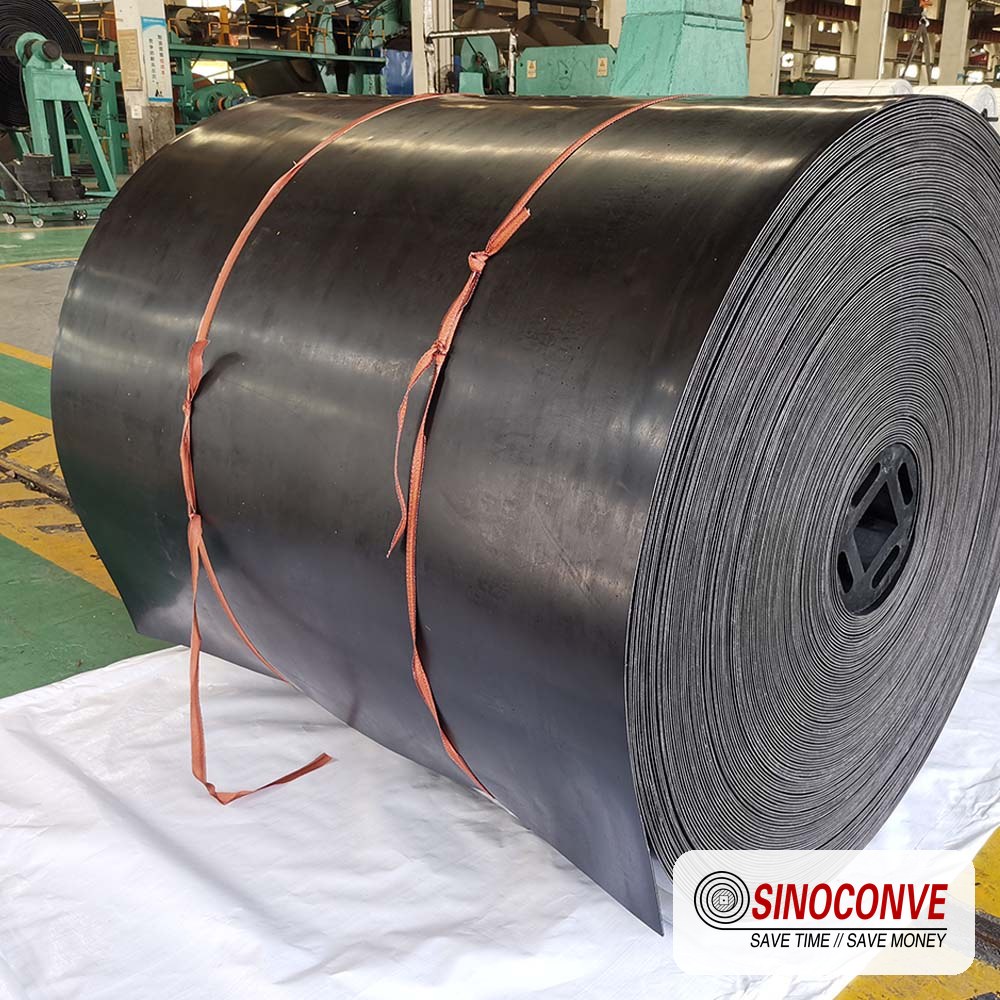
Heavy-duty rubber belt roll. Cover thickness and ply count are visible before the belt is even cut — and they are what the price is actually paying for.
11Hidden Comparison Costs: Splice, Pulley, Take-Up, Energy
The belt is typically the smaller half of the lifetime bill. Here is where the rest lives.
Splice economics
A vulcanized step splice takes hours, skilled people, and a press.A mechanical fastener takes one person and a hammer. On a light PVC line with 60 N/mm working tension, mechanical fastening is normal and sensible. On a 900 N/mm EP belt at the primary crusher, a mechanical splice is an interim repair at best. If you plan to run rubber at high tension with bolt-on fasteners, budget for repeated splice attention — and note that a heavier ply count is what makes those fasteners hold at all, which is one of the few legitimate reasons to add a ply.
Pulley diameter and structural cost
Ply count sets a minimum pulley diameter, and PVC notches the requirement down to a fraction of that. Retrofitting a conveyor from a thin PVC belt to a 5-ply rubber belt is rarely just a belt change: pulleys may need resizing, the take-up may need more travel, and the chute may need impact idlers. Estimate that scope before comparing the two belt prices, because in a retrofit the belt is often the cheapest item in the change.
Energy, honestly
Rubber belts running on rolling idlers have low running resistance, commonly quoted around 0.02 to 0.03 coefficient of friction equivalent. PVC and PU belts running on a slider bed are higher, often in the 0.2 to 0.35 region depending on surface and loading. That sounds decisive until you look at length. On a 500 m overland conveyor the idler arrangement wins comfortably. On a 12 m sorter with frequent starts, the lower belt mass of PVC can offset its higher friction, and the difference is measured in fractions of a kilowatt rather than in megawatt-hours. Do not import the overland energy argument into a packaging hall.
Field note from our engineers: A cement plant replaced a 4-ply belt with a 6-ply on the same drive because "heavier is safer." Two years later the take-up was at the end of its stroke and the belt was still stretching, because the extra plies added total elongation to a system that had no travel left to give. Heavier was not safer. It was just later to fail.
12Sustainability, Measured in Belt Life Times Replacement Cycles
Environmental claims about belts are usually written as adjectives. Let us do it as arithmetic instead, because the arithmetic is far more persuasive and it is the only version a plant manager can act on.
The useful metric is material consumed per tonne conveyed, and it has three inputs: belt mass per meter, service life, and the number of replacements inside a fixed period. Service life multiplies through everything. Halve the life and you double the belt mass consumed, double the splicing consumables, double the transport of new and scrap belt, and double the downtime hours.
Work an example. A 1000 mm, 14 mm thick fabric belt weighs roughly 17 to 19 kg per meter at typical compound density. On a 200 m conveyor that is about 3.6 tonnes of belt in service. Say the correct EP construction gives four years on a granite feed. Over a twelve-year horizon that is three belts, roughly 11 tonnes of belt consumed, three or four field splices, and maybe 40 hours of planned downtime. All of it predictable and schedulable.
Now put a 3 mm PVC belt of the same width on that duty. It weighs about 4 kg per meter, so one belt is under a tonne — which is exactly the number that makes the purchase order look good. But it will not survive four years at that loading point. At three months per belt, you need roughly 48 belts across the same twelve years: about 46 tonnes of belt, 48 installs, 48 splicing operations, and downtime counted in weeks rather than hours. The lighter belt consumed four times the material and one to two orders of magnitude more maintenance labour.
| Metric over 12 years | EP rubber on the right duty | PVC belt on the same duty | Ratio |
|---|---|---|---|
| Belts replaced | 3 | ~48 | 16× |
| Belt mass consumed | ~11 t | ~46 t | 4.2× |
| Field splices | 3–4 | ~48 | 12–16× |
| Unplanned downtime | ~40 h total | hundreds of hours | Large, and mostly unplanned |
That last row is the one that never appears in a sustainability report and should. Every hour of stopped line is an hour of idling equipment, re-heating, re-starting, and trucking product somewhere else. The emissions and the energy cost of that downtime almost always dwarf the embodied carbon of the belt itself, whichever polymer it is made from.
Recyclability, without the marketing
Rubber belts have a workable second life. Worn belts are cut into chute liners, impact bars, matting, and haul-truck bed liners, or granulated for low-grade rubber applications, with energy recovery as the last resort. The material is tough and it keeps working in less demanding roles, which is a genuine circular pathway. PVC is harder, because plasticizer content and chlorine chemistry complicate most mechanical recycling streams, although some volume PVC belt waste does return to industrial compounding. PU generally fares better than PVC in chemical and mechanical recovery routes.
Be careful with how much weight you put on that paragraph though. The difference in recyclability between the two polymers is small next to the difference in how many times you have to buy one. A correct material choice buys you a factor of four on material consumption. A slightly better recycling label buys you a fraction of that. Choose the material by duty first, and the environmental case mostly takes care of itself.
The cheapest sustainability measure is alignment
Before anyone redesigns a conveyor in the name of carbon, check the belt training, the skirting pressure, the impact bed position, and the scraper setting. A belt that runs off-center wears its edge and dies early; a chute that drops material on the wrong spot cuts cover life by years, as the quarry in section 07 discovered. Those are maintenance-line items with a payback measured in months, and they reduce belt consumption without changing a single specification. We would rather help a plant get an extra two years out of the belt it already owns than sell it a belt it did not need.
13Failure Signatures That Reveal a Wrong Material Choice
Belts fail in a shape. Learn to read the shape and you can usually name the wrong decision before anybody opens a catalogue. Send us a photograph of the failure and most of the diagnosis is already done.
| What you see | Most likely cause | What it says about the choice |
|---|---|---|
| Cover worn through in a patch, fabric visible | Impact point or chute misalignment, not belt grade | Fix geometry or thicken the cover, do not add plies |
| Brittle cracks across a PVC belt in winter | Below the polymer's cold-flex limit | PVC was specified outside its temperature window |
| Edge tear that runs transversely within weeks | Sharp load, off-center loading, thin body | Light-duty belt in a heavy-duty job |
| Take-up at end of stroke, belt still slack | Carcass elongation exceeded the design travel | NN chosen where EP or more travel was needed |
| Splice pulling apart at the step joints | Working tension close to full rating, or a weak step | Safety factor or splice method was under-specified |
| Cover hardening and cracking on a hot line | Compound not rated for the material temperature | Standard grade used where a heat grade belonged |
Notice that only three of those six point at the polymer family. The rest point at geometry, temperature, or the arithmetic in section 06. That is the correct proportion, and it is why a straightforward "rubber versus PVC" comparison with two tick-box columns misleads so many buyers. The material matters, but it matters as the last consequence of a chain of measurements rather than as the first decision.
So which one fits your line?
Rubber with an EP carcass, unless impact loading on a short conveyor argues for NN. That covers hard rock, ore, clinker, coal, wet aggregate, long flights, high tension, hot material, and any layout where a chute drops something heavy onto the belt. If your working tension is above roughly 100 N/mm, or your largest lump exceeds about 150 mm, or the material arrives hotter than 80 °C, this is not a judgement call.
PVC or PU for packaged and light loose goods: cartons, parcels, food, small parts, sortation lines, short transfers, small pulleys, washdown environments, and working tensions under roughly 40 to 50 N/mm with gentle loading. Where hygiene approvals drive the design, PU usually edges PVC on oil resistance and temperature range, and PVC usually wins on price.
In the band between, the tie-breakers are in this order: maximum lump size, drop height, material temperature, cleaning regime, then cost. Not the reverse. When those four are known, the answer is usually obvious within a minute — and if it is not, send us the numbers. Whether you buy from us or not, you will get a straight answer, because a belt that fails in eleven weeks costs us a customer and costs you a shutdown. That trade is not worth the extra margin.
If the project also touches factory layout, drive selection, or site-wide belt standardization, our team can review the whole picture rather than one conveyor. Details of what we make and where we make it are on the drive and belt engineering overview, and if you source through an established conveyor belt distributor network we are happy to work through them.

14Frequently Asked Questions
Is a PVC conveyor belt ever a direct replacement for a rubber belt?
Rarely, and only when four conditions hold at once: light unit loads or small uniform lumps, gentle loading with no free fall, working tension under about 40 N/mm, and a clean indoor environment. Miss any one of them and the substitution will cost more than it saves. We have seen exactly one successful drop-in replacement in the last few years, on a fertilizer bag line where the loads were 25 kg sacks.
What working tension is too high for PVC?
Above roughly 50 N/mm we stop recommending it for bulk material. PVC can be engineered to carry more in special constructions, but at that point you are paying rubber-belt money for a belt with a shorter life, which makes no commercial sense.
How do I choose between NN and EP?
Ask one question: what is the drop height at the loading point, and how far does the belt have to run? Severe drop on a conveyor under roughly 40 m, and your maintenance crew uses mechanical fasteners, so NN earns its place. Long flights, wet material, or a take-up with limited travel, and EP is the answer. Everything else is a compromise in one direction or the other.
Does a higher ply count make a belt last longer?
Only if the failure mode was a tension or splice problem. Plies do not slow abrasion, do not stop gouging, and do not raise temperature resistance. A 6-ply belt with a 4 mm Y cover will die faster on sharp granite than a 3-ply belt with an 8 mm X cover, and it will cost more to buy and to splice.
What cover grade fits granite or basalt?
X as a minimum, W if you can justify it. Then look at thickness before you look at the letter: going from 4 mm to 8 mm of X-grade compound usually returns more service hours per dollar than moving from X to W at 4 mm. Add impact idlers under the loading zone while you are at it.
Why does the rubber belt cost several times the PVC belt?
Because it contains several times the material and a more expensive reinforcement. More kilograms of compound, thicker covers, multiple layers of high-tenacity polyester and nylon fabric, a wider range of service conditions it has to survive, and a vulcanized carcass that is built to be repaired rather than thrown away. You are not paying a premium for the same belt.
Can one plant run both rubber and PVC belts?
Most of ours do. Rubber on the raw material side, PVC and PU on packaging, sampling, and bagging lines. The only rule is not to let a light belt migrate upstream during a breakdown, which is exactly how the recycling-yard failure in section 05 happened.
What temperature limits should I write into the specification?
For PVC, plan on a working ceiling near 80 °C and treat anything below -10 °C as a flex risk. PU handles roughly -20 °C to +90 °C. Standard rubber compounds are comfortable up to about 80 °C, with dedicated heat grades covering roughly 100 °C to 180 °C depending on construction. Above that, and you are outside what a conveyor belt should be doing at all; the fix is a cooler, a water spray, or a different transport method.
How many years should a heavy-duty belt give me?
On a correctly specified EP belt at a well-designed transfer point, three to five years is a reasonable planning figure for a two-shift operation, and we have belts in the field that have gone longer. If you are changing belts inside twelve months, the problem is almost never the belt brand.
Related Products You May Need
| Product | Where it fits |
|---|---|
| Rubber conveyor belt | Heavy bulk materials |
| EP rubber conveyor belt | Quarry, cement, wet ore and long flights where carcass stability decides belt life |
| PVC conveyor belt | Packaging, food, logistics lines |
| Chevron and profile belt | Inclines above 20 degrees where material would otherwise slide back down the belt during the climb |
| Heat resistant belt | Clinker and sinter duty |
| V-belt | Crusher and screen drives on the same plant |
| Timing belt | Synchronous drives and packaging machinery |
Related Blog Posts
- EP vs NN
- Reading rubber belt cover grades against real abrasion data
- Abrasion resistant belt guide for quarry work
- What actually drives rubber conveyor belt prices
- Rubber conveyor belt guide: types, grades and how to choose one
- PVC conveyor belt guide to types and surface patterns for light duty lines