

We have stood on urea lines where the belt was in excellent condition — cover gauge intact, edges square, no gouges — and the plant was still fighting dust at the transfer tower and cake in the silo. The belt was not worn out. It was breaking the product. Those are two different failures, and only one of them shows up when somebody walks the line with a gauge and a notebook.
This page is about the other one, and about what a urea prill conveyor belt has to do differently. It is written for the people who own the conveyors between the granulator, the cooler, the warehouse and the ship loader, and who have already discovered that the whole-prill figure at the end of the route is not what the design promised.

01On urea, breakage comes before wear
Start the survey at the finished product. Take a sample before the first transfer and another immediately after it, then compare whole prills and fines. A sound belt can still deliver a poorer product if the chute makes the particles strike steel twice. Cover wear, tracking and edge damage matter, but they will not show that loss.
We have walked urea conveyors that had run for years with almost no cover loss while the fines collected at the dedusting system told a different story. As a conveyor belt manufacturer we would rather sell a belt that lasts, and we build them in our own conveyor belt factory. On this duty a belt that lasts while destroying the cargo is not a good belt, and the invoice is paid by the bagging line.
A prill is a manufactured particle, not a small rock
Prills roll freely and do not form the same interlocking cushion as angular stone. Under a falling stream, the first layer can take a hard contact against the receiving surface. Look for the point where dust first appears, then check whether the stream lands on a moving bed or on exposed steel. A broken particle may be hidden in an otherwise clean-looking load.
What we unlearn from aggregate duty
The cover damage we actually find on a urea line is nearly always second-order. Fines that have caked onto the belt act as a lapping paste under the skirt and under the return idlers. A set lump that falls at a transfer point gouges. A scraper blade set too hard shaves.
| The duty this belt actually carries | Why it behaves differently from aggregate | What we examine first on site |
|---|---|---|
| Carrying whole prills without reducing their size | Prills split and shed dust instead of wearing down gradually | First transfer geometry and the drop height above the belt |
| Surviving caked lumps that form after a humidity cycle | A set lump arrives as a dense body with a point load | Impact support under the load zone and chute corner condition |
| Running clean on the return side with fine damp dust | Fines stick to a damp cover and build a crust on idlers | Return-side scraping pressure and the pulley build-up |
02Which part of the line you are on, and what the plant pages already cover
The duty changes along the route. Product leaving a granulator may be warm; reclaim material can bring caked lumps and fines back from storage; bagging and ship loading add more transfers. This article follows one loose-prill conveyor at a time. Note the sampling points and the transfer immediately upstream of each one before attributing a plant-wide dust figure to a single belt.
The industry overview is useful when the enquiry covers a whole site. For incoming raw materials and storage, see agriculture. A shiploader adds a very different final drop, discussed under port bulk material handling. Once urea is in bags, logistics and warehousing becomes the closer comparison. Here we follow loose prills on the belt.
The check here is deliberately narrow: where do whole prills become fines? Put a sampling point on each side of a suspect transfer. If the rise occurs there, look at the falling stream, impact face and skirt before changing a belt specification.
| The question you are actually asking | Page that answers it, and what it adds | Where this page deliberately stops short |
|---|---|---|
| Which compound or construction the whole plant should standardise on | The compound selection guide for fertiliser plants compares cover choices across a site | It does not follow prills through a transfer point |
| Whether one belt suits a sequence of different chemical products | The chemical products and fertilizer belt article works through compatibility on mixed lines | It does not measure breakage or the dust it generates |
| How belts are chosen across a whole chemical and fertiliser plant | The chemical and fertilizer plant belt overview covers selection conveyor by conveyor | It does not go down to chute geometry and skirt pressure |
Compound choice belongs alongside product compatibility and the plant layout. For the present conveyor, record the actual speed, loaded profile and chute geometry. The belt and the hardware around it have to be assessed together.
Most buyers arrive at this question through a conveyor belt supplier quoting a replacement, and the replacement is usually specified from the belt that failed. That is the weakest possible starting point on urea, because the belt may have been sound and simply asked to do the wrong job. What we ask for instead is the transfer arrangement, the way the belt is supported under the load zone, and what the skirt and scraper settings have been.
On this duty the belt itself is often a rubber conveyor belt with a fabric carcass and a smooth, non-marking cover. The construction is rarely exotic. The detailing around it is where the prills are saved or lost. If you are still shortlisting, the wholesale conveyor belts in our catalog are grouped by carcass and cover, so at least the list starts in the right family.
03Why a broken prill is worse than a worn cover
Three ways a prill breaks
Watch the stream from a safe hatch. At this transfer, does the dust appear on the first landing, after a bounce off the deflector, or under the skirt? Each points to a different fix. The belt cover alone cannot tell you which collision broke the prills.
One transfer we inspected had been given a new drive without moving the chute. At full load, the stream struck the side plate, then crossed back onto the belt. The belt cover looked fine; the discharge sample did not. A short video from the inspection hatch made the path obvious. Record belt speed under load, the first contact point and any second collision before adjusting the chute.
Fines, moisture and the caking chain
After a humid shift, scrape a little material from the chute corner and the skirt entrance. A hard deposit there is a likely source of the next lump in the feed. The return strand deserves the same check; powder pressed into the belt can travel back to the tail unnoticed.
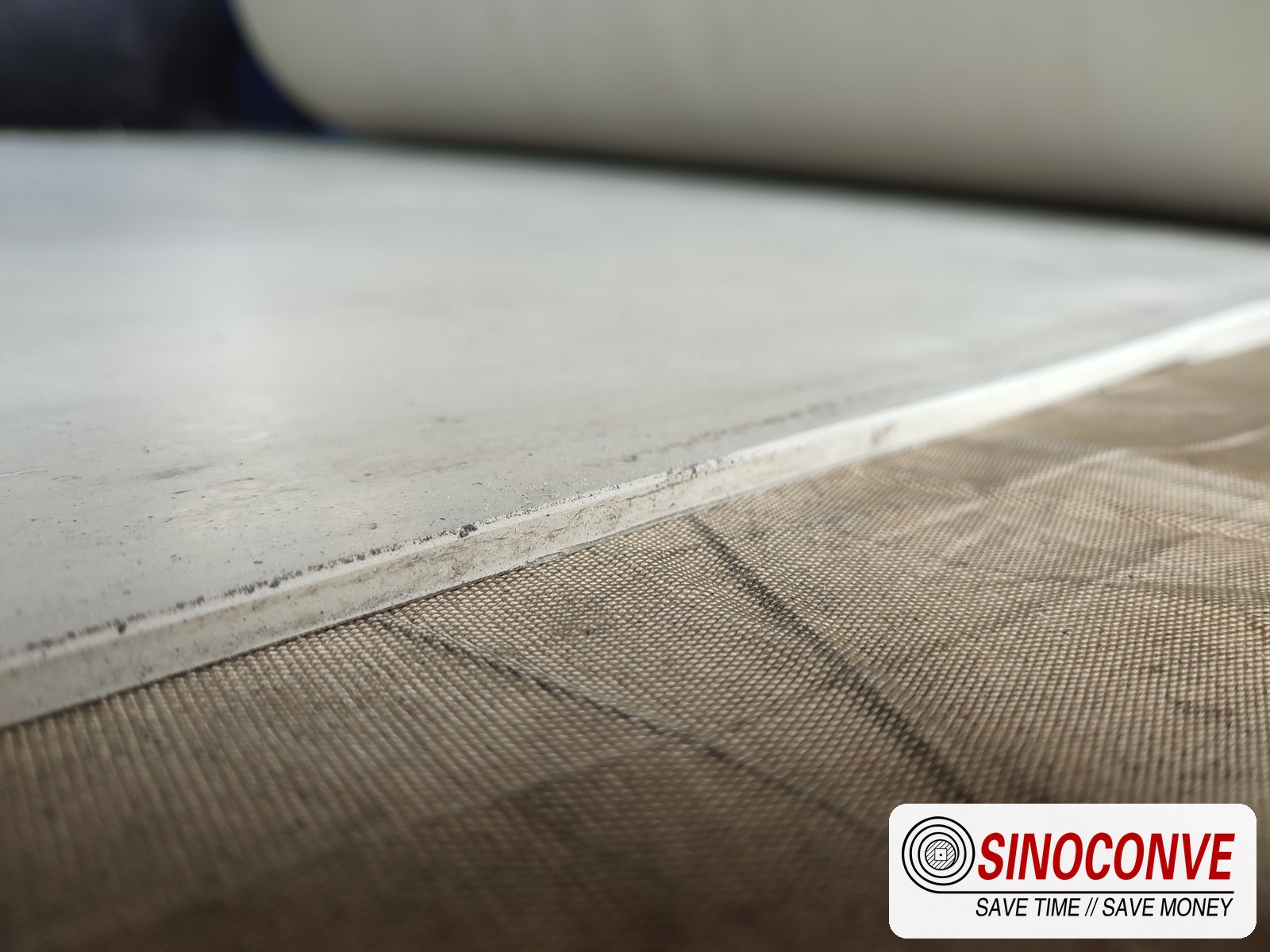
The useful measure here is the change in fines from one sampling point to the next. If the dust rises only downstream of a transfer, a tougher cover will solve the wrong problem. If it rises in the silo, look at storage conditions too.
04Drop height, belt speed and the trajectory that decides breakage
The old chute drawing may no longer describe the discharge. A drive or liner change can move the stream enough to put the first landing onto steel. Trace that path at operating load, then measure the fall and the angle where it strikes.
The first impact is the one you can still design out
Energy at impact climbs with the square of the arrival speed, so a modest increase in fall height costs far more than it looks like it should. That is the argument for keeping the drop short, and it is also why the argument is so often lost: drop height is set by the equipment above, not by the belt, and nobody wants to move a screen deck to save some dust.
A bed of moving product cushions a fall better than an exposed steel floor. Watch whether the first few seconds of a start-up leave the receiving belt bare at the landing point. If they do, a gentle steady-state transfer may still produce a burst of fines at every restart.
Count the contacts after the first landing as well. In one transfer, a liner bolt head caught the rebound and made a small but steady dust plume. The cleanest view was during start-up, before a bed of prills had covered the receiving belt.
A faster belt is not automatically gentler
Changing speed moves the landing point. The slower trial put prills near the head pulley; the faster one sent them against a chute side. A simple speed change is therefore a poor substitute for watching where the stream actually goes.
A chevron profile can stop rollback on an incline. At discharge the ribs may release the product in pulses. Check that behavior with the proposed rib height before ordering a full roll.
For a drive investigation, record speed under load and inspect pulley grip. The transmission belt manufacturer and V-belt manufacturer can confirm drive specifications. The field speed belongs on the chute sketch beside the observed landing point.
| What the discharge actually looks like | What it does to the prill stream | The first change we would make |
|---|---|---|
| A short drop onto a bed that is already moving | Prills land on prills and the energy spreads through the bed | Keep the drop short and load in the direction of travel |
| A long drop onto a bare steel plate | Each prill takes the full hit on a hard unyielding surface | Fit a cushioned impact face and cut the fall |
| A stream crossing onto a belt running the other way | Opposing travel raises relative impact speed at the join | Rework the transfer so both belts run together |
| A chute face set for a slower belt than the one fitted | Prills strike the wall square instead of sliding along it | Re-cut the chute face to match the real trajectory |
One habit from ore handling is worth borrowing, with a warning. The dead box — a pocket of stationary material the stream lands on instead of steel — is the cheapest impact absorber ever invented, because prills cushion themselves. On urea it works until it stops working, because a dead box is a stagnant zone with a large exposed surface and damp fines find it ideal. The pocket sets, hangs, then releases as a lump. If you keep one, give it a purge point and an inspection hatch, and use them.
05Transfer point support, skirt pressure and the fines you create there
Support under the load zone decides how hard the landing is
At the first landing, look at the belt with a full load on it. One plant added cushioned impact idlers and the dust barely changed. The supports had a wide gap just inside the skirt entrance, leaving a dip that trapped prills against the seal. Closing that gap changed the loaded profile.
Skirt clearance under load
We inspect the shiny line made by the skirt after a loaded run. A groove next to spilled product is a reason to check both the clamp and the chute mouth. When the incoming stream spreads past the opening, clamp adjustments alone never settle the spill.
A short, abrupt taper can become a pocket for fines. Check it during a safe stop after humid operation. If a hard ridge has formed at the entrance, provide a cleanout and change the convergence rather than forcing the material through with more skirt pressure.
| Element at the transfer point itself | If it is set too tight or too hard | If it is set too loose or too soft |
|---|---|---|
| Skirt rubber along the loading zone | Clamp load crushes prills against a belt with no give | Product escapes and is recirculated as fines |
| Scraper blade at the head pulley | The edge shaves the cover and takes prill shells with it | A film stays on the belt and travels back as carryback |
| Impact support under the loading point | The belt cannot deflect and the prill takes the whole blow | The belt sags into a valley that traps the bed |
| Convergence angle of the skirt walls | The wedge compresses the bed before it reaches full width | The stream spreads and the skirt cannot contain it |
One plant had a soft landing liner and still made dust: its proud fixing caught the stream at the liner joint. A flush joint and an accessible inspection hatch mattered more than another change of cover compound.
06When fines meet humidity: caking, carryback and blocked chutes
Caking is an impact problem, not a wear problem
A damp, set lump should be treated as a different feed condition. If one reaches the loading point, it can gouge the cover and disturb the skirt gap. Inspect the corners where fines collect and identify how operators remove buildup before it detaches as a large piece.
Scraper pressure is the setting nobody records
Every plant we visit keeps a greasing schedule and a mental note about belt tracking. Almost none of them records scraper blade pressure, and pressure is the whole story on this duty. A blade loaded hard against the belt cleans beautifully and shaves prills at the same time, particularly at the head pulley where the bed is still full. A blade left soft leaves a film that becomes lapping paste under the first return idler it meets.
Check the scraper at both operating and start-up conditions. A blade that cleans the return well but catches a proud splice is not a stable setting. Choose contact and edge material from a trial on the actual belt, then record the setting so the next shift does not tighten it by feel.
At the next shutdown, examine the return cover just before the tail. If fines have set into a crust, trial a return-side cleaner and check where it deposits the removed material. The tail should remain free of buildup after several loaded shifts.
07What to specify, and what to check on arrival
What belongs on the specification
Width and tensile rating are only the starting dimensions for the RFQ. We ask for the route sketch with the drop heights and operating speed written onto it, plus a photograph of the loaded skirt zone. Add the product form and seasonal humidity. For construction, discuss cover marking, trough shape, edge condition and a joint that clears the scraper. The splicing checklist is useful when settling the joint drawing with the installer.
At receipt, inspect the edges and cover, then check width and construction against the order. Run the installed belt empty before loading it. During the first loaded pass, collect product just upstream and downstream of the troublesome drop. Mark the actual landing position on the drawing and keep the samples with the commissioning record.
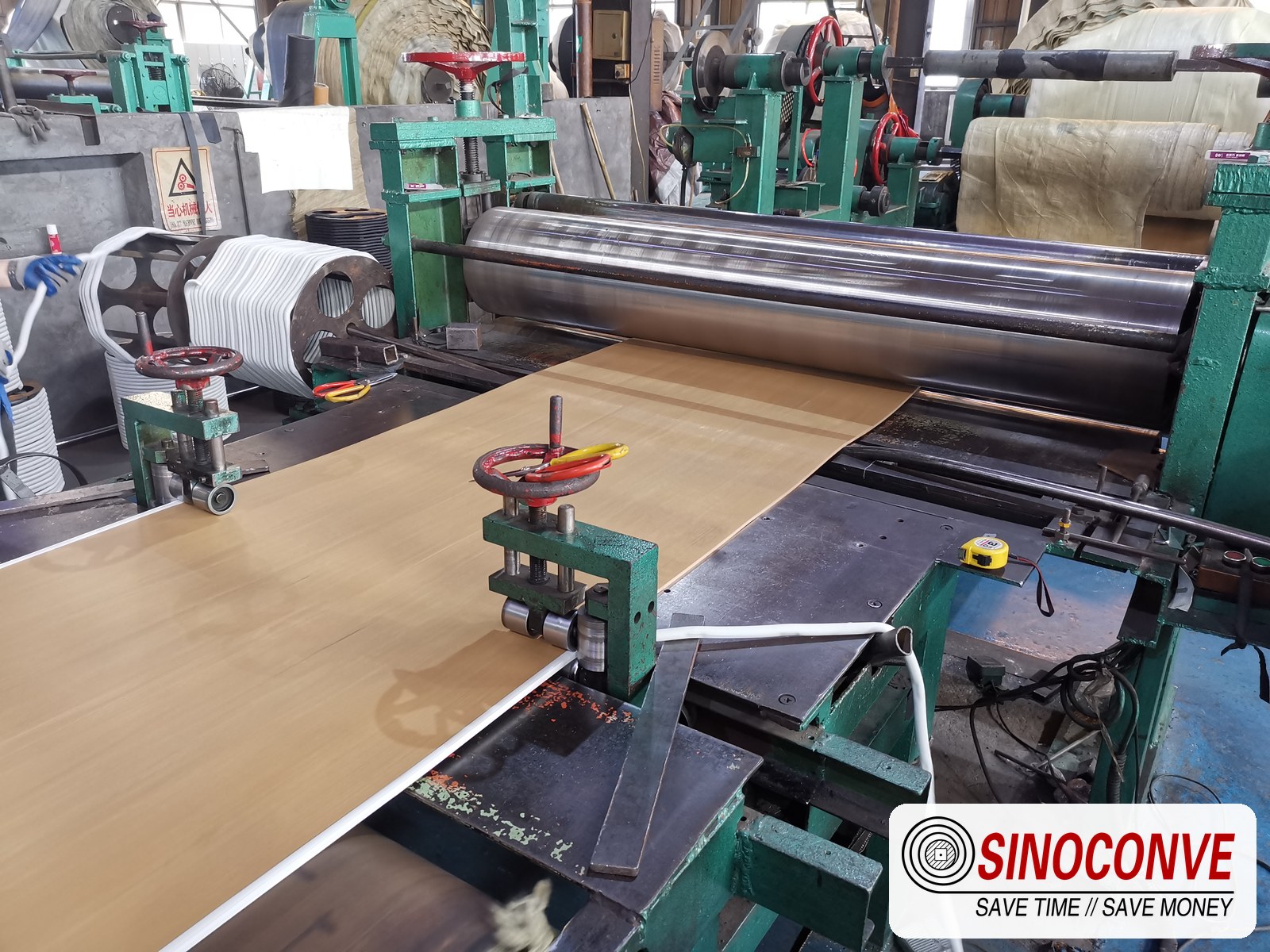
A useful enquiry package is the layout drawing with the observed landing point marked on it, two product samples and photographs of the skirt and return. Our frequently asked questions cover routine ordering details.

08Questions from urea conveyor buyers
Can the conveyor really be the reason our urea cakes in storage?
It can add fines before storage. Compare samples before and after each transfer, then check the moisture and storage conditions as separate causes. A reduction in dust at the belt should be visible in the later handling record.
Is a softer cover always the answer for prills?
No. A soft surface cannot compensate for a long drop onto bare steel or a tight skirt. Test the impact support, cover and seal as one arrangement; the loaded belt must keep a stable profile.
How do we tell whether breakage happens at the transfer or along the run?
Take comparable samples immediately before and after a transfer, then across a straight run. A jump at the transfer points to its path and landing; a rise on the run directs attention to the skirt, scraper and support.
Should we keep a dead box on a urea chute?
Only where it can be opened and cleaned. Product landing on product may soften the impact, but damp fines can set inside a stagnant pocket. Include a purge route in the inspection plan.
Does bagged urea need a different belt from bulk prills?
A bag conveyor is selected for package grip, transitions and handling. Loose-product spill conveyors beneath a bagging line still carry prills and need the transfer checks discussed here.
What is the cheapest single change that reduces breakage?
Find the hard contact first. A liner change, or a shorter fall where the steelwork permits it, may be enough. Retain the product samples and the dust result from both sides of the modification so the team can judge what changed.