
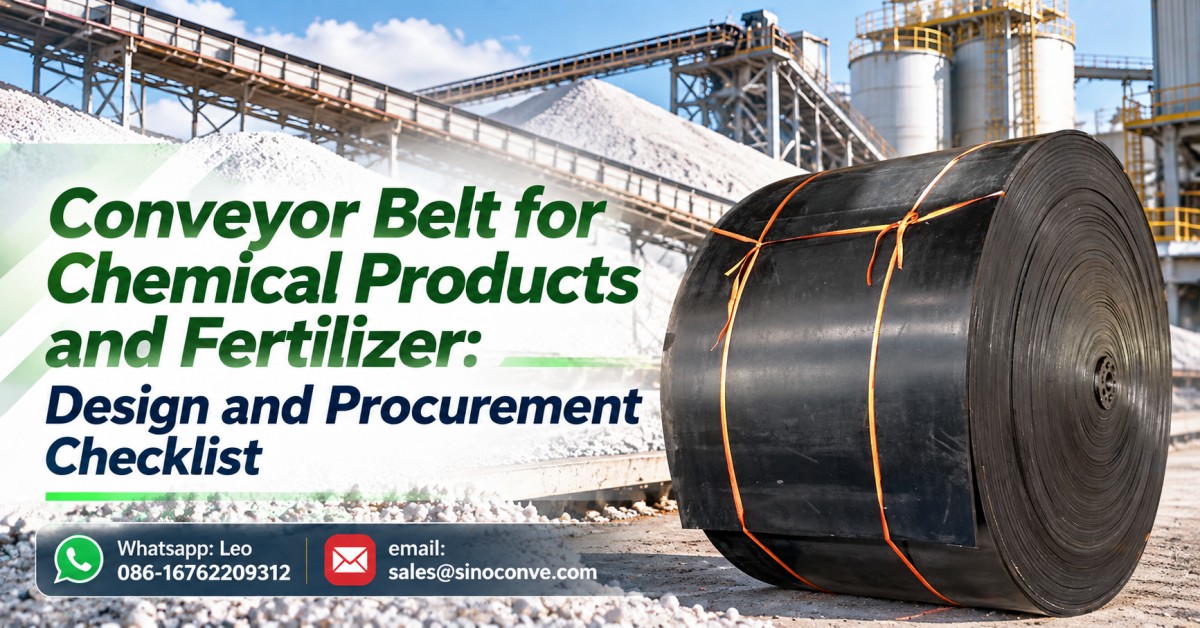
A fertilizer or chemical line is not specified belt by belt. It is specified zone by zone, because the feed hopper, the transfer towers and the bagging floor do not punish a belt in the same way. Moisture, temperature and corrosion load change several times between the railcar unloader and the palletizer, and one belt grade copied across all of those zones is the most expensive shortcut we find on plant audits. Here is the rule worth remembering: hygroscopic and caking cargo is a cover-and-cleaning problem, not a carcass-strength problem. Put the budget into cover compound, surface finish and wash-down design, and keep the carcass conservative.
That single idea drives everything else in this specification checklist for a conveyor belt for chemical products and fertilizer. By the end you will have three deliverables you can paste straight into a scope of work: a process zone table, a material-property register, and a procurement acceptance clause list.

01From Feed Hopper to Bagging: Mapping the Process Zones
Every chemical and fertilizer plant looks chaotic from the control room and simple from the catwalk. The material path is short. What makes it hard is that each short run has its own failure mode. When we open a specification review, the first thing we do is number the zones on the structure with a paint marker, from the unloading pit to the palletizer. Zone boundaries sit at transfer points, at any change of enclosure, and anywhere the belt surface swings between dry and damp.
Zone mapping is not paperwork. It decides where you can share a belt grade and where you cannot. A line moving 180 t/h of granular compound fertilizer through six conveyor sections may need only three distinct belt specifications. Picking the wrong three is how a 24-month cover life becomes a 7-month cover life.
Record the dominant load per zone, not every load. One or two words per row keeps the table usable when a contractor reads it at 2 a.m. during a shutdown.
| Zone | Material State | Dominant Load | Belt Requirement |
|---|---|---|---|
| Unloading pit to feed hopper | Lumpy, damp, 40-55 °C | Impact and edge cutting | Impact idlers, 8-10 mm cover, low-stick surface |
| Weigh feeder and mixer discharge | Free-flowing granules | Tracking drift, spillage | Flat belt with a low-friction skim, tight skirt gap |
| Transfer towers | Fines cloud plus humidity | Wear, dust retention | Wear-grade cover, anti-static option, full skirt |
| Cooler or dryer discharge | Hot, 70-110 °C on upset | Heat ageing of the cover | Heat-rated compound, EPDM-class where temperature is stable |
| Storage and reclaim | Ambient, condensation cycles | Rot, splice creep | Moisture-tolerant compound, vulcanized splice |
| Screening and coating drum feed | Oily or coated granules | Swelling, slip at the drive | Oil-tolerant cover, higher friction top face |
| Bagging and palletizing | Dry, dusty, intermittent | Grade changeover, contamination | White or light cover, easy-release surface, fast wash-down |
Notice how the table ends. The packing floor is not a strength zone at all. It is a hygiene zone, and it fails in a completely different way from the unloading pit. Split those two ideas early and the rest of the specification becomes straightforward. A broader view of the range we build sits in our product catalog, and the same zone logic transfers to plants handling clinker, where we have written about cement conveyor belt selection.
Where zone boundaries actually fall
Put a boundary wherever the belt changes from enclosed to open, wherever a chute drops material more than one belt width, and wherever hot material joins the stream. Three or four boundaries on a typical fertilizer line. Not more than six.
02Material Profile: Fertilizer and Chemical Cargo Properties
Two fertilizer lines with identical tonnage can demand completely different belts. The difference sits in four properties of the cargo: how readily it takes on moisture, how aggressive its chemistry is when wet, how strongly it cakes after a condensation cycle, and how heavy a cubic meter of it is. We ask for all four before we quote anything.
Bulk density matters more than most buyers expect. Urea at roughly 750 kg/m³ and potassium chloride at 1,100 kg/m³ sit on the same 800 mm belt width, but the load per meter of belt differs by nearly half. That changes idler spacing, sag, and the edge tension that decides whether the belt trains properly on a slightly misaligned frame. Values below are the ranges normally quoted across the industry; confirm them against your own lab sheet, because prill size and coating shift them.
| Material | Hygroscopicity | Corrosivity When Damp | Caking Tendency | Bulk Density (kg/m³) |
|---|---|---|---|---|
| Urea prills | High | Mild, but releases ammonia | Moderate to high | 720-780 |
| Ammonium sulphate | Moderate | High, acidic | High | 850-980 |
| DAP and MAP | Moderate | Moderate | Moderate | 800-950 |
| Potassium chloride (MOP) | Moderate | High, chloride pitting | Moderate | 950-1,150 |
| NPK compound blends | Moderate to high | Mixed, depends on the salt pair | High at grade changes | 850-1,050 |
| Ammonium nitrate (oxidizer) | High | Moderate | High | 800-900 |
| Soda ash | Moderate | High, alkaline | Moderate | 800-1,100 |
| Caustic soda flakes | Very high | Very high | Severe | 900-1,100 |
| Rock salt and de-icing salt | Moderate | High, chloride | Low to moderate | 1,000-1,250 |
Hygroscopicity is about the surface, not the bulk
A urea prill absorbs moisture through its outer skin first. The prill stays dry in the middle while the surface turns tacky, which is exactly the condition that makes a belt look like the wrong choice when the belt is fine and the enclosure is not.
Corrosion is usually a chloride story
We have pulled more failed idlers out of chloride service than out of acidic service. Salt, MOP and any blended fertilizer containing them leave a damp film on steel that keeps working between shifts, and the pitting starts under the paint, where nobody looks. For the heavier fabric sections that follow this cargo, a well-built industrial conveyor belt is the starting point, not the finish line. The finish line is what happens to the surrounding steel.
03Hygroscopic and Caking Loads: What They Do to a Belt
Caking never announces itself as caking. It arrives as a tracking complaint, then as a drive overload, then as a torn edge at a transfer point. The sequence is predictable once you know where to look.
| Phenomenon | Cause | Consequence | Countermeasure |
|---|---|---|---|
| Tacky film on the cover | Relative humidity above 75% at the transfer | Material rides back on the return strand | Enclose the transfer, low-stick cover, primary scraper |
| Caked crust under the skirt rubber | Fines plus condensation on a cold frame | Edge abrasion, off-center loading | Insulate the chute, re-set skirt gap to 15-20 mm |
| Hard lumps at the discharge lip | Standing material left over a shutdown | Impact damage at the loading point | Drain the line before stopping, impact bars under the chute |
| Dust binding on a dry cover | Fine fraction plus static buildup | Thick carryback layer, idler stalling | Anti-static compound, dust suppression at the transfer |
| Wash-down residue re-caking | Water left in the troughs after cleaning | Cement-like deposit on the return rollers | Drain slope of at least 1:100, air knife on the return |
Field note from our engineers: A compound fertilizer plant fed a weigh feeder with an ordinary flat belt. Caked material stuck to the return strand every shift and crews stopped the line for about 25 minutes per shift to shovel it out. We kept the same carcass, changed the cover to a low-adhesion compound and fitted one primary scraper at the head pulley. Cleaning time fell to roughly 5 minutes per shift. Nothing about the belt tension changed.
Carryback shows up first on the return strand
Walk the return run before you blame the training. If material is sitting on the belt surface between the head pulley and the snub, the problem is adhesion, and buying a thicker belt will make it heavier to clean without making it cleaner.
04Corrosion Pathways: Contact, Vapour and Wash-Down
Buyers usually audit corrosion by looking at the cargo. We audit it by looking at where water ends up. Three pathways do nearly all the damage on a fertilizer line, and only one of them touches the product directly.
Contact corrosion is the obvious one. A damp film of chloride salt sits between the belt cover and the idler shell, and the idler fails from the outside in. Vapour corrosion is the one that gets missed. Enclosed galleries on a wet process hold humid air against cold steel, so condensation drips onto the return strand all night and the damage appears on the top of the frame rather than the bottom. Wash-down corrosion is the fastest of the three. A hose at 4 bar drives water into places a plant never intended to be wet, and the rinse chemistry itself is often more aggressive than the cargo.
| Exposure Path | Affected Component | Recommended Material | Risk Level |
|---|---|---|---|
| Damp product film, continuous | Idler shells and bearing housings | Sealed-for-life bearings, polymer shell ends | Medium |
| Chloride splash at the loading point | Chute liners and skirt plate | HDPE or UHMWPE liners, 316 stainless where wet | High |
| Condensation in an enclosed gallery | Frames, bolts and return strand top face | Hot-dip galvanized steel, stainless fasteners | High |
| Vapour from a wet process stream | Scraper blades and mounting hardware | Polyurethane blades, 304 stainless brackets | Medium |
| Wash-down spray with detergent | Belt cover, pulleys, take-up frame | Wash-down tolerant cover, coated pulleys, drained pits | High |
| Caustic or acidic rinse carryover | Sump, floor steel, cable trays | Epoxy lining, FRP trays | Severe |
The pathway plants forget: condensation from the inside
On one soda ash line, every frame member above the return strand was rusted through in four years while the frames below the belt were still intact. The gallery was sealed to keep rain out and had no extraction, so the moisture the process released simply stayed there. Adding two extraction points turned the corrosion rate around without changing a single belt.
Pair the belt choice with the hardware choice
Specifying a high-grade cover while using painted mild steel scrapers and mild steel liners is a common mismatch. The belt survives and the hardware around it does not. Where the cargo carries oil or a coating agent, the surface behavior of the cover, including the swelling question, is covered in our notes on oil resistant conveyor belts.
05Temperature Bands Along the Line
Temperature on a chemical line is not one number. Material leaves a dryer hot, cools through a transfer tower, and reaches the bagging scale barely above ambient. Each band needs its own statement, because a cover compound selected for a 110 °C discharge point is a waste of money at the bagging floor and a liability if it is soft and sticky there.
| Line Section | Typical Band | Peak Events | Cover Requirement |
|---|---|---|---|
| Raw feed and reclaim | 15-45 °C | Ambient swing, frost in winter | Standard compound, low-temperature flex if the plant runs cold |
| Granulator and mixer discharge | 50-75 °C | Steam injection upsets | Heat-resistant grade, abrasion loss under 150 mm³ |
| Dryer or cooler discharge | 70-110 °C | Short excursions to 130 °C | Heat-rated compound, matched splice rubber |
| Transfer and screening | 35-60 °C | Condensation cooling, not heat | Moisture tolerant cover with a wear-grade top face |
| Bagging and palletizing | 20-40 °C | None | White or light cover for hygiene, easy-release finish |
Worked example: a loading point at 65 °C
Suppose your granulator discharge runs at 65 °C continuously, with a 90 °C excursion when the dryer is pushed. Ambient on the tower deck is 30 °C in summer. A standard compound will hold up for a while and then start to harden; we have measured covers that lost most of their elongation in under two years in that band. Specify a heat-resistant compound rated for continuous service in the 60-80 °C window with a short-term capability around 120 °C, then verify it with an air-oven ageing test run for 72 hours at 100 °C and require retained tensile strength of at least 80% of the original value. Abrasion resistance should be checked to DIN 53516, and for a granular cargo we look for a volume loss at or below 150 mm³ rather than the 90 mm³ reserved for sharp, high-silica stone.
Where the joint becomes the temperature limit
Cover grade data is measured on a slab in a lab. In the field, the hottest spot is often the vulcanized splice, because splice rubber cures at a different rate from the cover and softens at a different point. Require the splice compound to carry the same temperature rating as the belt, and demand that as a written clause. Temperature selection depth, including how to read a specification table, sits in our notes on heat resistant conveyor belt specification and in this field study on heat resistant conveyor belt for hot material.
06Cover, Carcass and Interlayer Rules
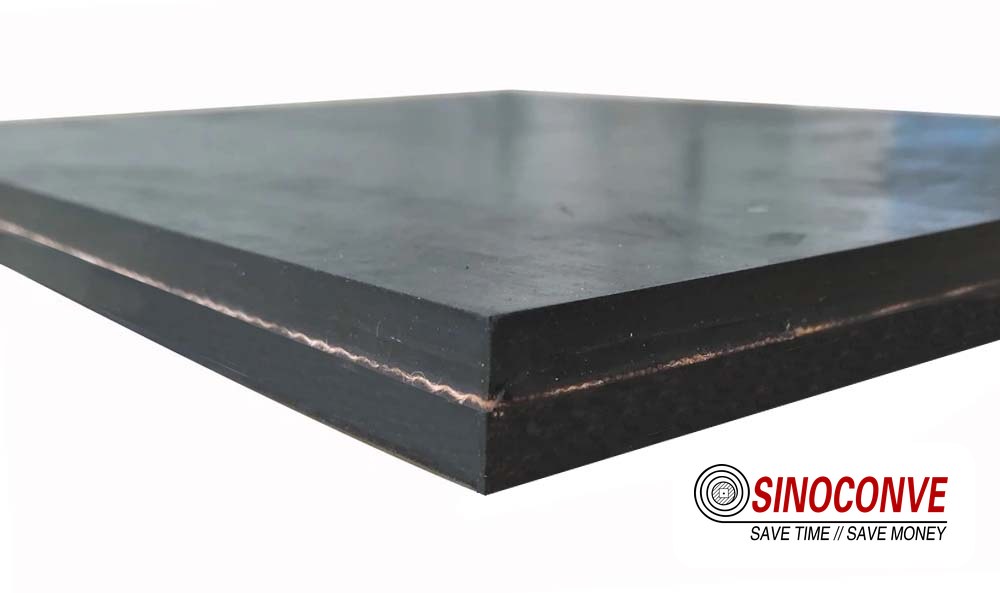
Think of the belt as two products bolted together. The carcass carries tension and resists impact. The cover carries chemistry, abrasion and cleaning. Most over-specified fertilizer belts are over-specified in the wrong half: buyers raise the ply count when the real problem is a 4 mm top cover being scrubbed twice a day by a high-pressure hose.
Our default position on a chemical or fertilizer line is simple. Keep the carcass at the conservative rating the duty actually needs, and move the budget into the cover and the joint. A belt with two extra plies costs more per meter and adds weight to every idler it touches, and it will still fail early under a hose if the cover cannot take it.
| Layer | What It Handles | Typical Specification Basis | What We Ask For in Writing |
|---|---|---|---|
| Top cover | Cargo contact, abrasion, wash-down | DIN 22102 cover grade, DIN 53516 abrasion loss | Thickness to the nearest 0.5 mm and a stated volume loss |
| Bottom cover | Scraper contact, idler face, friction drive | Same grade family, thinner gauge | 1.5-2 mm minimum, more only where scrapers are aggressive |
| Fabric plies | Tension and impact resistance | EP or NN fabric, DIN 22102 or ISO 340 for fire behavior | Ply count from the tension calculation, not from habit |
| Interlayer adhesion | Resistance to ply separation under impact | Adhesion values quoted against DIN 22102 | A number in N/mm, tested on the delivered batch |
| Impact or breaker layer | Lump impact under the chute | Project-specific, no single universal standard | Only at the loading zone, not for the whole run |
| Edge construction | Skirt contact and tracking | Built to the same carcass class | Cut or molded edge stated on the drawing |
Compound chemistry, in one line
The polymer and additive selection behind these covers is a subject on its own, and we keep that discussion in our guide to chemical resistant conveyor belts. What matters here is that whatever you choose has to be written into the purchase order as a measurable property, not a trade name. A general-purpose rubber conveyor belt in the right cover grade will outperform a premium belt in the wrong one on this kind of duty. The grade ladder itself, and how the numbers are published, is explained in our notes on rubber conveyor belt cover grades.
07Component Combination: Rollers, Skirt, Chute and Cleaning
A belt does not fail by itself. It fails in combination with the parts around it, and on chemical lines the combinations repeat. We keep a matrix of the pairings we see work and the pairings we see destroy belts early. The matrix is not a catalogue. It is a checklist for the mechanical scope that has to be bought at the same time as the belt.
Start with the loading point, because that is where the harshest combination sits. Steep chute angle plus a short drop plus hard lumps plus a skirt rubber set too tight is the classic four-part recipe for edge damage. Change any one of the four and the damage rate changes.
| Component | Pair With | Common Mistake |
|---|---|---|
| Carrying idlers | Trough angle matched to cargo flow, 1.0-1.2 m spacing | Wide spacing to save cost, then center sag and spillage |
| Impact idlers or bars | Directly under the chute, 300 mm centers | Fitting them along the whole conveyor |
| Skirt rubber and liners | 15-20 mm gap, taper at the tail, polymer liner | Pressing the rubber onto the belt to stop spillage |
| Chute and drop height | Drop at or under 600 mm, angle steep enough to self-clear | Leaving a 1.2 m free fall because the structure is already built |
| Primary scraper | Polyurethane blade, pressure just enough to touch | Over-tensioned blade that wears the bottom cover out |
| Return rollers | Disc or spiral pattern in the sticky zone | Plain rollers that the material wraps around |
Field note from our engineers: A blending plant asked us to quote a thicker belt for a transfer that kept tearing along the left edge. We measured instead. The chute was discharging 200 mm off center, so the skirt rubber was pinching the edge on every revolution. Re-centering the chute and re-setting the skirt gap to 18 mm solved it. The original 8 mm cover belt is still running, roughly 30 months later.
Do not forget the drive side of the scope
The same maintenance team owns the feeder drives and the coating drum drive. Where those are belt-driven, the specification should come from the same drawing set as the conveyor scope, and we quote both, since we are a transmission belt manufacturer as well as a belt supplier. It saves a second purchase order and it keeps the spare-parts shelf coherent. Being a V-belt manufacturer as well means profile and length questions on the drive side can be answered from the same shaft drawing that fixes the conveyor pulley.
08Belt Type by Zone: Flat, Chevron, Cleated or Sidewall
Most of a fertilizer plant should run flat belt. That statement surprises people who have seen chevron belts sold as a cure for everything, so let us be blunt about the trade. A patterned surface buys you incline capability, and it costs you cleanability. On a line where the cargo is hygroscopic and the wash-down is routine, that trade is usually a bad one. Take the incline with a longer conveyor or a smaller lift, and keep the surface smooth.
There are cases where the geometry leaves no choice. A bagging hall with 4 m of headroom cannot fit a 20-degree incline in flat belt without eating the operator walkway. There, a sidewall construction earns its place, and we specify it deliberately, with a scraper arrangement that can still reach the belt surface.
| Zone | Belt Construction | Cover Grade | Surface | Reason |
|---|---|---|---|---|
| Feed and reclaim | EP fabric, extra top cover | Wear grade | Smooth | Impact, lumps, easy scraping |
| Inclines above 18 degrees | Chevron or cleated top | Wear grade with a flexible pattern | Patterned | Roll-back control when flat belt slips |
| Cramped vertical lift | Corrugated sidewall with cleats | Wear or moisture tolerant | Flights and walls | Raises material without spillage in a small footprint |
| Transfer and screening | EP fabric, standard build | Wear grade, anti-static where dust is present | Smooth | Dust control and tracking stability |
| Packing and bagging | Light fabric construction, thin cover | Light or white, moisture tolerant | Smooth, low release | Hygiene, quick grade changeover |
| Weigh feeder discharge | Short center, tight tolerance | Light grade, low stretch | Smooth | Mass-flow stability, no pattern pockets |
The patterned-belt trap
Chevron and cleated belts hold material that flat belt would not. They also hold cleaning water, trap fines between the ribs, and make a scraper almost useless. If your cargo cakes, a patterned surface gives the cake somewhere to live, and you will be removing it by hand. Where the mechanical reason for a pattern is gone, go back to flat, and if you do need a pattern, our notes on chevron conveyor belts on inclines cover how to run them without wrecking tracking.
Choosing a supplier for a mixed belt schedule
Few chemical plants buy one belt. They buy a mixing of flat run belts, one or two patterned sections, and a couple of light belts at the bagging end. Buying that mix from one source keeps thickness conventions, splice methods and cover grades consistent across the site. We hold the stock position of a conveyor belt supplier for exactly this reason, and where a plant needs several surface types in the same schedule, our role as a conveyor belt distributor for patterned products covers the sections that a flat-belt catalogue cannot.
09Contamination Control Between Product Grades
Grade changeover is where a plant loses money quietly. A 200 kg carryover of an ammonium sulphate run into a urea run is not a safety event, but it is an off-spec batch, and the customer complaint lands on the production manager. Traceable contamination almost never comes from the belt surface alone. It comes from the places material is allowed to sit.
| Residue Location | Why It Holds Material | Cleaning Means | Verification |
|---|---|---|---|
| Skirt zone along the load point | Material lodged between rubber and belt | Lift skirt, vacuum, wipe with damp cloth | White cloth wipe after two empty belt revolutions |
| Chute pockets and dead corners | Angles below the material repose angle | Air lance, re-angle the plate to 60 degrees or steeper | Inspect by opening the access door, not by looking through it |
| Return strand and roller faces | Carryback drops onto the return and sticks | Scraper plus rinse, disc return rollers | Weigh the material swept from one 10 m run |
| Belt surface texture | Fibrous residue in a worn or patterned cover | Replace the cover at the wear limit, avoid patterns here | Color comparison against a clean reference sample |
| Bagging chutes and scale hoppers | Fine fraction settles at each stop | Flush with the incoming grade, then empty | First 50 kg of the new run goes to a retest bin |
Light covers and visual control
Visual control needs contrast, so on plants running white or pale products we specify a light cover. It shows contamination immediately. There is a practical limit, though, and the honest trade-off between a white surface and cleaning chemistry is set out in our buyer notes on the white rubber conveyor belt. When a site runs several surface types across one schedule, the fastest way to keep the spares list straight is a single wholesale conveyor belts schedule agreed at purchase rather than ordered piecemeal.
10Cleaning Regime for Fertilizer and Chemical Lines
The cleaning regime is a design input, not a maintenance afterthought. It decides the cover compound, the bottom cover thickness, the scraper type, the floor slope and the drainage. Get the regime agreed before the belt is ordered, and the purchase order becomes one document instead of three conflicting ones.
What follows is deliberately at the level of the procurement table. Which method to use on which residue, and when a scraper is the wrong answer, is a subject we have covered separately, and we point to that material at the end of this section.
| Zone | Method | Frequency | Rinse Chemistry | Compatible Belt Requirement |
|---|---|---|---|---|
| Feed and reclaim | Dry scrape, occasional hose | Weekly | Water only, pH 6-8 | Wear grade with a water-tolerant compound |
| Transfer and screening | Dry, air lance in the chute | Each shift | None, keep the section dry | Anti-static, dust-tolerant cover |
| Bagging hall | Low-pressure spray and manual wipe | End of each grade | Mild alkaline detergent, under 1% active | Light cover, no fabric exposed at the edges |
| Cooler discharge | Dry brush, no water | Daily check | None, thermal shock risk from cold water | Heat-rated compound that tolerates brushing |
| Chloride service anywhere | Rinse then dry, never leave standing water | After every wash | Fresh water, no recycled rinse | Compound rated for repeated wet-dry cycling |
| Oily or coated product | Solvent-free alkaline wash, warm | Two or three times per week | Warm water up to 50 °C with detergent | Oil-tolerant cover, no swelling in service |
Write the chemistry list into the purchase order
Name every chemical the belt will meet, including the cleaning agents and any coating or anti-caking additive applied to the product. Suppliers cannot design for a chemistry they were not told about, and the cleaning agent is usually the aggressive one. A regime built around scrapers and standard practice is set out in our guide to conveyor belt cleaning methods and schedules, and where a plant wants fixed equipment instead of a labour routine, the equipment side is discussed in our note on conveyor belt cleaners.
11Dust, Damp and Explosive-Atmosphere Risk
Fertilizer dust is not harmless. Fine fractions of nitrate-based and urea products burn, and in an enclosed gallery a settled layer can be lifted into a cloud by a single shock. This is a hazard review question, and the belt is one line item in it rather than the whole answer. Still, there are belt properties that belong in the decision.
| Risk Source | Decision Basis | Mitigation |
|---|---|---|
| Settled dust in enclosed galleries | Layer depth and dust clouding risk from the site hazard study | Extraction, no ledges, no horizontal surfaces, scheduled wash-down |
| Static discharge from a moving belt | Ignition sensitivity of the specific dust, not a generic assumption | Anti-static cover and carcass, earthing of frames and pulleys |
| Oxidizer storage adjacent to the conveyor | Separation distances and housekeeping rules from the site assessment | Segregation, isolated drives, no combustible build-up beneath the line |
| Damp cargo held over a shutdown | Standing time and enclosure humidity | Empty and dry the line before every stop, ventilate the gallery |
| Hot surface near a dust layer | Surface temperature limits set by the site, not by the belt supplier | Guard hot equipment, keep the gallery clean rather than relying on covers |
What the belt supplier can and cannot sign
We can supply a belt with a documented anti-static surface property and fire-behavior data measured to ISO 340 or, where the market requires it, to a national scheme such as EN 12882 or MSHA 30 CFR Part 14. We cannot certify that a plant is safe, because that depends on dust layers, extraction and housekeeping that we do not control. Buyers who ask a belt supplier to sign the whole hazard case are asking the wrong company. The belt-side options for dusty service, including how they are tested, are set out in our notes on the dust resistant conveyor belt, and the constructions are made at our own conveyor belt factory rather than sourced through traders.

12Splicing and Joint Integrity in Chemical Service
The joint is where the belt stops being a manufactured product and becomes a field assembly. That is also where most of our warranty conversations start. In chemical service the joint has three jobs at once: hold tension, resist the same moisture and chemistry as the cover, and survive every wash-down cycle the plant throws at it.
Count the number of times a joint on a wet line gets soaked and then dried. On a plant washing twice a day, an endless belt passes through a full wet-dry cycle every working day, and any moisture that has crept into an open splice ply keeps working at the fabric interface from the inside. That is why we push vulcanized joints on these lines and treat mechanical fasteners as an emergency device.
| Joint Method | Suitable Zones | Strength Basis | Procurement Note |
|---|---|---|---|
| Hot vulcanized step splice | Every permanent position, all zones | Typically quoted at 60-75% of the belt's breaking strength | Splice rubber must carry the same grade and temperature rating |
| Finger splice | Thin and light belts, bagging sections | Similar range, better distribution on short splices | Requires a jig and a press that fits the width |
| Mechanical fastener | Emergency repair and temporary runs | Commonly quoted at 30-50% of breaking strength | Use corrosion-resistant plates, remove before the next wash cycle if possible |
| Cold bonded splice | Where a press cannot reach, only with the supplier's approval | Lower and more variable, sensitive to cure conditions | Ask for the cure schedule in writing and record humidity |
What to put in the purchase order
State the splice method, the number of splices, the cure temperature and the pressure, plus who owns the press and the jig. Buyers who leave splicing out of the belt order end up negotiating it during the shutdown. Our own verification list for joints is in the conveyor belt splicing buyer checklist, and the choice between a vulcanized and a fastened joint is compared directly in splice versus mechanical fastener.
13Support and Structure Under Corrosive Exposure
The belt is the part everyone watches. The structure underneath it decides whether the belt survives. On a chloride-exposed line, a rusted take-up frame will pull the belt out of alignment, and a seized idler will scrub a flat spot into the cover, long before the cover itself wears out.
| Element | Corrosive Exposure | Recommended Grade | Service Interval |
|---|---|---|---|
| Carrying idlers | Damp product film, chloride | Sealed polymer-end rollers, 1.0-1.2 m pitch | Rotate and inspect every 2,000 hours |
| Return rollers | Carryback build-up, standing water | Disc or spiral type, 2.5-3.0 m pitch | Clean every shift in the sticky zone |
| Conveyor frame | Condensation and splash | Hot-dip galvanized stringers, drainage holes at the low points | Touch-up coating annually |
| Fasteners and brackets | Chloride pitting under paint | 316 stainless in the wet zones, 304 elsewhere | Sample a fastener every quarter |
| Pulleys and lagging | Wet drive contact, slip | Coated or rubber-lagged shell, crowned face | Check lagging wear each year |
| Take-up assembly | Frozen threads, blocked travel | Stainless screw, greased and protected | Free the travel every shutdown |
Specify the structure with the belt
As a conveyor belt manufacturer we see the consequence of splitting these scopes: a good belt supplied against a frame that was never designed for the moisture in the gallery. Roller selection under damp and dusty conditions, including the sealing detail that decides service life, is treated in our corrosion resistant conveyor roller notes, and the wider load-matching logic is in our conveyor roller types and load ratings guide.
14Procurement Acceptance Clauses
This is the section most buyers copy straight into a tender. A clause only has value if it names a metric, a measurement basis and a document. "High quality rubber cover" is not a clause. "Top cover thickness 6.0 mm, plus or minus 0.5 mm, measured at five points per 20 m length" is a clause. Add the test method and the paper trail and the argument at delivery disappears.
| Clause | Metric | Measurement Basis | Required Document |
|---|---|---|---|
| Cover thickness | Nominal plus or minus 0.5 mm | Five points per 20 m, both faces | Dimensional record signed by the inspector |
| Abrasion resistance | Volume loss stated in mm³ | DIN 53516 on a cover sample | Test report from the batch, not a catalogue value |
| Tensile strength | Minimum N/mm for the declared class | DIN 22102 class or ISO 583 tensile method | Mill test certificate per production lot |
| Interlayer adhesion | N/mm between plies and to the cover | Values referenced to DIN 22102 | Adhesion test sheet |
| Heat ageing | Retained tensile strength, target at least 80% | Air oven, 72 hours at 100 °C, per ASTM D573 | Ageing report for heat-rated constructions |
| Fire and static behavior | Pass or fail against the declared class | ISO 340, plus surface resistance for anti-static builds | Certificates from an accredited laboratory |
| Splice performance | Splice strength as a percentage of belt strength | Destructive test on a production splice sample | Splice record with cure temperature and time |
| Traceability | Batch code on every roll | Readable marking, matched to the certificate | Packing list linking roll numbers to test lots |
Do not accept a catalogue as a certificate
The single most common documentation failure we see is a data sheet presented as a test report. A data sheet describes what a construction can do. A test report describes what this batch did. Ask for the second one, dated, with the batch code printed on it. Buyers who want a wider checklist of what to insist on, in a related oil-contact service, can read our oil resistant conveyor belt buying check.
Commercial terms worth writing down
Lead times, minimum order quantities and warranty periods on industrial belts are quoted as industry ranges and vary with construction and width. Confirm them against the actual duty and drawing before you sign, and get the splice work, packing method and roll core size included rather than assumed. Delivery, warranty and product documentation questions are answered on our FAQ page.
15Incoming Inspection and Documentation
Inspection at the gate takes about 20 minutes per roll and settles most disputes before the belt reaches the structure. Do it in daylight, on a flat surface, with the roll still banded. Once a roll is opened on the frame, nobody can prove whose knife made the mark.
| Inspection Item | Gauge or Tool | Acceptance Criterion |
|---|---|---|
| Cover thickness | Depth gauge or caliper on the cut edge | Within the stated tolerance at all sampled points |
| Overall thickness and width | Measuring tape on a flat floor | Width within 1% of nominal, thickness within tolerance |
| Cover hardness | Durometer, Shore A | Within 5 points of the quoted figure |
| Edge condition | Visual, full circumference | No exposed fabric, no crushed edge, no knife chatter marks |
| Roll core and packing | Visual plus lifting check | Core sound, no water staining, no mould odor |
| Splice sample or prepared ends | Visual and measurement | Step lengths match the agreed drawing |
| Documentation set | Checklist against the purchase order | Batch-linked certificates present, dates current, roll numbers matched |
16Cost Across the Replacement Cycle
Belt price per meter is the smallest number in the decision, and it is the one most buyers negotiate hardest. The full cycle includes the belt, the splice work, the hours the line is down while the splice cures, and the cost of the cleaning labor that the cover grade decides. On a plant washing twice a day, cleaning labor can exceed the belt cost over a three-year cycle.
| Cost Element | Main Driver | How It Is Usually Quoted | Reduction Lever |
|---|---|---|---|
| Belt purchase | Width, construction, cover grade | Per meter, varies with construction | Buy the correct grade once instead of an over-built first attempt |
| Splice work | Number of joints, width, method | Per joint, plus press time | Reduce the joint count by using longer rolls where handling allows |
| Production loss | Hours down times plant value per hour | Site-specific, ask finance for the number | Planned changeout in a shutdown instead of a breakdown |
| Cleaning labor | Cover adhesion, surface finish, drainage | Minutes per shift, booked as overtime in many plants | Low-adhesion cover plus one well-set scraper |
| Wash consumables | Water, detergent, wastewater load | Per cycle, rarely tracked separately | Cut carryback at the source; less material means less washing |
| Idler and roller replacement | Corrosion rate, sealing quality | Per piece, often by annual contract | Better sealing and galvanized frames, not more spares |
The abrasive question in a chemical plant
Fertilizer granules are not stone, so abrasion is rarely the top failure mode. It still matters at the loading point, where lumps arrive with velocity, and the selection logic for hard material is treated in our abrasion resistant conveyor belts guide. Plants that run their own maintenance crews tend to budget the same way as heavy industry, which is why the thinking in belt supply for cement plants applies more closely than the cargo difference suggests.

17Frequently Asked Questions
What belt construction suits a fertilizer bulk line?
For the main run, an EP fabric carcass with a 6 mm wear-grade top cover and a 2 mm bottom cover covers most granular fertilizer duties. Patterned or sidewall constructions belong only where the geometry forces them.
Why does caking matter more than tensile strength here?
Because the belt almost never breaks from tension on this cargo. It fails from material sticking to the surface, clogging the return and wearing the edges. Tensile strength is set by the load calculation, and after that the money belongs in the cover.
How do I handle a line that loads at 65 °C?
Specify a heat-resistant compound rated for continuous service in the 60-80 °C band with short-term capability near 120 °C, and confirm it with a 72-hour ageing test at 100 °C. Then check the splice rubber, because that is usually where the temperature limit actually sits. If the cargo also carries moisture, keep the bottom cover intact so the carcass never sees the heat.
Which cover compound resists both urea and wash-down water?
There is no single answer, and any supplier who gives you one without asking about your rinse chemistry is guessing. What you can do is state both the cargo and the detergent in the purchase order and require a compound tested for wet-dry cycling.
Do I need different belts in the feed and packing zones?
Yes, in most plants. The feed zone needs impact resistance and a heavier top cover. The packing floor needs a light, easy-release surface that can be wiped between grades, and it will be damaged rather than helped by heavy construction.
How often should a chemical line be washed?
Base the frequency on the residue, not on the calendar. A bagging hall changing grades daily needs a wash at each change, while a dry transfer tower may never need water at all. Adding water to a dry section creates the caking problem you were trying to avoid.
What corrosion path is usually missed on a plant audit?
Condensation inside an enclosed gallery. Teams check the outside of the frame and the cargo contact points, then walk past the top of the return strand, which is where the drips land. Fit extraction and the same steel lasts three times as long.
Can I use one belt grade across the whole process?
Rarely. Three specifications is the usual number on a fertilizer plant: a wear-grade belt for feed and transfer, a heat-rated belt behind the dryer, and a light easy-release belt at bagging. One grade everywhere is either over-built at the packing floor or under-built at the discharge chute.
What acceptance clauses should a chemical buyer insist on?
Cover thickness with a stated tolerance, abrasion loss in mm³ to DIN 53516, interlayer adhesion in N/mm, retained tensile strength after oven ageing, splice strength as a percentage of belt strength, and batch traceability on every roll. Ask for each of those to be supported by a test report tied to the production lot rather than by a catalogue sheet.
How do I trace a contamination problem between grades?
Wipe the belt, the chute walls and the roller faces with a white cloth after two empty revolutions, and weigh the material you sweep from a fixed 10 m length of return strand. Repeat in the same places for a week and the source will show itself. In our experience it is usually a chute pocket or the skirt zone, not the belt cover.
Is a chevron belt ever the right answer here?
Only when the geometry leaves you no alternative. If the incline exceeds roughly 18 degrees and there is no room to lengthen the conveyor, a patterned belt is legitimate. Where the cargo cakes, expect to trade cleanability for that incline capability, and plan the cleaning routine accordingly.
What documents should arrive with the belt batch?
A mill test certificate for the production lot, cover compound and abrasion test reports, the ageing report if the belt is heat-rated, fire and static certificates where the plant requires them, a packing list matching roll numbers to lots, and the splice record including cure temperature and time.
18Closing Notes From Our Engineering Team
Most of the fertilizer and chemical belts that fail early were bought on a price per meter and installed into a process nobody had mapped. Map the zones first, register the cargo properties, write the acceptance clauses, and the belt becomes a boring purchase that lasts. We have been building belts in Ningbo for this kind of duty for decades, and the questions we ask before quoting have not changed much: what is the material, how wet does it get, how hot is it, and who cleans what, how often.
If you want a second opinion on a specific zone, send us the material, the tonnage, the incline and the temperature band, and we will come back with a construction and a cover recommendation rather than a catalogue page.
Related Products You May Need
- EP rubber conveyor belt for feed and transfer duty — fabric carcass for granular fertilizer service.
- Wear-grade rubber belt with a low-adhesion cover for sticky, hygroscopic cargo.
- Chevron belt for inclined transfer sections in tight plant layouts.
- PVC belt for the light bagging floor lines where hygiene and changeover speed decide.
- Full product catalog — constructions, grades and widths in one place.
Related Blog Posts
- Chemical resistant conveyor belts
- Compound selection for fertiliser and chemical plants
- Rubber conveyor belt cover grades
- Heat resistant conveyor belt specification table
- Oil resistant conveyor belts
- White rubber conveyor belt buying notes
- Dust resistant conveyor belt supply
- Cleaning methods and schedules for conveyor belts
- Conveyor belt splicing buyer checklist
- Cement conveyor belt selection