
A rice mill is not a grain silo with a milling machine bolted onto the side of it. The material changes four times between the intake pit and the bag sealer, and every change rewrites what the belt underneath has to survive. Paddy arrives rough, damp and full of field dust. Husked brown rice arrives fragile, with a kernel that will crack after a short free fall onto a hard surface. Polished white rice arrives clean enough that one rust streak or one shred of belt edge turns into a rejected container. We have walked through mills where the same specification was ordered for all five floors. The paperwork looked tidy. The polishing floor still changed belts twice a year.
That is the reason we stopped quoting a single rice mill conveyor belt for a whole plant. A mill is a sequence of small, hostile environments stacked in one building, and the belt that wins in the husk line usually loses in the packing room. This article explains how we split the line, what we ask buyers to measure before they order, and where our knowledge stops.

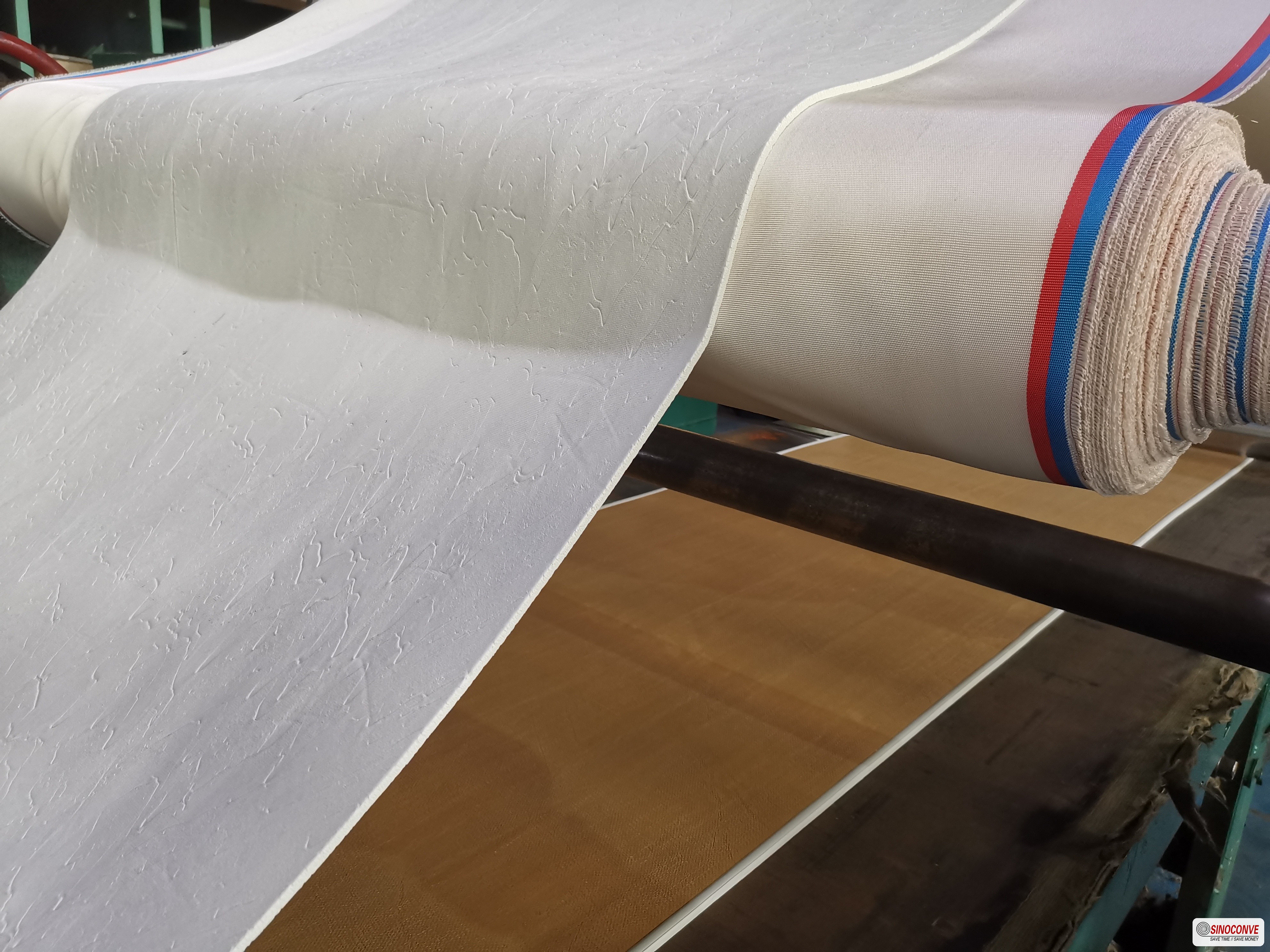
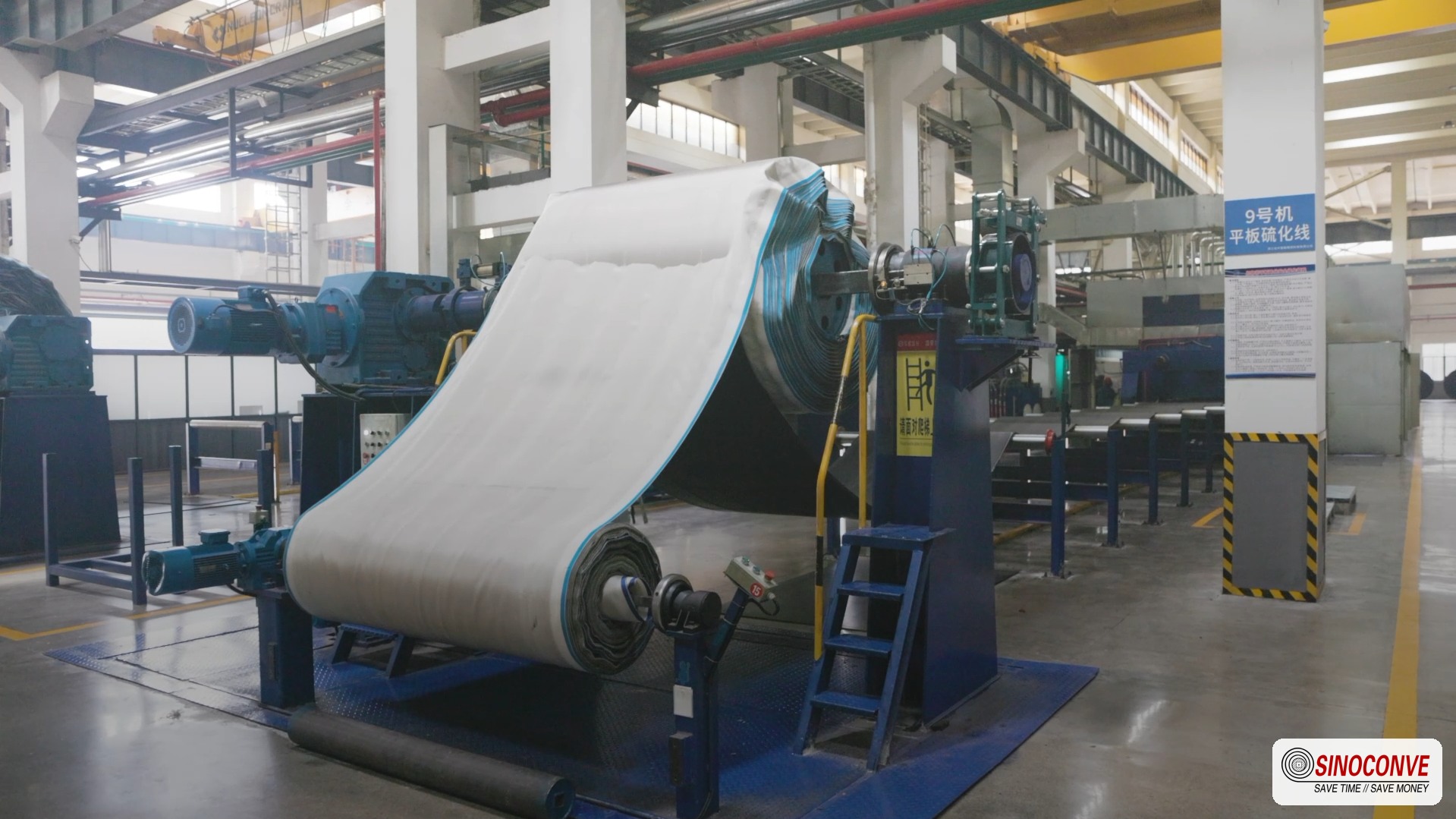
White-surfaced belting on a polished-rice transfer section, photographed before the packing feed.
01Why One Belt Cannot Serve Every Rice-Mill Zone
Start with the material, not with the belt catalogue. Paddy at the intake still carries straw, mud, small stones and the silica-rich husk that will be released two floors later. Brown rice, once the husk is off, is a soft kernel inside a thin bran layer. It dents under a point load and cracks when it lands badly. White rice after polishing has had that bran layer removed, so the surface is starch, and starch marks easily. Three materials, three different failure paths, and only one of them is about wear.
The husk side of the mill is an abrasion problem with a dust problem attached. Husk fragments are sharp at a scale you cannot see, and they pack into every gap that is not sealed. We opened a husker discharge conveyor after eight months and found the idler face coated in grey paste. That paste does not wear the cover evenly; it builds a crown in the middle and pulls the edges down against the structure.
The white rice side is a cleanliness problem with a tracking problem attached. Belts there run 400 to 600 mm wide and fast enough that a 3 mm wander shows. They also run empty part of the time, which is when a poor splice starts to hunt.
The five zones and what each one does to a belt
Table 1 is the version we sketch on a whiteboard during the first site visit. It is not a specification. It stops a buyer from averaging five incompatible duties into one purchase order, and it shows why the second and fifth zones fail when a mill orders one belt type everywhere.
| Process zone inside the rice mill building | What the belt surface actually sees in service | Failure mode that we find first on site | Selection emphasis that matters for that zone |
|---|---|---|---|
| Paddy intake, cleaning and stone removal stage | Wet field soil, straw fragments and small stones arrive together | Cover gouging and edge tearing at the loading point | Thicker abrasion-resistant cover with a sealed edge build |
| Husker discharge and husk collection conveyor | Airborne sharp husk powder that settles into every open gap | Idler seizure and belt mistracking from a crowned face | Dust-tolerant construction and a static-dissipating path to ground |
| Brown rice separation and kernel grading stage | Fragile kernels dropped from short heights onto a moving surface | Broken grain counted at the discharge and splice impact marks | Softer cover, flush splice and generous pulley diameters |
| Polishing and finished white rice transfer stage | Clean starch dust, water mist and residual polishing agent | Grey and yellow surface marks that cannot be washed away | Non-marking white surface with closed, low-porosity finish |
| Color sorter feed and packing infeed belts | Narrow, fast, frequently stopped and restarted product streams | Edge fray, guide wear and product left in the cleat roots | Precise width tolerance, moulded guides and easy cleanout |
Read the table sideways and a pattern appears. Zones two and three lose money quietly, because a seized idler or a cracked kernel does not stop the line, it only reduces yield until someone weighs the output. The last two zones lose money loudly, because a marked bag reaches a customer.
02Where This Article Stops and the Grain-Elevator Guide Begins
We already publish a long guide to the grain elevator conveyor belt, and that page owns a different territory: the intake pit at harvest, the dryer infeed and outfeed, silo filling, bin cleanout, and the loadout spout that fills a truck or a rail wagon. Those duties are about volume, heat and long centres. This page does not repeat them.
The line we describe here begins at the paddy shed inside the mill fence and ends at the bag sealer. In sequence: paddy receiving and pre-cleaning, destoning, husking, paddy separation, brown rice grading, the first and second whitening passes, water misting, color sorting, the finished rice bin, the bagging scale, metal detection and bag closing. Everything upstream of the paddy shed belongs to the elevator guide. Everything downstream of the sealed bag belongs to warehouse handling, a third conversation.
Why draw the line so sharply? Because the numbers move by an order of magnitude when you cross it. A silo filling conveyor may run 120 m between centres at 200 t/h with a 1,000 mm belt. A color sorter feed belt runs 3 m at 6 t/h, is 400 mm wide, and is judged on whether it cleans in fifteen minutes. Same industry, opposite engineering.
A zone-by-zone division of labour between the two guides
Table 2 is the boundary in tabular form. Buyers who are assembling a full mill package often print both pages and mark the overlap, which is usually the paddy shed. That shed is the only place where the two documents touch, and even there the duty splits cleanly: reception and drying on one side, mill feed on the other.
| Stage in the overall grain handling chain | Which document covers the belt duty | Why the duty is engineered differently |
|---|---|---|
| Harvest reception pit and pre-cleaning shed | Grain elevator guide, because the load is bulk and seasonal | Very high tonnage with wet, straw-laden material and shock loading |
| Grain dryer infeed and discharge conveyors | Grain elevator guide, because heat dominates the selection | Warm, moist grain demands heat-tolerant covers and thermal growth allowance |
| Silo filling, aeration floor and bin cleanout | Grain elevator guide, because centres are long and access is poor | Long spans, deep troughs and belt tensions set by sag rather than load |
| Truck and rail wagon loadout spouts | Grain elevator guide, because impact and reach define the design | Free fall over a vehicle body plus dust control at the spout mouth |
| Husking, separation and brown rice grading | This article, because kernel integrity outranks tonnage here | Short centres, soft product and a hard limit on broken grain |
| Polishing, color sorting and packing feed | This article, because surface cleanliness becomes the driver | Narrow belts, frequent washdown and visible marks on a white product |
If you are planning the whole site rather than one mill building, the industries overview groups our line concepts by material, and the agriculture handling page sits closest to the paddy reception and grain processing end of this work.
Field note from our engineers: On a 240 t/day mill in Anhui we measured 41 °C and 78 percent relative humidity on the husk floor at 3 pm, and 26 °C in the packing room forty metres away. The two areas had been specified with the same belt. The husk floor belt was glazed and slipping within a season; the packing belt was still serviceable. Nothing was wrong with either belt. The specification had been written for a climate that did not exist on that floor.
03Husk Removal: Abrasion, Dust and Static Paths
Husk is roughly one fifth of the paddy by weight, and almost all of it leaves the process in one short section of the mill. That concentration is what makes the husk floor different from every other floor. The material is light, it flows like a liquid when aerated, and it is abrasive in a way that wheat or maize never is. A husk fragment is a thin silica plate with a sharp edge, and thousands of them pass a fixed point every second.
We specify the husk line like a light quarry duty, not a food line. That sounds like a contradiction in a rice mill, and it is exactly the point of this article. A rubber conveyor belt with a 5 mm abrasion-resistant cover usually outlasts a thin thermoplastic belt on husker discharge by a wide margin, even though the thermoplastic belt is easier to clean. Buyers who start from hygiene and work backwards replace that belt three times before accepting the trade-off.
Where the abrasive load actually lands
Look at the discharge chute of a husker, not at the middle of the conveyor. The stream leaves the chute at maybe 2 m/s, hits the belt in a narrow band, and spreads within half a metre. If the chute is centred and the belt is 800 mm wide, the wear strip is often only 250 mm across. That is why a belt can look new at the edges and be worn through the carcass in the middle. We ask for a photograph of the belt after the first 500 hours, because the wear pattern says more about the chute than any drawing.
Three corrections fix most of these lines. First, a skirt rubber that guides the stream without touching the belt, with 15 to 20 mm clearance and a flexible lip. Second, an impact zone with closer idler spacing, 300 mm instead of the usual 1,000 to 1,200 mm, so the belt is supported where the stream lands. Third, a cover grade chosen for volume loss rather than for tensile strength. Tensile strength comes from the carcass; surface survival comes from the cover compound, and the two are quoted separately for a reason.
Dust, static and the tracking path
Husk dust does two things that surprise maintenance teams. It bridges, and it insulates. Bridging means the powder arches across a gap instead of falling through it, so a "sealed" idler becomes a solid block of husk within weeks. Insulating means the frame no longer drains charge away from a dry, fast-moving belt. In a closed husk gallery at 35 °C we have watched a belt hold enough charge to lift dust off the floor and carry it to the next transfer point.
Grounding is a maintenance item, not a purchase item. Bond the frame to the plant earth, check the resistance at commissioning, and re-check after any structural work. Where the buyer asks for a static-dissipating belt, we supply one and ask them to confirm the earthing path separately, because a dissipating belt with an isolated frame achieves nothing. We do not quote explosion or classification figures for a mill we have not surveyed. Those belong to the plant's own risk assessment.
Tracking problems on this floor almost always trace back to build-up rather than to belt geometry. Husk packs the pulley face, the pulley effectively becomes crowned, and the belt climbs. A dust-resistant conveyor belt supplier can give you a cover that releases dust, but the pulley still needs a scraper and an inspection window. We would rather sell one belt with a clean pulley than three belts with a dirty one. As a conveyor belt manufacturer we can only control half of that equation, and we say so at the quotation stage.
04Brown Rice Transfer Without Cracking the Kernel
Brown rice is the most fragile material in the building, and it spends more time on belts than any other grade. The bran layer holds the kernel together, but it also lubricates the surface, so grain slides and tumbles instead of settling. Every transfer is a small drop test. A kernel that lands flat survives. A kernel that lands on its end at 400 mm usually does not.
We start with the drop height and work back towards the belt. On a grading line, reducing a 600 mm chute drop to 250 mm with a sloped dead-box or a short inclined slide often removes more broken grain than any change to the belt itself. Belting is the second lever; geometry is the first. Buyers who expect a new belt to fix a badly designed transfer point are buying the wrong thing.
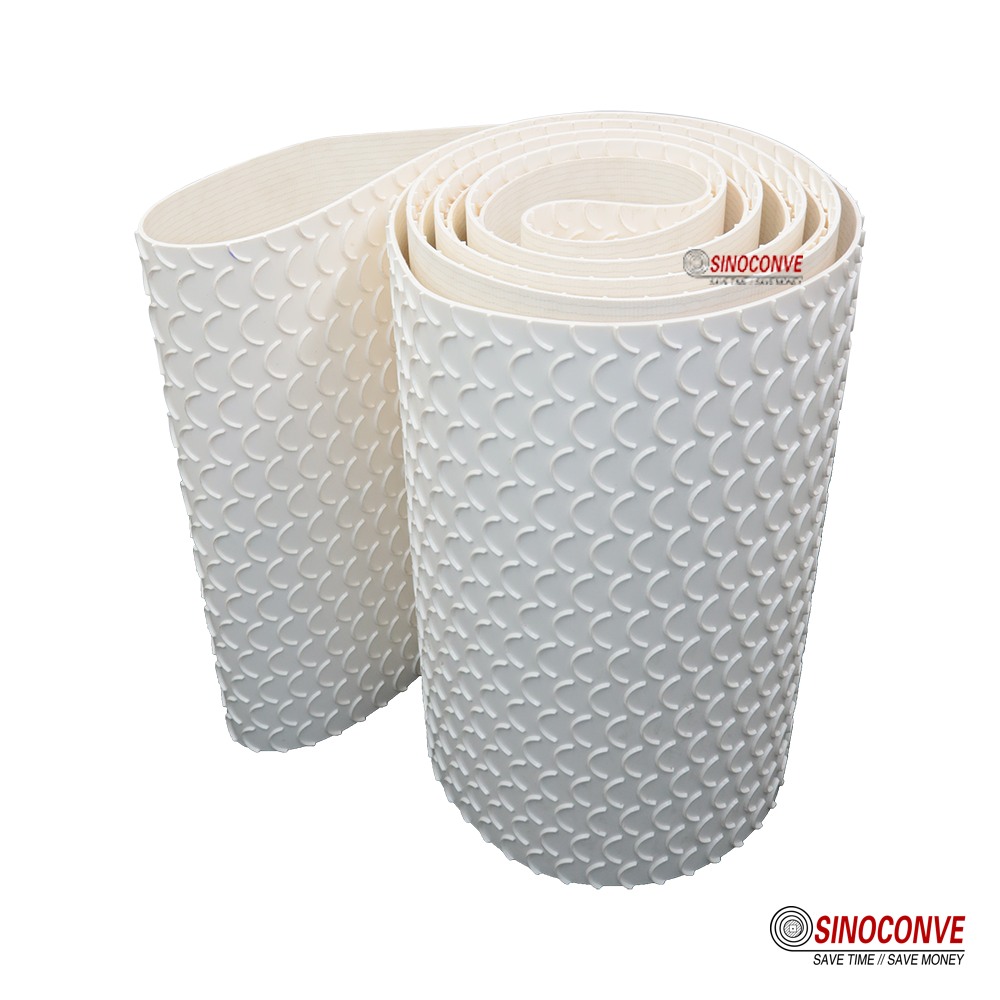
Surface texture and edge build on a white PVC belt, inspected before a grain transfer section is assembled.
Drop points, skirt rubber and cover hardness
A cover in the 55 to 65 Shore A range absorbs the landing without gripping the grain. Harder covers last longer on abrasive duty and transmit more impact into the kernel, which is why we do not use the husk-line cover on a grading conveyor. The difference is measurable: on one 12 t/h grading line, a change from 70 Shore A to 60 Shore A at the same drop height moved the broken-grain reading from a visible scatter to occasional singles. One line, one afternoon, not a guarantee, but the physics points that way.
Skirt rubber should guide, not pinch. A common mistake is to set the skirt hard against the belt to stop spillage. The grain then travels through a narrow throat, and the belt wears a groove along both edges within months. We prefer a 15 mm gap, a flexible lip and a slight outward flare, accepting a small amount of spill that a dribble tray catches.
Splice steps and pulley diameter
The splice is where broken grain concentrates. A finger splice with a step of 0.3 mm or less passes under a kernel without lifting it. A step of 1 mm acts as a small ramp, and at 1.2 m/s that ramp flicks grain instead of carrying it. If the belt is mechanically fastened, the plates and exposed bolt heads are impact points, and no cover softening compensates for them.
Pulley diameter matters for the same reason. A thin belt running over a 200 mm tail pulley bends sharply, and the bend cracks the cover at the splice long before the carcass fails. As a rule we keep the tail pulley at 250 mm or more for 3 mm covers and larger for thicker ones. This is also where an industrial conveyor belt carcass choice gets misapplied: a heavy EP carcass rated for a quarry face is stiff enough that it will not conform to a small pulley, and the splice pays for that stiffness. For mill duties we usually want a lighter, more flexible carcass, and we size it on the actual running tension rather than on a headline rating.
Splice method deserves its own decision, and the comparison between a vulcanised joint and a mechanical fastener on short mill conveyors is covered in our note on splice versus mechanical fastener joints. Short centres with frequent starts favour a vulcanised endless joint, and the kernel damage numbers usually agree.
05Polished White Rice: Preventing Yellow Marks and Foreign Particles
After the whitening passes, the rice leaves the machine warm, slightly moist and coated in starch. That combination produces most of the yellow marks we are asked to investigate. The mark is rarely mould; it is usually a transfer from the belt to the grain, or a stain where grain sat against a warm surface during a stoppage.
Three sources cover most cases. First, an exposed fabric edge wicking polishing water and carrying dye or dirt back onto the product. Second, a black or grey cover that has been abraded by a guide, leaving fine rubber powder in the rice. Third, iron or rust particles from a worn frame, a corroded fastener or a bare pulley. A white surface does not prevent any of these, but it makes them visible in time to act.
Surface colour, porosity and the yellow-mark problem
Our default for polished rice and packing feed is a white PVC or white PU belt with a closed surface and sealed edges. Porosity is the number that matters and the one least often quoted. A closed surface releases starch at the scraper; an open, fabric-textured surface holds it, and the held starch turns yellow-brown over a shift. White PVC is the economical choice for straight runs. White PU is the better choice where oil, grease or cleaning chemistry is present, because it resists swelling that would soften a PVC cover.
We do not describe these belts as certified for food contact, and buyers should be suspicious of a supplier who does without asking which market the mill ships into. What we do is select a food-contact-oriented surface, declare the compound family and the colour, and hand over the documents we hold so the buyer can verify them against their own market requirements. If a specific declaration is required, it has to be requested before production, not discovered at the port.
| Surface option we recommend for white rice | Where it usually earns its place | How it behaves in cleaning and marking |
|---|---|---|
| White PVC with a smooth closed cover | Straight polished rice runs and packing infeed belts | Wipes clean quickly and shows contamination early on white |
| White PU with sealed fabric edges | Lines with oil mist, grease or aggressive washdown chemistry | Resists swelling and keeps the cut edge from wicking water |
| White PVC with moulded guide profiles | Narrow sorter feed belts that must hold a straight path | Guides run in machined grooves and avoid edge fraying entirely |
| Anti-static white PVC for dry rice dust | Enclosed transfer points where dust clings to the cover | Releases airborne dust instead of holding it on the surface |
Documents the buyer should request before the order
Ask for the compound data sheet, the colour reference, and a statement of which declarations the factory supports for the destination market. Ask who signs it, and whether it covers the finished belt or only the raw compound. Those are different documents, and the gap between them is where most compliance arguments start. We keep our own test records and can trace a belt to its forming batch, but we will not invent a certificate number for a buyer who needs one by Friday.
Volume buyers often consolidate these belts with other light-duty items. Our wholesale conveyor belts catalogue lists the standard white PVC constructions, and the PVC conveyor belt range gives the thickness and pattern options. For a wider discussion of what a hygiene-minded buyer should check, see our note on food-grade PVC belt checks. The food packaging handling page shows how these belts sit in a packing line.
06Tracking, Splices and Cleanout Between Product Grades
Below the color sorter the belts get narrow and the tolerances get tight. A sorter feed belt is often 300 to 500 mm wide and 2 to 4 m long, presenting grain to the camera in a single even layer. If the belt wanders 5 mm, the layer edges shift and the ejector nozzles fire at shadows. Operators notice a rising reject rate long before anyone looks at the belt.
Narrow belts fail at the edges first. A cut edge that was clean at installation frays within a few hundred hours if it runs against a fixed guide. Once the fabric is exposed, the fray wicks water, stiffens, and starts to steer the belt. We prefer moulded guide profiles running in machined UHMWPE grooves over fixed side guides for anything under 600 mm wide. The guide takes the load, the edge stays sealed, and the belt tracks without training idlers that a short centre cannot use effectively.
Width and joint inspection on the assembly bench, recorded against the order before packing.
Splice quality on short centres
Short centres are unforgiving. A splice that is 1.5 mm out of square will steer a 4 m belt into the frame within a week, because there is no length for the error to average out. We square and press every joint on a bench and record the diagonal difference, aiming to keep it under 1 mm on belts up to 600 mm wide. A press in a dusty gallery at 38 °C produces a different joint than a press on a bench, and we say so when a buyer asks for a technician instead of an endless belt.
As a conveyor belt supplier we are judged on the joint as much as on the cover, because the joint is the part the mill actually feels. If tracking is already unstable before a belt change, our note on conveyor belt tracking walks through the frame, pulley and loading checks in the order we use on site.
Changing grades without carrying the last one forward
Grade changes are where a clean belt earns its keep. Moving to a premium or export grade means the line must be visibly free of the previous product, and the places that hide grain are predictable: cleat roots, guide grooves, the gap under the skirt, and the tail pulley guard. A smooth cover with moulded cleats releases those pockets with a brush and a vacuum. A fabric texture or a bolted-on cleat does not, and the operator ends up scraping with a putty knife, which is how covers get gouged.
We suggest a written changeover sequence with a target time, usually fifteen to twenty minutes on a short packing line, and a torch check at three fixed points. Our note on conveyor belt cleaning methods explains why a scraper alone will not clear a textured surface. Distribution partners who service several mills tend to standardise on two belt constructions; our conveyor belt distributor range includes the profile and cleat options used on incline sections. For the bagged end of the process, the logistics and warehousing page covers the conveyors that take over once the bag is sealed.
07RFQ, Acceptance and Daily Inspection Checklist
Most bad belt decisions on a rice mill are made before the enquiry is sent, because the enquiry asks for a width, a length and a price. A belt is a system component, and the mill knows things the supplier cannot guess: pulley diameters, cleaning chemistry, the temperature at the whitener discharge, and whether the line stops with product on it. Give us those and the recommendation narrows fast. Leave them out and you get a generic belt that suits two of the five zones.
What to put in the enquiry, and how to accept the delivery
Table 4 is the form we send to mills that are replacing belts on more than one floor. It is deliberately short. Each row has a matching acceptance check, because a specification that cannot be measured at goods-in is a wish rather than a requirement.
| Information to state in the enquiry | What the mill should write down | How to verify it when the belt arrives |
|---|---|---|
| Product grade and the process position | State whether the belt carries paddy, brown rice or polished white rice | Compare the cover colour and compound against the order sheet |
| Width, overall length and centre distance | Measure the existing belt under tension, not lying on the floor | Check width at three points and overall length on a flat floor |
| Pulley diameters and available take-up travel | Record head, tail and snub pulley sizes plus available adjustment | Confirm the minimum pulley diameter stated on the data sheet |
| Temperature and moisture at the belt | Measure with a probe after a full shift, not at start-up | Match the reading against the declared working temperature range |
| Cleaning method and the chemicals used | Name the detergent, the concentration and the water temperature used | Ask for the chemical resistance statement covering that product family |
| Joint type, guide profile and cleat layout | Describe how the belt is joined and whether guides are moulded | Measure splice squareness and check guide position against the drawing |
Goods-in inspection takes twenty minutes and saves arguments. Unroll the belt on a clean floor, check the width at both ends and the middle, look at the cut edges for exposed fabric, and put a straight edge across the joint. Then confirm the belt is marked with the batch and the direction of travel. A mill that keeps those records can tell a manufacturing fault from an installation fault, and so can we.
Commissioning checks are about behaviour under load. Run the empty belt for thirty minutes and watch the tail pulley; then load it and watch the same point again. Record the motor current at the normal feed rate, because a belt that is 30 mm too short shows up as a higher current long before it fails. Sample the discharge for broken grain and compare it with the previous belt at the same feed. If the number is worse, suspect the splice or the drop height before the cover.
Daily inspection is a five-minute walk with a torch. We ask operators to look at five things: edge condition, cover wear over the loading point, build-up on the pulley face, the splice step, and product trapped under the skirt. Anything found on that walk is cheap; the same defect found after a shutdown is expensive. A weekly check of guide grooves and a monthly check of frame earthing adds years to the same belt, and none of that is a product feature. It is discipline.
Machine builders and EPC contractors usually need the belt and the drive package from one source. Our V-belt range covers the fan and blower drives around a mill, and as a V-belt manufacturer we can match a transmission belt manufacturer schedule to the same delivery. If you want to see how the belts are built and tested before they are packed, the conveyor belt factory page shows the forming, pressing and inspection areas.
Field note from our engineers: A mill in Jiangxi replaced four sorter feed belts with a heavier construction because the previous set had frayed at the edges. The new belts were 2 mm thicker and 15 Shore A harder, and they frayed faster. A fixed guide was running 2 mm into the belt path after a frame repair. We moved the gap to 3 mm, and the next set ran a full season.

08Frequently Asked Questions About Rice Mill Conveyor Belts
What width of belt does a rice mill usually need?
Between 400 and 800 mm covers most of the mill, with two exceptions. Paddy intake and husk collection often justify 800 to 1,000 mm to handle surge loads, while color sorter feed belts are commonly 300 to 500 mm because the camera needs a single even layer. Measure the existing belt under tension before you order, and check the frame width, because a replacement that is 20 mm wider will rub.
Can one belt type serve the whole line from husking to packing?
No, and the attempt is the most common specification error we see. Husk duty needs an abrasion-resistant cover that will tolerate sharp silica dust. Polished rice duty needs a non-marking white surface that releases starch. A single belt compromises both ends. Mills that standardise on one construction usually accept a shorter life in the husk line, which can be a rational choice if the belt is cheap and the change is quick.
Why does polished rice turn yellow where it touches the belt?
Heat, moisture and time. Rice leaves the whitener warm and slightly damp, and starch on a warm surface stains within twenty to thirty minutes of a stoppage. Exposed fabric edges and abraded dark covers make it worse by adding material to the grain. A closed white cover, sealed edges and a clean scraper remove most of the risk, but stopping the line with a full belt will still mark the product.
Is a white PVC belt automatically food grade?
No. Colour tells you nothing about the compound, and the phrase itself means different things in different markets. Ask for the compound data sheet, the colour reference and a statement of which declarations the factory can support for your destination. Then verify those documents against your own market requirements before the belt is produced. Any supplier who answers this question with a yes in the first sentence is worth a second look.
How often should mill belts be inspected?
Daily for edges, cover wear, pulley build-up and the splice, which takes five minutes with a torch. Weekly for guide grooves and skirt clearance. Monthly for frame earthing and take-up travel. The interval matters less than the record, because a belt that has been tracked since installation tells you when something changed on the frame rather than on the belt.
Do you supply belts with moulded guides and cleats?
Yes, and for narrow sorter and packing belts we usually recommend them over glued-on profiles. Moulded guides hold their position through washdown and do not leave an adhesive line that traps starch. Send the groove width and the pulley drawing with the enquiry, since a guide that is 1 mm proud of the groove will steer the belt into the frame.
Related Products You May Need
- White PVC belting for polished rice and packing feed sections
- Abrasion-resistant rubber belting for husk and paddy duty
- Chevron and cleated belts for inclined mill transfers
- V-belts for mill fans, blowers and drive packages
Related Blog Posts