
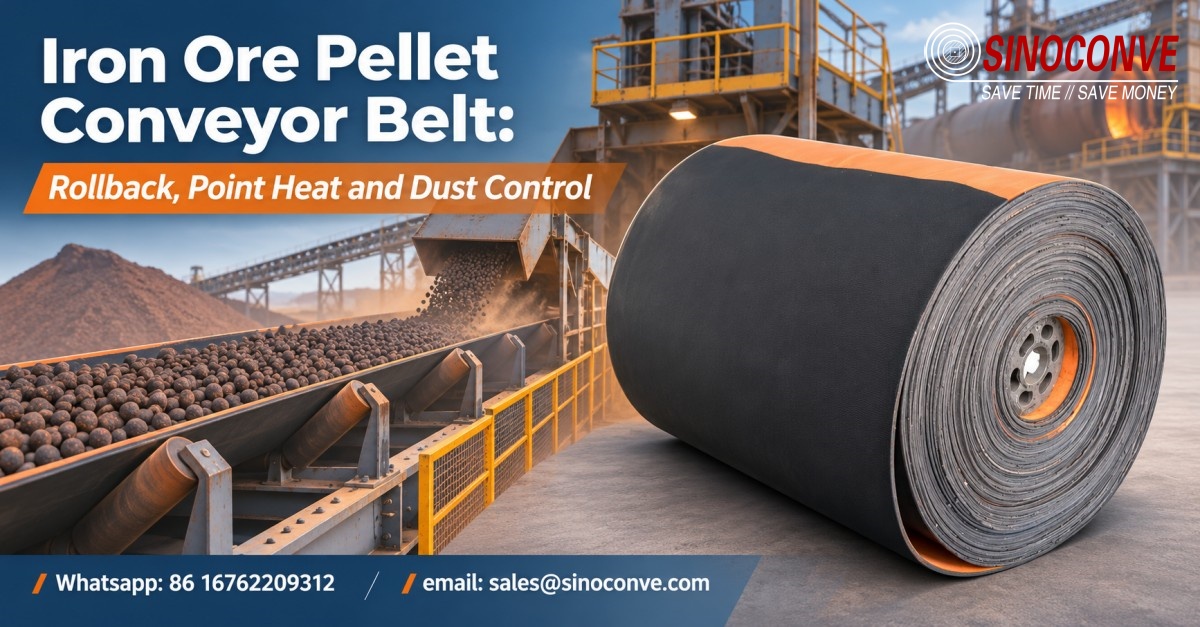
At the discharge of a grate-kiln line, the pellets leaving the cooler still hold heat in their cores. We have stood beside those conveyors on a morning cold enough to see breath, with the burden in the trough warm enough that a bare hand held above it felt the difference. Round, dense and slightly springy, an indurated pellet looks mild beside a slab of run-of-mine ore. It is not mild to a belt cover.
The damage we are called out to explain rarely looks dramatic. There is no torn gash, only a cover gone glassy along one narrow lane, fine cracks crossing it at right angles to travel, and a patch of rubber the size of a coin lifting. Further up the incline, pellets have built against a skirt board and spill over the edge every second or third shift. Three mechanisms are at work.

This page is for the people who specify and maintain belts downstream of induration: cooler discharge, roller screens, transfer towers, stockpile feed and the shiploader line. We build rubber conveyor belt for exactly these duties. If you already handle angular lump ore, the failure language you are used to will mislead you here.
01What an Indurated Pellet Does to Rubber
Pellets are not one material. Green balls leave the disc soft enough to deform under a thumb. After induration they are ceramic-like, with a skin that rings when two are knocked together. The same conveyor may see both states after a process upset, and a soft green ball smears fines into the cover while a fired pellet scratches and heats it.
Size sits in a narrow band compared with mined ore. Blast furnace feed is typically quoted between nine and sixteen millimetres, most of the stream near twelve. That band is why a pellet stream behaves like a bed of ball bearings rather than a heap of blocks, with little interlocking to hold the burden on a slope.
The angle of repose is not a conveying angle
A stockpile of pellets stands at roughly thirty degrees, which tempts a designer to accept a twenty-degree incline. Do not read a stockpile angle as a conveying angle. On a moving belt the surface is disturbed by idler flexure, splice passage and feed surges, and a round body that starts to roll keeps rolling. A plain cover above about fifteen degrees will shed pellets backwards during a loaded start, even when the same belt carries crushed rock at twenty degrees without complaint.
The rolling is not uniform. Pellets migrate to the low side of a misaligned trough, gather against the skirt and climb the rubber until they escape. The escape is a trickle at first. Eight weeks later there is a cone of pellets under the transfer and a polished strip where the stream rubbed.
Point heat is a contact problem, not an ambient one
A hot pellet touching rubber for two seconds delivers a very different load from air at the same temperature. The contact area is a few square millimetres, the pellet conducts heat well, and the rubber beneath cannot share it sideways fast enough. That spot cures further, hardens, and loses the elastic reserve it needs to bend over an idler. A million such contacts per shift leave the cover twenty degrees harder at the loading point than at the head pulley.
We measure this with a contact probe rather than an infrared gun. An infrared reading on a mixed pellet surface bounces between hot pellets, cooler fines and the belt, and the emissivity of dark rubber flatters the number. A probe held on the rubber for ten seconds after the belt stops tells you what the cover actually absorbed.
| Handling point on the pellet route | What the burden is doing there | Which belt property is tested hardest | What an inspector should record on the stop |
|---|---|---|---|
| Cooler discharge and first transfer chute | Pellets arrive warm at the core and fall loosely | Point heat resistance and resistance to surface hardening | Cover temperature after stop and depth of any glossy patch |
| Roller screen feed and oversize return | Small pieces roll freely and the stream spreads wide | Troughing shape and edge control under a shifting load | Burden position at each edge and skirt contact marks |
| Inclined transfer to the stockpile feed | Round bodies roll backwards against the direction of travel | Surface grip, cleat stability and splice smoothness on the incline | Rollback depth at the tail and the angle on the drawing |
| Reclaim tunnel and the shiploader boom section | Abrasive fines separate from the pellets and settle on the return side | Dust resistance, cleaner performance and return-side tracking | Deposit thickness on rollers and condition of each cleaner blade |
Table 1: Pellet condition changes along the route, and the belt property each stage loads most heavily.
02From Cooler to Shiploader: Where the Duty Changes
Start at the cooler. Induration is followed by forced-air cooling, and discharge temperature depends on retention time, ambient air and the rate the line is pushed to. We routinely see surface temperatures between eighty and one hundred and fifty degrees Celsius at the outlet, with the core of a larger pellet hotter than its skin. That core heat is why a belt can run cool for a hundred metres and still bake its cover. Between the cooler and the tower, roller screens split oversize from product, and both decks drop a thin, fast layer onto short belts.
Figure 1: Round pellets spread across the trough instead of heaping, which puts the hottest contact line close to the skirt.
The transfer tower is the hardest point. Pellets leave one belt with forward velocity, hit a deflector, lose energy and drop into the next chute. Every impact makes fines, and every fines pile becomes a wear point. A plain plate and a drop above two metres will scour one lane into the receiving cover within months. A rock box or a dead bed is a better lining than steel, provided it stays full at low feed.
Field note from our engineers: At a pellet plant in northern China we quoted a heat-resistant belt for a transfer that kept failing in one place. The old belt was not overheating generally; the cover was cracked in a strip four hundred millimetres wide under the chute lip. A reline had shortened the opening by sixty millimetres, so the stream landed half a metre further down the belt. A belt change would have hidden that for one season. We asked for the chute drawing, the plant fitted a dead bed, and the replacement belt is still running.
The port end is the last change of duty. A shiploader boom is long, the incline is steep, and the belt must hold a full stream while the boom moves. This is where rollback becomes public, because a spill on a jetty is a cleanup with a boat. Our port bulk material handling pages cover the wider terminal layout. Each of the six positions needs its own line on the enquiry, because a conveyor belt manufacturer given one line for the whole route will quote to the average and miss both extremes.
Mark belt speed at each position too. A cooler discharge belt often crawls below one metre per second while a port belt runs at three. Slow belts hold hot pellets against one spot longer; fast belts throw material further. Neither is captured by tonnage. That is why an industrial conveyor belt for this duty is specified by temperature and geometry, and a conveyor belt supplier quoting from tonnage alone is guessing at the two variables that decide cover life.
03Why This Is Not the Lump Ore Problem
We publish a separate page on iron ore conveyor belts for run-of-mine material, and the two are deliberately kept apart. That page deals with angular lumps falling from a primary crusher, with edges that cut a cover before any heat is involved, and with the tension calculations that push a long overland route toward steel cord. Read it when your problem is a gouge with a clean bottom and a torn ply beneath. This page deals with round, fired pellets.
The distinction is not academic. A buyer who describes a pellet line as "iron ore" receives a quotation built for lump handling: thicker covers, a harder compound, breaker plies, a heavier carcass. Some of that is harmless. Some of it hurts. A hard cover is more brittle under repeated point heat, and a heavy carcass on a short transfer can be stiff enough to misbehave at the trough and the splice.
Different first damage, different evidence trail
Lump ore fails at the loading point with a cut or a bruise that reaches structure. Pellet damage starts as a change of surface state. The cover glosses over, hardens, cracks in a fine mosaic, and only later does a patch lift. Walk up to a failed pellet belt expecting a hole and you will photograph the wrong area and order the wrong belt.
The second difference is where the material goes. A lump that bounces off a chute lands and stays. A pellet keeps rolling until it finds the lowest point of the structure. That is why the evidence is often not on the carrying side: a cone under the tail pulley, a drift of fines along the return strand, a polished track where a skirt has been acting as a scraper.
Temperature is the variable lump ore does not have
Mined ore arrives at ambient temperature unless the mine sits in a hot climate. Pellets arrive hot by design, and the heat is inside the piece rather than on its surface. That one fact changes the cover specification, the cleaning method, the splice material and the maintenance schedule. Water sprayed on a hot cover to settle dust will thermal-shock the rubber and craze the surface. A cleaner blade set hard against a warm, softened cover will shave it instead of wiping it.
| Observed condition found on the belt surface | A lump ore circuit would show | A pellet circuit usually shows instead | Component that the physical evidence points to |
|---|---|---|---|
| A narrow band of glazed and cracked cover | A gouge with a bright bottom and displaced rubber | Fine mosaic cracking with the cover still in place | Chute lip height and temperature of the landing stream |
| Material found under the tail pulley | A few scattered lumps that bounced off the skirt | A growing cone of round pellets that rolled back | Incline angle, surface grip and skirt gap height |
| A polished stripe with a straight edge | Usually a steel liner plate rubbing on the cover | Skirt rubber loaded with fines acting as an abrasive block | Skirt clearance, clamp pressure and fines behind it |
| A splice that opens in the middle | Often blamed on impact near the joint area | Frequently a heat-cure mismatch on a warm belt | Splice material and the temperature during cure |
Table 2: The same symptom means different things on a lump ore line and a pellet line.
Our mining and quarrying overview covers the shared plant context, but a pellet transfer should be argued on pellet terms. If your site also runs lump ore elsewhere, keep two specifications and two histories. One ore belt standard leaves a plant with an over-built primary belt and an under-specified stacker belt at once.
04Choosing a Cover for Point Heat Instead of Air Heat
Heat-resistant belt data usually appears as a continuous service temperature, with grades commonly quoted at one hundred and twenty, one hundred and fifty and one hundred and eighty degrees Celsius. Those figures come from oven ageing, where a sample sits in hot air and its tensile and elongation values are measured before and after. The test is useful. It does not describe a pellet landing on the cover.
A pellet contact is short, intense and local. The rubber under the contact point may reach a temperature well above the oven figure for a few seconds, then cool as the pellet rolls away. Damage accumulates as small overcures rather than one bulk degradation. That is why a belt which passes an oven test can still crack at the loading point in a single campaign, and why we ask for the landing temperature rather than the average.
Compound and hardness decisions
For pellet duty we start from a heat-resistant compound based on an EPDM-type polymer rather than a plain natural rubber blend. Not because EPDM is magic, but because the polymer keeps more elastic behaviour after repeated hot contact, so the cover can flex over an idler without cracking. A general-purpose abrasion compound may show a better drum wear number and still fail here, because a drum test does not heat the rubber.
Hardness is the second lever. Around sixty Shore A gives a useful balance on a pellet belt: firm enough that a round body does not sink in at the transfer, soft enough to conform at the trough and survive splice flexing. Going harder to resist indentation is a common mistake. A seventy Shore A cover on a hot incline crazes sooner, and the cracks then collect fines that hold moisture against the carcass.
Cool the pellet, not the belt
The most effective heat control sits upstream of the belt. Extra cooler retention, a controlled mist on the burden at the outlet, or a longer air-cooled transfer can drop pellet surface temperature by tens of degrees before it touches rubber. Mist belongs on the pellets in a defined zone, never as a jet on a hot cover; direct water on hot rubber is a thermal shock no compound survives for long.
Field note from our engineers: A client returned a failed sample with the complaint that the compound was not heat resistant. The sample told another story. The cracked zone was about three hundred millimetres long, and the rest of the cover still read sixty-two Shore A against sixty-five when new. A whole-belt heat problem would have hardened the full length. The local patch matched a chute moved during a maintenance campaign. We supplied the same compound with a revised chute lip and a new dead bed, and that belt lasted four campaigns.
Adhesion between cover and carcass matters more on a hot belt. Heat softens the tie layer, and a pellet stream working at a cut edge starts a separation that a cold belt would never develop. Ask for the peel strength figure on the quotation and ask how it was measured. A number without a method is decoration, and a conveyor belt factory that cannot describe its own test procedure is unlikely to control the process behind the roll.
| Position along a typical pellet plant route | Cover approach that we would normally propose | Engineering reason that sits behind the proposal | Practice we would argue against there |
|---|---|---|---|
| Cooler discharge with a short drop | Heat-resistant compound at moderate hardness with a smooth surface | Hot pellets arrive in a shallow stream and slide | A deep chevron profile that traps hot fines |
| Screen feed with a fast thin layer | Smooth cover with good elastic recovery and a controlled splice | Many individual contacts per tonne reward flexibility over hardness | A very hard compound chosen only to resist indentation |
| Inclined transfer steeper than about fifteen degrees | Shallow cleat or rough-top surface in a heat-resistant compound | Round bodies need mechanical interference, not friction alone | Tall chevron ribs that crack at the base |
| Shiploader boom with a long exposed run | Heat-resistant cover plus a carcass sized for boom tension | The boom combines the highest tension with the least shelter | A light two-ply build carried over from a stockpile belt |
Table 3: Cover decisions by position, the reason behind each, and the common counter-productive choice.
Buyers comparing mills should know that the same nominal grade can behave differently. Two rolls labelled heat resistant will diverge if one was cured longer at a lower temperature. That is a process question for the audit, not the price column, and our wholesale conveyor belts pages describe how we control it.
05The Carcass, the Trough and the Case for a Grip Surface
Most pellet conveyors are short enough that a fabric carcass is the sensible choice. Polyester warp with nylon weft, usually written EP, balances low stretch against fatigue resistance and splices well with a vulcanised step joint. Nylon-nylon constructions stretch more under the same tension, so on a conveyor with limited take-up travel the counterweight runs out of room during the first weeks.
Rollback is geometry before it is rubber
When operators report pellets running back down the incline, the first instinct is a rougher cover. Sometimes that helps. Often the real answer is a smaller angle, a deeper skirt, or a short horizontal section at the feed so the stream settles before the climb. Rubber can add only so much grip, and a round body on a vibrating incline finds that limit sooner than an angular one.
If the angle cannot change, the surface must provide mechanical interference. A shallow cleat, fifteen to twenty millimetres high and pitched closely enough that a pellet cannot sit between two ribs, works better on hot pellets than a tall chevron. Tall ribs flex at the base on every pulley pass, and heat accelerates the cracking that starts there. A rough-top surface is milder; it interrupts rolling contact without creating a deep pocket for fines.
Whichever profile you choose, the splice must match. A cleated belt with a smooth vulcanised joint leaves a bare patch that pellets cross exactly where the belt is least flexible. Continue the profile through the joint, or place the joint on a horizontal section where rollback cannot start. This is the kind of detail a conveyor belt distributor should raise before the roll is cut, not after the crew is at the tail with a knife.
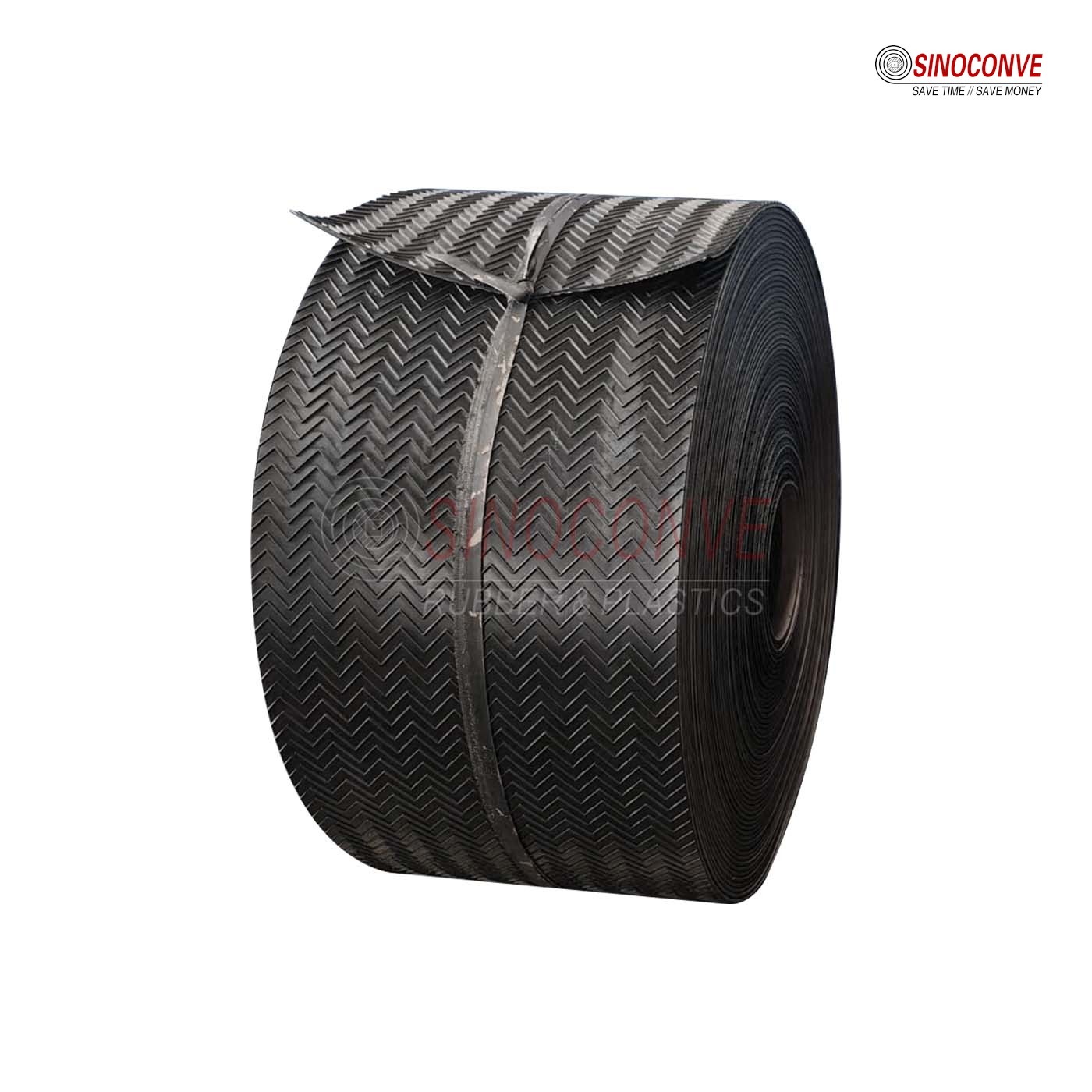
Figure 2: A shallow cleat pitched so a pellet cannot lodge between ribs, with the profile carried through the splice.
Trough shape decides where the hot line falls. A wide, shallow trough lets the burden fan out until the edges sit near the skirt, putting the hottest contact line against steel. A deep trough heaps pellets in the centre, concentrating the next impact. Neither extreme is comfortable, and the right answer depends on feed rate and belt width. Photographs of the loaded cross-section at normal and surge rate often look like two different conveyors.
Drives on the same plant deserve the same discipline. Crusher and screen drives often use banded or cogged belts, and a transmission belt manufacturer should match the pulley groove to the belt section rather than substituting the nearest size. A mismatched groove wears the shoulders and shortens drive life in a way that looks like overload. Our v-belt manufacturer pages list the sections we produce.
06Chute, Cushion and Skirt: The Hardware Around the Belt
A pellet transfer is process equipment that happens to sit above a belt. Built well, it delivers a gentle, centred stream at a temperature the cover can absorb. Built badly, no cover survives. We spend as much time on chute geometry as on compound selection, and the conversation starts with three measurements: drop from the lip to the belt, distance to the first support, and the angle of the back plate. Drop height is the one most often misreported, because a relined opening shortens it and a wear plate lengthens it. Measure it with a tape on the stopped machine, from a mark you can find again.
Let the pellets build a cushion
The best impact protection for a pellet belt is a bed of pellets. A rock box or dead bed absorbs energy that would otherwise enter the cover, provided it stays full through a surge and does not empty at low feed. We have seen a well-built rock box outlast three belts, and a shallow one deliver a direct hit on restart.
Below the landing point, support matters as much as the chute. Impact idlers or a rubber-cushioned bed keep the belt from deflecting into the gap between carrying idlers, which is where a hot stream does its worst work. Spacing under a loading zone is typically half the normal carrying spacing, and the first station should sit where the stream actually lands, not where the drawing says it lands. Our impact roller selection notes go through the load assumptions.
Skirt rubber is the third element and the most mistreated. Its job is to contain the stream, not scrape the belt. A skirt set too low presses fines into the cover and polishes a stripe that looks like wear but is abrasion under pressure. Set too high, it lets pellets escape down the incline. Aim for a gap that just clears the running belt including the splice, check it with a feeler at three points, and re-check after a week because a new belt settles into its trough.
Field note from our engineers: On a port shiploader, the skirt on the boom had been clamped down hard to stop a spill that appeared only when the boom was raised. The pressure had worn an eight-millimetre groove into a twelve-millimetre cover along nine metres of belt. The spill came from the incline, not the skirt gap, so the extra clamp load simply moved the problem from the jetty to the belt. We changed the surface profile on that section and reset the skirt clearance. Spillage stopped and the groove stopped growing.
Consider access, too. A transfer that needs a scaffold will not be inspected, and an uninspected skirt fails quietly. Walkways and a proper lockout point belong in the belt's service life even though they sit on another drawing. When we review a project with an EPC contractor, we ask for the access drawing as well, because the industrial equipment package usually holds both.
07Reading Temperature and Dust Before They Read the Belt
A pellet belt gives warning. The cover hardens before it cracks, and the return strand collects fines before an idler seizes. Measure at the same place, in the same way, often enough that a trend appears. Four readings a year taken properly beat a monthly walk-past with a torch.
Figure 3: A contact probe on the cover after a stop gives a more useful number than an infrared reading on mixed pellets.
A baseline you can defend
Choose three points on the carrying side: under the chute lip, one metre downstream of the landing point, and at the head pulley. Mark them with paint and a number. After a normal stop, with the belt locked out, hold a contact probe on each mark for ten seconds and record the value with ambient temperature and time since stop. The change from the last visit matters more than the absolute number.
A thermal camera finds the hot lane quickly, but treat its numbers as relative unless the emissivity is set for the cover. We use the camera to locate and the probe to quantify. If the chute-lip reading sits about thirty degrees above the downstream reading, the landing geometry needs a look. If all three read high, the problem is upstream cooling, and no cover change will fix it.
Hardness is the other simple measurement. A durometer pressed on a warm cover reads low, so take it after the belt cools, at the same three marks. A cover that started at sixty-five and now reads seventy-two at the chute lip has lost elasticity exactly where pellets land. That number is more actionable than an argument about whether the surface looks shiny. Our temperature data notes explain how suppliers generate published figures.
The return strand is where dust becomes a tracking fault. Fines adhere to the cover, pass the head pulley and pack onto roller shells, changing the effective diameter. A roller with a lump of packed fines on one side runs eccentric, and an eccentric roller steers the belt. By the time the belt looks off-centre, the cause is a metre of dust nobody inspected.
Match the cleaning sequence to the material. A primary scraper with a heat-resistant blade removes most carryback while the cover is warm, a secondary cleaner catches the rest, and a brush or a water spray at a cool section handles what passes both. Setting a blade hard against a hot cover is counter-productive: the rubber is softer when warm and the blade shaves a groove instead of wiping. The cleaning method comparison covers cases where a scraper is the wrong tool.
Roller choice matters as much as cleaning frequency. A sealed bearing with a labyrinth seal survives fine hematite dust far longer than an open one, and a smooth shell sheds packed fines better than a recessed shell. We specify sealed rollers on the return side of every pellet transfer we quote and ask plants to record deposit thickness at three fixed rollers each month. That number has predicted more seizures for us than any vibration reading.
| Check performed on the stopped and locked belt | Instrument or method used for the check | Reading that starts a work order | Action that should follow from that reading |
|---|---|---|---|
| Cover temperature under the chute lip | Contact probe held ten seconds after a normal stop | More than thirty degrees above the downstream mark | Review chute lip height and the cooling before transfer |
| Cover hardness at the marked points | Shore A durometer on a cooled, cleaned surface | Seven points above the recorded baseline value | Plan a cover or belt change before the campaign |
| Fines deposit found on the return rollers | Steel rule against the shell at three fixed rollers | A layer thicker than five millimetres on one side | Clean the strand and reset the primary cleaner |
| Skirt gap along the loading zone | Feeler gauge at three points with the belt stopped | Contact at any point or a gap passing pellets | Reset the clamp and inspect beneath the skirt line |
Table 4: A four-line inspection sheet a shift fitter can complete in fifteen minutes.
None of this needs a specialist. A probe, a durometer, a rule and a feeler gauge cost less than one metre of belt. The discipline is in repeating the measurement and writing it down, so the next conveyor belt decision rests on evidence rather than on whoever was on shift. Plants across several industries use the same four lines, and the useful difference is always the trend.

08Frequently Asked Questions About Iron Ore Pellet Conveyor Belts
Can one heat-resistant grade cover every pellet conveyor on the site?
Rarely. The cooler discharge and the boom see different temperatures, angles and tensions. One grade across the plant is convenient for stores and expensive at the two positions that needed something else.
Why does the cover crack only under the chute?
Because that is where the heat is concentrated. A pellet carries its warmth inside, releases it at the first hard contact, and leaves the rest of the cover to age at a slower rate. Check the drop height before you blame the compound.
Do pellet inclines need a chevron belt?
Not always, and not a tall one. A shallow cleat often holds round pellets better than a deep rib that traps fines and cracks at its base. Reducing the angle is cheaper still when the layout allows it.
How hot is too hot for the cover?
There is no single number, which is why we ask for the landing temperature. A cover rated for a continuous figure can still fail if a small area runs thirty degrees hotter than the rest of the belt. Measure the difference, not just the peak.
Should we spray water on the belt to control dust?
No. Water on a hot cover thermal-shocks the rubber and accelerates cracking. Mist the burden before the transfer, or enclose the chute and extract the dust at the source.
What should we send with an enquiry for a pellet belt?
Width, speed, lift, trough angle, pulley diameters, peak rate, landing temperature and a photograph of the failed area with a ruler in frame. Add the chute drawing if the same lane keeps failing. Our FAQ page covers the commercial questions, and the technical ones are quicker to answer with those eight items in hand.
Related Products You May Need
- Heat-resistant conveyor belt for cooler discharge and transfer duty
- EP fabric conveyor belt for short pellet transfers and stacker feeds
- Chevron and cleated belts for inclined pellet conveying
- Sealed conveyor rollers and impact idlers for dusty return strands
Related Blog Posts