
Anyone who has replaced a belt twice in the same year on the same kiln discharge line already knows the lesson this guide is built around. Heat damage rarely comes from the temperature printed on the purchase order. It comes from a second number nobody wrote down. What the rubber actually sees. How long it stays there. How often the process pushes past it.
We build heat resistant conveyor belts for cement kiln discharge, sinter and coke lines, foundry sand loops, fertilizer granulation plants, hot clinker silos and steel mill slag runs. In that work we quote from a grade table. Never from the words "heat resistant" on their own. What follows is the grade classes and how they map to real duty, the selection matrix we use every week, how cover and carcass construction change with temperature, what the wrong grade really costs over three years, the failures we see most in the field, and what to put in an RFQ. Get the RFQ right and the belt that arrives is the belt you specified.
Here is the conclusion first, because it decides everything below. Match the belt to the material contact temperature and the peak excursion. Not to the ambient air temperature of the building. Almost every heat-related belt failure we're called out to inspect traces back to that one mistake.

01What "Heat Resistant" Actually Means in Service
"Heat resistant" is not a property. It's a range, and the word means nothing until you say which range, and under what conditions. Here is how that plays out on a real line. A compound that survives 150 °C for eight hours a day can fail in three weeks on a line that touches 150 °C and spikes to 210 °C every shift. So we split the question into four parts before we discuss grades at all: material contact temperature, then radiant and ambient heat, then continuous against peak. And what the load is carrying.
Material contact temperature is the number that matters
This is the surface temperature of the load where it touches the top cover. Nothing else. On a well-run cement line, clinker leaving the grate cooler often sits between 100 °C and 150 °C, and it climbs fast after a kiln upset or a cooler stoppage. Sinter return fines, dry coke, foundry shakeout sand, hot briquettes and slag all arrive hotter than most engineers assume when they write a specification the first time.
Because we're a conveyor belt manufacturer and not a trading office, we can look at the compound rather than the label. When a buyer sends us a duty point, we want the measured contact temperature — ideally from a handheld pyrometer reading taken on the load at the transfer point. Not from a plant design document written five years ago. Design documents describe the process. The pyrometer describes the belt. That gap is where most of our arguments with a purchasing department start.
Ambient and radiant heat attack the belt from a second direction
Ambient air in a cement cooler building, a coke wharf or a foundry bay can sit at 45 °C to 70 °C for a full shift. That's rarely the reason a belt fails, but it shortens the working life of the rubber in every ply, because ageing reactions run faster when the whole belt stays warm, not just the cover. Radiant heat is a different animal. A belt passing under a hot kiln shell, beside a red-hot chute or below an unlagged duct can bake one edge or one half of the width while the rest of the belt stays cool.
We've pulled belts where the cover on one side had hardened into a shell that cracked under a thumbnail, while the opposite edge still flexed like new. That pattern points to radiant heat or a hot spill, and it changes what we recommend. A higher grade helps. The real fix is usually a heat shield, or better skirt spacing. Sometimes it's the transfer chute. Which sounds simple until you look at where the chute actually sits in the layout.
Continuous rating versus peak excursion
Every grade we quote has two temperatures: a continuous band the belt can live in for the long term, and a short-term peak it can survive without permanent damage. Treat that peak budget as finite. It doesn't reset on a calendar. A plant that runs three 20-minute excursions above the class limit per shift burns the budget far faster than the same plant running one excursion a week.
One 1,200 mm kiln discharge line we sized last year ran a comfortable 135 °C average and still ate a belt in nine months. The shift log showed two clinker surges a shift at close to 195 °C, maybe twenty minutes each. That's the number that decides the grade, not the average.
Which is why two plants at identical average temperatures can get very different belt life. When we review a failure, we ask the maintenance team to write down the upset events from the last month — not just the normal operating temperature. Nine times out of ten the pattern is sitting right there in the log.
Why the cover usually fails before the carcass
The carcass carries the tension, and on a correctly rated belt it usually outlives the cover. Heat attacks the compound first. Plasticizers migrate out. The rubber hardens. Small cracks open where the belt flexes around the smallest pulley or over the impact idlers. Once those cracks reach the fabric, hot material works into the plies and ply separation follows.
That sequence matters for selection. Buying a higher tensile carcass does nothing for a heat problem. Buying a higher grade cover, or a thicker cover with a proper heat-resistant compound, does. We regularly quote a 4-ply EP500 with a 6 mm heat cover where a 5-ply EP630 with a 4 mm standard cover would have cost less and failed sooner.
02Grade Table: T1, T2 and T3 Classes Against HR120 to HR200 Designations
Two naming systems show up in tenders, and buyers mix them up constantly. The T classes come from the heat-resistant belt test classification used in Chinese production standards, where the class number tracks the ageing test temperature applied to the cover compound. The HR numbers are commercial designations, and the number is the continuous material temperature the compound is designed around. EN and DIN-driven projects also speak about heat-resistant covers in plain temperature terms. That's why we convert every request into a temperature, not a letter.
How the T classes are defined
The T class is a laboratory statement about the cover. T1 is tested at 100 °C, T2 at 125 °C, T3 at 150 °C and T4 at 175 °C. After ageing, the compound still has to keep a defined proportion of its original tensile strength and elongation at break, with a limit on hardness change and mass loss. A supplier who writes "T2" with no test report is telling you which shelf the roll came off. Nothing more.
DIN 22102, ISO and RMA based orders work differently. Those specifications describe the belt construction, cover grade and mechanical properties. Heat resistance gets added as an additional requirement on the compound. If your project specifies DIN 22102 with a heat-resistant cover, we supply to that construction and confirm the temperature band separately on the drawing. AS 1332 or BS 490, same logic.
What the HR numbers mean in a quotation
When our quotation says HR150, that number is a promise about the continuous material contact temperature band. Not a marketing label. HR120 covers warm duties that sit up to roughly 120 °C. HR150 covers most cement clinker after the cooler. HR180 is the practical answer for sinter fines and kiln upset conditions. HR200 sits at the top of what we're willing to recommend in rubber; above that we start steering buyers toward steel cord construction with a protective cover, or away from rubber altogether.
As a conveyor belt supplier working with cement, steel, fertilizer and mining plants, we've learned to write both numbers on the data sheet: the HR designation, plus the continuous temperature band in °C and °F. Maintenance teams read the second one.
Heat resistance is not flame resistance
These are separate properties, and the paperwork proves it. A fire resistant conveyor belt is tested for flammability, typically against ISO 340 or an equivalent national method, and it's built for underground coal, tunnels and enclosed transfer towers where a spark could start a fire. A flame resistant conveyor belt carries the same idea: it won't propagate a flame once you remove the ignition source. Neither test tells you anything about how long the cover survives at 180 °C.
You can buy a belt that's both, and in a coal handling plant feeding a hot process you usually should. Don't assume one implies the other, though. We've seen tenders where the buyer wrote "fire resistant" in the technical section and meant "heat resistant". The belt that arrived was correctly flame-tested and completely wrong for a 170 °C clinker duty. Say both words if you need both properties.
Grade and temperature reference table
| Grade designation | T class | Continuous material temperature | Short-term peak | Typical duty |
|---|---|---|---|---|
| HR120 | T1 | up to 120 °C / 250 °F | about 130 °C | Warm clinker after the cooler, foundry sand, dry ash, hot grain, fertilizer prills |
| HR150 | T2 | up to 150 °C / 300 °F | about 165 °C | Cooler discharge, coke, sinter fines, rotary dryer outlet, hot briquettes |
| HR180 | T3 | up to 180 °C / 355 °F | about 200 °C | Sinter return fines, kiln upset conditions, slag transfer, hot cement clinker on short lines |
| HR200 | T3 to T4 | up to 200 °C / 390 °F | about 220 °C | Foundry shakeout, hot sinter, DRI transfer, quenched coke, specialty high temperature conveyor belt duties |
Continuous bands shown are the design targets we quote; confirm the final band against your measured duty and drawing. Above 200 °C continuous we recommend a steel cord carcass with a heat barrier or a change of conveying method.
Two footnotes on that table. First, the peak column is a survival figure for short excursions, not a second continuous rating, and we'll ask how often it happens. Second, cold resistant conveyor belt compounds are a separate compounding job for plants that run outdoors below minus 20 °C, and a heat compound isn't the right answer there either. When buyers want to compare the options in one view, we point them at our wholesale conveyor belts catalog, where heat, wear, oil and flame grades sit side by side with their cover thickness options.
03Selection Matrix: Material Temperature, Peak and Material Characteristics
A grade table answers "what exists". A selection matrix answers "what should I buy". We use the second one in every quotation review. It starts with five inputs from the customer: measured material temperature, expected peak and frequency, material characteristics, ambient conditions, and the mechanical duty of the line itself. Get those five right and the rest of the specification falls into place.
The five inputs we ask for before we quote
Measured material temperature isn't the same as design temperature. We say so every time. Peak and frequency decide whether the belt lives inside its class or spends its life in the excursion budget. Material characteristics cover abrasion, stickiness, oil content, moisture and chemical attack. Ambient conditions cover radiant heat, dust and outdoor exposure. Mechanical duty covers lump size at the loading point, drop height, belt speed, troughing angle and the diameter of the smallest pulley. Those figures have to travel from the site to the mill floor, because we cut, calender and cure to the drawing inside our own conveyor belt factory. A wrong figure on the drawing becomes a wrong belt on the line.
We've quoted heat belts rebuilt three times on the same line because nobody asked about drop height. A 1.8 m drop of 300 mm clinker punches through a standard impact zone inside a season, and then the belt gets blamed for a heat problem it never had. If you want a reference on that, our notes on how we read temperature data from a supplier walk through what to send with an inquiry.
Worked selection matrix
| Material temperature | Peak pattern | Material characteristics | Recommended grade | Cover thickness and note |
|---|---|---|---|---|
| 60–100 °C | stable, no upsets | abrasive, dry, mineral | HR120 or abrasion grade | 4+2 mm; check whether heat is really the issue or wear is |
| 100–130 °C | occasional 150 °C | abrasive, some fines | HR150 | 6+2 mm; impact idlers at the load point |
| 130–160 °C | frequent 180 °C | abrasive, hot, sharp lumps | HR180 | 6+3 mm or 8+3 mm; breaker fabric under the top cover |
| 160–200 °C | regular excursions above 200 °C | very abrasive, clinging, fine dust | HR200 with steel cord or heavy EP carcass | 8+3 mm; heat barrier layer, shortest possible exposure time |
| above 200 °C | sustained or uncontrolled | sinter, molten splash risk | special construction, project review | We will usually propose a non-rubber or hybrid solution rather than oversell a compound |
Matrix values are our standard recommendations for typical duty; final selection must be confirmed against measured temperature, drawing and site data.
The same logic applies to oily and sticky loads, which is why one column in that table is about material characteristics rather than temperature. Hot clinker from a well-controlled cooler is a heat and abrasion problem. Hot material carrying oil mist or process dust is a compounding problem.
If you're comparing heat grades across suppliers and want to see how we build the carcass underneath them, the tensile and cover data for our industrial conveyor belt range is a useful reference point for a typical quarry and crusher duty.
One more input belongs on the list even though it isn't part of the belt itself: the drive. Hot bays are hard on drive belting too, and as a V-belt manufacturer we get asked for the same crushers, cooler fans and bucket elevators that sit beside a hot conveyor. A wrapped belt with dust on the pulleys ages faster than the rated curve suggests. When the bay runs hot, we treat the drive belts as part of the same review.
04Heat Versus Chemical Versus Oil Resistance: When You Need a Combined Grade
Temperature is only one attack. In fertilizer granulation, phosphate processing, coke plants and many steel mill buildings, the same belt has to survive heat and chemistry at the same time. When the load carries oil mist from a shredder, a machine tool or a warm bearing, heat and oil arrive together. Once two attacks overlap, a single-property compound stops being enough. That's where most mis-bought belts come from.
Heat plus oil: the case for a combined compound
An oil resistant conveyor belt uses a polymer system that resists swelling when hydrocarbons sit on the cover. A heat resistant compound uses a different curing and stabilizer package so it doesn't harden at temperature. Combine the two badly and you get a cover that swells at 120 °C and delaminates within a few months. Combine them properly and you pay a real premium, which is why we ask buyers to confirm oil is genuinely present before we add it to the specification.
Our rule of thumb. If the oil is a light film that shows up occasionally, we specify heat resistance first and add a modest oil resistance to the compound. If the load is oily grain, recycled scrap or oily foundry sand, the oil resistance has to lead, and the temperature band usually drops one step because the compounding freedom is smaller. You can't have the widest band and every chemical property at once, and any supplier who claims otherwise is guessing. The background on the compounding trade-offs sits in our piece on oil resistant conveyor belts.
Heat plus chemical attack: acids, alkalis and fertilizer salts
A chemical resistant conveyor belt is specified when the load or the atmosphere attacks the compound, not when the load is simply hot. Fertilizer plants are the classic case. Urea, ammonium nitrate, ammonium sulfate and phosphate rock all carry salts that pull moisture out of the air and sit on the cover as a damp, aggressive film. Add 60 °C to 90 °C of process heat and the cover has to resist both.
We treat chemical exposure as a materials question with three variables. The chemical family. The concentration. And the contact time, which is the one buyers leave out most often. Dilute fertilizer dust at ambient temperature is a very different problem from saturated ammonium nitrate solution at 80 °C. Send us the chemical name, the concentration and the temperature, and we'll tell you honestly whether a rubber cover is the right answer at all. For some concentrated acids it isn't.
For plants running both duties on the same site, we frequently propose a conveyor belt for chemical products and fertilizer that is built as a single specification across several belts: a heat-resistant compound with a chemical-resistant cover, over a carcass that has a protected bonding interface so moisture carried into a splice cannot start ply separation. Standardizing the specification across a fertilizer plant also simplifies spares. That matters more than most buyers expect at the first unplanned stop.
When a combined grade is genuinely worth the money
Not every combined duty is worth the premium. Three cases are. When the belt spends more than half its life above the abrasion-only grade's temperature band, pay for the better compound. When the load carries a chemical or oil film that will reach the carcass once the cover fails, pay for it too. And when a belt change costs you a production day? A 20 percent premium on the belt is cheap insurance. Everything else, buy the single-property grade and spend the difference on the right cover thickness.
As a rubber conveyor belt maker, we would rather sell you the belt that lasts than the widest specification on paper. Buyers who have run a fertilizer line for ten years already know which of the two keeps a plant running. One habit is worth keeping whatever route the belt takes to your store: make sure the grade and the temperature band travel with the order. A conveyor belt distributor who passes on an item code instead of a specification is how a T2 belt ends up on a T3 duty.
05Cement, Steel and Fertilizer Plant Cases
Three industries send us most of the heat belt inquiries, and each one stresses the belt differently. Cement is a heat and abrasion problem with a temperature pattern. Steel is a heat and impact problem with sharp edges. Fertilizer and chemicals are a heat and chemistry problem with moisture. Work out which pattern you're dealing with, and the specification narrows faster than any grade chart will manage.
Cement: clinker handling between cooler and silo
The hardest cement duty in most plants isn't the kiln feed line. It's the clinker path between the grate cooler discharge and the clinker silo, plus the bypass and dust return lines. Clinker arriving from a healthy cooler typically runs 100 °C to 150 °C at the transfer point, and the fines fraction stays hotter than the coarse lumps because it has more surface area per ton.
We normally specify HR150 for that duty, with a 6+2 mm cover and impact idlers under the loading chute. We move to HR180 when the plant reports frequent upset conditions, or when the same belt also carries kiln bypass dust. Gypsum and limestone feed lines are cooler and usually land on a standard abrasion grade. Cement mill rejects and hot dust return lines deserve their own review. Our field notes on this specific duty are in the article on heat resistant conveyor belts in cement plant clinker handling. On a 1,400 mm clinker line feeding two silos, relocating the transfer chute 600 mm further from the cooler discharge knocked roughly 30 °C off the cover temperature at the load point. Same grade, longer life.
Two details decide the life of a clinker belt. The first is skirt rubber — a metal skirt rubbing a hot cover wears a groove that becomes a crack starter, so we ask plants to check clearance and material type. The second is cleaning. Clinker dust that builds on the return idlers holds a hot layer against the bottom cover, and that's one of the few ways to damage the bottom side on a belt that is otherwise correctly specified.
Steel: sinter, coke, slag and DRI
Steel plants push the same material harder. Sinter return fines can leave the strand at 150 °C to 180 °C. Coke wharf belts see hot quenched coke. DRI transfer lines carry material that is both hot and highly abrasive. Sharp lumps at the transfer point mean impact damage arrives long before heat ageing does. The specification has to protect the carcass as well as the cover.
For those lines we usually raise the cover thickness rather than the tensile rating, add a breaker fabric under the top cover to spread impact energy, and check the smallest pulley diameter, because a thicker belt needs a larger minimum pulley to flex without cracking. We have also supplied drive-side belting for the same plants, and as a transmission belt manufacturer we see a steady flow of V-belt replacements where a hot environment plus dust accelerated cracking in a wrapped belt. Drive maintenance rarely appears on a heat belt drawing, but it fails on the same schedule.
Fertilizer and chemical plants: heat with a chemical film
Fertilizer plants run two duties that look similar on a P&ID and behave completely differently on the belt. Granulation and cooling lines carry warm prills at 60 °C to 90 °C with a mildly aggressive surface film. Raw material and product handling lines carry damp salts that stay on the cover through the whole circuit. Both need a chemical resistant conveyor belt specification, and the temperature band is usually HR120 or HR150 rather than the highest grade available.
What goes wrong most often is moisture, and under-estimating it. Fertilizer salts are hygroscopic. They pull water from humid air, and that film carries dissolved salts into any cover crack or splice gap. Once inside, it attacks the fabric-to-rubber bond. A belt that would have run five years in a dry quarry can lose a splice in eighteen months in a fertilizer store. That is the reason we insist on a heat and chemical specification for a conveyor belt for chemical products and fertilizer rather than a plain heat grade.
Phosphate and potash handling adds abrasion to the list. Urea lines are usually gentler on the cover but harsher on the splice, because the material is fine and free-flowing, so it finds any opening. In all of these cases we ask for the chemical name and the moisture level before quoting.
06Belt Construction Choices: EP Plies, Cover Thickness and Edge Protection
Grade gets the compound right. Construction decides whether the belt survives the mechanical duty on top of the heat. Three choices matter most. The carcass type and ply count. The cover thickness split between top and bottom. And the edge treatment. Get those wrong and a correct heat grade still fails early.
Carcass: EP plies versus steel cord
For most heat duties we start with EP (polyester warp, nylon weft) fabric, because it stretches little and holds splice strength well. Ply count follows the required tensile rating and the belt width. A 1,000 mm belt carrying a modest load may only need 3 plies. A 1,400 mm primary crusher discharge belt at 400 t/h may need 5 or 6. The fabric itself has a temperature limit too, and a compound rated at 180 °C doesn't make the carcass a 180 °C carcass. That's why we quote a construction, not a single grade.
Steel cord enters the picture for very high tension, long centers or the top end of the temperature range. A steel cord belt tolerates heat better in the carcass, because there's no textile to age, but it demands larger pulleys, careful splicing and a thicker cover for protection. Above roughly 200 °C continuous we usually recommend steel cord with a heat-resistant cover and a barrier layer, and we set expectations on life rather than promising a number.
Cover thickness: where the money should go
| Duty | Top cover | Bottom cover | Carcass | Why |
|---|---|---|---|---|
| Warm fines, light abrasion | 4 mm | 2 mm | 3–4 ply EP | Heat ageing is the main risk, thickness adds little |
| Clinker, coke, sinter fines | 6 mm | 2 mm | 4–5 ply EP | Balanced heat and wear; standard heat duty answer |
| Sharp lumps, high drop height | 8 mm plus breaker fabric | 3 mm | 5–6 ply EP or steel cord | Impact energy spreads before it reaches the plies |
| Fertilizer, chemical film | 5–6 mm | 2–3 mm | 3–4 ply EP with protected edges | Cover depth buys time before chemistry reaches the fabric |
One number people forget is the bottom cover. On a hot return run with misaligned material or a dragging skirt, the bottom side wears and cracks as well, and a 2 mm bottom cover on a hot line is normal for a reason: it keeps the belt flexible around small pulleys. Increasing the bottom cover is the wrong fix for heat. Fix the carryback instead.
Edge protection and splice preparation
Belt edges fail early on hot, abrasive duty. The edge is where cover thickness is thinnest, and where misalignment concentrates stress. Options are a thicker edge or a cut-edge versus molded-edge construction; in severe cases, an edge repair programme. For a hot line we usually prefer a molded edge on the top cover with a slightly increased edge thickness, and we ask the plant to check training idlers before blaming the belt.
Splicing deserves its own paragraph. A vulcanized splice on a heat belt uses heat and pressure, and on a fully cured heat-resistant compound the splice window is narrower than on a standard belt. We supply splice material matched to the compound, and we tell customers to keep the splice out of the hottest zone where the layout allows. A 1,200 mm hot clinker belt with a splice sitting directly under the discharge chute is a design mistake, not a belt defect. In our experience that matters less than the grade table suggests — and unlike a grade change, it costs nothing to fix at the design stage.
Because we run ten production lines, eight fabric and two steel cord, we can build heat belts and the V-belts that drive the same plant from one order. Buyers who consolidate often ask us for wholesale conveyor belts and drive belting together, which also means one inspection report and one shipping schedule instead of three. As a V-belt manufacturer, we see the same heat and dust problems on the drive side, and the same logic applies: match the belt to the real duty, not to the label.
07Total Cost of Ownership: The Price of One Grade Up Versus Downtime
Belt price is the number everyone negotiates, and it's almost always the smallest number in the calculation. What decides whether a heat belt was a good buy is how many times you change it, and how long the line stands still each time. We build this comparison for customers whenever they ask whether HR180 is worth the premium over HR150. The answer depends on two figures they usually already have: belt life on the current specification, and the cost of an hour of lost production.
What goes into the calculation
Six cost lines matter. Belt purchase price per meter. Freight and customs. Removal and installation labor, plus the vulcanizing crew. Lost production during the change. Emergency freight if the spare isn't on site. And the maintenance hours spent on temporary repairs before the failure. Most buyers track the first two and estimate the rest. That's exactly why the cheap belt keeps winning tenders and then keeps losing money. One cement plant we worked with tracked everything except the vulcanizing crew's travel time. Over three years that single line item was worth more than the difference between the two grades.
A worked example over 36 months
Assume a 1,200 mm wide, 150 m center belt on a hot clinker line, running 6,000 hours a year. The plant currently runs HR150 and gets about 14 months from a belt. The alternative is HR180 at roughly 18 percent more per meter, which our experience on this duty suggests can reach around 26 months before the cover cracks reach fabric. Both figures depend on the individual line, so treat them as a model, not a promise. Contribution lost during a change is taken at USD 1,500 per hour, and a change takes 16 hours.
| Cost line over 36 months | HR150 today | HR180 alternative | Difference |
|---|---|---|---|
| Belt price per meter (model) | USD 45 | USD 53 | +USD 8 |
| Number of belt changes | 3 (roughly every 14 months) | 2 (roughly every 26 months) | one less change |
| Belt spend, 150 m per change | USD 20,250 | USD 15,900 | −USD 4,350 |
| Installation and vulcanizing labor | 3 changes | 2 changes | closely follows change count |
| Lost production, 16 hours per change | USD 72,000 | USD 48,000 | −USD 24,000 |
| Model total, belt plus lost production | USD 92,250 | USD 63,900 | −USD 28,350 |
Illustrative model with the stated assumptions; prices, belt life and production value must be replaced with your own figures before any purchasing decision.
Read that table twice, because the belt price line points the wrong way. The premium specification costs more per meter and less per year. When the belt you buy costs about three percent of what a change costs in lost output, arguing over eight dollars a meter isn't cost control. It's a distraction.
The other side: oversizing is not free
One grade up is usually the right call. Two or three grades up on a line that doesn't need them is a different purchase with its own costs. Hotter compounds are stiffer and troughing is slightly worse. They flex less readily around small pulleys. Splice preparation also demands more care. We've seen an oversized compound cup badly on a light-load line and put the belt onto the edge rollers, which then wrecked the edges within four months.
There's also a storage and spares cost. If every line has a different premium compound, the warehouse carries three specifications instead of one, and the plant loses the ability to move a spare between lines. A conveyor belt distributor who understands the plant will often push for one extra grade and a standardized spare pool rather than a different compound for every chute. That's a purchasing decision as much as a technical one.
08Common Mistakes and Field Failures
We inspect failed heat belts in cement, steel and fertilizer plants, and the causes repeat. The table below lists what we actually see on site and what it tells us. Use it as a diagnostic list before you order the next belt. The next belt will fail the same way if the cause is still in the plant.
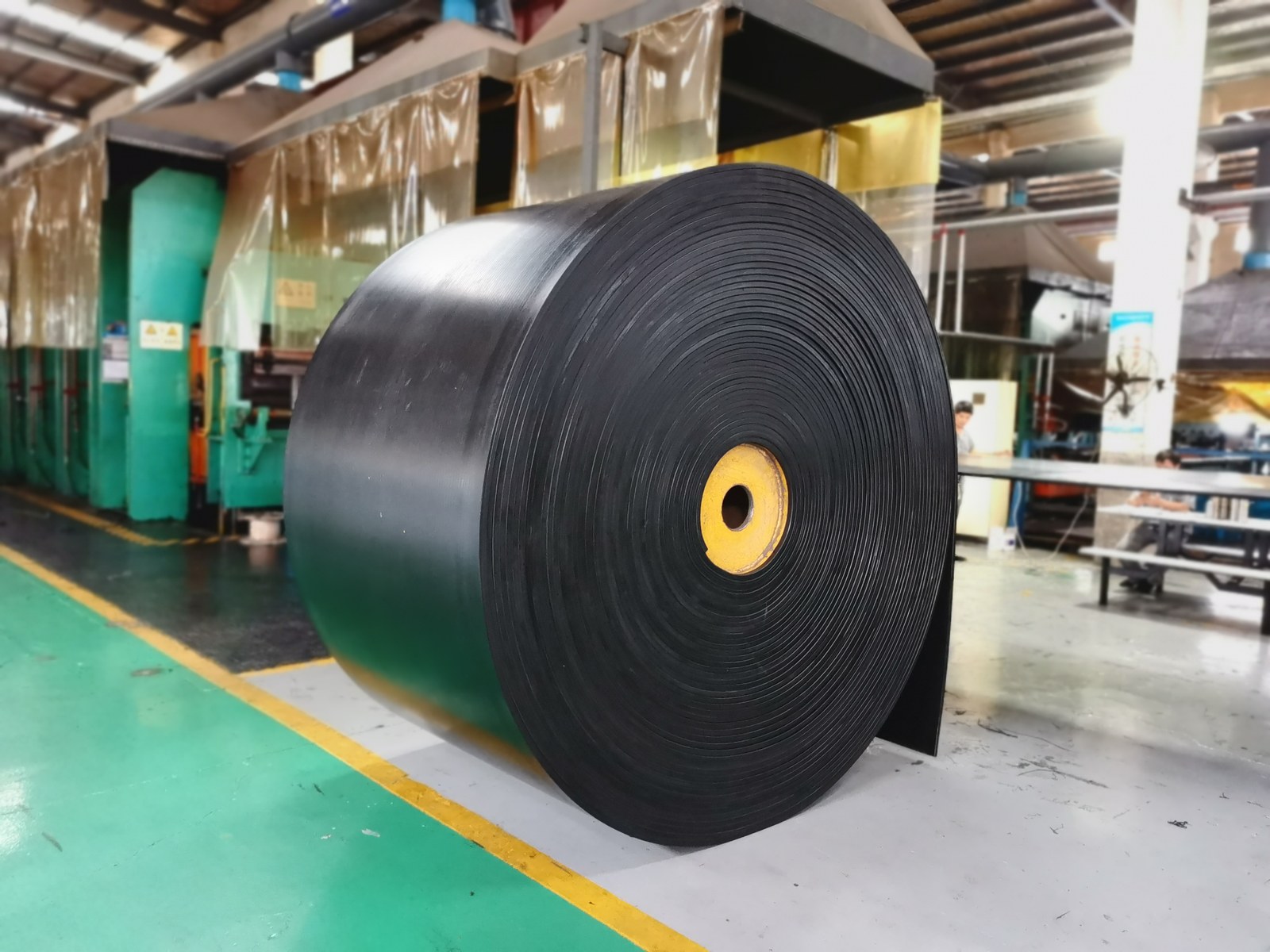
Symptom to cause reference table
| What you see | Most likely cause | What we check on site |
|---|---|---|
| Cover hardens and cracks in a fine network | Continuous temperature above the grade band | Pyrometer readings at the load point and along the top run |
| Cracks concentrated on one edge or one half | Radiant heat, hot spill, or misalignment against a skirt | Proximity to hot ducts and shells, skirt clearance, training |
| Blisters or bubbles on the top cover | Short peak far above the class limit, or trapped moisture from a poor splice | Upset logs, splice quality, cooling water leaks at the chute |
| Ply separation starting at the splice | Wrong splice material, overheating during vulcanizing, or water carried in with the material | Splice record, cure temperature, material moisture |
| Broken or crushed cords under the loading point | Impact from large lumps and a high drop, not a heat issue | Lump size, drop height, impact idler spacing, chute design |
| Bottom cover wear and grooving on the return run | Carryback building on idlers, holding hot fines against the belt | Scraper condition, return idler build-up, material moisture |
The seven mistakes we see most often
Specifying by ambient temperature instead of material temperature is the first and biggest. Measuring at the wrong point is second: a reading taken on the belt at the head pulley tells you nothing about the temperature at the transfer point, which is often 40 °C hotter. Third, buying higher tensile strength to solve a heat problem. That changes the carcass and leaves the compound exactly as it was. Fourth, ignoring the peak events in the shift log, which is where the real fatigue accumulates.
Fifth, forgetting the bottom cover and the carryback system on a hot line. Sixth, re-using splice material bought for a standard belt on a heat compound, which produces a splice weaker than the belt around it. Seventh, storing spare rolls in sunlight against a south-facing wall for a year and then wondering why the new belt cracked early. Rubber ages in storage. Heat accelerates it.
We'd rather spend twenty minutes on the phone before the order than inspect a failed belt six months later, so we ask these questions every time. Our buyers' checklist for high-temperature duties is documented in the high temperature conveyor belt buyers check, and it works as a pre-order gate for a maintenance planner. If you want to know how the belts themselves are made and tested, the process is described on our conveyor belt factory page, including the incoming rubber and fabric inspection, calendering, and the laboratory tests reported with each shipment.
09MOQ, Lead Time and How to Write the RFQ
The technical side of a heat belt is solvable in an afternoon. The commercial side trips up more projects than any grade question, mostly because buyers send a three-line email and expect a firm answer. Here's what we need, and what we can commit to once we have it.
Order quantities, samples and lead time
For conveyor belting our minimum order quantity is about 50 m per specification. Below that we can still help, but the economics change, because each specification needs its own compound batch and calender setup. V-belts start at 30 to 50 pieces per size. Samples are quoted and shipped in 2 to 5 days for standard constructions, and longer where a special compound has to be milled.
Standard production lead time is around 30 days from confirmed drawing and deposit. When a plant has a failed belt and no spare, we run a priority slot and can usually compress that to 15 to 20 days. That's a favour we ask the workshop for, not a standing commitment, and it depends on the width and the compound. Payment terms are T/T with 30 percent deposit and 70 percent before shipment, or a letter of credit when the buyer's bank requires it. We also supply under OEM and ODM arrangements with logo printing and custom width, thickness and cover color.
RFQ checklist for a heat resistant belt
Copy this list into your inquiry and you'll get a specification back instead of a question. Missing items usually cost a week of email. The awkward one is almost always peak frequency — plants log it, but rarely in a readable form.
| Item | Why we need it | Typical answer |
|---|---|---|
| Belt width and center distance | Decides the cut plan and where the splice sits | 1,200 mm, 150 m centers |
| Material and measured temperature | Picks the grade band | Clinker, 135 °C measured, peaks near 180 °C |
| Peak and frequency | Tells us if one grade up is justified | 2–3 events per shift, 20 minutes each |
| Tensile class and ply count | Sizes the carcass, or confirms what you run now | EP400, 4 ply, or "match current belt" |
| Cover thickness, top and bottom | Wear life, and pulley compatibility | 6+2 mm |
| Smallest pulley diameter | Flex without cracking at the tightest pulley | 400 mm at the snub pulley |
| Splice type and location | Matched splice material, plus a cool zone in the layout | Hot vulcanized, ends prepared by your crew |
| Standards and documents | Tells us which report you want with the belt | DIN 22102 construction, ISO 340 flame test if required |
| Quantity, destination and date | Shipping plan, and any priority slot | 220 m to Jebel Ali, on site by week 6 |
We keep inspection records from incoming rubber and fabric checks through calendering, dimension and appearance checks, and laboratory abrasion, adhesion and tensile tests, with the results issued alongside the shipment. If your project needs third-party inspection, tell us at the RFQ stage, so we can plan the schedule around it rather than after the belt is built. One email to sales@sinoconve.com with the list above is enough for us to come back with a specification and a price.

10Frequently Asked Questions
What temperature range can a heat resistant conveyor belt handle?
Our standard range covers continuous material temperatures from about 120 °C to 200 °C, split across the HR120, HR150, HR180 and HR200 designations, with short-term peaks roughly 10 to 20 °C above each band. The practical limit depends less on the label than on how often the process goes above the band. Above 200 °C continuous we usually recommend steel cord construction with a heat barrier, or a non-rubber conveying method. And yes, we'll tell you when rubber is the wrong answer.
Can one belt handle cement clinker at 180 °C?
Yes, if 180 °C is the peak and not the normal condition. For clinker that arrives at 130 °C to 150 °C with occasional excursions near 180 °C, we specify HR150 with a 6+2 mm cover and add impact protection at the transfer point. If the belt really rides at 180 °C for most of the shift, the choice becomes HR180, or a steel cord carcass, depending on how long the line is. Measure at the load point. Not at the head pulley.
What is the difference between heat resistant, fire resistant and flame resistant belts?
Heat resistance describes how well the cover compound survives temperature over time. Fire resistance and flame resistance describe behavior in a fire: the belt won't propagate a flame after the ignition source is removed, tested typically to ISO 340 or a national equivalent. A flame resistant conveyor belt isn't automatically suitable for 180 °C, and a heat resistant belt isn't automatically fire rated. Underground coal and tunnel projects need the flame property as well, and we quote both when the application requires it.
Can I use a heat resistant belt in a fertilizer or chemical plant?
Only if the specification also addresses chemistry. Fertilizer salts are hygroscopic, and the damp film they leave carries aggressive ions into cover cracks and splice gaps. That's why we quote a chemical resistant conveyor belt specification for that duty rather than a plain heat grade. Send the chemical name, the concentration and the temperature. For mixed plants that handle several products, we build one standard conveyor belt for chemical products and fertilizer and apply it across the site, so spares stay interchangeable.
Do you supply oil resistant belts for hot, oily material?
We do. An oil resistant conveyor belt uses a polymer system that resists swelling from hydrocarbons, and when heat is present as well we combine both requirements in one compound. There's a trade-off. A combined compound covers a slightly narrower temperature band than a pure heat grade, so we ask you to confirm whether oil is a constant condition or an occasional film before we fix the specification.
How do I choose between HR150 and HR180?
Look at the temperature distribution, not the average. If your belt spends most of the year below 140 °C with short peaks, HR150 is usually the economical answer. If peaks above 170 °C happen several times per shift, or if the return run stays hot, HR180 pays for itself. The calculation in section 07 shows why the belt price is rarely the deciding figure.
What is your MOQ and lead time for a heat resistant conveyor belt?
Minimum order quantity is about 50 m per specification, with samples in 2 to 5 days. Standard lead time is around 30 days from confirmed drawing and deposit, and we can normally compress that to 15 to 20 days for a plant that has stopped. Payment is T/T with 30 percent deposit and 70 percent before shipment, or a letter of credit.
Can you supply to DIN 22102 or AS 1332 and provide test reports?
Yes. We build to DIN 22102, ISO, RMA, AS 1332, BS and SANS based requirements, and we state which construction and grade the quotation follows, so the drawing and the belt match. Inspection records cover incoming rubber and fabric checks, in-process calendering and dimension checks, and laboratory abrasion, adhesion and tensile tests, and they ship with the order. Tell us at the RFQ stage if an independent third-party inspection is required.
11Related Products You May Need
| Product | What it is for |
|---|---|
| Rubber Conveyor Belt | EP and NN fabric belts for quarry, cement and general bulk duty, at the base of the range. |
| Heat Resistant Conveyor Belt | HR120 to HR200 compounds for clinker, sinter, coke, foundry sand and hot fertilizer lines. |
| Steel Cord Conveyor Belt | For high tension and long centers, plus hot duties where a textile carcass is the weak link. |
| Chevron Conveyor Belt | Profiled belts for inclines, in cement, aggregate and fertilizer handling. |
| V-Belt and Drive Belting | Classic, cogged, wrapped and multi-ribbed drive belts for crushers, fans and conveyors. |
| Contact SINOCONVE | Send duty data and we'll come back with a specification, a price and a delivery date. |