
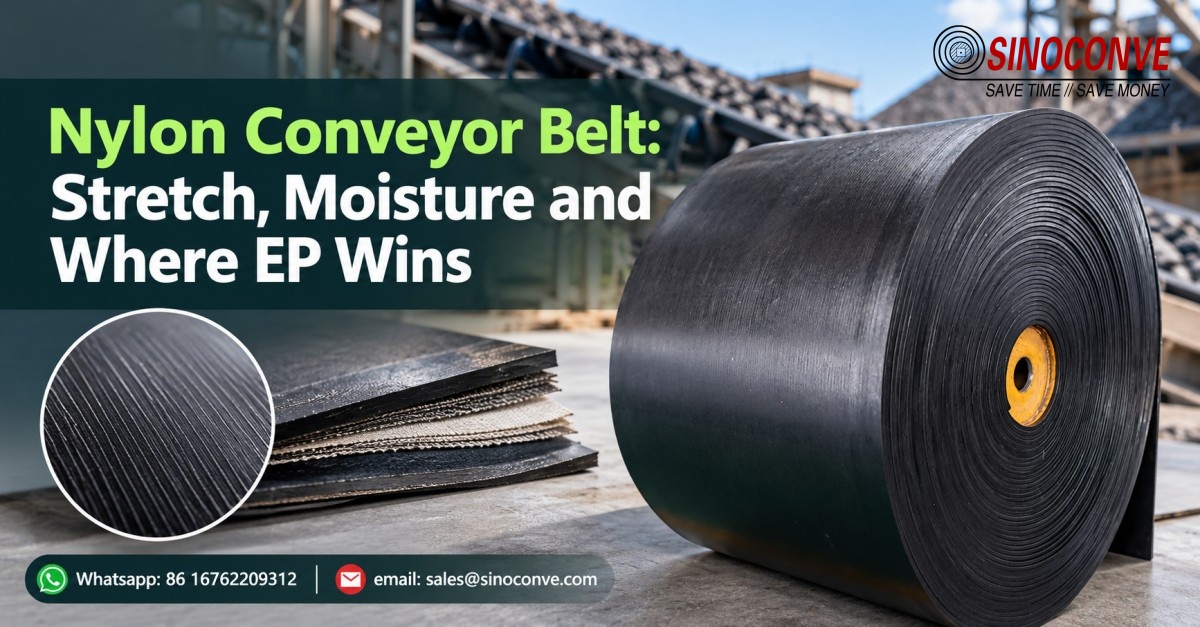
The stores card says NN. The old belt says NN. So the replacement order says NN, too. Nobody has measured the take-up in years, though, and the screw is nearly at the end of its thread. That detail matters more than the letters on the card.
The question behind the order is simple enough: will the replacement fit the conveyor that is actually standing in the yard? We make NN and EP constructions in our conveyor belt manufacturer range. Below are the measurements that help separate them, including a few that rarely appear on a requisition.

01How much thread is left on the tail screw?
Put the old belt marking, width, plies, fitting date and reason for removal on the enquiry. Then go to the conveyor. Is the take-up a screw, a gravity carriage or something else? Photograph its position with the line under normal load. Put a tape measure in the picture. The remaining stroke is worth knowing before anyone quotes another NN roll.
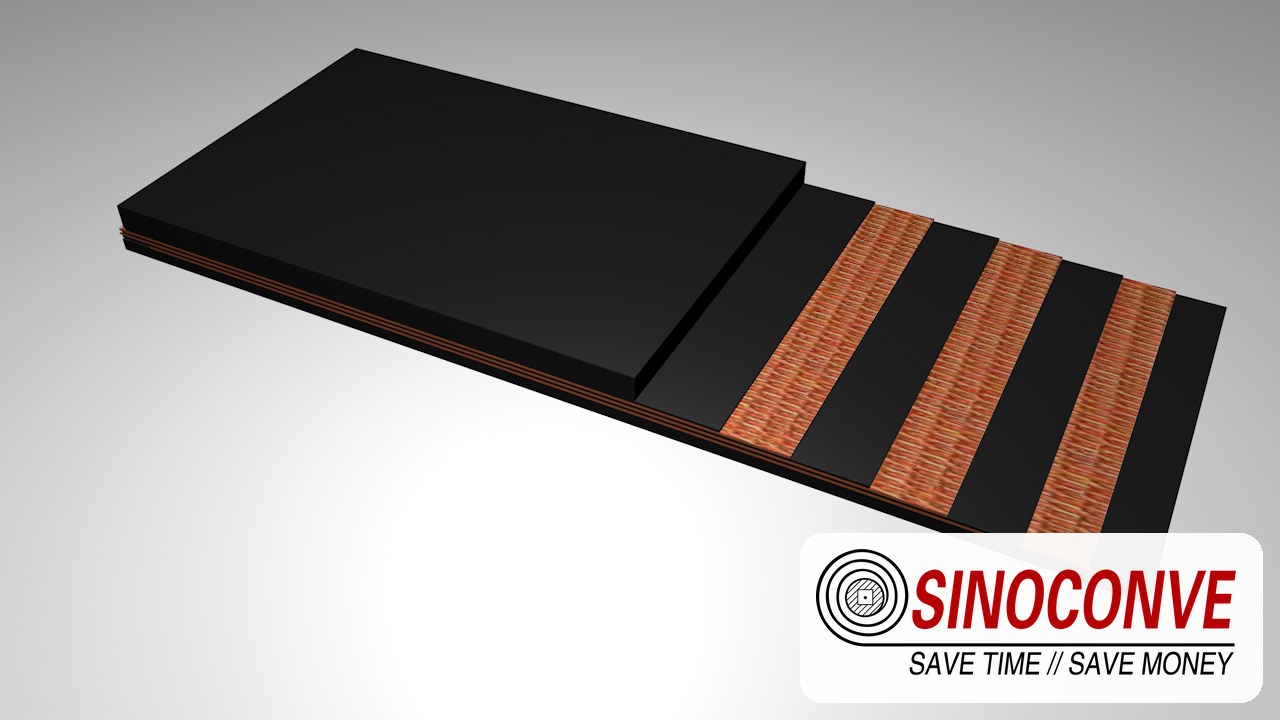
Look lengthwise through the belt. That yarn is the warp, and its extension is what the tail arrangement must accommodate. NN has nylon there and across the width; EP has polyester there, with nylon still running across. The maker can give working extension and permanent growth for the proposed fabric at the actual design tension. “NN400/3” describes rated strength and plies. It says nothing about the remaining thread on this particular tail screw.
A short transfer beneath a rough chute may leave plenty of room for NN to settle. On a long climb with a screw take-up already at its stop, there may be no room at all. The fabric versus steel cord construction comparison becomes relevant at high tension; see also heavy duty rubber belting for mining lines. For a fabric replacement, measure first.
A note from the maintenance book
Record the carriage position at installation, after the first loaded running period, and at the next planned stop. Date each entry. “Tightened again” is difficult to use six months later; “moved 35 mm, loaded, 14 May” gives the supplier something to compare with the proposed belt. Check that a gravity carriage is free to move before assuming it will absorb extra length.
02Why the same plant may stock both
Look at the pit-to-stockpile layouts used in mining and quarrying on a typical site: receiving transfer, screen feed, stockpile line. Those conveyors share material, but not centre distance, loading height or take-up space. NN may be worth pricing for one, EP for another. Our overview of how we map whole lines by industry is useful for locating each duty; the individual conveyor drawing still sets the belt.
On compact machines from equipment builders who integrate belts into their own machines, measure the small pulleys before choosing a thick multi-ply build. In warehouse and bulk terminal handling, look at starts and stops. On seasonal grain and crop receiving lines, check what happens after the spare roll has sat in store. None of these questions is settled by an industry name on a catalogue page.
The conveyor belt factory can supply different covers and carcasses, and the wholesale conveyor belts list is useful for a shortlist. Use the failure record to shorten that list. If the old edge rubbed against steel, a fresh copy of the same belt will probably rub against the same steel.
03What NN and EP actually change
The two letters name fibres, not the whole belt. Ply count, weave, fabric treatment, skim rubber and cover thickness still have to be specified. EP keeps nylon across the width; “polyester belt” does not mean that every yarn is polyester. The crosswise yarn helps form a trough, while the lengthwise yarn largely controls stretch at working tension.
At the loading point
A big lump lands. Before debating fibre, look under the belt: idler, impact bed or an unsupported gap? Note the actual drop height and the largest lumps that get through, not just the nominal feed size. A flexible NN construction may suit a short, hard-loaded transfer. A properly built EP belt with adequate support may also work. Rock hitting a gap between idlers can damage either one.
We would put the industrial conveyor belt construction beside the load-point drawing, then compare it with the guide to EP and NN fabric constructions. That is more useful than claiming that NN always wins on impact.
| Check | NN option | EP option |
|---|---|---|
| Working extension | Ask for the figure at actual tension; allow room at take-up | Usually lower for a comparable build; still check its figure |
| Loading point | May be useful where impact and flexibility dominate | Check support, cover and weave before ruling it out |
| Troughing | Check the chosen ply build and width | Nylon weft is retained; check the full build |
| Wet edge or cut | Keep water out of exposed fabric and splice | Lower fibre moisture pickup does not seal a bad joint |
| Long run with little stroke | Confirm that the take-up can accept growth | Often worth the first quotation for length control |
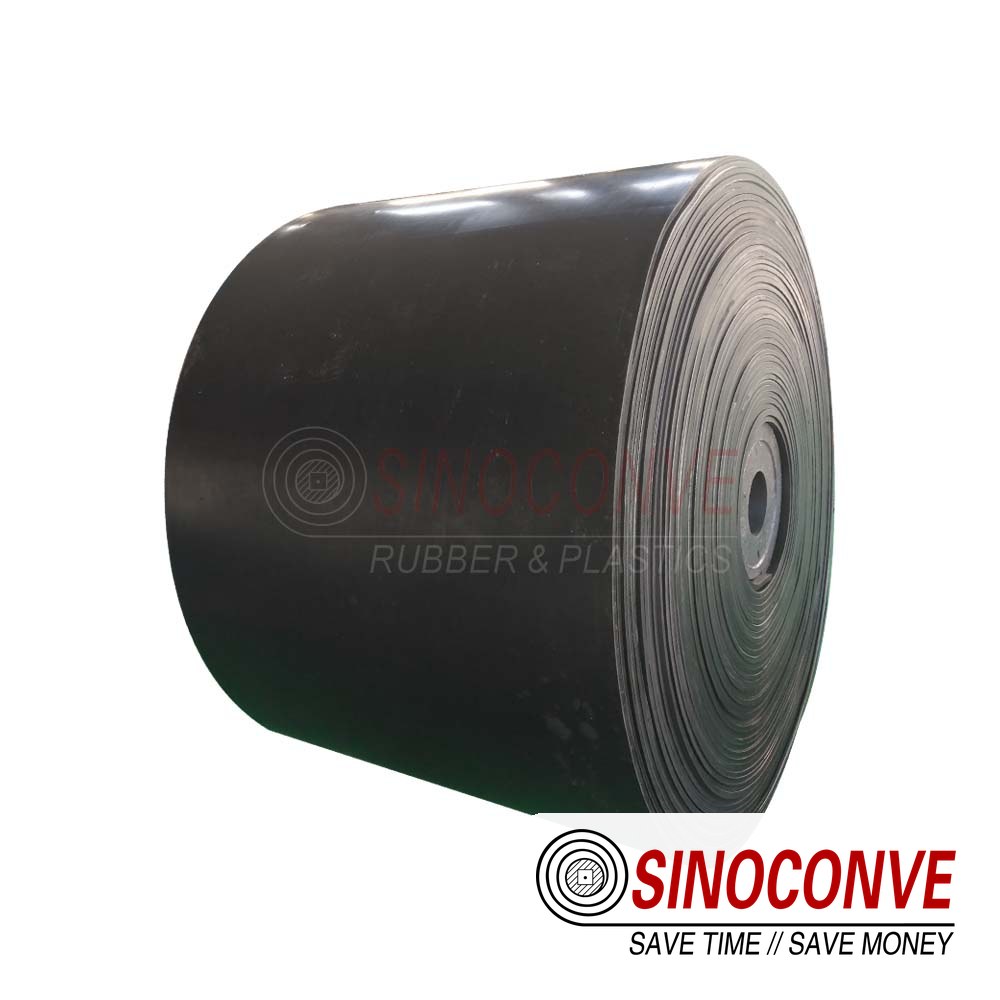
The label names the fibre; the complete build decides how the belt runs.
04The splice and the first weeks of running
At commissioning, some of the yarn crimp straightens under load. Do not guess the recheck interval. Put the belt maker’s instruction on the job card, with a place to write the take-up position and running tension. On a screw system, calculate what stroke is left for later adjustment. A counterweight should be observed through its full working travel; it is no help if the carriage binds.
There is also an easy slip test. Watch the head pulley while the conveyor starts. If it spins beneath a stationary belt, look at grip, lagging, tension and the starting load. If the pulley itself lags behind the motor, look upstream at the drive. Where V-belt products are fitted, the transmission and conveyor belt can create similar noises while failing in different places.
Joint drawing, not just “vulcanised”
Ask for the step layout and cure instructions for the exact ply build. Confirm press size, materials and access at the planned splice position. A mechanical fastener used to get a line running also needs a rating check. The comparison of conveyor belt joint methods sets out the choices; the splicing checklist for buyers helps capture the installation details.
Keep failed joint pieces labelled. Did a shoulder lift near a cut? Was the cure uniform? Did the splice pass a hard scraper on every lap? Those observations are better than a general verdict that NN splices fail or EP splices do not. A long incline may justify EP or a steel cord conveyor belt once the crusher discharge and plant layout and tension calculation are in hand.
| What the operator sees | First places to look | Useful record |
|---|---|---|
| Take-up at the stop | Initial setting, belt growth, stuck carriage | Stroke left at a known load |
| Belt slips at start | Tension, lagging, load, pulley speed | Short video showing pulley and belt |
| Splice shoulder opens | Cut face, cure, water path, flexing | Joint record and labelled sample |
| Cover bruises under chute | Drop and support beneath the belt | Chute and impact-zone photographs |
| Fine carryback on return | Cleaner and dirty rolls | Roll condition after cleaning |
05Wet cover or wet carcass?
Fibre matters once water reaches it: nylon takes up more than polyester. From outside, though, a soaked cover and a soaked ply can look much the same. Trace an opening before assigning the failure to rain. Label and retain the failed piece; otherwise the cause of an opened joint will be guessed at over a photograph. The cure, a dirty bonding surface and too much bending also belong on the list.
At a wash plant, note rain, spray, wet feed and washdown separately. Look at the edges and splice shoulders with the belt stopped safely. An intact rubber cover is one condition; an open cut held under wet fines all shift is another. EP may be the easier choice for a cramped take-up in wet service. The joint still needs to be sound.
The cover comes next. Use the rubber cover grades guide to discuss abrasion, cuts, oil or heat in the material. A steep incline might call for chevron belt products. Draw those ribs on the skirt detail before ordering. They do not alter the warp extension underneath.
Mark the damaged edge and keep a cut sample for inspection.
06Read the edge before adjusting tracking
From the flat tail pulley to the first full trough set: ________ mm. Trough angle: ________. Wing rolls free to turn: yes / no. Put those three entries beside a photo of each edge. A short transition can put strain into the shoulders. So can a worn wing roll. One polished edge against the frame points somewhere else again.
Observe from a guarded position while it runs loaded. Stop and isolate the equipment for measurements. Check the skirt gap again with the line empty; the belt may have occupied a different position under the material. A bent skirt or off-centre feed can make the same mess. Work through the belt tracking diagnostic before moving idlers. Where dirty return rolls are involved, see cleaning methods and when scrapers will not work.
Do not order NN merely to make a deep trough, or reject EP because its warp is polyester. Ask for the troughability and transition recommendation for the proposed width, ply count and working tension. The finished belt, rather than a fibre label, must fit that transition.
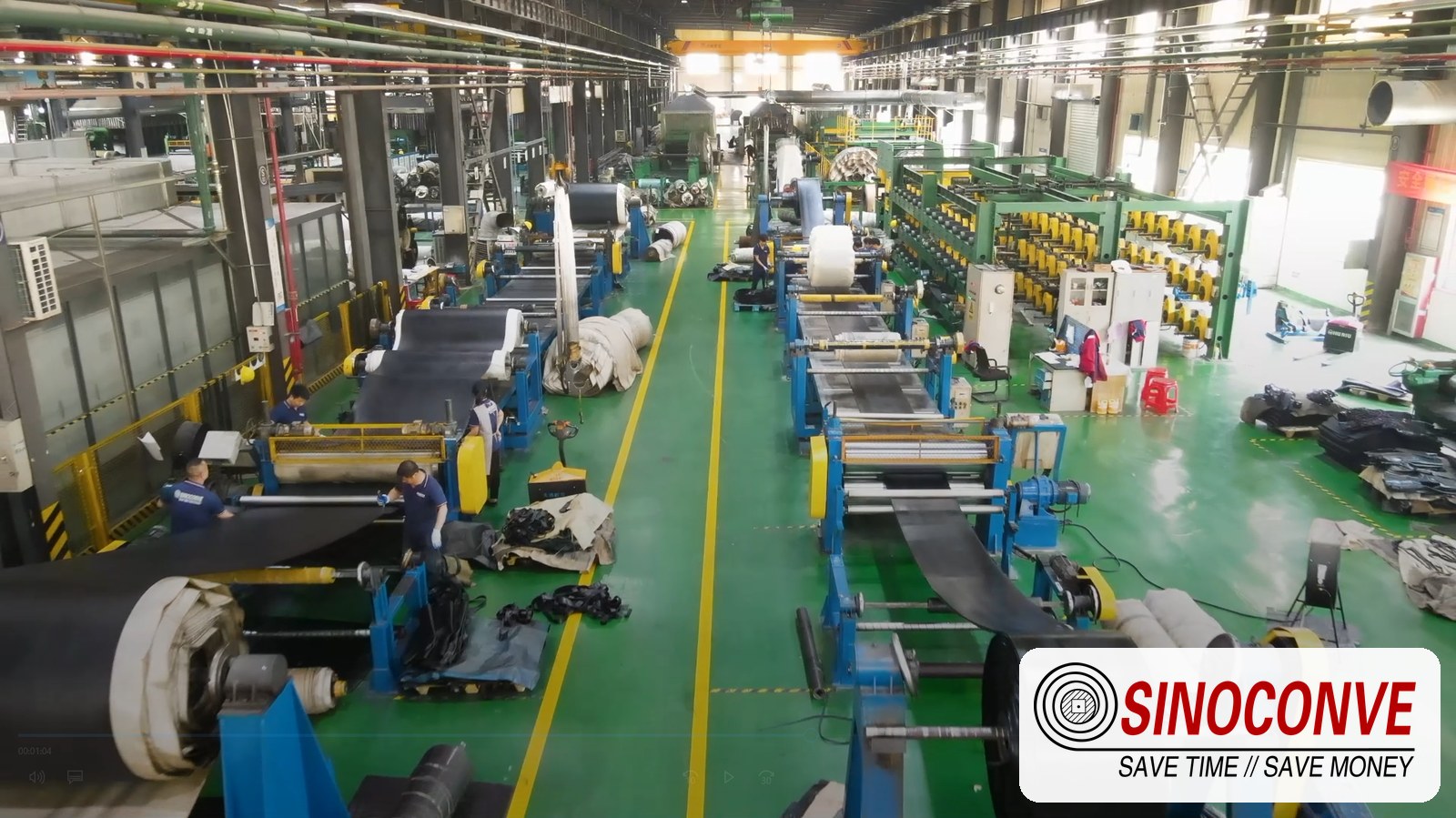
Fabric conveyor belt production line.
07The enquiry sheet
Send the belt path and a side view of the take-up. Add the old marking and any tension log. The blanks in the table are deliberate: filling them on the machine is quicker than another exchange of emails about an NN or EP label.
| Write this down | Why it matters | Attach |
|---|---|---|
| Centre distance, slope, take-up stroke | Stretch allowance and running tension | Conveyor path and tail photo |
| Starts per shift; loaded restarts | Tension cycling and slip diagnosis | Operating note |
| Largest lump, drop height | Impact and support | Side view of chute |
| Wet feed, rain, washdown, temperature | Water route and cover selection | Photo of damaged edge or splice |
| Pulleys, trough angle, transition | Flexing and edge stress | Dimensions and idler drawing |
| Site splice method and press | Joint design and access | Joint photo and equipment list |
Ask for working extension, permanent growth, minimum pulley diameters, troughability, transition length and splice drawing for the offered belt. If one is missing, leave it open on the purchase sheet. A catalogue strength value alone cannot close the question. Our frequently asked questions page handles general product points; the contact link below is for a drawing-based review.

08Questions that come up after the quote
Can an NN belt replace an EP belt?
Maybe. Measure the take-up stroke and compare the proposed working extension first. Then check pulley diameters, belt thickness, transition and splice materials. A matching width and strength mark is only the start of that check.
Why was the tail screw adjusted twice after fitting?
The new weave settles as it carries load. Date and measure each adjustment. If movement continues past the maker’s allowance, review tension and construction before turning the screw again.
Will nylon fail in a wash plant?
Wet service alone does not answer that. Inspect edges, cuts and joints for a route into the fabric. Compare the complete belt construction and the maker’s adhesion and extension data for the exposure.
Which joint should the crew use?
Get the joint drawing for the actual ply build and working tension. If the crew uses a press, keep its temperature, pressure and cure record. If fasteners are used instead, verify that their rating covers the belt and load.
Why has the edge curled?
Measure the transition, inspect wing rolls and look for rubbing. The wear mark may point to one side, both shoulders or the splice. That pattern is more useful than the fibre name.
What spare should be kept?
Match the installed construction and store the joint materials alongside it. Mark the intended conveyor on the roll, together with its manufacture date. A spare of the right width can still be wrong for the available take-up.
Related Products You May Need
- Rubber conveyor belt range in EP and NN fabric constructions
- EP rubber conveyor belt for long runs and wet duty
- EP stone crusher belt built for aggregate plant discharge points
- Steel cord conveyor belt where tension and distance decide
- Heat resistant belting for clinker, ash and hot sinter
- Full product catalogue with dimensions and construction options
Related Blog Posts
- EP vs NN conveyor belt guide
- Fabric vs steel cord: which carcass fits the conveyor
- Conveying solutions for mining duty and transfer points
- Rubber conveyor belt cover grades explained for buyers
- Cleaning schedules and when scrapers will not work
- Splicing methods, field tips and what each one costs you in downtime