
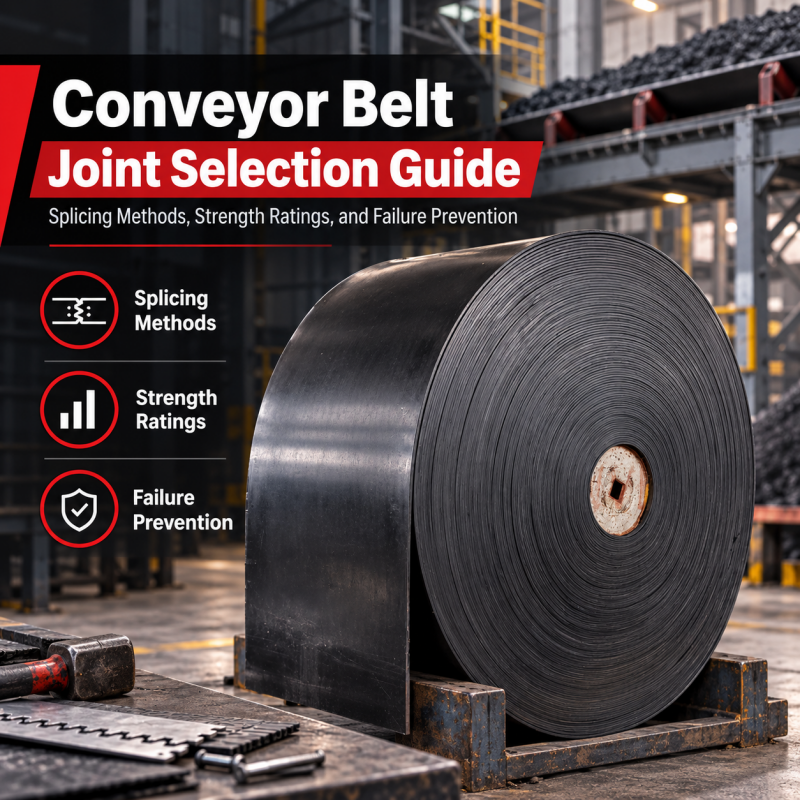
Conveyor Belt Joint Selection Guide: Splicing Methods, Strength Ratings, and Failure Prevention
A conveyor belt almost always fails at its splice long before the rest of the belt carcass wears out. The rubber cover may still maintain adequate thickness, idler rollers turn freely, and drive motors operate smoothly—until a splice edge lifts, a mechanical fastener snags a primary belt cleaner, or carcass ply delamination triggers severe mistracking.
The conveyor belt joint is not merely a connection point; it is the most critical dynamic link in the entire conveyor system. It must continuously transmit longitudinal working tension, endure reverse flexing over drive and snub pulleys, absorb severe loading impact, and maintain precise transverse troughability without causing spillage or structural wear.
Selecting the optimal splice method depends on belt carcass construction (EP fabric, NN fabric, or Steel Cord), rated tension, pulley diameters, environmental conditions, and the allowable maintenance shutdown window.
01What a Conveyor Belt Joint Must Withstand in Real Service
In high-capacity bulk material handling, a conveyor splice operates under relentless mechanical stress. An engineered joint must satisfy four essential operating criteria:
- Tensile Load Transfer: Maintain at least 75% to 90%+ of the nominal belt breaking strength across dynamic start-stop cycles.
- Flex Fatigue Resistance: Pass repeatedly over head, tail, bend, and take-up pulleys without internal ply separation, cleat detachment, or fatigue cracking.
- Cleaner & Skirting Compatibility: Present a flush, low-profile top surface that does not catch on tungsten-carbide or polyurethane belt scrapers, skirt rubbers, or transfer chutes.
- Moisture & Contaminant Sealing: Prevent water, fine abrasive dust, corrosive chemicals, or oils from penetrating the fabric carcass and degrading internal ply adhesion.

02The 4 Primary Conveyor Belt Joint Methods
Industrial conveyor splicing is categorized into four distinct methods, each offering specific trade-offs between tensile strength, installation time, and lifecycle durability:
1. Hot Vulcanized Splice (Highest Strength & Durability)
Hot vulcanization uses heat (approx. 145°C ± 5°C), hydraulic/pneumatic pressure (1.0–1.5 MPa), and uncured intermediate rubber/cements to molecularly crosslink the belt ends into a unified, seamless structure.
- Joint Efficiency: 85% – 100% of original belt rating.
- Best For: Heavy-duty mining, ports, steel mills, cement plants, and long-center overland conveyors.
- Key Advantages: Completely flush surface, zero scraper interference, 100% leak-proof seal, longest service life.
- Limitations: Requires heavy vulcanizing presses, specialized field technicians, and 4–8 hours of planned downtime.
2. Cold Chemical Bonding (Cold Vulcanization)
Cold bonding utilizes a two-part polyurethane/chloroprene chemical adhesive system applied to meticulously buffed, stepped fabric plies at ambient temperatures without a heated press.
- Joint Efficiency: 75% – 85% of original belt rating.
- Best For: Medium-duty fabric belts (EP200–EP500), underground mining where explosion-proof presses are unavailable, and fast on-site repairs.
- Key Advantages: No heavy vulcanizing equipment required; lower tooling cost.
- Limitations: Highly sensitive to humidity, oil, dust contamination, and requires 2–6 hours of adhesive curing before restarting.
3. Mechanical Fastener Joint (Fast Emergency Solution)
Mechanical joints connect belt ends using high-tensile steel hinged rivets, solid-plate fasteners, or staple fasteners clamped through the belt carcass.
- Joint Efficiency: 50% – 70% of original belt rating.
- Best For: Mobile crushers, portable screening plants, aggregate stackers, and emergency breakdown recovery.
- Key Advantages: Fast installation (under 1–2 hours) with portable hand tools; easy to shorten or extend belt length.
- Limitations: Raised profile damages belt cleaners; potential fine material leakage; higher operating noise; lower fatigue life.
4. Stepped-Ply & Finger Splice Geometry
Rather than a square 90° butt cut, high-performance splices utilize an angled bias cut (typically 18° to 22°) with matched stepped plies (for multi-ply EP/NN belts) or finger-interlocking patterns (for PVC/PVG solid woven and single-ply thermoplastic belts). This spreads transverse shear forces across the pulley radius and prevents stress concentration along a single line.
03Engineering Comparison of Joint Methods
Use the matrix below to evaluate splicing methods against your plant's operating priorities:
| Joint Method | Strength Efficiency | Typical Downtime | Scraper & Cleaner Impact |
|---|---|---|---|
| Hot Vulcanized | 85% – 100% (Excellent) | 4 – 8 hours (Long) | Completely flush; zero scraper wear |
| Cold Bonded | 75% – 85% (Good) | 3 – 6 hours (Moderate) | Smooth profile; minimal scraper wear |
| Mechanical Fastener | 50% – 70% (Moderate) | 0.5 – 2 hours (Fast) | Raised plate; requires countersinking |
| Finger Splice | 80% – 95% (High) | 3 – 5 hours (Moderate) | Excellent flexibility over small pulleys |
04Key Factors in Selecting the Right Joint Method
Before executing a splice, maintenance supervisors and plant engineers should verify the following operating parameters:
| Operating Factor | Engineering Splicing Rules |
|---|---|
| Belt Carcass Type | Multi-ply EP/NN belts suit stepped cold/hot vulcanization; Steel Cord belts strictly mandate multi-stage finger hot vulcanizing; PVC/PVG solid woven belts use mechanical or hot finger splicing. |
| Working Tension & Speed | Belts operating above 630 N/mm tension or belt speeds exceeding 2.5 m/s should avoid mechanical fasteners due to severe fatigue cycles. |
| Pulley Diameters | Stiff mechanical fasteners or overly thick cold splice steps will crack on undersized drive pulleys. Always verify minimum pulley diameter ratings per DIN 22101. |
| Material Moisture & Temp | Hot materials (>120°C clinker/coke) or fine wet powders (damp coal/sand) require hot vulcanized joints to prevent chemical breakdown and fine material seepage. |
05Root Causes of Premature Joint Failure & Diagnostic Guide
When a splice fails prematurely, the fault is rarely in the rubber belt alone. Use this diagnostic matrix to identify and correct root causes:
| Observed Failure Mode | Root Cause & Corrective Action |
|---|---|
| Splice Edge Lifting / Peeling | Moisture or dust contamination during gluing; inadequate buffing depth; incorrect bias cut angle relative to belt travel direction. |
| Fastener Pull-Out / Tear | Working tension exceeds fastener capacity; improper fastener pitch; heavy loading impact directly at the splice line. |
| Transverse Cracking at Joint Root | Drive pulley diameter too small; excessive vulcanization temperature causing rubber embrittlement; over-tightened take-up unit. |
| Belt Mistracking Near Splice | Non-square belt cut (centerline alignment error > 1.5 mm); uneven step tension during vulcanization clamp-down. |
06Quality Assurance: Post-Splicing Inspection Checklist
Before returning the conveyor system to full production loading, complete this 6-point verification protocol:
- Squareness & Alignment Check: Verify centerlines of both belt ends align within ±1.0 mm using a 5-point squaring method.
- Edge & Step Uniformity: Confirm joint edges are seamlessly flush with zero steps, blisters, porosity, or exposed fabric threads.
- Unloaded Test Run (30 Mins): Run the conveyor empty at creep speed; observe the joint passing over head, tail, and gravity take-up pulleys.
- Cleaner & Skirting Clearance: Confirm primary and secondary scrapers glide smoothly across the splice seam without chattering or snagging.
- Tracking Verification: Confirm the belt maintains true center tracking before, during, and after the splice passes the idler transition zone.
- 24-Hour Loaded Re-Inspection: Check for edge fraying or heat buildup after the first full production shift.
07Frequently Asked Questions (FAQ)
Q1: Why is an angled bias cut (18°–22°) preferred over a 90° square cut?
A: An angled bias cut ensures the joint does not hit pulleys or belt scrapers all at once across its full width. It distributes dynamic impact forces gradually, reduces operating noise, and increases splice fatigue life by over 30%.
Q2: Can all industrial rubber conveyor belts be hot vulcanized?
A: Most standard multi-ply rubber belts (EP, NN, Steel Cord) are fully suitable for hot vulcanization. However, specific lightweight PVC/PU belts, thin food-grade belts, or worn-out belts with severely degraded carcasses require specialized cold bonding or mechanical fasteners.
Q3: How much overlap length is required for stepped-ply vulcanization?
A: Step length is determined by belt tension and fabric ply rating. As a rule of thumb, each step requires 200 mm to 350 mm per ply, plus a 25 mm–50 mm bias overlap. For high-tension EP500/4 belts, total splice length typically ranges from 800 mm to 1,200 mm.
08Maximize Belt Lifespan with SINOCONVE Engineering
A conveyor belt is only as reliable as its splice. Choosing the correct joint geometry, high-grade unvulcanized splice tie-gum, and compatible cover compounds prevents catastrophic belt parting and costly unscheduled downtime.
📩 Need factory-matched splicing materials, vulcanizing kits, or custom endless belts? Visit our home page or contact SINOCONVE technical support. We provide step-by-step splicing manuals and certified conveyor belting to over 100 countries.

Products You May Need
| EP Rubber Conveyor Belt Polyester-nylon carcass for low elongation, high impact, and superior vulcanized joint retention. |
Steel Cord Conveyor Belt High-tension steel cables designed for long-distance overland conveying and multi-stage finger splicing. |
| Chevron Conveyor Belt Moulded cleat profiles engineered for steep-angle incline bulk handling up to 40°. |
Sidewall Conveyor Belt Corrugated sidewalls and cross cleats for vertical 90° steep elevation in tight plant layouts. |
| Full Product Catalog Browse our full range of fabric, steel cord, heat-resistant, and oil-resistant belts. |
Contact Splicing Specialists Send your belt tension, carcass specs, and operating conditions for custom splicing kits. |
Related Blog Posts
- EP vs NN Conveyor Belt: Which Fabric Carcass Should You Choose?
- Conveyor Belt Sourcing Guide: How to Reduce Downtime
- Unleashing Efficiency: Chevron Rubber Conveyor Belt
- Sidewall Conveyor Belts: Space-Saving Solutions for Steep Transport
- Heat Resistant Rubber Conveyor Belt: Modern Solutions
- How Importers Can Reduce Supply Risk When Choosing an Industrial Belt Supplier