
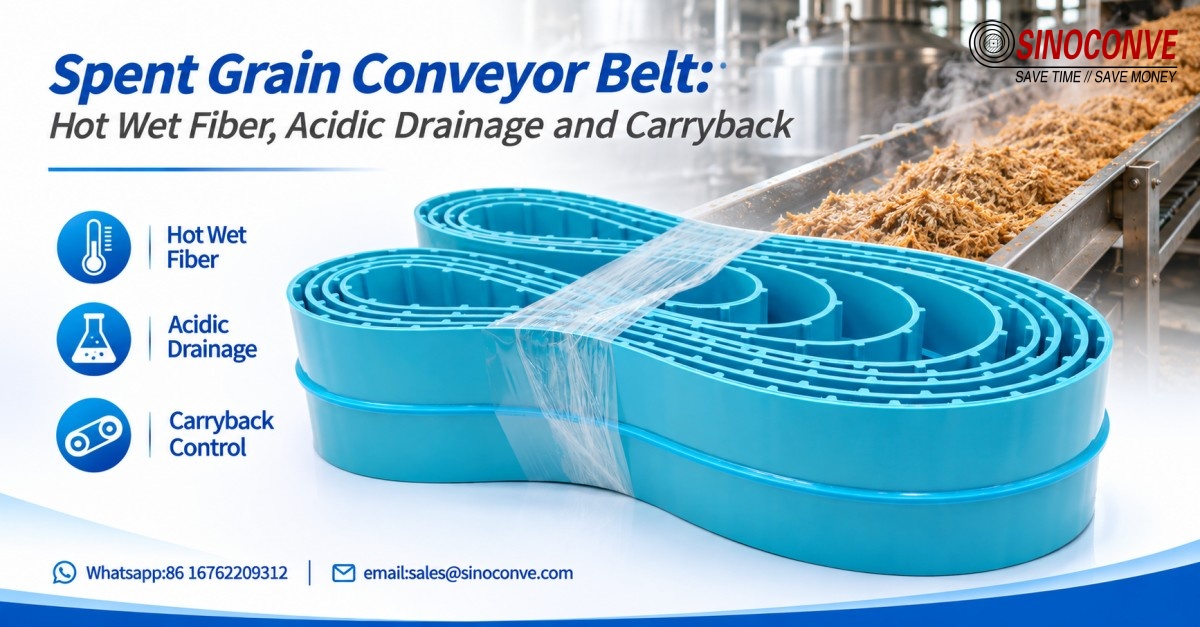
Spent grain does not arrive on a belt. It arrives as a collapsing heap at the bottom of a chute, steaming, dripping, and already heavier than the thin sheet of dry malt the line was originally sized around. Anyone who has stood under a lauter tun door at shift start knows the splash pattern. The first meter of belt takes a slug, not a feed rate.
That single fact drives every specification decision on this page. Brewery spent grain, wet brewers grain, draff, whatever the plant calls it, is a hot fibrous by-product with free liquid still draining out of it. It compacts into a cake within a few meters of travel, weeps at the edges, wraps anything that protrudes, and begins to sour wherever it sits. A belt that survives dry grain or dry feed pellets will not automatically survive this material, and the failures tend to appear at the splice, the skirt line and the return rollers rather than in the middle of the carry side.
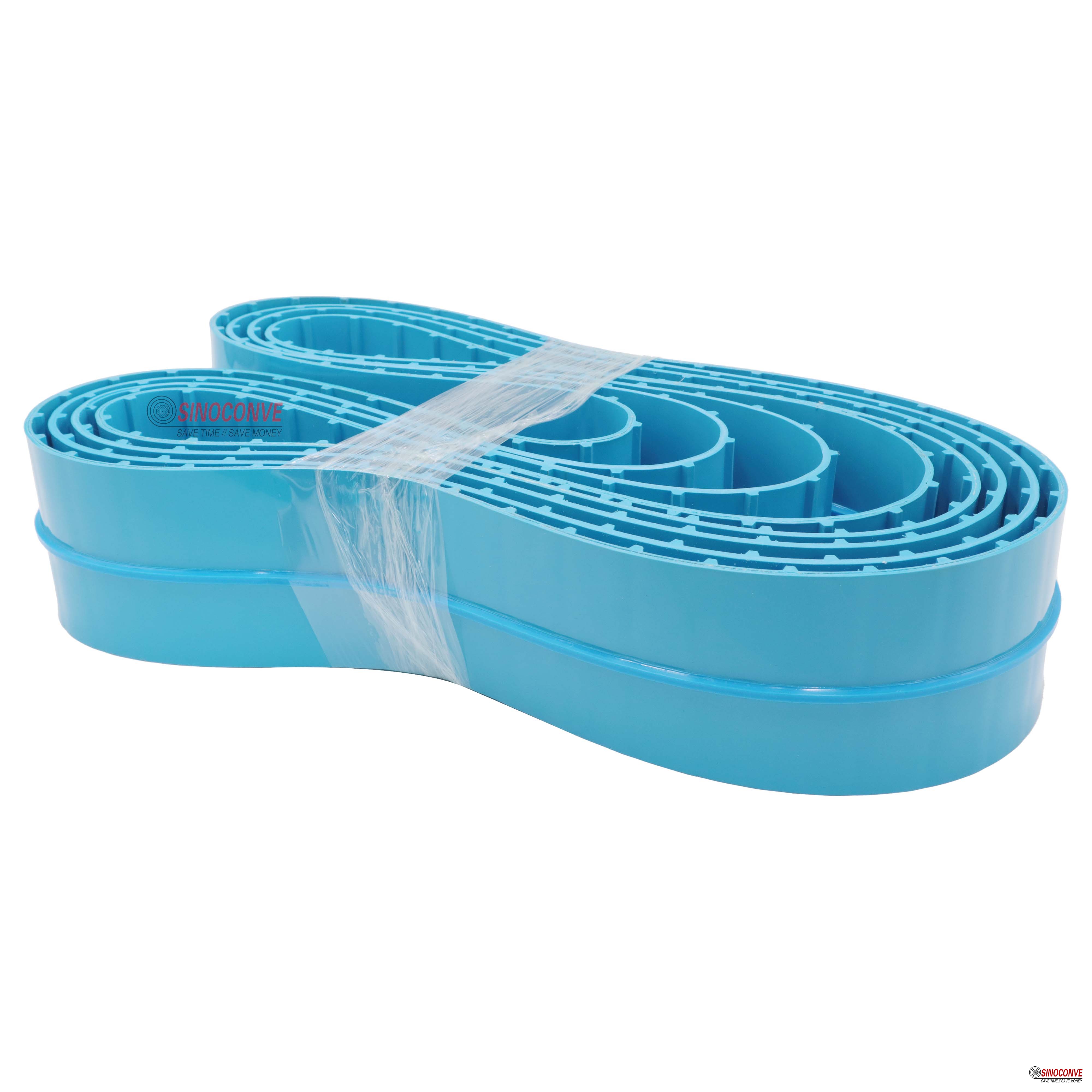
A low-retention cover in a food-processing grade, photographed before slitting and splicing.

01Why Spent Grain Becomes a Different Conveyor Load
A malt house moves a kernel. A brewhouse moves a drained fiber mass that happens to contain husks, and the gap between those two materials is wider than most line upgrades assume. We have been called to plants where a belt bought for dry malt was moved one floor down to the spent grain run, on the reasoning that both streams come out of the same building. It rarely ends well. The belt is not too weak. It is simply wrong in the places that matter.
What Leaves the Lauter Tun Is Not Grain
Look at the discharge closely and the structure becomes obvious. Husk fractions give the mass its skeleton. Fine grit and coagulated protein fill the gaps, and residual extract keeps the whole thing tacky. Free wort drains out of it for minutes after the door opens, so the material reaches the belt with a liquid phase that is still mobile. Heat comes with it, and so does steam, which condenses on every cool surface in the transfer tower and drips back onto the belt.
Mechanically, the mass sits somewhere between a wet soil and a damp fibrous pulp. Squeeze a handful and it holds shape. Smear it across a smooth surface and it leaves a film that will not run off. That combination is what defeats a cover chosen only for abrasion resistance. Abrasion is not the enemy here. Adhesion, compression and liquid are. When we survey a brewhouse we spend more time watching the discharge and the return run than reading the datasheet the plant bought against.
Four Behaviors That Break a Dry-Grain Belt Design
Compaction comes first, and it comes fast. Within the first few meters the heap stops behaving like loose material and starts riding as a slab. From that point the belt is no longer carrying grain, it is carrying a mat that grips the cover and resists every attempt by the skirt rubber to keep it centred. Load surges make this worse, because a fresh slug lands on a surface that is already coated.
Then there is edge weeping. Liquid pressed out of the cake migrates sideways, and the belt edge is where it collects. On a fabric belt with an open cut edge, that moisture works into the plies and stays there. Splice steps lift. Cover-to-carcass adhesion at the joint becomes the weakest point on the whole run, which is exactly what we tell buyers to look at when they compare quotations from any conveyor belt manufacturer.
Fiber wrap is the third, and it is the one that gets noticed only after the belt has already started to misalign. Husks and long fibers hook on return roller brackets, on the backs of skirt clamps, on bolt threads, on anything with a lip. The wrap consolidates into a hard ring that lifts the belt locally. A plant will chase the resulting tracking problem for weeks without noticing the dough-like collar on a single return roller. We wrote a separate note on reducing carryback sludge because the same mechanism shows up on sludge and pulp lines.
Carryback closes the loop. A wet film clings to the cover past the head pulley, drops onto the return strand, and gets pressed into the belt by every roller it passes. Fermentation follows in any pocket that holds cake overnight, and the smell is the honest indicator that the cleaning regime is losing. None of these four behaviors is solved by a thicker cover. They are solved by surface release, edge integrity, joint flatness and access for cleaning, which is why the rest of this page is organised around those four levers rather than around tensile grade.
Field note from our engineers: On a brewery line in eastern China we were asked to fix a tracking fault on a 800 mm spent grain belt. The belt was fine. The tail pulley had a collar of dried grain roughly the size of a fist on one side, built up over two weeks of night shifts, and the plant had been adjusting the take-up to compensate. We scraped the pulley, reset the take-up to its original mark, and the belt ran true. The lesson was not about tracking at all. It was about how quickly this material finds a place to accumulate where nobody looks.
02Where Malt Handling Ends and Spent-Grain Handling Begins
Three guides on this site now touch the same brewery, so the boundaries need to be explicit rather than implied. The dividing line is the lauter tun or mash filter door. Upstream of that door the material is dry, free-flowing and destined for the mill. Downstream of it the material is a hot wet by-product destined for a press, a trailer or a feed mixer. Nothing in between belongs to both pages.
If your question is about steeping, germination, kilning, rootlet removal or the dry malt run into the mill, the relevant guide is malt conveyor belt selection for the malting stage. That article stops at the mill inlet for good reason: dry kilned malt is abrasive and warm, but it does not drain, it does not cohere into a slab, and it does not ferment in a dead corner. Cover choice there is dominated by abrasion and by keeping the kernel intact.
If your question is about receiving raw barley, dryer infeed, silo discharge or truck loadout of dry grain, the relevant guide is grain elevator conveyor belt design for dry bulk storage. That page deals with dust, free-flowing fill, silo geometry and dry loadout. Spent grain shares none of those conditions after the first meter. It is a soft, wet, cohesive cake, and the equipment around it has more in common with a dewatering line than with a silo.
Three Questions That Settle the Boundary
Ask whether the material drains free liquid. If it does, you are on this page. Ask whether it holds shape when squeezed in a gloved hand. If it does, you are on this page. Ask whether a heap of it left overnight will heat, sour or grow a skin. A yes to that question settles the argument, because dry grain in a silo does none of those things, and a belt specified for silo duty has no answer for any of them.
The table below is the version we use in meetings when a plant has one maintenance budget and three different conveying problems. It is deliberately blunt about who owns what, because mixed ownership is how a spent grain line ends up with a cleaner designed for cereal dust.
| Process stage in the brewery or malt house | Material condition we see at that point | Which guide owns the belt specification | Reason the boundary sits exactly there |
|---|---|---|---|
| Road intake, dryer and silo for raw barley | Dry, free-flowing grain carrying dust and light chaff | The dry bulk storage guide owns this stage | Nothing here drains liquid or ferments in place |
| Steeping, germination, kilning and rootlet removal | Dry kilned malt, warm and mildly abrasive to the cover | The malting stage guide owns this stage | The material ends at the mill inlet, still dry |
| Lauter tun or mash filter discharge | Hot wet husk mass with free wort still draining | This spent grain guide owns the boundary | Liquid, heat and fermentation all start at this point |
| Dewatering press feed and press discharge | Compressed cake that still weeps at the trimmed edges | This spent grain guide owns the press line | The cake is cohesive and no longer free-flowing |
| Loadout to farm trailer or feed mixer | Cooled, dense cake with a wet outer skin | The outbound logistics guide owns this leg | Handling is now batch, truck and yard based |
The boundary has a practical consequence for tendering. A brewery that buys one belt specification for the whole building is buying a compromise, and the compromise usually fails on the wet side. Read the stage list above, split the enquiry at the lauter tun door, and send two duty sheets. Our own conveyor belt factory quotes those two lines separately for exactly this reason, and the price difference is smaller than the cost of one unplanned stoppage. If you are still mapping the plant, the industry overview at belt specifications by industry is a reasonable place to see how the segments are usually divided.
03Receiving the First Hot Wet Discharge Without Packing the Chute
The discharge end is where a spent grain line is won or lost, and it is usually the part of the layout that gets the least drawing time. A lauter tun door opens and the material comes out as a surge with a steep leading edge. It hits whatever is underneath with more energy than the steady-state calculation suggests, and it arrives with liquid that will separate the moment it is disturbed.
Chute Geometry and the Bridge That Forms Overnight
Treat the chute as a vessel with a moving floor rather than as a slide. Any horizontal ledge, any bolted flange with an exposed lip, any inspection hatch that steps into the flow will hold a pocket of cake. That pocket drains, dries at the surface, and turns into a shelf. The next surge bridges across it. Once bridging starts the chute either blocks or dumps its whole contents in one go, and both outcomes end with a shovel and a stopped line.
We prefer a chute that stays steep through its whole length, with a straight back plate and no sudden change of section. Where a transition is unavoidable, put it above the material surface, not in the flow path. Doors should be flush on the inside. If the plant needs an inspection opening, hinge it on the outside face and keep the inner line continuous. The same discipline appears in clean food handling layouts, which is why we usually point breweries at the food and packaging conveying overview when the transfer tower is being redrawn.
Skirting, Baffles and the First Meter of Belt
Skirt rubber should guide, not clamp. Press it hard against a wet fibrous cake and the material squeezes sideways under the skirt instead of being contained, taking the fines with it and leaving a ridge of grit on the belt edge. Leave a small controlled gap, use a soft compound, and let the skirt wear in against the cake rather than against the cover. A relief cut at the trailing end prevents the skirt from folding under itself when the belt reverses for cleaning. A short impact cradle under the load point belongs in the same drawing.
Width matters more than people expect. A belt chosen on average tonnage will spill on the surge, and spilled cake under the chute is the beginning of the return-side problem described later. Ask for the peak discharge, not the daily average, and size the width so the deepest cake still sits inside the skirt line with margin. When the enquiry goes out to wholesale conveyor belts suppliers, that peak figure is the one number that changes the whole quotation.
04Belt Surface, Carcass and Splice Choices for Wet Fiber
Once the material is on the belt and moving, the questions narrow to three: does the cover release the cake, does the carcass survive the moisture, and does the joint stay flat. Everything else is secondary. This is the part of the specification where buyers most often accept whatever the quotation says, and where a small difference in cover compound shows up eighteen months later as a lifted splice.
Surface Topography and Liquid Release
A smooth cover releases wet fiber better than a textured one. That statement surprises plants that have been told texture improves grip, and grip is genuinely useful on an incline. On a spent grain run, though, every groove and every fabric impression is a reservoir. Fines pack into it, the packed layer holds moisture against the cover, and the next scrape passes over a lubricated mat instead of cleaning the belt. Deep impressions are the worst case because they cannot be brushed out during a shift.
Drainage grooves are a real compromise rather than a solution. They move free liquid away from the cake on a flat run, then clog with fiber within a few days if nobody brushes them. We specify them only where the belt is short, accessible and washed daily. For most press feed and incline duty we would rather have a plain low-friction surface and a properly drained chute than a patterned cover doing two jobs badly. Our PVC conveyor belt range covers the light-duty end of that logic, and the food handling notes at PU belts for hygienic food lines explain where a polyurethane top earns its cost.
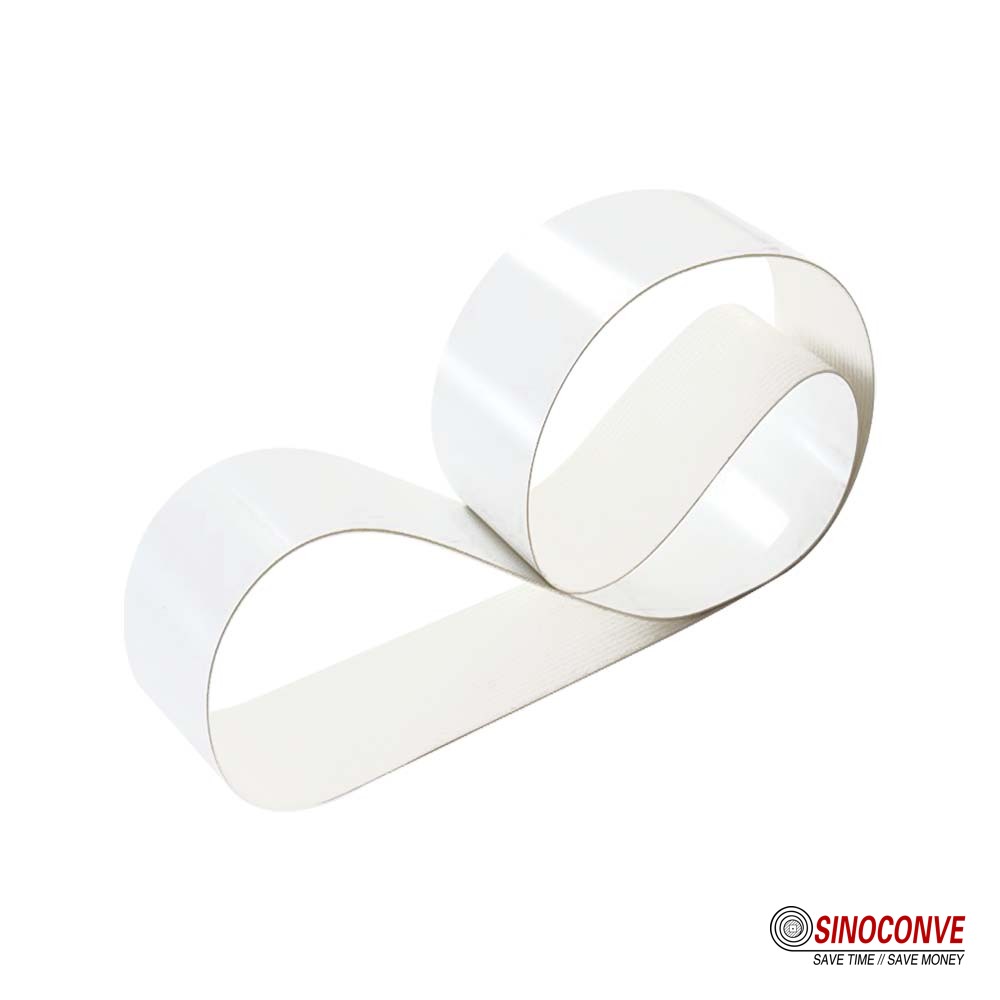
Plain cover, sealed edge, no exposed fabric at the join. The details that keep wet fiber from finding a home.
Carcass, Edge and Splice Details That Survive Wet Starts
Fabric carcasses are the normal choice at this duty, and the ply count is less interesting than how the edges are finished. An open cut edge wicks moisture into the carcass by capillary action every time the belt runs through a wet zone. Once the edge softens, the plies separate and the belt starts to dish. Sealed or gummed edges cost a little more per meter and are worth it on any line with washdown or standing water under the return strand.
Splice design decides how long the belt lasts. A stepped, vulcanised joint with the steps cut along the load direction keeps the surface flat and spreads shear across several interfaces. Mechanical fasteners are quicker to install and much easier to inspect, but the plates create a step that a scraper blade will catch, and a caught fastener tears the blade and the belt in the same event. Where a mechanical joint is unavoidable because the take-up has no reserve travel, use it as a temporary repair and plan the vulcanised replacement.
Cover thickness is a trade that should be made with the pulley diameters in hand. Thicker covers last longer against abrasion but stiffen the belt, and a stiff belt on a small head pulley cracks along the splice line. If the existing pulleys are small, a thinner cover on a flexible carcass will outlast a heavy cover that is being over-flexed every revolution. We would rather adjust the cover than change the pulley, but the drawing has to be checked before either decision is made. Buyers comparing an industrial conveyor belt against a light-duty belt should note that the heavy carcass is not automatically the better answer on a short wet run.
| Surface option we quote for this duty | How it behaves under hot wet fiber | Where we would normally shortlist it | What the buyer has to verify |
|---|---|---|---|
| Smooth polyurethane cover with a matte finish | Releases cake well and resists smearing under the scraper | Short press feed belts and inclined runs | Product contact documents for the intended use |
| White rubber cover on a fabric carcass | Grips a wet incline but holds a thin film longer | Steady low-angle runs without daily washdown | Cleaning method the supplier actually allows |
| Light PVC cover with a low-friction top | Cleanest release but softens under sustained heat | Cooled cake and outbound packing lines | Actual cake temperature measured at the press |
| Fabric impression top with a visible weave | Traps fines in the weave and grows a sour mat | Almost nowhere on a spent grain line | Why the texture is needed at all |
| Grooved or ribbed top used for drainage | Drains free liquid but the grooves pack with fiber | Wet sorting tables ahead of the press | Access for brushing the grooves every shift |
Food contact is a separate conversation from belt construction, and it should stay that way. We build surfaces that a plant can put forward for product contact review, and we supply the material documentation that goes with them. We do not tell a brewery that a belt is approved for their process. That judgement belongs to the buyer, against the documents their own quality team accepts, and any supplier who shortcuts that step is handing the plant a liability. The checklist at food grade PVC belt checks for buyers is a reasonable starting point for that review.
05Drainage, Cleaner Staging and Return-Side Fiber Wrap
Everything that leaves the carry side ends up somewhere. On a spent grain line, a good share of it ends up on the return strand, then on the floor, then in the drain. The engineering question is not how to eliminate carryback, because no scraper removes a wet fiber film completely. The question is where to put the residue so that it can be removed by a person with a hose in under a minute.
Where the Liquid Actually Goes
Free liquid leaves the cake at three points: the discharge, the first compression zone under the skirt, and the head pulley where the belt curves away. A troughing belt concentrates what is left along the centre line, and a flat belt pushes it to one edge depending on the camber of the frame. Both patterns are predictable, and both can be caught with a drain pan that has a real fall on it.
Scraper Staging and the Return Run
Stage the cleaning rather than asking one blade to do everything. A primary scraper mounted close to the head pulley takes the bulk of the cake while it is still coherent. A secondary unit a little further around removes the film. Both need consistent pressure, and that means a spring or counterweight arrangement that an operator can check by hand, not a fixed bracket that was set once at commissioning. A polyurethane blade holds an edge on a smooth cover; a rubber blade is more forgiving on a worn or uneven surface but passes more film.
Angling the primary blade slightly across the belt helps move residue to one side where a chute can catch it. On a rubber conveyor belt with a textured cover, expect the blade to wear faster and plan the adjustment interval accordingly. The wider principles are set out in our note on return side belt cleaning, and the practical schedule question is covered in cleaning methods and when scrapers will not work.
The return run then needs its own defence. Standard return rollers with a smooth shell are an invitation: fiber wraps, compresses, and forms the collar described earlier. Disc return rollers shed most of it because there is no continuous surface for the fiber to grip. Spiral rollers do the same job with a different geometry. Either way, fit them on the first three or four return positions after the head pulley, where the belt is still wet, and leave conventional rollers further back where the surface has dried.
Access decides whether any of this gets done. If a cleaner is mounted behind a guard that needs two spanners and a ladder, it will be inspected quarterly at best. Hinged guards, a wash point near the head, and a floor that drains away from the frame turn a twenty-minute job into a two-minute one, and that difference is what keeps a spent grain line from developing the sour smell that tells everyone in the building the maintenance regime has slipped. A wash-down routine also has to suit the cover, which is why we ask plants to describe the chemicals they actually use rather than the ones on the procedure board. The same reasoning sits behind the spray cleaning approach described in belt spray cleaning in practice.
Field note from our engineers: A press cake line we visited had two scrapers, both correctly tensioned, and still left a trail of cake on the floor every shift. The problem was the blade material. Someone had fitted a hard polyurethane blade to a belt with a worn cover, and the blade was skating across the high spots instead of following the surface. We changed to a softer compound, reduced the pressure, and the trail stopped. The belt had not changed at all. On wet fiber, cleaner tuning matters more than cleaner force.
06Tracking Through Wet Starts and Variable Cake Loading
Spent grain lines tend to start loaded. The press is empty, the belt has been sitting under a cake that drained overnight, and the drive has to break the whole thing loose at once. That single condition explains most of the tracking complaints we hear, and it is rarely a belt manufacturing fault.
Tension, Traction and the Wet Start
Wet covers lose friction against the drive pulley, and the loss is worst on the first revolution after a washdown. Lagging helps, but only if it is grooved or ceramic in a pattern that lets water escape rather than sitting under the belt. Check the take-up reserve before winter, not during a stoppage. A belt that has already used most of its travel has nowhere to go when the splice settles.
Resist the temptation to over-tension a misbehaving belt. Extra tension raises the load on the pulley bearings, pulls the edges tight against the skirt, and makes the splice work harder, all without addressing the cause. If the belt runs true empty and wanders when loaded, the problem is the loading pattern or the frame alignment. If it wanders in both states, look at the pulleys. Our belt tracking guide for fabric carcass belts walks through that sequence in order, and it applies to wet fiber as well as to aggregate.
Drive side details matter too. A spent grain line usually runs at low speed, so the reducer and the drive belts are often overlooked until they slip. We supply V-belts for the drive package alongside conveyor belting, and as a V-belt manufacturer we see the same failure pattern on brewery drives that we see on quarry drives: matched sets replaced one belt at a time until the whole set runs unevenly. Replace the set, check the sheave wear, and re-tension after the first shift.
Loading pattern is the other half of tracking. A discharge that lands to one side pushes the cake into a curve, and the belt follows the load. Correcting it with the training idlers is a temporary fix that hides a chute problem. Fix the chute, then align the frame, then let the training idlers do the small corrections they were designed for. If the spent grain leaves the press and enters a yard or feed system, the same logic carries over to the outbound leg covered under agricultural conveying applications and the warehousing and loading bay layouts that follow it.
07RFQ, Acceptance and Shift Inspection Checklist
A spent grain enquiry that contains only width, length and "heat resistant" will produce a quotation that is wrong in at least two places. Send the layout, the peak discharge, the cake thickness, the washdown routine and the pulley diameters. If the belt has to be installed through a hatch, say so, because splice design is decided by access as much as by load.
Acceptance should be a sequence rather than a signature. Check the belt on arrival against the approved drawing, run it empty, then run it loaded for a full shift with the scrapers at working pressure. Look at the return side after that shift, not before.
| Checkpoint we write into the order | When it gets verified in the project | Pass condition we accept at site | Record that the buyer should keep on file |
|---|---|---|---|
| Discharge rate range and peak slug size | Before the quotation is fixed in writing | Belt width covers the peak without spill | Signed duty sheet with the measured peaks |
| Cake thickness and the typical load profile | During the site survey walk with production | Skirt height clears the deepest cake | Photographs of the loaded belt in normal run |
| Pulley diameters and available take-up travel | At the drawing approval stage of the order | Splice opens with the take-up still in reserve | Approved general arrangement drawing with dimensions |
| Washdown routine and the chemicals actually used | Before the cover grade is confirmed | Cover survives the real cleaning routine | Cleaning procedure sheet from the plant |
| Splice access and the available shutdown window | When the installation plan is agreed | Joint fits inside one planned stoppage | Splice report with cure records attached |
When the line reaches the end of its life, the replacement decision should start from the same duty sheet, not from the old belt's dimensions. Lines get faster, cakes get thicker and washdown routines change. An item ordered from a conveyor belt supplier who still has the original drawing will quote the original belt. That may be exactly right, and it may be two covers out of date. Send the current numbers, and ask for the joint to be planned around your shutdown rather than around a standard length.
Distributors and OEMs building these lines for a brewery group usually need a consistent specification across several sites. That is where a conveyor belt distributor arrangement with a fixed cover, a fixed splice pattern and a documented inspection sheet pays for itself, because the maintenance team can move between buildings without relearning the belt. The same applies to the drive package, where a single transmission belt manufacturer for all sites removes a surprising amount of storekeeping.
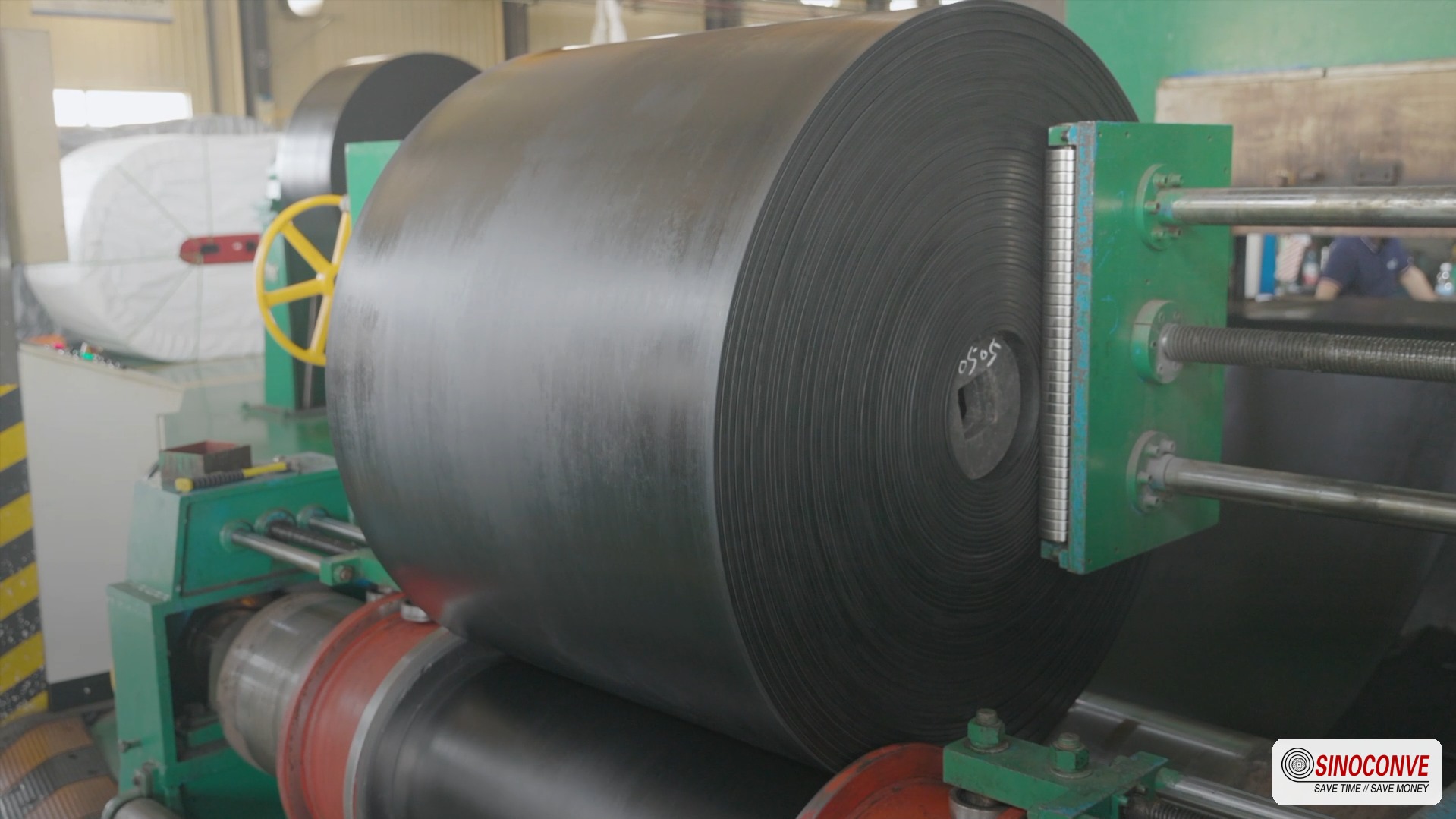
Final inspection before packing. Every belt leaves with its dimensions and joint plan checked against the approved drawing.

08Frequently Asked Questions
Can we run spent grain on the same belt that carries dry malt?
No. Dry malt and spent grain need different surfaces, different joints and different cleaning. The wet material compacts into a cake, drains liquid at the edges and wraps the return rollers, and a cover chosen for abrasive dry grain has no answer for any of that.
Which cover surface releases wet brewers grain best?
A smooth, low-friction top generally releases the cake most cleanly, because there is no texture for fines to pack into. Polyurethane and light PVC both work on the right duty. What matters more than the family name is the actual cake temperature at the press, which is why we ask for a measurement rather than an estimate.
Do we need cleats or sidewalls on an inclined spent grain run?
Sometimes, and less often than people assume. Cleats help when the incline is steep enough that the cake would slide, but they also create pockets that hold fiber and resist cleaning. A short flight with open corners and a smooth face is usually better than a tall cleat that traps material against itself.
How do we stop fiber from wrapping the return rollers?
Give it nothing to grip. Disc or spiral return rollers shed fiber far better than a plain shell, and they should be fitted on the first few positions after the head pulley where the belt is still wet. Add a wash point and a hinged guard so somebody can actually clear the frame during a shift.
Is a mechanical fastener acceptable for the joint?
As a temporary repair, yes. As a permanent joint on a line with scrapers, it is a liability, because the plates create a step that catches the blade. A stepped vulcanised splice keeps the surface flat and is the normal choice wherever the take-up has enough travel to allow it.
What information do you need to quote a brewery spent grain line?
Send the layout, the peak discharge rather than the daily average, the cake thickness, the pulley diameters, the take-up travel, the washdown routine and the splice access. With those six items we can size the belt and plan the joint without guessing at the duty.
Related Products You May Need
- PVC conveyor belt for wet and light food duty
- Rubber conveyor belt for heavier loaded runs
- Conveyor rollers and return idler options
- V-belts for the press and drive package
Related Blog Posts