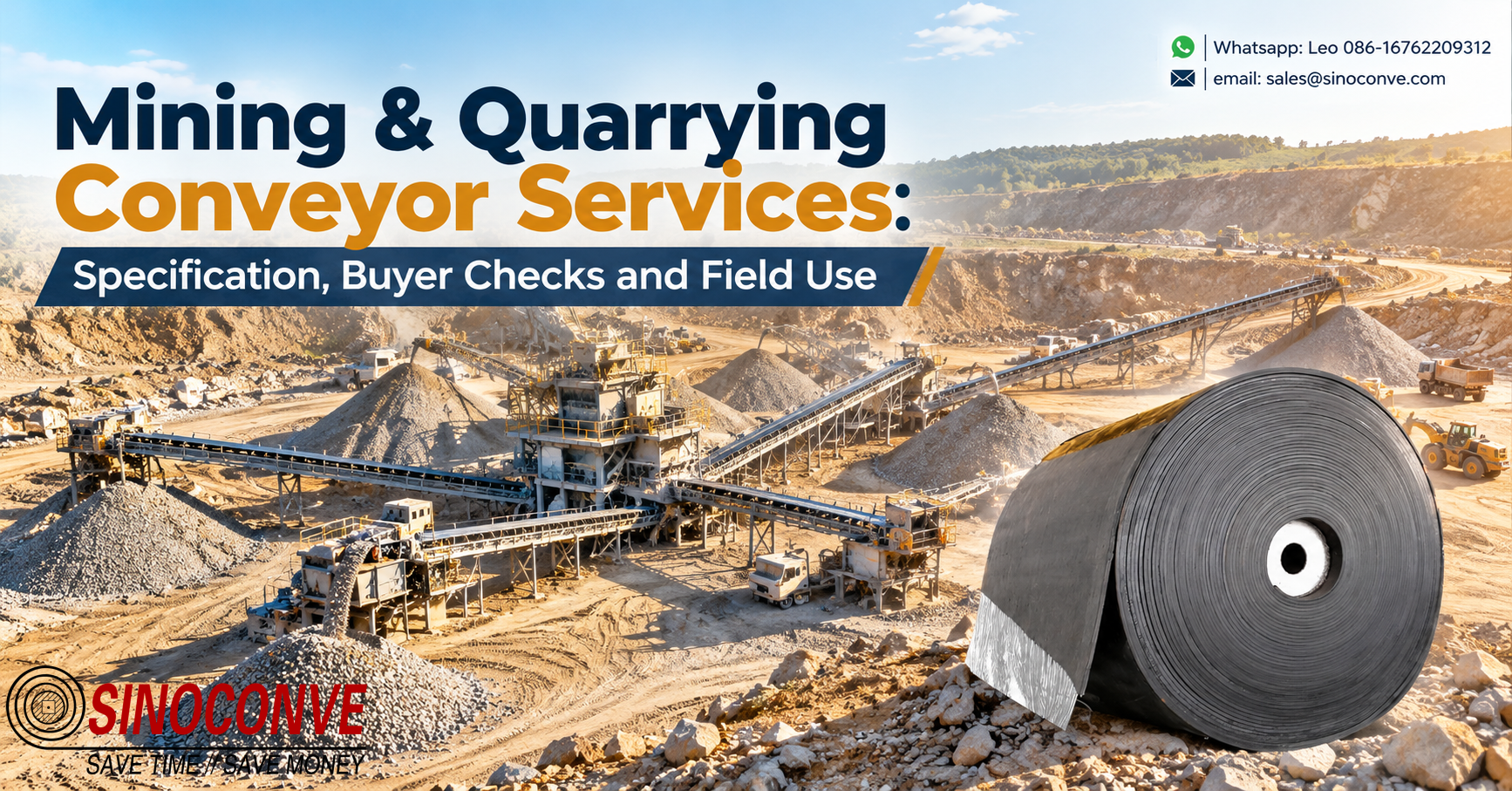

Quarry and stone-crushing conveyors operate in a high-energy environment. Large, sharp, and irregular material can strike the belt at the loading point, cut the cover, gouge the surface, damage the carcass, and create a tear that grows during continuous operation.
Many buyers start with a single question: “What is the most abrasion-resistant conveyor belt?” Abrasion matters, but it is only one part of the selection. A belt can have good laboratory wear performance and still fail early when the actual problem is impact, trapped stone, edge damage, mistracking, or an unsuitable loading arrangement.
For quarry operators, OEMs, importers, and distributors, the better method is to identify the dominant failure mechanism first and then match the cover, carcass, splice, and system conditions to that risk.
Why abrasion grade alone does not solve quarry belt failure
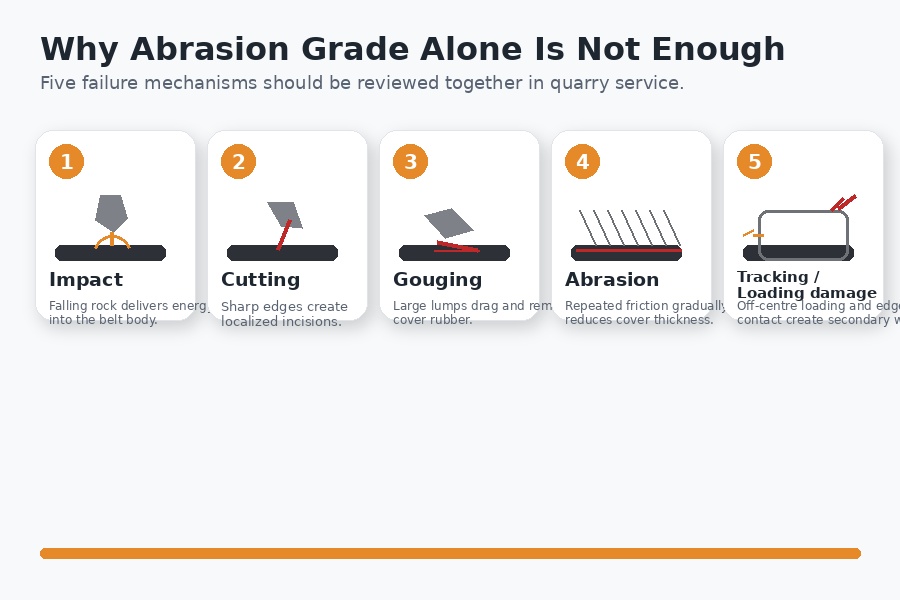
Uniform abrasion removes material gradually across the cover. Impact and gouging are different. A large rock can deliver a concentrated load that creates a deep cut or damages the reinforcement in one event. Repeated sharp contact can then turn a local defect into a longitudinal tear.
A quarry belt should therefore be reviewed against at least five mechanisms:
- Impact: energy delivered when material falls onto the belt.
- Cutting: sharp edges create localized incisions in the cover.
- Gouging: large pieces drag across the cover and remove rubber.
- Abrasion: repeated friction gradually reduces the cover.
- Tracking and loading damage: edge contact, spillage, skirt friction, and off-centre loading create secondary wear.
The belt selection should address the combination that actually appears on site.
Seven data points to collect before choosing the belt
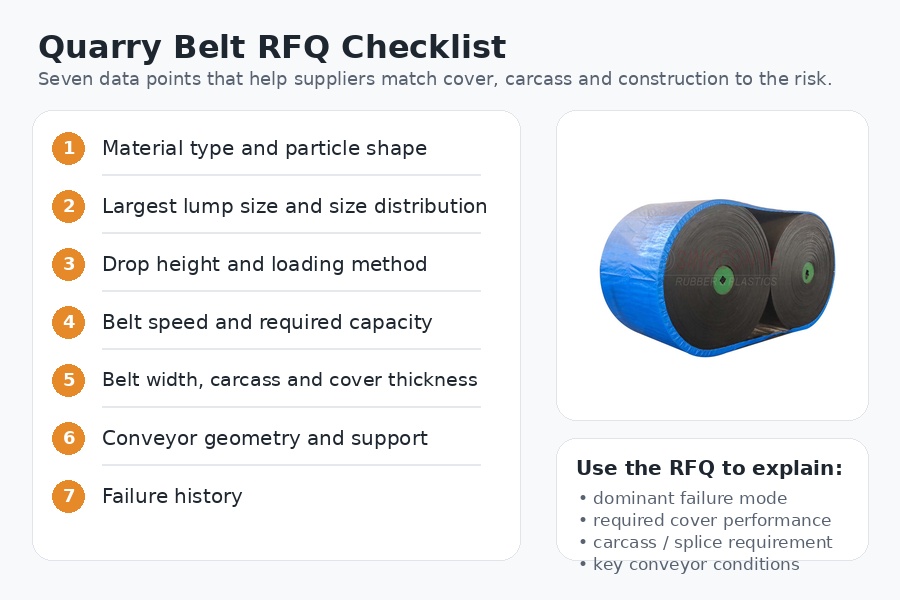
1. Material type and particle shape
“Stone” is not a complete material description. Record whether the conveyor handles limestone, granite, basalt, recycled concrete, coal, ore, or mixed quarry material. Note whether the particles are rounded, angular, plate-like, wet, sticky, or contaminated with metal.
Sharp, angular material generally creates a different risk from rounded aggregate. The supplier needs this information to review cut, tear, and impact requirements rather than quoting a general-purpose belt by width.
2. Largest lump size and typical size distribution
The largest lump affects impact, while the overall size distribution affects loading stability, chute build-up, and belt filling. Include maximum lump size and the normal range if available. If oversize material occasionally enters the system, record that as a separate risk instead of hiding it inside an average value.
3. Drop height and loading method
Drop height is a major input for loading-zone impact. A belt under a controlled transfer chute experiences a different event from a belt receiving material directly below a crusher discharge. Describe the chute, impact bed, skirt arrangement, loading direction, and whether the material lands in the centre of the belt.
A stronger belt cannot fully correct a transfer point that throws material sideways or allows large pieces to strike the belt without support.
4. Belt speed and capacity
Speed influences contact frequency and the time available for material to settle. Capacity affects loading density and may change the consequences of spillage or mistracking. Provide design and actual operating values when they differ.
5. Belt width, carcass, and cover thickness
Belt width alone is not enough to select the replacement. Include existing carcass construction, tensile rating, top and bottom cover thickness, edge type, belt length, and splice method. If the existing belt failed prematurely, photos and removed-belt sections are valuable evidence.
6. Conveyor geometry and support
Provide pulley diameters, trough angle, idler spacing, transition length, take-up arrangement, and any impact idlers or beds. Geometry affects bending, tracking, load support, and the stress placed on damaged areas.
7. Failure history
Record where and when the belt failed. A cut concentrated below the loading zone suggests a different intervention from edge wear along the return path. Failure location is one of the most useful pieces of information in an RFQ.
Failure mode versus specification focus
| Failure mode | What the belt or system is experiencing | Selection and engineering focus |
|---|---|---|
| Uniform cover wear | Repeated friction across the loaded surface | Suitable wear-resistant cover plus correct loading and cleaning |
| Deep cuts | Sharp particles create local incisions | Cut resistance, cover toughness, loading-zone control |
| Gouging | Large material drags and removes cover rubber | Gouge resistance, impact support, chute design |
| Carcass damage | Impact or sharp material penetrates the cover | Carcass protection, cover thickness, impact-bed condition |
| Longitudinal tear | A local cut propagates along the belt | Tear-resistant construction, rip detection, loading control |
| Edge abrasion | Belt rubs structure or mistracks | Alignment, idlers, edge construction, tracking control |
| Splice damage | Joint receives impact, bending, or contamination | Correct splice design, pulley compatibility, installation quality |
A cover-grade label should be interpreted together with the failure mechanism. Do not select by the smallest abrasion figure without reviewing impact and cut risk.
Cover properties and carcass construction must work together
The cover meets the material first, but the carcass carries the tension and supports the belt through the conveyor. Quarry selection therefore needs both surface and structural thinking.
A wear-resistant cover may be suitable for continuous abrasive contact, while a high-impact area may require a different balance of toughness, cover thickness, reinforcement, and support. A belt that is too stiff can create tracking or transition problems. A belt that is under-reinforced can stretch or suffer splice stress under load.
Ask the supplier to explain:
- Which cover property addresses the dominant failure mode
- How the selected carcass handles working tension and impact conditions
- Whether the joint design is compatible with the belt construction
- What pulley diameter and troughing assumptions were used
- Which testing or inspection documents will accompany the order
This produces a technical recommendation rather than a generic “heavy-duty” label.
The transfer point is often the first place to improve
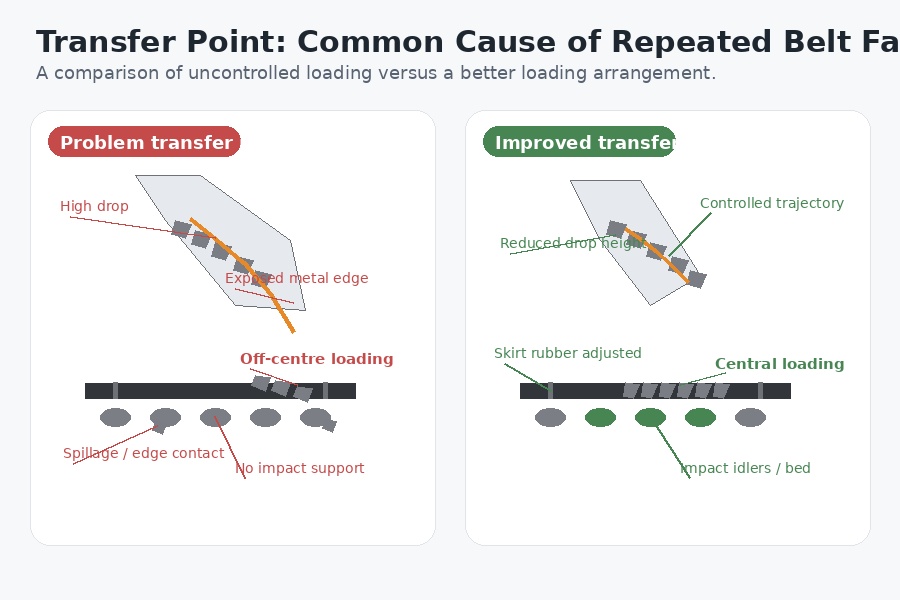
Many quarry belts are replaced repeatedly because the belt is blamed for a transfer-point problem. Before upgrading the belt, inspect:
- Whether the material lands centrally
- Whether the chute reduces drop height and controls trajectory
- Whether impact idlers or an impact bed support the loaded area
- Whether skirt rubber is correctly adjusted and not dragging on the belt
- Whether trapped rocks are cutting the cover at the loading zone
- Whether fines build up under the belt or at the return path
- Whether the loading point has exposed metal edges
A practical maintenance team should photograph the loading point and failed belt together. The relationship between belt damage and transfer-point geometry is often more informative than a product label.
How to identify whether the problem is impact or abrasion
Impact damage is usually localized. Look for deep dents, punctures, cuts, carcass exposure, or damage concentrated beneath the loading point. The pattern may repeat at the same transfer location.
Abrasion is usually more distributed. The cover becomes thinner over a wider zone, often in the carrying area or under continuous contact. However, both mechanisms can occur together. Impact creates defects, and subsequent abrasion enlarges them.
A simple field record should include:
- Damage depth and approximate area
- Distance from the loading point
- Direction of cuts or tear growth
- Material size and shape at the time of failure
- Belt speed and operating load
- Whether the belt was mistracking
- Condition of skirts, idlers, cleaners, and impact support
This record helps the supplier choose an appropriate construction and helps the plant verify whether the corrective action worked.

Quarry belt RFQ checklist
A quarry or crusher belt RFQ should include more than “abrasion-resistant rubber belt.” Add:
| RFQ section | Information to provide |
|---|---|
| Conveyor duty | Crusher discharge, screen feed, stockpile, transfer, or finished aggregate |
| Material | Type, moisture, particle shape, maximum lump size, and bulk density if available |
| Loading | Drop height, chute type, impact bed or idlers, skirt arrangement, and loading direction |
| Belt data | Width, length, speed, capacity, incline, carcass, tensile rating, and cover thickness |
| Geometry | Pulley diameters, trough angle, idler spacing, transition, and take-up type |
| Failure history | Location, damage pattern, operating time, and photos |
| Required properties | Wear, impact, cut, tear, heat, oil, flame, or other application requirements |
| Jointing | Hot-vulcanized or mechanical method, field equipment, and installation location |
| Quality documents | Applicable standard, inspection plan, test reports, marking, and packing |
If the buyer cannot provide every value, clearly mark the missing information. A supplier can then identify assumptions instead of treating unknown conditions as standard service.
When to consider a stronger construction
A stronger or more reinforced belt may be justified when the conveyor has high working tension, severe impact, large lump size, frequent deep cuts, or a documented tear-propagation problem. The correct upgrade might involve the carcass, cover system, breaker or tear-resistant design, impact support, or loading-point modification.
Do not automatically increase belt strength when the observed failure is edge rubbing or cleaner damage. A higher tensile rating will not correct a seized idler, an off-centre chute, or a poorly adjusted skirt.
SINOCONVE provides application-matched solutions for mining and quarrying conveyor systems. Its quality assurance process can be discussed when the order requires inspection records, performance testing, or agreed documentation.
FAQ
Is the most abrasion-resistant belt always the best quarry belt?
No. If the main failure is impact, cutting, gouging, edge rubbing, or tear propagation, abrasion performance alone may not address the cause. Select around the dominant failure mechanism and confirm the whole belt construction.
What is the most important information for a crusher conveyor belt quotation?
Start with material type, maximum lump size, drop height, loading arrangement, belt width and speed, capacity, existing carcass, pulley diameters, and failure photos. These details affect both cover and carcass selection.
Why does a quarry belt tear longitudinally after a small cut?
A local cut can propagate when material continues to catch the defect, the belt is under tension, or the belt lacks suitable tear-resistance measures. Inspect the loading point, belt support, and rip-detection or maintenance procedure.
Can increasing cover thickness eliminate impact damage?
Not necessarily. More cover may help in some duties, but transfer-point geometry, impact support, material trajectory, carcass protection, and cover toughness also matter. The supplier should review the complete loading condition.
Should I choose a fabric or steel cord belt for a quarry conveyor?
That depends on tension, distance, capacity, lift, pulley geometry, and maintenance requirements. Carcass selection should be made together with the impact, cut, wear, and splice review.

Conclusion: specify the failure you need to prevent
A reliable quarry conveyor belt is not selected by the word “heavy-duty” or by an abrasion number alone. It is selected by translating the field condition into a controlled specification: material shape, lump size, drop height, impact, cutting, gouging, tension, geometry, and splice requirements.
If you are preparing a replacement order or a new crusher-line RFQ, send SINOCONVE the conveyor data and photos of the loading zone and failed belt. The more clearly the failure mechanism is described, the easier it is to compare technically suitable offers and reduce repeat downtime.