
Heat Resistant Conveyor Belt Supplier for Cement and Steel Plants: What Temperature Data Matters
A heat resistant conveyor belt supplier cannot make a reliable recommendation from “high temperature material” alone. A cement plant moving hot clinker and a steel plant handling sinter may both need heat-resistant belts, but the thermal load reaching the belt can be very different. Material temperature at loading, continuous versus intermittent exposure, hot-lump size, loading impact, cooling between cycles, belt speed, and the existing failure pattern all affect the specification.
For procurement teams, this creates a practical RFQ problem. Asking only for a T1, T2, or T3 belt may produce quotations that look comparable while actually being based on different assumptions. A better purchase starts with temperature data, operating conditions, required belt construction, and evidence that the proposed belt can be manufactured and checked against the agreed specification.
Quick answer: Before requesting a heat resistant conveyor belt quotation, provide the normal material temperature, expected peak temperature, duration and frequency of peaks, material type and lump condition, loading-point conditions, belt speed, current belt specification, and observed failure mode. Temperature grade should be selected from those conditions rather than from an application name alone.
1. Why “Operating Temperature” Is Not Enough for an RFQ
A buyer may send an inquiry such as “Need heat resistant conveyor belt for 150°C clinker.” That number is useful, but it still leaves important questions unanswered.
Where was the 150°C measured? Is it the bulk material temperature before loading, the hottest individual lump, or a belt-surface measurement after contact? Is that temperature continuous during an eight-hour shift, or does it occur only during a short process upset? Does the material form a deep bed that keeps heat against the belt, or a thin layer that cools rapidly?
These distinctions matter because a conveyor belt does not experience heat as an isolated laboratory number. Heat transfers from the conveyed material into the top cover and then through the belt construction. The thermal exposure changes with contact time, material distribution, lump size, airflow and operating cycle.
That is why a qualified supplier should clarify the measurement basis before treating one temperature figure as a complete specification.

2. The Temperature Data a Heat Resistant Conveyor Belt Supplier Actually Needs
| RFQ Data | What the Buyer Should Provide | Why It Matters |
|---|---|---|
| Normal material temperature | Typical temperature where material reaches the conveyor | Defines the normal thermal duty rather than an exceptional event |
| Peak temperature | Highest credible temperature and how it was measured | Helps identify short-duration thermal excursions that may be hidden by an average value |
| Peak duration and frequency | How long peaks last and how often they occur | Continuous and intermittent exposure should not be treated as the same duty |
| Hot-lump condition | Maximum lump size, distribution and presence of unusually hot pieces | Individual hot lumps can create concentrated thermal and impact loading |
| Contact conditions | Belt speed, loading pattern and approximate material bed condition | These affect how long heat remains in contact with the cover |
| Existing belt condition | Photos and description of hardening, cracking, delamination, splice problems or abnormal wear | Failure evidence can reveal whether heat is the only problem |
For cement applications, this distinction is especially important around clinker handling. Hot, abrasive clinker can expose the cover to thermal degradation and mechanical wear at the same time. SINOCONVE's technical discussion of heat resistant conveyor belts for cement plant clinker handling explains why heat resistance and abrasion conditions should be reviewed together.
3. T1, T2 and T3 Should Not Replace the Operating Data
T1, T2 and T3 are commonly encountered when buyers source high temperature conveyor belts. They are useful grade references, but the grade name should be tied to an agreed specification and test basis rather than treated as a universal shorthand that answers every temperature question.
This is particularly important when quotations come from several suppliers. A line item saying “T3 heat resistant conveyor belt” does not by itself tell the procurement team what temperature definition the supplier used, what cover properties are being offered, how the belt will be tested, or whether the construction matches the conveyor.
RFQ warning: Do not compare T1/T2/T3 quotations by grade name and price alone. Ask each bidder to state the applicable specification or test basis, proposed construction, cover requirements, and the operating-temperature assumptions used for selection.
ISO 4195 is one useful reference when heat-resistant rubber covers are being evaluated. The standard addresses requirements and test methods for the relative heat resistance of conveyor belt rubber covers, including changes in properties after heat exposure. It should not be interpreted as proof that a complete conveyor belt will automatically survive any material temperature stated in an RFQ.
For buyers, the practical lesson is simple: a test standard describes what is being evaluated under defined conditions. The application still has to be matched to the product.
4. Cement and Steel Plants Can Impose Different Thermal Loads
4.1 Cement clinker: heat plus abrasion and impact
Clinker service is not only a temperature problem. Material can be abrasive and irregular, and larger pieces can impose impact at the loading point. If the chute produces a high drop or concentrates material in a narrow area, the top cover may experience thermal exposure, abrasion and impact simultaneously.
This means an RFQ should not stop after specifying a heat grade. Buyers should also provide material size, loading arrangement, existing top-cover thickness, belt width, belt speed and the wear pattern of the current belt.
If the current cover becomes hard and develops cracks before significant abrasive wear occurs, excessive thermal exposure may deserve closer investigation. If the cover is being cut or worn away rapidly around the loading zone, temperature may be only part of the failure mechanism.
4.2 Steel plants: do not hide hot lumps inside an average
Steel-industry conveyors can handle sinter, coke and other heated bulk materials. Here, a procurement specification based only on average bulk temperature can conceal local extremes.
A small number of hotter pieces can create concentrated contact points on the belt. Their effect depends on temperature, size, contact duration and how quickly the material moves away from the loading area. Where process conditions fluctuate, the buyer should therefore distinguish normal operating temperature from credible maximum temperature.
The loading system deserves attention as well. A belt compound selected for heat resistance cannot compensate for every mechanical problem created by excessive drop height, poor chute control, trapped material or damaged idlers.
5. Temperature Is Only One Part of the Belt Specification
Once the thermal duty is understood, the supplier still needs to establish the rest of the belt construction.
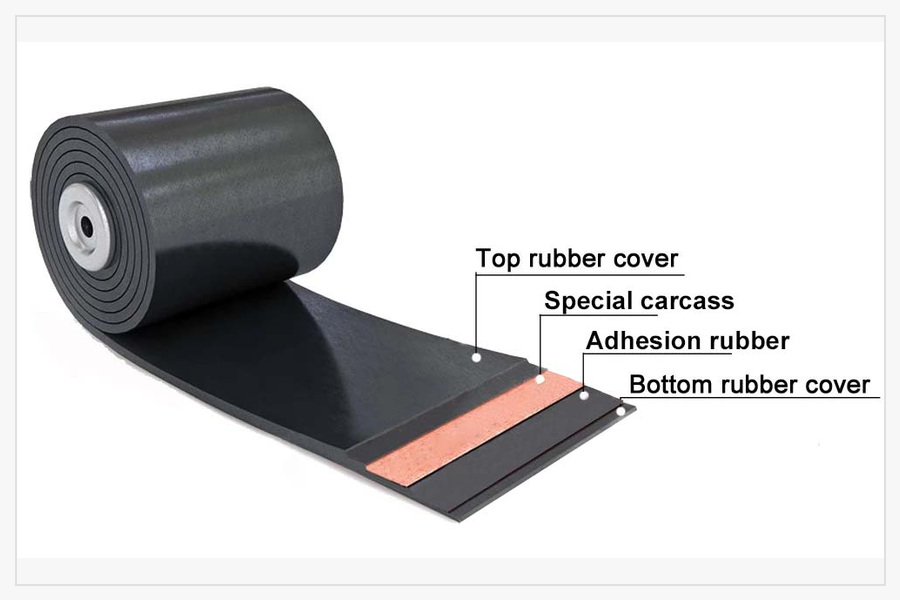
Carcass strength: The carcass must suit conveyor tension and geometry. SINOCONVE manufactures fabric conveyor belts across its confirmed EP100–EP600 production range and steel cord belts from ST500–ST7500. These are manufacturing ranges, not automatic recommendations for a cement or steel conveyor. The required rating must come from the actual conveyor duty.
For fabric constructions, buyers can review the EP rubber conveyor belt category as a starting point, while long-distance or high-tension projects may require a different carcass decision.
Cover thickness: The top cover is the first barrier between hot material and the carcass, but simply asking for a thicker cover is not a complete engineering solution. Cover thickness should be considered with impact, abrasion, pulley requirements and the overall belt construction.
Splicing: A high-temperature application also puts attention on the splice. The splice method, materials and procedure need to be compatible with the selected belt and site conditions. A technically suitable belt can still become an operational problem if the joint is poorly executed.
Conveyor geometry: Width, length, pulley diameters, take-up arrangement and operating tension affect which construction can run correctly on the existing equipment. Substituting a different carcass or increasing belt thickness without checking the conveyor can introduce another problem while attempting to solve the heat problem.
6. Use the Existing Failure Pattern as Procurement Data
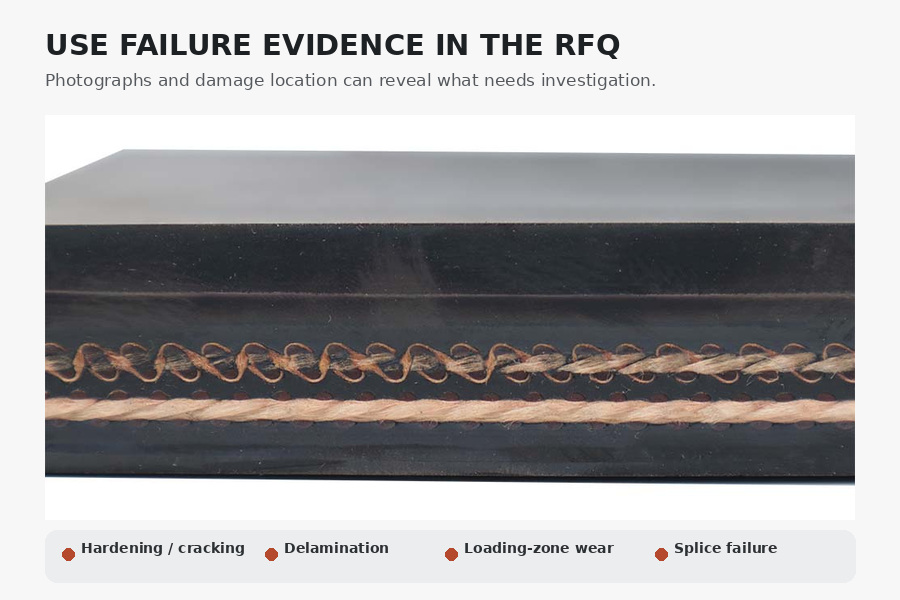
An old belt is often one of the most useful pieces of information available to a new supplier. Instead of sending only a nameplate specification, send clear photographs and describe where the damage occurs.
| Observed Problem | What to Investigate | Useful RFQ Evidence |
|---|---|---|
| Cover hardening or surface cracking | Actual thermal exposure, peak events, cooling cycle and existing cover specification | Temperature records, close-up photographs and current belt data |
| Cover separation or delamination | Heat exposure, adhesion condition, impact and belt age | Cross-section photos, damage location and operating history |
| Rapid wear at loading point | Abrasion, lump size, drop height, chute condition and material temperature | Loading-point photos, material details and wear measurements |
| Repeated splice failure | Splice procedure, belt construction, heat exposure and mechanical stress | Splice photos, joint method, failure position and service history |
The table is diagnostic, not a remote failure verdict. Similar visible damage can have more than one cause. Its value is that it tells procurement teams what evidence to preserve instead of discarding the failed belt and repeating the previous specification.
7. How to Qualify a Heat Resistant Conveyor Belt Supplier
Once technically plausible quotations arrive, supplier evaluation should move beyond price per meter. For a cement plant buyer, steel plant buyer, EPC contractor or industrial distributor, the objective is to reduce the risk that the delivered belt differs from the specification used to approve the purchase.
7.1 Ask for a traceable technical proposal
The quotation should make clear what is being offered: belt width, length, carcass or strength rating, cover thickness, heat-resistant requirement, applicable standard or agreed test basis, quantity and any project-specific construction.
If the supplier changes a requested specification, that deviation should be visible. Silent substitutions make technical and commercial comparison difficult.
7.2 Verify manufacturing capability against your project
SINOCONVE's conveyor belt factory was established in 1988. Its confirmed production setup includes eight fabric conveyor belt production lines and two steel cord conveyor belt production lines. The stated manufacturing range covers widths from 100 mm to 3000 mm and thicknesses from 3 mm to 100 mm.
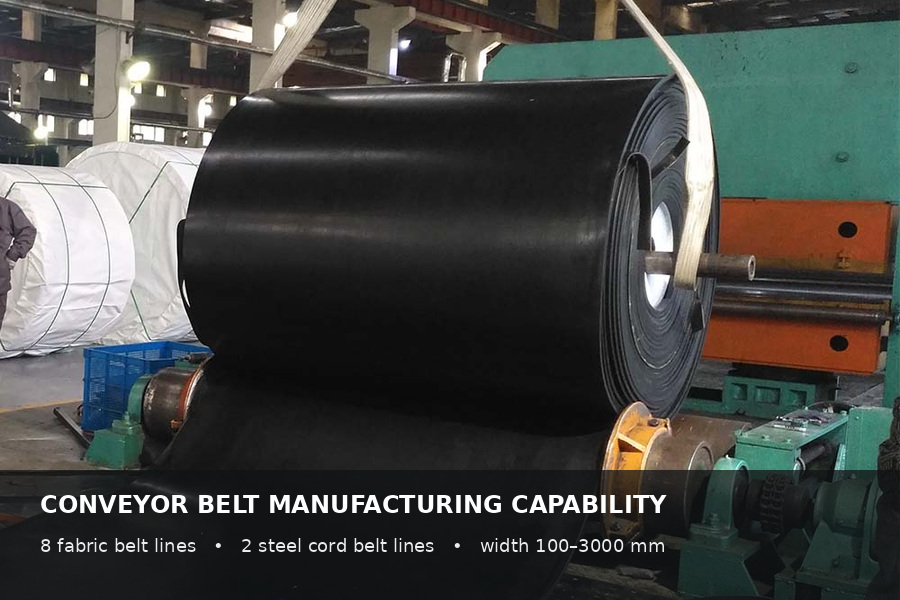
The factory's stated annual production capacity is 10 million meters of fabric conveyor belt and 3 million meters of steel cord conveyor belt. Capacity figures are useful for supplier qualification, but they should not be confused with a promise that every project can be produced immediately. Actual delivery depends on the ordered specification, quantity and production schedule.
7.3 Ask what will be inspected before shipment
A supplier qualification process should examine QC evidence rather than relying on “strict quality control” as a marketing phrase.
SINOCONVE's confirmed process includes incoming raw-material inspection, in-process inspection and final testing/inspection before shipment. Its conveyor belt operation has 15 quality-control personnel and one laboratory, and product test reports can be provided. Where a customer has a special standard requirement, third-party testing can also be arranged subject to project confirmation.
The useful purchasing question is therefore not simply “Do you have QC?” It is: Which properties will be checked for this order, against which agreed requirement, and what documentation can accompany the shipment?
8. A Practical RFQ Checklist for Cement and Steel Plant Buyers
A technically useful inquiry does not need to be a long engineering report. It needs enough information to remove dangerous assumptions.
| Information Category | What to Send |
|---|---|
| Material | Clinker, sinter, coke or other material; typical and maximum lump size |
| Temperature | Normal temperature, peak temperature, measurement point, peak duration and frequency |
| Existing belt | Width, length, strength/carcass, top and bottom cover thickness, existing heat grade or specification |
| Conveyor | Belt speed, conveyor length, inclination and relevant pulley information where construction changes are being considered |
| Loading conditions | Loading arrangement, impact conditions and any unusual hot-lump exposure |
| Failure history | Photos and description of cracking, hardening, wear, delamination or splice failure |
| Commercial requirement | Quantity, destination, required documentation and target delivery schedule |
SINOCONVE states a 50 m minimum order quantity for conveyor belts. Standard production lead time is normally around 30 days, while urgent orders may be discussed for an accelerated production arrangement. These commercial terms should still be reconfirmed against the final belt specification and order quantity before purchase.
9. What Proof of Capability Should You Request Before the PO?
For project procurement, proof should correspond to the risk you are trying to control.
- Specification confirmation: Make sure the supplier acknowledges the complete belt construction and heat-resistance requirement rather than only the product name.
- Test documentation: Agree in advance which test reports or inspection records are required with the shipment.
- Standards: State the required standard in the RFQ instead of assuming every supplier interprets T1/T2/T3 terminology identically.
- Manufacturing scope: Confirm that the required width, thickness and carcass fall within the supplier's production capability.
- Deviation control: Require technical deviations to be declared before the order is approved.
- Third-party inspection: If the project or tender requires independent verification, discuss the inspection scope before production rather than after the belt is finished.
SINOCONVE states that its products can be manufactured according to different market requirements with reference to DIN, RMA and ISO standards. The relevant standard and acceptance criteria should be agreed for the specific order rather than assuming that a general company statement establishes compliance with every clause of every standard.
Buyers who need to review broader supplier capability can also use the SINOCONVE manufacturing overview and then place project-specific requirements through the conveyor belt inquiry channel.
10. Common Procurement Mistakes That Increase Purchase Risk
Buying from one temperature number. A single figure without measurement location, peak duration and operating context can lead suppliers to quote against different assumptions.
Treating T1/T2/T3 as a complete belt specification. The heat grade does not define belt width, carcass strength, cover thickness, splice requirement or the mechanical duty of the conveyor.
Ignoring the old belt's failure mode. Reordering the same specification without investigating cracking, delamination or loading-point wear can reproduce the same failure.
Comparing quotations only by price per meter. Two offers are not commercially comparable if their construction, testing, documentation or temperature assumptions differ.
Requesting documents after production. If a tender requires specific inspection records or third-party testing, those requirements should be included before the purchase order so the supplier can plan the correct verification process.
11. FAQ for Heat Resistant Conveyor Belt Buyers
Is a T3 conveyor belt automatically better than a T1 or T2 belt?
No. A higher heat-resistance category should not be treated as an automatic upgrade for every conveyor. The belt should match the actual temperature exposure, material, mechanical duty and applicable specification. Over-specifying one property can add cost without solving the real failure mechanism.
What temperature should I give the supplier?
Provide both the normal material temperature and the highest credible peak temperature, together with where and how they were measured. Also state how long peak conditions last and how frequently they occur. If individual hot lumps are significantly hotter than the bulk material, report that separately.
Can a heat resistant conveyor belt still wear quickly?
Yes. Heat resistance does not eliminate abrasion, impact, cutting, misalignment or mechanical damage. Cement clinker and other abrasive hot materials can require both thermal and mechanical conditions to be considered in the specification.
Should cement and steel plants use the same heat resistant belt?
Not automatically. Two plants may have different material temperatures, lump sizes, conveyor speeds, loading impact, carcass requirements and failure histories. Application names are not enough to determine an identical construction.
What should I ask a supplier to include in a quotation?
Ask for the proposed belt construction, width, length, strength/carcass, cover thickness, heat-resistant requirement, applicable standard or test basis, documentation, quantity, delivery terms and any deviations from your RFQ.
Can SINOCONVE provide test reports?
Yes. SINOCONVE's confirmed company information states that product test reports can be provided. Special standard requirements and third-party testing can also be discussed before the order.
What is SINOCONVE's MOQ for conveyor belts?
The confirmed minimum order quantity for conveyor belts is 50 meters. Because heat-resistant belts are produced according to customer requirements rather than held as standard stock, buyers should confirm the final specification and production schedule when requesting a quotation.

12. Prepare the Temperature Data Before Asking for a Quote
The strongest RFQ for a high temperature conveyor belt is not the one with the longest specification sheet. It is the one that gives the supplier enough evidence to understand the real duty.
For a cement or steel plant project, prepare the conveyed material, normal and peak temperatures, measurement point, hot-lump condition, current belt specification, belt width and length, belt speed, loading conditions, failure photographs, required standard, quantity and destination. If some information is unavailable, identify it as unknown rather than replacing it with an assumption.
SINOCONVE can review this information against its conveyor belt manufacturing scope and prepare a project-specific quotation. Send the RFQ to sales@sinoconve.com, submit it through the SINOCONVE contact page, or review the SINOCONVE conveyor belt website before starting the technical discussion.