
Sand on the return after the wash screen tells a different story from the carry side. At the tail, check for a ridge beneath the pulley.
Use a wet feed sample in the enquiry. Include the loaded-start condition if the stacker is parked full overnight.

01Wet Pit Reality: Saturated Silt, River Gravel Impact and Traction Loss
A pit drawing often gives belt width, nominal tonnes per hour and incline. Walk the route before accepting those numbers. Excavator discharge, washed oversize, dewatered sand and loadout do different work; their covers should not be selected from one line of a purchase order.
The Silt Film That Replaces Friction
On a controlled start, paint reference marks on belt and pulley. A moving gap between those marks isolates the slipping interface.
Where Rounded Cobble Lands Twice
A cobble may roll beyond its first landing. Inspect the support beneath the second contact as well as the initial impact patch.
Glazed lagging and a take-up near the end of travel can appear together. Write down both observations before an adjustment.
Include tail drainage and the wet feed on the RFQ. The related wet-service article discusses cleaner layout. See conveyor belt manufacturer and conveyor line that runs wet all year.
02Pit Circuit Segmentation: Dredge/Excavator Discharge, Screen Decks, Wash Towers and Loadout
Mark each transfer on the route drawing. The first wet rollback point is particularly useful on a stacker.
Read the rows against the actual pit arrangement; a section can have more than one of these conditions.
| Pit section | What to check on site | Specification point to discuss |
|---|---|---|
| Dredge or excavator transfer | Landing point through the full boom swing; largest admitted cobble | Chute control, impact support, cover and breaker choice |
| Wash screen discharge | Oversize drainage, fines and slurry at the head | Release behavior, edge treatment and cleaning access |
| Dewatering discharge | Carryback on a short, nearly level route | Smooth cover option and return support |
| Stacker and loadout | Wet rollback during start and feed surges | Profile capacity, traction and cleaning arrangement |
Transfer Points Take More Abuse Than Any Crusher
Stand beside the transfer through a full boom swing. A moving boom can shift the stream toward a skirt or an unsupported edge. The hopper and belt support have to be checked at that extreme position.
After a mobile link moves, compare its chute position with the belt centreline. Send edge-damage photographs with the enquiry if the feed routinely lands to one side. See conveyor belt supplier.
Oversize and undersize leave the same screen in different conditions. The fines may follow the return belt past the head, so inspect underneath before picking a rib pattern.
A short, nearly level dewatering discharge is often easier to clean with a smooth cover. Check the wet sand on the return after the head cleaner has worked for a full shift.
Trial the stacker at its normal wet feed rate. If stone rolls back, note whether it begins at the loading point, mid-incline or on a loaded restart. Rib dimensions and available capacity then need to be checked together.
03Boundary vs Hard Rock Quarry and Underground Coal Handling Lines
Similar-looking belts may serve very different plants. A washed alluvial circuit brings persistent water and fine carryback; a blasted-rock transfer concentrates sharp impacts; an underground coal route adds mandatory safety approvals. Identify the route before comparing belt quotations.
Blasted Rock Leaves a Different Mark
At a crusher transfer, compare cut depth and the point of first contact with the belt. In the washing section, look for sand and water entering edges and cleaner gaps.
Underground coal projects have site-specific flame and static requirements. Check the applicable approvals before discussing cover thickness. A belt ordered for an open gravel pit must not be assumed suitable for an underground installation merely because its dimensions match.
This guide concerns wet gravel, bank-run material and washed sand. A plant that crushes hard rock before washing can specify those sections independently. The linked quarry and crusher guides give the adjacent duties; keep the transfer data for each section rather than averaging it into one feed description. See aggregate and quarry pit operations and sizing belts behind a primary crusher.
For multi-site stock, common widths and splice procedures can simplify repairs. Keep the cover and carcass schedule tied to the particular conveyor. Mark the spare roll with its route, profile, cover thickness and minimum pulley requirement so a stacker spare is not installed at the primary loading point by mistake. See industrial conveyor belt and review the full range of industry conveying configurations.
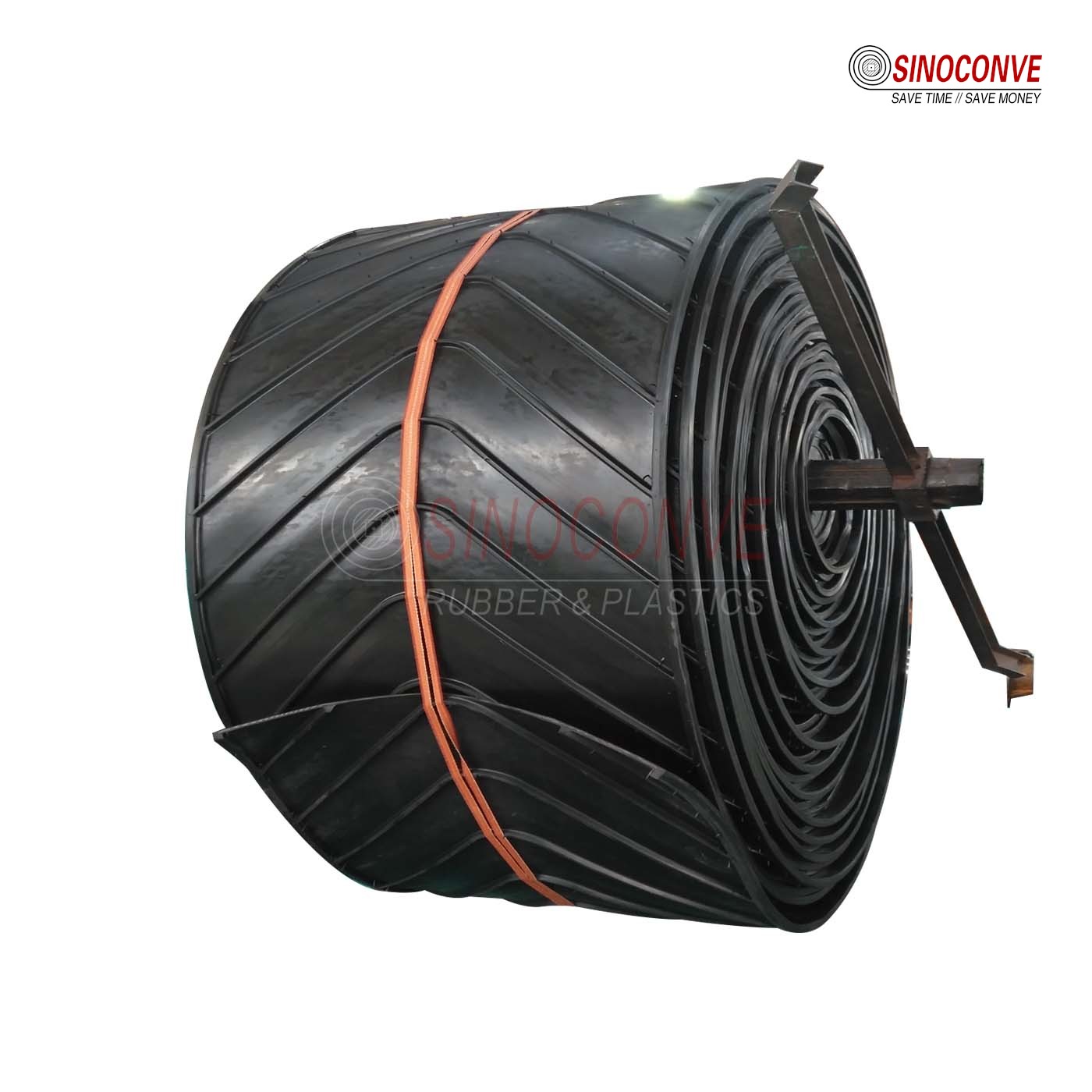
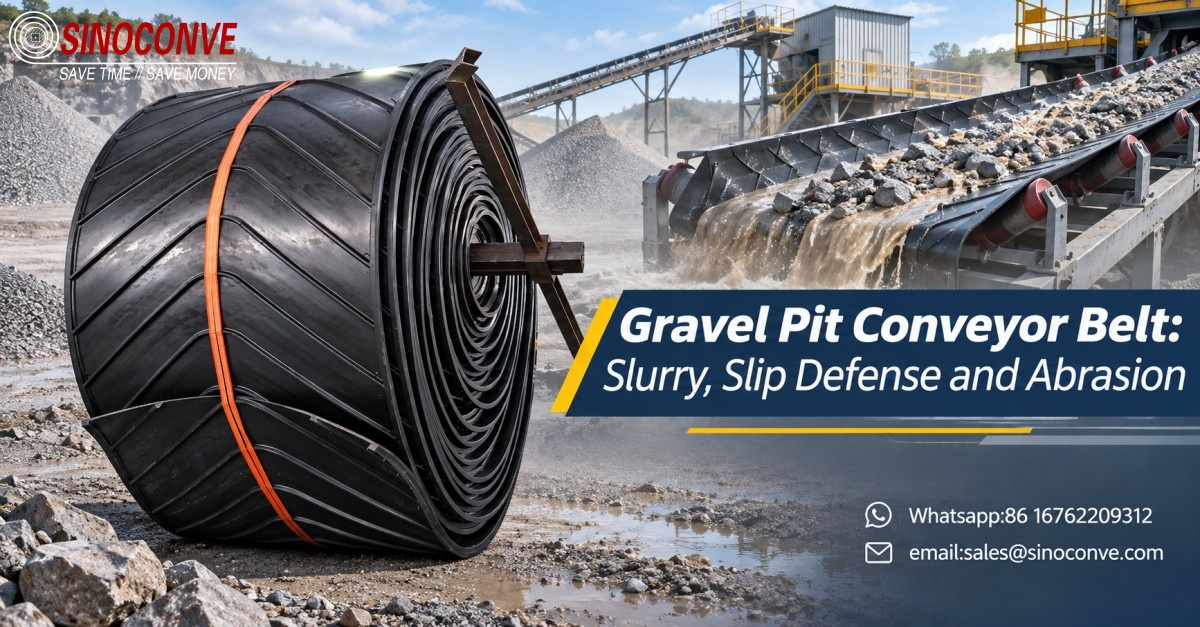
A chevron profile helps hold material on the incline; check how it is cleaned on the return.
04Cover Compound and Tread Profile: Chevron Drainage Patterns vs Smooth Covers
At a level discharge, a smooth cover may clean easily. On a stacker, test wet rollback with that same material.
Reading a Cover Grade for Wet Abrasion
Section a worn sample if one is available. Broad centre thinning, a local impact cut and a cleaner-width groove call for different fixes. The bend around the smallest pulley still sets a practical limit on a heavy replacement.
Rib Spacing and the Return Run
Use the existing incline and the wettest ordinary feed as the reference. A quoted angle from a dry material test will not settle the question for a surging stacker.
Look at the profile after a loaded stop.
| Surface option | Where to trial it | Inspect before ordering |
|---|---|---|
| Smooth cover | Level or moderate incline with effective head cleaning | Wet rollback, release at the head, available traction |
| Open chevron | Incline where smooth cover loses wet material | Rib height, pitch, drainage and profile-compatible cleaner |
| Closed chevron | Coarse stream with limited fine packing | Mud retained in the pockets after shutdown |
| Shallow patterned cover | Short transfer where a modest grip change is needed | Wear of pattern peaks and the actual wet feed rate |
Compare smooth and patterned samples against the same wet material. Run the trial long enough to see a loaded start and the condition after shutdown. The useful outcome is a measured feed rate, rollback observation and cleaning time, not a claimed maximum angle from a different aggregate. See chevron belt specifications.
Request a section drawing with cover thickness, rib geometry, edge and splice detail. Keep the test reports with that drawing so quotations refer to the same construction. See rubber conveyor belt.
05At the Fabric and Edge
Fabric exposed in a gouge changes the inspection priority.
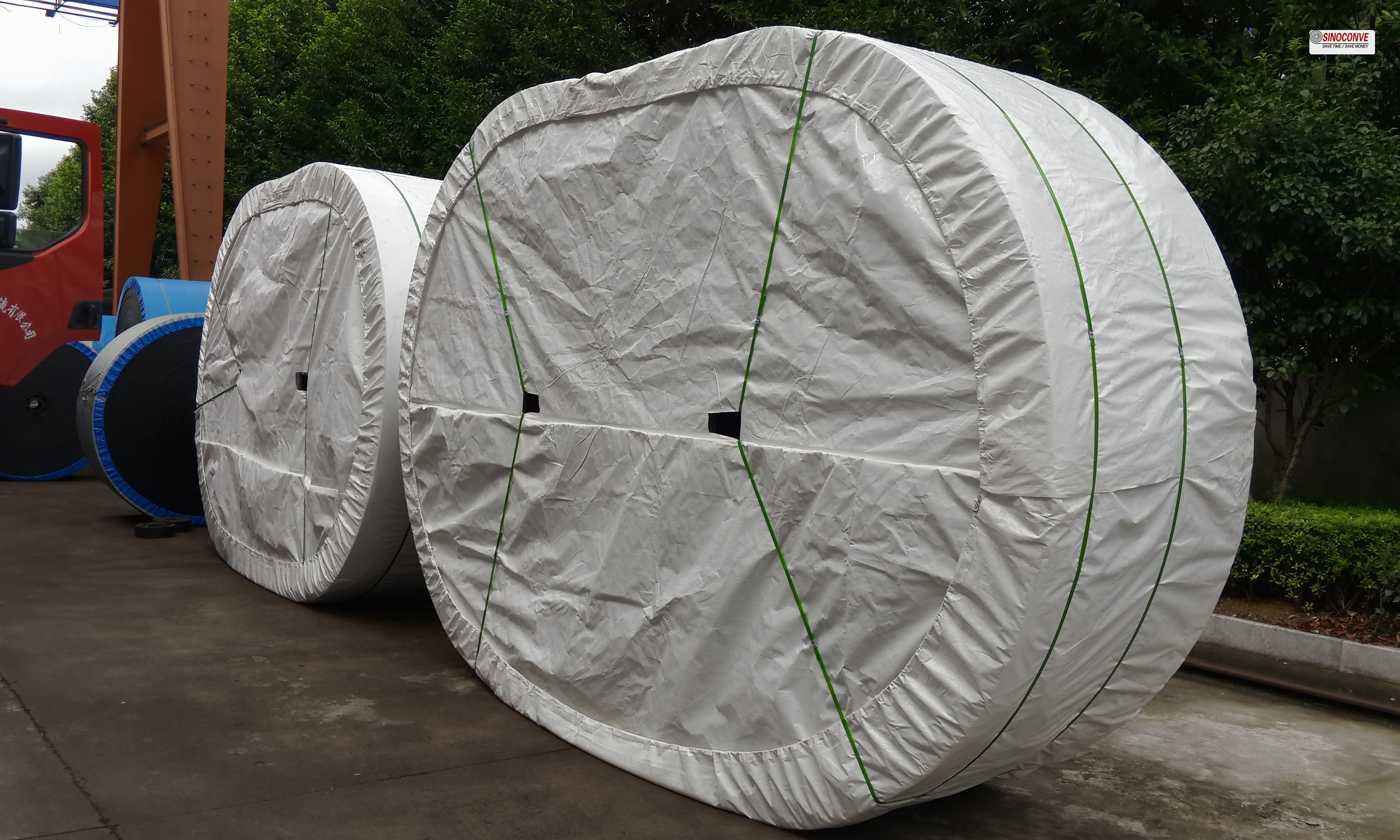
Why Polyester Retains More Strength Wet
In the EP designation, polyester runs lengthwise and polyamide across. Check the maker's construction sheet for the proposed belt.
Compare the smallest pulley with the construction sheet and consider a local breaker at the loading point.
The Slit Edge After a Wet Shift
| Construction candidate | Why consider it | Check before approval |
|---|---|---|
| EP fabric with an impact breaker | Local loading point needs extra penetration resistance | Calculated tension, pulley diameter and breaker bond |
| Heavier multi-ply EP build | Longer or more highly tensioned fabric-belt route | Flexibility, take-up travel and splice efficiency |
| NN fabric construction | Application where flex and impact response are priorities | Wet dimensional behavior and the supplier data |
| Steel cord construction | High tension on a long trunk route | Design tension, transition, pulley and splice system |
Common stock can help a group of pits, provided each roll is labelled with its intended section. The linked EP and EP-versus-NN guides explain fabric options; compare those options with measured tension and pulley geometry. Do not select steel cord from throughput alone: route length, tension and splice arrangements govern whether it belongs there. See wholesale conveyor belts and EP rubber belt range and EP versus NN fabric carcasses in wet service.
06Mud on the Return Side
From a guarded access point, note where material first appears on the return. A ridge below one roller localizes the drop; edge scuffing shows where the belt touches after drifting.
Rollers That Shed Instead of Pack
Mud on a roller shows that something survived the head cleaner. Compare the deposit there with the first one found on the return.
Roller type, spacing and access should be laid out on the return-run drawing. A disc roller also has to support the belt between its discs.
Scraper Sequences for Slurry Instead of Dust
For a smooth belt, inspect the head cleaner while the feed is wet. Check full-width contact, blade condition and whether the scraped material drains away. A secondary cleaner may help with fine carryback.
A V-plough protects the tail from debris on the inside face; it is not a replacement for cleaning the carrying cover at the head.
If the stacker's power transmission uses V-belts, inspect that drive separately. A slipping V-belt set and a slipping conveyor at the head are different faults, though both lower belt speed. Compare drive and driven pulley speeds, examine tension and wear, and order matched replacement belts to the drive maker's specification. See transmission belt manufacturer.
When the belt, cleaners, lagging and rollers come from different scopes, put their interfaces on one drawing. SINOCONVE manufactures conveyor belts and can supply rollers and related components through qualified partners. The integrator should confirm clearances, mounting and responsibility for commissioning. See original equipment builders and plant integrators.
07Gravel Pit Operator Checklist for Belt Sizing and Seasonal Wet Starts
Use a wet-start sheet for each conveyor rather than applying one multiplier to every pit. Record material mass at start, take-up position, drive condition and the worst normal moisture. An engineer can then check start-up traction and motor torque using the actual layout.
Derating Tension for a Wet Start
A loaded overnight stop is the difficult case. Note whether the tail is packed, whether any return roller has seized and where the take-up stood before the start.
The condition of the lagging matters more than a copied groove dimension. A dirty contact band should be photographed, cleaned and compared with the supplier's wear criteria.
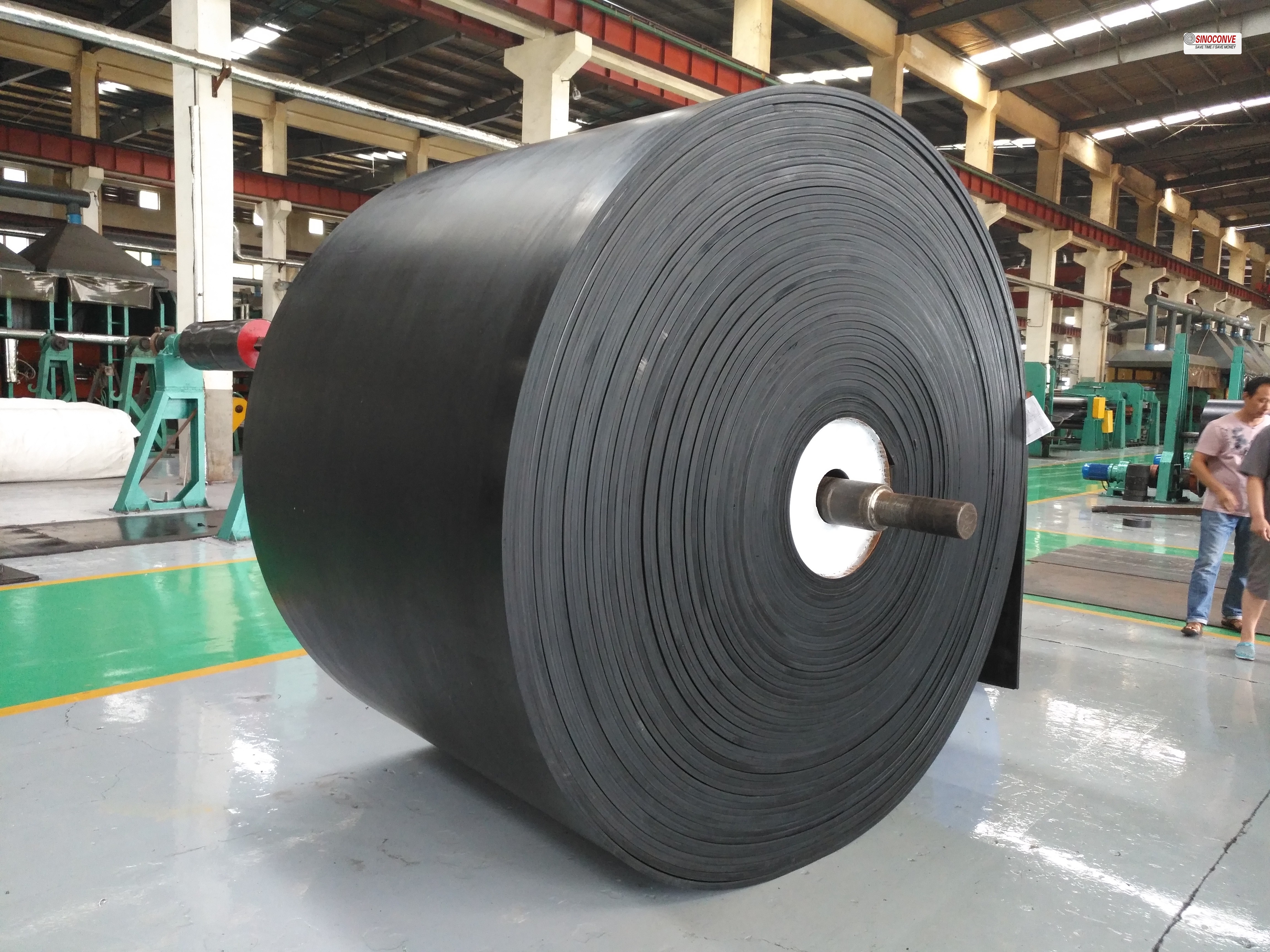
Match the delivered roll to its drawing and label. Any difference in edge finish or profile should be resolved before the splice is prepared. See conveyor belt factory.
| Wet-start check | Observation to record | Action if abnormal |
|---|---|---|
| Drive face | Mud-filled or glazed contact band | Clean and inspect the lagging |
| Take-up travel | Position before and after wet start | Compare against the design setting |
| Head cleaner and discharge | Full-width contact and slurry drainage | Adjust to the cleaner maker’s instruction |
| Return rollers and tail | Free rotation, deposit and material at the nip | Isolate, clean and correct carryback source |
Before loading, inspect the splice and run the belt empty while observing tracking from guarded points. Then introduce material gradually and watch the head cleaner, return rollers and tail. Keep the first wet-start observations in the quality record; the linked splice guide gives further failure clues. See inspection steps behind each delivery and the common causes of splice failure.
End a shift with the trough and discharge clear where operating rules allow. Wet stone left on an incline changes the next start and can conceal a blocked chute. Tell dispatch and maintenance when the belt was stopped loaded so the morning inspection starts at the right place. See Stockyard and loadout handling teams.
08Questions From the Pit
Why does wet weather reveal drive slip?
Put a reference mark on the belt and drive pulley for a controlled start. Relative movement calls for a closer look at lagging, slurry buildup and the engineered take-up setting.
What if sand remains between the chevron ribs?
Fine sand can pack into the pattern. Inspect a stopped belt just after discharge and check whether the chosen cleaner can reach the valleys.
Where does a wet splice begin to fail?
An opening at the splice edge can hold grit. Mark the location and assess the joint under the belt maker's repair procedure.
How do we judge replacement timing?
There is no dependable calendar life without the feed, route, operating hours and failure record. Track cover loss at fixed points, cuts at transfers, splice condition and edge damage. Those trends support a planned change-out and a better next specification.
Can we keep one spare for every pit conveyor?
A shared spare is possible where the tension and pulley geometry overlap. The route label should remain on the roll.
What belongs on the RFQ?
Start with the route drawing and photographs of the old belt. Add pulley sizes, speed, wet feed and loaded-start condition.

Related Products You May Need
- EP fabric rubber belts built for pit and aggregate duty
- Chevron patterned belts for wet stacker inclines
- Spiral rubber disc return rollers that shed mud
Related Blog Posts