
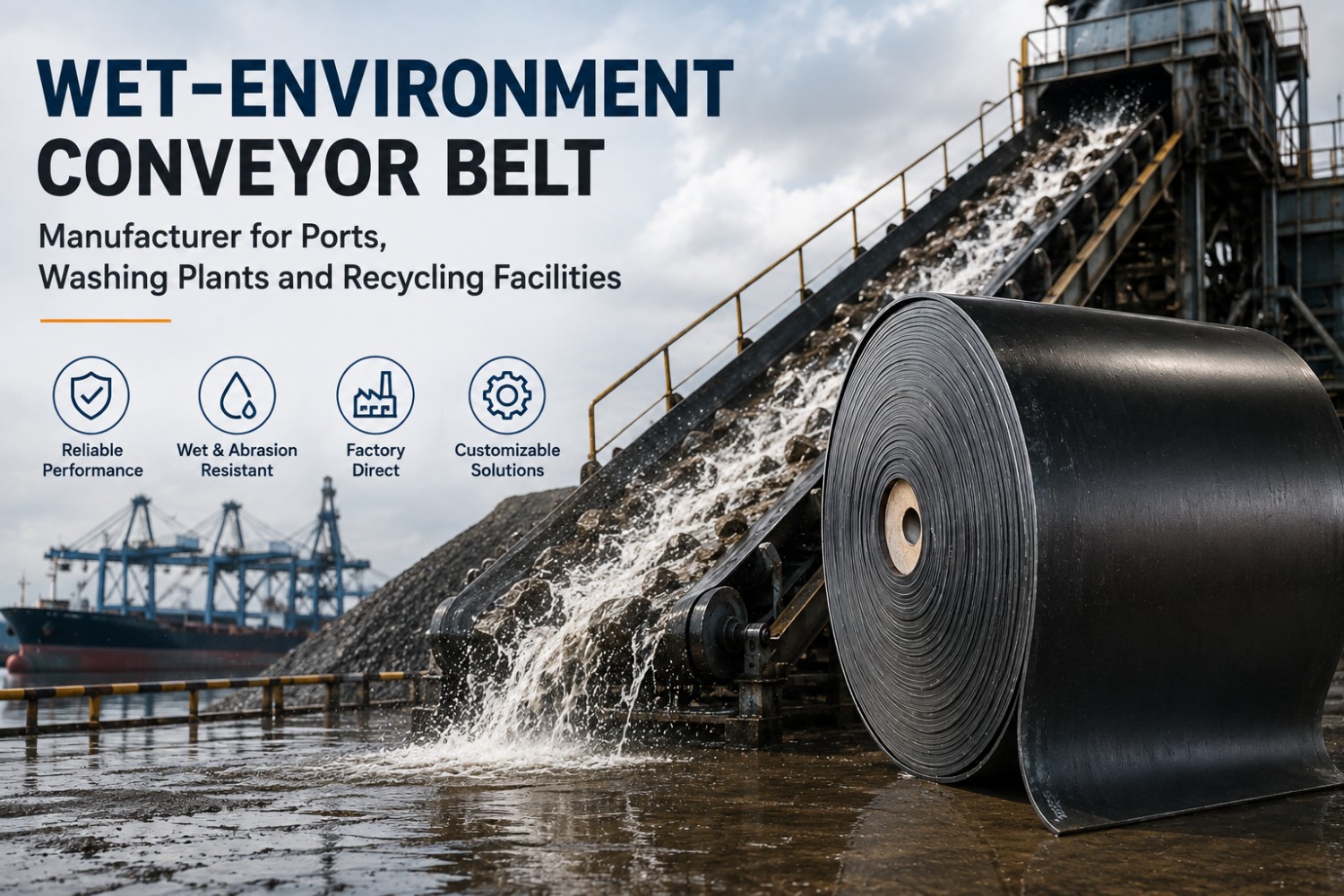
Wet-Environment Conveyor Belt Manufacturer for Ports, Washing Plants and Recycling Facilities
A wet-environment conveyor belt project is rarely just a request for a “water-resistant belt.” At a port terminal, washing plant or recycling facility, water changes several parts of the conveying problem at the same time. Material becomes heavier or more adhesive, fines accumulate on the return side, pulley traction can become less predictable, and damaged belt edges or covers may expose the carcass to prolonged moisture.
For project procurement teams, the bigger risk is often specification uncertainty. A quotation based only on belt width, length and ply count may look complete while leaving the actual wet-service conditions undefined. That becomes more serious when a project requires multiple belt sizes, batch deliveries, spare rolls, inspection documents and export packing.
This guide explains what buyers should define in an RFQ, how to evaluate a wet-environment conveyor belt manufacturer, and what evidence to review before approving production.
Quick Answer: For wet conveyor applications, do not qualify a supplier from a generic “water-resistant” statement. Define the material and water exposure, abrasion and contamination, conveyor geometry, belt construction, splice, cleaning method and acceptance requirements. Then verify whether the factory can manufacture, test, document, pack and deliver the complete project BOM consistently.
1. Why Wet Conveyor Projects Need a Different Procurement Approach
Water itself is only one part of the operating condition. The more useful engineering question is what happens when water interacts with the conveyed material, belt surface, carcass, splice, pulleys, cleaners and return system.
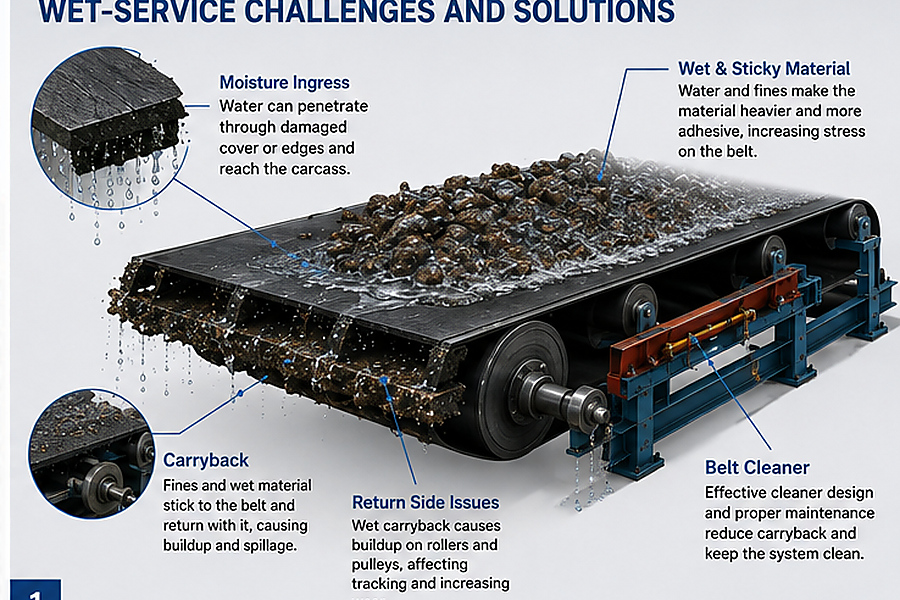
Research on textile-reinforced conveyor belting has shown that moisture can penetrate belt structures and that the textile carcass is more sensitive to water ingress than the rubber cover. In practical procurement terms, this makes cover integrity, edge condition, adhesion and splice quality relevant when a belt will spend long periods in wet service.

Wet bulk material can create another problem: carryback. Clay, fines, sludge, washed aggregate and mixed recycling residue may adhere to the carrying surface and return beneath the conveyor. The result can be buildup on rollers and pulleys, more cleaning work and tracking problems. A belt compound cannot correct poor scraper adjustment or a badly designed transfer point, so belt selection and conveyor condition need to be considered together.
| Operating Condition | Procurement Risk | Specification Implication |
|---|---|---|
| Continuous water exposure | Moisture can exploit damaged covers, edges or splice areas | Review belt construction, cover integrity, adhesion and splice requirements |
| Wet abrasive fines | Cover wear and carryback may occur together | Define material characteristics, abrasion duty and cleaning arrangement |
| Sticky clay or sludge | Material release and return-side buildup become important | Discuss surface behavior, cleaners, transfer design and maintenance access |
| Oil or chemical contamination | A general-purpose cover may not match the exposure | Identify the contaminant instead of specifying only “wet service” |
| Inclined wet conveying | Material may slip or roll back | Confirm incline, material behavior and whether a patterned or cleated construction is needed |
2. Ports, Washing Plants and Recycling Facilities Do Not Have the Same Wet Duty
2.1 Ports and Bulk Material Terminals
Port conveyors can combine moisture with high throughput, long operating hours, outdoor exposure and long conveyor routes. Rain, sea-side humidity and wet bulk cargo may all be present, but the correct belt still depends on the cargo and conveyor design.
For a terminal project, procurement should confirm whether the belt handles coal, ore, aggregate, fertilizer or another material; whether the material is normally dry, damp or saturated; and whether contamination such as oil or chemicals is possible. Long conveyors also make strength, elongation behavior, splice design and replacement planning more consequential than a generic cover description.
If an existing installation is being replaced, send the old belt specification together with failure photos. Edge damage, cover loss, splice separation, cracking and abnormal wear patterns provide useful information that a model code alone cannot show.
2.2 Washing and Wet-Processing Plants
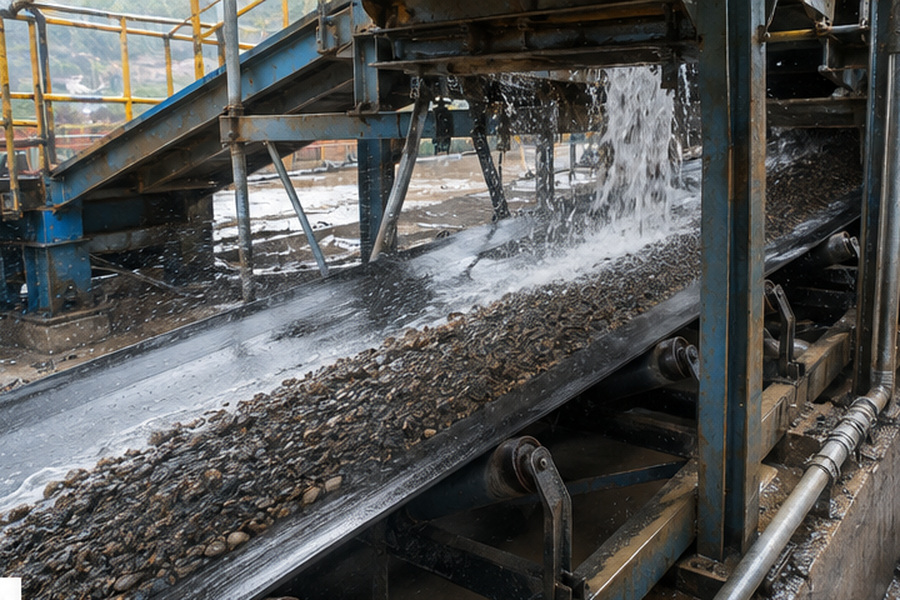
Aggregate, sand, mineral and other washing processes can expose a conveyor to both water and fine abrasive particles. Saturated material may also behave differently at the loading point and discharge compared with the same material when dry.
The RFQ should therefore state where the belt sits in the process. A feed conveyor before washing, a dewatering discharge belt and a conveyor carrying wet fines may require different attention even when their dimensions are similar.
Buyers should also examine carryback and cleaning. If the existing belt returns with a layer of fines, simply purchasing a thicker cover may not solve the underlying problem. Cleaner condition, belt surface, pulley buildup, loading alignment and the return path should be checked before repeating the existing specification.
2.3 Recycling and Waste-Handling Facilities
Recycling adds variability. A wet recycling stream can contain sharp pieces, fines, dirt and contaminants whose composition changes from batch to batch. Water resistance alone says little about cut risk, impact or chemical exposure.
Describe the actual stream to the manufacturer. Mixed municipal material, construction waste, scrap, wet plastics and washed recyclables do not create the same belt duty. Where oils or process chemicals are present, identify them in the RFQ so compatibility can be reviewed rather than assumed.
For more general application context, SINOCONVE's guide to rubber conveyor belt applications explains how conveyed material and operating conditions change belt selection across industrial sites.
3. Build the RFQ Around Operating Conditions, Not a Product Name
A useful RFQ gives the conveyor belt factory enough information to identify technical gaps before the quotation becomes a purchase order.
For an existing line, start with the approved belt specification if one exists. Add the current belt marking, dimensions, construction and splice information. Then describe what the conveyor actually does.
| RFQ Information | What the Buyer Should Provide | Why It Matters |
|---|---|---|
| Conveyed material | Material type, approximate lump size and whether it is wet, saturated, sticky or abrasive | Defines the actual cover and loading duty |
| Water exposure | Intermittent spray, rain, washing, continuous wet material or immersion zones | “Wet environment” can otherwise describe very different conditions |
| Belt dimensions | Width, total length and required thickness or existing construction | Required for manufacturing and BOM control |
| Strength and carcass | Approved EP/ST rating, ply construction or conveyor design data for review | Should not be guessed from belt width or application name |
| Conveyor geometry | Conveyor length, incline, pulley diameters and take-up arrangement where relevant | Affects carcass, flexing, tension and surface selection |
| Operating duty | Capacity, belt speed, operating hours and loading arrangement | Helps distinguish light wet exposure from demanding continuous duty |
| Contaminants | Oil, grease, chemicals or cleaning agents that can contact the belt | May require a different compound from a general wet-service belt |
| Existing failure | Photos and description of wear, edge damage, delamination, splice failure or tracking issues | Reduces the risk of reproducing an unsuitable specification |
| Acceptance requirement | Applicable standard, test items, report format and third-party inspection requirement | Allows the supplier to price testing and documentation before production |
SINOCONVE supplies customizable rubber conveyor belts. The confirmed manufacturing range includes fabric and steel-cord conveyor belt production, but the final construction should be based on the approved project specification rather than an application label alone.
4. Qualify the Factory Behind the Quotation
For a project order, supplier qualification should answer a basic question: can the quoted factory repeatedly manufacture the required BOM and provide evidence that the finished belts match the purchase specification?
SINOCONVE's conveyor belt manufacturing operation has more than 35 years of manufacturing experience. The confirmed production resources include eight fabric conveyor belt production lines and two steel cord conveyor belt production lines, supported by more than 200 employees, 26 engineers, one laboratory and 15 quality-control personnel.
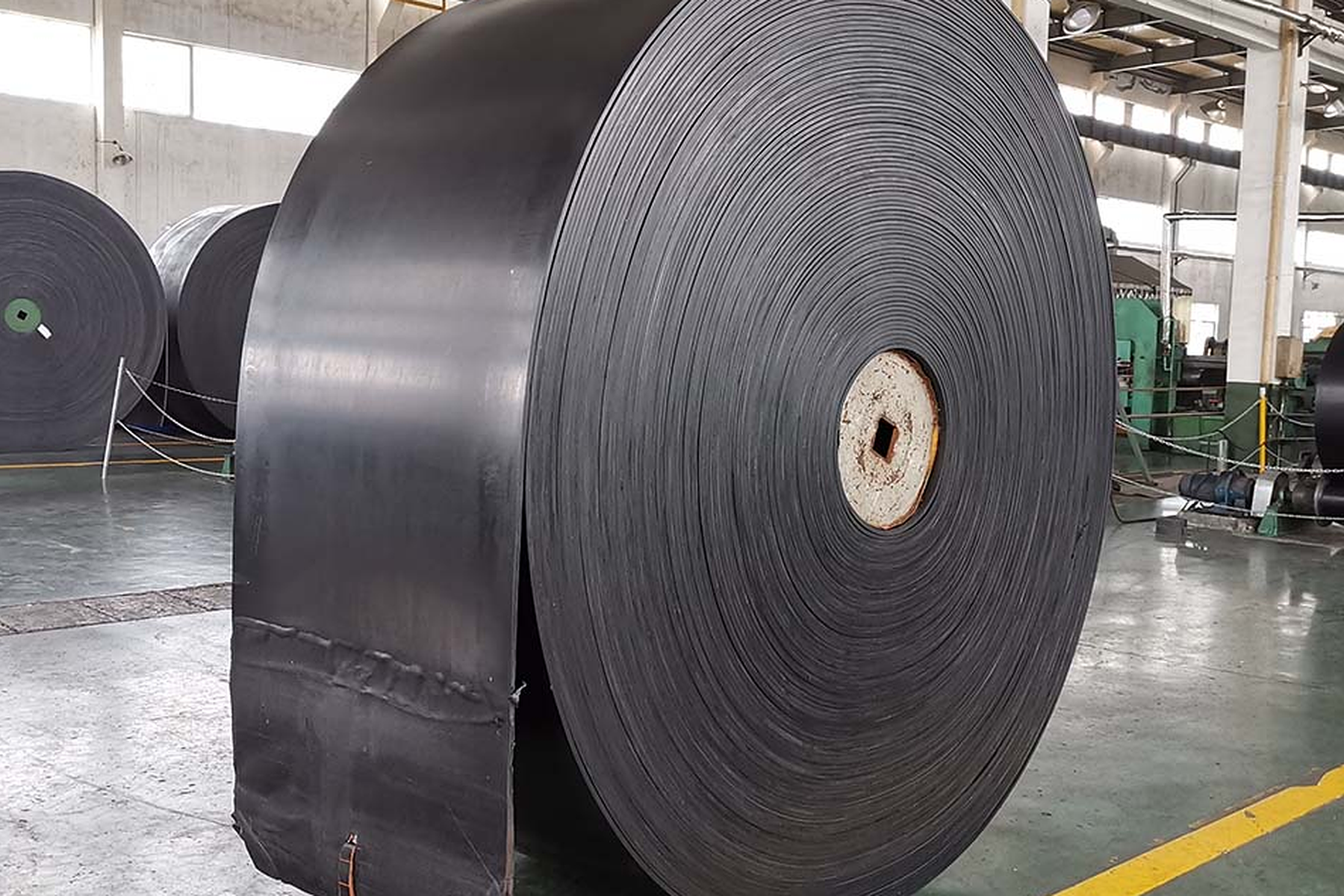
Confirmed annual capacity is 10 million meters of fabric conveyor belt and 3 million meters of steel cord conveyor belt. The reported manufacturing range covers belt widths from 100 mm to 3000 mm, thicknesses from 3 mm to 100 mm, fabric ratings from EP100 to EP600 and steel-cord ratings from ST500 to ST7500.
These figures are useful for supplier qualification, but capacity alone is not proof that a particular belt meets a project specification. Buyers should connect factory capability to the exact BOM, test plan and delivery schedule being quoted. More information about SINOCONVE's production resources is available on the conveyor belt manufacturer profile.
Procurement Warning: Do not treat a factory presentation, ISO certificate or sample coupon as interchangeable evidence. A quality-management certificate describes a management system. A sample can help with construction or visual review. Neither automatically proves that every production roll complies with the approved purchase specification. Define batch-specific acceptance evidence in the PO or inspection plan.
5. Define Quality Evidence Before Production Starts
A strong project purchase order should say not only what belt is required, but how conformity will be checked.
SINOCONVE's confirmed QC process starts with incoming raw-material inspection, continues with production monitoring, and includes finished-product testing and final inspection before shipment. The company can provide ISO documentation and product test reports. Where a buyer has special standard requirements, third-party testing can also be arranged.
That capability should be converted into an order-specific inspection plan. The buyer should identify which properties require reports, which standard or agreed test method applies, what acceptance criteria are used, and whether the report must be traceable to the production batch.
For wet-service belts, relevant checks depend on the construction and application. They may include dimensions, tensile properties, adhesion, abrasion-related performance or other characteristics defined by the purchase specification. Do not add tests merely because they appear on another project's certificate.
SINOCONVE states that conveyor belts can be manufactured with reference to DIN, RMA and ISO requirements according to the customer's market and specification. The applicable requirement should still be written into the RFQ rather than reduced to a statement such as “DIN quality.”
6. Control the Project BOM and Batch Deliveries
Ports, washing plants and recycling projects often contain more than one conveyor. A single sourcing package may include different widths, lengths, strengths, covers and surface configurations. This is where a BOM becomes a procurement-control document rather than an administrative spreadsheet.
Each line item should have a unique item number and connect the technical specification to quantity, roll length, marking, inspection documents, packaging and required delivery batch.
| BOM Field | What to Control | Typical Risk if Missing |
|---|---|---|
| Item / conveyor ID | Link each roll to the correct conveyor | Similar-looking rolls are assigned to the wrong line |
| Approved specification | Width, length, carcass, covers and special construction | Quotation and engineering documents describe different products |
| Roll configuration | Required roll lengths and identification | Installation team receives impractical roll sizes |
| Inspection records | Required reports linked to the order or batch | Documents arrive after the site needs them for approval |
| Delivery batch | Which rolls are required for each project milestone | Critical installation belts are delayed behind lower-priority items |
| Spare requirement | Critical replacement rolls or agreed spare lengths | Project starts without recoverable stock for a critical failure |
Batch delivery should be planned before manufacturing is completed. If installation is phased, identify which belts belong to commissioning, later construction stages and operational spares. This prevents an apparently “complete” shipment from being commercially useless because the first belt required on site is still in a later production batch.
7. Treat Spare Belts as an Engineering Decision
Ordering one spare of every belt can consume budget and storage space without reducing the most important downtime risks. Ordering no spare can leave a critical port or processing line exposed to manufacturing and international transport lead time.
Classify each conveyor by consequence of failure, interchangeability and replacement time. Two conveyors with the same nominal width are not necessarily interchangeable if their strength, cover, length, surface, splice or operating duty differs.
For critical lines, ask whether multiple conveyors can use the same approved spare construction without compromising the engineering requirement. Where interchangeability is real, it may reduce the number of unique spare rolls. Where it is not, forcing standardization creates another risk.
SINOCONVE has also published a dedicated guide to conveyor belt sourcing and replacement-risk control, which can be used alongside the project BOM when planning procurement and spare inventory.
8. Verify Packaging for Wet-Environment Project Deliveries
A belt designed for wet operation still needs protection before installation. Long-distance export logistics can expose a roll to handling damage, contamination and poor storage conditions before it ever reaches the conveyor.
SINOCONVE's confirmed conveyor belt packaging options include PVC board with metal-sheet protection and palletized packing to reduce transport damage. For a project order, packing requirements should be agreed together with roll identification and unloading arrangements.
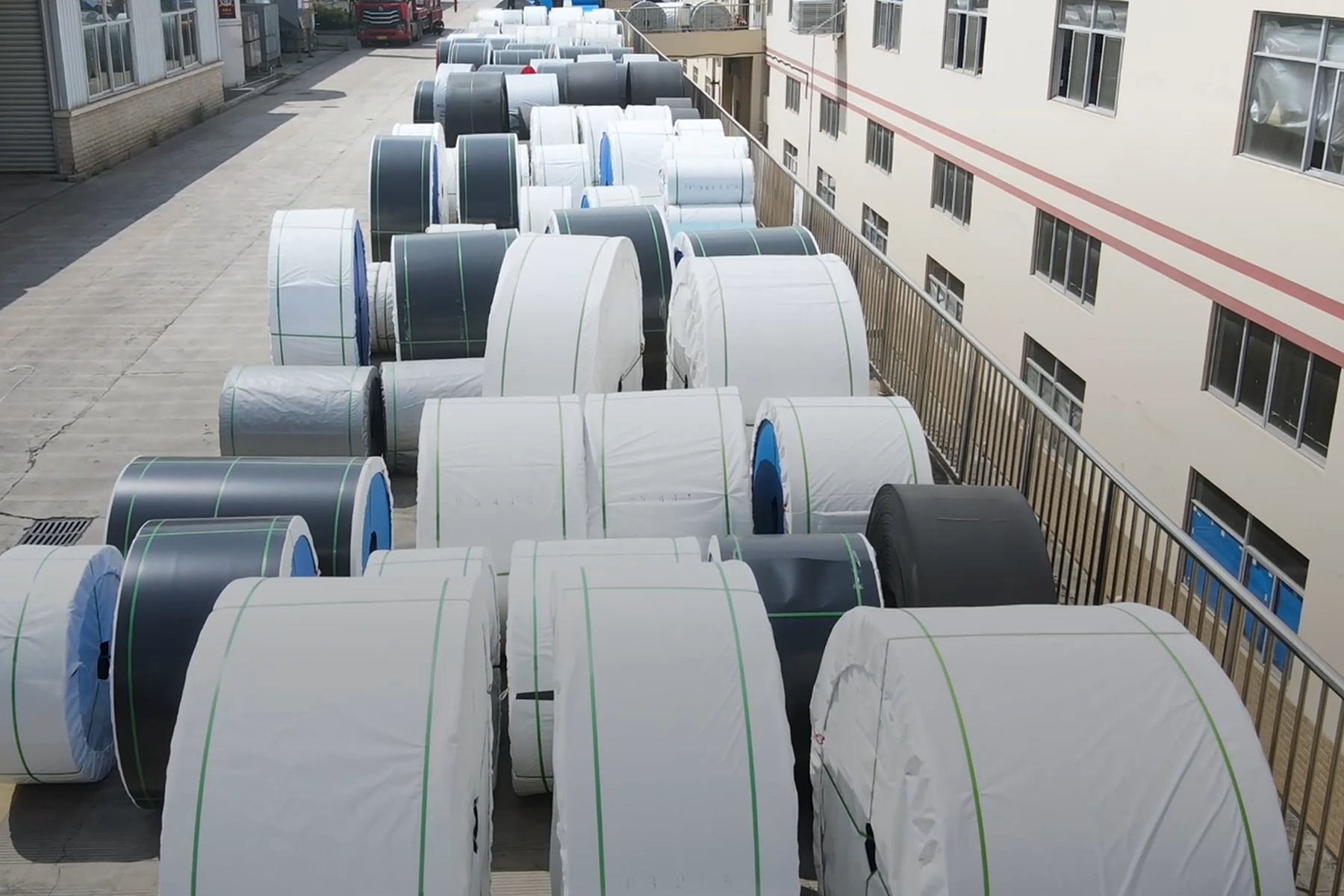
The RFQ should specify any limits on roll diameter or weight, required labels, project item numbers, destination marks and special lifting or handling requirements. If the belts will be stored outdoors or in a humid location before installation, the buyer should also define storage protection and inspect the packaging on arrival.
Wet-service capability should never be interpreted as permission to store a belt carelessly. Excessive moisture, contaminants, heat, sunlight and poor roll handling during storage can affect belting before commissioning.
9. Compare Conveyor Belt Suppliers on Evidence, Not Claims
For project procurement, the cheapest quoted meter of belt is not necessarily the lowest-risk offer. A more useful comparison separates technical compliance from commercial price.
| Supplier Check | Evidence to Request | Warning Sign |
|---|---|---|
| Manufacturing scope | Factory equipment and production process relevant to the quoted belt | Supplier cannot clearly identify where the belt will be manufactured |
| Technical review | Written clarification of missing operating data | “Wet resistant” is accepted without asking what the belt carries |
| Specification control | Approved construction or order specification | Quotation uses vague descriptions that cannot be inspected |
| Quality control | Inspection process and agreed product test reports | Only a company certificate is offered as product evidence |
| Batch traceability | Roll markings and documents tied to BOM items | Multiple project specifications use indistinguishable labels |
| Delivery capability | Production plan and batch-delivery schedule | Lead time is promised without reference to quantity or production scope |
| Export packing | Packing method, roll identification and handling plan | Packing is discussed only after production |
This evidence-based approach is especially important when comparing a conveyor belt manufacturer with a trader or general supplier. Factory-direct sourcing can shorten the communication path between the buyer's technical requirement and production, but “factory direct” by itself does not guarantee correct engineering. The factory still needs a controlled specification and acceptance plan.
10. What SINOCONVE Can Support for Project Procurement
Ningbo Sinoconve Belt Co., Ltd. manufactures industrial conveyor belts for applications including mining, cement plants, ports, logistics and other material-handling operations. Buyers can review the broader SINOCONVE product range when a project contains multiple conveyor-belt requirements.
Conveyor belts are customized rather than supplied as general stock items. The confirmed minimum order quantity for conveyor belts is 50 meters. Normal production lead time is approximately 30 days; urgent orders may be considered for a 15–20 day production arrangement depending on the actual specification, quantity and production schedule. Project buyers should therefore confirm the current schedule before treating these periods as a contractual delivery commitment.
Customization can be based on customer requirements, drawings or samples, with OEM/ODM support including logo, color and packaging requirements. Standard or small test samples can also be discussed before an order where appropriate.
For larger BOMs, buyers should send the complete project package rather than requesting each belt separately. This makes it easier to identify repeated specifications, special constructions, critical delivery batches, inspection requirements and spare-belt opportunities before production begins.
11. Frequently Asked Questions
Is a standard rubber conveyor belt suitable for continuous wet operation?
Not automatically. Suitability depends on the belt construction, conveyed material, degree of water exposure, abrasion, contamination, splice and conveyor conditions. Define the service environment before confirming the belt.
What information should I send for a wet-environment conveyor belt quotation?
At minimum, provide belt dimensions, approved strength or existing construction, conveyed material, water exposure, operating duty, incline, relevant pulley information, splice requirement, quantity and required standard. Photos of the existing conveyor and failed belt are useful for replacement projects.
Should I request a sample before a bulk project order?
A sample can support visual and construction review, and SINOCONVE can provide standard or small test samples where applicable. However, a small sample does not prove full-roll dimensions, batch consistency or every required performance property. Define production inspection and test evidence separately.
Can one wet-environment belt specification be used across a whole port or washing plant?
Only if the operating conditions and engineering requirements are genuinely compatible. Conveyors in the same facility can have different material, loading, length, incline, speed and contamination conditions. Standardization should follow engineering review rather than purchasing convenience alone.
Can SINOCONVE provide product test reports?
Yes. According to the confirmed company information, SINOCONVE can provide ISO documentation and product test reports. Third-party testing can also be arranged where the customer has special standard or verification requirements. The required tests and acceptance criteria should be agreed before production.
How should spare conveyor belts be included in a project RFQ?
Identify critical conveyors, replacement lead time, true belt interchangeability and installation constraints. Then specify spare rolls as separate BOM items with the same technical, marking, testing and packaging controls as operational belts.
What is SINOCONVE's MOQ for conveyor belts?
The confirmed minimum order quantity is 50 meters for conveyor belts. For project procurement involving several specifications, send the full BOM so quantity and production planning can be reviewed together.

12. Prepare a Better Wet-Environment Conveyor Belt RFQ
A wet-environment conveyor belt purchase becomes easier to control once “wet resistant” is replaced by measurable project information. Define what material is being conveyed, how water reaches the belt, what abrasion or contamination is present, the approved belt construction, the conveyor geometry and what evidence will be required before shipment.
For a port, washing plant or recycling project, send SINOCONVE your belt BOM, existing specifications or drawings, conveyed-material information, photos where relevant, required testing or standards, quantities, delivery batches and destination. The team can review these requirements against the available manufacturing and inspection capability before quotation.
For technical and commercial review, use the SINOCONVE RFQ and contact page or email sales@sinoconve.com. A complete RFQ gives both buyer and manufacturer a better basis for controlling specification, production, inspection, packing and delivery risk.