
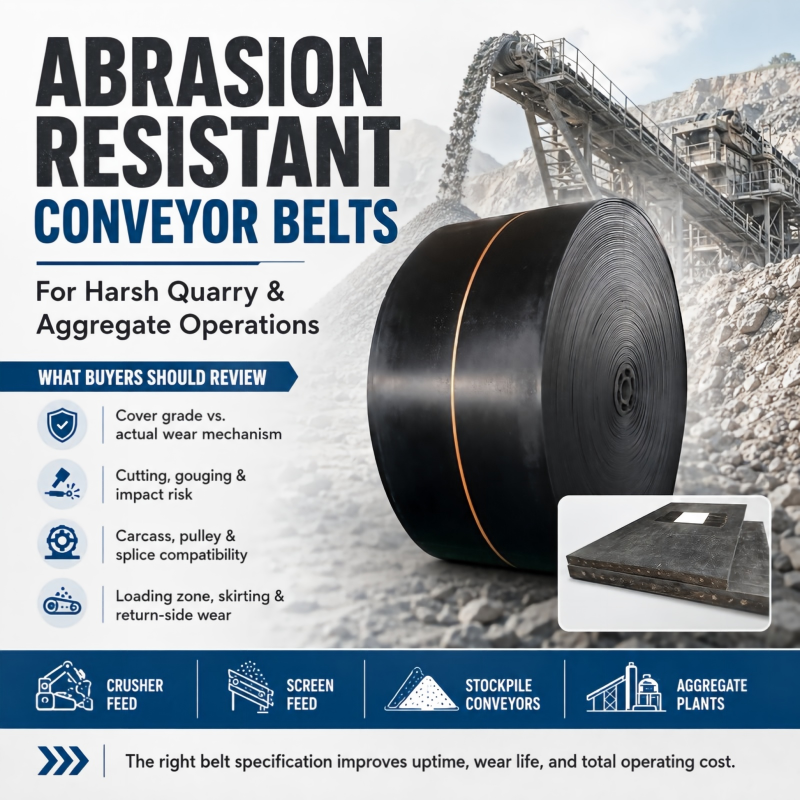
A quarry belt can lose its top cover without ever suffering a dramatic failure. The change may begin as a polished strip below the crusher discharge, then become shallow grooves under the skirting, followed by exposed fabric during a busy production week. The conveyor still runs through most of that process, which is why the true cost is easy to miss until replacement can no longer be postponed.
An abrasion resistant conveyor belt is intended to slow that wear, but the label alone does not define a suitable quarry belt. Fine sand scours rubber differently from angular granite. A stone crusher discharge creates impact and gouging that cannot be judged from an abrasion test alone. Wet fines, trapped rock, mistracking, and aggressive cleaners can remove cover even when the rubber compound is technically wear resistant.
For an aggregate plant, belt life is decided by three connected choices: the cover grade, the belt construction beneath it, and the way material enters and leaves the conveyor. Buyers who review all three usually get a more reliable specification than buyers who compare only cover thickness or price per metre.
Quarry Productivity Is Closely Tied to Belt Wear
A quarry conveyor rarely operates in isolation. It links the primary crusher, screens, secondary crushing, stockpiles, washing equipment, and load-out areas. When one critical belt is stopped, material can back up upstream while downstream equipment runs empty. The production loss may be much larger than the value of the damaged belt section.
Fenner Dunlop describes quarry service as a combination of repeated impact, heavy broken material, and sharp edges, often falling from height. Those conditions explain why quarry belts need both wear resistance and tear resistance. The cover must resist surface loss, while the carcass and loading-zone support must limit damage that reaches deeper into the belt.
|
Quarry condition |
Typical belt effect |
What buyers should review |
|
High hourly throughput |
More tonnes pass each loading and discharge point |
Cover grade, belt speed, capacity margin |
|
Short crusher-to-screen conveyor |
The same belt section cycles through impact zones more often |
Wear allowance, loading support, inspection frequency |
|
Large angular stone |
Cutting, gouging, puncture, local carcass damage |
Cut-resistant cover, carcass, breaker, chute design |
|
Wet fines or clay |
Carryback, roller buildup, mistracking |
Cleaning, return rollers, bottom-cover wear |
|
Outdoor operation |
Water, sunlight, temperature cycles, contamination |
Weather resistance, edge protection, storage |
Abrasion, Cutting, and Impact Are Different Damage Mechanisms
A common purchasing mistake is treating every form of cover loss as abrasion. In practice, quarry materials damage a rubber conveyor belt in several ways. Fine particles rub against the surface over a large area. Sharp stone removes chunks from the cover. Heavy lumps strike the belt and deform the carcass. A trapped object can cut a longitudinal groove for many metres.
Fenner Dunlop specifically distinguishes fine-particle abrasion from cutting and gouging by heavy, sharp materials such as rock. This matters because a compound that performs strongly in a standardized abrasion test may not provide the best resistance to deep cuts. The material shape and loading method should therefore be included in the RFQ.
|
Damage mechanism |
Common appearance |
Selection direction |
|
Fine abrasion |
Gradual, relatively even top-cover loss |
High-quality abrasion-resistant compound |
|
Cutting and gouging |
Deep cuts, chunks missing, rough local damage |
Cut/gouge-resistant cover and controlled loading |
|
Impact |
Punctures, bruised carcass, local delamination |
Impact support and suitable reinforcement |
|
Entrapment |
Long grooves below skirting or chute areas |
Eliminate belt sag and trapped material |
|
Carryback wear |
Return-side buildup and irregular underside wear |
Cleaner setup, return roller condition, bottom cover |
What Cover Grade Actually Controls
The top cover protects the tensile carcass from the conveyed material. Its performance depends on rubber formulation, tear strength, resistance to ageing, production quality, and thickness. The term wear resistant belt should therefore describe more than a thick layer of black rubber.
ISO 14890:2026 sets requirements for rubber- or plastics-covered textile conveyor belts used on flat or troughed idlers. Quarry specifications may also refer to regional cover grades or customer standards. Buyers should state the required standard and test properties instead of relying on a supplier's generic phrase such as 'premium abrasion grade.'
Cover thickness remains important because it provides a wear allowance. However, adding more of the wrong compound only delays the same failure. A thick general-purpose cover can still be cut rapidly by sharp basalt, while a better cut-resistant compound may last longer at a more balanced gauge.
|
Cover decision |
Question to ask |
Why it matters |
|
Rubber grade |
Is the main risk abrasion, cutting, oil, heat, or weather? |
Different compounds solve different damage |
|
Top-cover thickness |
How much usable wear allowance is required? |
Affects service life, belt weight, and pulley demand |
|
Bottom-cover thickness |
How dirty and abrasive is the return side? |
Protects the carcass on pulleys and idlers |
|
Tear strength |
Will sharp stone remove chunks from the cover? |
Important for quarry and sharp material handling |
|
Ageing resistance |
Will the belt run outdoors for long periods? |
Supports stable properties over time |
The Loading and Impact Area Often Decides Belt Life
The cover compound cannot compensate for a poorly controlled stone crusher discharge. Martin Engineering notes that impact, belt sag, trapped material, and unstable loading zones are common causes of belt damage. When the belt sags between support points, pieces of aggregate can become trapped against the skirting and cut grooves into the moving cover.
The receiving belt should be supported through the impact and settling zones. Material should be directed close to the belt centreline and, where practical, in the direction of belt travel. Impact cradles or correctly spaced impact idlers can reduce deformation. Stable support also helps the skirting form a consistent seal without excessive pressure.
An aggregate plant expansion should trigger a transfer-point review. Higher capacity can change the material trajectory, increase bed depth, and overload support that was adequate at the original design rate. Reordering the old quarry belt conveyor specification without checking the revised flow can lead to faster wear even if the belt quality has not changed.
Carcass Construction Must Support the Cover
An abrasion resistant conveyor belt still needs a carcass suited to the calculated load, impact, pulley diameters, and troughing arrangement. EP textile reinforcement is widely used in quarry conveyors because it combines useful tensile strength, controlled elongation, and flexibility. Higher-impact duties may justify a different fabric design, a breaker layer, or another reinforced construction.
Adding plies is not automatically an upgrade. A heavier, stiffer belt may require larger pulleys and longer transitions. If the carcass cannot flex correctly around the installed pulleys, cracking and splice stress can appear even though the cover grade is appropriate.
The splice must also suit the carcass and quarry duty. Mechanical fasteners can be useful for rapid field work in selected systems, while hot-vulcanized joints provide a continuous surface and are common on permanent heavy-duty belts. The final method depends on tension, belt construction, maintenance access, and shutdown time.
Why Short Quarry Conveyors Can Wear Surprisingly Fast
Short belts pass through the loading point and discharge point more frequently than long belts at the same speed. A particular metre of cover may therefore experience impact, skirting contact, and cleaner contact many more times during a shift. Fenner Dunlop highlights this repeated cycling as one reason cover-grade selection is especially important on shorter belts.
This is common around a stone crusher, screen feed, or transfer between processing stages. The conveyor may be short, but the duty is severe. Buyers should not classify it as light duty based on length alone.
Failure Marks Buyers Should Use as Evidence
|
Observed condition |
Likely cause |
Corrective review |
|
Even top-cover loss |
Normal abrasion or insufficient wear allowance |
Compound quality, thickness, tonnes handled |
|
Deep random gouges |
Large sharp rock and uncontrolled impact |
Chute, drop height, cut resistance, breaker |
|
Long parallel grooves |
Entrapment under skirting or load-zone sag |
Belt support and sealing system |
|
One edge wears rapidly |
Mistracking, off-centre loading, frame contact |
Alignment, pulleys, idlers, feed position |
|
Cracks across the belt |
Small pulley, stiff construction, ageing |
Pulley diameter, carcass, storage, environment |
|
Bottom cover wears unevenly |
Seized rollers, carryback, damaged pulley surface |
Return system and cleaning |
The old belt should remain available until the replacement specification is approved. Photographs of unworn cover, worn areas, edges, splice, underside, and loading zone help distinguish a material problem from a conveyor problem. Without that evidence, a supplier may simply increase thickness and repeat the original mismatch.
What to Include in a Quarry Belt RFQ
|
Information |
Example |
Why it matters |
|
Material |
Granite, limestone, basalt, sand |
Identifies abrasion and cutting behaviour |
|
Maximum lump size and shape |
200 mm angular stone |
Clarifies impact and gouging risk |
|
Conveyor duty |
Crusher discharge, screen feed, stockpile |
Shows where impact and cycling occur |
|
Capacity and speed |
800 t/h at 2.2 m/s |
Supports load and service calculations |
|
Belt dimensions |
Width, length, covers, carcass |
Creates a comparable quotation |
|
Drop height and chute |
1.5 m vertical drop |
Defines impact-zone requirements |
|
Pulley diameters |
Drive, tail, bend, snub |
Checks flexibility and splice compatibility |
|
Environment |
Outdoor, wet, dusty, 18 h/day |
Guides cover and edge protection |
|
Failure history |
Grooves under skirts after eight months |
Targets the real cause |
Common Buying Mistakes
The first mistake is choosing by abrasion-loss data alone while ignoring cuts and gouges. The second is increasing cover thickness without checking pulley diameter and belt weight. The third is buying a premium belt for an unsupported impact zone. Another is comparing quotations that list the same nominal belt size but different compounds, carcasses, tolerances, and testing.
A quarry buyer should also be cautious with unsupported service-life promises. Belt life depends on tonnes handled, material, chute condition, cleaner pressure, alignment, maintenance, and operating hours. A supplier can recommend a specification and provide test data, but no responsible quotation can predict exact life without a defined duty and site history.
FAQ
What makes a conveyor belt abrasion resistant?
Its rubber cover is formulated and manufactured to resist wear from the conveyed material. Actual performance also depends on tear strength, ageing resistance, cover thickness, and conveyor conditions.
Is the lowest abrasion-test value always the best choice?
Not necessarily. A quarry may suffer cutting, gouging, and impact as well as fine abrasion. The selected cover should match the dominant damage mechanism.
How thick should a quarry conveyor belt cover be?
Cover thickness depends on material, loading height, expected wear, belt construction, and pulley diameters. There is no universal thickness for all aggregate plants.
Can a stronger carcass stop top-cover wear?
No. The carcass carries tension and supports the load. Cover wear is controlled mainly by rubber grade, thickness, loading, cleaning, and alignment.
Why does a short crusher conveyor wear quickly?
Each belt section passes the loading, discharge, skirting, and cleaning points more frequently, so the cover experiences more wear cycles per operating hour.
What should buyers send for a quotation?
Send the material, lump size, conveyor position, capacity, speed, belt dimensions, pulley sizes, drop height, environment, existing standard, and failure photographs.
Final Buying Advice
A quarry conveyor belt earns its value by keeping the aggregate plant moving between planned shutdowns. The right specification begins with the actual wear mechanism: fine abrasion, sharp-rock gouging, impact, entrapment, or return-side damage. Match the cover grade to that mechanism, support the belt through the impact area, and confirm that the carcass, pulleys, and splice work together. That is more reliable than buying the thickest belt or the lowest price per metre.