
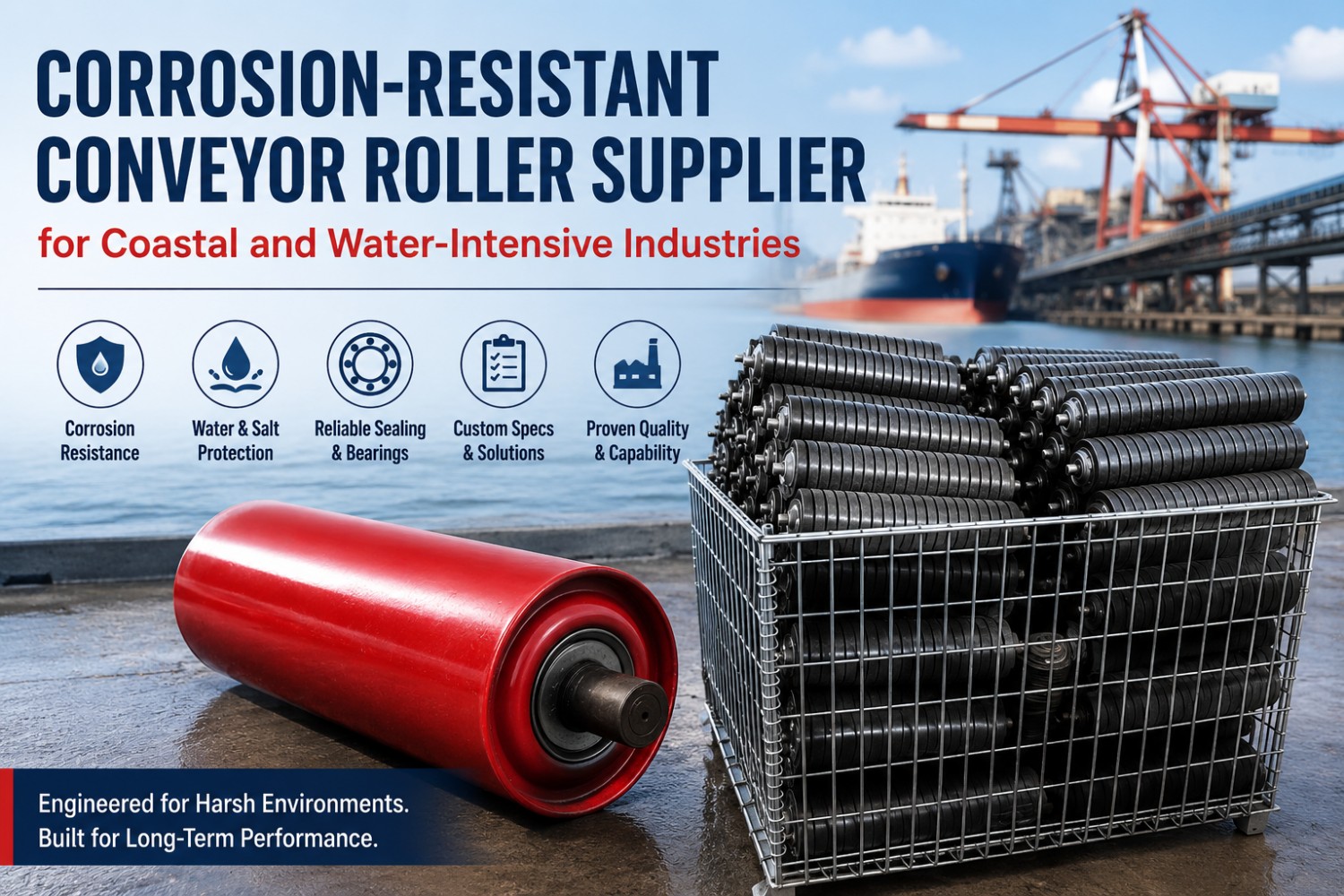
Corrosion-Resistant Conveyor Roller Supplier for Coastal and Water-Intensive Industries
At a port, coastal terminal, washdown plant, or other water-intensive facility, a conveyor roller can fail for reasons that are easy to miss during purchasing. The shell may still look serviceable while moisture has already reached the bearing area. A protective coating may slow external corrosion but do little if water enters through the end assembly. Salt, spray, humidity, wash water, abrasive contamination, and long outdoor exposure can turn a routine conveyor component into a recurring maintenance item.
For a port or plant buyer, this changes the sourcing question. Finding a corrosion resistant conveyor roller supplier is not simply about requesting a “rust-resistant” finish. The RFQ needs to define the exposure, roller duty, dimensions, load and speed requirements, sealing expectations, material or coating system, and the evidence required before shipment. Supplier qualification should then determine whether the proposed roller actually matches those conditions.
Quick Answer: For wet or coastal conveyor service, evaluate corrosion resistance as a complete roller system. Shell material or coating matters, but so do bearing protection, seal design, end construction, shaft exposure, drainage, load capability, dimensional compatibility, and inspection documentation. A quotation that only says “corrosion resistant” is not yet a technical specification.
1. Why Coastal and Water-Intensive Conveyor Service Changes the Purchase Specification
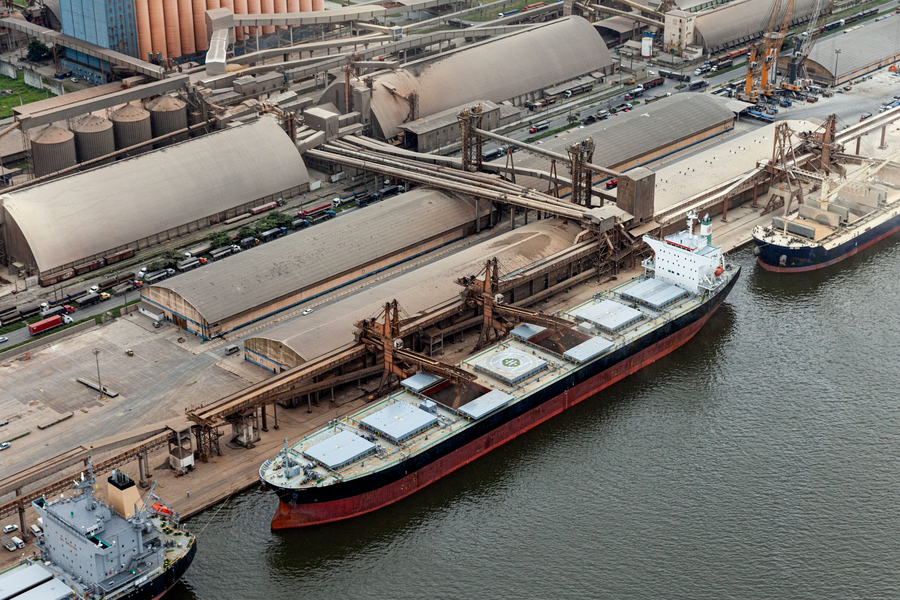
A dry indoor conveyor and a conveyor operating beside seawater may use components with similar basic dimensions, but their exposure conditions are very different. Coastal conveyors can face salt-laden moisture, condensation, rain and wind-driven spray. Ports handling bulk materials can add abrasive dust and contamination. Water-intensive plants may expose rollers to frequent washdown, splashing, process water or persistently high humidity.

The important engineering point is that corrosion and contamination do not act independently. External corrosion can attack the shell, shaft ends, housings and other exposed metallic surfaces. Water and fine contaminants entering the bearing area can affect rotation and bearing condition. Deposits around roller ends may also make inspection more difficult.
A roller that becomes difficult to rotate is no longer just a roller replacement issue. Increased rotational resistance contributes to conveyor resistance, while a seized roller can create sliding contact between the belt and stationary shell. That can accelerate local belt wear and create additional maintenance risk.
Buyers should therefore treat environmental exposure as part of the operating specification, not as a note added after the roller dimensions have already been selected.
| Operating Condition | Main Risk | Specification Implication |
|---|---|---|
| Coastal salt and humid air | Accelerated corrosion of exposed metallic components | Define material/coating requirements and identify exposed surfaces that require protection |
| Rain, spray or washdown | Moisture reaching the bearing and internal components | Review sealing architecture and end construction, not only shell finish |
| Water plus abrasive dust | Combined contamination, seal wear and surface attack | Specify both contamination exclusion and corrosion protection |
| Long outdoor conveyor | Many distributed maintenance points and costly replacement access | Compare maintainability, interchangeability and documentation as well as unit price |
2. “Corrosion Resistant” Is Not a Complete Roller Specification
The phrase can describe several very different approaches. Depending on the application, a supplier may propose coated or galvanized steel, stainless steel, polymer-based construction such as HDPE, or another engineered combination. These options should not be treated as automatically equivalent.
Steel provides a rigid shell and is widely used in belt-conveyor idlers, but the corrosion protection system must suit the environment. A coating can be useful only if its type, preparation, coverage and relevant acceptance criteria are understood. Stainless steel may offer stronger corrosion resistance in suitable environments, but material grade, load, cost and compatibility still require review. Polymer rollers can reduce corrosion exposure and roller mass in selected applications, but their load capability, temperature limits, impact conditions, dimensional stability, static requirements and site safety requirements must also be considered.
The correct choice therefore comes from condition → risk → specification, not from a material label.
Buyer Tip: If a quotation states only “galvanized,” “stainless,” “HDPE,” “anti-rust,” or “corrosion-resistant coating,” ask for the exact construction and technical basis. The material name tells you what the roller is made from; it does not by itself demonstrate suitability for your conveyor.
3. Bearing Protection and Sealing Deserve Separate RFQ Questions
Visible shell corrosion receives attention because it is easy to inspect. Bearing contamination is more difficult to see and can be more important to roller operation.
In a wet conveyor environment, buyers should ask how the end assembly limits the path of water and contaminants toward the bearing. The discussion should cover the sealing arrangement, bearing housing, shaft interface, lubricant strategy where applicable, and how the assembly behaves under the actual combination of water and solids.
A vague phrase such as “waterproof bearing” is not enough. Ask the supplier to provide a section drawing or construction description showing the sealing path and bearing arrangement.
This is particularly important where water exposure occurs together with coal dust, ore fines, fertilizer, aggregates, cementitious material or other particles. A design selected only for clean-water exposure may face a different challenge when wet solids accumulate around the roller ends.
SINOCONVE's existing conveyor idler roller selection guide discusses how moisture, contamination, bearing protection, roller position and dimensions affect idler selection. Buyers comparing replacements should use the same operating-condition approach rather than matching diameter alone.
4. Do Not Let Corrosion Requirements Hide the Mechanical Requirements
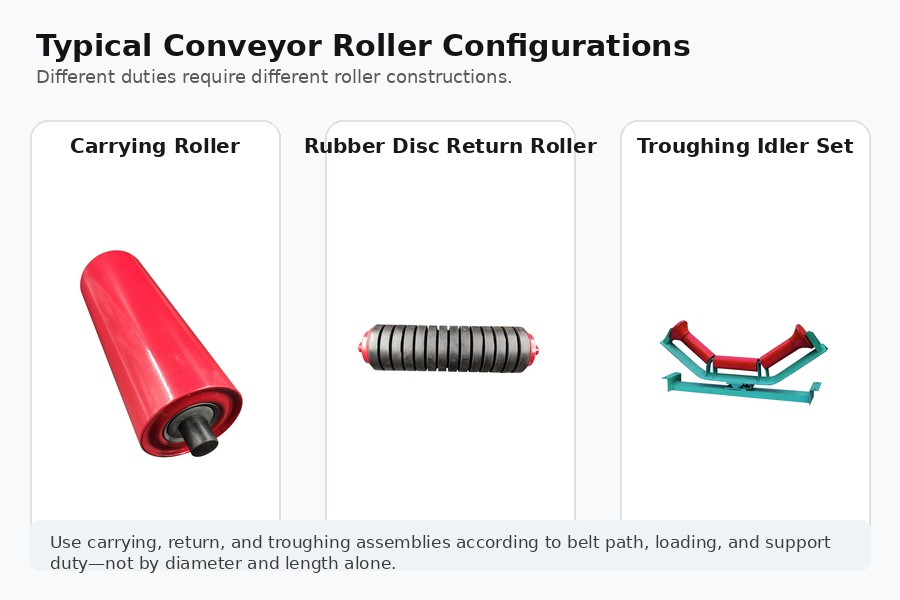
Corrosion resistance is only one part of roller suitability. A roller can have excellent environmental resistance and still be wrong for the conveyor if its load, speed, geometry or mounting details do not match the system.
For belt-conveyor idlers, the RFQ should normally identify the roller position: carrying, return, impact, transition or another project-specific arrangement. The supplier then needs enough information to check the shell, shaft, bearings, seals and mounting geometry for that duty.
Important dimensional information includes roller outside diameter, face length, overall shaft length, shaft-end geometry and frame interface. For replacement projects, a dimensioned drawing is usually more reliable than descriptions such as “standard port roller.”
Operating information also matters. Belt width, belt speed, conveyed material, loading conditions, idler spacing and required load basis can influence the selection. An impact-zone roller should not be evaluated in the same way as a lightly loaded return roller.
For a broader explanation of these mechanical checks, see SINOCONVE's guide to conveyor rollers for heavy-duty belt conveyor systems.
5. What Standards Can—and Cannot—Tell a Port Buyer
Standards can help establish a common technical basis, but buyers should identify exactly what a cited standard covers.
ISO 1537 addresses dimensions, arrangement and clearances for idlers used with three-idler troughed belt conveyors for loose bulk materials. It can therefore be relevant to dimensional and arrangement questions. It should not be interpreted as automatic proof that a particular roller has the corrosion resistance required for a coastal terminal.
Likewise, ISO 5048 concerns calculations for operating power and tensile forces on belt conveyors with carrying idlers. It helps show why conveyor resistance matters at system level, but it is not a corrosion qualification standard.
This distinction matters during tender evaluation. A quotation that lists a recognized conveyor standard may still leave the environmental protection requirement undefined.
For project procurement, state the required standard and edition where applicable, then separately define corrosion protection, sealing, dimensions, load basis, inspection requirements and any project-specific acceptance criteria. If the EPC specification or end-user standard requires particular coating tests, material certificates, dimensional reports or other documentation, identify those requirements in the RFQ rather than assuming every supplier uses the same package.
6. What a Useful RFQ Should Tell the Conveyor Roller Supplier
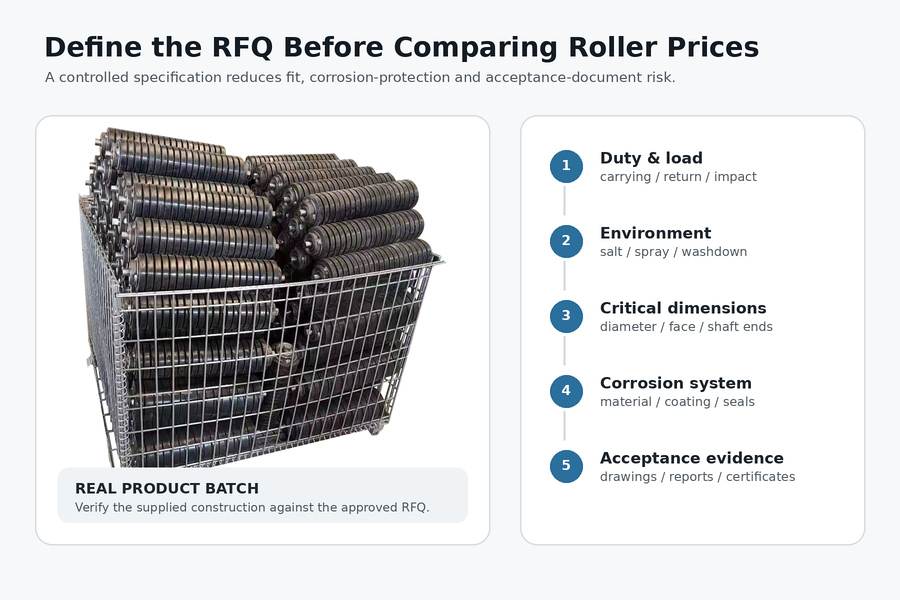
Better RFQ data reduces assumptions. It also makes supplier quotations easier to compare because each bidder is working from the same duty conditions.
| RFQ Item | What the Buyer Should Provide | Why It Matters |
|---|---|---|
| Roller duty | Carrying, return, impact or other installed position | Determines the mechanical duty and construction to review |
| Environment | Coastal atmosphere, direct salt spray, rain, washdown, humidity, process water or immersion risk | Defines the actual corrosion and moisture exposure |
| Contaminants | Dust, fines, mud, fertilizer, chemicals or other material around the idler | Affects sealing and material compatibility |
| Dimensions | Tube diameter, face length, shaft length, shaft-end details and drawing | Reduces replacement and frame-fit risk |
| Conveyor data | Belt width, speed, idler arrangement, spacing and relevant load information | Allows mechanical suitability to be reviewed |
| Corrosion requirement | Project coating/material specification and required test method where specified | Prevents “corrosion resistant” from remaining an undefined claim |
| Documentation | Required drawings, inspection records, certificates or third-party testing requirements | Makes compliance evidence part of the quotation |
| Commercial scope | Quantity, delivery destination, packaging and project schedule | Allows a supplier to quote the actual procurement scope |
Where an existing roller has already failed, add photographs and failure observations. Show shell corrosion, damaged shaft ends, seized rollers, bearing contamination, coating breakdown or material buildup where relevant. The failed component often contains information that a purchasing specification does not.
7. How to Qualify a Corrosion-Resistant Conveyor Roller Supplier
Once the RFQ is technically clear, supplier qualification becomes more meaningful. Instead of asking only for a catalog and price, evaluate whether the supplier can translate your operating conditions into a controlled product specification.
7.1 Ask for a construction proposal, not a product label
The quotation should identify the proposed roller type and enough construction detail to understand what is being supplied. Depending on the project, this can include shell material, corrosion-protection method, shaft details, bearing arrangement, sealing design and relevant dimensions.
If a supplier changes the material or construction from the tender specification, the deviation should be explicit. Silent substitutions create unnecessary approval and installation risk.
7.2 Compare drawings before comparing prices
For replacement projects, verify interface dimensions first. A lower-priced roller that requires frame modification, creates incorrect roll gaps or does not fit existing mounting slots is not a direct commercial alternative.
SINOCONVE's conveyor roller category provides an initial product path, but project buyers should still submit the actual operating and dimensional requirements for technical confirmation.
7.3 Define what proof must accompany the order
“Quality checked” is too broad for a project specification. Decide what evidence the procurement package requires before issuing the purchase order.
This may include dimensional inspection, material or coating documentation where specified, applicable product test reports, drawings and third-party inspection when contractually required. The correct evidence depends on the project specification; not every document proves every performance characteristic.
SINOCONVE states that its quality process covers incoming raw-material inspection, production inspection and final testing before shipment, and that product test reports can be provided. Special standard requirements and third-party testing can also be discussed when required. Buyers should define the exact acceptance documents needed for their project before order confirmation.
8. Compare Total Purchase Risk, Not Only Roller Unit Price
For a long port conveyor, rollers are distributed across a large number of maintenance points. Procurement decisions therefore affect more than the initial invoice.
A useful bid comparison should consider technical equivalence, expected interchangeability, inspection evidence, packaging, replacement availability and the consequences of premature failure. This does not mean the highest-priced roller is automatically the best choice. It means price comparisons should be made only after the technical scope is aligned.
RFQ Warning: Two suppliers can quote the same roller diameter and face length while offering materially different shell construction, shaft details, bearings, sealing systems and corrosion protection. Normalize those differences before treating the quotations as comparable.
Port procurement teams should also consider the cost of non-interchangeable replacements. If different batches use inconsistent shaft ends or dimensions, maintenance may need to maintain multiple spare variants. A controlled drawing and agreed tolerances can reduce this risk.
9. Supplier Capability Should Be Relevant to the Order
Supplier capability matters, but factory-size claims should not replace product-specific verification.
Ningbo Sinoconve Belt Co., Ltd. traces its manufacturing operations to 1988 and has more than 35 years of manufacturing experience. Its broader manufacturing organization includes more than 200 employees, engineering and quality-control personnel, production lines and laboratory/testing resources. SINOCONVE also supports OEM/ODM development based on customer drawings, samples and operating requirements.
These capabilities can support industrial procurement, but a port buyer should still qualify the actual conveyor roller being ordered. The useful questions remain product-specific: Can the proposed construction match the drawing? What corrosion protection is being offered? How is the bearing protected? What inspection documents will be supplied? Can required project testing be agreed before production?
Buyers conducting broader supplier due diligence can review SINOCONVE's manufacturing information alongside the product-specific quotation and technical documentation.
10. Common Procurement Mistakes in Wet and Coastal Roller Projects
- Specifying only “anti-corrosion roller.” This leaves the material, coating, exposure and acceptance criteria open to interpretation.
- Focusing on the shell while ignoring the bearing area. External appearance does not show whether moisture and contamination are adequately controlled at the end assembly.
- Buying by diameter and length alone. Shaft ends, bearing spacing, mounting interface, load, speed and installed position still matter.
- Assuming stainless steel or polymer is automatically better. Material selection must remain conditional on load, impact, temperature, static/fire requirements, environment and project specification.
- Listing a standard without defining the required evidence. A standard reference is useful only when its scope and project acceptance requirements are understood.
- Comparing prices before normalizing specifications. Different constructions can make apparently similar quotations technically unequal.
- Waiting until after production to discuss inspection documents. Documentation and testing requirements should be agreed in the RFQ or purchase specification.
11. Questions to Ask Before Approving a Supplier
A practical supplier review does not need dozens of generic questionnaire items. For corrosion-sensitive conveyor rollers, a smaller number of precise questions is more useful:
- What roller construction are you proposing for our exact water, salt, humidity and contamination exposure?
- What protects the shell, shaft ends and other exposed metallic surfaces from the specified environment?
- How does the sealing arrangement protect the bearing area from water and solids?
- Can you provide a drawing showing all critical dimensions and shaft-end details?
- What load and speed information do you need to confirm suitability?
- Which standard or project specification is the proposal based on, and which requirements are outside that standard's scope?
- What inspections and documents can be agreed before production and supplied before shipment?
- How will the rollers be packaged to protect finished surfaces and components during export transport?
Answers to these questions reveal much more than a generic claim such as “industrial-grade corrosion-resistant roller.”
12. FAQ
What is the best conveyor roller material for coastal applications?
There is no single best material for every coastal conveyor. Coated or galvanized steel, stainless steel and suitable polymer constructions can each have a place. The choice depends on corrosion exposure, load, speed, impact, temperature, contaminants, fire or static requirements, maintenance strategy and project specifications.
Is a galvanized conveyor roller enough for a port?
Not necessarily. “Galvanized” identifies a corrosion-protection approach but does not by itself define suitability for a particular port. Buyers should verify the specified coating system or relevant requirements, exposed surfaces, sealing arrangement, mechanical duty and project acceptance criteria.
Why is roller sealing important in water-intensive plants?
Because corrosion protection on the outside of the shell does not prevent water or fine contamination from reaching the bearing area. The end assembly and sealing path should therefore be reviewed separately from the external finish.
Does ISO 1537 certify that an idler is corrosion resistant?
No. ISO 1537 addresses dimensions, arrangement and clearances for idlers in the specified troughed belt-conveyor configuration. Corrosion resistance and project-specific environmental performance need separate specification and verification.
What should I send when requesting a replacement conveyor roller?
Send a dimensioned drawing where possible, plus the roller position, tube diameter, face length, overall shaft dimensions, shaft-end details, belt width, speed, operating environment, conveyed material, quantity and any required standard or inspection documentation. Photographs of the existing roller and failure condition can also help.
Can SINOCONVE manufacture according to a buyer's drawing or sample?
SINOCONVE supports customized production and OEM/ODM cooperation based on customer drawings, samples and technical requirements. Final feasibility and specifications should be confirmed against the actual application before production.
Can product test reports or third-party testing be requested?
SINOCONVE can provide product test reports, and third-party testing can be discussed when customers have special standard or project requirements. Buyers should identify the exact test method, acceptance criteria and required documents during the RFQ stage.
13. Prepare the RFQ Around the Environment, Not Just the Roller Size
A corrosion-resistant conveyor roller purchase becomes easier to control once the environment and acceptance requirements are converted into measurable RFQ information. Start with the installed roller position and dimensions, then add belt speed and relevant load data, exposure to salt or water, contaminants, required construction or corrosion specification, project standards, inspection documents, quantity and delivery destination.
For an existing installation, include drawings or clear photographs of the roller, shaft ends, frame interface and any corrosion or bearing-related failure. SINOCONVE can review customized conveyor roller requirements against this information.
Submit the project through the SINOCONVE RFQ page or email sales@sinoconve.com. The objective is not simply to quote a roller that fits the frame, but to define a component whose construction, documentation and environmental protection can be checked before the purchase order is released.

Related Products & Technical Guides
If you are evaluating conveyor rollers for ports, bulk terminals, mines, or other demanding material-handling systems, these SINOCONVE resources can help with the next stage of product selection and supplier evaluation.
- Conveyor Roller — Explore SINOCONVE conveyor roller products for industrial material-handling applications and discuss customized dimensions, construction, and operating requirements.
- Conveyor Roller Product Catalog — Review the SINOCONVE product catalog when preparing a sourcing list or comparing conveyor components for a new project or replacement program.
- Conveyor Idler Roller Guide: How to Choose the Right One — Learn how roller position, dimensions, shaft design, bearing protection, water, contamination, and operating conditions affect idler selection.
- Conveyor Rollers for Heavy-Duty Belt Conveyor Systems — A buyer-focused guide to shell construction, shafts, bearings, sealing, runout, load, speed, and frame compatibility for demanding conveyors.
- Steel Conveyor Rollers for Heavy-Duty Industrial Use — Review the factors that should be checked when comparing steel rollers beyond purchase price and outside dimensions.
- Self-Aligning Roller: Choosing the Right Conveyor Solution — Understand when a self-aligning roller can help with belt tracking and when misalignment, seized rollers, loading, or conveyor structure should be investigated first.