A seized return roller does not always stop a conveyor immediately. The belt may keep moving while rubbing across the stationary shell, heating the cover and leaving a polished strip that maintenance notices days later. By then, the purchase is no longer about replacing one roller. The belt, power demand, tracking, and shutdown schedule may all be involved.
That is why a conveyor idler roller should be selected from its installed position and working conditions, not from tube diameter and price alone. A carrying idler under loaded belt sees different forces from a return roller. An impact station needs a different construction from a clean indoor transfer. Dust, water, belt speed, shaft support, bearing protection, and mounting accuracy all change the result.
For buyers, the useful question is not “Which roller looks strongest?” It is “Which roller will rotate freely, support the belt correctly, and keep contaminants away from the bearings for the required service life?”
First Confirm Whether You Need an Idler or a Unit-Load Roller
The term conveyor roller is used for two different product groups. In a belt conveyor system, idler rollers support the belt and the bulk material carried on it. In a gravity or powered roller conveyor, cartons, pallets, or totes run directly on the rollers. The products may look similar, but their mounting, load distribution, drive arrangement, and performance requirements are not the same.
This article focuses on belt-conveyor idlers. ISO 1537 addresses idlers for troughed belt conveyors handling loose bulk material, while ISO 5048 explains how carrying idlers contribute to conveyor resistance and power calculations. These standards reinforce a practical point: rollers are part of the conveyor design, not interchangeable hardware.
|
Roller category |
What it supports |
Typical buyer concern |
|
Belt conveyor idler |
Loaded or empty conveyor belt |
Rotation resistance, sealing, runout, belt support |
|
Gravity conveyor roller |
Cartons, totes, or pallets directly |
Product load, pitch, shaft mounting, free rolling |
|
Powered conveyor roller |
Unit loads, often through chain, belt, or internal motor |
Drive interface, torque, speed, controls |
Choose the Roller From Its Position in the Conveyor
The same belt conveyor can use several idler types. Each position exposes the roller to a different load and failure pattern. Using a generic roller description in an RFQ makes it easy for suppliers to quote different products under the same name.
|
Idler position |
Main function |
What to check |
|
Troughing carrier idler |
Supports loaded belt and forms the carrying trough |
Trough angle, centre and wing-roll lengths, load class |
|
Flat carrier idler |
Supports a flat carrying belt |
Belt width, load distribution, roller spacing |
|
Return roller |
Supports the empty belt on its return run |
Carryback, shell wear, alignment, cleaning |
|
Rubber-disc return roller |
Helps break up sticky material on the return side |
Disc spacing, belt contact, material buildup |
|
Impact idler |
Absorbs loading-zone impact through rubber rings or discs |
Drop height, lump size, idler spacing, support frame |
|
Self-aligning idler |
Assists belt training when correctly applied |
Pivot action, installation position, cause of mistracking |
A self-aligning idler should not be used to hide a crooked structure, off-centre loading, or seized rollers. Training devices can help correct small deviations, but continuous side force can damage belt edges and mask the actual cause. Alignment problems should be investigated before more guide hardware is added.
Dimensions Buyers Need to Specify
Roller diameter and face length are only the beginning. The shaft end must fit the frame. The bearing position must suit the applied load. The shell needs enough wall thickness and roundness to rotate without excessive deflection or vibration. A drawing is far safer than a description such as “standard 89 mm roller.”
|
Dimension or feature |
Why it matters |
RFQ detail |
|
Tube outside diameter |
Affects speed, bearing cycles, shell stiffness, and belt contact |
State nominal diameter and tolerance |
|
Roller face length |
Must support the belt without frame interference |
Give face length separately from overall length |
|
Overall shaft length |
Controls fit in the idler frame |
Include both ends and shoulder positions |
|
Shaft-end design |
Determines mounting and replacement method |
Flats, slots, threads, drilled ends, spring-loaded ends |
|
Bearing spacing |
Influences shaft bending and bearing load |
Provide drawing or section view |
|
Shell wall thickness |
Affects wear life and resistance to denting |
State material and minimum wall |
|
Concentricity and runout |
Influence vibration, belt movement, and seal life |
Request allowable runout |
Bearings and Seals Usually Decide Service Life
The shell is visible, but bearing protection is often the more important difference between a low-cost roller and a reliable one. SKF identifies contamination and lubrication problems among the most common causes of bearing damage. In a conveyor, abrasive dust or water entering the bearing can raise drag, produce noise, and eventually stop rotation.
Rulmeca uses multi-stage labyrinth sealing on heavy-duty rollers to lengthen the path that dust and moisture must travel before reaching the bearing. Its roller ranges also distinguish between medium-duty constructions and rollers designed for mines, cement plants, ports, and other aggressive environments. The lesson for buyers is not that one seal design suits every plant. It is that the sealing system should be described and matched to the exposure.
|
Environment |
Bearing/seal priority |
Buyer question |
|
Clean indoor conveyor |
Low rotational resistance and consistent assembly |
Are bearings permanently lubricated and shielded? |
|
Dusty quarry or cement plant |
Labyrinth sealing and robust end housing |
How many sealing stages protect the bearing? |
|
Wet outdoor conveyor |
Moisture exclusion and corrosion protection |
Is the end assembly suitable for rain and wash exposure? |
|
Sticky return side |
Sealing plus buildup control |
Would rubber-disc or spiral return rollers help? |
|
High- or low-temperature duty |
Bearing grease, seals, and materials rated for temperature |
What is the complete roller temperature range? |
Tube, Shaft, and Surface Material Should Match the Duty
Steel is common because it provides a rigid tube and suits medium- to heavy-duty belt conveyors. Galvanized steel can improve corrosion resistance. HDPE and other polymer rollers may reduce mass, noise, and corrosion in selected applications, but load, temperature, static behaviour, impact, and fire requirements must still be checked.
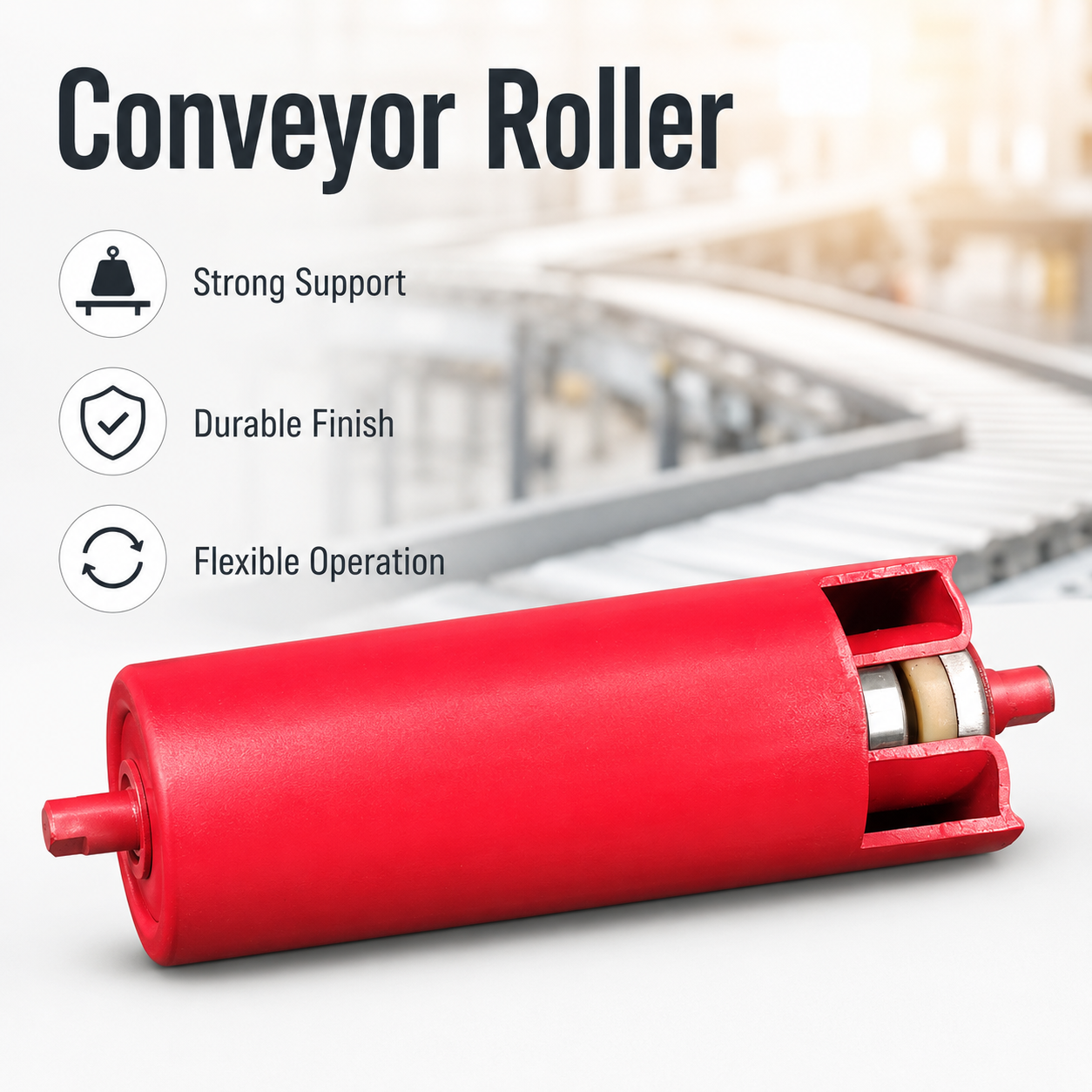
A painted red shell does not confirm the steel grade, wall thickness, or corrosion class. Colour is not a technical specification. Buyers should request the tube material, coating or galvanizing process, shaft material, weld or end-housing construction, and any corrosion test or thickness requirement that matters to the site.
Where material sticks to the return belt, smooth steel rollers may accumulate buildup and disturb tracking. Rubber rings, rubber discs, or spiral arrangements can help shed adherent material. Rulmeca specifically describes spaced rubber-ring return rollers as a method of limiting scale buildup and supporting more stable belt alignment.
Do Not Ignore Rotational Resistance, Runout, and Balance
A roller can carry the static load and still be a poor choice for a fast conveyor. Excessive seal drag, bearing preload, poor concentricity, or imbalance adds resistance and vibration. Across a long belt conveyor system, small losses repeated over hundreds or thousands of idlers can affect power demand and operating temperature.
ISO 5048 treats idler-related resistance as part of the calculation of conveyor power and belt tension. For high-speed or long-distance projects, buyers should request test values or acceptance limits for rotational resistance, axial movement, radial runout, dynamic balance, and starting torque. For a short, slow conveyor, the same level of testing may not be economical. The testing scope should follow the project risk.
Match the Roller to Load, Speed, and Spacing
Roller load is affected by more than the total tonnes per hour. Belt width, bulk density, trough angle, idler spacing, material cross-section, impact, and the position of each roll within the troughing set all matter. The centre roll and wing rolls do not necessarily carry equal loads.
Bearing life should be calculated from the actual radial load and speed rather than guessed from the bearing number. In severe loading zones, reducing idler spacing or using an impact bed may protect both the rollers and the belt. A larger bearing cannot compensate for a thin shell that dents under impact or a shaft that bends in the frame.
Common Failure Signs and What They Suggest
|
Observed condition |
Likely causes |
What to inspect |
|
Roller does not turn |
Contamination, bearing failure, damaged seal, bent shaft |
End seals, bearing, shaft alignment, buildup |
|
Rhythmic noise or vibration |
Runout, imbalance, bearing damage, shell dent |
Shell roundness, welds, bearing fit |
|
Belt wears over one roller |
Seized roll, sharp edge, heavy buildup |
Rotation, shell surface, return-side cleaning |
|
Frequent bearing failure |
Weak sealing, wrong bearing load, water ingress |
Environment, seal design, load calculation |
|
Roller falls out of frame |
Wrong shaft ends or inconsistent overall length |
Mounting drawing and frame slots |
|
Belt runs to one side |
Misaligned frame, off-centre loading, seized idler |
Complete conveyor alignment before adding trainers |
Information to Send With an RFQ
A reliable quotation needs a drawing or a complete dimensional schedule. Photos are useful for understanding the installed position, but they cannot confirm bearing size, shaft-end geometry, or tolerance.
|
Information |
Example |
Why it matters |
|
Installed position |
35-degree carrying set, flat return, impact zone |
Defines roller type and loading |
|
Belt data |
1000 mm belt, 2.5 m/s |
Supports face length, speed, and load review |
|
Roller dimensions |
Diameter, face, overall length, shaft ends |
Ensures frame compatibility |
|
Material load |
Coal, limestone, grain, cartons |
Clarifies duty and contamination |
|
Operating environment |
Dusty, wet, outdoor, corrosive |
Guides seals and surface protection |
|
Required standards |
ISO, CEMA, DIN, project drawing |
Aligns design and inspection |
|
Current failure |
Seizure after six months, shell denting, noise |
Helps correct the old weakness |
|
Quantity and packaging |
Sets, loose rollers, palletized export packing |
Supports production and logistics |
Common Buying Mistakes
The first mistake is ordering by diameter and length only. The second is using one roller for carrying, return, and impact positions without checking the load. The third is choosing a bearing by brand or number while ignoring sealing and housing quality. A fourth is specifying a premium coating but leaving shaft ends and tolerances undefined.
Price comparisons also become misleading when one supplier includes tested runout, labyrinth seals, thicker tube, and machined shaft ends while another quotes a basic assembled roller. Put every offer into the same technical schedule before comparing unit cost.
FAQ
Is a conveyor idler roller the same as a carrier roller?
Carrier rollers are one type of conveyor idler roller. They support the loaded side of the belt. Return, impact, rubber-disc, and self-aligning rollers are other idler types.
Can the same roller be used on the carrying and return sides?
Sometimes, but it should not be assumed. Loads, face lengths, buildup, spacing, and mounting arrangements can differ.
What causes an idler roller to seize?
Common causes include dust or water entering the bearing, lubricant breakdown, damaged seals, a bent shaft, poor bearing fit, or material buildup around the end housing.
Are HDPE rollers better than steel rollers?
They can offer lower mass, corrosion resistance, and quieter operation in suitable duties. Steel may be preferable for higher loads, impact, temperature, or project requirements. Selection depends on the application.
Should guide rollers be used to stop belt mistracking?
They may assist in specific layouts, but the cause of mistracking should be corrected first. Off-centre loading, structural misalignment, buildup, and seized idlers are common root causes.
What should buyers request from a supplier?
Request a dimensional drawing, tube and shaft materials, bearing and seal construction, load and speed suitability, runout limits, coating, inspection scope, and packing details.
Final Buying Advice
The right conveyor idler roller is the one that fits the frame, supports the calculated load, rotates with controlled resistance, and protects its bearings from the real environment. Define the roller's position first, then confirm dimensions, shaft ends, tube, bearings, seals, runout, and testing. A small saving on an underspecified roller can become belt damage, extra power, and repeated shutdown work later.