
Why an automotive timing belt deserves more attention than it usually gets
An automotive timing belt is one of those parts buyers tend to notice only when they have to replace it, but in practice it sits at the center of timing accuracy, noise control, and uptime. In a vehicle, the belt keeps rotating components in the right relationship. In broader industrial use, the same synchronous belt principle supports motion control where slip is not acceptable. That makes it relevant not only to repair and maintenance teams, but also to engineers who compare drive options for automation equipment, packaging lines, and textile machinery.
The decision is rarely just “belt or no belt.” Buyers are usually weighing durability, heat resistance, tooth wear, pulley compatibility, and whether the drive can stay synchronized under changing loads. A rubber timing belt can look simple on the shelf, yet the wrong construction can lead to noise, tooth skipping, premature cracking, or a maintenance interval that is shorter than the machine owner expected. That is the real problem this article helps solve: how to evaluate the belt as a working component, not just as a spare part.
What the belt construction tells you
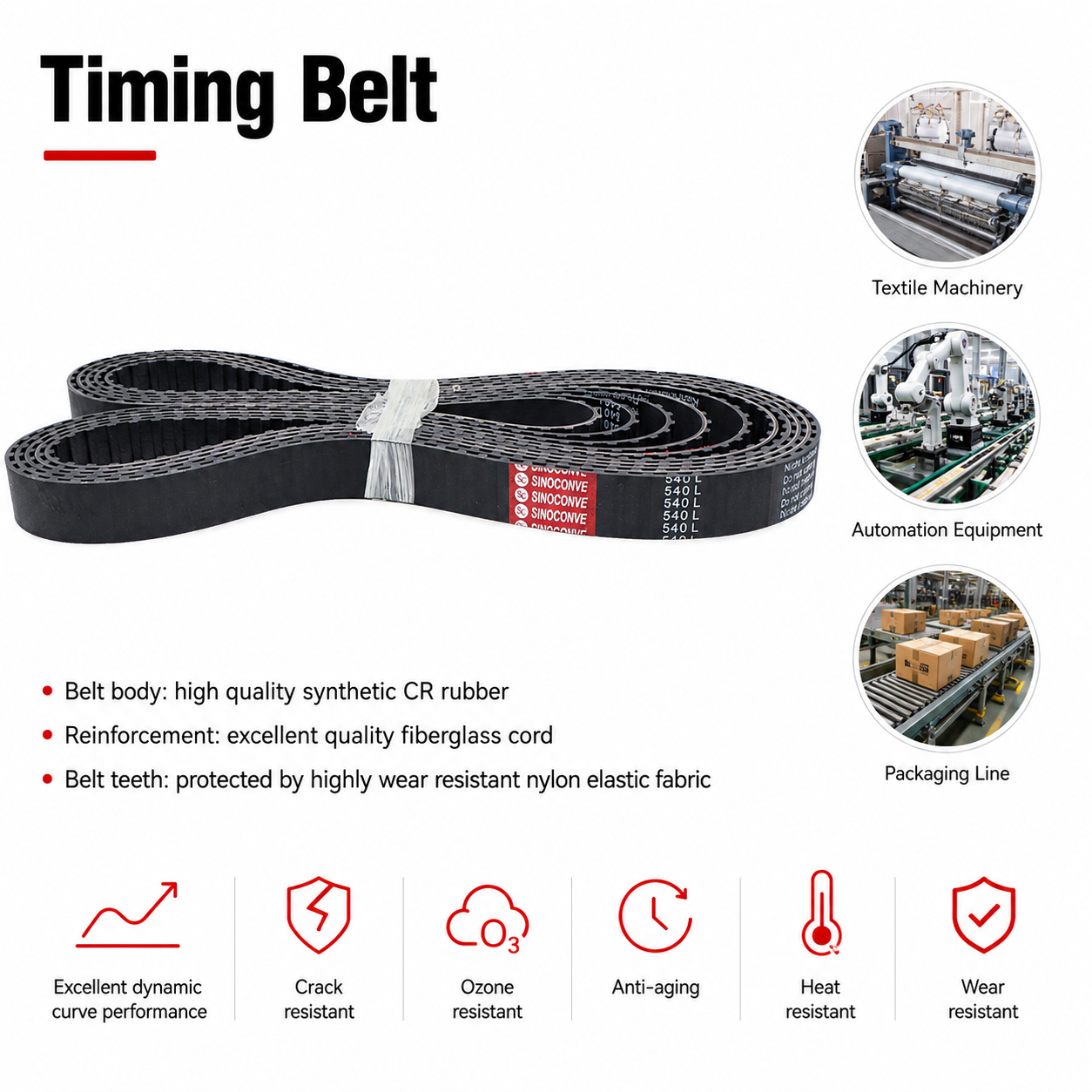
The belt described here is a continuous-loop timing belt with a toothed inner surface, black outer body, and a visible size/model marking of “540 L.” Based on the supplied product information, the belt body is synthetic CR rubber, the reinforcement uses fiberglass cord, and the tooth-facing wear layer is nylon elastic fabric. That combination is familiar in industrial rubber belt manufacturing because each material serves a different purpose: the rubber body gives flexibility, the fiberglass cord helps carry load and control elongation, and the fabric layer reduces wear where the teeth engage the pulley.
The visible claims also matter. Excellent dynamic curve performance, crack resistance, ozone resistance, anti-aging, heat resistance, and wear resistance all point to a belt intended for repeated bending and stable service in a demanding drive path. Buyers should still be cautious here: these are useful indicators, but they are not a substitute for the actual size, pitch, width, pulley profile, and speed requirement of the application.
Where this type of synchronous belt is used
Although many people search for an automotive timing belt with engine service in mind, the same general drive logic extends into industrial equipment. In the supplied application notes, the belt is positioned for textile machinery, automation equipment, and packaging lines. Those environments have one thing in common: timing matters more than brute force.
Typical buyer use cases
Engine drive system replacement is the obvious automotive example, but machine builders often look at the same belt architecture for conveyor synchronization, line indexing, and motion transfer between shafts. An auto belt used in a synchronized drive should maintain repeatability under start-stop cycles and should not stretch excessively over time. If a system depends on exact position control, even small changes in tooth engagement can become a production problem.
How to evaluate a belt before you buy
Start with compatibility, not price. The marking on the belt, such as “540 L,” may indicate a size or model designation, but it is not enough on its own to confirm fit. Buyers should verify the pulley tooth profile, the center distance, and whether the belt is intended for the same operating environment as the original part. If the machine runs hot, has frequent acceleration, or sees dust and fiber contamination, the rubber timing belt needs to be judged on more than catalog appearance.
Next, look at the wear pattern the application creates. A belt in packaging machinery may see repeated indexing and quick reversals. A belt in textile equipment may face lint, higher duty cycles, and more frequent inspection intervals. In both cases, fiberglass reinforcement and a tooth-facing fabric are useful, but only if the pulley geometry and installation tension are correct. A well-made belt can fail early if a misaligned pulley is chewing one side of the tooth flank.
Common mistakes buyers still make
The biggest mistake is treating all synchronous belts as interchangeable. They are not. Another common issue is assuming heat resistance means the belt can live in any hot enclosure. That is too broad. Heat resistance helps, but machine layout, ambient conditions, and pulley wrap still shape service life. A smaller but costly mistake is reusing a belt after a major service intervention. Once a timing belt has been overstressed, reinstalled, or contaminated, the risk of timing drift rises.
It is also worth noting that packaging and automation users sometimes order by outer appearance alone. That is risky. A black belt with a toothed inner face can still differ in pitch family, width, and reinforcement setup. If the sourcing file does not include those details, ask for them before committing to a lot purchase.
Practical buyer advice for sourcing teams
If you are comparing suppliers, ask for the material build, the intended application range, and the dimensions that matter to your assembly, even if the seller markets the item as a standard part. For an automotive timing belt or related engine drive system component, the installation environment is part of the specification. For industrial use, request alignment guidance and replacement recommendations tied to your duty cycle, not just a part number.
If you are evaluating this belt for automation equipment or packaging machinery, the selling point is usually stable synchronous motion with low slip. That is useful, but only if the belt is matched to the rest of the drive train. A good belt cannot compensate for worn pulleys, poor tensioning, or a misread application requirement.
What to ask before placing a purchase order
Confirm the exact belt size designation, the pulley standard it matches, the reinforcement material, and whether the belt is intended for continuous-duty or intermittent service. If the supplier cannot clarify those basics, the risk sits with the buyer.
Need a tighter specification match?
If you are sourcing an automotive timing belt or a related synchronous belt for machinery, build the request around the application first: operating speed, load pattern, pulley profile, and environment. That is the fastest way to avoid a part that looks right but performs badly in service.