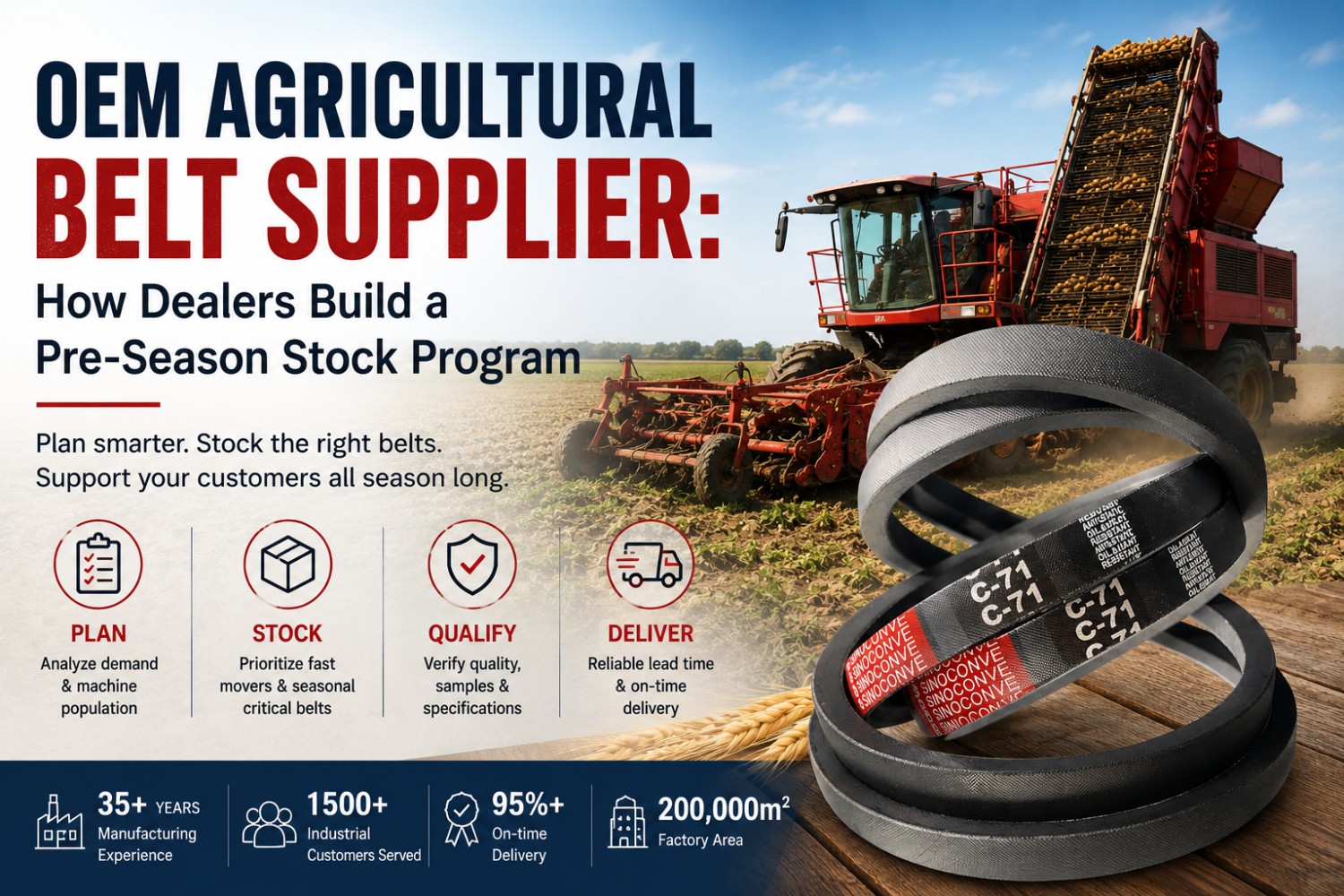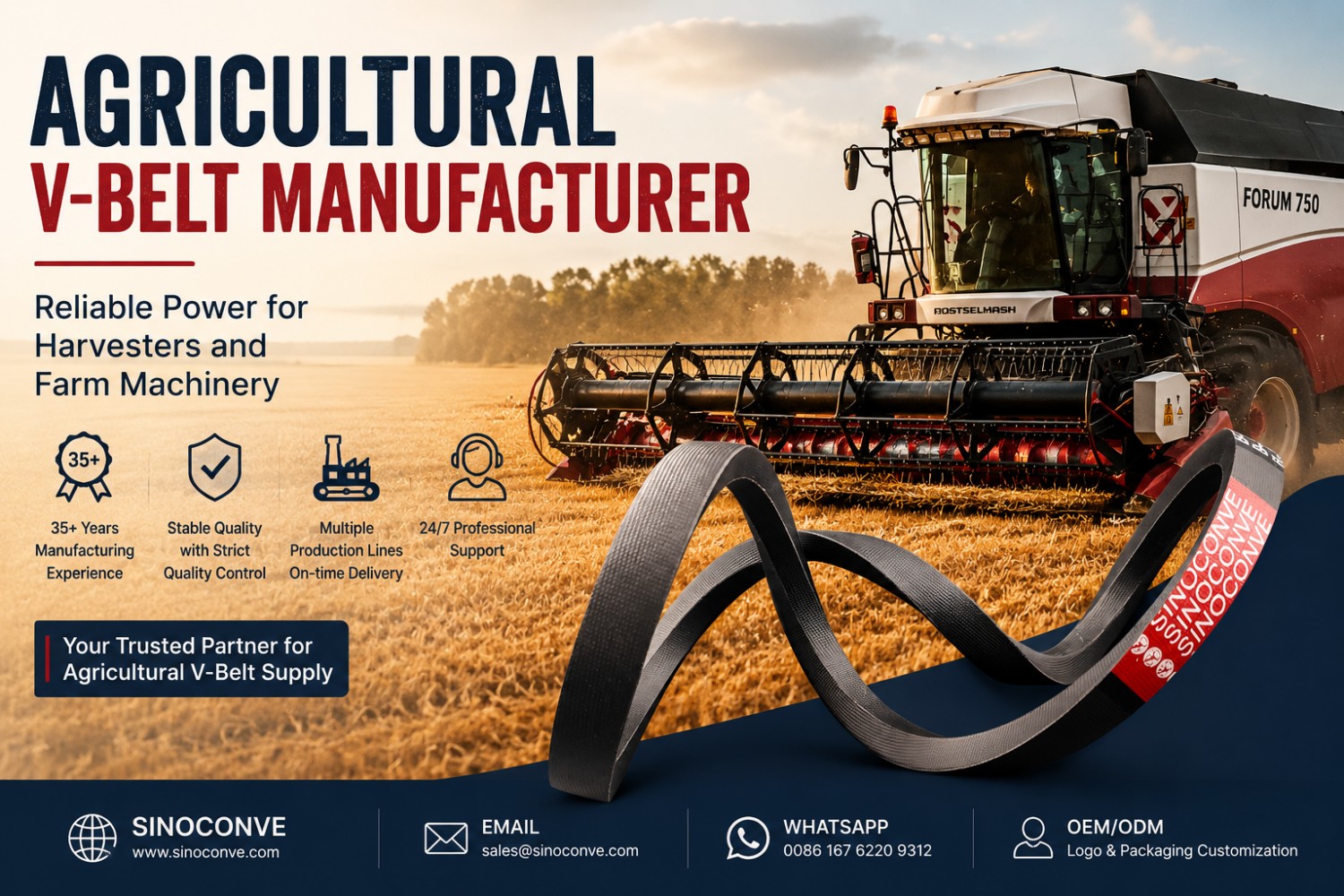

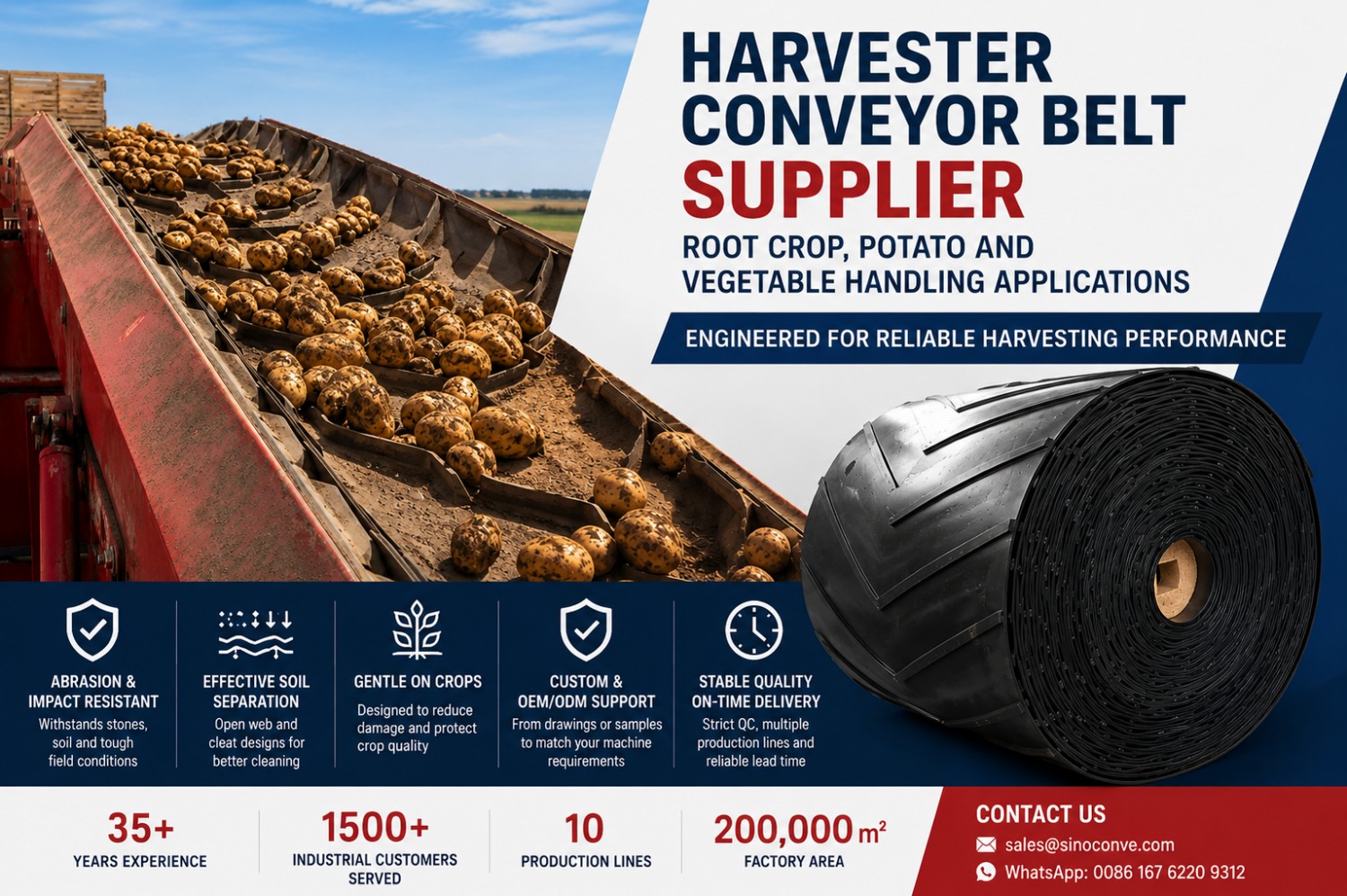
Harvester Conveyor Belt Supplier: Root Crop, Potato and Vegetable Handling Applications
A replacement harvester belt can match the old belt in overall width and length and still be wrong for the machine. For potato, carrot, onion, beet and other root-crop equipment, performance also depends on where the belt or web operates, what it must separate from the crop, the size range being handled, soil and stone conditions, and how the belt interfaces with rods, joints, rollers and drive components.
That makes sourcing a harvester conveyor belt supplier different from buying a general-purpose conveyor belt. Agricultural OEMs and equipment manufacturers need more than a catalog item. They need a supplier that can interpret drawings or samples, identify the dimensions that control compatibility, establish an approval process and reproduce the agreed specification when production orders follow. This guide explains what to verify before RFQ, sample approval and supplier qualification.
Quick Answer for Agricultural OEM Buyers
Do not qualify a harvester conveyor belt from price and overall dimensions alone. Define the crop and machine position first, then confirm belt or web construction, width and effective length, pitch or spacing where applicable, edge and joint design, interface dimensions, operating environment and the approval criteria that production orders must reproduce.
1. Why Harvester Conveyor Belts Need Application-Specific Sourcing
A harvesting machine does not present the stable operating conditions of a fixed indoor conveyor. Crop load changes as the machine moves through the field. Soil can shift from dry and loose to wet and adhesive. Stones, vines and crop residue can enter the conveying path. At the same time, the belt may be expected to lift, clean, separate, meter or transfer a crop without causing unnecessary damage.
The first sourcing question therefore should not be “What belt do you have in this size?” It should be “What does this belt have to do at this position in the machine?”
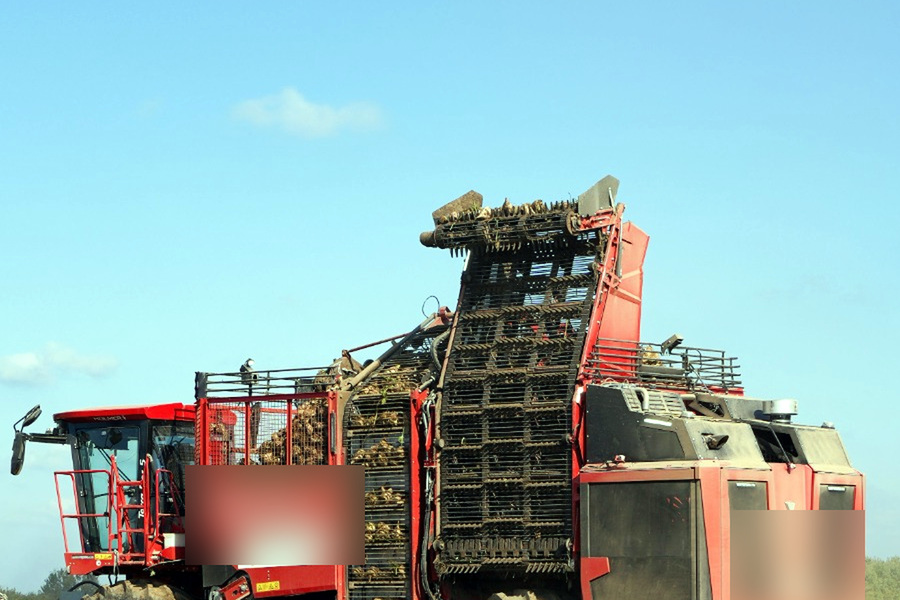
A lifting or primary cleaning web may need open spacing that allows soil to fall through. A transfer section may place more emphasis on crop support and controlled movement. An elevator can introduce different retention and transition requirements. Even within one potato harvester, several conveying positions may require different structures.
For a broader explanation of these operating differences, buyers can review SINOCONVE's root and stem crop harvester conveyor belt guide.
| Operating Condition | Possible Risk | Specification Implication |
|---|---|---|
| Small potatoes or root crops | Crop may fall through an overly open web | Confirm crop size range against rod or opening spacing |
| Wet clay and sticky soil | Buildup can interfere with cleaning and belt movement | Review open area, cleaning behavior and machine clearances |
| Stones mixed with crop | Impact, jamming or localized structural damage | Review rod, joint and supporting structure for actual field duty |
| Sensitive vegetables or repeated transfer | Bruising and surface damage | Review contact surfaces, transition geometry, drop and operating speed |
| Replacement on an existing harvester | New belt fits nominal dimensions but not drive or tracking geometry | Capture interface dimensions and construction details from the original assembly |

2. Potato, Root Crop and Vegetable Applications Are Not Interchangeable
“Agricultural conveyor belt” is a useful product category, but it is too broad to serve as an OEM specification. A potato harvester, beet harvester, carrot harvester and vegetable transfer machine can impose different requirements even when their belts look similar in photographs.
2.1 Potato harvesting
Potato handling combines crop protection with soil separation. The incoming stream can contain tubers, loose soil, clods, vines and stones. An open web can help soil separation, but opening dimensions cannot be selected independently of potato size. The machine's transition points also matter because repeated drops, bouncing and hard contact can damage crop even when the belt itself remains mechanically intact.
SINOCONVE currently lists a potato conveyor belt on its official product site. For an OEM project, however, a listed product should be treated as a starting point for technical discussion rather than evidence that one configuration fits every potato harvester.
2.2 Carrots, onions, beets and other root crops
Crop geometry changes the selection problem. Long, narrow roots behave differently around openings and transitions from larger round crops. Beets can introduce different load and impact conditions. Onions bring their own sensitivity to handling and surface damage.
For that reason, an RFQ should identify the crop and its expected size range rather than simply requesting a “vegetable harvester belt.” If one machine is designed for multiple crops, tell the supplier which crops and configurations must be covered.
2.3 Transfer and discharge sections
Not every agricultural machine position needs an open rod web. Closed rubber conveyor belt constructions can be relevant where the primary job is transfer rather than soil separation. The choice depends on the machine function. A closed surface may support material differently, but it does not provide the same soil-release behavior as an open web.
This distinction should be settled before discussing detailed dimensions. Otherwise an RFQ can become a comparison of products that perform different jobs.
3. What an Agricultural OEM Should Put in the RFQ
The quality of a supplier quotation depends heavily on the quality of the incoming specification. A drawing is preferable for a new OEM program. For replacement or localization projects, an undamaged sample combined with measurements, photographs and machine information can establish a much stronger reference than photographs alone.
RFQ Warning
Do not send only width × length and ask suppliers to quote “same as sample.” Two belts can share those dimensions while differing in pitch, spacing, joint geometry, edge construction or machine-interface details. Those differences may not become visible until installation or field operation.
| RFQ Information | What the Buyer Should Provide | Why It Matters |
|---|---|---|
| Machine identification | Machine type, model and belt position | Establishes the mechanical context and function |
| Crop information | Potato, carrot, beet, onion or other crop; expected size range | Influences spacing, retention and crop-handling decisions |
| Field conditions | Dry soil, wet clay, stones, vines and typical contamination | Defines cleaning, impact and buildup risks |
| Core dimensions | Width, effective length and other drawing-controlled dimensions | Establishes physical compatibility |
| Web geometry | Pitch, rod spacing, rod dimensions and layout where applicable | Affects crop retention, soil separation and machine fit |
| Interface details | Joint, edge, drive and attachment geometry | Prevents a nominally correct belt from becoming an installation mismatch |
| Reference material | 2D/3D drawing, old sample and clear close-up photographs | Allows construction details to be reviewed before production |
| Failure history | Photos and location of breakage, wear, tracking or buildup | Helps prevent an existing problem from being copied into the replacement |
| Commercial requirement | Sample quantity, forecast/order quantity, packaging and required delivery date | Separates prototype requirements from production-order planning |
4. Supplier Qualification Should Start Before the Production Order
Agricultural OEM sourcing carries a particular commercial risk: the belt may be a relatively small part of the machine's total value, but an incompatible component can delay assembly, field testing or spare-parts delivery. Supplier qualification should therefore test the process, not just inspect the supplier's catalog.
A useful qualification sequence is:
- Application review: confirm that the supplier understands the crop, machine position, operating conditions and required belt function.
- Specification review: identify the dimensions, materials and construction features that will define acceptance.
- Drawing or sample confirmation: resolve ambiguous features before production rather than after the finished belt arrives.
- Prototype or sample approval where appropriate: verify critical dimensions, assembly compatibility and the agreed acceptance points.
- Production-order control: reference the approved drawing, sample or specification revision on subsequent purchase orders.
- Pre-shipment verification: check the agreed dimensions, appearance, documentation, packaging and labeling before dispatch.
This sequence matters especially for custom belts. An approved sample has limited value if the production order is not tied back to the same controlled specification.
5. Sample Approval: Decide What “Approved” Actually Means
Sample approval should not be reduced to “the belt looks right.” The buyer and supplier need to know which characteristics are critical to fit, function and repeatability.
For a replacement program, start by distinguishing reference characteristics from critical-to-function characteristics. Surface color or a non-functional visual detail may be less important than pitch, effective length, joint geometry or an interface dimension. For a new OEM design, the approved engineering drawing should make those priorities explicit.
Depending on the belt structure, approval can include:
- overall and effective dimensions;
- pitch, rod spacing and relevant web geometry;
- edge and joint construction;
- attachment or drive-interface dimensions;
- material or construction requirements defined by the OEM;
- workmanship and visible defects;
- installation fit on the intended machine;
- field behavior during prototype testing where the application requires it;
- packaging, marking and traceability requirements for production supply.
For field evaluation, record the conditions under which the sample was tested. A successful run in clean, dry conditions does not automatically demonstrate equivalent behavior in wet clay or stone-heavy soil.
6. Proof of Capability: What to Ask the Supplier to Show
“We can make it” is not sufficient evidence for an OEM sourcing decision. The useful question is how the supplier will convert your specification into a controlled production order.
Evidence should be proportional to project risk. For a custom harvester belt, buyers can examine drawing review capability, sample-development workflow, incoming material controls, in-process inspection, finished-product dimensional inspection, test documentation relevant to the agreed specification, packaging control and how production changes are handled after approval.
SINOCONVE states that it supports OEM/ODM production based on customer drawings, samples and special requirements. The company-provided manufacturing information also identifies a technical/product-development team and laboratory/testing capability. Its quality process covers incoming raw-material inspection, production inspection and final testing before shipment.
That capability still needs to be connected to the individual OEM project. The purchase specification should define what must be inspected and which documents must accompany the order. A general factory certificate cannot replace product-specific acceptance criteria.
7. How SINOCONVE Handles Custom Agricultural Belt Projects
SINOCONVE's factory was established in 1988 and has more than 35 years of manufacturing experience. According to the company's confirmed production information, its conveyor belt operation has more than 200 employees, including 26 engineers and 15 quality-control personnel, with one laboratory. The company supports custom conveyor belt production and OEM/ODM cooperation from drawings, samples or specific customer requirements.
For buyers evaluating broader manufacturing capability, SINOCONVE's official conveyor belt product range provides a starting point for product review.
Standard samples or small test samples can be provided for evaluation. For commercial planning, SINOCONVE's confirmed minimum order quantity for conveyor belts is 50 meters. General production lead time is normally around 30 days; urgent orders may be discussed for an accelerated 15–20 day schedule. These are general company terms rather than a guaranteed schedule for every custom harvester-belt design, so OEM projects should confirm sample and production timing against the actual specification before issuing a purchase order.
Buyer Tip: Separate Prototype Terms from Production Terms
Agricultural OEMs should ask for sample cost, sample timing, production MOQ, production lead time and packaging requirements as separate items. Prototype development and repeat production are different stages, and treating them as one commercial condition can create avoidable misunderstandings.
8. Reduce Purchase Risk with a Controlled Production Specification
Once a sample passes approval, the next risk is specification drift. Procurement should not rely on email history or an old sample alone when repeat orders begin.
The production purchase order should reference the latest approved drawing or specification revision. Critical dimensions and acceptance criteria should be measurable. If an approved sample is retained as a master reference, both parties should identify it clearly and define which characteristics it controls.
Change management is equally important. If the OEM changes crop range, machine geometry, pulley or roller arrangement, operating speed or a related component, the old belt specification should not automatically be assumed to remain suitable. Likewise, any supplier-proposed material or construction change that affects the approved specification should be reviewed before production.
This approach turns supplier qualification into a repeatable process rather than a one-time sample comparison.
9. Common Sourcing Mistakes in Harvester Conveyor Belt Projects
9.1 Buying from overall dimensions only
Width and length identify only part of the component. Web geometry, joints, edges and drive interfaces can determine whether it actually fits and functions.
9.2 Copying a failed belt without diagnosing the failure
If the existing belt repeatedly breaks, mistracks or accumulates material, an exact copy may reproduce the problem. Send failure photographs and operating conditions with the sample so the cause can at least be reviewed before duplication.
9.3 Approving appearance instead of function
A sample that looks similar on a bench may still behave differently once installed. For application-critical parts, approval should include the dimensions and interfaces that control machine operation and, where appropriate, actual machine testing.
9.4 Treating every root crop as the same application
Crop geometry, sensitivity, soil condition and machine function change the handling requirement. Specify what the machine actually harvests.
9.5 Asking for the lowest unit price before freezing the specification
A lower quotation is difficult to compare if suppliers are quoting different constructions or interpreting an incomplete drawing differently. Technical alignment should come before final commercial comparison.
10. A Practical Supplier Comparison Framework
| Qualification Area | What to Verify | Warning Sign |
|---|---|---|
| Application understanding | Supplier asks about crop, machine section and field conditions | Quotation based only on a photo and overall dimensions |
| Engineering review | Critical dimensions and interfaces are confirmed | Ambiguous features remain unresolved before production |
| Sample approval | Acceptance criteria are documented | Approval depends only on visual similarity |
| Quality control | Inspection points correspond to the purchased specification | Only generic quality statements are provided |
| Repeat production | Orders reference an approved revision or master specification | No clear link between approved sample and future orders |
| Commercial readiness | MOQ, lead time, packaging and documentation are confirmed for the project | Catalog terms are assumed to apply to every custom order |
11. FAQ for Agricultural OEM and Equipment Buyers
Can a harvester conveyor belt be manufactured from an existing sample?
Yes, sample-based development can be appropriate for replacement and localization projects, but the sample should be supported by measurements, machine information and clear photographs. If the old belt is stretched, worn or damaged, it should not be treated as an unquestioned dimensional master.
What should I send for a potato harvester conveyor belt quotation?
Provide the machine type and belt position, crop and size range, belt or web dimensions, pitch and rod spacing where applicable, edge and joint details, old-belt photographs or drawings, soil conditions, known failure symptoms, required quantity and delivery requirement.
Should an OEM approve a sample before a production order?
For a custom or newly localized belt, sample or prototype approval can reduce compatibility risk. Define what approval covers—dimensions, construction, installation fit, workmanship and any required field test—rather than relying on visual confirmation.
Is the strongest harvester belt automatically the best choice?
No. Strength is only one consideration. The structure must also suit crop size, soil separation, machine interfaces, bending and tracking conditions, and the required handling behavior. Adding strength without considering compatibility can create a different problem rather than solve the original one.
How should buyers compare two harvester conveyor belt suppliers?
Compare them against the same controlled specification. Review application understanding, drawing and sample capability, inspection process, acceptance documentation, repeat-production control, MOQ, lead time and how engineering changes are managed. Unit price becomes meaningful only after the quoted scope is technically comparable.
Can SINOCONVE support custom agricultural conveyor belts?
Yes. SINOCONVE supports conveyor belt customization and OEM/ODM cooperation based on customer requirements, drawings or samples. Because harvester designs vary, final manufacturability and specifications should be confirmed for the individual project.
What is SINOCONVE's MOQ and production lead time?
The company's confirmed general MOQ for conveyor belts is 50 meters. Normal production lead time is around 30 days, with urgent production potentially shortened to 15–20 days after confirmation. Custom development or sample timing should be confirmed separately because project complexity can affect the schedule.

12. Prepare the Right Data Before Supplier Approval
A reliable harvester belt sourcing program starts with a controlled technical reference, not a price request. For root crop, potato or vegetable equipment, prepare the machine model and belt position, crop and field conditions, drawing or original sample, critical dimensions, web or belt construction details, interface geometry and any failure evidence from the current component. For a new OEM program, also define how the prototype will be approved and how that approval will control repeat production.
SINOCONVE can review custom agricultural belt requirements from drawings or samples. To discuss a project, use the SINOCONVE contact and RFQ page or email sales@sinoconve.com. Sending complete application and dimensional information with the first inquiry helps the technical team evaluate the requirement before quotation and sample development.
12. Related Products and Technical Guides
If you are evaluating conveyor belts for potato harvesters, root-crop equipment or other agricultural handling systems, the following SINOCONVE products and technical guides can help you compare belt structures and prepare a more complete specification before RFQ.
Related Conveyor Belt Products
| Product | Relevant Application | Product Link |
|---|---|---|
| Potato Conveyor Belt | A relevant starting point for potato, mud and clay handling applications where belt construction must be matched to the machine and operating conditions. | 1200mm Width 5ply Mud Clay Potato Conveyor Belt |
| Rubber Conveyor Belts | For agricultural transfer and other material-handling positions where a conventional rubber belt construction is more appropriate than an open harvesting web. | SINOCONVE Conveyor Belt Products |
Related Agricultural Conveyor Belt Guides
Root and Stem Crop Harvester Conveyor Belt Selection
Continue with application-level selection for potatoes, beets, carrots, onions and similar crops, including soil conditions, belt position, crop damage risks and common failure signs.
Agricultural Conveyor Belt Selection Guide
Useful for buyers comparing conveyor belts across broader farm applications, including crop transfer, packing, inclined conveying and field replacement.
Farm Chevron Conveyor Belt Selection
Review when agricultural material must be conveyed on an incline and rollback, profile selection, residue buildup or belt tracking need to be considered.
Cleated Conveyor Belt for Inclined Crop Handling
Relevant when vegetables, seed, grain or other agricultural materials need additional load control during inclined conveying.
13. Prepare the Right Data Before Supplier Approval
A reliable harvester belt sourcing program starts with a controlled technical reference, not a price request. For root crop, potato or vegetable equipment, prepare the machine model and belt position, crop and field conditions, drawing or original sample, critical dimensions, belt or web construction details, interface geometry and any failure evidence from the current component.
SINOCONVE supports customized conveyor belt production and OEM/ODM cooperation based on customer requirements, drawings and samples. For a new agricultural OEM project, send the application information together with the required quantity and delivery requirements so that technical compatibility and commercial conditions can be reviewed before production. SINOCONVE's confirmed company information supports drawing/sample-based customization and conveyor belt OEM/ODM production.
To discuss a harvester conveyor belt project, visit the SINOCONVE official website or email sales@sinoconve.com.