
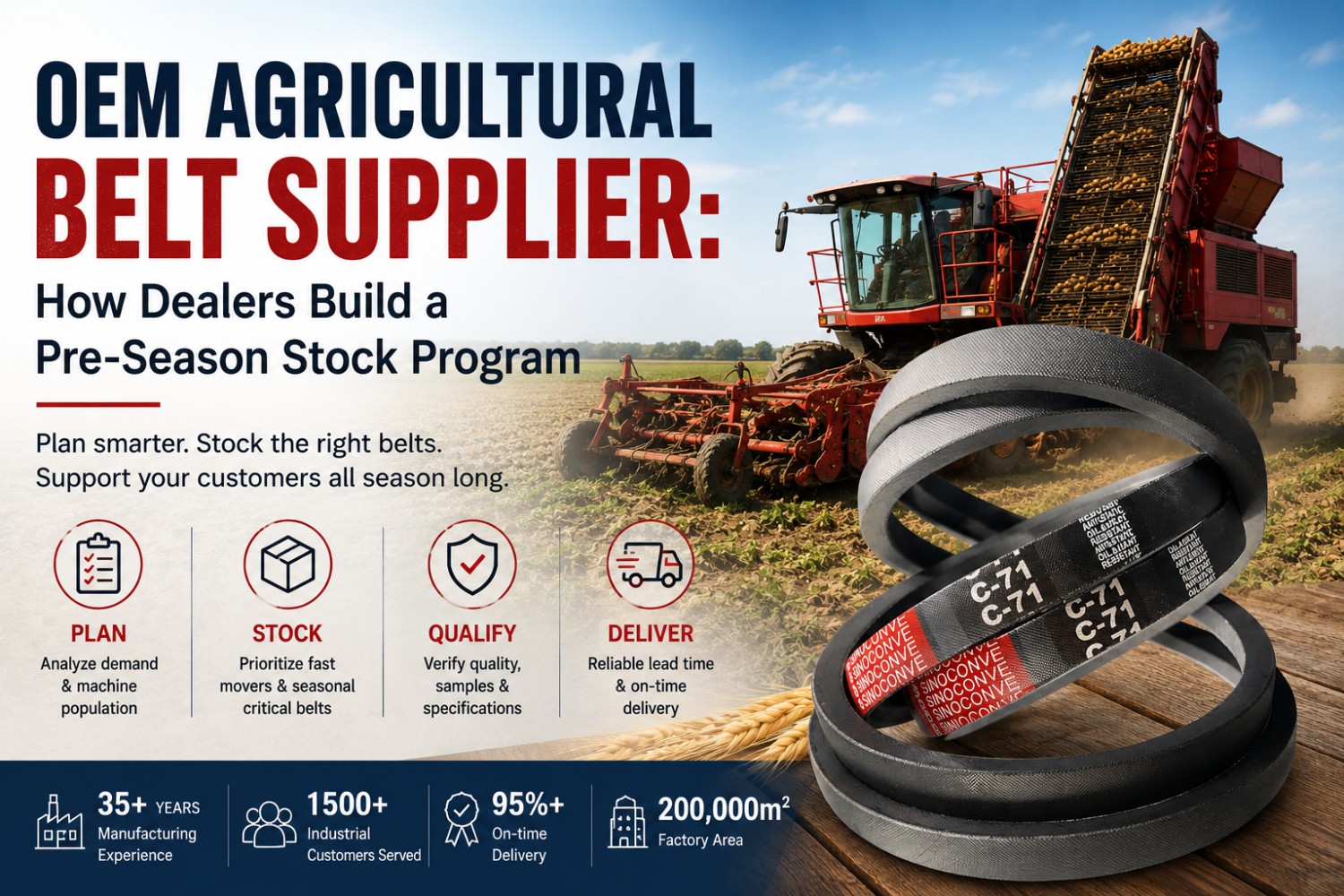
Agricultural belt demand is rarely even throughout the year. A distributor may see moderate replacement business for months, then face a sharp increase as tractors, harvesters, balers, pumps, and crop-handling equipment return to intensive service. At that point, a missing belt is not simply a lost SKU sale. It can mean an urgent customer, an emergency shipment, or a machine waiting during a narrow working window.
For that reason, choosing an OEM agricultural belt supplier is partly a product decision and partly an inventory-planning decision. Dealers need to know which agricultural belts deserve pre-season stock, which references should remain order-on-demand, how much customization is practical, and whether the supplier can reproduce the same specification on repeat orders. A useful stock program starts with those questions before anyone discusses a bulk order.
Quick Answer: A dealer should not build pre-season agricultural belt inventory by ordering equal quantities across a catalog. Start with historical sales and machine population, separate fast-moving replacement belts from seasonal and long-tail references, verify samples and specifications, then place the main order early enough to absorb production and international logistics time. Keep a smaller replenishment plan for the models that prove faster-moving than forecast.
1. Why Agricultural Belt Stock Has to Be Planned Before the Season
Agricultural replacement demand has a timing problem. Farmers can postpone some purchases, but a drive belt failure during planting, haymaking, irrigation, or harvest usually creates immediate demand. The dealer who has the correct replacement available has an advantage that cannot be recreated by offering a slightly lower price several weeks later.
That does not mean every agricultural belt should be kept on the shelf. Excess inventory creates a different problem: cash becomes tied up in slow-moving sizes while the references customers actually request may still be unavailable.
The practical objective is therefore not “more stock.” It is better-positioned stock.

Before sending an RFQ to an agricultural belt supplier, review at least the previous season's sales, emergency orders, lost sales, service records, and repeated customer requests. Then compare that history with the agricultural machines operating in the territory. A dealer serving combine-intensive grain farms will need a different assortment from one serving irrigation, vegetable harvesting, or general tractor applications.
Inventory warning: Do not let a supplier's catalog determine your opening order. A broad catalog shows supply capability; it does not show which references will turn in your local market.
2. Divide the Belt List by Stocking Role, Not Just Product Type
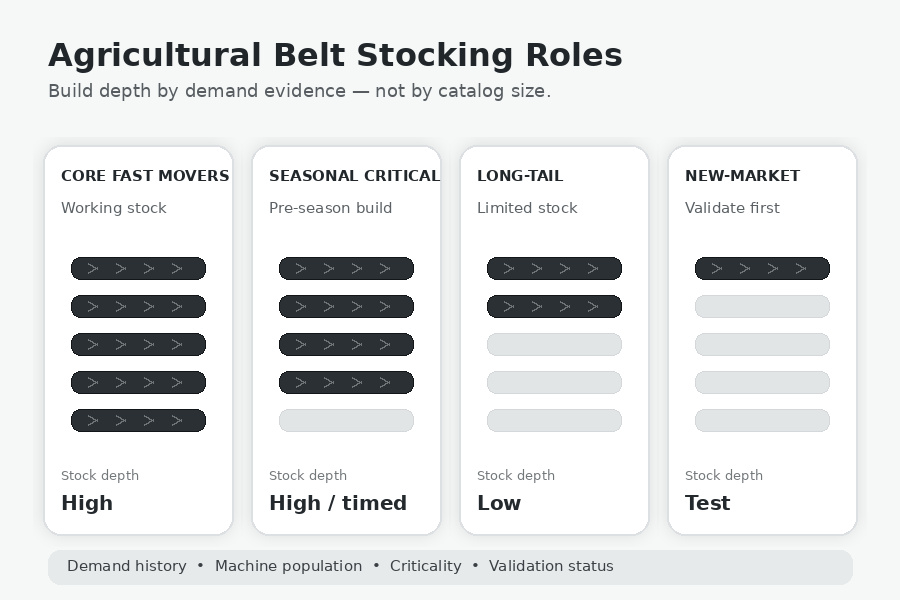
One useful way to prepare a pre-season order is to classify each reference by the job it performs in the dealer's inventory. This is more actionable than simply separating V-belts, harvester belts, and conveyor belts.
| Stocking Group | Typical Situation | Dealer Action | Supplier Question |
|---|---|---|---|
| Core fast movers | References with repeat sales across machines already common in the territory | Hold working stock and define a replenishment point | Can repeat orders maintain the approved specification and labeling? |
| Seasonal critical belts | Harvester or other machine belts with concentrated seasonal demand | Build stock before the operating window rather than after demand appears | What production lead time applies to the planned quantity? |
| Long-tail references | Low-frequency sizes or belts for uncommon machines | Keep limited stock or source against confirmed demand | What is the MOQ for this individual type or size? |
| New-market references | Models the dealer has not sold before | Validate fit and market response before deep stocking | Are samples or small test quantities available? |
This classification also improves negotiations with an OEM agricultural belt supplier. Instead of asking for one generic “best price,” the buyer can discuss different quantities, validation requirements, packaging, and reorder expectations for each group.
3. Build the SKU List from Machines and Demand Evidence
Part numbers alone are a weak starting point when building a new agricultural belt program. The stronger approach connects each proposed SKU to a machine population, an existing sales record, or a documented customer requirement.
3.1 Start with last season's movement
Review which belts sold repeatedly, which were requested but unavailable, and which required emergency sourcing. A SKU with modest annual volume can still deserve stock if its demand is highly concentrated and customers cannot tolerate a delay when the machine is working.
Also identify stock that did not move. Repeating last year's purchase quantity without checking sell-through is an easy way to accumulate obsolete or low-demand inventory.
3.2 Map the installed equipment base
Machine population provides a second layer of evidence. Record the tractors, combines, harvesters, balers, tillage equipment, irrigation systems, and other belt-driven machines commonly supported by the dealership.
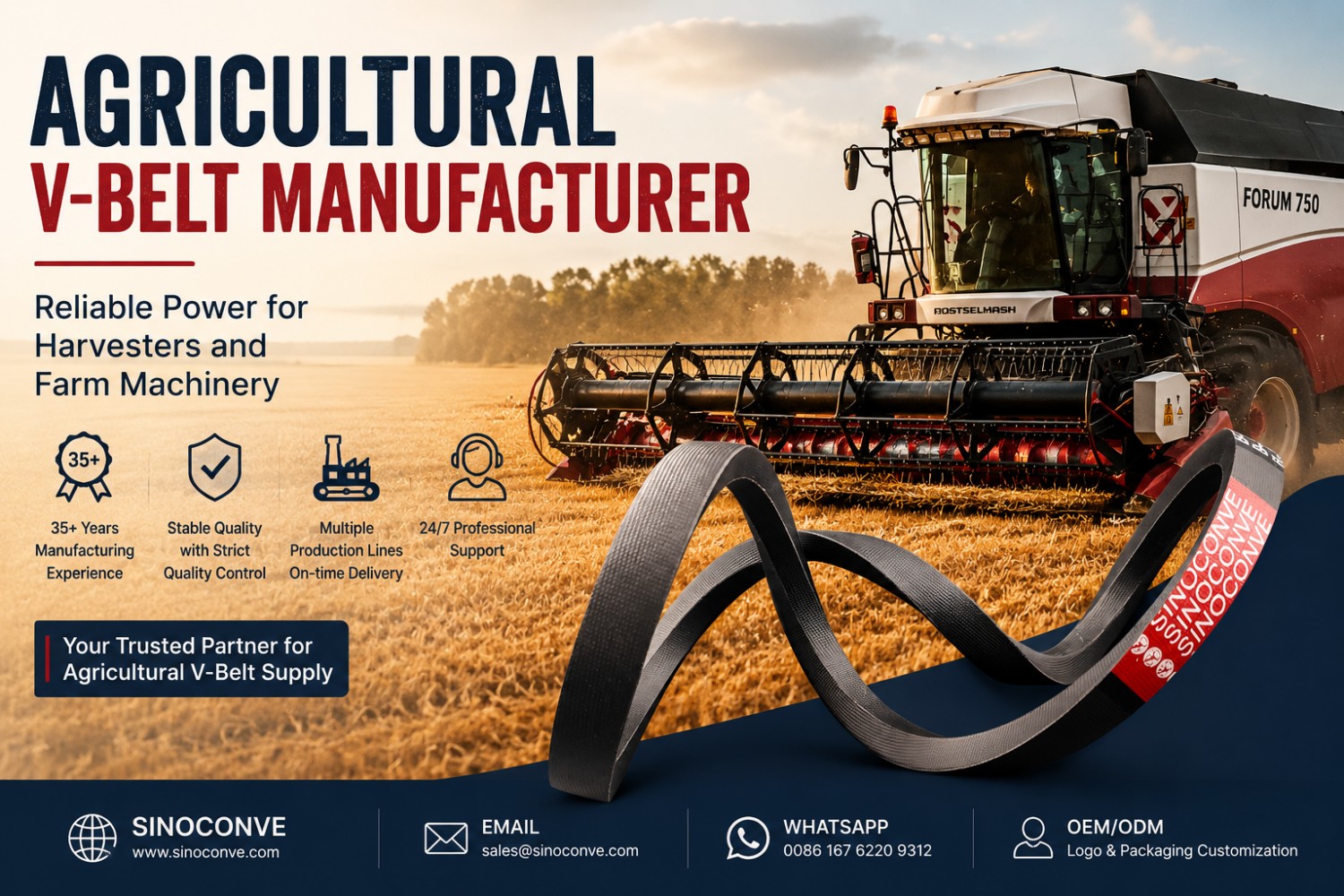
For power-transmission applications, SINOCONVE's V-belt product range provides a starting point for reviewing available transmission belt categories. Dealers should still confirm the exact section, dimensions, construction, application, and compatibility rather than selecting by a broad product family alone.
3.3 Separate confirmed references from cross-reference work
Some replacement inquiries arrive with a readable belt marking. Others arrive with an old belt, machine information, dimensions, photographs, or a reference from another brand. These situations should not be treated as equally certain.
Mark the source of each SKU in your sourcing sheet: confirmed specification, approved sample, historical purchase, customer reference, or pending cross-reference. That small distinction helps prevent an uncertain interchange from becoming a large stock commitment.
4. Product Qualification Comes Before Bulk Ordering
A low unit price has limited value if the dealer later discovers that the belt does not fit correctly, does not behave properly on the drive, or cannot be reproduced consistently.
Agricultural machinery can expose belts to dust, moisture, repeated flexing, variable loading, contamination, and shock loads. The important conditions depend on the machine. A belt driving a harvester component has a different job from a belt moving harvested material on a conveyor.
For transmission applications, buyers should confirm the belt profile and dimensions, length designation, construction, operating conditions, pulley arrangement, and whether the drive uses a single belt or matched multiple belts. Where the application is unclear, an approved sample or machine information can reduce cross-reference risk.
SINOCONVE's technical guide to agricultural V belts provides additional application context for farm power-transmission systems.
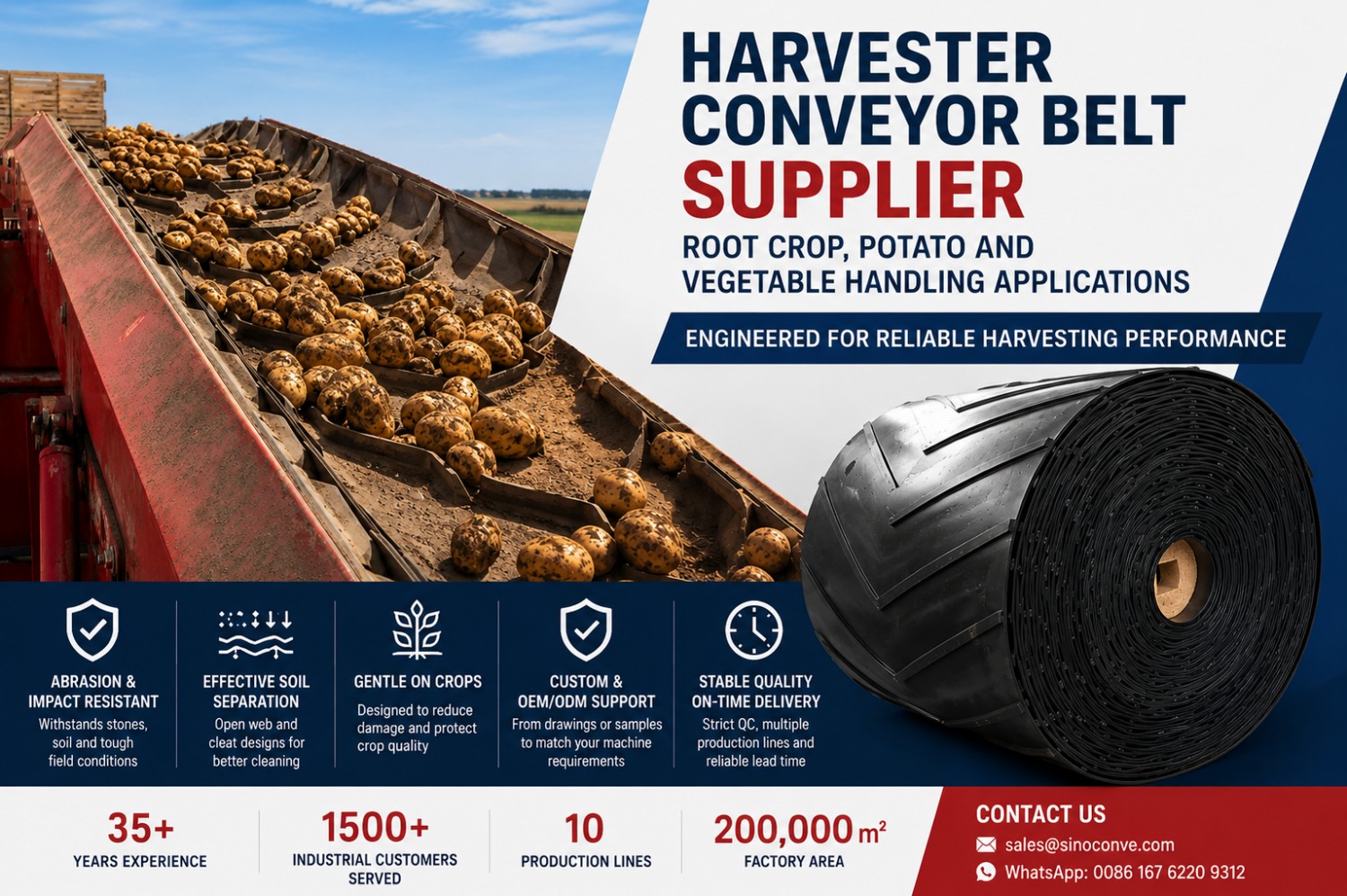
Material-handling belts require a different RFQ. Dealers sourcing an agricultural conveyor belt should identify the material handled, machine position, belt dimensions, surface requirement, incline, pulley arrangement, and any failure observed on the existing belt. Smooth, textured, chevron, cleated, and application-specific constructions should not be treated as interchangeable merely because the overall dimensions are similar.
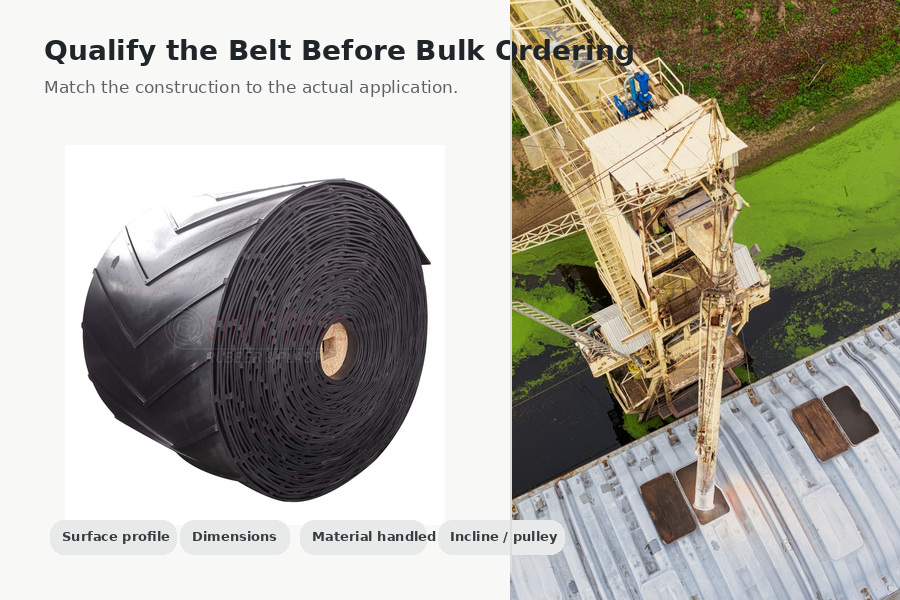
Buyer tip: For an unfamiliar reference, sample approval can be more valuable than negotiating the final few percentage points of bulk-order price. The expensive mistake is not paying slightly more for validation; it is stocking a belt that customers return during the season.
5. What Dealers Should Ask an OEM Agricultural Belt Supplier to Prove
Supplier qualification should separate statements that can be verified before purchase from general claims such as “high quality” or “professional manufacturer.” For a distributor building inventory under its own name, repeatability and documentation matter because the dealer carries the customer relationship after the goods arrive.
| Qualification Area | What to Request or Verify | Why It Matters to a Distributor |
|---|---|---|
| Specification control | Drawings, dimensions, belt markings, approved samples, or agreed technical requirements | Reduces wrong-reference and repeat-order variation risk |
| Quality documentation | Relevant certificates and product test reports for the order | Provides evidence beyond catalog claims |
| Sample capability | Availability of standard or small test samples where applicable | Allows validation before committing to wider stock |
| OEM/private label | Logo, marking, color, packaging, drawing/sample customization, and approval process | Protects brand consistency at the dealer level |
| Production planning | MOQ by product type, confirmed production lead time, and treatment of urgent orders | Determines how much seasonal buffer the importer needs |
| Packaging | Retail/dealer packaging, labels, carton requirements, and shipping protection | Avoids repacking work and supports private-label resale |
| Corrective action | Process for documenting and resolving confirmed product-quality issues | Clarifies responsibility before an urgent field claim occurs |
For SINOCONVE orders, quality control includes raw-material inspection, production monitoring, final inspection, and testing according to the order requirements. Product test reports can be supplied, and third-party testing can be discussed when a customer has a specific requirement.
6. Use MOQ as an Inventory Tool, Not Just a Negotiation Point
MOQ becomes important when a distributor has dozens or hundreds of references. A seemingly reasonable minimum can become a large inventory commitment when multiplied across the full assortment.
SINOCONVE's confirmed MOQ for V-belts is generally 30–50 pieces depending on the type. For conveyor belts, the confirmed MOQ is 50 meters. These numbers should still be confirmed against the actual products included in an RFQ because the assortment may contain different constructions or customization requirements.
For a new dealer program, this supports a simple purchasing principle: do not apply the same quantity to every SKU just because that quantity clears the MOQ.
Higher-confidence fast movers can justify deeper stock. Unproven references should be handled more cautiously. Where practical, ask whether multiple sizes or models can be coordinated within a broader purchase while retaining the agreed requirements for each individual reference.
7. Work Backward from the Required Warehouse Date
“Pre-season” is not a purchase date. It is a required-availability date.
The dealer should first decide when the belts must be physically received, checked, entered into inventory, and ready for sale. Then work backward through receiving, customs clearance, international transit, export handling, production, sample or artwork approval, and RFQ confirmation.
SINOCONVE's confirmed general production lead time is approximately 30 days. For urgent requirements, an expedited production arrangement may be available at approximately 15–20 days, subject to the specific order. These are production lead-time references, not a promise of total door-to-door delivery time.
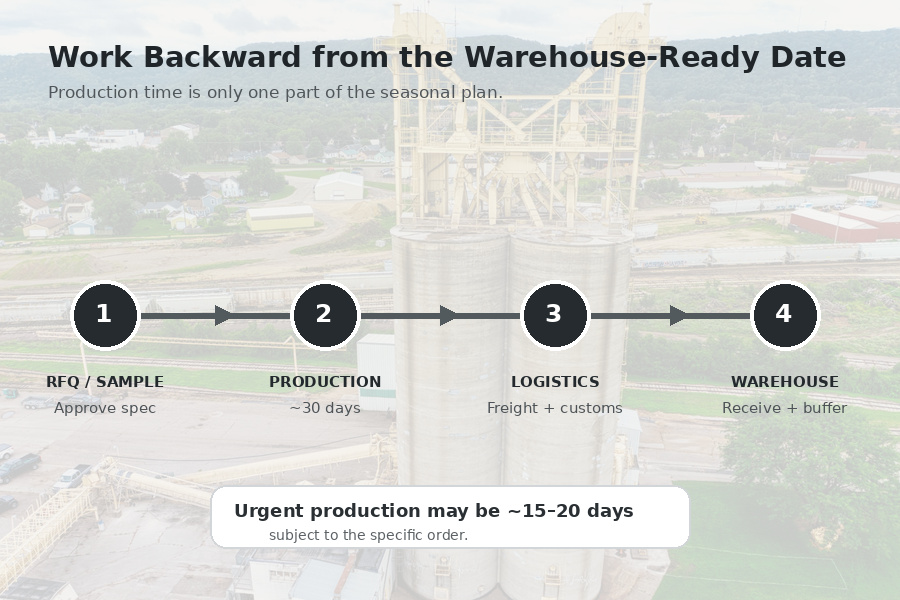
That distinction matters. International buyers still need to add freight, customs, local transportation, and a realistic buffer for their destination. Waiting until the beginning of harvest to place an overseas bulk order defeats the purpose of a pre-season stock program.
RFQ warning: Ask the supplier to confirm the production lead time against the actual SKU mix and quantity. Do not build the season plan around a generic website lead-time statement.
8. Private Label Requires More Than Printing a Logo
For wholesalers and distributors, private label changes the purchasing process. The product now has to arrive not only with the correct technical specification but also with controlled branding and packaging.
SINOCONVE supports OEM/ODM cooperation and customization based on customer drawings, samples, and requirements. Logo, color, and packaging customization can also be discussed.
Before production, the dealer should define:
- brand name and logo artwork;
- belt marking format and required product identification;
- individual or grouped packaging requirements;
- carton or outer-package labeling;
- language and market-specific information required by the buyer;
- how revisions to artwork or SKU codes will be controlled;
- whether a pre-production sample or artwork confirmation is required.
A private-label error repeated across a bulk shipment can create substantial relabeling work even when the belt itself is technically correct. Treat packaging approval as part of order qualification, not an afterthought.
9. Why Supplier Capacity Still Matters to a Seasonal Program
A distributor does not need the largest factory. It needs a factory whose production capability matches the order and whose lead time can be confirmed realistically.
SINOCONVE's factory was established in 1988 and has more than 35 years of manufacturing experience. The confirmed conveyor-belt manufacturing operation includes eight fabric conveyor belt production lines and two steel-cord conveyor belt production lines, supported by more than 200 employees, 26 engineers, a laboratory, and 15 quality-control personnel.
Those figures describe manufacturing capability; they should not be interpreted as guaranteed capacity reserved for an individual agricultural belt order. For seasonal purchasing, the buyer should still ask for a lead-time confirmation based on the actual products, quantities, customization, and requested shipment date.
Dealers comparing product families can also review SINOCONVE's verified product catalog before building the RFQ.
10. Build Replenishment into the Program Before the First Shipment
A pre-season purchase should not be treated as a one-time forecast that cannot change. Even good historical data cannot predict every breakdown, weather pattern, machine mix, or local demand shift.
Set a review point during the season. Watch actual sell-through and identify which SKUs are moving faster or slower than expected. For critical fast movers, decide in advance what stock level should trigger a replenishment discussion.
Keep the approved technical information attached to each SKU. If the first order was validated from a sample, drawing, machine reference, or agreed specification, the reorder should refer back to that record rather than restarting the identification process from memory.
This is particularly important for private-label programs. The dealer should be able to connect the commercial SKU used in its warehouse to the supplier's controlled specification, packaging version, and previous purchase order.
11. A Better RFQ Produces a More Useful Supplier Comparison
Quotations become difficult to compare when suppliers are answering different questions. One may quote a standard belt, another a customized construction, and another may price a different packaging configuration. The lowest number on the spreadsheet is then not necessarily the lowest comparable offer.
For an agricultural belt sourcing program, prepare an RFQ file containing the information relevant to each SKU:
- belt type and existing reference or marking;
- dimensions and length designation;
- machine make/model or application where relevant;
- photos, drawings, or physical sample for uncertain cross-references;
- operating conditions that affect belt selection;
- quantity by SKU rather than only total order quantity;
- required logo, marking, and packaging;
- sample or pre-production approval requirements;
- required quality documentation or testing;
- destination and required warehouse-ready date.
Then compare suppliers on the same basis: specification match, evidence, MOQ, customization control, lead time, packaging, communication, and commercial terms. Unit price belongs in that comparison, but it should not replace it.
12. Common Mistakes in Pre-Season Agricultural Belt Sourcing
Buying the full catalog. Product breadth is useful, but local demand should determine stock depth.
Cross-referencing by dimensions alone. Physical size is important, but construction and application requirements can also affect suitability.
Skipping sample validation on unfamiliar references. The risk increases when the original marking is unclear or the supplier is working from incomplete machine information.
Using one MOQ across every SKU. This can overstock slow movers while leaving insufficient inventory for critical references.
Planning around production time only. Overseas purchasing also requires logistics, customs, receiving, inspection, and contingency time.
Approving private-label packaging after production starts. Branding, markings, and carton requirements should be controlled before the main run.
Comparing only FOB or unit price. A lower purchase price can be offset by emergency freight, returns, repacking, inconsistent repeat orders, or unsold inventory.
13. FAQ for Agricultural Belt Distributors
What should a dealer stock before agricultural peak season?
Start with belts supported by historical sales, lost-sale records, service demand, and the installed machine population. Give additional attention to seasonal critical parts where a customer cannot easily wait for a replacement. Low-frequency references can remain limited-stock or order-on-demand items.
What is SINOCONVE's MOQ for agricultural V-belts?
The confirmed MOQ for V-belts is generally 30–50 pieces depending on the type. The exact MOQ should be confirmed for the specific models included in the quotation.
Can dealers request agricultural belt samples before a bulk order?
Yes. SINOCONVE can provide standard samples or small test samples where applicable. For an unfamiliar or cross-referenced SKU, sample validation is particularly useful before committing to pre-season volume.
Does SINOCONVE support private-label agricultural belts?
Yes. OEM/ODM cooperation is supported, including customization based on drawings or samples as well as logo, color, and packaging requirements. The exact customization should be defined and approved for the order.
How early should an importer place a pre-season belt order?
Work backward from the date the inventory must be available in your warehouse. SINOCONVE's general production lead time is approximately 30 days, with urgent production potentially available in about 15–20 days depending on the order. International transit, customs, receiving, and contingency time must be added separately.
What quality documents can a distributor request?
SINOCONVE can provide ISO certificates and product test reports. If the customer has specific testing requirements, third-party testing can also be discussed. Buyers should state the required standard or test documentation in the RFQ rather than assuming that every document automatically applies to every product.
What information is needed to cross-reference an agricultural belt?
Provide as much identification evidence as possible: existing belt marking, dimensions, machine make and model, application position, photos, drawing, or a physical sample. If the old belt failed prematurely, include photos and operating information so the replacement is not selected solely by copying the failed belt.
```html
14. Turn the Pre-Season Order into a Repeatable Supply Program
A strong dealer program is not built by guessing the largest possible opening order. It starts with demand evidence, qualifies uncertain references, puts more inventory behind high-confidence SKUs, and leaves a controlled path for replenishment.
If you are preparing an agricultural belt program, send SINOCONVE your SKU list, existing belt references or samples, machine/application information, expected quantity by reference, private-label requirements, destination, and required warehouse date. For unfamiliar belts, include photos or drawings so the technical team can review the request before quotation.
Dealers sourcing power-transmission products can first review SINOCONVE's V-belt product range. If the application is specifically for tractors, harvesters, balers, or other farm machinery, the agricultural V-belt selection guide explains the main application and selection considerations.
For crop and material-handling equipment, see the agricultural conveyor belt guide. Buyers working with root and stem crop harvesters can also review the more application-specific guide to root and stem crop harvester conveyor belts.
Related Agricultural Belt Resources
- V-Belt Product Range — Review available transmission V-belt categories for agricultural and industrial drive applications.
- Agricultural V-Belt Selection Guide — Understand belt profiles, farm machinery applications, selection factors, and common failure considerations.
- Agricultural Conveyor Belt Guide — Review selection factors for crop, grain, feed, fertilizer, and other farm material-handling applications.
- Root and Stem Crop Harvester Conveyor Belt Guide — Explore belt considerations for potatoes, beets, carrots, onions, soil, residue, and demanding harvester conditions.
- Farm Chevron Conveyor Belt Guide — See when a chevron profile can help control material on inclined agricultural conveyors.

15. Prepare Your Agricultural Belt RFQ
For a pre-season quotation, prepare the belt references or samples, machine models and applications, quantity by SKU, OEM or private-label requirements, required documentation, destination, and the date the inventory needs to be available. This gives the supplier enough information to review both the technical requirements and the production plan instead of quoting from part numbers alone.
Send your sourcing list to sales@sinoconve.com, or use the SINOCONVE contact and RFQ page to discuss your agricultural belt stock program.