
Agricultural V-Belt Manufacturer for Harvesters and Farm Machinery Distributors
A broken drive belt during harvest is more than a spare-parts problem. The machine may be needed for only a narrow seasonal window, while the replacement belt has to match the pulley, drive layout and operating load closely enough to put it back into service without creating another failure.
That changes how distributors should evaluate an agricultural V belt manufacturer. A low unit price is useful only after the supplier can identify the required belt correctly, reproduce it consistently, support the models your market needs and deliver before seasonal demand becomes urgent.
For distributors, dealers and farm machinery parts wholesalers, supplier qualification therefore starts with product and application matching, but it should also cover quality control, samples, private labeling, MOQ, production planning and documentation. The objective is not simply to buy an agricultural V belt. It is to build a repeatable supply program with fewer specification mistakes and fewer surprises after the order is placed.
Quick Answer for Distributors
Before approving an agricultural V-belt supplier, verify five things: whether the supplier can match your actual machine and belt references, whether the required constructions are available, how samples and production orders are inspected, whether OEM/private-label requirements can be controlled consistently, and whether MOQ and lead time fit your seasonal stocking plan. Price comparison should come after these points, not before them.
1. Why Agricultural V-Belt Sourcing Is Different from General Industrial Belt Purchasing
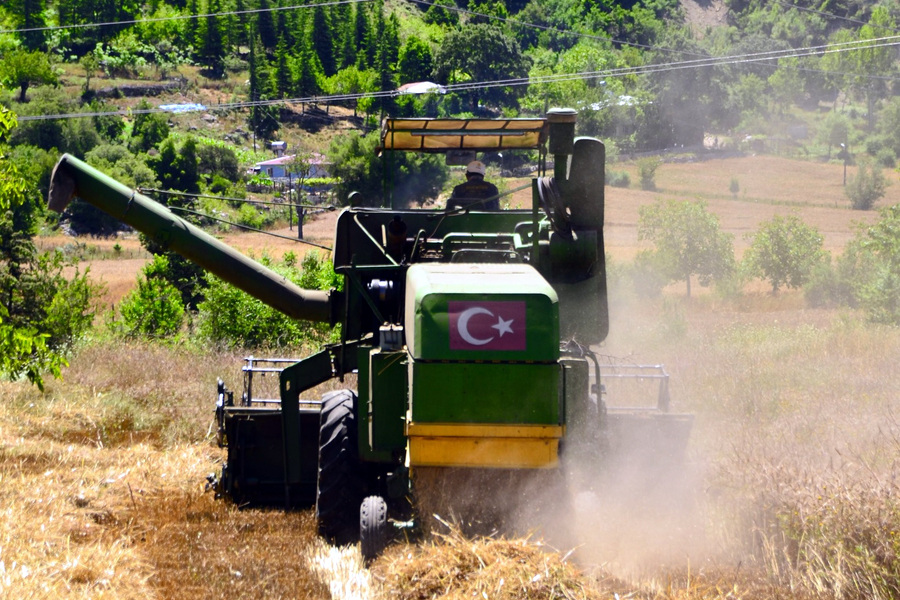
Agricultural drives do not all operate under the same conditions. Harvesters, threshers, rotary tillers, pumps and other farm machines can expose belts to changing loads, vibration, dust, outdoor conditions and repeated starting. Combine-harvester drives can be particularly demanding because some positions experience high or pulsating loads and relatively complex pulley arrangements.
A V-belt transfers torque through friction and the wedging action between its sidewalls and the pulley groove. This means the belt code alone does not explain every replacement problem. Pulley profile, belt section, drive geometry, tension and operating conditions all affect how the belt behaves.
For example, a standard single wrapped belt can be appropriate for a relatively straightforward drive. A cogged construction can provide greater flexibility where bending conditions require it. Banded belts connect multiple V-belt sections and can help control lateral movement in drives exposed to shock or pulsating loads. Agricultural equipment may also use variable-speed or double-sided belt constructions depending on the original drive design.
The purchasing implication is simple: a supplier offering “farm belts” as one generic category is not enough. Distributors should determine whether the manufacturer can work from the actual replacement information used in their market.
SINOCONVE's V-belt product range provides a starting point for reviewing transmission belt options, while buyers dealing specifically with farm equipment can also review the company's technical introduction to agricultural V belts.

2. Start Supplier Qualification with Product Coverage, Not the Factory Introduction
A distributor normally serves more than one machine. The commercial question is therefore not “Can you manufacture a V-belt?” but “Which part of my replacement range can you manufacture consistently?”
Prepare a representative list from your sales history before requesting a quotation. Include fast-moving references, difficult-to-source belts and several products that have caused previous fit or quality problems. This gives the manufacturer something concrete to evaluate.
| What to Verify | What the Distributor Should Provide | Why It Matters |
|---|---|---|
| Belt identification | Existing belt code, machine brand/model, clear belt photos | Reduces errors caused by quoting from a generic description |
| Section and dimensions | Required profile, length reference and available dimensional data | The belt must fit the existing pulley system correctly |
| Construction | Wrapped, cogged, banded or other original construction | Different constructions respond differently to bending, vibration and load |
| Application | Harvester, thresher, tiller, pump or other machine and belt position | The same nominal size may be used under very different duty conditions |
| Failure history | Photos and description of cracking, glazing, rollover, abnormal wear or breakage | Helps determine whether simply copying the previous belt will repeat the problem |
This exercise also reveals whether the supplier is technically useful. A manufacturer that asks for missing information before quoting is often giving the distributor more value than one that immediately confirms every reference from a short description.
3. Match Belt Construction to the Harvester or Farm Machinery Drive
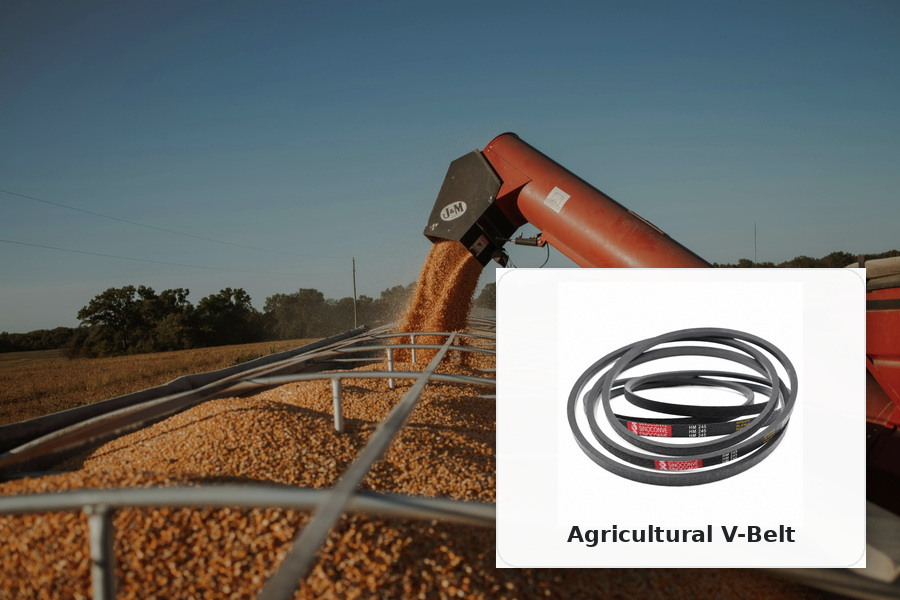
Distributors do not need to redesign their customers' machines, but they do need enough technical understanding to avoid treating visibly similar belts as interchangeable.
3.1 Wrapped V-belts
Wrapped V-belts remain practical for many conventional pulley drives. Their external fabric wrapping protects the belt body and provides a familiar construction for general replacement markets. They can be suitable where the drive geometry and load agree with the original specification.
The limitation is equally important. A wrapped belt should not be substituted automatically into a drive designed around another construction merely because the nominal dimensions appear close.
3.2 Cogged V-belts
Cogged V-belts use molded notches to increase flexibility during bending. The cogs are not timing teeth: power is still transmitted through friction at the pulley groove. This distinction matters when distributors prepare catalogs because “cogged” and “timing” should never be treated as equivalent product descriptions.
For applications where this construction is specified, buyers can review SINOCONVE's rubber cogged V-belt range.
3.3 Banded V-belts
A banded V-belt joins multiple belt sections across the top. Agricultural machinery is one application where this construction can be useful when the drive is exposed to vibration, pulsating load or belt whip. The joining band helps the individual sections move together rather than behaving as independent belts.
That does not make a banded belt automatically superior. It still has to match the pulley arrangement and the original drive requirement. Distributors should therefore sell it by application and reference, not simply as an “upgraded” V-belt.
A broader comparison of these constructions is available in SINOCONVE's guide to different V-belt models and applications.
4. Use Samples to Reduce Replacement and Catalog Risk
For a new agricultural V belt manufacturer, a sample is not merely a sales courtesy. It is part of supplier qualification.
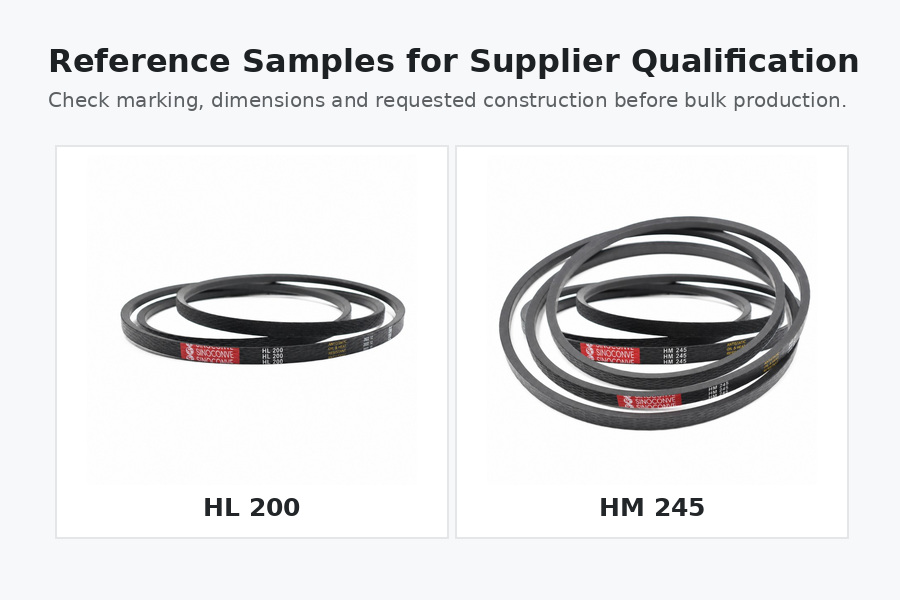
SINOCONVE can provide standard samples or small test samples for evaluation. For a distributor developing a new private-label range, sampling is particularly useful for unfamiliar references, important seasonal items or belts where the existing identification is incomplete.
Do not evaluate a sample only by appearance. Compare the marking and specified dimensions with the approved reference, confirm that the construction corresponds to what was requested, and check how the belt fits the intended pulley system. If you are replacing an existing belt, keep the original sample available for comparison.
Buyer Tip: If the old belt has failed unusually early, send failure photos together with the sample. A polished or glazed sidewall, edge damage, cracking or uneven wear may point to pulley, alignment, tension or application problems. Copying the old belt dimensions without investigating the failure can reproduce the same result.
SINOCONVE's transmission belt and V-belt maintenance guide provides additional failure signs that distributors can use when discussing replacement requirements with end users.
5. Ask What Quality Evidence Will Accompany Production Orders
Supplier qualification becomes more meaningful when “good quality” is replaced with evidence that can be checked.
According to SINOCONVE's current company information, raw materials are inspected before production, production processes are monitored, and finished products receive testing and final inspection before shipment. ISO certificates and product test reports can be provided, while third-party testing can be discussed where customers have special standard requirements.
For distributors, the important question is how those controls apply to the product being ordered. Before approving a supplier, discuss what will be checked for the sample, what is controlled during repeat production, what inspection documentation can accompany the shipment, and how non-conforming goods are handled.
Do not assume that a company-level certificate proves every performance characteristic of every belt. Likewise, a test report is useful only when the buyer understands what product or batch it covers and which requirement is being verified.
This distinction becomes especially important when your own customer, OEM or tender specification calls for a particular standard or test. Send that requirement before production rather than asking for compliance evidence after the belts have already been made.
6. Evaluate the Manufacturer as a Private-Label Supply Partner
For a distributor, the belt itself may be only part of the SKU. Branding, carton information, product marking and repeatability determine whether the product can be integrated into an existing sales program.
SINOCONVE supports OEM/ODM cooperation and customization based on customer drawings, samples and specific requirements. Current company information also confirms support for logo, color and packaging customization.
Before launching a private-label agricultural V-belt program, approve these details in writing:
- belt reference and construction for each SKU;
- brand and product marking requirements;
- carton or other packaging artwork;
- quantity per package;
- label information and barcode requirements, where applicable;
- sample approval procedure before bulk production;
- how revisions to artwork or specifications will be controlled on repeat orders.
The last point is easy to overlook. A distributor may reorder the same SKU for several seasons. Maintaining an approved specification and packaging reference helps prevent small changes from becoming customer complaints later.
7. MOQ and Lead Time Should Fit the Agricultural Sales Calendar
Agricultural replacement demand is seasonal. That makes procurement timing part of supplier qualification rather than a separate logistics issue.
SINOCONVE's current stated MOQ for V-belts is 30–50 pieces depending on the type. Normal production lead time is approximately 30 days. For urgent requirements, a 15–20 day production arrangement may be available depending on the order and production schedule.
These figures should be confirmed against the actual SKU mix when requesting a quotation. A distributor ordering many references in smaller quantities has a different production requirement from a buyer ordering one belt type in volume.
| Procurement Situation | Main Risk | Better Purchasing Action |
|---|---|---|
| First order from a new manufacturer | Ordering too many unverified SKUs | Prioritize representative samples and important references before expanding the range |
| Pre-harvest stocking | Production or shipping overlaps the demand peak | Work backward from the required warehouse arrival date, not the purchase-order date |
| Private-label launch | Packaging approval delays production | Complete belt and artwork approval before the seasonal order becomes urgent |
| Urgent replenishment | Assuming expedited production is always available | Confirm current production capacity and achievable dispatch date before committing to customers |
SINOCONVE products are generally made to order rather than supplied from a standard stock program. For a distributor, this makes demand forecasting more important. Fast-moving agricultural V-belt references should be identified before harvest season so the purchasing plan does not depend on emergency production.
8. Compare Quotations on the Same Technical Basis
A common sourcing mistake is sending different information to several manufacturers and then comparing the resulting prices as if the offers were equivalent.
One supplier may quote a standard construction from a belt code. Another may interpret the same inquiry as an agricultural-duty product. A third may include custom packaging or testing. The prices cannot be compared intelligently until the scope is normalized.
For each shortlisted agricultural V belt manufacturer, compare:
- confirmed belt reference, dimensions and construction;
- sample status and approval criteria;
- material or performance requirements actually included in the quotation;
- product marking and private-label scope;
- packaging configuration;
- MOQ by model or order;
- production lead time;
- inspection or test documents supplied;
- payment terms;
- procedure for handling confirmed quality problems.
SINOCONVE's current payment options include a 30% deposit before production with the remaining 70% paid before shipment, or L/C payment. Buyers who prefer platform-based transaction arrangements can discuss Alibaba Trade Assurance for applicable orders.
If a quality issue is confirmed to result from the supplied product, SINOCONVE's stated approach is to work with the customer on an appropriate solution, which can include replacement, compensation or technical support depending on the situation.
9. What Distributors Should Verify During a Factory Evaluation
A factory profile should support the sourcing decision, but it should not replace product-level verification.
Ningbo Sinoconve Belt Co., Ltd. traces its factory establishment to 1988 and has more than 35 years of manufacturing experience. The company supplies conveyor belts and power transmission products including V-belts, timing belts and ribbed belts, and supports OEM/ODM development.
For a distributor considering a longer-term agricultural belt program, a factory review should connect those capabilities to the actual order. Ask who reviews samples and specifications, how customized requirements are transferred to production, how inspection results are recorded, and how repeat orders are controlled.
You can review additional company and manufacturing information on the SINOCONVE company page.
For buyers who cannot conduct an immediate on-site audit, documentation, product samples, video review and a controlled trial order can provide a practical first qualification stage. A larger stocking program can follow after the supplier has demonstrated repeatability on the references that matter to your market.
10. Build an RFQ That a Manufacturer Can Quote Accurately
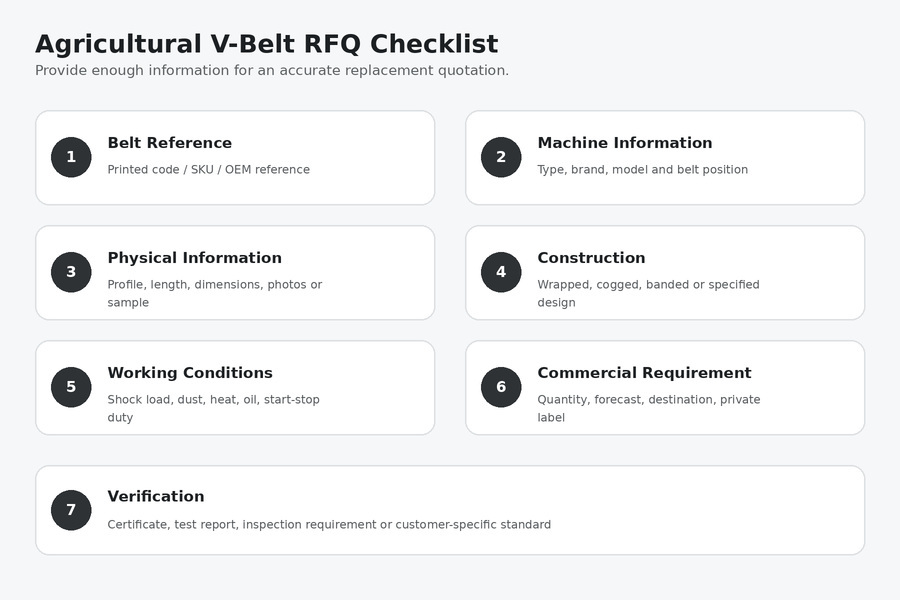
The quality of an RFQ affects the quality of the quotation. “Need harvester V belts, send price” forces the supplier to make assumptions, and assumptions made before production can become wrong stock after delivery.
| RFQ Information | What the Buyer Should Provide |
|---|---|
| Belt reference | Printed code, existing SKU or OEM/replacement reference where available |
| Machine information | Machine type, brand/model and belt position |
| Physical information | Profile, required length reference, dimensions and clear photos or an original sample |
| Construction | Wrapped, cogged, banded, double-sided, variable-speed or other specified design |
| Working conditions | Known shock load, dust, heat, oil exposure, frequent start-stop operation or other relevant conditions |
| Commercial requirement | Quantity by reference, forecast or repeat-order plan, and destination |
| Private label | Logo, belt marking, packaging artwork and labeling requirements |
| Verification | Required certificate, test report, inspection requirement or customer-specific standard |
If you have an existing failed belt, include photos before disposing of it. Failure evidence can be commercially valuable because it helps distinguish a straightforward replacement order from a drive that needs additional investigation.
11. Agricultural V-Belt Manufacturer FAQ
What is the MOQ for SINOCONVE agricultural V-belts?
The current V-belt MOQ is generally 30–50 pieces, depending on the belt type. For a multi-SKU distributor order, send the required quantity for each reference so the manufacturer can confirm the applicable MOQ rather than assuming the same quantity applies to every model.
Can distributors request V-belt samples before placing a bulk order?
Yes. SINOCONVE can provide standard samples or small test samples. For new replacement references or private-label programs, sample approval can reduce specification risk before a larger production order.
Can agricultural V-belts be supplied with a distributor's brand?
SINOCONVE supports OEM/ODM, logo and packaging customization. Buyers should provide the required artwork, marking instructions, packaging details and SKU list so these requirements can be confirmed during quotation and sample approval.
What should I send if I do not know the exact harvester belt specification?
Start with the printed code on the old belt, clear photos, machine brand and model, belt position and available dimensions. If possible, provide an original sample. Avoid ordering solely from an approximate length or visual comparison.
Is a banded V-belt always better for a harvester?
No. Banded construction can be useful on drives with shock load, vibration, belt whip or stability problems, but it must suit the pulley and drive design. The original machine requirement remains the starting point.
How long does V-belt production take?
SINOCONVE's normal stated lead time is approximately 30 days. Urgent orders may be arranged in around 15–20 days depending on the order and production schedule. Distributors should confirm the current lead time before promising a delivery date to customers.
What quality documents can a distributor request?
SINOCONVE can provide ISO certificates and product test reports. Third-party testing can also be discussed when a customer has a specific requirement. Buyers should state the required document or standard before production so the scope can be confirmed.
Should a distributor buy agricultural belts only on price?
Price matters, especially for wholesale replacement programs, but compare it only after belt construction, specification, inspection scope, packaging, MOQ and lead time are aligned. A cheaper quotation based on a different product specification is not a true like-for-like comparison.

12. Qualify the Supplier Before You Build the Stock Program
An agricultural V-belt distributor carries two risks at the same time: product risk and inventory risk. The wrong belt can create a field complaint, while the right belt delivered after the harvest demand peak can become slow-moving inventory. Supplier qualification needs to address both.
Start with a representative SKU list. Verify the belt construction and machine application. Use samples where the reference or supplier is new. Agree on inspection documents and private-label details before bulk production. Then align MOQ and lead time with the season in which your customers actually need the belts.
If you are evaluating SINOCONVE as an agricultural V belt manufacturer, prepare your belt codes or old-belt photos, machine models, required quantities, branding or packaging requirements, destination and any specific testing requirements. Send them to sales@sinoconve.com, or submit the project through the SINOCONVE contact and quotation page. This gives the technical and sales teams enough information to check compatibility and prepare a more useful quotation instead of guessing from a generic product description.
- V-Belt Product Range — Browse SINOCONVE transmission V-belt options for industrial and agricultural power transmission applications.
- Agricultural V-Belts: Types, Applications and Selection — Review agricultural V-belt construction, farm machinery applications and practical selection considerations.
- Different Models of V-Belt and Their Applications — Compare wrapped, cogged, banded and other V-belt options according to drive conditions.
- Transmission Belt & V-Belt Selection and Maintenance Guide — Learn what to check when selecting, installing, inspecting and replacing V-belts.
- Banded V-Belt Selection for Heavy-Duty Drives — Understand when a banded construction may be useful for drives exposed to shock load, vibration or belt whip.