
A V belt looks simple until the drive starts eating belts faster than expected. One machine may run for years with a standard wrapped belt. Another, with roughly the same motor size, may glaze the sidewalls, squeal at start-up, or need tension adjustment every few weeks. The difference is often not the belt brand alone. It is whether the belt model matches the pulley, load, speed, and working conditions.
The application of different models of V belt is really a matching question. A classic section may be enough for a fan or pump with moderate speed. A cogged belt may behave better around smaller pulleys. A banded belt may be needed where several belts must carry shock load together. None of these choices is “best” in isolation.
For SINOCONVE V belt buyers, the first step is usually to understand what type of drive is being served: automotive auxiliary drive, industrial fan, agricultural machine, compressor, HVAC blower, or general workshop equipment. The same black rubber belt family can cover many machines, but the section, profile, reinforcement, and surface construction still have to be right.
What Different Models of V Belt Actually Change
The name on the belt only tells part of the story. Different models of V belt change how the belt bends, how much load it can carry, how it sits in the groove, and how it handles heat. The visible size code matters, but so does the belt construction behind that code.
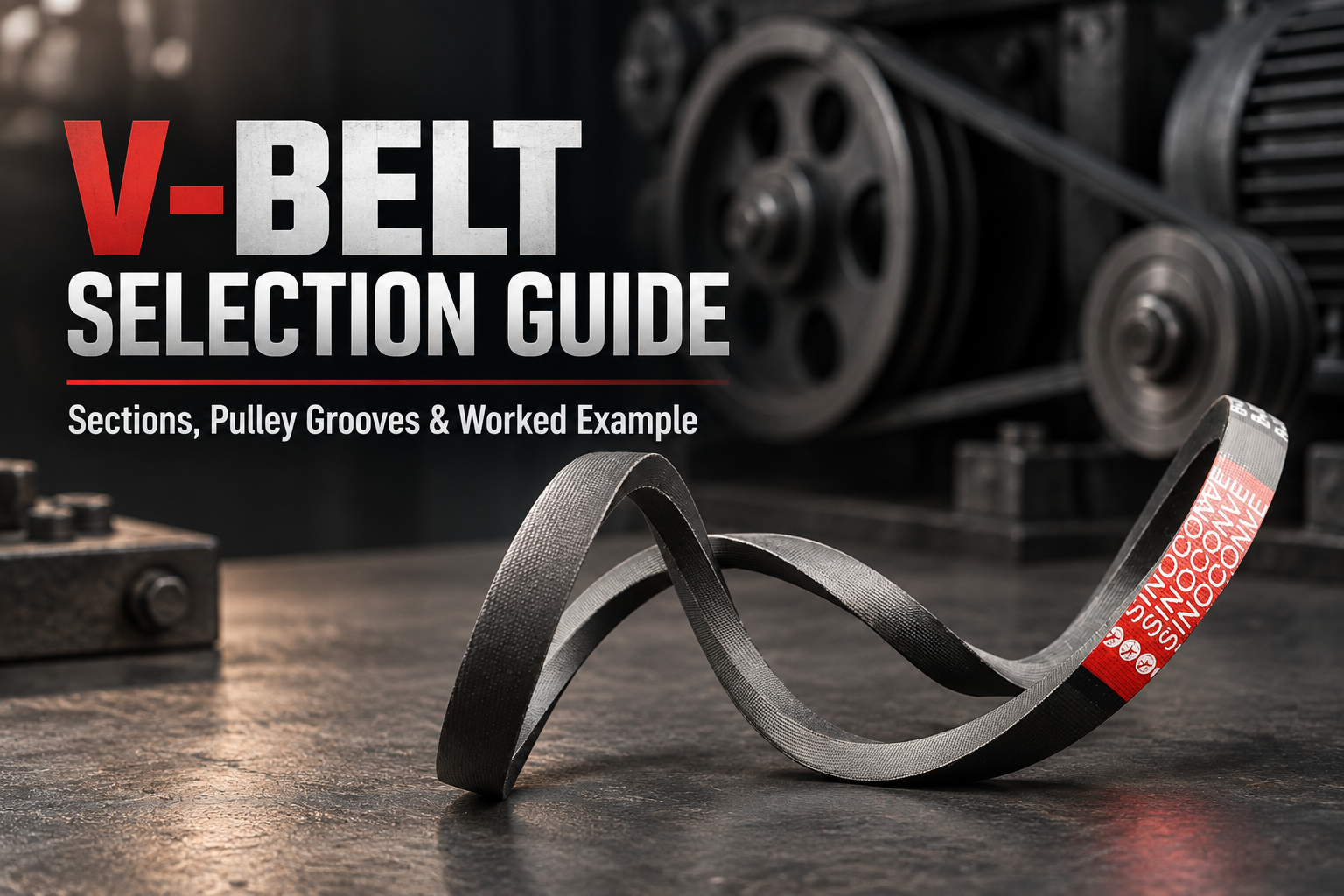
A standard wrapped V belt has a fabric-covered outside and a solid body. It is forgiving, easy to replace, and still common on many older machines. A raw-edge or cogged V belt exposes a more flexible side or inner profile, helping the belt wrap tighter around smaller pulleys and shed heat more easily. A banded V belt ties several ribs together, useful where individual belts would whip or turn over under uneven load.
Quick comparison of common V belt models
|
V belt model |
Where it usually fits |
Main strength |
Watch point |
|
Classic V belt |
Fans, pumps, small machines, older drives |
Simple replacement, steady grip |
Not ideal for very small pulleys |
|
Narrow V belt |
Compact drives needing higher power density |
More load in less space |
Pulley profile must match |
|
Cogged V belt |
Higher speed drives, smaller pulleys, hotter areas |
Better flexing and heat release |
Not a timing belt; it still runs by friction |
|
Banded V belt |
Agricultural machines, crushers, shock-load drives |
Less belt whip, better load sharing |
Needs matched pulley grooves |
|
Double V belt |
Drives with power taken from both sides |
Useful for multi-pulley layouts |
Less common; confirm layout first |
Classic V Belt: Still Useful on Straightforward Drives
A classic V belt is often the easiest answer when the machine is not asking for anything unusual. Industrial fans, water pumps, blowers, small compressors, and workshop machines often run well with this type. The belt sits in the pulley groove, grips through its wedge-shaped sides, and transfers power without needing complicated setup.
This is where a lot of replacement work happens. A maintenance team checks the old printed code, confirms the belt width and length, and fits a new belt during a scheduled stop. If the pulley groove is still clean and the load is moderate, the classic belt does its job quietly.
Problems appear when the drive is forced beyond that comfort zone. Tight pulley diameters, frequent start-stop cycles, oil mist, or high ambient heat can shorten belt life. In those cases, simply installing another classic belt may not solve the reason the old one failed.
Cogged V Belt: Better When Bending and Heat Become Problems
A cogged V belt has notches on the inner side. These cogs are not timing teeth. They do not lock into a pulley the way a synchronous belt does. Their job is to let the belt flex more easily and reduce internal stress as it bends around the pulley.
That makes the cogged style useful in compact layouts, higher-speed drives, and systems where heat buildup is already visible on the belt. Automotive accessory drives, small industrial machinery, compressors, and some HVAC units often benefit from this type of construction.
The phrase Application of different models of V belt often comes up exactly here: when a buyer wants to know why a cogged V belt costs more than a plain one. The answer is not decoration. It is about bending loss, heat, pulley diameter, and service conditions.
Banded and Narrow V Belts: When the Load Is Less Friendly
Some machines do not load the belt smoothly. Agricultural cutters, threshers, crushers, and heavy-duty fans can create shock loads that make individual belts jump, twist, or wear unevenly. A banded V belt helps because the belts are joined across the top, so they work as one set instead of several loose belts competing with each other.
Narrow V belts are a different solution. They are commonly selected when the drive needs more power capacity in a compact pulley arrangement. The cross-section carries load efficiently, but only when the pulley groove is correct. Put the wrong section into the wrong groove and the belt may ride too high or bottom out.
Application map for different V belt models
|
Industry / machine |
Common V belt choice |
Why that choice is used |
|
Automotive auxiliary drives |
Cogged or narrow V belt |
Compact pulley layout, higher speed, heat around engine bay |
|
Industrial fans and pumps |
Classic V belt or narrow V belt |
Steady load, easy maintenance, common replacement sizes |
|
Agricultural machinery |
Classic or banded V belt |
Dust, vibration, shock load, field repair needs |
|
HVAC blowers and compressors |
Classic or cogged V belt |
Long running hours, noise control, heat management |
|
Workshop and processing machines |
Classic V belt |
Simple drive design and practical replacement |
|
Heavy intermittent drives |
Banded V belt |
Better stability where single belts may whip or roll |
How Buyers Should Choose Between Models
Selection should start with the drive, not the catalog photo. Pulley groove profile, belt section, top width, datum length, center distance, speed, and working load all matter. If the old belt failed early, check the pulleys before blaming the belt material. A polished groove or slight misalignment can ruin a new belt quickly.
The application of different models of V belt also depends on maintenance access. A belt used in a clean workshop is different from one buried inside a dusty harvester or mounted near a hot compressor. The belt may be technically suitable, but if inspection access is poor, a more durable model may be the safer choice.
For OEM orders or distributor stock, the safest approach is to send the old belt code, belt section, length, pulley photos, working environment, and quantity requirements. SINOCONVE can then help match the V belt model to the actual drive rather than guessing from appearance.
Common Ordering Mistakes
The most common mistake is treating different models of V belt as interchangeable just because the outside looks similar. A cogged belt, a wrapped belt, and a narrow section belt may all appear to be black rubber loops, but they do not sit in the pulley the same way.
Another common mistake is ordering only by approximate length. The belt may fit over the pulleys but still run at the wrong depth in the groove. That changes contact area, heat, slip, and wear. For repeated orders, keeping a simple belt record by machine model saves trouble later.
FAQ
What is the main Application of different models of V belt?
The main use is power transmission between pulleys, but the model changes with the job. Classic belts suit general drives, cogged belts suit smaller pulleys or hotter drives, and banded belts suit shock-load systems.
Is a cogged V belt the same as a timing belt?
No. A cogged V belt still transmits power by friction in the pulley groove. The inner notches help flexibility; they are not synchronous timing teeth.
When should I use a banded V belt?
Use it when several belts run together and the drive has shock load, belt whip, or uneven loading. Agricultural and heavy industrial machines are common examples.
What information should I provide for a quotation?
Send the belt code, section, top width, length, quantity, pulley type, machine use, and any heat, oil, dust, or outdoor exposure around the drive.
Practical Takeaway
A V belt should not be chosen by shape alone. The right model depends on how the drive behaves after hours of real work: heat, slip, shock load, pulley size, and maintenance access. When those details are clear, choosing between classic, cogged, narrow, or banded construction becomes much easier.