
Heavy-Duty Rubber Conveyor Belt Supplier Selection for Crushers and Screening Plants
A conveyor belt quotation for a quarry can look technically acceptable and still leave an EPC contractor exposed. The belt width may match the drawing, the quoted strength may look sufficient, and the price may fit the budget. What is often missing is evidence that the proposed belt actually matches the crusher discharge, transfer-point impact, abrasive aggregate, conveyor geometry, splice arrangement, and required inspection documentation.
That distinction matters in crusher and screening plants because a belt is part of the material-handling system, not an isolated consumable. A specification error can move downstream into tracking problems, cover damage, splice failures, unplanned shutdowns, and difficult warranty discussions.
For a quarry buyer, therefore, selecting a heavy duty conveyor belt supplier should be a qualification process. The objective is not simply to identify who can manufacture a rubber belt. It is to determine whether the supplier can translate operating data into a technically defensible belt proposal, manufacture it consistently, document what was supplied, and respond when the project changes.
1. Start with the Conveyor Duty, Not the Supplier's Standard Belt
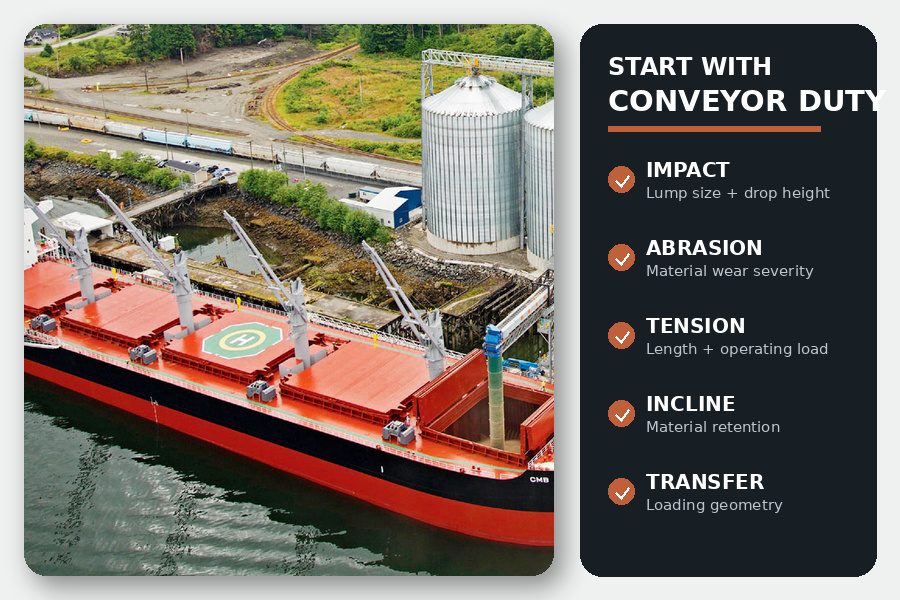
"Quarry belt" or "crusher conveyor belt" is not a complete specification. Two conveyors in the same crushing plant may require different constructions because their duties are different.
A primary-crusher discharge belt may receive coarse, sharp material at a severe loading point. A transfer conveyor may operate over a longer center distance and place more emphasis on tension behavior. A screen discharge conveyor may handle smaller material but experience continuous abrasive wear. An inclined conveyor introduces another issue: keeping material stable on the carrying surface.
The supplier therefore needs to understand the operating conditions before recommending carcass strength, cover characteristics, belt thickness, or construction. Buyers evaluating a stone crusher conveyor belt for quarry use should treat a catalog model as the beginning of the technical discussion, not as proof that it suits every crusher conveyor.
| Operating Condition | Main Risk | Specification Implication |
|---|---|---|
| Large or sharp crusher discharge | Impact, cutting, localized carcass damage | Review lump size, drop height, loading arrangement, carcass construction and cover requirements together. |
| Highly abrasive aggregate | Accelerated top-cover wear | Specify the required cover performance and test basis rather than asking only for a "wear-resistant belt." |
| Longer conveyor or higher operating tension | Excessive elongation, take-up limitations, splice stress | Confirm required belt rating, carcass type, conveyor tension data and splice arrangement. |
| Inclined conveying | Rollback or material spillage | Review material behavior and inclination before deciding whether a flat, patterned, chevron or sidewall construction is appropriate. |
| Poorly controlled transfer point | Off-center loading, impact damage, mistracking | Do not expect a heavier belt alone to correct a conveyor-system or loading-point problem. |
The last point is important during supplier evaluation. Belt damage does not automatically prove that the belt specification is inadequate. Transfer geometry, loading direction, idlers, pulley alignment, take-up condition and foreign objects can contribute to failures. A technically useful supplier should be willing to distinguish belt selection from conveyor-system diagnosis.
2. What Should an EPC or Quarry Buyer Send in the RFQ?
A supplier cannot prepare a reliable technical offer from "1,000 mm heavy-duty quarry belt, please quote" alone. The more demanding the conveyor, the more important the RFQ data becomes.
At minimum, provide the belt width and required length, conveyed material, maximum lump size, capacity, belt speed, conveyor center distance or relevant layout, inclination, existing belt construction or approved design specification, and the required standard. Where available, include drive and take-up information, pulley diameters, loading-point details, splice requirements, drawings, and photographs of an existing installation.
For a replacement belt, the current belt marking and failure history can be especially useful. If the previous belt suffered rapid cover wear, edge damage, delamination, repeated splice problems, or excessive stretch, tell the supplier. Otherwise the new RFQ may simply reproduce the old specification without addressing why it failed.
3. Compare Belt Construction Before Comparing Price
Once suppliers receive the same RFQ, normalize their technical offers. A cheaper quotation is not actually cheaper if it represents a different construction.
3.1 Fabric carcass versus steel cord
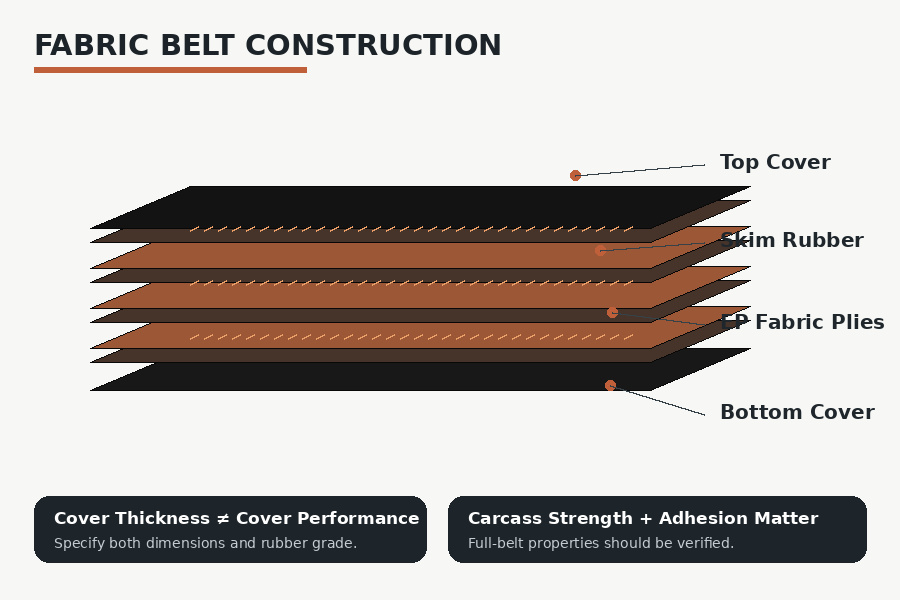
Fabric-reinforced rubber belts are widely applicable in quarry conveying, but the construction still has to match the required operating tension, elongation behavior, troughing and impact conditions. SINOCONVE's confirmed manufacturing range includes EP100 through EP600 fabric constructions, with project-specific selection based on the required specification.
The company's EP rubber conveyor belt range is one relevant starting point for fabric-belt projects. The rating should not, however, be selected merely by copying another conveyor in the plant.
For applications where conveyor length and tension requirements move beyond a practical fabric construction, steel cord becomes an option to evaluate. That does not make steel cord automatically "better." Splicing, inspection, pulley requirements, installation capability and project economics also change. EPC teams evaluating this transition can use the steel cord conveyor belt selection guide as a separate engineering reference.
3.2 Cover performance and cover thickness are different decisions
Quarry buyers sometimes reduce cover specification to one question: "How many millimeters?" Thickness matters, but rubber performance matters too.
Abrasive aggregate removes material from the carrying cover. Sharp material can also cut or gouge it. Impact at a loading point introduces another mechanism. Increasing cover thickness may provide more sacrificial material, but thickness alone does not prove that the rubber compound has the required abrasion behavior.
For this reason, technical comparison should identify both the specified cover dimensions and the required performance or grade under the project standard. Laboratory abrasion testing is useful for comparative and quality-control purposes, but it should not be treated as a direct prediction of field service life. Actual wear depends on the material, transfer design, belt speed, loading and operating conditions.
3.3 Adhesion and full-belt properties deserve attention
A belt is a composite structure. The covers, carcass plies and bonding between them have to continue working together under repeated flexing and tension. This is why a useful technical submittal goes beyond a rubber-compound description.
For textile conveyor belts, buyers can ask how full-thickness tensile properties and elongation are verified and how adhesion between belt elements is controlled. The purpose is not to collect the longest possible test list. It is to make sure the tests correspond to the properties that matter in the purchase specification.

4. Require a Technical Submittal You Can Actually Compare
An EPC procurement team should be able to place competing offers side by side without interpreting vague descriptions such as "high strength," "premium rubber," or "excellent wear resistance."
A useful technical submittal identifies exactly what the manufacturer proposes to supply and highlights deviations from the RFQ. Depending on the project, that can include construction, width, total thickness, top and bottom cover thickness, carcass or strength designation, relevant cover classification, edge construction, roll length, splice recommendation, applicable manufacturing/test standard, tolerances, and inspection documentation.
| Submittal Item | What the Buyer Should Verify | Warning Sign |
|---|---|---|
| Belt construction | Matches approved carcass and project duty | Generic "heavy duty" description |
| Dimensions | Width, length and cover/total thickness are clearly stated | Important dimensions omitted from the offer |
| Performance requirements | Required properties tied to an agreed test method or standard | Marketing adjectives without measurable acceptance criteria |
| Standards | Correct standard, edition where contractually relevant, and scope | A long standards list with no explanation of applicability |
| Inspection documents | What report is supplied and which properties are recorded | "Certificate available" without defining the document |
| Deviations | Every exception to the RFQ is stated before PO placement | Substitutions discovered after production starts |
This comparison process reduces a common procurement problem: awarding on price when suppliers have priced different technical scopes.
5. Verify Standards by Scope, Not by Logo
Standards are useful when they define what is being specified or tested. They are less useful when they appear as a collection of logos on a quotation.
For example, ISO 14890:2026 covers rubber- or plastics-covered textile conveyor belting for general surface use on flat or troughed idlers. ISO 283:2023 defines a method for determining full-thickness tensile strength and elongation properties of textile conveyor belts. ISO 252:2023 addresses adhesion testing between constitutive elements for applicable conveyor-belt constructions.
These standards do different jobs. A reference to one does not automatically verify every other property of the belt.
The same caution applies to abrasion data. ISO 4649:2024 provides laboratory methods for measuring rubber abrasion resistance using a rotating cylindrical drum device. Such results can support comparison, quality control and specification compliance, but the test itself does not establish how many months a quarry belt will last in service.
For an EPC project, the practical question is therefore: Which standard governs the supplied belt, which tests are required by the purchase specification, and what evidence will be included in the inspection package?
6. Audit Manufacturing and QC Claims Before Award
A technical datasheet describes the intended product. Supplier qualification should also establish whether the factory has the equipment and control process to manufacture that product repeatedly.
According to SINOCONVE's confirmed company information, its conveyor-belt factory operates eight fabric conveyor belt production lines and two steel cord conveyor belt production lines. The company reports more than 200 employees, including 26 engineers, a laboratory and 15 quality-control personnel. Its stated annual production capacity is 10 million meters of fabric conveyor belt and 3 million meters of steel cord conveyor belt.
The confirmed manufacturing range covers widths from 100 mm to 3,000 mm and thicknesses from 3 mm to 100 mm. These figures describe manufacturing capability; they should not be interpreted as a recommendation that every crusher or screening conveyor should operate near those limits.
Buyers can review SINOCONVE's broader manufacturing information on its conveyor belt supplier and factory page and available product families through the conveyor belt product catalog.
Factory scale alone should not decide an EPC award. QC traceability matters more. SINOCONVE's confirmed inspection process starts with incoming raw-material checks, continues with inspection during production, and finishes with testing and final inspection before shipment. Product test reports can be supplied, and third-party testing can be arranged where customers have special standard requirements.
7. Do Not Ignore Transfer Points and Plant Geometry
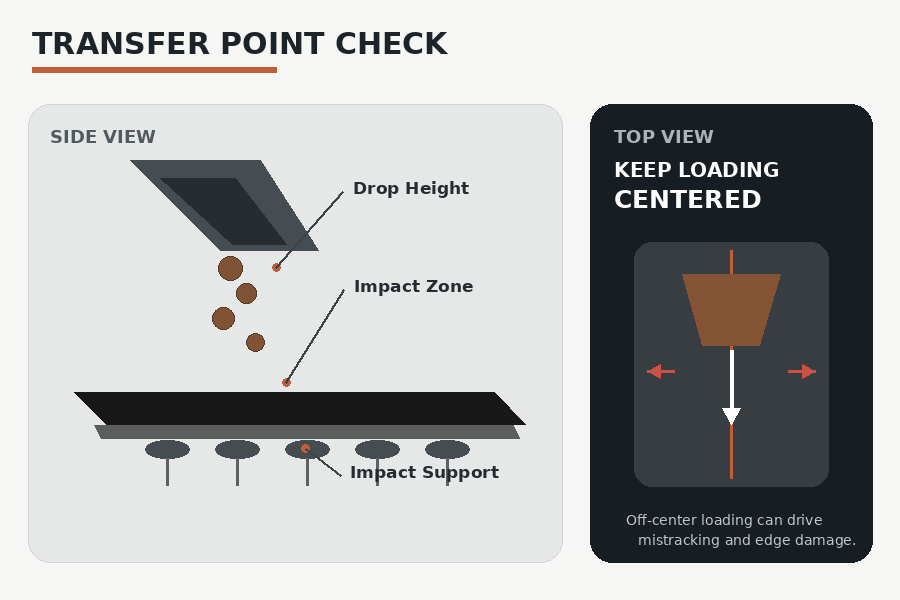
Crusher and screen conveyors are interconnected. That makes transfer points one of the most important places to investigate when a belt fails prematurely.
Impact severity is affected by more than material tonnage. Lump size, mass, drop height and how material meets the receiving belt all matter. Off-center loading can contribute to mistracking; inadequate impact support can concentrate load on the belt; poor containment can increase spillage and housekeeping problems.
This is also why a belt upgrade should not be used as a substitute for correcting a bad transfer point. If an existing belt repeatedly suffers damage in one localized area, provide photographs and transfer geometry to the supplier instead of simply ordering a thicker replacement.
Inclination needs similar attention. Where a plant layout requires steep lifting, the selection problem changes from simple strength and abrasion resistance to material retention and conveyor configuration. SINOCONVE's guide to sidewall conveyor belts for quarry and bulk handling discusses this type of application separately.
8. Compare Commercial Risk After Technical Compliance
Once competing suppliers have reached an acceptable technical baseline, commercial comparison becomes meaningful.
For a project buyer, the relevant questions extend beyond the price per meter. Confirm production lead time, MOQ, packaging, inspection requirements, payment terms, document schedule, deviation handling, after-sales procedure and the response if a manufacturing quality issue is confirmed.
SINOCONVE's confirmed standard MOQ for conveyor belts is 50 meters. Normal production lead time is approximately 30 days; for urgent requirements, the company states that a 15–20 day production arrangement may be possible subject to order conditions and confirmation. Because SINOCONVE conveyor belts are made to order rather than held as standard finished stock, the required construction and delivery schedule should be confirmed before the PO is released.
For transport protection, SINOCONVE can use PVC board and iron-sheet protection for conveyor belts and palletize where required. Packaging requirements should still be written into the order, especially for export projects involving multiple handling stages before the belt reaches the quarry.
For normal conveyor belt products, the company's confirmed warranty is typically one year. Warranty terms should never replace technical acceptance criteria: buyers should establish what constitutes a manufacturing defect, what evidence is needed for a claim, and what remedy applies before shipment.
9. A Practical Supplier Qualification Scorecard
Procurement teams can use a weighted scorecard, but the weighting should follow the project's risk profile rather than a universal formula. A critical overland or primary-crusher conveyor may justify heavier technical weighting than a short, accessible secondary conveyor.
| Evaluation Area | Evidence to Request | Why It Matters |
|---|---|---|
| Application understanding | Technical questions, review of operating data, identified assumptions | Reduces specification mismatch |
| Technical compliance | Completed datasheet, construction details, deviation list | Makes bids comparable |
| Quality control | Inspection flow, test report scope, third-party inspection options | Connects the PO specification to the delivered belt |
| Manufacturing capability | Relevant production equipment and achievable size/construction range | Confirms the factory can manufacture the proposed construction |
| Project execution | Confirmed lead time, packaging, documentation and communication process | Reduces schedule and logistics uncertainty |
| Commercial terms | Normalized price, payment terms, warranty and claim process | Reveals the real commercial exposure instead of unit price alone |
A useful procurement rule follows from this: technical exceptions should be resolved before commercial ranking is finalized. Otherwise the lowest quotation may simply contain the most unpriced assumptions.
10. Common Supplier-Selection Mistakes
- Buying by belt width and ply count alone. These do not describe the complete duty or construction.
- Assuming a thicker cover automatically solves premature wear. Material abrasiveness, rubber properties, loading conditions and conveyor geometry also influence wear.
- Comparing quotations before normalizing specifications. Two prices may represent materially different belts.
- Accepting "DIN," "ISO" or "RMA" without a specific requirement. Ask what standard or classification applies and which property it governs.
- Leaving deviations undocumented. A substitution discussed informally can become a dispute after delivery.
- Ignoring the existing failure pattern. Photos and operating history can reveal information that a dimensional RFQ cannot.
- Choosing solely on initial purchase price. Installation access, downtime exposure, splicing, documentation and replacement logistics can matter more than a small difference in belt price.
11. FAQ for Quarry and EPC Conveyor Belt Buyers
What information does a heavy duty conveyor belt supplier need for a crusher plant quotation?
Provide the required belt dimensions and construction where already specified, conveyed material, maximum lump size, capacity, speed, conveyor geometry, inclination, loading conditions, applicable standard, quantity and delivery destination. For replacement projects, include the existing belt marking, drawings and photographs of abnormal wear or failure.
Is an EP belt always suitable for a quarry crusher conveyor?
No. EP fabric belts cover many quarry duties, but suitability depends on operating tension, conveyor length, impact conditions, pulley geometry, required elongation behavior and other design factors. The correct strength class and construction should come from the conveyor requirements rather than the application name alone.
When should an EPC buyer consider a steel cord belt?
Steel cord becomes relevant when the design requires properties such as higher tensile capacity and lower elongation than a practical textile construction can provide. It should be evaluated as part of the complete conveyor design because splicing, inspection, pulleys and installation requirements also differ.
Does a lower abrasion-test value guarantee longer quarry belt life?
No laboratory abrasion result can by itself guarantee service life. Abrasion testing is useful for comparison, QC and specification verification, while field wear also depends on conveyed material, loading and transfer conditions, belt speed, maintenance and system geometry.
What documents should be requested before shipment?
The exact package depends on the contract, but an EPC buyer can define the approved technical datasheet, purchase specification, inspection or test report, dimensional verification and any required third-party inspection documentation before production begins.
Can SINOCONVE manufacture customized quarry conveyor belts?
Yes. According to SINOCONVE's confirmed manufacturing information, conveyor belts can be customized to customer requirements, with OEM/ODM support based on technical requirements, drawings or samples. The final construction remains subject to technical review and production confirmation.
What is SINOCONVE's MOQ and normal lead time for conveyor belts?
The confirmed conveyor belt MOQ is 50 meters. Normal production lead time is approximately 30 days. For urgent requirements, a 15–20 day arrangement may be possible, but it should be confirmed for the specific specification and production schedule before ordering.

12. Prepare a Better RFQ Before Asking for the Final Price
The strongest supplier comparison starts with the same technical information going to every bidder. For a crusher or screening project, prepare the current or required belt specification, belt width and length, conveyed material and lump size, capacity and speed, conveyor geometry, loading-point information, applicable standard, quantity, destination, and any drawings or photographs that clarify the duty.
SINOCONVE has manufactured industrial belts since its factory was established in 1988 and supports customized fabric and steel cord conveyor belt production. For project-specific evaluation, send the technical package to sales@sinoconve.com or submit it through the SINOCONVE conveyor belt RFQ page. The objective should be a technically comparable proposal first and a commercial comparison second.