
Steel Cord Conveyor Belt Manufacturer for Long-Distance Mining Projects: Buying Guide
A long-distance mining conveyor is a poor place to discover that two belts carrying the same ST designation are not commercially or technically equivalent. By the time the belt reaches site, the project may already have committed to a splice plan, pulley arrangement, shutdown window, installation crew, and commissioning schedule. A mismatch in construction, documentation, or manufacturing capability can therefore become much more expensive than the original price difference between suppliers.
For a mining project buyer, selecting a steel cord conveyor belt manufacturer is consequently not just a product search. It is a supplier-qualification exercise. The manufacturer must be able to understand the conveyor duty, translate tender requirements into a controlled belt specification, provide appropriate inspection evidence, and manufacture the required quantity consistently. This guide explains what to verify before a technical proposal becomes a purchase order.
Quick Answer for Mining Project Buyers
Do not shortlist a steel cord conveyor belt supplier from ST rating and unit price alone. Compare the proposed belt construction, cover requirements, splice compatibility, applicable standard, inspection documents, manufacturing capacity, delivery plan, packing, and the supplier's response to your actual conveyor data. For a long-distance conveyor, unresolved technical differences should be closed before commercial comparison.
1. Why Long-Distance Mining Projects Need a Different Buying Process
Steel cord reinforcement is used where the conveyor design requires high longitudinal strength and low elongation. These characteristics make it relevant to long-distance, high-tension and heavy-duty conveying, but they also make specification control more important.
The belt cannot be treated independently from the conveyor. Required belt strength comes from the system design and calculated tensions. Pulley diameters must suit the selected belt construction. The splice must transfer operating tension reliably. Meanwhile, the covers still have to protect the carcass against the actual ore, loading impact, abrasion, cutting, moisture and other site conditions.
This is why an RFQ containing only “steel cord belt, width, ST rating and quantity” leaves important decisions unresolved. A responsible supplier should ask for enough operating and design information to confirm what is being quoted.
Buyers who are still defining the technical specification can review SINOCONVE's guide to specifying a steel cord conveyor belt before preparing the tender package.
2. Start Supplier Qualification with the Conveyor Duty
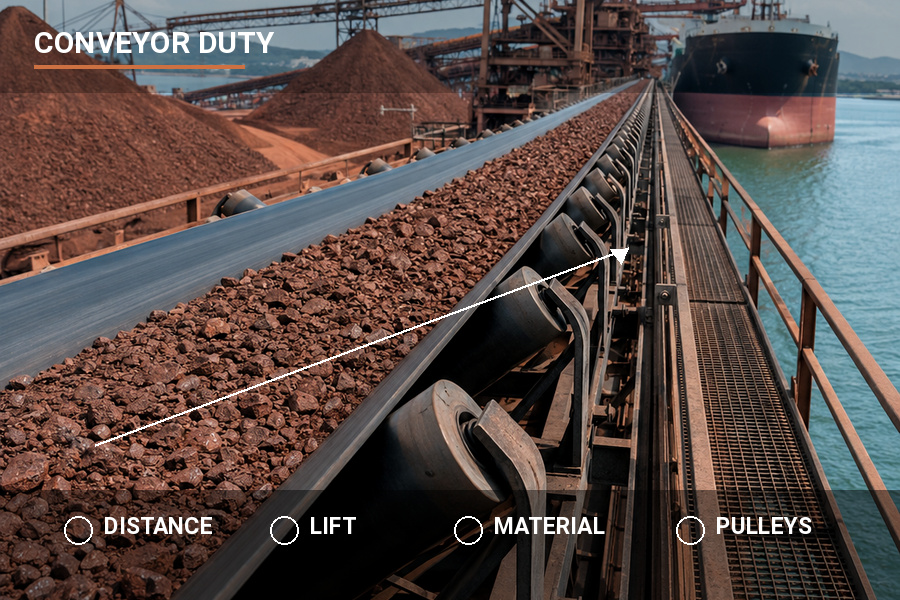
A supplier cannot meaningfully evaluate a long-distance mining belt from the product designation alone. Before comparing manufacturers, establish a common technical baseline so every bidder is responding to the same duty.
| Project Information | What the Buyer Should Provide | Why It Matters |
|---|---|---|
| Conveyor geometry | Center distance, lift, incline profile and conveyor drawing | Provides context for the system tension and belt duty |
| Design data | Approved ST rating, belt width, speed, capacity and calculated tension data where available | Prevents a supplier from selecting strength from capacity or belt width alone |
| Material | Ore type, lump size, loading conditions and known abrasion or cutting problems | Influences cover and impact-protection decisions |
| Pulley system | Drive, tail, bend and take-up pulley diameters | Must be reviewed against belt construction and bending requirements |
| Existing belt | Current specification, drawings, photos and recurring failure evidence | Helps identify requirements that a simple tender description may miss |
| Site requirements | Required standard, safety requirements, inspection plan and documentation | Defines what must be manufactured, tested and submitted for approval |
For a replacement project, old belt evidence can be particularly useful. Exposed cords, longitudinal cuts, abnormal cover wear, splice damage or edge deterioration point to different problems. A new belt with a higher nominal strength will not automatically correct loading, alignment, pulley or splice problems elsewhere in the conveyor.

3. What to Check in a Steel Cord Conveyor Belt Manufacturer
3.1 Relevant manufacturing capability
Ask for capability that relates directly to the belt in the tender, rather than relying on general factory statements. For steel cord belts, relevant questions include the manufacturer's available strength range, belt dimensions, steel cord production equipment, quality-control process and ability to handle the required order volume.
SINOCONVE's conveyor belt factory has two steel cord conveyor belt production lines. Based on the company's confirmed production data, its steel cord range extends from ST500 to ST7500, and annual steel cord conveyor belt production capacity is stated as 3 million meters. The wider conveyor belt manufacturing operation has more than 200 employees, including 26 engineers, 15 quality-control personnel and a laboratory.
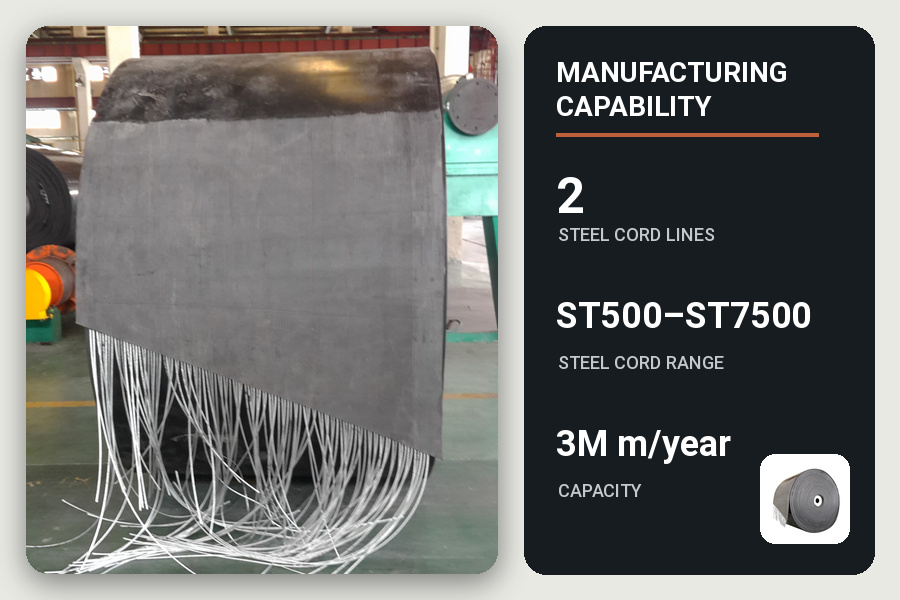
Those figures are useful for initial qualification, but a project buyer should still confirm the exact construction, width, quantity and delivery schedule for the individual tender. General factory capacity is not the same thing as confirmed capacity for a particular purchase order.
More information about the manufacturer's production setup can be reviewed on the SINOCONVE company and manufacturing page.
3.2 Ability to review the complete belt specification
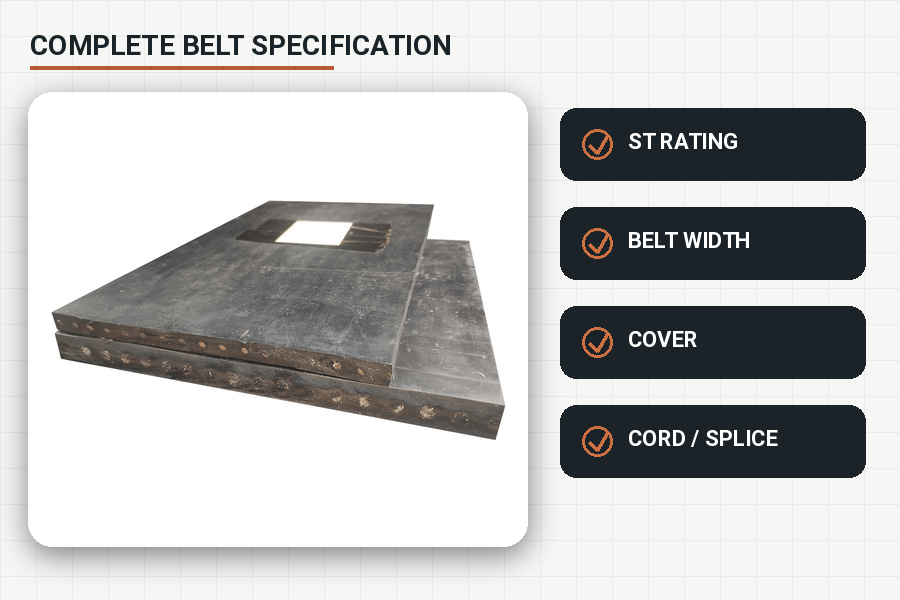
A technically useful proposal should go beyond “ST2000” or another strength designation. Depending on the project, the specification may also need to define belt width, top and bottom cover thickness, cover performance, cord construction, splice requirements, dimensional tolerances and other requirements from the approved project standard.
ISO 15236-1, for example, addresses design, dimensions and mechanical requirements for conveyor belts reinforced longitudinally with steel cords. A tender referencing a standard should identify the required edition or project specification rather than assuming that the words “ISO standard” are sufficient.
RFQ Warning: Do not allow suppliers to substitute a different belt construction merely because the nominal tensile-strength designation appears equivalent. Any deviation from the tender specification should be declared and technically reviewed before the bid is accepted.
3.3 Quality control and inspection evidence
Mining buyers should distinguish between a manufacturer saying that it performs QC and the manufacturer agreeing in advance on what evidence will accompany the order.
SINOCONVE's confirmed quality process includes incoming raw-material inspection, in-process inspection and final testing before shipment. Product test reports can be provided, and third-party testing can be arranged when a customer has special standard requirements.
For steel cord construction, buyers may need to verify characteristics beyond external appearance. For example, ISO 7623 defines a test method for determining the bond strength between metal cords and their surrounding coating. Other project requirements can concern dimensions, cover performance, flame behavior or electrical conductivity.
Not every mining conveyor requires the same tests. Surface and underground applications can have very different safety obligations. ISO 340:2022 covers laboratory-scale flammability characteristics of conveyor belts, while ISO 284:2025 covers electrical conductivity and its test method. Referencing either test does not by itself establish compliance with every mine-specific regulation. The project's applicable legal, mine-safety and tender requirements should control the inspection plan.
4. Make the Technical Proposal Comparable Before Comparing Price
One of the easiest ways to make a tender difficult to evaluate is to accept quotations with different technical assumptions. Supplier A may quote the requested cover construction, Supplier B may propose a thinner alternative, and Supplier C may exclude inspection or packing. The resulting unit prices are not directly comparable.
A useful bid tabulation should normalize the important technical and commercial points.
| Tender Check | What to Verify | Commercial Risk if Unclear |
|---|---|---|
| Belt strength | Quoted ST rating matches approved design | Non-equivalent bids or engineering reapproval |
| Belt dimensions | Width and cover construction match RFQ | Fit, wear or acceptance disputes |
| Cover requirement | Compound/performance requirement matches conveyed material and tender | Premature cover damage despite adequate tensile strength |
| Splicing | Splice design, materials and responsibility are clearly defined | Installation delays or splice reliability problems |
| Testing | Required tests, reports, acceptance criteria and third-party inspection | Disagreement at pre-shipment inspection |
| Delivery | Manufacturing schedule, roll plan and shipment scope | Installation sequence or project schedule disruption |
| Packing | Export protection and handling requirements | Transport or storage damage before installation |
This approach also exposes apparently low quotations that have achieved their price by excluding part of the required scope.
5. Splice Planning Belongs in the Purchase Decision
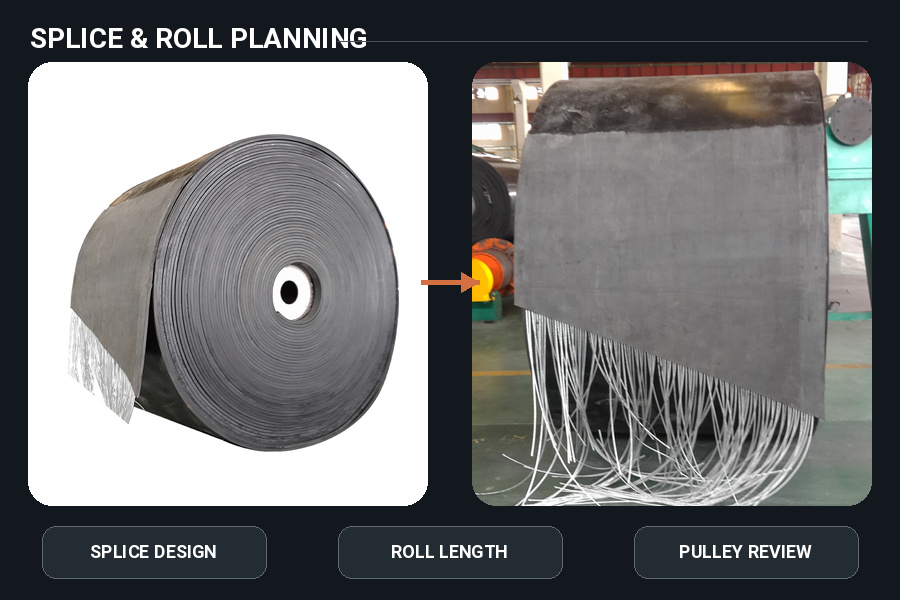
For a long-distance conveyor, the splice is not a minor installation detail. It has to transfer tension from one belt end to the other while repeatedly passing around the conveyor's pulley system.
The buyer should establish who is responsible for splice design, splice materials, vulcanizing instructions, installation supervision where required, and final acceptance. The supplier should also receive the pulley information and approved belt construction needed for its technical review.
Shipping and installation constraints matter as well. A project may require the total belt length to be divided into multiple rolls because of manufacturing, transport, lifting or site-handling limits. More rolls can mean more field splices, so roll-length decisions should not be made by the logistics department in isolation.
For more background on the available joining approaches and the variables that influence them, see the SINOCONVE guide to conveyor belt joint methods.
6. Evaluate Delivery Capability Against the Project Schedule
Lead time has a different meaning in a mining project than in a routine MRO purchase. The relevant date may be the required-on-site date, not simply the factory completion date.
According to SINOCONVE's confirmed company information, the normal conveyor belt manufacturing lead time is approximately 30 days. For urgent requirements, a 15–20 day production schedule may be available subject to order review. The minimum order quantity for conveyor belts is normally 50 meters.
These figures should be treated as general commercial capability, not an automatic promise for every mining tender. A large steel cord order can involve specific raw materials, production scheduling, testing, packing and shipment requirements. Buyers should therefore request a project-specific production and delivery confirmation before contract award.
For international shipment, SINOCONVE can use PVC board and metal-sheet protection for conveyor belt rolls, with palletizing where required. The final packing specification should still account for the shipment route, unloading method and expected storage period at the mine or project site.
7. What Proof of Capability Should a Mining Buyer Request?
A professional prequalification package should contain evidence that helps the project team verify the proposed supply. The exact document list depends on the tender, but useful requests can include:
- manufacturer and factory information relevant to steel cord belt production;
- available manufacturing range and confirmation that the tender specification is within it;
- technical datasheet for the exact proposed construction;
- declared manufacturing standard and any deviations from the tender;
- quality-control and inspection plan;
- required product test reports and acceptance criteria;
- third-party inspection arrangements where specified;
- splice-related technical documentation where included in the supply scope;
- production, inspection, packing and shipment schedule;
- export packing and roll identification details.
The objective is not to collect the largest possible document package. It is to obtain evidence that closes the important technical and commercial risks before shipment.
8. Common Supplier-Selection Mistakes in Mining Tenders
8.1 Ranking suppliers by price before closing technical deviations
A lower price is meaningful only after the bids are technically comparable. First identify deviations in strength, construction, cover, testing, splice scope, packing and delivery. Then compare commercial terms.
8.2 Treating factory size as proof of product suitability
Production capacity matters for a bulk order, but capacity cannot replace engineering review. A large manufacturer can still quote the wrong belt if the RFQ contains insufficient conveyor information.
8.3 Specifying only ST rating
The ST designation addresses an important strength requirement, but it does not describe the entire belt. Cover protection, dimensions, splice requirements, conveyor geometry and site conditions remain part of the decision.
8.4 Leaving inspection requirements until production is complete
If the buyer requires specific reports, witness inspection or third-party testing, those requirements should be agreed before the order enters production. Adding them at the end can create delays or disputes over test methods and acceptance criteria.
8.5 Ignoring the previous belt's failure evidence
On replacement projects, the old belt is part of the engineering record. Photos of cover wear, cuts, exposed cords, edge damage and splice deterioration can help determine whether the problem originated in belt selection or elsewhere in the conveyor.
9. How SINOCONVE Supports Steel Cord Conveyor Belt Projects
Ningbo Sinoconve Belt Co., Ltd.'s factory was established in 1988 and has more than 35 years of manufacturing experience. For conveyor belt production, the company reports eight fabric belt production lines and two steel cord conveyor belt production lines.
The confirmed steel cord manufacturing range is ST500–ST7500. Across its conveyor belt manufacturing capability, SINOCONVE reports widths from 100 mm to 3000 mm. Because actual manufacturability depends on the complete belt construction and project requirement, buyers should submit the required width, strength and construction for confirmation rather than relying on range figures alone.
SINOCONVE also supports customized production based on customer requirements, including OEM/ODM arrangements. Its quality-control workflow covers incoming materials, production-stage inspection and final pre-shipment inspection. Test reports can be supplied, and third-party testing can be discussed when the tender requires it.
Buyers evaluating the product category can review the verified steel cord conveyor belt page and the broader SINOCONVE product catalog. For mining-specific technical considerations, the article on heavy-duty conveyor belts for mining provides additional application context.
10. FAQ for Mining Procurement Teams
What information should be included in a steel cord conveyor belt RFQ?
At minimum, provide the approved belt width, length, ST rating, cover requirements, conveyed material, quantity, required standard and delivery destination. For technical review, also provide relevant conveyor drawings, belt speed, capacity, pulley diameters, tension data, splice requirements and any existing belt specification or failure evidence.
Is a higher ST rating automatically safer?
No. Belt strength should follow the conveyor design and required safety factors rather than a “higher is better” rule. Changing the belt construction can also affect pulley and splice requirements. Any departure from the approved design should be reviewed by the responsible conveyor engineer.
Which standard should be specified for a steel cord conveyor belt?
That depends on the project's engineering and regulatory requirements. ISO 15236 is directly relevant to steel cord conveyor belts, but a mine may also have project-specific, national or safety requirements. State the applicable standard and edition in the tender instead of requesting generic “international standard” compliance.
Do surface and underground mining belts have the same safety requirements?
No. The applicable safety requirements depend on the installation and jurisdiction. Underground applications can require specific flame and electrical properties. Buyers should identify the mine's regulatory requirements in the RFQ rather than assuming that a general-purpose steel cord belt is suitable.
Can SINOCONVE provide product test reports?
Yes. According to the company's confirmed quality information, product test reports can be provided. Third-party testing can also be arranged where customers have special standard or tender requirements. The required tests and acceptance criteria should be agreed before production.
What is SINOCONVE's MOQ and typical lead time?
The confirmed conveyor belt MOQ is normally 50 meters. General manufacturing lead time is about 30 days, while urgent orders may be reviewed for a 15–20 day schedule. A mining project should obtain order-specific confirmation because belt construction, quantity, testing and production scheduling can affect delivery.

11. Prepare a Better RFQ Before Requesting the Final Quote
The strongest purchasing position is not simply having more suppliers. It is having several technically qualified suppliers quoting the same clearly defined scope.
Before requesting a final proposal, prepare the belt width and required length, approved ST rating or conveyor design data, top and bottom cover requirements, conveyed material and loading conditions, pulley information, applicable standard, splice scope, required inspection documents, quantity and destination. For replacement projects, attach the current belt specification, conveyor drawing and photographs of recurring damage where available.
SINOCONVE can review this information against its manufacturing capability before quotation. Submit the project through the SINOCONVE RFQ page or email sales@sinoconve.com. A technically complete RFQ makes it easier to identify deviations early, compare proposals on the same basis, and reduce avoidable purchasing risk before a long-distance mining belt reaches site.