
Conveyor Roller and Pulley Supplier for Port Conveyor Systems: One-Stop Procurement Guide
Port conveyor projects rarely fail because a purchasing team forgot to order a roller or pulley. The larger risk is that components arrive with the right general description but the wrong interfaces: an idler frame does not match the existing structure, a pulley shaft does not fit the bearing arrangement, lagging is unsuitable for the duty, or drawings and BOM revisions do not agree.
For EPC contractors, port operators and bulk-material-handling buyers, choosing a conveyor roller and pulley supplier is therefore a project-control decision as much as a component-price decision. Rollers, idlers, pulleys, bearings, belt geometry and surrounding structures work as one conveyor system. Procurement needs to control those interfaces before manufacturing and shipment.
This guide explains what to put into a port conveyor RFQ, how to compare suppliers, which technical details require verification, and where one-stop sourcing can reduce purchasing risk without sacrificing engineering control.
Quick Answer: For a port or EPC project, do not qualify a conveyor component supplier only by catalog coverage and unit price. Verify drawing control, roller construction, pulley interfaces, applicable standards, inspection documents, packaging, BOM management and the supplier's ability to identify specification conflicts before production.
1. Why Port Conveyor Procurement Is Different from Buying Individual Components

A port conveyor system may operate over long distances, carry abrasive bulk materials and work in an environment exposed to dust, moisture, salt-laden air and frequent loading cycles. More importantly for procurement, a single project can contain many conveyor sections and a large number of nominally similar components.
That creates a configuration-control problem.
A quotation may list “carrier roller,” “return roller” and “drive pulley,” but those descriptions alone do not establish interchangeability. Roller diameter, face length, shaft-end geometry, bearing arrangement, sealing, trough configuration and frame dimensions still need to match the approved conveyor design. For pulleys, buyers may need to control shell dimensions, face width, shaft arrangement, hub connection, bearing interfaces and lagging requirements according to the project design.
The procurement risk increases when components are sourced independently from several suppliers. Each supplier may interpret the same BOM differently, while the EPC team becomes responsible for finding inconsistencies between quotations.

Procurement Warning: “Same size” does not necessarily mean “interchangeable.” For replacement projects, drawings, shaft ends, mounting dimensions and existing frame interfaces are often more useful than a component name alone.
2. What Should Be Included in a One-Stop Conveyor Component Package?
One-stop sourcing should not mean putting unrelated parts into one purchase order. It should mean managing related conveyor components against one controlled technical package.
Depending on the conveyor design, a port project may require combinations of:
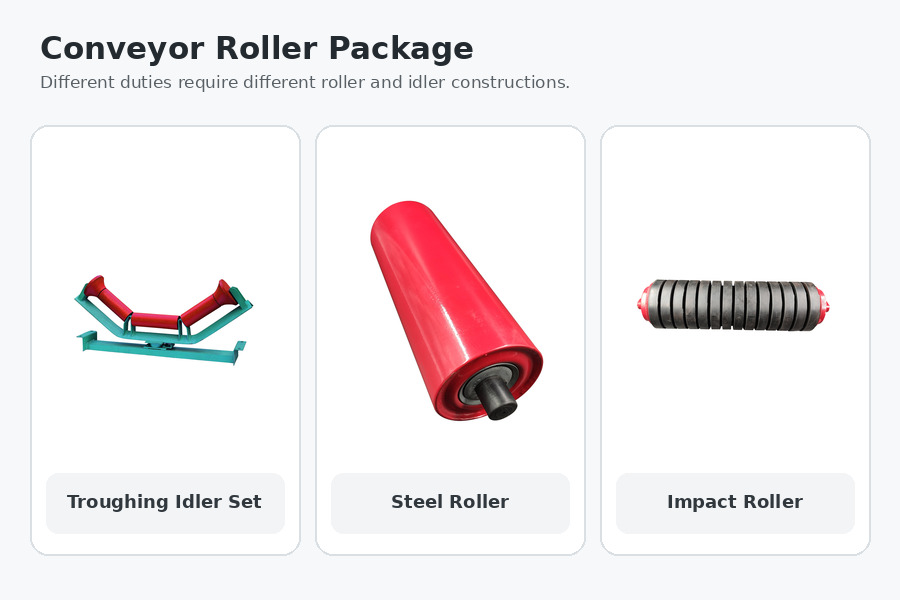
- carrying or troughing rollers and idler sets;
- return rollers;
- impact rollers or loading-zone idlers;
- self-aligning or tracking idlers where specified;
- idler frames and mounting hardware;
- drive, head, tail, bend, snub or take-up pulleys;
- pulley shafts, hubs and associated bearing interfaces;
- pulley lagging where required by the approved design;
- conveyor belts and related material-handling components;
- project-specific spare components.
The exact package should follow the approved conveyor design rather than a generic supplier catalog. SINOCONVE's confirmed product range includes conveyor rollers, and its wider material-handling portfolio includes conveyor belts and related products. Pulley requirements, however, should be submitted with the project RFQ and technically confirmed for the specific order rather than assumed from a general product list.
3. Conveyor Roller Specification: Go Beyond Diameter and Length
Rollers appear simple, which is why underspecified roller RFQs are common. A buyer may provide diameter, length and quantity, receive several quotations and assume the offers are technically equivalent. They may not be.
For heavy-duty belt conveyor systems, the roller construction has to match its installed duty. SINOCONVE's technical guide to conveyor rollers for heavy-duty belt conveyor systems discusses the relationship between shell, shaft, bearings, sealing, frame fit and operating conditions.
| RFQ Item | What the Buyer Should Provide | Why It Matters |
|---|---|---|
| Roller duty | Carrying, return, impact, transition, tracking or other specified position | Different conveyor positions experience different loads and contamination conditions. |
| Dimensions | Roller diameter, shell/face length, overall length and shaft-end dimensions | Controls physical fit and compatibility with the frame. |
| Conveyor data | Belt width, speed, trough angle, spacing and operating load/design information | Allows the roller arrangement to be checked against actual duty. |
| Environment | Dust, moisture, washdown, corrosion exposure and material characteristics | Affects sealing, surface protection and bearing protection requirements. |
| Interface | Frame drawing, mounting slot details or existing component drawing | Reduces the risk of receiving a roller that meets nominal dimensions but cannot be installed. |
For replacement programs, photographs are useful but should not replace dimensional information. An existing drawing, marked-up sketch or measured sample can make the RFQ much more precise.
ISO 1537:1975 remains a published ISO standard for idlers used on troughed belt conveyors for loose bulk materials and addresses idler dimensions, arrangement and clearance for the equipment within its scope. ISO 5048:1989 addresses operating power and tensile-force calculations for belt conveyors with carrying idlers. These standards reinforce an important purchasing principle: the idler is part of the conveyor design, not an isolated commodity.
4. Pulley Procurement Requires Interface Control
Pulleys create a different set of risks. A roller primarily supports the belt and load; a drive pulley must also participate in transmitting traction, while other pulleys redirect the belt or form part of the tensioning arrangement.
For this reason, “pulley diameter × face width” is not a sufficient EPC specification.
A pulley RFQ should normally reference the approved engineering drawing and identify the pulley duty, belt width, pulley diameter and face width, shaft arrangement, bearing interfaces, hub arrangement, lagging requirement and relevant design loads. For replacement work, the existing shaft and bearing arrangement deserves particular attention.
Lagging also should not be treated as a decorative option. On drive pulleys it influences the traction interface between the belt and pulley, while lagging can also be specified to address wear or material buildup depending on the position and operating conditions. The required lagging material, pattern, thickness and attachment method should therefore come from the approved project specification or engineering review rather than a supplier's default configuration.
Buyer Tip: If two pulley quotations have a significant price difference, compare the complete construction before negotiating the price. Check whether shaft, hub, bearing interfaces, lagging, coating, inspection requirements and documentation are genuinely equivalent.
5. Build the RFQ Around the BOM, Drawings and Revision Control
For EPC procurement, the most useful RFQ is not necessarily the longest one. It is the one that gives every bidder the same technical baseline.
Start with a controlled BOM. Assign each roller, idler assembly and pulley a tag number or item number that can be traced to a drawing. If a component has several variants, do not rely on similar descriptions to distinguish them.
A practical RFQ package can include:
- project and conveyor identification;
- equipment tag numbers and BOM quantities;
- approved or inquiry-stage drawings with revision numbers;
- belt width, speed and relevant conveyor operating data;
- conveyed material and environmental conditions;
- roller/idler arrangement and mounting dimensions;
- pulley duty and applicable mechanical/interface data;
- specified materials, coatings or corrosion-protection requirements;
- applicable project standards and inspection requirements;
- required supplier drawings and document schedule;
- packing, marking and shipping requirements;
- spare-parts quantities separated from installation quantities.
For large projects, ask suppliers to return their quotation against the same item numbering. This makes technical and commercial comparison much easier than receiving several differently formatted catalogs.
6. Supplier Qualification: What Proof Should an EPC Buyer Request?
A supplier statement such as “heavy duty,” “high quality” or “for port use” does not demonstrate that the offered components meet a particular project specification. Supplier qualification should focus on evidence relevant to the order.
| Qualification Area | What to Verify | Procurement Risk Reduced |
|---|---|---|
| Technical review | Ability to review drawings, specifications and operating conditions before quotation or production | Incorrect selection and unresolved technical deviations |
| Drawing control | Supplier drawings, revision status and approval process | Manufacturing to obsolete or mismatched dimensions |
| Quality control | Incoming material, in-process and final inspection procedures relevant to the ordered product | Undetected manufacturing nonconformity |
| Documentation | Inspection reports, certificates and other documents specifically required by the PO | Missing handover and project records |
| Packaging | Export packing, identification and protection appropriate to transport and storage | Transit damage and site identification errors |
| Commercial control | Scope exclusions, deviations, delivery basis and document responsibilities | Late variation orders and hidden scope gaps |
This evidence-based approach is particularly important when sourcing overseas. A purchasing team can use SINOCONVE's guide on conveyor components for bulk material handling to review how component interfaces can affect overall conveyor reliability.
7. Why One-Stop Sourcing Can Reduce Project Risk
One-stop sourcing has value when it reduces interfaces without removing technical accountability.
Instead of sending roller, belt and related component inquiries to unrelated vendors, a buyer may consolidate compatible scopes under fewer purchase packages. This can simplify BOM communication, drawing exchange, shipment planning and commercial coordination.
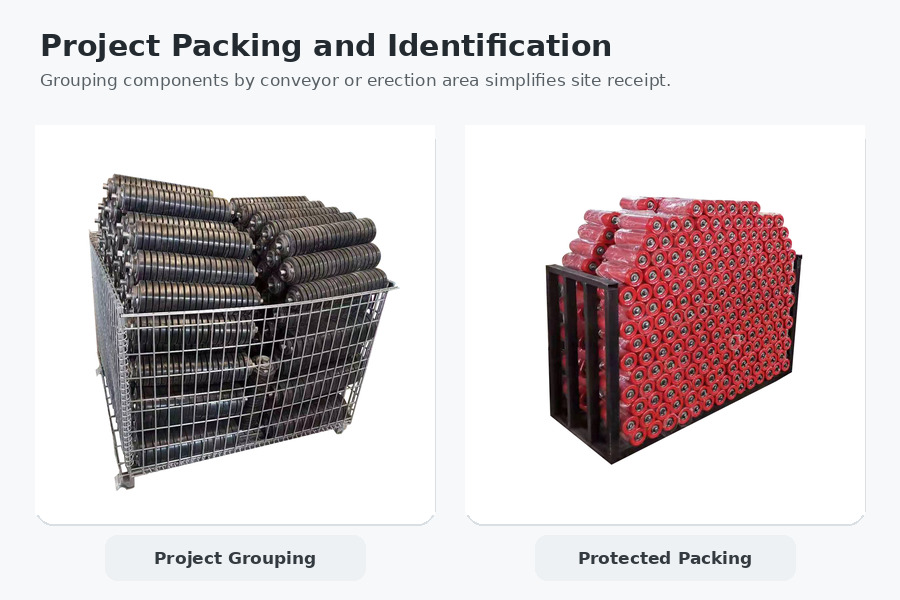
There are also practical benefits at the packing stage. Components belonging to the same conveyor or erection area can be identified against the project BOM, making site receipt and distribution easier.
But consolidation has a limitation: one purchase order does not guarantee one technically compatible system. The EPC team still needs to approve the specifications, drawings and deviations. A capable supplier should make those checks easier, not ask the buyer to abandon them.
Condition → Risk → Procurement Implication: The more conveyor components and tag numbers a project contains, the greater the risk of BOM, drawing and shipment mismatches. Consolidated sourcing is most valuable when it is paired with controlled item numbering, technical review and traceable packing lists.
8. How to Compare Conveyor Roller and Pulley Supplier Quotations
Do not begin the comparison with the total price. First normalize the technical scope.
One bidder may have included complete idler sets while another quoted rollers only. One pulley offer may include lagging while another excludes it. Inspection documentation, export packaging or spare quantities may also be treated differently.
A useful comparison sequence is:
- Confirm scope equivalence. Check every BOM item, quantity and accessory.
- Compare technical compliance. Separate compliant items, proposed alternatives and explicit deviations.
- Check interfaces. Review mounting dimensions, shafts, frames, bearings and related drawing references.
- Compare inspection and documentation. Determine exactly what evidence will accompany the order.
- Review packing and logistics. Confirm marking, shipment grouping and protection requirements.
- Only then compare commercial terms. Evaluate price against an equivalent technical and logistical scope.
This process prevents a low headline price from winning simply because important scope was omitted.
9. What SINOCONVE Can Support for Port and EPC Procurement
SINOCONVE has more than 35 years of confirmed manufacturing experience in industrial conveyor and power-transmission belt solutions. Its material-handling range includes conveyor belts and conveyor rollers for applications including ports, mining, cement and other industrial operations.
For conveyor belt production, the company's confirmed manufacturing resources include more than 200 employees, 26 engineers, a laboratory and 15 quality-control personnel, with eight fabric conveyor belt production lines and two steel-cord conveyor belt production lines. SINOCONVE also supports customized production according to customer requirements.
Quality control covers raw-material inspection, production-stage inspection and final testing before shipment. Product test reports can be provided, and third-party testing can be arranged when a customer has specific standard requirements.
For buyers assembling a broader project package, the SINOCONVE product catalog provides an overview of the available material-handling product categories.
Because pulley design and supply details are project-specific and are not fully defined in the confirmed company data used for this article, EPC buyers should include pulley drawings, loads, shaft/bearing interfaces and required standards in the RFQ for capability and technical confirmation before placing an order. This is safer than assuming that every pulley configuration can be supplied from a generic description.
10. A Practical RFQ Checklist for Port Conveyor Projects
Before sending the inquiry, procurement and engineering teams should review the package together. The goal is to remove questions that would otherwise appear after quotation or, worse, after production begins.
| RFQ Section | Information to Prepare |
|---|---|
| Project identification | Project name, conveyor number, equipment tags and BOM revision |
| Operating conditions | Conveyed material, capacity/design data, belt speed and relevant environmental conditions |
| Roller / idler data | Type, dimensions, shaft ends, arrangement, trough angle, spacing, frame and mounting information |
| Pulley data | Pulley duty, diameter, face width, drawing, design loads, shaft/hub/bearing interfaces and lagging requirements |
| Quality requirements | Applicable project standard, inspection requirements and required reports or certificates |
| Commercial information | Quantities, spare quantities, destination, required delivery schedule and quotation terms |
| Logistics | Packing, marking, shipment grouping and site identification requirements |
11. Frequently Asked Questions
11.1 What information should I send to a conveyor roller supplier?
At minimum, provide the roller duty, dimensions, shaft-end configuration, belt width and relevant frame or mounting information. For heavy-duty port applications, also provide belt speed, loading conditions, material characteristics, environment and any project-specific standard or inspection requirement. For replacement rollers, an existing drawing or measured sample data is especially useful.
11.2 Can I order a roller based only on diameter and length?
That is risky for an industrial belt conveyor. Two rollers can have similar external dimensions but differ in shaft geometry, bearings, seals, shell construction and mounting arrangement. Those differences can affect fit and performance.
11.3 What should an EPC contractor specify for a conveyor pulley?
Use the approved engineering specification and drawing. Relevant information can include pulley duty, belt width, diameter, face width, design loads, shaft and hub arrangement, bearing interfaces, lagging, coating and inspection requirements. Do not assume that diameter and face width define the complete pulley.
11.4 Which standards are relevant to conveyor rollers and pulleys?
The answer depends on the project and market. ISO 1537 covers defined dimensional and arrangement aspects of idlers for troughed belt conveyors within its scope. ISO 5048 covers belt-conveyor power and tensile-force calculations. For projects using CEMA requirements, standards such as ANSI/CEMA B105.1 for welded steel conveyor pulleys may also be relevant. The purchase specification should identify the required standard rather than asking the supplier to choose one after quotation.
11.5 Is one-stop procurement always better than sourcing components separately?
No. It is useful when the supplier can manage the relevant components, documentation and interfaces competently. For highly specialized components or project requirements outside a supplier's verified capability, separate sourcing may be preferable. The goal is fewer unmanaged interfaces, not simply fewer purchase orders.
11.6 What documents should I request before shipment?
Document requirements should be agreed in the PO. Depending on the project, buyers may require approved drawings, inspection records, product test reports, packing lists, identification records and specified certificates. Requesting documents after manufacturing is complete can create avoidable delays.

12. Prepare the Technical Package Before Requesting a Price
The most effective way to reduce purchasing risk is to make the RFQ technically comparable before asking suppliers to compete commercially. For a port conveyor project, prepare the BOM and revision, roller and idler drawings, pulley drawings, belt and operating data, applicable standards, inspection requirements, quantities, spare requirements and destination.
SINOCONVE can review conveyor roller and related material-handling requirements against the information supplied with your inquiry. For a project quotation, send your BOM, drawings and operating conditions to sales@sinoconve.com or submit them through the SINOCONVE Request a Quote page. Pulley requirements should be included in the same technical package for project-specific capability confirmation.
Related Products & Technical Articles
Related Product:
Conveyor Roller — Explore SINOCONVE's conveyor roller product category for industrial material-handling applications.
Product Catalog:
SINOCONVE Conveyor Product Catalog — Review conveyor rollers, conveyor belts and other available material-handling product categories.
Related Article:
Conveyor Rollers for Heavy-Duty Belt Conveyor Systems — A detailed buyer guide covering roller construction, bearings, seals, frames, failure signs and RFQ data.
Related Article:
Conveyor Components That Improve System Reliability in Bulk Material Handling — Understand how belts, rollers, pulleys and other components interact within a bulk conveyor system.
Further Reading:
Conveyor Idler Roller Guide: How to Choose the Right One — Selection guidance for carrying, return, impact and other belt-conveyor idler applications.