
Endless Conveyor Belts: Seamless Performance for High Precision and Clean Conveying
Quick answer: an endless conveyor belt is a splice-free continuous loop that removes the single most common failure point on a conveyor line — the joint. With no fastener and no joint edge in the running path, the belt tracks straighter, vibrates less, runs quieter, and stays cleaner, which is why it is the default choice for packaging, printing, food, pharmaceutical, and electronics conveying. This guide covers where endless belts earn their cost, the four problems they solve, the four they cannot, and the checklist to send with an enquiry.
What Is an Endless Conveyor Belt?
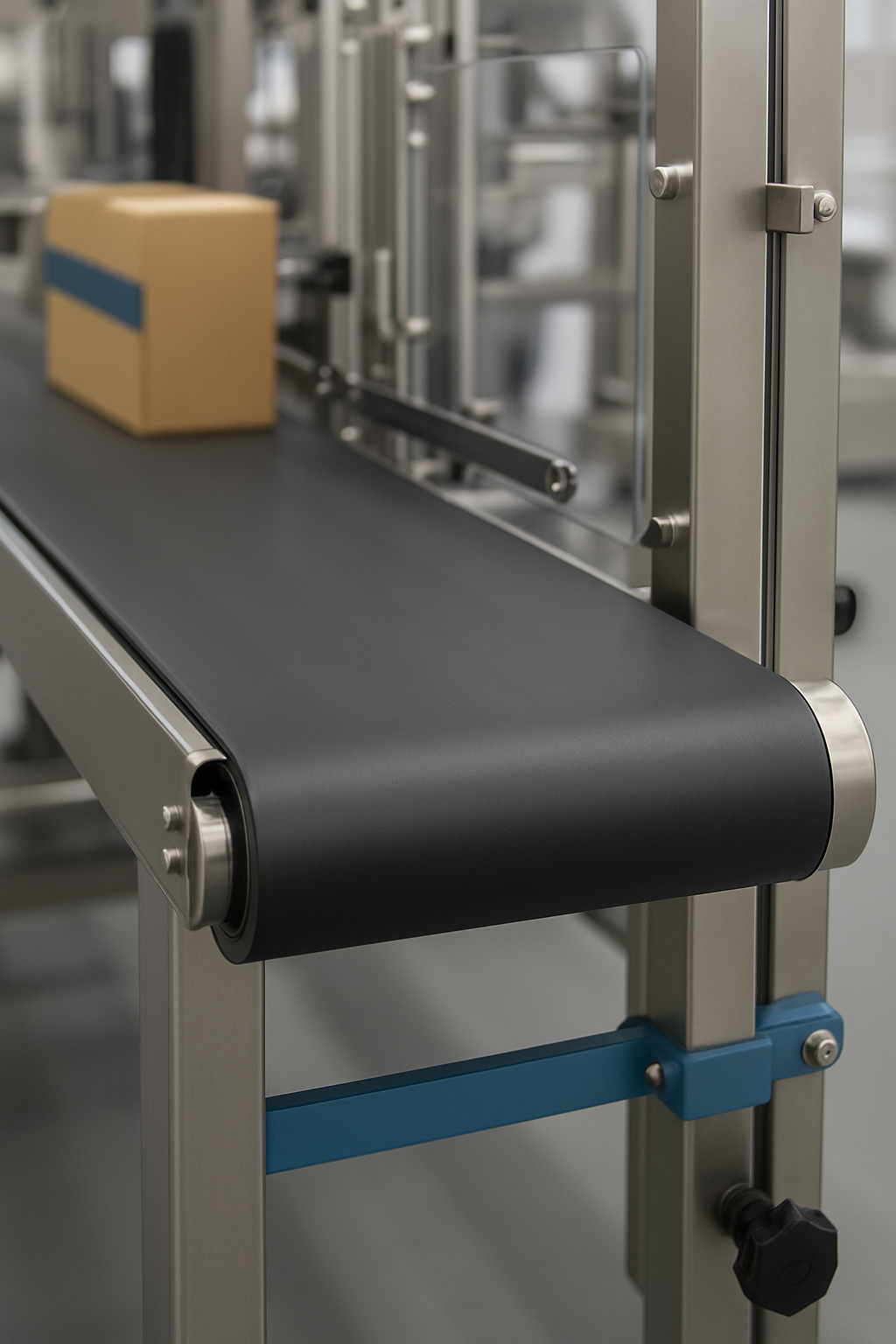
An endless conveyor belt is a belt manufactured without any mechanical or vulcanized splice, meaning the belt is produced or joined into a continuous loop. This jointless structure offers superior tracking, reduced vibration, and a smoother surface compared to traditional belts with cold joints or mechanical fasteners.
These belts are typically fabricated through endless weaving, mold-cured loops, or hot vulcanization, depending on the material and application.
Key Features and Benefits
Zero Splice, Zero Weak Point
No risk of joint failure, delamination, or breakage—ideal for 24/7 operations where downtime is costly.
Smooth Surface for Precision Handling
No bump or thickness inconsistency at the splice—essential for sensors, labeling, inspection, or printing.
No Noise, No Vibration
Seamless belts run quietly and without tension imbalance, improving bearing life and machine stability.
Improved Tracking and Alignment
Splice-free construction ensures better belt tracking, reduces off-tracking risk, and simplifies tension calibration.
More Hygienic in Clean Environments
No splice edges means fewer places for debris, bacteria, or liquid to accumulate—especially important in food, pharma, and electronics.
Typical Applications of Endless Conveyor Belts
Endless belts are chosen in industries requiring precision, cleanliness, or continuous operation without interruption:
Packaging and Labeling
-
For automated carton sealing, bottle labeling, pouch packing
-
Seamless movement improves print alignment and packaging accuracy
Printing and Inspection
-
Used in high-speed printing lines, camera vision systems, and optical sorters
-
Splice-free belt avoids signal interference and print skewing
Pharmaceutical & Cleanroom Systems
-
In tablet counting, filling, or blister packaging systems
-
Endless belts reduce particulate generation and avoid dead zones
Electronics Assembly
-
Conveyorized SMT (surface mount technology) lines and circuit board handling
-
Requires antistatic, clean-running, zero-bounce belt movement
Precision Parts Transfer
-
Bearings, gears, machine parts, small components
-
Endless belts support low-impact, synchronized conveying
Endless Belt vs. Spliced Belt: Quick Comparison
| Feature | Endless Belt | Spliced Belt |
|---|---|---|
| Splice Strength | Uniform—no splice | Weakened at splice |
| Tracking | More stable | May drift if splice misaligned |
| Surface Smoothness | Seamless | Slight bump or unevenness |
| Hygiene Level | Very high | Lower (prone to buildup) |
| Vibration | Low | Higher at splice area |
| Durability (under tension) | High | Depends on splice quality |
Where an Endless Conveyor Belt Makes Sense — and What Still Needs Checking
Endless construction pays off when the joint itself is the weak point, or when product contact has to stay perfectly smooth. The five cases below are the ones where buyers most often move from a jointed belt to an endless loop, together with the points that still have to be confirmed before the belt goes into production.
| Application Area | Why Endless Construction Helps | What Still Needs Checking |
|---|---|---|
| Packaging and carton transfer | No metal fastener to mark cartons, pouches, or wrapped goods | Product contact surface, pulley diameter, and splice thickness |
| Compact machinery and short pulley centres | Smooth running over small transfer points and tight pulley centres | Whether the machine frame can be opened for a closed-loop belt |
| Agricultural handling and light bulk transfer | Fewer catch points when moving grain, feed, or light crop material | Residue build-up, moisture, and return-side cleaning access |
| Inclined conveying with chevron or cleats | A continuous loop avoids fastener interference on the return path | Pattern height, minimum pulley diameter, and return clearance |
| Light aggregate or sand transfer | A factory-made loop reduces joint lifting under moderate impact | Cover grade, loading-point impact, and joint method |
Two checks decide more endless belt projects than any other: pulley diameter and installation access. A thick belt forced around a small pulley does not become flexible simply because the loop is endless, and a closed frame that cannot be opened turns a technically correct belt into an installation problem — endless belts cannot be shortened or repaired on site. Where the joint is being reconsidered rather than removed, our conveyor belt jointing methods guide compares mechanical fastening, cold bonding, and hot vulcanizing by belt type, tension, and downtime.
Four Problems an Endless Belt Solves — and What It Cannot Fix
Most endless belt enquiries start from one specific failure: a joint that lifts, a fastener that marks the product, a cleaner that chatters, or tension that never stays set. The four cases below cover the majority of them, and the final part of this section explains what endless construction cannot correct on its own.
1. Joint lifting on small pulleys
When a belt passes over a small pulley many times per hour, the joint area bends more sharply than the rest of the belt. If the splice is stiff or poorly prepared, one edge starts to lift, and the belt then clicks, vibrates, or tears at the joint. An endless conveyor belt removes that local stiffness because there is no fastener and no joint edge in the running path. The pulley diameter still has to match the belt construction, however: a thick belt forced around a small pulley will not become flexible just because the loop has no splice.
2. Product catching on fasteners
Small bags, cartons, soft packages, and loose light goods can catch on a raised mechanical fastener. That is not a cosmetic issue: it disturbs spacing, confuses photocells and vision systems, and creates jams at transfer points. Removing the fastener from the carrying surface is the main reason endless belts dominate lines where product contact matters. If you are diagnosing an existing joint problem rather than specifying a new belt, our breakdown of the eight causes of conveyor belt splice failure follows the same inspection order we use on site.
3. Cleaner and scraper interference
On bulk handling conveyors the cleaner or scraper strikes the joint area on every revolution. If the fastener sits too high it chatters against the blade, so cleaner wear, cover damage, and joint fatigue all appear together. An endless rubber belt helps here, but only when cover grade, scraper pressure, and material carryback are controlled at the same time.
4. Repeated tension adjustment
A weak or uneven joint makes operators keep re-adjusting the take-up. Too loose and the belt slips; too tight and bearings, pulleys, and the splice take extra stress. A continuous loop makes tension behaviour far more stable, but it will not correct a bent frame, a dirty pulley face, or a take-up setting that was wrong to begin with.
What endless construction cannot fix
An endless belt removes one failure point — it does not correct a bad conveyor layout. If material is dropped from too high, if the return path is packed with residue, if the belt is too wide for the frame, or if the pulley is badly worn, the same failure will return. Endless construction also does not make a belt stronger: strength still comes from the carcass, the plies, the cover grade, and the belt thickness. A thick belt on a small pulley can crack early, and a light-duty endless belt under sharp stone will fail quickly no matter how good the loop is. Treat “endless” as one design choice inside the specification, not as the specification itself.
When a Chevron or Patterned Endless Belt Is the Right Choice
Some buyers order an endless rubber belt and a chevron profile in the same enquiry. That combination makes sense when material moves uphill and there is no room for rollback, because profile height, spacing, and rubber grade decide how the belt bends, cleans, and releases material. Chevron is not decoration, and it is not free: a raised pattern needs more pulley clearance and gives residue somewhere to sit. Match the surface to the material behaviour, not only to the incline angle.
| Material or Condition | Recommended Belt Direction | Buyer Note |
|---|---|---|
| Cartons or packed goods | Smooth or lightly textured endless belt | Avoid over-gripping if discharge needs clean release |
| Grain, feed, or light fertiliser | Chevron rubber endless belt for inclined runs | Check residue build-up and return-path cleaning |
| Sand or light aggregate | Endless rubber belt with abrasion-resistant cover | Loading-point impact may matter more than the splice |
| Sticky or wet material | Surface must balance grip and release | Chevron can collect residue if cleaning access is weak |
| Small pulleys or compact frame | Flexible endless belt construction | Confirm the minimum pulley diameter before production |
Where an inclined belt also has to be joined, the choice between a chevron endless loop and a field-made joint usually comes down to installation access and to the equipment available on site. If a hot-vulcanized joint has to be produced in the field, belt surface, press condition, and working conditions all affect the result — our vulcanizing machine guide covers the equipment side of that decision.
Failure Causes, Common Mistakes, and the RFQ Checklist
Most early endless belt failures trace back to a handful of causes that were already visible on the old belt before the replacement was ordered. The tables below map the symptoms we see most often to their likely cause and to the check that resolves them, then list the information that shortens a quotation.
Problem, cause, impact, and practical correction
| Problem Seen on Site | Likely Cause | Impact | Practical Check |
|---|---|---|---|
| Joint area opens first | Wrong splice method, repeated bending, poor preparation | Belt stops long before the cover is worn out | Consider endless construction and check pulley size |
| Belt tracks to one side | Frame misalignment, uneven loading, roller build-up | Edge wear and early carcass damage | Inspect return rollers, loading point, and belt path |
| Surface cracks near the pulley | Belt too thick or pulley too small | Cover fatigue and possible carcass exposure | Confirm the minimum pulley requirement before ordering |
| Material catches on the joint | Raised fastener or lifted splice edge | Spillage, product damage, unstable running | Use a smoother joint or an endless design where suitable |
| Fast cover wear | Wrong cover grade or impact at the loading point | Short service life even with a sound carcass | Review material abrasiveness and chute design |
Four mistakes that shorten endless belt life
- Treating endless as a stronger version of every belt. It solves joint-related problems; it does not replace correct cover grade, belt strength, pulley fit, or tracking control.
- Ordering the loop before checking installation access. If the conveyor frame cannot be opened, a belt that is correct on paper can still be impossible to install.
- Adding surface features without checking bending. Chevron, cleated, or thick endless belts need more pulley clearance than a plain flat belt, so a design that works on one conveyor can fail on another.
- Ignoring the previous failure mark. If the old joint opened because the pulley was too small, repeating the same construction in endless form only delays the problem.
What to send with your endless belt enquiry
| Information to Send | Why It Matters |
|---|---|
| Belt width, endless length, and thickness | Basic production size and loop dimension |
| Open-frame or closed-frame installation | Decides whether a closed loop can be installed easily |
| Pulley diameter and conveyor layout photos | Checks bending stress, clearance, and minimum pulley limits |
| Material handled, incline angle, and belt speed | Drives cover grade, surface pattern, and the need for chevron or cleats |
| Old belt failure photos and failure marks | Shows whether the real issue was the joint, cover, tracking, or residue |
| Surface and cleaning requirement | Clarifies whether smooth running, grip, release, or containment matters most |
| Quantity, packing, and labelling needs | Supports OEM supply, repeat orders, and export packaging |
A clear enquiry removes most of the back-and-forth in an endless belt project: loop length, pulley layout, surface pattern, joint method, and working conditions can all be checked before production instead of after installation. Send photographs of the old belt even when it looks unusable — the failure mark usually explains the real selection issue, and it is the fastest way to avoid ordering a second identical problem.
Materials Available for Endless Belts
Endless belts are available in different base materials depending on usage:
| Material | Application |
|---|---|
| PU / TPU | Food, pharma, electronics, cleanroom |
| PVC | Packaging, logistics, textile |
| Rubber (natural, neoprene, EPDM) | Heavy-duty or outdoor systems |
| Fabric (cotton, polyester) | Friction drive systems, dry use |
| Nylon Core / Timing Core | High-speed synchronized motion systems |
Most endless belts can be custom ordered in looped fabric or molded cured rubber, with antistatic, oil-resistant, or FDA-grade options available.
How to Select the Right Endless Conveyor Belt
Selecting the right endless belt depends on application precision, environmental cleanliness, and motion control needs. Focus on these five key factors:
-
Length & Loop Accuracy: For synchronous systems, ensure belt length tolerance within ±0.5–1 mm. Even slight deviations can cause drift or timing errors.
-
Material & Surface: Choose PU or TPU for cleanroom and pharma lines, PVC for dry packaging, and rubber for friction-heavy or outdoor use. Match surface finish (smooth, matte, fabric-back) to friction and release needs.
-
Width & Edge Control: The belt width should be 1–3 mm narrower than the pulley face to allow clean tracking without edge wear.
-
Antistatic Requirements: Electronics and printing systems need conductive or static-dissipative belts to avoid damage or misprints.
-
Cleanability: For food or pharma, select closed-surface, non-porous belts that resist water and cleaning agents.
Tip: Endless belts cannot be trimmed or repaired—confirm specs carefully before ordering.
Why Choose Sinoconve’s Endless Belts?
At Sinoconve, we manufacture precision endless conveyor belts with:
-
Seamless PU, PVC, and rubber compounds
-
Looping accuracy up to ±1 mm for synchronous applications
-
Antistatic and FDA-certified options
-
Embossed, smooth, or custom textures
-
OEM/ODM support for industrial equipment manufacturers
-
Fast global delivery and design assistance
Our belts run in labeling machines, medical systems, electronics lines, and packaging equipment across 100+ countries.
Choose Seamless Precision—Choose Endless Belts
If your application demands clean, quiet, and uninterrupted conveying, an endless conveyor belt is the smart choice. No splices, no weak points—just performance that runs smooth and lasts longer.
If you are looking for this type of conveyor belt or want to learn more, please visit our home page or contact us directly. We will get back to you within 24 hours.