
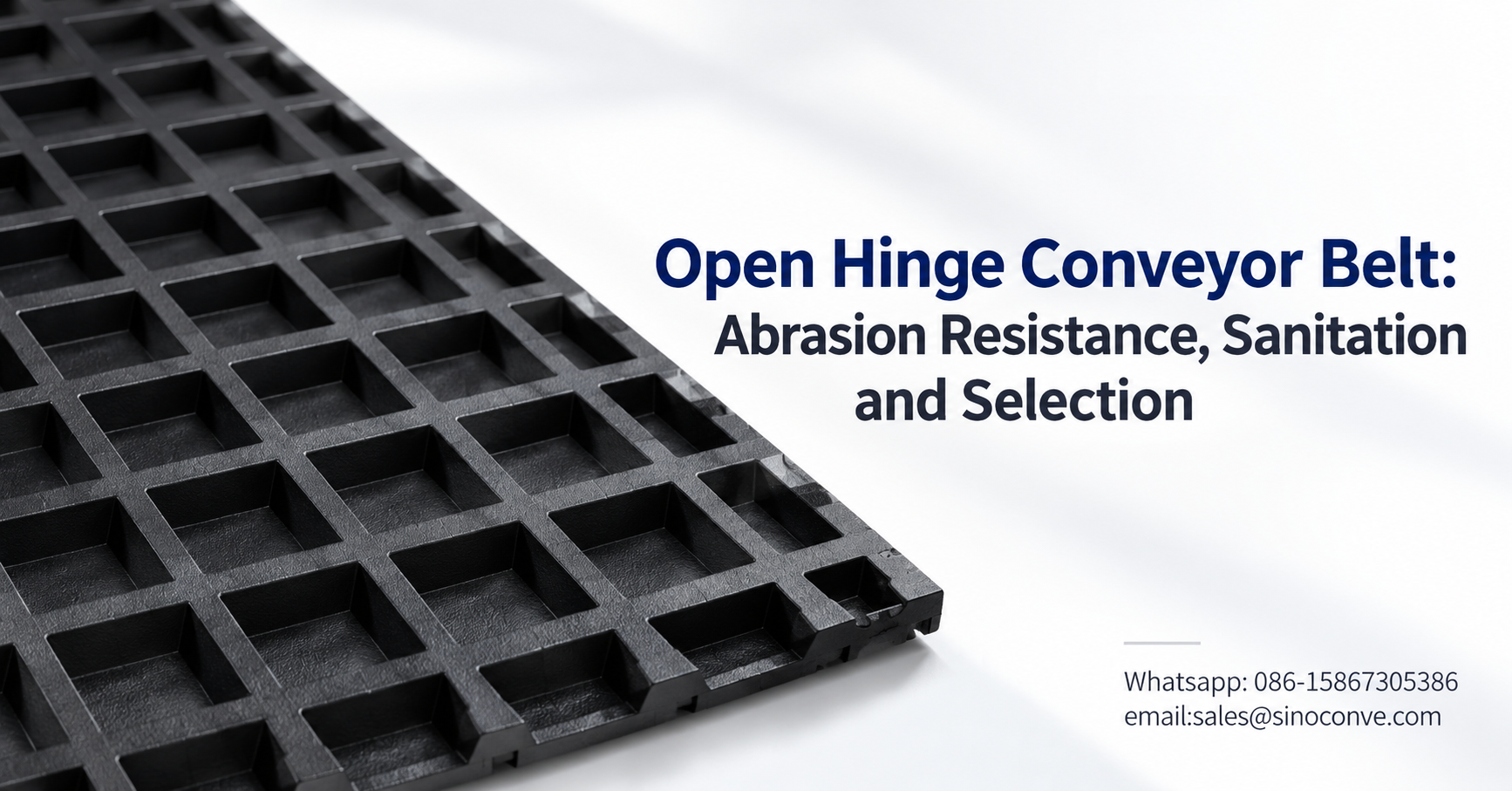
An open hinge conveyor belt is a modular belt whose crosswise hinge joints are deliberately left open, with through-holes and a slotted pin bore in place of the sealed joint line used on a straight-running belt. That single geometric decision changes three things at the same time: how abrasive fines leave the belt, how wash water passes through it, and how the hinge pin carries load and how fast it wears. The sections below stay on that structure layer, because almost everything else written about modular belting assumes the joint is a solid one.

01What "Open Hinge" Means and Where the Geometry Differs
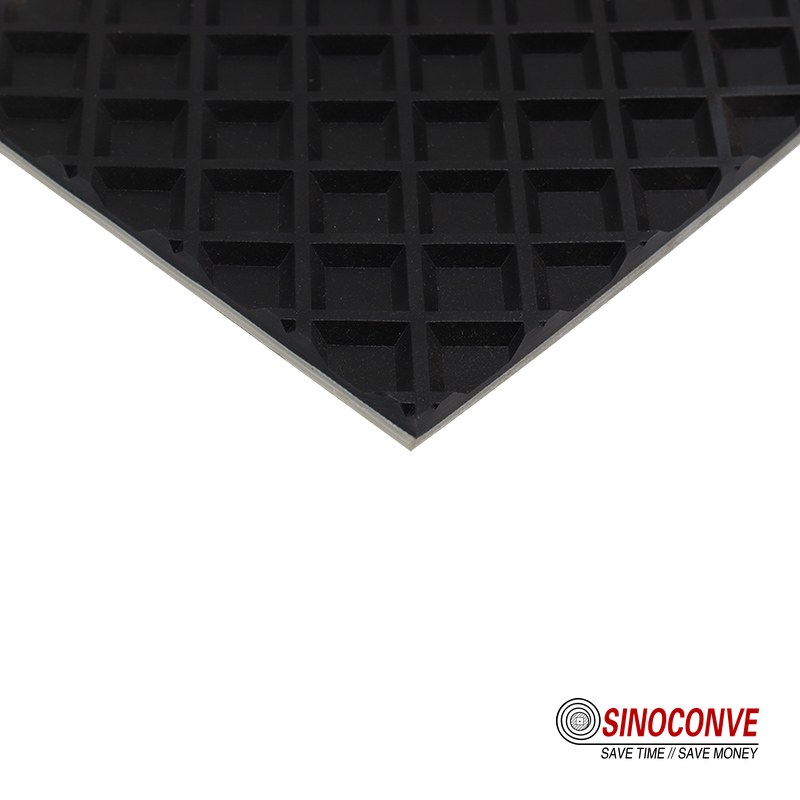
A modular belt is an assembly of interlocking plastic modules, threaded onto pins to form an endless surface. On a closed, straight-running design, neighboring modules butt together along the crosswise joint, and the pin sits inside a bore that is almost fully enclosed. The gap between modules stays small and even, so the running surface reads as one continuous sheet. An open hinge keeps the same interlocking principle but leaves the joint porous on purpose. The bore is slotted, the material between pin stations is cut away instead of molded solid, and the belt reads as perforated along every crosswise seam.
That is the whole structural difference. Everything else follows from it.
Straight-Running Modules and Open Hinge Modules Compared
Side by side, the two modules differ in three visible ways. A straight-running module closes the joint with a flat land that carries product across the seam, which gives the smoothest top surface but tends to trap anything that reaches the bore. An open hinge module replaces that land with a row of through-holes, so the seam is no longer a solid bridge. On the straight-runner the pin is shielded from the product stream; on the open hinge the pin line is exposed to whatever passes through the joint. That exposure is exactly what the design trades against, and it is why the choice is never made on looks alone.
Which one fits depends on two questions. Is the product abrasive and fine enough to reach the joint line? Does the line get washed? When both answers are yes, the open hinge usually wins, and the reason has surprisingly little to do with the belt's top surface.
Which Part of the Joint Is Actually Open
It pays to name the openings, because "open" is never a single feature. There are through-holes spread across the joint face, sized to pass fines and water. There is a slot or open channel in the bore, which turns the pin housing into a cradle rather than a tube. Then comes the running clearance between adjacent modules, set by pin diameter and bore tolerance, and finally the gap where the joint meets the edge module. Each opening does a different job, and each one also creates a place where residue can sit.
As a conveyor belt manufacturer, we ask buyers to describe all four openings before we quote a modular belt, since changing one changes the others. Widening the through-hole to shed grit, for example, also removes bearing area from the pin and softens the module under load. A 0.5 mm change in bore clearance can move the pin's load-bearing face enough to change wear life by months in a hard, dry product. None of these numbers can be read off a photograph; they have to come from the drawing and from the duty you actually run.
02How One Geometry Change Alters Fines, Water and Pin Load
A single change in joint geometry shows up as three separate effects, and the trick to specifying an open hinge is to keep all three in view at once. They are the path that fines take when they reach the joint, the path that wash water takes when it is sprayed at the belt, and the path that load takes from the module down through the pin. Optimize one of the three and you move the other two. The rest of this article follows each path in turn.
The Fines Path Through the Joint
Picture a 2 mm quartz grit sitting on the carrying surface. On a closed hinge it migrates into the running clearance at the seam and stays there. The next module sweeps over it, the pin presses it against the bore wall, and the grit is now a lapping compound working on both parts at every pass. An open hinge gives that same grit an exit route. Through-holes and the bore slot let it drop through under gravity and belt flex instead of being trapped in the contact zone. Removing abrasive fines from the bearing area, rather than merely surviving them, is the whole abrasion argument in one line.
The Water Path Through the Joint
Water behaves the same way, only faster. A closed joint lets rinse water pool against the seam, where it dissolves residues and holds them against the pin. An open joint passes water straight through the belt, top to bottom, carrying fines out with it. That through-flow is why open hinge belts appear on lines that must drain, rinse and drain again in a short window. The caveat arrives later: the same openings that let water through also give biofilm a place to anchor, so drainage and cleaning are not the same claim. A conveyor belt supplier who knows your product can usually tell you in one call whether the fines are fine enough to reach the joint at all.
The load path is the third leg, and it deserves its own section because pin wear is where open hinge belts are most often misjudged. We cover it in section 04.
03Abrasion: Why Open Gaps Shed Fines Instead of Grinding Them
Abrasion on a modular belt is rarely caused by the product sliding over the top surface. It is caused by abrasive fines that reach the joint line and then get worked against the pin and the bore. On a solid joint, those fines have nowhere to go, so each revolution recycles them through the same contact. The open geometry interrupts that recycling, and understanding how it does so is the difference between buying the right belt and buying a belt that wears its joints out in a season.
The Grinding Effect in a Packed Hinge
We call the failure mode lapping, and it is unforgiving. A few grams of fine, hard grit sit in the running clearance and are pressed by the pin against the bore with every cycle. Because the grit is harder than the polymer, it cuts a groove rather than wearing evenly. Over a million cycles the bore ovalizes, the clearance grows, and the module starts to rock on the pin. What began as a dust nuisance becomes a joint that no longer holds pitch, and the surface pattern begins to misalign. Dried fines are worse than wet ones here, since a dry film stays put instead of draining away.
Materials resist this differently. Link the choice to your duty. Polypropylene is the cheapest and the least abrasion-resistant in a gritty joint; POM is markedly tougher and holds bore geometry far longer under grit. The DIN 53516 abrasion figure a supplier quotes for a resin, typically 90 to 250 mm³ of volume loss depending on grade, tells you how the surface resists wear but not how the joint behaves, so treat it as one input and not the answer.
Letting Abrasive Fines Fall Out
An open hinge does not make the module harder; it makes the joint self-clearing. Through-holes let grit drop out of the joint plane as the belt flexes over the sprocket and back up again. The pin line is exposed rather than sealed, so material that would otherwise be trapped is free to leave on the return side. On an industrial conveyor belt handling crushed aggregate, that shedding is what keeps the joints from turning into a grinding mill. It is also why an open hinge is a poor fit for very fine, dry dust that would pass straight through and simply return as airborne carryback.
Field note from our engineers: On a foundry sand line we tracked two identical drives, one closed hinge and one open hinge, over eleven weeks. The closed-hinge belt showed visible bore ovality on the fourth crosswise row by week seven and needed two rows replaced. The open-hinge belt on the twin drive, same throughput, same 1.1 m/s, kept its pitch and showed only polish at the pin seats. The difference was not the resin — both were POM. It was that the sand could drop out of one joint and had to grind in the other.
| How the joint behaves under abrasive duty | What a closed or straight-running hinge does at the seam | What the open hinge geometry does in the same situation | What it means on an abrasive production line |
|---|---|---|---|
| Abrasive fines that reach the load-bearing joint | Trapped inside the running clearance and recycled against the bore every cycle | Dropped out through the through-holes and the slotted bore | Open geometry trades a higher opening area for slower bore wear |
| Water and wash liquor arriving at the seam | Pools against the seam and holds dissolved residues firmly in place | Passes straight through the belt from the top face down | Drainage is fast, but the same gaps become biofilm anchors later |
| Exposure of the hinge pin to the product | Pin stays shielded behind a solid land and rarely sees the product stream | Pin line is openly exposed to whatever passes through the joint face | Pin material choice matters far more on an open hinge than on a closed one |
| Load-bearing area still available at each bore | The full bore wall shares the pull across a wide contact patch | The slotted bore removes area, so contact pressure rises for the same pull | Watch the tension rating on heavy pulls, since open bores soften the joint |
| Where this joint normally belongs on a line | Dry, fine, non-draining duties where a smooth top surface is the priority | Washed, gritty jobs that must shed material and drain quickly between shifts | Match the joint to the duty, then confirm against the maker's rating |
04Hinge Pin Wear Life: What Actually Controls It
Pin wear is the number that decides whether an open hinge belt earns its keep, and it is set by four things working together rather than one. The pin material and its surface, the contact area available at the bore, the load the joint has to carry, and the line speed that multiplies every cycle into a wear rate. Change any one and the expected service life moves, so the honest answer to "how long will the pins last" is always a range tied to those four inputs.
Pin Material and Surface Finish
Stainless steel is the default pin on abrasive, washed lines, for two reasons that have little to do with looks. It resists corrosion from the rinse water, so it does not pit and then chew the bore, and it holds a hard, smooth surface that the polymer can slide on without galling. The grade matters: a 304 pin handles most food and aggregate rinse chemistry, while a 316 pin is the safer call where chlorides or aggressive cleaning agents are present. On lighter, non-corrosive duties some builders use polymer or composite pins, which are quieter and gentler on the bore but wear faster under grit. Through-hardened or coated stainless pins cost more and can extend life where the product is unusually hard.
Surface finish is the part buyers forget. A pin with a rough, as-drawn finish abrades the bore like a file, whereas a polished pin lets the two surfaces slide with far less friction and heat. On a rubber conveyor belt line we rarely see this, because the belt is endless and jointless, but on modular belting the pin is a wearing component and should be specified like one.
Contact Area, Load and Line Speed
Two pins of the same material will not last the same time if the bores differ. A slotted bore shares the pull across less area, so bearing pressure rises and wear accelerates roughly with that pressure. Heavier pulls, wider belts and longer runs all add to the load each pin sees. Line speed then multiplies the count: at 0.6 m/s a pin passes a given point about 1,400 times an hour on a one-meter pitch, but at 1.2 m/s the same pin sees roughly 2,800 cycles, and wear tracks the cycle count more than the clock. This is why we size the pin and bore against the actual belt pull and speed, not against belt width alone.
| Wear control that changes pin life | How it drives the rate of pin wear | What we check in the field during inspection |
|---|---|---|
| Pin material and its surface grade | Hardness, corrosion resistance and surface finish set how fast the bore polishes or pits | Confirm the grade matches the rinse chemistry before a hard-to-reach run |
| Bore contact area left by the slot | A slotted bore raises bearing pressure and speeds up wear for the same belt pull | Measure bore ovality across several rows at each inspection window |
| Belt pull and the load on each pin | Higher tension and wider belts push more of the drive load into every joint | Compare measured chain tension against the maker's rating for the module |
| Line speed and the number of joint cycles | Wear tracks the number of joint cycles per hour more closely than operating hours | Log speed and hours so cycle count can be compared between similar drives |
| Abrasive ingress into the running clearance | Grit that stays in the clearance works as a lapping compound under the pin | Look for fine dust bridging the through-holes on dry, non-washed duties |
05Sanitation: Open Drains and Rinses Better, But Open Is Not Clean
Walk into a plant that has switched its washed line to open hinge and the first thing you hear is praise for drainage.Water no longer sits on the belt; the rinse runs through and the product zone dries faster between shifts. That is real, and it is why open hinges are common in food, beverage and wet bulk handling. It is also only half the story, because the same openness that lets water through lets bacteria in, and an open joint that is never cleaned is a worse place to grow a biofilm than a smooth one.
Why Open Design Drains and Rinses Better
Drainage is pure geometry. Closed joints hold a film of liquid by capillary action at the seam, and that film keeps residues wet, which is precisely the condition that lets microbes multiply. An open joint breaks the capillary path, so the liquid leaves instead of lingering. Rinsing is easier for the same reason: sprayed water passes through the belt and flushes the joint from both faces at once rather than skimming over the top. Where a line runs a short wash window between batches, that faster drain and rinse can be the deciding factor in belt selection.
Open Gaps as Biofilm and Residue Hideouts
Now the caution. Every opening is also a cavity, and a cavity that collects product and stays damp is where biofilm starts. The pin bores, the module-to-module seams and the edge-chain pockets all trap residues that a spray over the top will not dislodge. On an open hinge, the pin line sits directly in the product path, so fines and food soil press into the bore on every pass. Open does not mean self-cleaning, and a plant that treats it that way will find residue rebuilding inside the joints within one production week.
Where Cleaning Validation Has to Reach
Validation has to cover the places water alone will not reach. That means the pin bore, the module seams on both faces, the hinge pockets at the edges, and the underside return where material can settle. A practical routine adds a joint-level check to the standard swab or ATP pass, especially after an allergen changeover, because the bore is the last place residue leaves. On a conveyor belt cleaning methods, schedules, and when scrapers will not work basis, an open hinge usually wants intermittent disassembly at the joint, not only a heavier spray — a nuance that belongs in the cleaning plan from day one rather than after a failed audit.
Field note from our engineers: A ready-meal line we audited had been running open hinge for two years and passed every visual check. Swabs from the belt surface were clean. Swabs from the pin bores on the third and fourth rows, taken after a normal CIP cycle, came back positive for organic soil in nine of twelve samples. Nothing was wrong with the belt or the CIP recipe; the plan simply never defined the bore as a food-contact-adjacent zone. Two extra minutes of joint flushing per cycle fixed it. As a transmission belt manufacturer, we see the same lesson on pump and agitator drives in the same rooms: the wet zone is unforgiving about any surface the cleaning routine ignores.
06Materials: PP, POM, PE and Stainless Pins in Plain Terms
Materials decide how an open hinge behaves under grit, heat and cleaning chemicals, and the choice is rarely one resin for the whole belt. Modules and pins are selected separately, and the pairing matters as much as either part alone. Get the pairing wrong and the belt either wears early, cracks under load, or fails a sanitation spec it was bought to meet.
Module Resin Trade-Offs
Polypropylene is the economical choice, chemically broad and light, and it works well on mild duties without hard grit. POM, often called acetal, is stiffer and markedly more abrasion-resistant, which is why it dominates gritty, loaded open hinge joints. Polyethylene sits between the two on toughness and carries a low-friction surface that releases sticky product, but it softens earlier than POM and is usually reserved for cooler lines. Temperature limits matter here: PP is typically quoted to about 100 °C, POM to roughly 90 °C, and PE lower still, so a hot product will rule a resin out before abrasion ever does.
Pin Material Trade-Offs
Stainless steel is the workhorse pin on washed, abrasive lines. Grade 304 suits most rinse water and food duty, while grade 316 earns its price where chlorides or aggressive detergents are in play. Composite and polymer pins cost less and run quieter, and they protect the bore on light, dry duties, but under hard grit they wear faster than steel. The pairing is the point: a hard steel pin in a soft PP bore can wear the bore faster than the pin, because the abrasive sits on the harder surface and cuts the softer one. That is the kind of mismatch a wholesale conveyor belts buyer only discovers after a season of unexplained joint play.
| Part and the material it is made from | Strong points of this material on an open hinge | Limits worth weighing up before you specify it | Where this material usually fits best |
|---|---|---|---|
| Polypropylene module for light abrasive duty | Light, affordable, and broadly resistant to mild wash chemistry | Softer bore that wear and grit can cut faster than most buyers expect | Mild, lightly abrasive duties that do not carry heavy point loads |
| Acetal (POM) module for gritty loaded joints | Stiff, dimensionally stable, and the best all-round abrasion resistance of the three | Higher cost and a lower temperature ceiling than many buyers assume | Gritty, loaded joints especially on the drive side of the belt |
| Polyethylene module for cooler sticky product | Tough and low-friction, so sticky product releases and impact is absorbed | Softer and with a lower melting range than POM, so hot lines are out | Cooler lines handling moist, tacky or lightly abrasive material |
| Grade 304 stainless steel hinge pin for general duty | Hard, smooth and corrosion-resistant in most rinse and food environments | Can pit where strong chlorides are used, then abrade the surrounding bore | General washed and food-grade open hinge duty on most lines |
| Grade 316 stainless steel hinge pin for chloride duty | Extra corrosion resistance where chloride or aggressive cleaning agents are present | Higher cost that is only justified by the chemistry it faces every day | Salty, acidic or heavily cleaned production lines and washdown zones |
| Composite polymer pin for light duty | Light, quiet and gentle on the bore, with no corrosion concern at all | Wears quickly under hard grit and carries a much lower absolute load | Light, dry, low-abrasion duties where quiet running matters most |
07Open Area and Weight: Carrying Capacity, Cleaning and Drive Load
Open area is a currency, and you spend carrying strength to buy drainage. A module with more through-hole area cleans and drains better but has less material to carry the product and to resist the pin load, so the two move in opposite directions. Weight follows the same logic, and weight is what the drive has to pull and the chain has to survive.
How Open Area Trades Against Load Bearing
A practical open hinge sits somewhere in a middle band of open area, high enough to shed water and fines, low enough to hold the load and the pin seats. Push the opening too far and the module flexes between pins, which lets product bridge and droop into the gap. On a heavy pull, the exposed bore also takes more of the load per unit area, and that is where a rated, heavier module earns its place. We size the opening, the module thickness and the pin together against the belt pull, then confirm the choice against the maker's load rating rather than a rule of thumb. If you also need edge containment, a conveyor belt distributor can usually supply matched side modules so the open center and the closed edge are specced as one assembly.
08Edge Chain, Sprocket and Take-Up: Matching the Supporting Hardware
An open hinge belt is never just a belt. It is a system in which the open center modules run between edge chains that the sprockets actually drive, and the take-up keeps the whole loop at the right tension. Buy the belt without thought for the hardware and you inherit a tracking problem that no module change will fix.
Edge Chain and Sprocket Engagement
The edge chain carries the pull and sets the path, so its pitch, pin diameter and side-flex determine what the drive can accept. Sprockets must match the chain pitch exactly; a half-tooth mismatch is enough to make the belt run off-center and load one edge chain harder than the other. Take-up travel has to cover the stretch the chain will take over its service life, plus the slack needed for a joint repair. As a conveyor belt factory that also builds chains and sprockets, we treat these three as one purchase and one set of drawings, because splitting them across suppliers is where most tracking faults are born. A matched set also makes spare-part ordering faster when a chain finally needs replacing mid-campaign.
09Drive Effects: Tension, Sprocket Engagement and Speed Limits
The open joint changes the drive in ways that are easy to miss on a data sheet. Because fewer material bridges carry the load and the bore is slotted, chain tension has to be set with the module rating in hand, and the line speed ceiling is lower than a comparable closed surface would allow.
Tension, Speed and Tracking at the Edge
Higher speed raises the cycle count on every pin and the impact when the joint engages the sprocket, so open hinge belts are usually run slower than solid ones on the same duty. Tension has to be set high enough to keep the chain seated but not so high that the pin seats crush under load. Tracking is managed at the edge chain, not the open center, so any wander first shows as uneven edge-chain wear. Where a line pairs its conveyor drive with a separate V-belt drive on the same frame, the wet or dusty environment derates both, and a V-belt manufacturer will size the auxiliary drive for the same conditions the modular belt sees. When speed is the constraint, raising it is far more expensive than adjusting the belt width or the module pitch.
10When an Open Hinge Belt Is the Wrong Choice
Open geometry is not universally better, and we talk buyers out of it as often as we recommend it. The design assumes that the material can leave through the joint and that losing a little load area is acceptable. Break either assumption and a closed surface usually wins.
The Duties That Argue Against an Open Joint
Fine, dry, non-draining dust is the clearest case against an open hinge. Nothing passes through cleanly, grit settles in the slots, and the belt sheds material wherever gravity points. Strongly magnetic product is a second exception, because fines cling and bridge whether the joint is open or closed. When a line must seal product to the belt for hygiene or to prevent loss, an open surface gives away exactly the contact you need. Each of these is a reason to step back to a closed or covered hinge, not to fight the design.
| Duty condition that rules the open hinge out | Why an open hinge struggles under this condition | What to consider using in its place instead |
|---|---|---|
| Very fine dry dust that never drains | Fines settle into the slots instead of leaving, then shed onto the floor | A closed hinge paired with dust control or an enclosure upstream |
| Strongly magnetic or statically clinging material | Fines bridge across the openings and defeat the self-clearing geometry | A covered hinge with a smooth, easy-to-release product face |
| Hygiene duty that needs a sealed contact face | Through-holes give up the continuous contact that containment demands | A solid-top module with a fully specified cleaning routine |
| Very heavy belt pull at low running speed | The slotted bore lifts bearing pressure and shortens pin life under load | A thicker module or a closed joint rated for the measured belt pull |
| Sticky paste that packs hard on flexing | Cohesive material blocks the openings and holds water inside the joint | A low-friction release surface and a stronger wash cycle |
11The Selection Matrix for Abrasion and Hygiene Duty
No single factor decides open versus closed. The matrix below reads left to right: the factor, the condition that favours an open hinge, the condition that favours a closed one, and the reason the geometry decides it. Use it to narrow the choice, then settle the final call on measured duty data and the maker's specification rather than on a rule of thumb.
How to Read This Matrix
| Duty factor driving the joint choice | Leans toward an open hinge when the material and line look like this | Leans toward a closed hinge when the material and line look like this | Why the joint geometry decides it |
|---|---|---|---|
| Particle size and abrasiveness of the product | Coarse, granular, hard material that can fall clear of the joint line on its own | Very fine dry dust that settles into any opening instead of passing through | An opening only helps if the grain can actually leave through it |
| Moisture level and the cleaning method used | Wet product, spray or flood rinse, and a line that must drain between shifts | Dry product with no wash step, where drainage is not part of the routine | Through-flow needs an exit path and water that is meant to pass |
| Hygiene level required by the production area | Washdown lines where fast drain and visible rinse matter more than containment | High-care zones needing a continuous contact face and controlled residue paths | Open gaps drain better but add cavities that a cleaning plan must reach |
| Line speed and the running cycle count | Moderate speeds where the joint still engages the sprocket smoothly | High speeds that raise cycle count and impact load on every pin | Pin wear follows cycles per hour more than it follows operating time |
| Load carried and the belt pull involved | Lighter pulls where the lost bore area does not lift bearing pressure much | Heavy, sustained pulls that need the full bore wall to share the load | A slotted bore carries less area, so load per unit area rises |
| Product temperature against the resin limit | Cool to warm product that stays inside the resin's comfort range | Hot product that would sit near or beyond the resin's temperature ceiling | Softening reduces bore stiffness before abrasion even becomes the limit |
The matrix is a filter, not a verdict. Two identical-sounding lines can still land on different joints once the grain shape, the cleaning chemicals and the real belt pull are known, and the only reliable test is a review of the measured duty against the maker's specification.
12How This Article Splits Work With Our Quarry Abrasion Guide
We keep this piece narrow on purpose, because a neighboring article already covers the rubber-belt side of abrasion and we do not want to repeat it. Our abrasion-resistant conveyor belt guide for quarry and steep-angle conveying owns the cover-grade question: wear classes, the DIN 53516 volume-loss bands that are typically quoted at 90, 150 and 250 mm³, and how to pick a rubber cover for hard rock and inclines. If your belt is a fabric or steel-cord rubber belt and the question is which cover compound survives the rock, that is the page to read.
This article owns a different layer entirely. It is about the modular, open hinge structure, where the joint itself is a working part, and about how its geometry changes fines ejection, wash-through and pin wear. The two guides touch the same word, abrasion, but they answer different questions. Cover rubber resists sliding wear on a continuous surface; an open hinge manages wear by moving grit out of a bearing pair. A buyer sourcing a hinged belt on a washed, gritty line needs this page, and a buyer choosing cover thickness on a quarry conveyor needs the other one. Where a plant runs both — a rubber main line feeding a modular washer section — the two decisions are made separately and then reconciled at the transfer point.
For the hardware around the joint, the product catalog lists the matched modules, pins, chains and sprockets, and our conveyor rollers cover the support side of the same line.
13Procurement and Acceptance Checklist Before You Order
Most open hinge belts are bought in a hurry to replace a failed one, which is how a mismatched resin or an undersized pin ends up back on the line. The fields below are the ones we ask every buyer to pin down first. They map to the failure modes in this article, so a filled-in checklist is also a short diagnosis of the duty.
| Field to specify in the request sheet | Why it changes the belt and the quote | What to write down on the form |
|---|---|---|
| Module resin and the pin material grade | Sets abrasion life, temperature ceiling and corrosion resistance of the pair | Resin such as POM or PP, pin such as 304 or 316 stainless |
| Open area and the bore tolerance range | Decides drainage and fines release against load-bearing area | Opening size, pitch and the clearance range you will accept |
| Belt pull and the rated module load | Confirms the open bore can carry the load without crushing the pin seats | Belt width, pull, and the maker's rated load for the module |
| Line speed and the product temperature | Drive wear rate and rule out resins near their heat limit | Operating m/s and the product temperature range in °C |
| Cleaning routine and the chemical exposure | Drives pin grade choice and the cleaning plan for the joint | Detergents, rinse chemistry, and the joint-flush routine |
| Spare parts held and the lead time | A pin or module row that is not stocked turns a repair into a shutdown | Spare rows, pin sets, and the promised delivery window |
Two support items belong on the same RFQ even though they are not part of the belt. Dust control upstream keeps fine material out of the joints on dry lines, and our dust resistant conveyor belt supplier page covers enclosure choices; on washed lines, a defined spray pattern is what actually reaches the bores, which is the subject of our conveyor belt spray cleaning guide. For food and beverage lines, the wider hygiene context sits in our conveyor systems for food processing article. Roller and support selection for the return side is covered by the conveyor roller ultimate guide, and where a sealed support suits a dusty or wet run, our sealed conveyor roller manufacturer note explains how the bearing protection is built.

14FAQ
What is an open hinge conveyor belt?
It is a modular belt whose crosswise hinge joint is left open, with through-holes and a slotted pin bore so material and water can pass through the joint instead of being trapped inside it.
How does an open hinge design improve cleaning?
Water passes straight through the belt rather than pooling at the seam, so residues leave with the rinse and the surface dries faster between shifts. The gain is real, but it only holds if the cleaning plan also reaches the pin bores and module seams.
Does an open hinge belt wear faster?
Not automatically. Grit that would grind inside a closed joint has a path out of an open one, so bore wear often drops. The trade is a smaller load-bearing area at the bore, so pin material, load and speed have to be sized properly or the advantage disappears under a heavy pull.
Open hinge vs closed hinge: which one should I choose?
Choose open when the material is coarse, the line is washed and drainage matters. Choose closed when the duty is fine dry dust, a sealed contact face is required, or the pull is heavy enough that the lost bore area hurts.
What materials are open hinge modular belts made from?
Modules are usually molded from PP, POM or PE, and pins are most often stainless steel in grades such as 304 or 316. Composite pins appear on light, dry duties. The resin sets the temperature and chemical limits, while the pin grade sets how the joint survives corrosion and grit, so the two are chosen as a pair rather than one at a time.
What are the temperature limits?
As a rough guide, PE is the most heat-sensitive, PP is typically quoted to about 100 °C, and POM sits below that. Confirm the exact ceiling for the resin you order, because running near the limit softens the bore before abrasion becomes the controlling factor.
How do I inspect hinge pin wear?
Park the belt and check a few rows across the width. Look for bore ovality, a polished or grooved pin seat, and any play that lets the module rock on the pin. Measure the bore on the drive-side rows first, since they carry the most load. Compare the reading against the wear limit your supplier gives you, and log it so the trend tells you when to plan a replacement rather than reacting to a failure. The same rows will reveal whether grit is bridging the through-holes.
Can an open hinge belt handle abrasive, wet material?
That is close to its design case. Coarse abrasive material that can fall clear, combined with a washed line that needs drainage, is exactly where the open joint earns its keep, provided the pin and bore are sized for the belt pull.
Is an open hinge belt harder to clean than I think?
Usually yes, in the sense that the openings are cavities, not self-cleaning features. Good drainage is not the same as a clean joint, so budget time to flush and periodically check the bores, or the joints will become the dirtiest part of an otherwise spotless line.
15Related Products You May Need
- Product Catalog — modular belts, pins, and matched drive hardware in one place.
- Conveyor Rollers — return-side and impact rollers for abrasive bulk lines.
- Rubber Conveyor Belt — cover grades for abrasive and damp material duty.
- PVC Conveyor Belt — light, washable belting for hygiene-conscious lines.
- Chevron Conveyor Belt — patterned covers where wet material slips on the incline.
16Related Blog Posts
- Abrasion Resistant Conveyor Belt Guide for Quarry and Steep-Angle Conveying
- Conveyor Belt Cleaning Methods, Schedules, and When Scrapers Will Not Work
- Conveyor Belt Spray Cleaning
- Conveyor Roller Ultimate Guide 2026: Types, Materials and Load Ratings
- Dust Resistant Conveyor Belt Supplier
- Conveyor Systems for Food Processing