
A V belt size is not one number. It is a code in two parts. The section symbol fixes the cross-section, while the length figure fixes the run around the pulleys. Read both correctly and a buyer can price a replacement, compare a rival brand, or stop a wrong part before it reaches the line. This guide sets out the naming rules we find on real belt stock, how to measure a belt whose markings have worn away, and the details we need to quote a cross-reference you can trust.

01How a V Belt Size Code Is Built
Belt codes look like noise until you split them. Take a stock string such as 5VX900, SPB2360 or 6PK1200 and mark the break point. Everything before the break names the section; everything after it names the length. That single habit answers most of the questions that reach our desk, because the hardest part of cross-referencing is rarely the arithmetic. It is working out which part of the string you are actually reading.
The Section Symbol Comes First
A section symbol names a family, not a dimension you can pull off a ruler. The classic family uses plain letters, so A, B, C, D and E each stand for a different cross-section. Narrow families put a number in front of the V, giving 3V, 5V and 8V. Metric drives opt for the SP order instead, written SPZ, SPA, SPB or SPC. Two families can sit on the same shelf and look nearly identical, which is why the section symbol is the first thing we ask a buyer to read back.
As a V-belt manufacturer, we keep sample rings of every family in the office. When a buyer sends a photo of a worn belt, the shape of the section usually tells us more than the faded ink ever could.
The Length Figure Comes Second
The number that follows the section is a length, and the unit is where orders go wrong. A wrapped belt coded for the North American market is normally counted in inches, so the figure is a count of inches along one reference line. A belt built for a European or Asian drive may carry digits that look the same but mean millimetres along a different line. You cannot convert between the two until you know which line the maker measured, so a unit that is merely assumed is a near-miss waiting to happen.
A near-miss belt is worse than a wrong one. It fits well enough to run, then slips, squeals, or chews its own edges across a single shift.
| The section family you are reading | Codes you will see printed on the belt | What that code is actually telling you |
|---|---|---|
| Classic lettered sections built around plain capitals | A single capital letter such as A, B, C, D or E opens the whole string. | The letter fixes the cross-section and therefore the pulley groove the belt was built to sit in. |
| Narrow sections written as 3V, 5V and 8V | A digit and a letter V run together, for example 3V, 5V or 8V. | You are looking at a slimmer profile than the classic family, aimed at compact drives running at higher speed. |
| Metric sections that follow the SP order | Two letters and a size letter appear as SPZ, SPA, SPB or SPC. | The SP group follows a metric naming habit, and the final letter steps up through the size order. |
| Cogged versions of the narrow sections | An X is added to the family, so you read 3VX, 5VX or 8VX on the jacket. | The X flags a cogged, raw-edge build rather than a wrapped jacket and its smooth sibling. |
| Multi-rib bands from the P letter family | A letter pair such as PH, PJ, PK, PL or PM sits between rib count and length. | The letter pair sets the rib pitch, and the number ahead of it counts how many ribs are joined into one band. |
02Classic Sections A Through E
The lettered family is the oldest naming habit in drive belts and still the one most often shouted across a maintenance shop. Its five members run from A, the slimmest, up through B, C, D and E, each a broader and deeper section than the one before. That ordering is a naming convention you can rely on, but the exact top width and height behind each letter are set by the maker and the standard, so treat the letter as a category and confirm the numbers against a data sheet.
Why the Letter Alone Is Never Enough
A single letter can hide real differences. Two belts sold as B section may carry different cord counts, different jacket builds and different length references, and only one of them may suit a drive that shocks and restarts all day. That is not a defect in the naming system. It is simply a system built to describe shape, not duty.
Classic sections also appear in a cogged version, where an X is appended to the letter to give AX, BX, CX and so on. The suffix points to a build that will flex over a smaller pulley than its wrapped sibling tolerates, which is a point we return to later on this page.
We keep a simple rule at the counter. The letter tells you which drawer to open, and the numbers moulded onto the belt tell you which item inside that drawer to take. A classic section purchase that skips the second step is the most common reason a customer calls back within a week, usually holding a belt that sits too low in its groove. When we quote a lettered section we also confirm the cord and the cover, because those two choices decide whether the belt survives a drive that shocks and restarts all day long.
There is a practical reason the classic family refuses to fade. Its pulleys are everywhere, its tooling is cheap and widely held, and a plant that already owns a rack of lettered grooves will keep buying lettered belts long after a narrower profile would have saved space and weight. That stubbornness is worth respecting, and it is the reason this page still starts with A and B rather than with metric codes.
We run into this weekly with a transmission belt manufacturer partner list, where a single drive may be quoted in three different families by three different suppliers. The shapes differ, the names differ, and the buyer has to decide which quote actually matches the hardware in front of them.
03Narrow Sections 3V, 5V and 8V
Narrow sections were developed to move the same power through a slimmer, lighter belt, and they now dominate confined drives on pumps, fans, compressors and crushers. The family writes as a number and a V: 3V is the shortest profile, 5V sits in the middle, and 8V is the widest of the three. A single drive rarely mixes them, because the pulley grooves are cut for one profile only. Drop a 5V belt onto an 8V pulley and it sinks straight to the bottom of the groove.
Where 8VX Shows Up and What the X Means
8VX is the code that brings a lot of buyers to this page, and it is simply an 8V belt with a cogged, raw-edge build. The cogs let the belt bend more tightly without cracking, which matters on short centre distances and small pulleys. In aggregate and quarry plants we meet 8VX on the big fans and crusher drives where heat and constant flexing punish a wrapped belt. The letter V and the number stay exactly where they were; only the construction behind them changes.
The same logic runs through the whole narrow family. 3VX and 5VX are the cogged relatives of 3V and 5V, and the trade treats the X as a marker of a raw-edge, cogged profile rather than a difference in cross-section. A wrapped 5V and a 5VX share a groove and a length reference; they do not share a fatigue life under the same duty.
The plant behind this page does not only make drive belts. As a conveyor belt manufacturer we run the same measuring routines on both sides of the business, so reading a section before a length has become second nature here.
Length control matters just as much as section on a narrow drive. A narrow belt runs faster and hugs a smaller pulley than a classic belt of similar duty, so a small error in the length can move the take-up through its whole travel and still leave the belt loose. We ask for the pulley diameters and the centre distance before we quote a 3V, 5V or 8V, which lets us check the wrap angle along with the length.
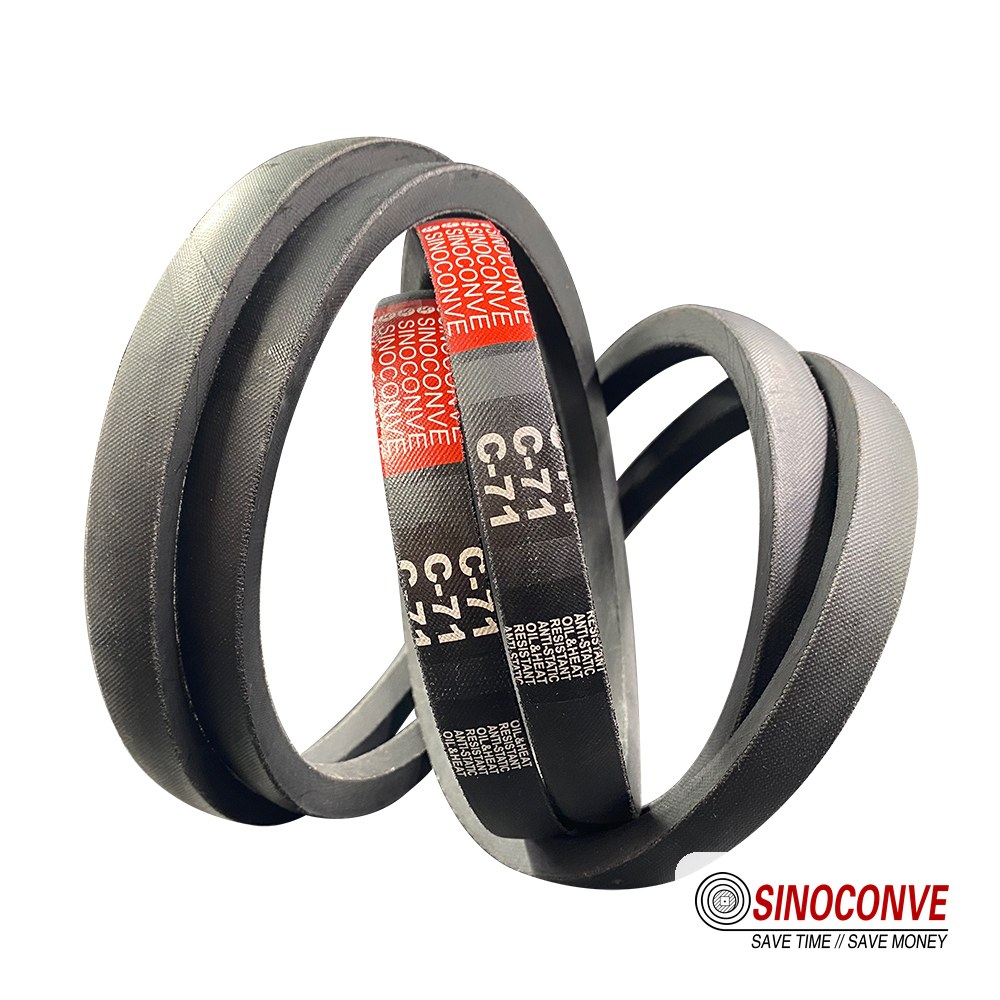
A wrapped narrow-section belt, where the printed section and length are still the first cross-reference clue.
04Metric Sections SPZ, SPA, SPB and SPC
Metric drives borrow the same idea but not the same letters. The SP group writes as SPZ, SPA, SPB and SPC, and the order steps up much as the classic letters do. You meet these on European machinery, on imported compressors, and on OEM drives where the original drawing was dimensioned in millimetres. Because the naming habit is metric, the numbers on the belt are usually metric too, which changes how the length reads.
Reading an SP Code Without Guessing
An SP code tells you the profile first and the length second, exactly like the lettered family. What it does not tell you is the brand, the compound, or whether the belt is wrapped or raw-edge. Two SPB belts of identical length can differ in cord package and cover, so a like-for-like swap needs more than the profile and the number.
We hear from buyers every month who are comparing quotes from a distance, and the rubber conveyor belt habit of naming by construction carries straight over into drive belts. Our answer is always the same: match the profile, then match the build, and only then talk about length.
Field note from our engineers: On a cement plant fan drive we traced a repeating belt squeal to one SPB belt that carried the right profile and the right length but a shorter cord package than its neighbours. The code matched; the build did not. Since then we photograph the old belt and the pulley groove before we quote, and the mismatches have almost stopped.
Metric codes and imperial codes can describe drives of the same duty, which is why a plant with mixed machinery ends up holding both. Neither naming habit is more correct than the other; they simply grew in different engineering traditions. What matters for a cross-reference is that you never assume the unit from the digits alone, because the same four digits can mean two very different loops.
05Multi-Rib Belts and the PK Family
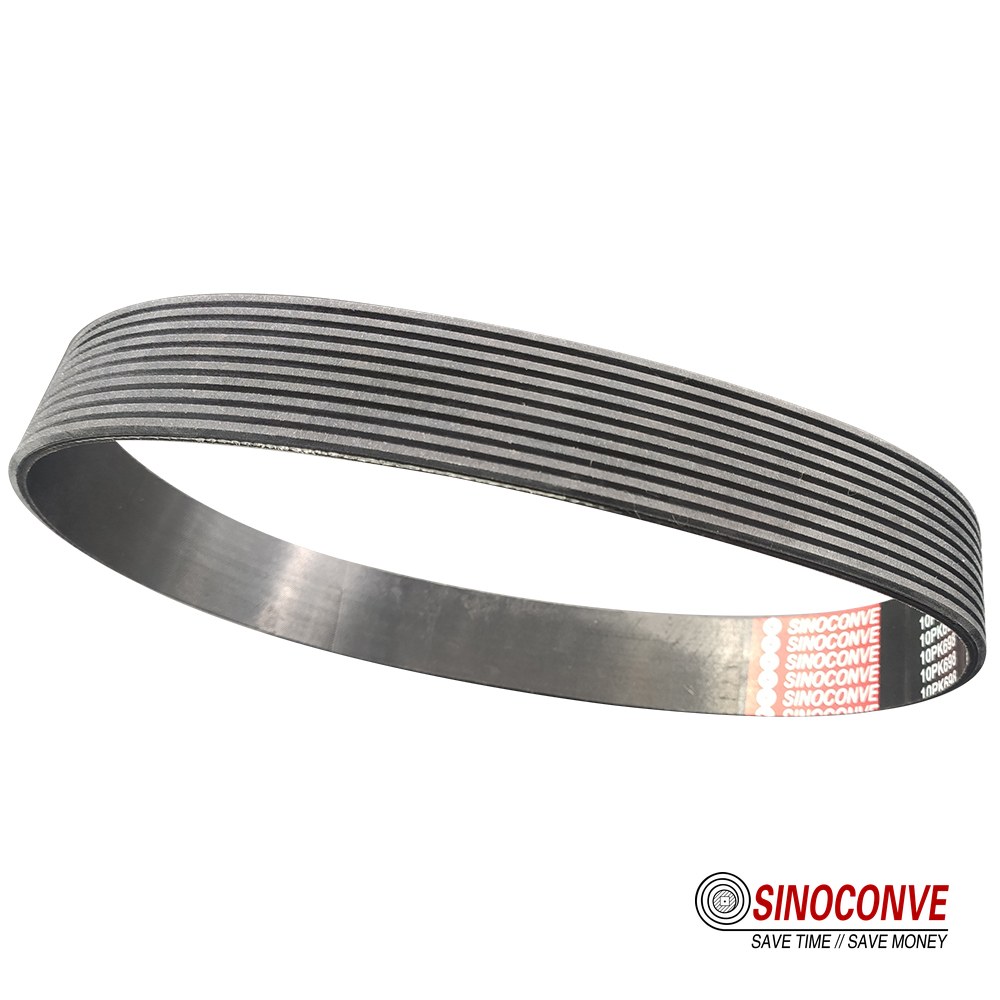
A multi-rib belt, often called a poly-V belt, carries several small V ribs moulded along one flat band. Instead of a single deep wedge, it grips with a row of shallow ribs, so the load spreads across many contact points and the belt bends over a very small pulley. The P family names the rib pitch: PH, PJ, PK, PL and PM each describe a different rib spacing, and PK is by far the most common in industrial and automotive drives.
How to Read a PK Belt Size
A PK belt size usually hides the rib count right next to the profile, ahead of the length. Read 6PK1200 and you have a belt with six ribs on a PK pitch, with 1200 as the length figure. Change the leading number to five and you have one fewer rib on the same band. That rib count is the field most often left off a quotation request, and it is the field that decides whether the belt wraps the pulley correctly.
Why the Rib Count Cannot Be Ignored
Two belts of the same profile and the same length but a different rib count are not interchangeable. A band with too few ribs carries more stress per rib and wears quickly; one with too many will not seat in the pulley at all. Count the ribs on the old belt, then cross-check that number against the number of grooves cut into the pulley.
Multi-rib work sits alongside our heavier lines, and the same crews that handle a industrial conveyor belt for a crusher line often ask us for PK belts for the same site's fans and screen drives.
We also meet multi-rib bands that were misread as classic belts, because the two look alike when seen through a guard. The ribbed band is thinner and flatter, and its grip comes from many small wedges rather than one deep one. A buyer who counts a single wide wedge where the pulley shows six narrow grooves has the wrong profile, whatever the length happens to suggest.
Pitch choice is set by the pulley, not by preference. A PJ band will not seat in a PK groove any more than a PK band will seat in a PJ groove, and the two are not close enough to force. When a machine arrives with an unfamiliar pitch, the fastest route is to count the grooves in the pulley and read that number back to us.
06The X Suffix and Other Letters on the Jacket
The X is not the only letter that changes a belt's meaning, and it is not always a V-belt marker either. On a classic or narrow belt an X means a cogged, raw-edge build, giving AX, BX and CX for the letter family and 3VX, 5VX, 8VX for the narrow one. Read the X as a description of construction rather than a new profile. Take the X away and you are left with the wrapped sibling of the same section.
When XXH Is Not a V Belt Code at All
Some strings on a nameplate belong to a different belt family entirely. Codes such as XL, L, H, XH and XXH identify synchronous, or timing, belts cut with teeth that mesh into a matching toothed pulley. XXH is one of those pitches, and no amount of cross-referencing will turn it into a V belt. If you find XXH on a part, you are holding a timing drive, and the right move is to read teeth and pitch instead of a wedge cross-section. Start with our timing belt pages when that is the case.
Buyers who keep a mixed store of spares often ask whether one order can cover both the drive side and the material side. It can, and the team that fills a request for wholesale conveyor belts is the same team that quotes a single 8VX for a fan. Keeping the two together is how a plant avoids a shelf full of belts that almost fit.
The same patience applies whether you are buying a drive belt or a heavy belt. Any conveyor belt supplier worth keeping will explain the code on a sleeve before taking the order.
Reading a code from a photograph is a routine part of our day, and it is easier than it sounds when the picture is taken well. Shoot the printed string straight on, put a ruler beside the section, and add one shot of the pulley groove. Those three images tell us the family, the approximate size and the groove angle, which is often enough to name a belt even when the ink has almost gone.
The jacket is where most of the confusion starts, because a single belt often carries more than one marking. A brand name, a country code and a compound code may sit beside the section and the length. Read the section and the length as the working fields and treat the rest as context, useful for a warranty question but not for matching a drive.
07Reading the Length: Effective Length vs Outside Length
The length figure is only useful once you know which length it is. Belt catalogues speak of an outside length measured around the outer surface of the belt, an effective or datum length measured along a reference line inside the section, and a pitch length that follows the cord on a cogged belt. These are not the same number, and the gaps between them grow as the section gets deeper.
Why the Three Lengths Never Match
Picture a belt bent into a loop. The material on the outer face has to travel further than the material on the inner face, and the cord line sits somewhere between them. That is the whole reason the figures differ. A catalogue that quotes an outside length for one belt and a datum length for another is not being careless; it is following the habit of that particular family.
Which Length to Quote
The safe answer is the one the catalogue for that family uses, and you confirm it rather than assume it. When we quote, we convert every figure to the reference line the maker expects, then state it back on the offer. That single step removes most length-based returns before they ever ship.
| The length figure you may see on a belt | What that length figure actually measures | Why it matters when you place the order |
|---|---|---|
| Outside length measured around the belt's outer face | This is the full distance around the outer face of the belt, as if it were laid flat and pulled straight. | Older inch-coded stock and many agricultural belts are still ordered by this figure, so it is the one a counter hand hands you first. |
| Effective, or datum, length along the inner cord line | This is the distance around a reference line set inside the section, at the cord line the maker has defined for that profile. | Most industrial and metric catalogues quote this figure, so it is the one to match when you compare two different brands. |
| Pitch length on a cogged belt | This is the length that follows the cord line on a cogged belt, and it sits between the outside and the datum figures. | Cogged belts are often listed by pitch, and ordering one by its wrapped sibling's length is a classic mismatch. |
| The same belt given in inch or millimetre form | One catalogue may publish an inch figure for a belt while another publishes a millimetre figure for the very same loop. | You cannot convert one to the other until you confirm which reference line each catalogue used, so ask before you multiply. |
Any conveyor belt distributor who also stocks drive belts will tell you the same thing. The figure printed on the belt is only half the story until you know its reference line.
Matched sets deserve their own warning here. Two belts running side by side on a two-groove pulley must match each other as well as the drive, or the shorter one takes more than its share of the load and fails first. When we supply a set we confirm that every belt inside it was measured on the same reference line, and we note the set on the offer so the next buyer does not have to guess.
It helps to picture the two belts that confuse buyers most. An inch-coded classic belt and a metric SP belt of similar duty can sit in the same store cupboard, share a rough width, and still be measured on different reference lines. Keeping the two families apart on paper is the quickest way to keep them apart on the drive.
08Measuring a Belt With No Markings
When the ink has worn away, the belt itself still carries nearly every dimension you need, provided you take the readings in a sensible order. Work from the cross-section outward. A worn belt will have lost some material at the sidewalls, so treat every reading as a best estimate and lean on the pulley grooves as the real reference.
A Reading Order That Saves Time
Measure the section before the length, and the length before you touch a catalogue. Most wrong orders come from a belt that was measured end to end, matched to a length, and never checked for section at all. A five-minute session with a caliper and an angle gauge will send us everything we need.
| The measurement to take on the belt | How to take the reading on the bench | What to record and pass on to us |
|---|---|---|
| Top width across the widest part of the section | Lay the belt flat and measure across the widest part of the section with a caliper or a steel rule. | Note the figure and the family you think it belongs to, so we can check the two against each other. |
| Full height of the section, top edge to bottom | Close the caliper across the full height of the wedge, from the flat top to the bottom edge. | A height that falls short of the catalogue value usually means wear, not a different section. |
| The wedge angle set by the two sidewalls | Set an angle gauge against the sidewall, or press the belt into a known groove and watch how it seats. | Report whether the belt sits proud, flush or sunk in the groove, which often tells us more than the angle alone. |
| The running length of the belt in its loop | Wrap a tape around the belt on a flat floor, or roll it one full turn against a mark. | Tell us which method you used, so we can convert to the reference line the catalogue expects. |
| Rib count on a multi-rib band | Count the ribs across the band and match that number to the grooves cut into the pulley. | Give us the rib count and the profile letter, because a length on its own will not identify a PK belt. |
Readings taken this way travel well. A buyer who sends section, angle, length and rib count in one message usually gets a firm answer the same day, while a buyer who sends a single length often gets a string of questions back. If you would rather not measure at all, send the worn belt to our conveyor belt factory and let our team read it for you.
A photograph of the belt beside a rule is often more useful than a long written description. Include the section face, the printed string if any of it remains, and the pulley the belt came from. With those three views we can usually narrow the family in a single pass and save everyone a round of emails.
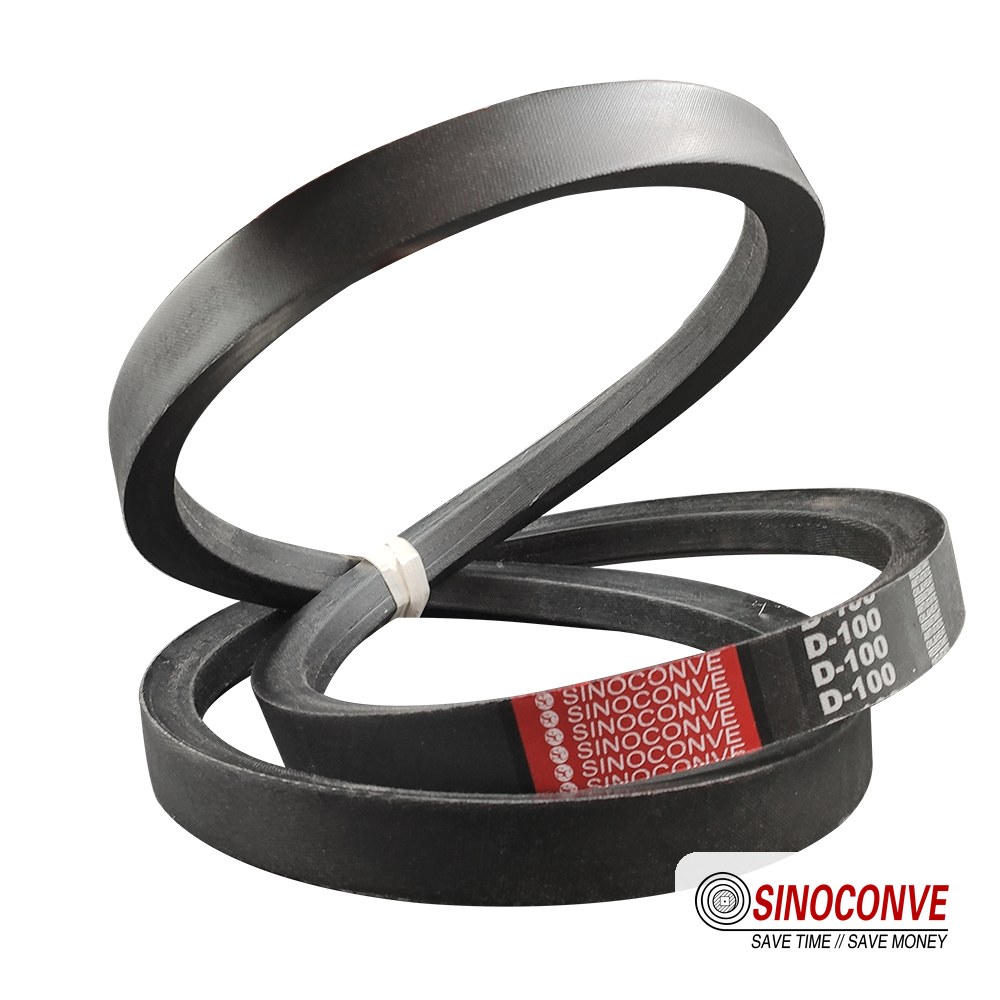
Measuring an unmarked belt on the bench: section first, length second, pulley groove as the final check.
09Cross-Referencing a V Belt Between Brands
Cross-referencing is a matching exercise, not a translation table. Two belts from different makers can carry different codes and still be near-equivalent, because every brand is free to name its own families. What you compare is not the string itself. You compare the four facts that sit behind the string, and you compare them in the same order every time.
The Four Facts to Match
Work through section, length, rib or cog pattern, and duty. Get those four right and the code on the jacket stops mattering. Miss one and the belt can look correct right up until it starts slipping.
| Each check point you have to compare | What you compare between the two belts | What goes wrong if you skip it |
|---|---|---|
| The cross-section and the measured wedge | Compare the profile family and the measured wedge, not merely the letter or number printed on the jacket. | A belt that is one family off will sink to the bottom of the groove or sit too proud to grip. |
| The effective length on a common reference line | Compare the length on a common reference line, converted with each maker's own convention. | A close but wrong length throws the take-up out of range on the first start of the drive. |
| The rib count or the cog pattern across the band | On multi-rib and cogged belts, compare the rib count and the cog pattern across the band. | The belt may fit the pulley shape yet fail to spread the load across its full width. |
| The cord package and the stated duty class | Compare the cord package and any temperature, oil or antistatic duty class the maker states. | The belt runs hot and stretches early, and the take-up runs out before the next planned stop. |
When one of those four cannot be confirmed from the jacket alone, we fall back on measurement, and we say plainly in the offer which figures were read and which were assumed. A cross-reference written down without that note is a guess dressed up as a specification.
Keep a written cross-reference on the shelf for any drive you rebuild. Six months later, when the same fan is down again and the ink has worn off the spare, that note is worth more than any catalogue on the internet. It also gives the next buyer a starting point instead of a blank page and a guess.
10Substitution Traps on the Floor
Most substitution mistakes look reasonable on paper and only reveal themselves on the second or third shift. These are the ones we see repeat, plant after plant, and they cost more than the belt that triggered them.
Where a Sensible Swap Goes Wrong
A cogged belt and a wrapped belt of the same section and length are not a straight swap. The cogged build is more flexible and stretches differently under load, so a take-up sized for a wrapped belt may run out of travel once a cogged belt settles in. The reverse swap is just as awkward: a wrapped belt forced onto a small pulley that a cogged belt used to handle will crack at the base of the wedge far sooner.
Groove shape catches people out nearly as often. A 5V belt is not a B belt and will not seat correctly in a B groove, even when the lengths happen to line up. The same caution applies across the metric families, where two profiles can sit side by side on a shelf with a similar width and still call for different groove angles.
Multi-rib bands add a third trap. Count the ribs wrong by one and the band either rides too low in the grooves or spreads its load across too many ribs, and neither problem shows up until the belt is hot and running. A fourth trap is simpler still. Buyers who measure only the length, and never the section, are the ones who send back a belt that fits the run and misses the groove.
None of this is a reason to avoid substitutions altogether. A swap made with the four checks clearly in view is routine and safe. The failures come from swaps made on length alone, which is the one field every buyer can read and the one field that never tells the whole story.
Field note from our engineers: A quarry replaced a set of wrapped narrow belts with cogged ones of the same length to gain flexibility on small pulleys. Three weeks later the driven sheave was scored and the belts were glazed. The take-up had been sized for the wrapped build, and the cogged belts had stretched past its limit. Matching the length was never the problem; matching the stretch behaviour was.
11What to Send Us for an Accurate Quote
A cross-reference quote is only as good as the information behind it. Give us the fields below and we can usually confirm a match without a second round of emails. Leave one out and the answer turns into a question.
The Fields That Decide the Quote
None of these fields is optional in practice. Each one removes a specific way for a belt to arrive that fits the drawing and fails on the drive.
Nothing on that list asks you to become a belt engineer. It asks you to read a few markings and take three or four measurements, which is work any maintenance hand can do in minutes. The reward is a quote that fits the first time and a spare that goes straight onto the shelf instead of back into a crate.
Two more fields turn a good quote into a great one. A photo of the old belt beside a rule settles most doubts about section and wear, and the name of the machine or the drive it sits on lets us compare your request against belts we have already supplied to similar equipment. Neither field is mandatory, yet both shorten the path to a firm answer.
| The field we need from you | Why this field changes the answer | What happens when it is missing |
|---|---|---|
| The full printed code from the old jacket | Send the whole string from the jacket, including any X, letters and running numbers. | Without it we are guessing at the family and may quote a belt with the wrong build. |
| The section family and the measured wedge | Give the profile family plus the top width and height you measured on the old belt. | A family name alone can hide two builds, so the measurement confirms which one fits. |
| The effective length and the method used to read it | State the length and the method or reference line you used to arrive at the figure. | We may convert against the wrong line and return a belt that is close but not right. |
| The rib count or the cog pattern on the band | For multi-rib and cogged belts, count the ribs or describe the cog pattern you see. | Length and profile on their own will not identify a PK belt or a cogged narrow belt. |
| The pulley groove type and the pulley diameters | Tell us the groove type and the pulley diameters you measured on the drive. | We cannot check the wrap angle or warn you that the belt will slip under load. |
| The centre distance and the take-up travel left | Describe the centre distance and how much take-up travel the drive still has left. | A drive with little travel cannot absorb the stretch of a different cord package. |
| The duty cycle and the surrounding environment | Note the temperature, oil or dust exposure, and how often the drive starts and stops. | Duty decides the build, and ignoring it is how a correct-looking belt fails early. |
| The annual volume of belts you expect to use | Give us the number of belts you expect to use across a full year. | It shapes the packing and the stock we hold, and keeps repeat orders consistent. |
12How This Page Fits Our Other V Belt Guides
This page does one job. It helps you read a belt code and check a cross-reference, and it deliberately stays away from everything else about drive belts.
If you want the basics of what a V belt is and how a drive turns at all, our earlier primer covers that ground. For the behaviour of a drive under load, and the limits of what a V belt can carry before you should be looking at another transmission, read industrial-v-belt-drive. For the build of a cogged belt and the reason a raw edge flexes further than a wrapped jacket, our cogged guide goes deeper into the construction.
Section depth gets its own treatment elsewhere, and the compound families that sit behind the cover are covered in a separate article. Keep this page bookmarked for the moment a belt reaches you without a legible code. That is when the naming rules here earn their keep.
One more point is worth saying plainly. We do not publish a universal chart that maps one brand's code onto another's, because no such chart can stay honest across every family and every duty. What we publish instead is the method, and the method travels further than any single table ever will.

13Frequently Asked Questions
What does the size code on a V belt mean?
A V belt size code carries two facts in a fixed order, with a section family such as A, B, 5V, SPB or PK first and a running length second.
How do I find the size of a V belt?
Start with the printed code, because it is faster and more reliable than any measurement. If the ink is gone, measure the section before the length. Then check the rib count on a multi-rib band, since the length alone will not pin down a PK belt. Send those readings to us and we will confirm the family before we quote.
Is 8V the same as 8VX?
No, and the difference matters. Both share the 8V cross-section and groove, but the X marks a cogged, raw-edge build, so check how the drive stretches and how much take-up travel is left.
What is a PK belt size?
A PK belt size pairs a rib count with a PK pitch and a length. In a code such as 6PK1200, the six is the number of ribs, PK is the profile, and the trailing figure is the length. Always include the rib count, because it decides whether the band seats properly in the pulley.
How do I cross-reference a V belt between brands?
Match four things in a fixed order. Compare the cross-section, then the effective length, then the rib or cog pattern, and finally the cord and duty class. The code on the jacket is only a starting point. It is not a translation key, and no brand publishes one that fits another. When a figure cannot be read from the belt, measure it and say plainly that you measured it.
How do I measure a V belt with no markings?
Measure the section before the length, using a caliper for the top width and height, an angle gauge for the wedge, and a tape around the belt for the running length, then count the ribs on any multi-rib band.
What is the difference between effective length and outside length?
Outside length runs around the outer face of the belt, while effective or datum length follows a reference line inside the section at the cord. The two figures differ, and the gap grows as the section gets deeper. Cogged belts add a third figure, the pitch length, which follows the cord itself.
Can I replace a B section belt with a 5V belt?
Usually not, because a 5V and a B belt call for different groove shapes, so the pulleys normally have to change along with the belt.
Does an XXH code belong to a V belt?
No. XXH is a pitch used on synchronous, or timing, belts whose teeth mesh into a toothed pulley, while a V belt grips with a wedge, so read such a part as a timing drive.
Why do two belts with the same code feel different?
The code describes shape, not build. Two belts with the same section and length can carry different cord packages, jackets and duty classes. Those differences show up under load, not on the shelf. That is exactly why a cross-reference has to look past the printed string and confirm what is behind it.
Related Products You May Need
- V-belts for industrial and agricultural drives
- Industrial timing belts for precise drives
- PU timing belts for automation and precision drives
- Conveyor rollers and idlers for bulk handling lines
- The full SINOCONVE product catalog