

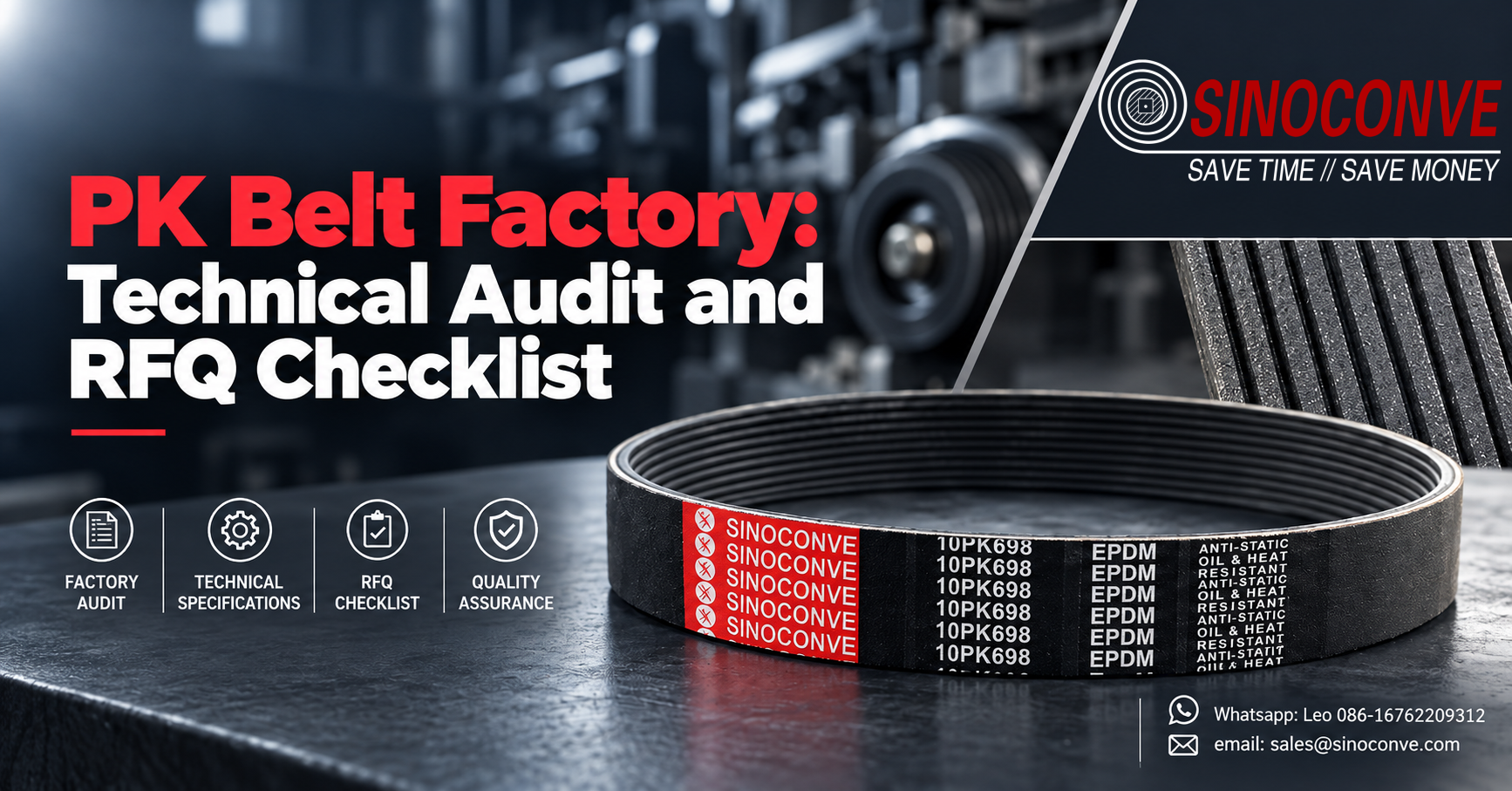
Auditing a PK belt factory is mostly about tooling records and cord tension logs, not a polished showroom sample. A plant that can hold rib pitch and rib height across a whole belt sleeve, and that can hand you cord tension data and cure charts sorted by batch, will ship poly-V belts that stay quiet and keep their grip for thousands of hours. A plant that cannot still passes a visual sample check, then fails on your machine six weeks later. This guide walks through the five processes that decide PK belt quality, the evidence a serious factory releases during an audit, the RFQ fields that make three quotations comparable, and the acceptance tests we would insist on if we were the buyer.
We build both transmission belts and heavy conveyor belting in Ningbo, so the checklist below is the one our own engineers answer to when a customer walks the floor. Nothing here is a ranking of suppliers, and we name no competitor. If you are building an audit plan or an RFQ for a multi-ribbed drive, you can lift the six tables in this article directly into your own template.

01Why a PK belt audit is not a conveyor belt audit
A conveyor belt is judged in the field. Cover grade, carcass, splice quality, and how the belt survives abrasion and impact over several years carry most of the risk, and much of that risk is only visible once the system is running. A poly-V belt is different in a way that changes the whole audit: nearly everything that decides its working life is locked into the sleeve before it is ever cut. Rib pitch, rib angle, rib height, cord tension uniformity, and the state of cure are all decided on the building drum and inside the press. By the time the belt reaches your receiving dock, the die is cast.
The load-carrying feature is a five-millimetre rib, not a ten-millimetre cover
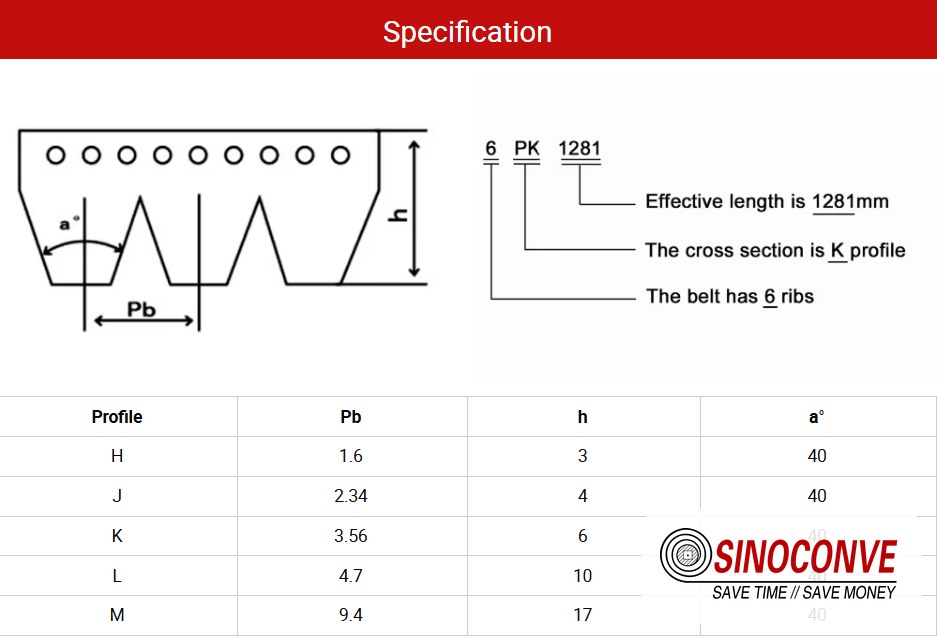
On a classic wrapped V belt, the load rides on two flanks and the section is chunky and forgiving. A PK belt spreads the same job across many small ribs, so the working surface is measured in millimetres, not centimetres. Take a six-rib PK belt at 3.56 mm pitch: the whole gripping zone is roughly 21 mm wide, and each rib has to seat in its own groove with very little clearance. If one rib is moulded a few tenths of a millimetre proud of the others, it grabs first, overheats first, and cracks first, while the rest of the belt is still fresh. Nobody sees this in a sample photo. They see it in a life test after 3,000 hours.
What a poly-V audit borrows from belt curing discipline
The unusual thing about our position is that we run rubbers through a press every day for conveyor work as well, which is why we keep pointing buyers back to cure discipline rather than to cosmetics. As a transmission belt manufacturer we answer the same audit questions a heavy-duty belt line answers, and the overlap is real. Platen temperature spread, drum pressure, and cure time under load matter just as much on a 12 mm poly-V sleeve as they do on a 1,200 mm wide belt. If you want a sense of how we run the plant as a whole, the conveyor belt factory page covers the same floor, the same presses, and the same quality gate. The difference in a PK audit is only in what you look at first.
02PK and poly-V construction: the layers you are really buying
A poly-V belt is one belt carrying many small V ribs that run the full length. The ribs do the gripping, a single flat bed of tensile cord sits just under them and carries the pull, and a backing compound above the cord holds everything together and takes the reverse bend over the smallest pulley in the drive. There is no fabric cover over the rib face in most constructions, which is exactly why the moulded and ground surface has to be right. You are buying a precision rubber part, not a length of belting.
Backing compound, tension cord, rib compound, and the mould face
Four elements have to work together, and each one leaves a different fingerprint in the audit. The backing compound has to be stiff enough to hold the cords and resist cracking on the reverse bend, yet flexible enough not to fight the ribs. The cord layer has to be laid in one plane at even tension, because a cord that wanders up or down shifts the neutral axis and shortens the belt. The rib compound has to grab, resist heat and oil, and grind cleanly. The mould face has to stay within its own wear limit, or every belt off that cavity drifts out of tolerance together. Ask a factory which of the four they control in-house and which they buy in; the answer tells you where the risk sits for your order.
Why cord choice sets the noise level as much as the rib shape
Buyers often blame noise on the ribs alone. In practice the cord is half the story. A low-stretch cord holds belt length and tension far more steadily over temperature swings, so the belt stays seated in the grooves instead of riding up and slipping in a stutter. A cord that creeps, or one laid at uneven tension, lets the belt stretch a little unevenly, and that unevenness shows up as a chirp at a specific speed. Pair a stable cord with a smooth rib flank and the drive runs quiet. Pair a creeping cord with a rough, glazed rib and no amount of tension will silence it.
| Layer in the belt | Typical material | The job it does in the drive | What the factory audit should show you |
|---|---|---|---|
| Tensile cord layer | Polyester, aramid, or glass fiber cord wound in a single plane under the ribs | Carries almost all of the torque and sets how much the belt stretches over its whole life | Cord tension logs per build, cord supplier certificates, and a cut sample showing even cord spacing |
| Rib compound below the cord | Heat and oil resistant rubber, often CR or EPDM based depending on the duty | Grips the pulley grooves, resists the heat of small pulley bending, and controls noise and slip | Compound batch cards, hardness after cure, and the rib surface photographed after grinding |
| Backing compound above the cord | A stiffer rubber compound, sometimes with a light fabric facing on the top face | Holds the cords in place and resists cracking where the belt bends backward over a small pulley | Cure records and a bend test run at the smallest pulley diameter actually used in the drive |
| Rib geometry formed by the mould | Moulded, then ground, rib flanks and valleys cut to the profile drawing | Determines how the ribs seat in the grooves and how evenly the load spreads across them | Mould maintenance records plus rib pitch, rib angle, and rib height readings taken from a real sleeve |
03Process audit one: rib moulds and the forming tools behind them
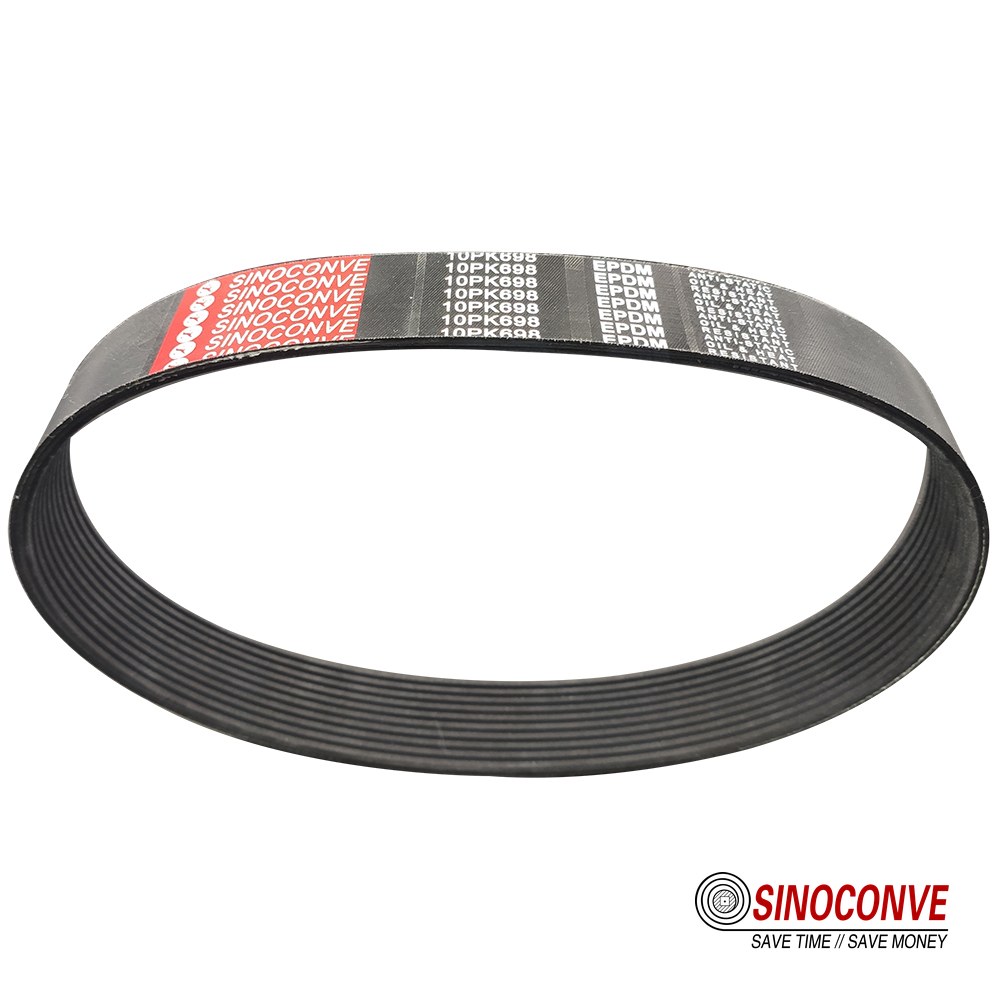
If you are auditing a plant, ask to see the mould register before you see the finished belts. A register that lists each profile, its cavity count, when it was last dressed, and how many sleeves it has run is the difference between a factory that manages tooling and one that reacts to complaints. We keep the same discipline on our V-belt manufacturer line and on the wider heavy-duty belt side of the floor, because a travelling cavity or a worn grinding wheel causes the same class of defect on both.
Mould lead time and the real cost of a worn cavity
Tooling lead time is the honest first filter on any custom profile. A new PK cavity is a machined part with a heat-treat step, not a purchase off a shelf, so a factory that claims every profile is available immediately is either stocking standard moulds or buying finished belts from someone else. Neither answer is wrong, but you should know which one you are dealing with, because it decides who owns the tolerance if something drifts. On a worn cavity the symptom is subtle: rib height creeps up at the tips, the flank finish goes slightly rough, and the belt starts running warm at the exact speed where it used to be cool. We have seen a cavity that was still producing dimensionally acceptable belts but with a rib tip radius worn well past its original form, and those belts began to chirp at about 2,400 rpm where the same drawing had been silent before.
What mould geometry looks like on a profile projector
You do not need to trust a verbal promise about the mould. Ask for a trace. A profile projector or an optical comparator takes a silhouette of at least five ribs across the sleeve and lets the inspector lay that silhouette over the drawing. On a healthy PK belt you see a repeatable rib, even pitch, and a clean flank. On a drifting mould you see the ribs stepping away from the nominal line, usually in the same direction, and often with a tip that has flattened. When we run this check we log the actual readings, not a pass or fail stamp, because the numbers are what let you compare two batches months apart. If a factory will not put a trace in front of you, that single refusal tells you more than any certificate would.
04Process audit two: cord placement and tension control
We photograph and log the winding station on every build because the eye cannot judge tension. The winder carries a load cell or a calibrated brake, and the set point is recorded per cord layer, not per belt. As a conveyor belt manufacturer we run cord and fabric tension control on the wide belt presses as well, and the lesson transfers unchanged: an unmeasured tension is an uncontrolled tension, whatever the product.
Tension per cord versus tension per belt width
There are two ways to specify winding tension, and asking the factory which it uses is a good test of how well it understands its own process. Tension per cord is the number the winder actually applies to each passing cord, and it is the more useful figure when the profile and the cord count change between orders. Tension per belt width is a rolled-up figure that is easier to quote and easier to hide a gap in. On a six-rib PK belt we would expect the cord coverage to be complete and even, with no visible gap where a pass doubled back. Ask what the spread is between the highest and lowest cord reading on a typical build. A tight, agreed band is a good sign. A shrug is not.
Cord wandering, crossover, and the scrap you never see
Cord wandering is the quiet defect. During winding, a cord can drift sideways, cross over its neighbour, or ride up toward the backing face. The belt looks fine on the outside. Inside, the crossed section is thicker, it cures under different pressure, and it becomes a stiff lump that eventually drives a rib crack from above. Factories that inspect the winding stage catch it and cut the sleeve out. Factories that only inspect finished belts ship a proportion of it, because the lump is hidden between the ribs until the belt has run long enough to fail. When you are auditing, ask to see the scrap record for the winding station. A plant that never scraps a sleeve is not flawless; it is simply not looking.
05Process audit three: compound formulation for ribs and backing
A poly-V belt is two or three different rubber recipes glued into one part, and the audit should treat them that way. The rib compound has to grip, resist heat from the tight bends, and grind to a clean flank. The backing compound has to hold the cords and survive the reverse bend without cracking. These are not the same job, so they are rarely the same recipe. A factory that can only describe its belt as "rubber" and cannot separate the layers for you has probably not formulated either one from first principles. Ask for the compound codes and the batch cards behind them.
Why the rib and backing compounds are usually different recipes
The rib has to be tough and grippy at the surface while staying cool under repeated flexing at small pulley diameters. The backing has to be stiff enough to stop the cords moving and to survive tension, yet flexible enough to bend backward without surface cracking. Push one compound to do both jobs and you usually get a rib that grips but cracks, or a backing that bends but lets the cords shift. So the factory runs two recipes and bonds them during build and cure. When you audit, ask how the two layers are kept from separating and what evidence exists that the bond holds after aging. Visual inspection of a cut sample, plus a peel or separation check after the belt has been heat aged, is the kind of proof that separates a formulator from an assembler.
Oil resistance, temperature, and what actually changes in the recipe
The two demands that move the recipe furthest are heat and oil, and they usually arrive together in engine bays, compressors, and enclosed machine guards. For sustained heat, the polymer family shifts toward an EPDM or similar heat-stable base, and the cure system is adjusted to hold hardness at temperature. For oil mist or splash, the base moves toward a nitrile or chloroprene direction so the rib does not swell and lose grip. Oil swell is the trap: a belt that swells two or three percent in service grows enough to ride high in the groove, and that costs you tension and noise. Tell the factory the real continuous temperature, the peak temperature, and what oil or coolant the belt will actually meet. If the RFQ only says "heat resistant", you will get a compromise recipe, and the compromise will usually be on the wrong side of your duty.
Weighing discipline and the tare-weight habit that hides errors
There is one small habit in a mixing room that predicts a lot: whether the batch card shows the actual weighed quantity next to each ingredient, or just a tick. A card with real weights lets a second person re-check the batch, and it lets you trace a hardness complaint back to a specific mix weeks later. A card with ticks does neither. We ask to see a filled card for the exact compound used on the order, and we compare the recorded weights against the formula. It is a two-minute check and it catches more real problems than a wall of certificates. If the weights are recorded, the factory is serious about low-volume correctness, which is exactly what a custom profile order needs.
06Process audit four: vulcanization cycles and the cure record
Cure turns a soft, grey built-up sleeve into a belt that can carry load, and it is the single step most likely to be run to a stopwatch rather than to a chart. A poly-V sleeve is cured on a heated drum inside a jacket or an autoclave, under pressure that keeps the ribs formed and the cords in place. Temperature, pressure, and time all have to sit inside the window for the compound, and the window narrows as the sleeve gets thicker or the profile gets larger. Under-cured rubber is soft and wears fast. Over-cured rubber is brittle and cracks at the rib root. Neither shows up in a photo, and both show up in the field.
What we hand a buyer is the cure chart for their batch, with the platen or drum temperature curve, the pressure trace, and the time stamp. As a conveyor belt supplier we log the same variables on the wide belt presses, and a buyer who has ever chased a mysterious hardness problem knows how valuable a clean chart is.
Reading a cure record that was written after the fact
Cure records are easy to fake in a notebook, which is why we look for the traces that come off the machine rather than a summary sheet. A genuine record shows the ramp, the dwell, and the cool-down, with the small wobbles a real press makes, and it carries a batch number that matches the sleeve still sitting on the floor. A suspicious record is suspiciously clean, written in one hand, in one pen, at one sitting, with all values exactly on nominal. Ask to see the raw chart for a batch you can still point at. Ask what the platen spread is across the working area, because a hot spot at one end cures that end faster and gives you a sleeve with two different hardness zones. We have measured spreads worth a few degrees on older presses, and on a thick PL sleeve a few degrees is not cosmetic; it is a different belt at one end than the other.
07Process audit five: rib grinding, cutting, and gauging
After cure, the sleeve is ground to bring the ribs to final form and finish, then cut into belts of the ordered width and length. Grinding is where the rib height and the flank finish are truly set, and it is a process that goes wrong quietly. A freshly dressed wheel cuts cool and leaves a fine, even flank. A loaded or badly dressed wheel burns the surface, glazes it, and leaves a rib that looks fine under a shop light but slips and squeals in the drive. So the state of the grinding wheel is a legitimate audit question, and the answer should be a dressing schedule, not a guess.
Cutting is the second half of this step. The sleeve is sliced to width with a blade or a rotating cutter, and the cut edge should be square, cool, and free of torn ribs. A hot or ragged cut disturbs the cord ends and can start a separation at the edge. On a wide belt line we finish and square edges as a routine operation, and the same care applies here; even on a compact industrial conveyor belt the edge is a wear surface, and on a PK belt the edge of every rib is exposed.
Grinding wheel dress and the slow drift in rib height
Rib height is not a fixed property of the mould; it is the result of how much material the grinding step removes. That means a change of operator, a different feed rate, or a wheel that has lost its form all move rib height without anyone touching the mould. We log the dress schedule and the first-off height readings at the start of every grinding run, so a drift is caught within a few belts rather than at the end of the batch. When you audit, ask what the operator does if the first-off height is at the edge of tolerance. The right answer is that they stop, re-dress, and re-check. The wrong answer, and a common one, is that they adjust the machine setting and carry on, which simply hides the problem for a while.
Measuring length on a tensioned belt versus a slack belt
Effective length is the parameter buyers argue about most, and almost every argument comes down to how the belt was measured. A poly-V belt is measured under a defined tension on a two-pulley rig, with the belt seated in the grooves, because a slack belt laid on a bench reads short and an over-tensioned one reads long. The difference on a 1,250 mm belt can be several millimetres, which is the whole reason length tolerance is quoted as a class rather than a single number. Ask to see the measuring rig and the tension it uses. If the factory measures belt length by wrapping a tape around a slack belt on the floor, its length claims are not comparable to anyone else's, and your tensioner will be doing the work that the drawing should have done.
08The factory audit evidence table we hand over
Pitch, angle, and height: the three rib numbers that decide everything
Of all the evidence rows, the rib geometry readings carry the most weight, so it is worth saying what each one does.Rib pitch is the distance centre to centre between ribs, and it has to match the pulley groove spacing or the belt will not seat. Rib angle governs how the flank contacts the groove wall; too shallow and the belt slips, too steep and it wedges and runs hot.Rib height controls how deep the belt sits and therefore the effective diameter of the drive. Measure any one of them wrong and the other two cannot save you. That is why we take all three from the same sleeve, on the same rig, and record them together rather than as separate checks.
| Area under audit | Evidence we hand over | Pass criterion we work to |
|---|---|---|
| Rib pitch and rib angle | Profile projector traces of at least five ribs per sleeve, logged against the profile drawing | Every sampled rib inside the drawing tolerance, not only the first and last rib |
| Rib height and flank finish | Depth gauge readings taken at four points around the circumference, plus a visual check of the flank | Height inside tolerance with no glazing, tearing, or grinding burn anywhere on the rib |
| Cord tension during build | Per-build winding log from the cord station, with the set point and the actual reading for each cord pass | The spread between the highest and lowest cord inside a tight band agreed at the RFQ stage |
| Flex fatigue on a test bench | A bench run at the smallest pulley in the drive, with rib temperature and crack checks at set intervals | No rib cracking at the end of the agreed running hours and a stable, bounded temperature rise |
| Batch traceability | A batch number on the sleeve that ties back to the compound card, the cure chart, and the cord lot | Every shipped belt traceable to its compound card and cure chart within a few minutes of asking |
| Gauge and rig calibration | Calibration stickers and certificates for callipers, depth gauges, the projector, and the length rig | All gauges in date and traceable to a known standard, with the certificates available on the day |
09Capability boundaries: what the honest answer sounds like
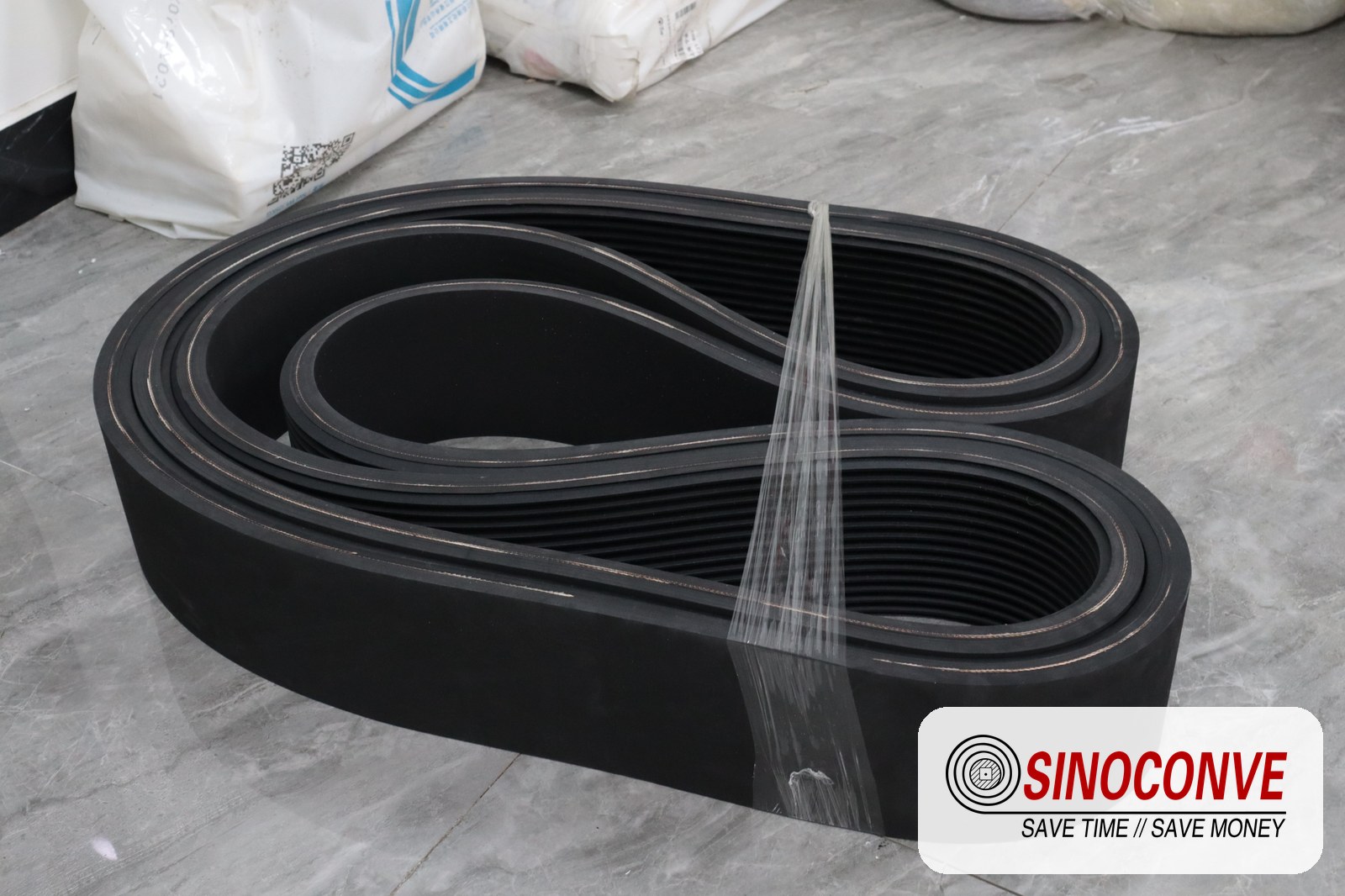
We are candid about our own boundaries because it saves everyone time. Profiles and rib counts we mould and grind in-house are quoted with tooling we own; anything outside that set is a conversation about tooling lead time, not an instant yes. If you need a wide spread of drive products alongside the ribbed belts, our wholesale conveyor belts range sits on the same platform, and it is normal for a distributor to buy ribbed transmission belts and heavy belting from one plant rather than two.
Section range, rib count, and the length limits of a real line
Length is limited by the drum, and rib count is limited by the building machine and the press width. When a factory tells you its capability, listen for the units. A statement like "we can do any length" is not a capability; it is a deflection. A real answer names the narrowest and widest drum, the smallest and largest effective length it can cure without a joint or a compromise, and the highest rib count its winder can feed evenly. Ask where the edge is on each of those, then ask what happens to price and lead time as you approach it. The answers should be specific, and they should match the machines you can see standing on the floor.
| Question to ask a factory | What an honest answer sounds like | What should make you cautious |
|---|---|---|
| Which profiles can you mould with your own tooling? | A named list of profiles you can see running, plus the ones that would need new tooling made | Every profile in the catalogue claimed at once, with no mention of who owns the moulds |
| How many ribs can you build and cure in one sleeve? | A stated rib range tied to the drum width and the winder on the floor | A vague answer that never mentions the drum or the winding machine |
| What is your minimum run, and does it change per compound? | A metre or piece minimum per profile and per compound, with the setup charge explained plainly | A friendly minimum that quietly grows once the purchase order has been placed |
| Which tests do you run in-house, and on what sample size? | Named benches, a sample frequency per batch, and the record that travels with the shipment | A broad promise of outside lab testing with no sample size and no frequency stated |
| Who signs the release, and against which drawing revision? | A named inspector and a drawing revision number printed on the inspection sheet | A stamp with no name and no revision, which makes later disputes hard to settle |
10The RFQ fields that make three quotations comparable
Two fields deserve a note before the table. First, always state the smallest pulley diameter in the drive, because it decides the rib bending stress and therefore the cord and compound choice more than the power rating does. Second, state the tolerance class for length rather than a single target, because a class is what a factory can actually hold batch to batch. If you buy transmission belts through a conveyor belt distributor rather than direct, send the same field list unchanged, and ask them to pass it through without paraphrasing.
The fields that turn a rough enquiry into a quotable specification
A poly-V RFQ that a factory can quote without guessing contains the profile, the rib count, the effective length and its class, the smallest pulley diameter, the power and speed, the continuous and peak temperature, the oil or chemical exposure, the noise and slip expectations, the required inspection documents, and the annual volume with a delivery pattern. Add the drawing revision if you have one, and say plainly whether the belt is running on new pulleys or existing worn ones. Worn pulleys change the effective fit and are a frequent cause of disputes that have nothing to do with the belt itself.
| RFQ field | Why it changes the design and the price | Example entry |
|---|---|---|
| Profile and rib count, such as PK with six ribs | Fixes the mould, the pulley groove spacing, and the width of the gripping zone | PK, six ribs, drawing PK-2026-04 revision B |
| Effective length and tolerance class | Drives the drum size, the cord length, and whether your tensioner can take it up | 1,250 mm effective, standard length tolerance class |
| Power, speed, and smallest pulley diameter | Sets the cord material and count, and the rib bending stress the belt must survive | 22 kW at 3,000 rpm, smallest pulley 65 mm |
| Continuous and peak temperature | Selects the polymer family and the cure cycle that holds hardness at heat | 90 °C continuous, 120 °C peak for short periods |
| Oil, coolant, or chemical exposure | Chooses a compound that resists swelling so the rib does not ride high in the groove | Light oil mist, occasional coolant splash |
| Noise and slip expectations | Drives the rib flank finish and the tension guidance the factory recommends | No audible slip at rated load, quiet across the working speed range |
| Inspection documents required | Defines what travels with the shipment and what you can audit after delivery | Rib pitch, height, and length readings plus the cure chart, per batch |
11Acceptance criteria and batch consistency on arrival
We hold the same line on our rubber conveyor belt business for the same reason: a specification that cannot be checked on arrival is not a specification, it is a hope. So we write the acceptance table into the quote and let the buyer hold us to it. Compare that with a supplier who quotes a price and nothing else, and you can see where the risk sits.
Length class, rib deviation, and the readings that trigger a rejection
Length is checked on a tensioned rig at the stated tension, against the class agreed in the RFQ, and anything outside that class is rejected on the spot rather than discussed. Rib pitch and angle are checked on the projector across at least five ribs, and a single rib outside tolerance in a sampled belt is enough to put the batch on hold, because it tells you the mould or the grinding setup has moved. Rib height is checked at four points around the belt, and a flank that is glazed, torn, or burned fails even if the height is nominally correct, since that surface will slip and squeal in service. Keep the sample and the readings together, so a later comparison is possible.
| Parameter | How we measure it | What we accept | What we reject |
|---|---|---|---|
| Effective length | Tensioned on a measuring rig at the stated tension, then compared with the drawing | Any belt sitting inside the length tolerance class agreed in the RFQ | Any belt outside the class when measured at the same tension on the same rig |
| Rib pitch and rib angle | Profile projector trace across at least five ribs of the sampled belt | Every sampled rib inside the drawing tolerance with an even pitch step | A single rib outside tolerance, which puts the whole batch on hold |
| Rib height and flank condition | Depth gauge readings at four points around the belt, plus a close visual check | Height inside tolerance with a smooth, matte flank against the light | Glazing, tearing, or grinding burn anywhere on the rib, regardless of height |
| Slip and noise under load | Bench run at the smallest pulley in the drive with a gradual load ramp | No audible slip at the rated load and noise inside the agreed limit | Slip at rated load, or noise above the limit at any working speed |
| Batch-to-batch consistency | The same three checks repeated on the next batch and laid beside the previous readings | Readings that fall in the same band as the last accepted batch | A visible shift that suggests the mould, the compound, or the cure cycle changed |
12PK, synchronous, or classic V: choosing the right drive
When the pulley is too small for a wrapped V belt
This is the classic PK case. A wrapped classic V belt has a chunky section and a large minimum pulley diameter, because the stiff carcass cannot bend tightly without cracking. When the drive geometry forces a small pulley, the V belt runs hot, slips, and dies young. A poly-V belt bends far more easily because the section is thin and the load is shared across ribs, so it handles small pulleys, high speeds, and back-side idler bends that would break a wrapped belt. If your drive has a small pulley, a back-side tensioner, or a serpentine layout with several bends, PK is almost always the right starting point, and a ribbed transmission belt is what we would quote for that layout.
When a synchronous belt wins, and when one PK replaces several V belts
If you need an exact speed ratio rather than a little tolerance, stop and look at a synchronous timing belt, because a ribbed belt will always slip a fraction under a hard shock load while a toothed belt will not. Timing drives, indexers, and anything that must stay in phase belong on that side of the problem, and our PU timing belt range covers it. The other clean case for PK is consolidation, where a drive that once used three separate V belts on a multi-groove pulley is replaced by one wide ribbed belt that runs smoother and keeps a single tension.
| Profile, and the drives it usually lands on | Rib pitch and rib height, held as typical values | Smallest pulley we would use in that drive |
|---|---|---|
| PH, and it sits on small appliances and light office equipment drives where the load is modest | A rib pitch of about 1.6 mm between rib centres, with a rib depth of roughly 3 mm | Down to about 13 to 20 mm in diameter, which keeps a small appliance drive quiet |
| PJ, common on power tools, small pumps, and light automation units | A rib pitch of about 2.34 mm between rib centres, with a rib depth of roughly 3.5 to 4 mm | A smallest pulley of about 20 to 30 mm, which suits compact hand tools and small pumps |
| PK, which covers automotive accessory drives and compact industrial units | A rib pitch of about 3.56 mm between rib centres, with a rib depth of roughly 5 to 6 mm | A smallest pulley of about 50 to 70 mm, the range where a wrapped V belt gives up |
| PL, often specified for medium fans, compressors, and mixing drives | A rib pitch of about 4.70 mm between rib centres, with a rib depth of roughly 9 to 10 mm | A smallest pulley of about 80 to 100 mm, and it still cools well under sustained load |
| PM, for large industrial drives and heavy agricultural machinery | A rib pitch of about 9.40 mm between rib centres, with a rib depth of roughly 16 to 17 mm | A smallest pulley of about 180 to 200 mm and upward, on the heaviest of drives |
13Six audit mistakes that let a weak factory through
The failures we see are rarely about missing knowledge. They are about audit habits that feel efficient while leaving the hard questions unasked. Judging a factory on a hand-picked sample is the most common of them, because a sample can be built slowly and checked twice, while a production sleeve runs at speed and gets checked once.
Price gaps are the second thing buyers misread, because the gap usually maps onto cord grade, compound, or cure time. The last three habits all come down to time and consistency. Buyers audit once, before the first order, then never return, even though a mould wears and a mixing room drifts. They check the first batch with real attention and the thirtieth not at all, which is exactly when a change would show itself. Then there is the habit of auditing the factory while ignoring your own pulleys, even though a worn groove will mistreat a perfectly good belt and make it look guilty, so audit the plant, then audit your own drive, and keep reading the numbers on both sides.
14Frequently asked questions about PK belt factories
What is a PK belt, and how is it different from a PJ belt?
A PK belt is a multi-ribbed poly-V belt built on a rib pitch of roughly 3.56 mm, while a PJ belt uses the same construction at a smaller pitch of about 2.34 mm.
What should I look at first during a PK belt factory audit?
Start with the tooling and the tension logs rather than the finished belts on the pallet. Ask to see the mould register first, because it tells you which cavities the plant actually owns and which ones it would have to buy in. Then ask for a profile projector trace taken from a real sleeve, not from a sample set aside for visitors. Then ask for the winding tension record of a batch you can still point at on the floor, with the set point logged for each cord pass rather than for the sleeve as a whole. Those few minutes of evidence tell you whether the factory can repeat the geometry you ordered, which matters far more than how the belts look on a pallet.
How do I write an RFQ so that three PK belt suppliers quote the same belt?
Fix every variable that changes the design and the price before you send anything out, then send the identical list to all three suppliers. That list should carry the profile and rib count, the effective length with its tolerance class, the smallest pulley diameter, the power and speed, the continuous and peak temperature, the oil exposure, the noise and slip expectations, the inspection documents you want, the drawing revision, and the annual volume with a delivery pattern.
What rib pitch tolerance can a good poly-V factory actually hold?
On a well-maintained PK mould and a properly dressed grinding setup, we expect pitch and height variation to stay well under half a millimetre across the sampled ribs, and often down to a couple of tenths of a millimetre, though the exact figure depends on the profile and the drawing.
Why does my PK belt get noisy, and is that a factory problem?
Sometimes it is a factory problem and sometimes it is not. A ribbed belt usually gets loud for one of three reasons, and the first is a flank that was glazed or burned during grinding. The second is a cord layer that creeps so the belt rides unevenly in the grooves, and the third is worn pulley grooves on your own machine. If a fresh belt runs quiet and the noise comes back after a few thousand hours, suspect the cord and the compound before you blame the plant. If it is noisy from the first day, check your own pulleys before you blame the belt.
Can one factory supply both PK belts and conveyor belts?
Yes, and it is common, because both products lean on the same rubber mixing, curing, and inspection discipline, and a distributor buying ribbed belts and heavy belting from one plant is a normal arrangement.
How small can a first order for a custom PK profile be?
For a profile the plant already moulds, the minimum is set by the sleeve and the setup charge rather than by the belt count, so modest quantities stay practical. A brand-new profile is different, because the first order has to cover the tooling lead time and a sensible production run on top of it. Whatever the factory quotes, get the minimum fixed in writing per profile and per compound, so it cannot quietly grow after the purchase order has been placed.
How can I verify effective length without a proper measuring rig?
Honestly, you cannot check it properly, because a tape run around a slack belt on a bench will always read short against the same belt pulled onto a tensioned rig. If you cannot build a rig, ask the factory to measure and record the length at a stated tension, and accept the belts against that method rather than against a number you produced yourself.
Do I really need a fatigue test on every batch?
No, and insisting on it for every batch usually just slows delivery without adding much information. A sensible schedule runs the fatigue bench whenever the profile, the compound, or the cord changes. It then repeats the bench periodically to confirm the process has not drifted. Between those runs, the batch release leans on rib geometry readings, cure charts, and a consistency check against the last accepted batch, and that combination catches drift long before a fatigue test would.

Related Products You May Need
- V-belts and multi-ribbed poly-V transmission belts for compact industrial drives
- Synchronous timing belts for drives that must hold an exact speed ratio
- PU timing belts for automation frames
- Heavy-duty rubber conveyor belting for bulk material handling on the same floor