

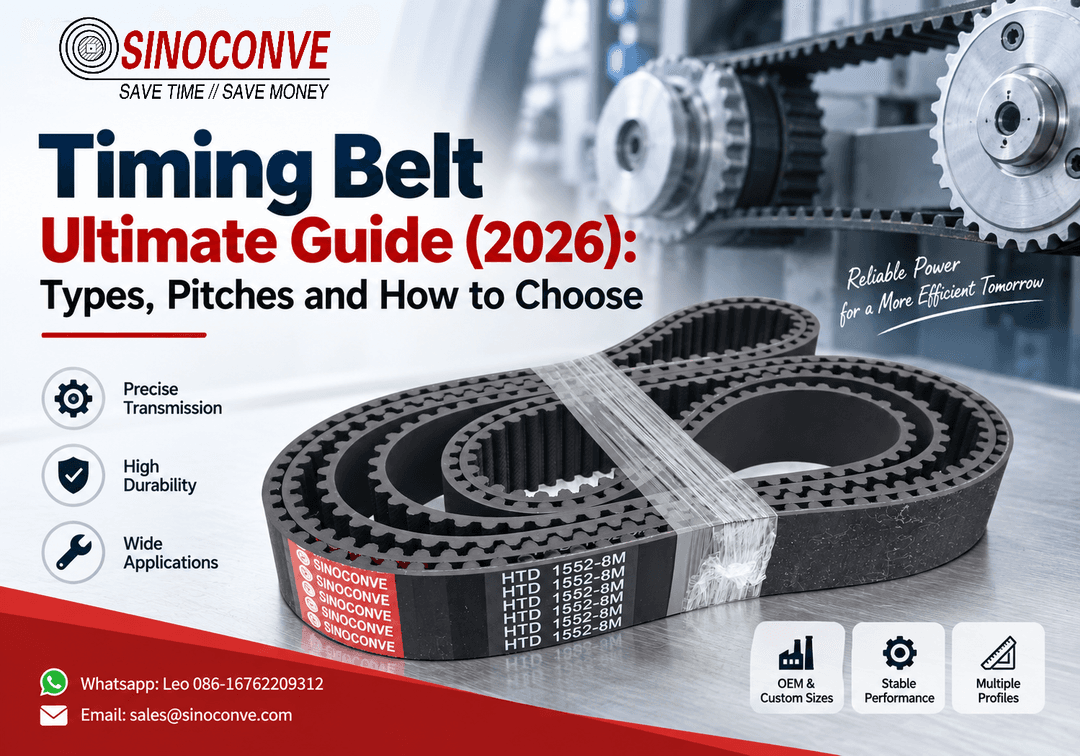
Timing Belt Ultimate Guide (2026): Types, Pitches and How to Choose
Timing belts are the one drive family where the part number tells you almost everything, provided you know how to read it. This guide sets out the profile families in the order a buyer meets them: inch-pitch trapezoidal from MXL up to XXH, metric T and AT sections, the curvilinear HTD range from 3M to 20M, and high-torque GT2 and GT3 for positioning work. Each family gets its pitch, its practical torque band and the belt widths it usually ships in. From there it covers how to decode a part number segment by segment, when fiberglass, aramid or steel cord is the right choice, how HNBR, CR and PU tooth faces behave against oil and heat, and why the number of teeth in mesh on the small pulley decides whether the belt survives. Tensioning, installation errors, common selection mistakes and the industries where timing belts earn their place close the guide.
V-belt vs Timing Belt: Which One Fits Your Line
The choice between a friction drive and a synchronous drive is usually made on the drawing, and often for the wrong reason. This comparison starts with the job rather than the belt: what the driven machine needs from the shaft, not just how fast it turns. It sets out the principle behind each family, then works through the practical detail on both sides. On the V-belt side you get classical A, B, C and D sections with their top widths and power bands, narrow sections SPZ, SPA, SPB and SPC under DIN 7753, and an explanation of what a raw edge belt actually buys you in grip and pulley size. On the other side, timing belt pitches from 3M through 14M and T5 to T10 are put in context, with a note on crusher drives where shock load decides everything and agricultural drives where dust and seasonal restart dominate. A selection matrix matches the condition to the drive, a twenty-four month cost and life view shows where the money goes, and the closing rules tell you plainly when to choose A, when to choose B, and when the answer is both.
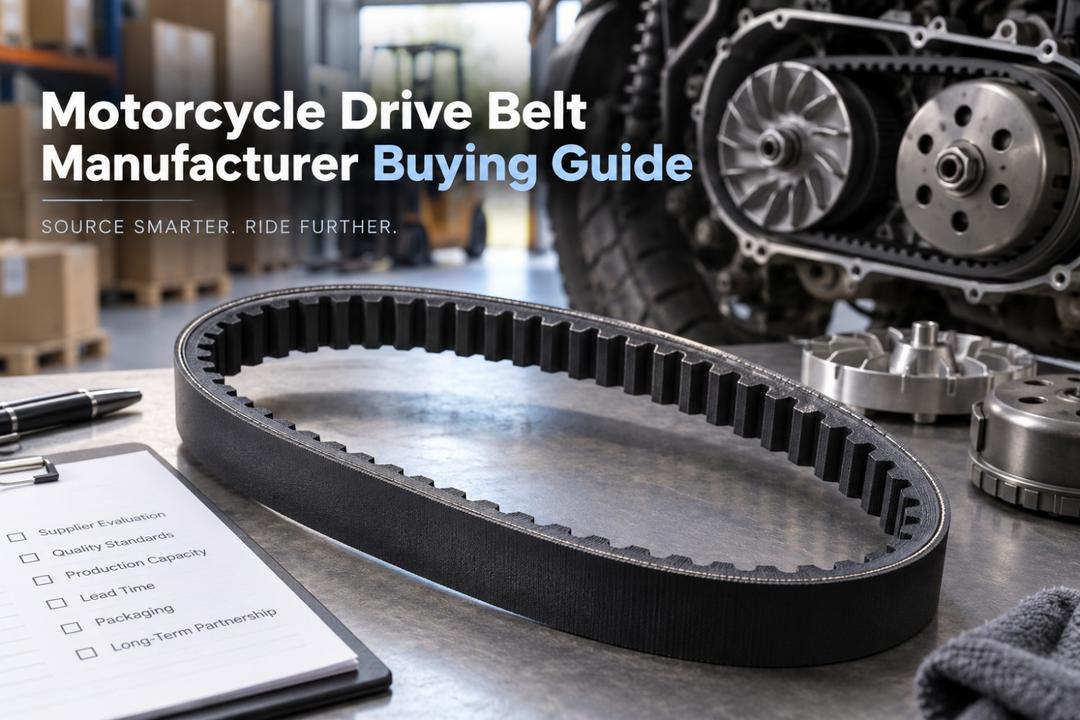
Automotive Timing Belt Manufacturer for Aftermarket Distributors: Sourcing Checklist
Distributors that stock automotive timing belts carry real liability: a belt that fails early comes back as a warranty claim, an unhappy workshop and a lost account. This sourcing checklist gives aftermarket distributors a repeatable process for qualifying an automotive timing belt manufacturer before the first bulk order. It covers the RFQ data you must send (engine application, OE number, tooth profile, belt width and tooth count), the capability evidence to request (production records, test reports, batch traceability), construction details that separate long-life rubber timing belts from cheap ones, and commercial terms from private label and packaging to MOQ, lead time and payment. Use the tables as templates for your next supplier audit, and you will cut the risk of buying engine belts that fail in service.
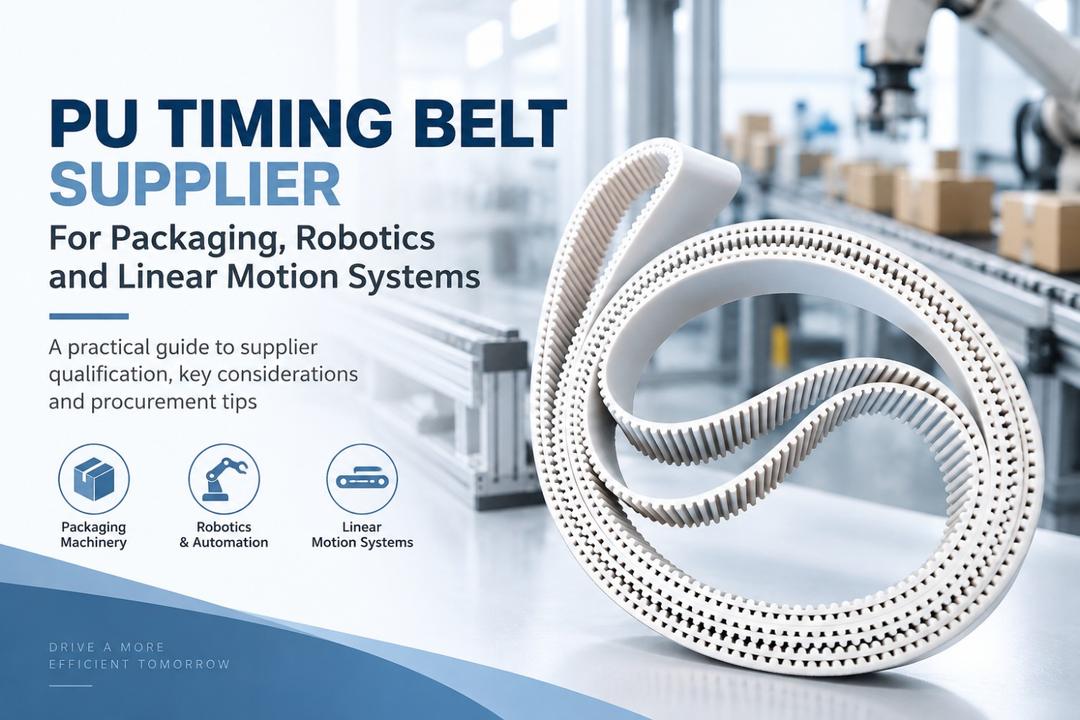
PU Timing Belt Supplier for Packaging, Robotics and Linear Motion Systems
Selecting a PU timing belt supplier for packaging, robotics or linear motion systems requires more than comparing belt price and delivery. OEM buyers need to verify tooth and pulley compatibility, tensile-member construction, working surfaces, motion conditions, sample approval and batch consistency. This guide explains how to qualify polyurethane timing belts technically and commercially, what information belongs in an RFQ, which supplier red flags deserve attention, and how to move from prototype validation to repeatable bulk sourcing.
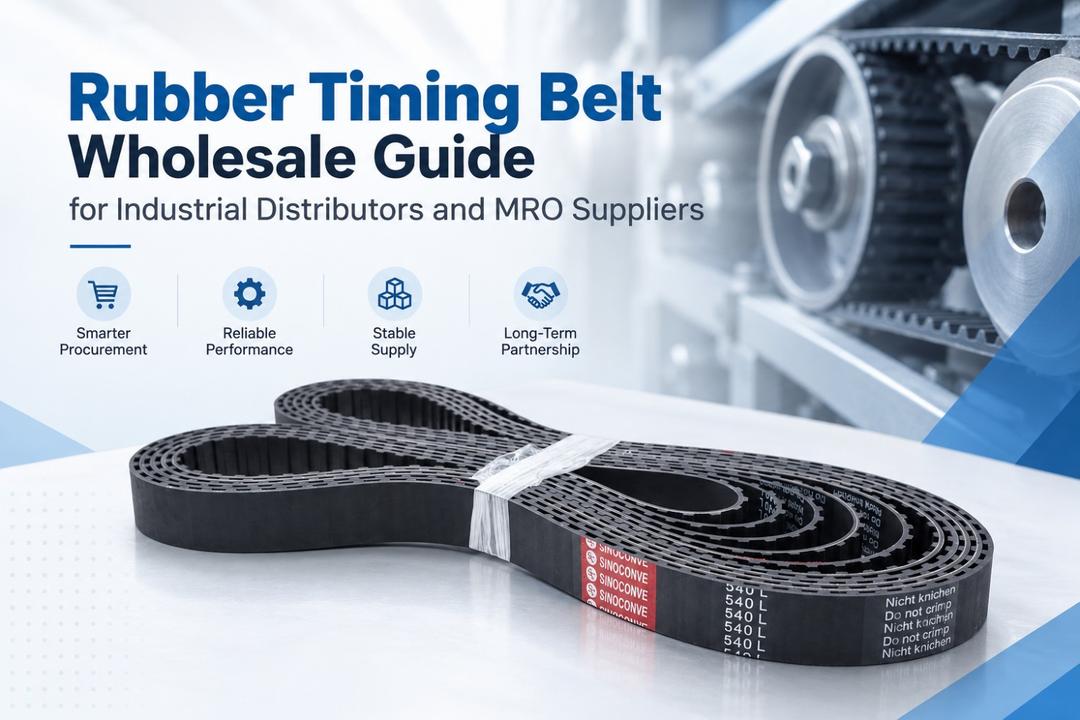
Rubber Timing Belt Wholesale Guide for Industrial Distributors and MRO Suppliers
Wholesale timing belt purchasing requires more than comparing unit prices. Industrial distributors and MRO suppliers need to control tooth profile, dimensions, pulley compatibility, sample approval, batch consistency, MOQ, private labeling, QC documentation and repeat-order identification. This guide explains how to prepare a technically comparable rubber timing belt RFQ, evaluate supplier capability, manage multi-SKU inventory risk and verify the commercial details that matter before moving from samples to bulk orders.
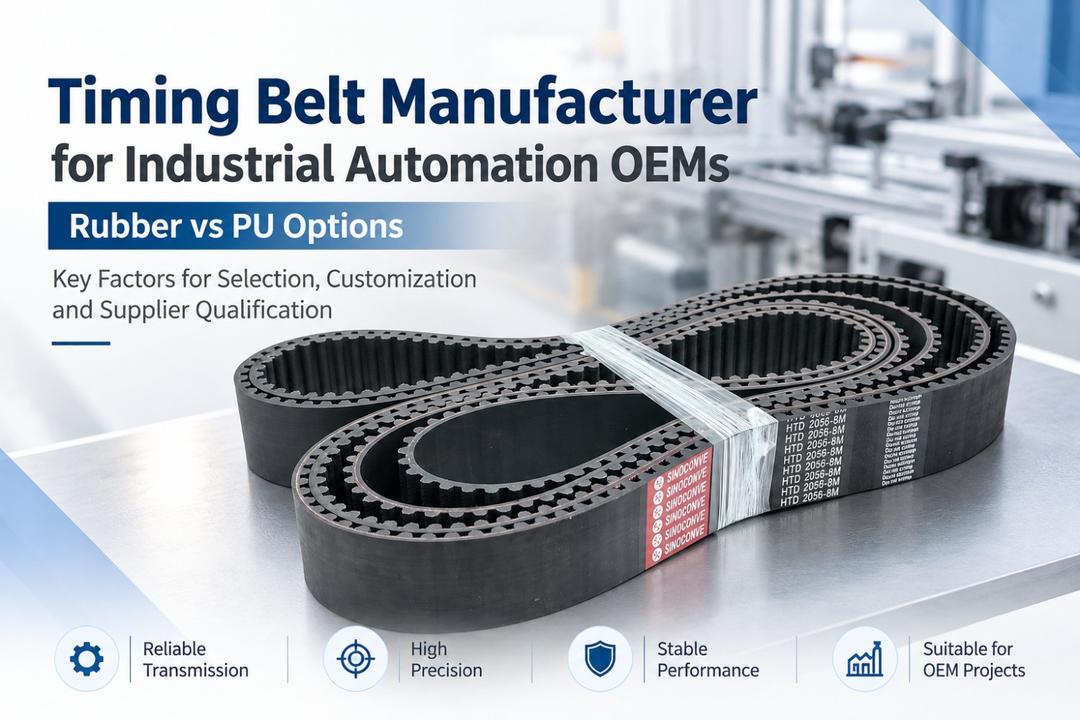
Timing Belt Manufacturer for Industrial Automation OEMs: Rubber vs PU Options
Industrial automation OEMs need more than a timing belt quotation: they need a repeatable specification that works from prototype through mass production. This guide explains how to evaluate a timing belt manufacturer, compare rubber and PU options, verify tooth and pulley compatibility, control drawings and sample approval, and define quality requirements for repeat orders. It also provides a practical RFQ framework for OEM buyers sourcing custom synchronous belts for automation machinery, packaging systems, indexing equipment and other precision drives.
Explore more
We are committed to providing you with better products and services. Welcome to browse more content for details