

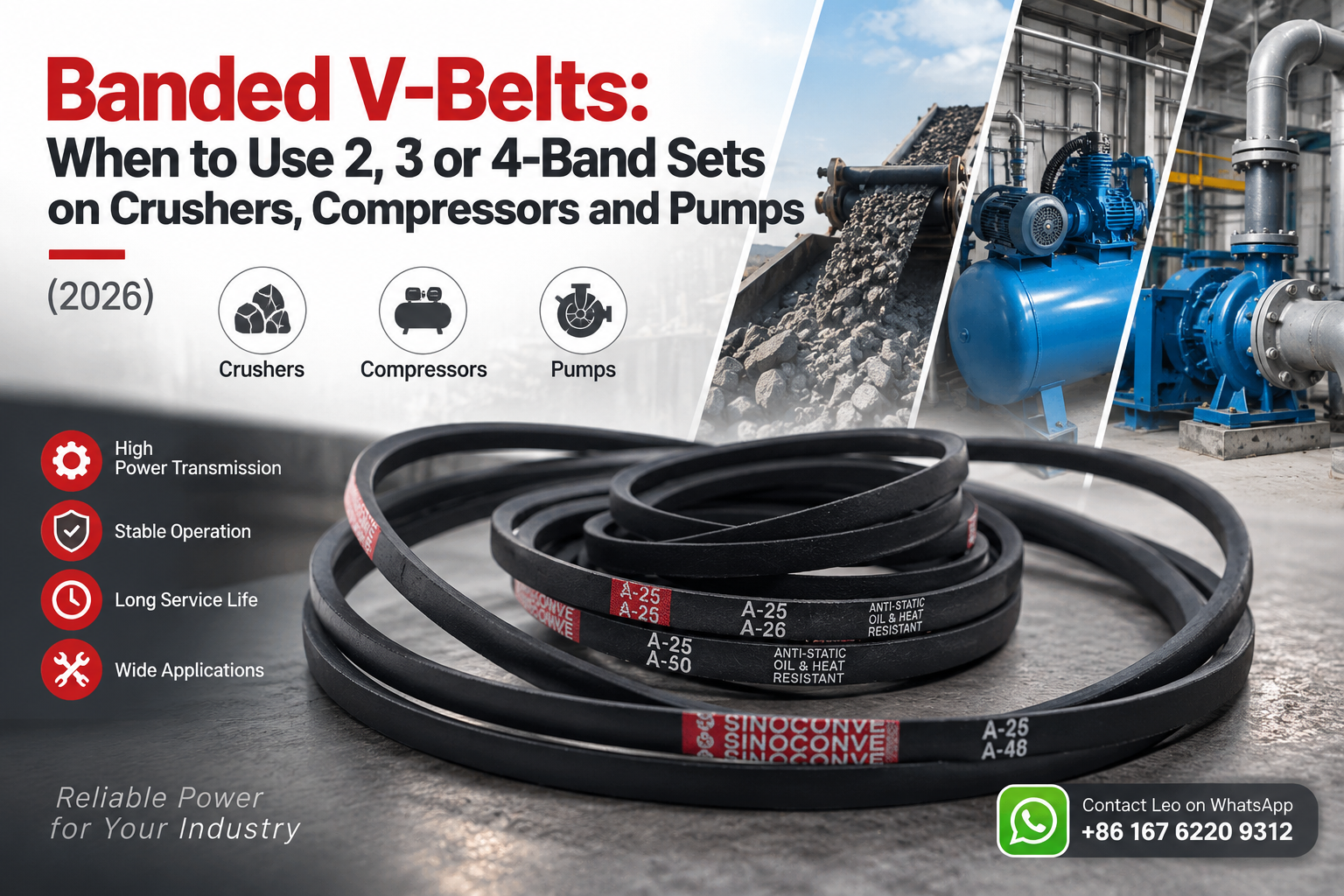
Banded V-Belts: When to Use 2, 3 or 4-Band Sets on Crushers, Compressors and Pumps (2026)
On any drive with more than two grooves, mixing individual belts is how a set fails early. This guide explains why: belts of different length or wear share load unequally, the shortest one carries more than its share, and the whole set goes down together. It then covers how banded V-belts are actually specified — profile, number of bands and datum length — and how to write that on an enquiry so the quote comes back comparable. A table sets out when a two, three or four band set is the right answer against load, groove count and equipment type, from jaw and cone crushers through screw compressors, centrifugal pumps, fans and mixers. Installation and tensioning get their own section, including the deflection method step by step, run-in and the re-tension most sites never do, and why half a degree of misalignment rolls ribs out of a groove. Failure modes are mapped to causes, and a worked example takes a 22 kW drive through service factor, section, datum length and band count. Two, three or four bands. The set is the unit.