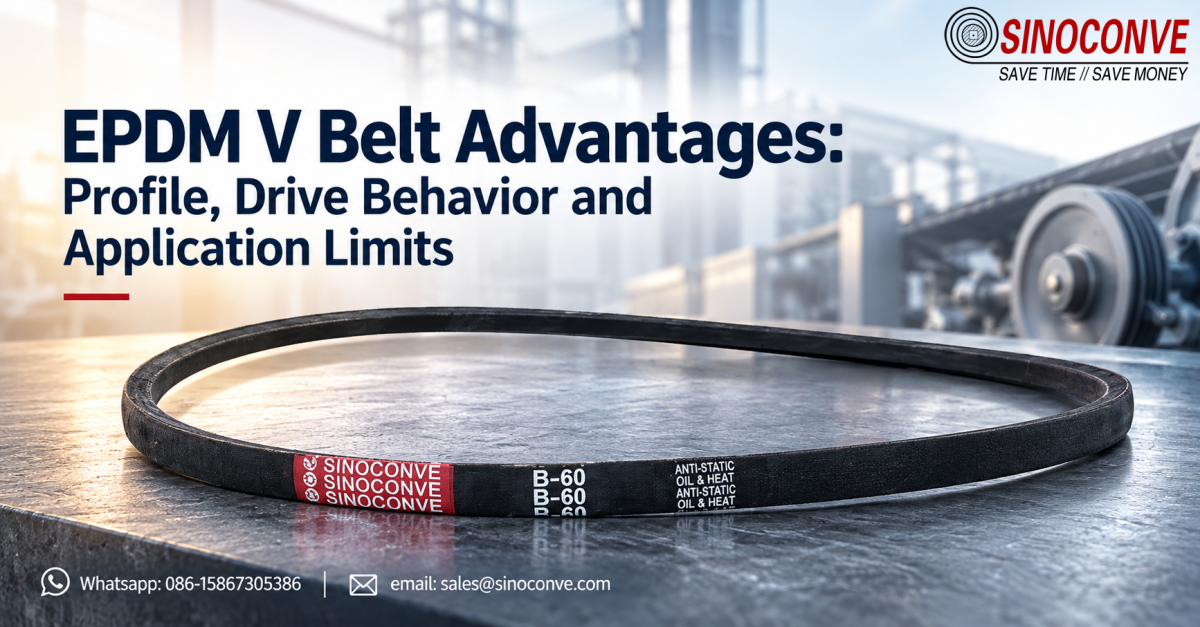
EPDM V Belt Advantages: Profile, Drive Behavior and Application Limits
EPDM V belts win on environmental resistance rather than raw strength. The compound shrugs off the ozone, weather, heat, water and steam that age natural rubber and SBR faster, and it pays for that durability with weak mineral oil resistance. This guide stays on the material layer. It explains the saturated backbone and non-polar chemistry behind those strengths and limits, compares natural rubber, SBR, chloroprene, EPDM and HNBR across heat, ozone, oil, water, fatigue and low temperature, and shows the situations where EPDM clearly earns its keep. It sets out the hard limits, oil and grease first among them, and explains what changes on the drive when the compound changes, including initial tension, startup slip and batch elongation consistency. It closes with how to specify EPDM in a request for quote, the misconceptions that cost buyers money, and how to verify a compound before you approve a sample. Drive design and belt sizing are left to their own dedicated pages.
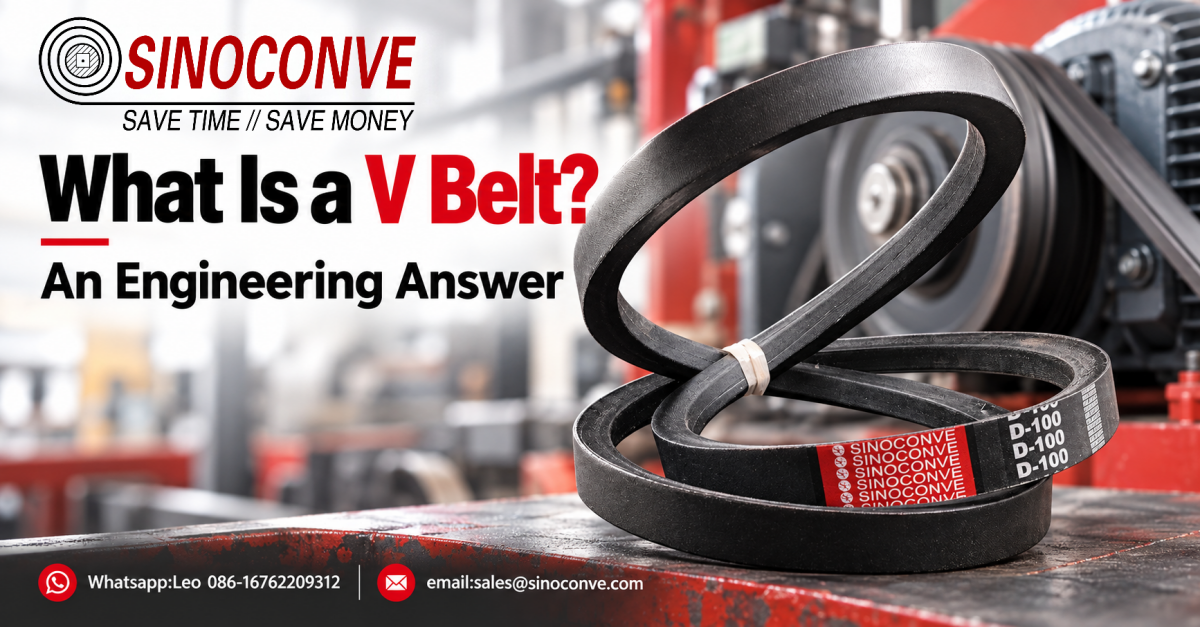
What Is a V Belt? An Engineering Answer
A V belt is an endless drive belt with a trapezoidal cross-section that transmits torque through wedge friction inside a grooved pulley, and a small amount of slip is designed-in behaviour rather than a fault. This page gives the engineering answer rather than the marketing one. It works through the wedge arithmetic, showing why a 40 degree included angle amplifies the flank normal force about three times compared with a flat belt. Cross-section geometry, flank angle control, section families and a method for identifying an unknown belt are set out with tables. Power rating inputs, tension and its effect on belt life, and matching a belt to a pulley groove are covered, along with common misapplications. Two comparisons decide most plant-floor arguments: V belt against flat belt, and V belt against synchronous belt.
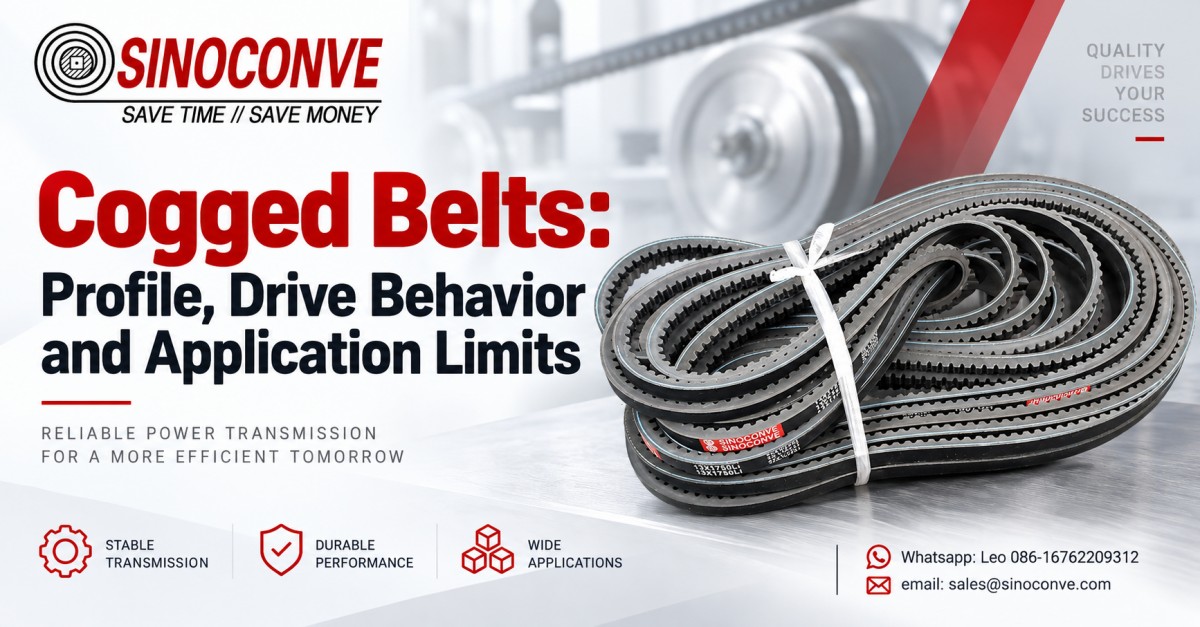
Cogged Belts: Profile, Drive Behavior and Application Limits
Cogged belts are notched V-belts that transmit torque through friction at the pulley sidewalls; their molded notches improve flexing and heat release but do not create synchronous timing. This engineering entry clarifies the overlapping terms cogged, notched, molded-notch and raw-edge, then separates them from timing belts and toothed conveyor belts. It introduces AX, BX and CX classical families, XPZ through XPC metric narrow profiles, and 3VX or 5VX inch-oriented profiles while directing exact dimensions to the applicable manufacturer data. Construction sections cover tensile cords, adhesion rubber, compression blocks, notch roots and raw sidewalls. The guide then connects notch geometry with bending loss, temperature, minimum pulley logic, belt speed, wrap angle and idler position. It closes with tension, alignment, sheave wear, matched-set discipline, failure diagnosis, replacement measurements and a buyer RFQ checklist.