
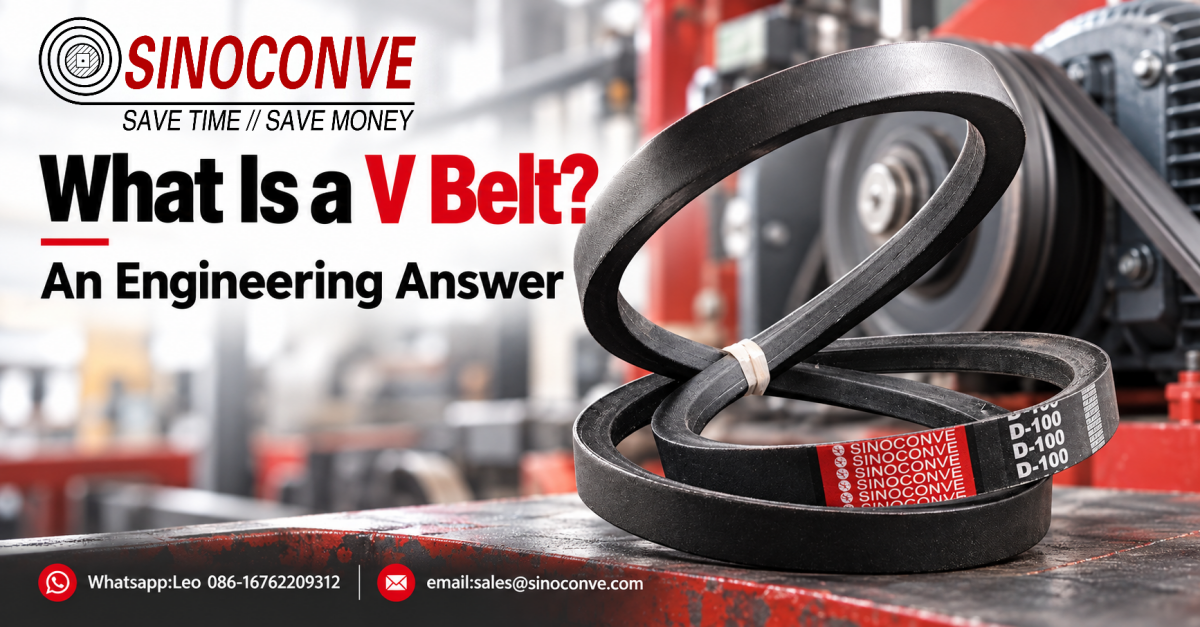
A V belt is an endless drive belt with a trapezoidal cross-section that transmits torque through wedge friction inside a grooved pulley. Nothing meshes. No teeth have to line up and no pitch has to match, so a small amount of slip is designed-in behaviour rather than a fault. Because the flanks sit at roughly 40 degrees included, the force they press against the groove walls is about three times what a flat belt develops over the same wrap, and that is how a belt 13 mm wide holds a 7.5 kW motor in step.
What follows is the engineering answer rather than the marketing one: a definition register, the wedge arithmetic, a section geometry table, a method for identifying an unknown belt, the inputs a quotation needs, and the two comparisons that decide most plant-floor arguments, V belt against flat belt and V belt against synchronous belt.

We mold V belts in Ningbo and press heavy conveyor carcass in the same plant, so two unrelated questions land on one desk more often than you would expect. As a conveyor belt manufacturer we keep one rubber laboratory for both families: the same abrasion box, the same heat-age oven, the same tensile bench. When a planner tells us a crusher drive belt fails every four months, we ask for the groove dimensions before we ask about the belt. In our records the groove is the guilty party about two times out of three.
One boundary before the tables. This page is about definition and geometry. The cogged profile family and the wrapped versus raw-edge construction choice each have a page of their own, and Section 14 holds a single pointer to each. We do not repeat either discussion here.
01The Engineering Definition of a V Belt
Take a V belt apart and you find four things. A tensile member, normally polyester or aramid cord, carrying the pull. A rubber undercord that supports the cord and lets the belt bend around small pulleys. An overcord or fabric cover that keeps oil, dust and heat off the cord. And two angled flanks, moulded or cut, which do the actual work. The flanks are not a manufacturing convenience; they are the mechanism. A V belt on its own transmits nothing, because the groove and the flank form a pair.
What the definition leaves out
Two things. A V belt is a consumable, so the drive should be built to replace it in minutes rather than hours, and we have seen a correctly specified drive need a nine hour belt change. The second is length terminology, which causes more ordering errors than any other field. Section 06 shows what we measure.
| Term | Meaning in practice | Common confusion |
|---|---|---|
| V belt | An endless belt with inclined trapezoidal flanks, driving by wedge friction in a grooved pulley | Mixed up with a poly-V belt, which carries several small ribs on one flat band |
| Wedge action | Amplification of the flank normal force by the groove angle | Described as extra friction; the coefficient is unchanged, only the normal force grows |
| Classical section | The inch-derived letter family Z, A, B, C, D, E at a nominal 40 degree flank | Known as standard, letter or V section in different plants; all three mean the same family |
| Narrow section | The metric SP family, SPZ to SPC, with more power per millimetre of belt height | Treated as interchangeable with a classical letter after comparing top width alone |
| Datum length | Length on the datum line, the neutral axis where the cord neither stretches nor compresses | Confused with inside length, which reads smaller and is easier to tape |
| Service factor | A multiplier on absorbed power covering shock, starting torque and running hours | Left at 1.0 because the motor nameplate power already looked comfortable |
To see these as finished product, the V-belt range lists what we mold, and the same presses run every rubber conveyor belt grade we ship.
02Wedge Action: How Friction Transmits Torque
Friction does not care about shape. It cares only how hard two surfaces are pressed together, and the wedge is a force multiplier that presses them harder without asking the shaft for anything extra. Drag the belt into the groove and each flank slides inward a fraction, and the groove wall pushes back along a normal tilted away from the radial direction by the half angle. Resolve that reaction and the amplification appears: one over the sine of the half angle.
At 40 degrees included the half angle is 20 degrees, its sine is 0.342, and the wedge factor lands at 2.92. Call it three. A flat belt presses its drum with the radial component of tension alone; a V belt presses each flank with about three times that. The friction coefficient itself is unchanged, but the effective value inside the groove rises from roughly 0.3 to roughly 0.88.
The wedge factor in one line, and the wrap that takes it back
Factor equals one over the sine of the half angle: 3.42 at a 34 degree groove, 2.92 at 40 degrees, 2.56 at 46 degrees. But normal force only becomes transmitted power after the wrap angle, and a short wrap takes most of it back. On a 157 degree wrap, a flat belt reaches a tension ratio near 2.3 while the V belt reaches about 11. In our quotations that works out at roughly 1.6 times the useful pull at equal tight-side tension, not three times. Anyone promising three times the power from the same drive has skipped the exponential.
Worked example: 7.5 kW at 1,440 rpm
A fan drive we quoted last year: 7.5 kW at 1,440 rpm, driver 120 mm, driven 300 mm, centre distance 450 mm, belt speed 9.05 m/s, effective pull 829 N, wrap 157 degrees. We quoted two B section belts rather than one, because two belts halve the damage from a single belt tracking badly.
| Quantity | Value in our example | What it changes |
|---|---|---|
| Half angle | 20 degrees from a 40 degree groove | The angle that enters the sine term |
| Wedge factor | 2.92 | Flank normal force against a flat belt on the same drum |
| Rubber on dry cast iron | About 0.3 | Base friction before the wedge acts |
| Effective coefficient | About 0.88 | Coefficient multiplied by the wedge factor |
| Wrap on the small pulley | 157 degrees | How much friction the drive can actually use |
| Tension ratio, flat belt | About 2.3 at the same wrap | Ceiling on useful pull before slipping |
| Tension ratio, V belt | About 11 at the same wrap | Ceiling on useful pull for the wedge drive |
| Useful pull at equal tension | About 1.6 times the flat belt | The practical gain, against the theoretical three times |
Field note from our engineers: A quarry conveyor gearbox ran four B section belts at 118 degrees of wrap because the motor had been moved 90 mm to clear a new transfer chute. Every belt failed inside six weeks, always in the same groove. Deflection was already 22 mm against a standard 15 mm, so the fitter had done what he was trained to do, and tension was never the problem. We supplied a banded set of four and raised the service factor from 1.2 to 1.5. The drive has run 19 months since.
We run this arithmetic on every quotation, which is why a transmission belt manufacturer with its own rubber laboratory tends to quote a drive rather than a bag of belts.
03Cross-Section Geometry: Top Width, Height and Angle
Three dimensions define a V section: top width, height and flank angle. Everything else about the belt, its minimum pulley diameter, its power per belt, its length tolerance and its bending stiffness, follows from those three numbers and from the cord inside them.
Why height matters as much as width
Height decides bending. A tall section needs a bigger pulley, because strain on the outer fibres grows as the belt wraps a small radius. Top width decides how much flank area touches the groove, so it sets the load per unit area. Measure width alone, the easiest thing to do with a caliper, and you cannot separate an A section from an SPZ, because the two sit within about 3 mm of each other on that one dimension.
Classical sections against narrow SP sections
The classical family is inch-derived: Z, A, B, C, D and E. The metric SP family is taller for its width, which raises power density by roughly 50 to 80 percent for the same section area. The families are not interchangeable even when the widths look close. An SPB belt measures about 16.3 mm across the top and 13 mm high; a B belt is 17 mm and 11 mm. Put an SPB into a B groove and it stands proud, contacting a narrow band high on the flank and running hot. Put a B belt into an SPB groove and it bottoms out.
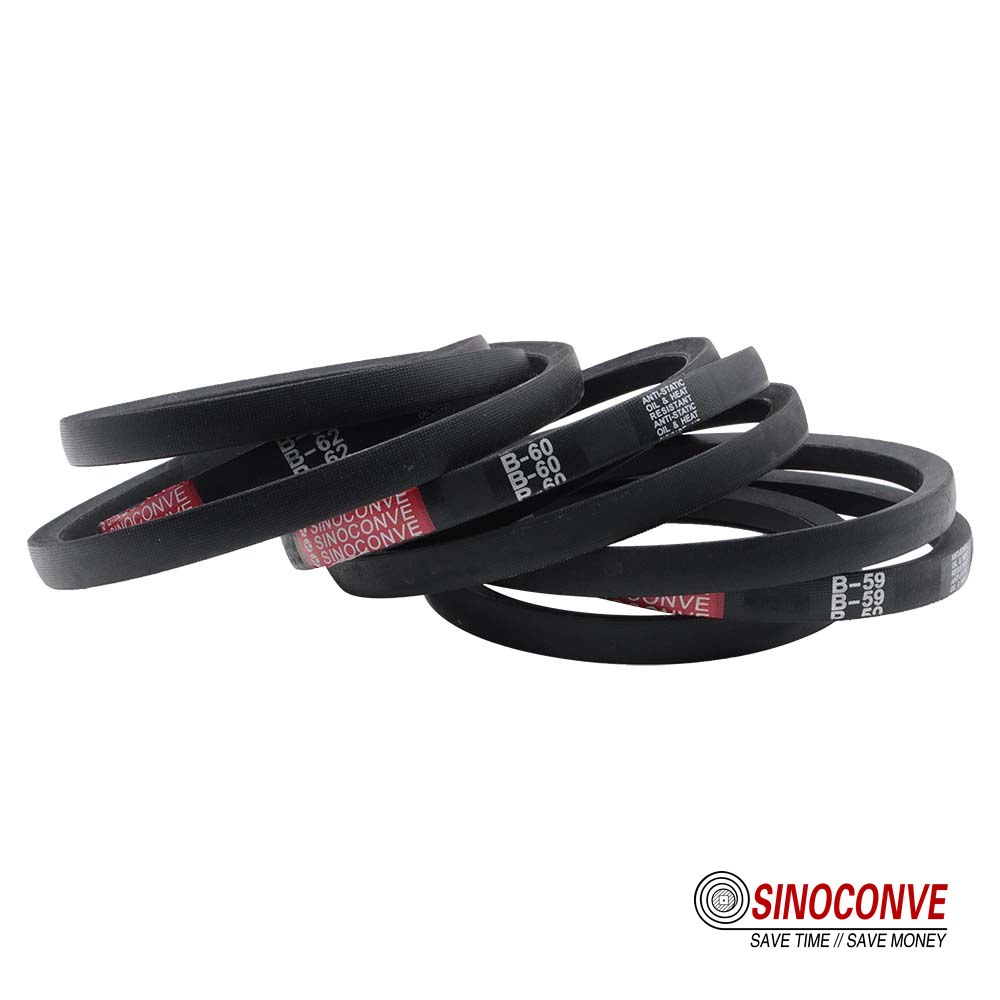
Trapezoidal section against a grooved pulley: top width, height and flank angle set the drive.
| Section | Top width | Height | Flank angle | Typically quoted power band |
|---|---|---|---|---|
| WITH | 10 mm | 6 mm | 40 degrees | 1 to 2.5 kW |
| A | 13 mm | 8 mm | 40 degrees | 3 to 5.5 kW |
| B | 17 mm | 11 mm | 40 degrees | 7 to 14 kW |
| C | 22 mm | 14 mm | 40 degrees | 15 to 30 kW |
| License plate | 9.7 mm | 8 mm | 40 degrees | 2 to 4 kW |
| SPA | 12.7 mm | 10 mm | 40 degrees | 4 to 8 kW |
| SPB | 16.3 mm | 13 mm | 40 degrees | 10 to 22 kW |
| SPC | 22 mm | 18 mm | 40 degrees | 22 to 45 kW |
Power per belt is not a constant, and the bands above are the ranges we typically quote for a single belt at 1,440 rpm on a well-matched pulley. A 4:1 ratio on a small pulley can knock 25 to 30 percent off the figure for the same section. Note that the angle column never changes: the 40 degree nominal flank runs through the whole family, because groove geometry is inherited rather than chosen per belt. If you buy from a conveyor belt supplier who also stocks transmission grades, the question worth asking is which family their V grooves were cut to, because that decides which half of this table is available to you.
04Why the Flank Angle Controls Grip
The belt is moulded at 40 degrees. The groove is usually cut smaller, somewhere between 34 and 38 degrees, which surprises people the first time they measure one. The reason is that a belt does not stay at its free angle once it is bent around a pulley. Bending tilts each cord and each flank slightly, and the flanks open up as the radius shrinks. Cut the groove at a true 40 degrees and a belt on a small pulley would touch only along its top corner. Cut it a few degrees tighter and the whole flank lands on the wall once the belt curves into place.
Groove angle is matched to pulley diameter, not to the belt. A 500 mm pulley gets a groove near 38 degrees; a 100 mm pulley something closer to 34. After a few weeks the flanks polish into the groove and contact evens out, and that run-in is where the drive finds its rated grip.
What riding high and bottoming out really cost
Ride high and the load passes through a narrow band near the top corner, where unit pressure passes the three megapascals a rubber flank is happy with. Look for a polished bright stripe, a hot rubber smell and black dust. Bottom out and the wedge disappears, slip and heat climb together, and a 30 kW drive can lose 40 percent of its capacity.
| Groove flank angle | Where it belongs | How the flank contacts | Slip and wear tendency |
|---|---|---|---|
| 40 degrees | Large pulleys above roughly 400 mm | Full-face contact only on a gently bent belt | Normal on large pulleys, corner loading on small ones |
| 38 degrees | Mid-size pulleys; the commonest groove in the field | Even contact after a short run-in | Balanced; the general-industry default |
| 36 degrees | Small pulleys, tight wrap, high ratios | Seats slightly deep, full contact under load | Good grip; check the worn belt does not reach the groove bottom |
| 34 degrees | Very small pulleys, typically under 120 mm | Deep seat and maximum grip | Highest wedge factor, and the fastest groove wear |
| Above 42 degrees | Nowhere; this is a wear or repair symptom | Belt rides high, contact narrows to the top corner | Persistent slip, flank burn, short life on that groove |
The lesson generalises well beyond transmission drives. A belt that is correct for one part of a plant can still fail because of a machine detail nobody recorded. When we survey an industrial conveyor belt installation in a quarry, the first measurements we take are of pulley crown and idler alignment, not of the belt. On a V drive the equivalent first measurement is groove angle and seating depth, and both questions get asked at the wrong end far too often.
05Section Families and How to Identify Them
On a shop floor you rarely have a datasheet. You have a belt on a shelf, or a belt still on a machine, and you need to know what it is before you order anything. The print on the top face usually answers the question, but print wears away and the section letter is often the first field to disappear, so the method has to work from dimensions too.
Reading the marking on the belt
A marking like A 1400 means an A section belt with a datum length of 1,400 mm: letter first, then length. Some mills print a longer string with cord type, an anti-static mark and a batch code. If the letter has gone, take top width with a caliper and height across the section, then work from the table below.
Sections side by side: top width alone cannot separate a classical letter from its narrow metric neighbour.
Two narrow families that cause export confusion
The metric SP series sits on European machinery. The US narrow series printed 3V, 5V and 8V sits on North American equipment, carrying inch-derived numbers for the same idea. Neither is interchangeable with a classical letter, and neither is interchangeable with the other, though a 5V belt at 15.5 mm across the top looks close to a B belt at 17 mm until you compare heights, where 13 mm against 11 mm gives the game away.
| Marking | Approximate dimensions | How we identify it | Typical use |
|---|---|---|---|
| Z or 10x6 | 10 x 6 mm | Reads 10 mm wide and 6 mm high, seats flush in a Z groove | Small pumps, light workshop drives |
| A or 13x8 | 13 x 8 mm | 13 mm wide, 8 mm high across a cut end | Fans, mixers, farm implements |
| B or 17x11 | 17 x 11 mm | 17 mm by 11 mm, the commonest industrial section | General industry, compressors, crusher auxiliaries |
| C or 22x14 | 22 x 14 mm | 22 mm by 14 mm, normally in a multi-groove pulley | Crushers, mill drives, large fans |
| SPZ or 9.7x8 | 9.7 x 8 mm | Narrow top but a full 8 mm high, which points to SP | Compact European machine drives |
| SPB or 16.3x13 | 16.3 x 13 mm | 2 mm narrower and 2 mm taller than a B, and it stands proud in a B groove | High-power drives on SP-grooved pulleys |
| 3V, 5V, 8V | 9.5, 15.5, 25.4 mm | SP-like heights printed as V numbers on US machinery | North American equipment and retrofits |
The full profile-by-profile tour, with the lengths and pulley combinations that go with each section, belongs to our V belt ultimate guide, and the purchasing side of the same material sits in our V belt buying guide profiles and sizes. What you will not find here is a repeat of either one.
06Measuring an Unknown Belt
An order built on a guess costs more than the belt. It costs the shutdown window, the freight, and often a second shutdown when the belt turns out not to fit. Proper measurement takes about four minutes with three tools every fitter already owns: a caliper, a steel tape and a straight edge.
Measure the section, not just the width
Top width is the number everybody takes first and the least decisive of the three dimensions. Take it on a straight run and across the widest point of the top face, because a belt that has run for a while crowns slightly. Then take the height across a clean end. If the belt is still endless, cut a 40 mm slice out of a damaged area, or use an end that has already failed. Height is what separates the classical letters from the narrow metric family.
Length: inside, datum or effective
Inside length is the easiest number to obtain and the least useful, because catalogues index on datum length. The datum line sits about 2.5 mm below the top face on an A section, adding roughly 16 mm to the circumference, and the gap passes 60 mm on an E section. Tape the outside, tape the inside, average them, subtract the section correction and order on datum.
| Tool | Method we use | What the reading settles |
|---|---|---|
| Vernier caliper | Top width on a straight run, at the widest point | Narrows the family to two candidates at most |
| Vernier caliper | Height across a cut or failed end, not over the crown | Separates A from SPA, and B from SPB |
| Protractor or profile gauge | Flank angle on a clean slice held square to the section | Confirms 40 degrees or exposes heat deformation |
| Steel tape | Inside circumference with the belt relaxed and flat | Inside length, usable only after correction |
| Steel tape, second reading | Outside circumference at the back of the belt | With the inside reading, gives the datum estimate |
| Groove gauge, or the belt itself | Seating depth in the pulley the belt will actually run on | The most reliable family check of the lot |
| Straight edge and scale | Deflection at mid-span with the drive tensioned as found | Shows whether tension caused the failure or something else did |
Field note from our engineers: A customer sent a drawing with two numbers on it, 13 mm top width and about 9 mm height, and asked for an SPA. A set belt measures tall, and 9 mm sits between the 8 mm of an A section and the 10 mm of an SPA, so the drawing alone could not settle it. We asked for the flank angle on a cut end and got 40.2 degrees at 8.1 mm on the clean slice. A section. Ordering the SPA would have meant 400 belts that would not seat in the customer's grooves.
When there is no old belt to measure at all, the job shifts to the machine itself, and the same discipline applies: measure the hardware rather than the part that failed. That approach is set out in our note on specifying wholesale conveyor belts and other belting for a plant, where the hardware usually survives the belt that died on it.
07Power-Rating Inputs: Speed, Ratio, Arc of Contact
A V belt drive is rated from a short list of inputs, and nearly every bad quotation we see is bad because one of them was missing rather than because the arithmetic was wrong. Send all of it and the quotation becomes a calculation. Send half and the supplier has to guess, which on a belt drive usually means a belt one size too small, running hot.
Absorbed power, not nameplate power
The first input is the power the machine absorbs, not the number on the motor. A 15 kW motor driving a fan that only ever pulls 9 kW is a 9 kW drive with a 15 kW starting transient, and the two want different belts. Where an operator can overload the machine, we rate on nameplate power and add a duty factor.
Speed, wrap and the two inputs people forget
Speed enters twice: it sets the power a section can transmit, and with the driver diameter it decides how hard the belt must bend. The two inputs most often missing are the arc of contact and the adjustment range. Below 120 degrees of wrap, power per belt falls away sharply.
| Input | Unit | Why it matters to the rating |
|---|---|---|
| Absorbed power | kW | The base number; everything else scales from it |
| Motor speed | rpm | Sets belt speed once the driver diameter is known |
| Driver pulley diameter | mm | Sets bending stress and the minimum permissible section |
| Driven pulley diameter | mm | Sets the ratio, and the ratio sets the wrap angle |
| Centre distance | mm | Turns two diameters into a belt length and a wrap angle |
| Arc of contact | degrees | Below 120 degrees the power per belt falls sharply |
| Number of belts or grooves | count | Divides the load and the consequence of one bad belt |
| Service factor | multiplier | About 1.1 for smooth fans, 1.6 to 2.0 for crushers and mills |
| Ambient and belt environment | degrees C, contamination | Above about 70 degrees C we change the compound, not the section |
The shape of that list will look familiar to anyone who specifies belting for other duties. It is the same discipline a conveyor belt distributor applies to an inclined conveyor: the geometry decides the family, the duty decides the grade, and the environment decides the compound.
08V Belt vs Flat Belt: The Essential Difference
The essential difference is not the shape, and it is not the material. A flat belt has to run tight enough to generate its grip from tension alone, while a V belt generates grip from geometry and can therefore run slacker, wrap a smaller pulley and drive a shorter centre distance. Everything else follows from that one sentence.
Why a flat belt needs more wrap
On a flat belt the usable tension difference is limited by the friction coefficient and the wrap angle, with nothing in the geometry to help. Lose wrap and you lose capacity almost linearly, which is why flat belt drives are built with long centre distances and large pulleys. A V drive tolerates 120 to 130 degrees because the wedge supplies the extra normal force that a flat belt cannot generate for itself.
Why we still keep flat belts
Two situations, and neither is rare. Very high speeds, where a thin flat belt runs cooler and quieter than a thick sectioned one. And drives that have to be shifted across from one pulley to another, which a wedge section simply cannot do. Flat belts are also more forgiving of small angular misalignment, because there is no groove for the belt to ride out of.
| Item | V belt | Flat belt | Synchronous belt |
|---|---|---|---|
| How torque crosses the gap | Wedge friction on two inclined flanks | Friction on one flat face | Tooth interlock, no slip by design |
| Minimum practical wrap | About 120 degrees | 180 degrees, or close to it | Six teeth in mesh, the usual rule |
| Slip under overload | Allowed, and it protects the machine | Allowed, but usually destructive at high tension | None; the teeth jump and the belt is scrap |
| Tension requirement | Moderate, set by deflection | High, often near the belt's own strength | Low, only enough to seat the teeth |
| Speed relationship | Near exact, with 1 to 2 percent creep | Approximate, with more creep and thermal drift | Exactly the tooth ratio |
| Bearing load from preload | High, often the dominant bearing load | Very high | Low, a main reason it replaced chain |
| Where it wins | Compact, tough, cheap to replace, shock tolerant | High speed, long centres, shifting drives | Positioning accuracy, low tension, fixed ratio |
We make all three kinds, which makes the discussion easier rather than harder. When a customer asks a V-belt manufacturer whether a flat belt would do a better job, the answer is usually no, because the compact frame that prompted the question is itself the reason the wedge wins. The honest exception is a drive above roughly 40 m/s, where a thin flat belt will outrun a sectioned one.
09V Belt vs Synchronous Belt: When Slip Is Acceptable
The question is not which belt is better. It is whether the drive needs the two shafts to stay locked in phase. A V belt slips slightly under overload and recovers when the load falls. A synchronous belt holds the ratio exactly and destroys itself if the load goes past what the teeth can carry.
Slip as a fuse
Slip is a safety valve. A blocked fan or a jammed screw takes a V drive into slip, the belt squeals, the operator hears it, and the gearbox survives. A timing belt in the same position does not slip; it jumps a tooth or snaps, and either outcome is expensive. That is the whole argument in two sentences, and it is why conveyors, fans, mixers and farm implements still run wedge drives.
Where slip stops being a feature
Continuous slip is not a feature. A belt slipping for a full shift generates heat, glazes the flanks and takes the groove with it. If a V drive squeals on start-up and settles, that is normal. If it squeals at steady load, the drive is under-specified or the groove is worn, and tightening the belt will only move the failure to the bearings.
| Question | V belt answer | Synchronous belt answer |
|---|---|---|
| Can the ratio drift? | Yes, by 1 to 2 percent creep | No, it is exactly the tooth count |
| What happens on overload? | Slip, with heat and noise as a warning | Tooth jump or belt failure, with no warning |
| Tension and bearing load | Moderate; preload stays on the bearings | Low; bearings last longer |
| Noise | Audible, louder with worn grooves | Quieter at low speed, louder above about 20 m/s |
| Cost of the pulley | Low; a turned or cast groove | Higher; needs a cut tooth profile |
| Where it fits best | Fans, pumps, crushers, farm implements | Indexing, positioning, packaging and robotics |
For field machinery the wedge drive is usually the sensible default, and that is why we keep a full range of agricultural V belts on the shelf. Where a machine indexes, positions or has to hold a phase relationship, the argument changes, and our V belt vs timing belt comparison takes it from there. If you want to see where the grooves are cut and the belts are cured, our conveyor belt factory page opens the doors.
10Tension and Its Effect on Belt Life
Tension decides belt life more than any other number, and it is the setting fitters adjust most often by feel. Too loose and the belt slips, heats and glazes. Too tight and the cord fatigues, the bearings carry load they were never sized for, and the belt dies of internal damage rather than wear. Between those two failures sits a workable band of roughly 20 percent.
The deflection rule and why it is only a start
The standard field test is deflection: lay a straight edge along the span, press the belt at mid-point with a firm thumb and read how far it moves, usually quoted as millimetres per 100 mm of span. It is a reasonable starting point and a poor finish, because it says nothing about the load the belt is carrying. On a drive with a high service factor, correct tension is firmer than the deflection table alone suggests, and on a low-ratio drive with generous wrap, a slightly slacker belt will live longer.
| Tension state | Symptom | Effect on life | What we do |
|---|---|---|---|
| Slipping at steady load | Squeal, polished flanks, black dust | Months of life lost to glazing | Add tension, then check the groove |
| Slipping on start-up only | A brief squeal that settles in a second | Harmless while it stays brief | Leave it; do not tension out a designed slip |
| Correct tension | Stable speed, no squeal, even flank polish | Full rated life | Re-check at 24 hours and again after two weeks |
| Over-tensioned | Whine, warm bearing housings | Short belt life plus bearing damage | Slacken back to the deflection figure |
| Re-tensioned every few weeks | The take-up keeps moving and the length grows | The cord is failing internally | Replace; stop chasing the slack |
Two pages go deeper into the maintenance side of this. Our rubber V belt guide covers compound and construction choices, and our transmission belt guide sets out the checking routine we recommend for a drive that is already running.
11Matching the Belt to the Pulley Groove
A belt and a pulley are a matched pair, and the match is measured in fractions of a millimetre. The test is simple enough to do during a walk-round: fit the belt into the groove on a stationary pulley and look at how far the top face stands above the rim. A new belt in a new groove sits flush or proud by a hair. Any belt that sinks below the rim is either the wrong section or sitting in a groove that has worn open.
A drive check in progress: seating depth in the real groove settles the section question faster than any catalogue.
Groove wear and the light test
A worn groove does not wear evenly. The flanks erode, the belt sits deeper, the effective pulley diameter shrinks, and the driven speed drops by a few percent. Put a straight edge across the groove and hold a light behind it: a worn groove shows a crescent of light on both flanks where the angle has opened. Once that crescent is visible, a new belt will not fix the drive.
| Groove condition | What it does to the belt | How we check it | Action |
|---|---|---|---|
| New groove, correct angle | Belt seats high and runs in over a few weeks | Straight edge across the rim | Normal; re-check tension after run-in |
| Worn flanks, opened angle | Belt rides high on a narrow band and runs hot | Light held behind a straight edge | Re-cut or replace the pulley |
| Belt bottoms out | The wedge is lost, so slip and heat both rise | Belt top face sits below the rim | Wrong section, or a badly worn groove |
| Misaligned pulleys | Edge wear, tracking drift, sidewall heat | Straight edge across both pulleys | Realign before blaming the belt |
| Uneven grooves within one pulley | One belt in the set does most of the work | Check each groove separately, not just the first | Match the set, or re-cut the pulley |
Field note from our engineers: A farm drive was burning through a set of belts in about eight months, always the same groove, always with the flanks glazed and the top corners polished bright. Measured against a straight edge, the belt sat 1.8 mm below the rim on that one groove and 0.4 mm below it on the other three. The groove had worn open and the belt was running on the bottom. We replaced the pulley, set tension to the standard deflection figure and the same drive went 20 months. The belt was never the problem.
When a drive needs several parallel power paths on a narrow pulley, the family changes and so do the rules. Our poly V belt guide covers the ribbed construction, and PK belt vs PJ belt explains why rib pitch matters more than rib count when you are matching a ribbed belt to a pulley.
12Common Misapplications
Almost every premature V belt failure we investigate traces back to one of a short list of mistakes, and none of them is exotic. They repeat across industries, machine types and continents, which is useful, because it means the list can be worked through in ten minutes at the machine.
| Misapplication | What happens | Correct practice |
|---|---|---|
| Buying on top width alone | An SPB into a B groove, running hot on a narrow band | Match width and height, then confirm seating depth |
| Running a mismatched set | The tightest belt carries the load and fails first | Replace the whole set, or move to a banded belt |
| Tensioning to silence a squeal | Bearing load rises and the cord fatigues early | Find the cause: worn groove, wrong section or short wrap |
| Reusing a worn pulley | The new belt takes the old groove's shape and dies the same way | Measure the groove before fitting the belt |
| Mixing classical and SP components | The belt bottoms out and the wedge is lost | Keep the families apart and label the pulleys |
| Ignoring ambient heat | Rubber hardens above about 70 degrees C and the flanks crack | Change the compound rather than the section |
| Leaving a drive under-tensioned | Slip glazes the flanks and the groove wears faster | Re-tension at 24 hours, then again after two weeks |
| Using a wedge drive where phase is locked | The ratio drifts by one or two percent under load | Move to a synchronous drive and accept the pulley cost |
For the failure patterns themselves, with the root causes and the field fixes we use, our note on V belt failure modes is the better read.
13Selection Input Checklist
This is the list we ask for before quoting a drive. Fill in what you have and mark the rest as unknown. A marked unknown is far more useful than a guessed number, because it tells us which assumption has to be stated in the quotation instead of being buried in it.
| Field | Why we need it | What to send |
|---|---|---|
| Absorbed power | Sets the design power | Measured kW, or motor rating if the duty varies |
| Motor speed | Sets belt speed | Shaft rpm, not synchronous speed |
| Driver pulley datum diameter | Sets bending and the minimum section | mm, measured on the datum line |
| Driven pulley datum diameter | Sets the ratio and therefore the wrap | mm, on the same basis as the driver |
| Centre distance and adjustment | Sets the belt length | mm nominal, plus the take-up range available |
| Number of grooves | Sets how the load is shared | Count, and whether the pulley takes a banded set |
| Duty and hours | Sets the service factor | A short duty description and hours per day |
| Ambient temperature | Sets the compound | degrees C, and any radiant heat source nearby |
| Contamination | Sets the compound and the cover | Oil, dust, water, or washdown chemicals |
| Groove family and angle | Decides which belt can physically be fitted | Classical or SP, and the angle you measured |
| Existing belt marking | Cross-check against the calculation | A photograph of the top face and a cut end |
Filling that in takes about ten minutes at the machine and removes most of the guesswork from the quotation. Where a field is genuinely unknown, our FAQ page lists the assumptions we make by default, and you are welcome to send the list to us so the gaps get closed before the order rather than after it.
14Reading a Belt Marking and Datasheet
The marking on a V belt is a compressed datasheet. It carries the section, the length basis and often the construction, and it is worth decoding before the belt goes in the scrap bin, because the marking is the last record of what the machine was designed to run.
Anatomy of a marking
A typical string reads SPB 2500 Lw, followed by a cord code, an anti-static symbol and a temperature class. SPB is the section, 2500 is the length in millimetres, and Lw tells you the length is quoted on the datum line. If the string says Li instead, the length is inside length and it has to be corrected before you compare it with a catalogue. Getting that one letter wrong is the single most common source of a belt that arrives 16 mm too short for the job.
| Field on the belt | What it means | What to verify |
|---|---|---|
| Section letter | The family and its dimensions | That width and height agree with the pulley groove |
| Length number | Nominal length in millimetres | Whether it is datum, inside or effective |
| Cord code | The tensile member construction | That it suits the duty, especially shock load |
| Anti-static marking | A conductive build for hazardous areas | That it is present wherever combustible dust is handled |
| Temperature class | The working range of the compound | That it covers the ambient you measured on site |
| Batch or mould code | Production traceability | Especially useful when a whole set failed together |
| Matched set code | Belts measured and grouped as one set | That every belt in the set carries the same code |
Branches: cogged, wrapped and raw-edge
The construction decision is not this page's subject, so we point at it once and stop there. The wrapped build is explained in our guide to the wrapped V belt, the cut-edge alternative in raw edge cogged V belt, the trade between the two families in classic V belts vs cogged, and the sourcing view in cogged V belt vs wrapped.
For the sections, lengths and constructions we hold as standard, our V belt supplier pages list what we mold, and we will happily cross-check a worn marking against a quotation before you commit to a quantity.

15Frequently Asked Questions
What exactly is a V belt?
A loop of rubberised cord with a trapezoidal cross-section, which drives by wedge friction in a grooved pulley. No teeth, no meshing to preserve, and a small amount of slip by design rather than by accident.
Why does a V belt grip better than a flat belt?
Because the groove multiplies the force that presses the flanks together. At a 40 degree included angle the multiplier is about three, and the friction coefficient itself is unchanged. None of the extra grip comes from a stickier rubber.
What does the 40-degree angle actually do?
It converts belt tension into flank normal force. That is the whole mechanism, and it is also why a groove that has worn open ruins the drive even when the belt on it is new and perfectly made.
How do I identify an unknown V belt section?
Measure top width on a straight run, then height across a cut end, then confirm seating depth in the pulley it actually runs on. Top width alone cannot separate a classical letter from a metric narrow belt.
What inputs do I need to size a V belt drive?
Start with absorbed power and shaft speed. Add both pulley datum diameters, the centre distance with its adjustment range, the groove count and a one line duty description. Nine fields in total, and ten minutes at the machine.
Can a V belt ever be better than a timing belt?
Yes, whenever the machine is better off slipping than breaking. Fans, crushers and farm implements are the usual cases. Anything that has to hold a phase relationship is not, and no amount of clever tensioning changes that.
How tight should a V belt be?
Tight enough not to slip at steady load, and no tighter. Set it to the deflection figure for the span, then re-check at 24 hours and again after two weeks, because most of the initial stretch happens early.
What happens if the belt does not match the groove?
Two different failures, depending on direction. A belt that is too wide rides high and burns a narrow band near the top corner. A belt that is too narrow bottoms out and loses the wedge completely.
Which measurement points matter most?
Seating depth in the groove, then height across a cut end. Those two settle the family question, and the top width then only confirms what the other two measurements have already told you.
Is slip always a fault?
No. A brief squeal on start-up protects the machine and is entirely normal on a wedge drive. Continuous slip at working load is a fault, and tightening the belt usually hides it rather than curing it.
How do I read the marking on an old belt?
Read the section letter first, then the length number. Then check whether the length is quoted inside, datum or effective, because that one letter is worth about 16 mm on an A section and more than 60 mm on an E.
When should I consider a cogged or raw-edge belt?
When a small pulley or a tight frame leaves no room for a classical wrapped belt. Those are separate designs with their own selection rules, so they live on their own pages rather than in this one.
16Related Products You May Need
- V-belts in classical and narrow sections for the wedge drives this page describes.
- Timing belts in PU and rubber when the drive has to hold phase instead of slipping.
- Rubber conveyor belts for the material-handling side of the same plant.
- Full product catalog when one consolidated enquiry is easier than four.
17Related Blog Posts
- V belt profiles and sizes for the family-by-family tour behind Section 05.
- V belt failure modes when the belt on your desk has already failed.
- Choosing and maintaining a V belt for the routine that keeps a drive inside its tension band.
- V belt vs timing belt if the slip question in Section 09 is still open.