
Why a wrapped V belt still matters in modern power transmission
A wrapped V belt may look old-school next to servo motors and direct drives, but it remains a practical answer in a lot of industrial drive layouts. When engineers need rotary power moved from one shaft to another with a belt and pulley set, the wrapped V belt is often chosen because it balances grip, flexibility, and cost in a way few alternatives can match.
That matters to sourcing teams too. A belt failure can stop a pump drive, fan drive, compressor, or generator set just as surely as a broken coupling. The real question is not whether belt-driven equipment is “modern enough.” It is whether the belt can hold load, run predictably, and survive the environment around it without constant attention.
What the product is designed to do
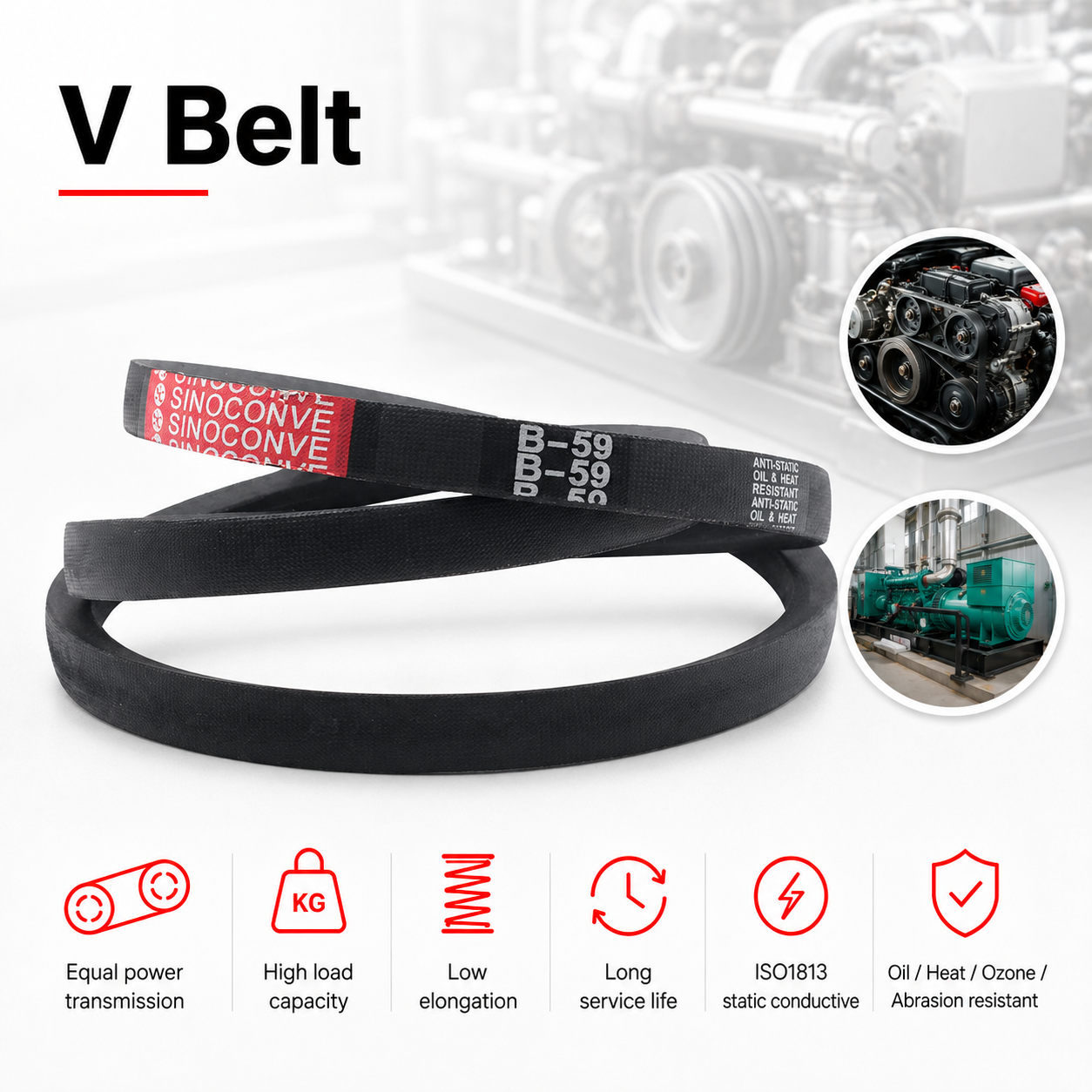
The product shown is a V-belt for power transmission in industrial machinery, likely a wrapped style with a trapezoidal cross-section and an endless loop construction. The visible marking includes B-59, along with SINOCOVE branding and printed performance claims. That tells a buyer a few useful things straight away: it is a standardized belt size or designation, it is meant for industrial use, and it is marketed around durability rather than novelty.
In a belt drive, the belt does not simply “spin.” It transmits torque through friction and tension, and the pulley geometry helps the belt wedge into the groove. That wedging effect is why a V belt can handle more load than a flat belt in many compact arrangements. It is also why pulley alignment and correct tension matter so much. A good belt installed badly will still disappoint you.
Key performance points buyers usually care about
The printed selling points on this belt focus on equal power transmission, high load capacity, low elongation, and long service life. Those are the phrases that matter in the field because they map to downtime, maintenance intervals, and energy transfer stability.
The label also mentions resistance to oil, heat, ozone, and abrasion, plus ISO 1813 static conductive performance. For industrial drive applications, that combination is especially relevant when the belt runs near machinery that generates heat, airborne contaminants, or electrical risk. A static conductive belt can be important where static buildup is not just annoying but a real hazard. I would still advise buyers to confirm exactly how those claims are documented before they lock in a sourcing decision.
Where wrapped V belts fit best
Wrapped V belts are widely used in pump drive systems, fan drive assemblies, compressors, generators, agricultural equipment, and general industrial motor drives. They are common because the systems they serve usually need a durable, serviceable transmission component rather than a precision actuator.
For a pump drive, the belt has to tolerate continuous duty and periodic load changes. In a fan drive, stable running and lower maintenance can matter more than peak torque. In compressors and generator sets, the belt may see harsher duty cycles and more heat exposure. Those differences are why the same belt family can be a good fit in one machine and the wrong choice in another.
How to compare belt options without overcomplicating it
1. Match the section and size first
The best belt in the world will not help if the section does not match the pulley groove. The B-59 marking is useful here, but it should be checked against the equipment requirement rather than assumed to be interchangeable with a similar-looking belt.
2. Consider the environment
If the drive sees oil mist, elevated temperature, or abrasive dust, the belt’s resistance claims matter more than marketing language might suggest. Harsh environments punish exposed rubber surfaces and weak covers quickly.
3. Look at service behavior, not just catalog language
Low elongation is valuable because retensioning schedules become easier to manage. Equal power transmission is another way of saying the belt should distribute load consistently, which is what maintenance teams want when multiple belts are used together.
Common buyer mistakes
One common mistake is treating all industrial drive belts as interchangeable if they have roughly the same width. They are not. Another is replacing one belt at a time in a multi-belt drive when the set should have been matched. That shortcut often saves a little time up front and costs more later.
Buyers also sometimes focus on resistance claims and ignore pulley condition. Worn grooves, misalignment, and poor tensioning can undo the advantages of even a well-made rubber V belt. The belt gets blamed first, but it is not always the guilty part.
Practical procurement advice
If you are sourcing a wrapped V belt for industrial equipment, ask for the exact size designation, intended application, and any available documentation behind performance claims such as ISO 1813 static conductive behavior. If the belt will run in a critical drive, it is worth checking how the supplier handles identification, traceability, and replacement consistency across batches.
For maintenance teams, it helps to standardize around the same belt family wherever the machine design allows it. That makes spares easier to stock and reduces the odds of mixing different constructions in the same drive.
A simple next step for buyers
Start with the machine requirement, not the belt catalog. Confirm the section, pulley profile, operating environment, and whether the drive is a single-belt or matched-set application. Then compare the wrapped V belt against those conditions instead of against a generic “industrial belt” description. That approach is less glamorous, but it prevents most of the expensive mistakes.